Stocks reach record highs after moves from China, Fed #ศาสตร์เกษตรดินปุ๋ย

#ศาสตร์เกษตรดินปุ๋ย : ขอบคุณแหล่งข้อมูล : หนังสือพิมพ์ The Nation

https://www.nationthailand.com/business/30382455?utm_source=category&utm_medium=internal_referral

Stocks reach record highs after moves from China, Fed

Feb 20. 2020
By Syndication Washington Post, Bloomberg · Vildana Hajric · BUSINESS, US-GLOBAL-MARKETS

Equities advanced on signs that China may be planning further measures to support its economy as it reels from a virus-induced slowdown and after Federal Reserve officials signaled that they aren’t anxious to raise interest rates anytime soon.

Gains for chipmakers and banks led the S&P 500 Index and Nasdaq Composite to record highs after Bloomberg News reported that China’s latest moves to aid growth include possible bailouts for hard-hit industries. The dollar climbed to the strongest since October after data on housing starts and building permits exceeded analysts’ estimates. Treasuries held steady after minutes showed that Federal Reserve officials viewed monetary policy as appropriate “for a time.”

The Stoxx Europe 600 Index reached new highs, and shares rose in Tokyo, Hong Kong and Sydney. The yen fell to a nine-month low on concern that Japan’s economy may slip into a recession. Oil gained as U.S. sanctions on Russia’s largest producer and conflict in Libya put the focus on supply threats.

Investors appear relatively confident in the ability of policymakers to contain fallout from the deadly coronavirus, even after Apple spooked markets this week by warning of a slowdown in sales. Data released Wednesday showed that the housing market remains a bright spot for the U.S. economy amid sluggish business investment.

“Housing is an economic bellwether and seeing data like this gives investors a lot of reasons to be optimistic, at least for the U.S. market,” said Mike Loewengart, vice president of investment strategy at ETrade Financial.

Gold traded near its highest level since 2013, while palladium extended its record-breaking rally on forecasts for a widening supply deficit.

– – –

Here are some key events coming up:

– Earnings season rolls on, with results from Deere & Co. set for Friday.

– Indonesia is expected to cut interest rates Thursday, following emerging-market peers that have already moved.

– Group of 20 finance ministers and central bank chiefs are scheduled to meet Saturday and Sunday in Riyadh, Saudi Arabia, and are expected to discuss efforts to support growth amid the coronavirus threat.

– – –

These are the main moves in markets:

Stocks

– The S&P 500 Index advanced 0.5% at the close of trading in New York.

– The Stoxx Europe 600 Index jumped 0.8%.

– The MSCI Asia Pacific Index fell 0.1%.

– The MSCI Emerging Market Index advanced 0.7%.

Currencies

– The Bloomberg Dollar Spot Index rose 0.2%.

– The euro rose 0.2%, to $1.0808.

– The British pound fell 0.6%, to $1.2924.

– The Japanese yen weakened 1.3%, to 111.28 per dollar.

Bonds

– The yield on 10-year Treasuries was little changed at 1.56%.

– Germany’s 10-year yield fell one basis point, to -0.42%.

– Britain’s 10-year yield fell one basis point, to 0.6%.

– Japan’s 10-year yield rose one basis point, to -0.05%.

Commodities

– West Texas Intermediate crude advanced 2.4%, to $53.28 a barrel.

– Gold strengthened 0.6%, to $1,611.87 an ounce.

Baht keeps strength despite coronavirus outbreak, economic decline #ศาสตร์เกษตรดินปุ๋ย

#ศาสตร์เกษตรดินปุ๋ย : ขอบคุณแหล่งข้อมูล : หนังสือพิมพ์ The Nation

https://www.nationthailand.com/business/30382434?utm_source=category&utm_medium=internal_referral

Baht keeps strength despite coronavirus outbreak, economic decline

Feb 19. 2020
By The Nation

The Thai economy in 2020 would expand at a much lower rate than previous forecast and way below its full potential, mainly due to the combined impact from the coronavirus outbreak, delay to enactment of the Annual Budget Expenditure Act and drought on a large number of businesses and employment, according to the minutes released today by the Monetary Policy Committee of the Bank of Thailand .

On February 5 ,  the committee  voted unanimously to cut the policy rate by 0.25 percentage point from 1.25 to 1.00 per cent, in a bid to shore up the economy.

Regarding exchange rates, the committee said although the Thai baht depreciated somewhat in recent days , it remained potentially inconsistent with economic fundamentals. During  inter-meeting period, the currency depreciated against the US dollar. The baht also depreciated against regional currencies as reflected by a decline in nominal effective exchange rate (NEER) despite its high level compared with that in the past. The recent  depreciation was mainly a result of  investors’ concerns over the softening outlook of  the Thai economy,  from both domestic and external prespectives , as well as the Bank of Thailand’s relaxation of foreign exchange regulations to facilitate capital outflows.

Investors started to view that the baht could depreciate after a substantial appreciation last year, the report said.

Meanwhile, a divergence in the trends of the baht and the prices of gold, a safe-haven asset, was more prominent amid the  coronavirus outbreak ,  reflecting a diminishing safe-haven status of baht-denominated assets from the investors’ perspective, according the central bank.

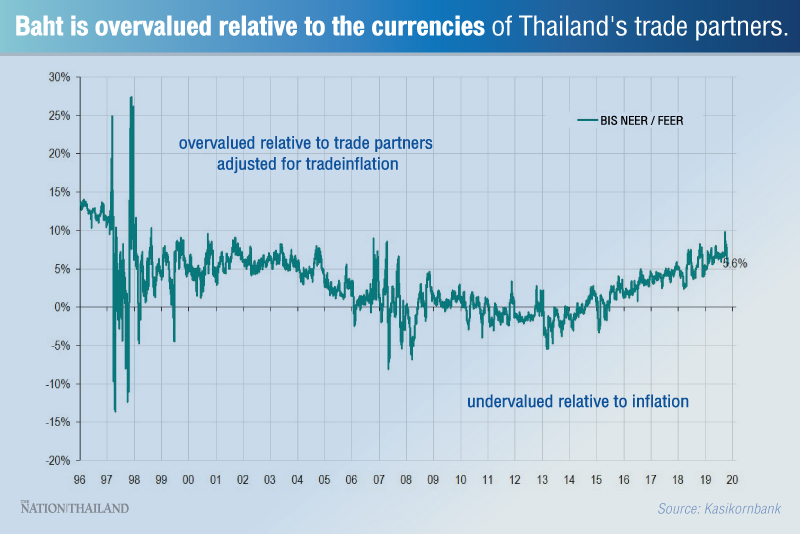
In an interview, Kobsidthi Silpachai, head of capital markets research at Kasikornbank told the Nation that the baht is currently 5.6 per cent overvalued.

While the country would have lower current account surplus this year, it still remains high, he said. Kasikornbank has lowered its projection of current account surplus to US$33 billion this year, down from the previous forecast of $33.8 billion, he said.

He said imports was  still falling faster than exports, resulting in a continuous  surplus of the current account, the  main factor behind the baht’s appreciation.

The weighted- average interbank exchange rate was Bt 31.187  per dollar  at the close of trade on February 19, according to the central bank.

Many research houses have revised downward their economic growth forecast to below 2 per cent rate this year.

CRC shares to begin trading on SET from Feb 20 #ศาสตร์เกษตรดินปุ๋ย

#ศาสตร์เกษตรดินปุ๋ย : ขอบคุณแหล่งข้อมูล : หนังสือพิมพ์ The Nation

https://www.nationthailand.com/business/30382389?utm_source=category&utm_medium=internal_referral

CRC shares to begin trading on SET from Feb 20

Feb 19. 2020
By THE NATION

The Stock Exchange of Thailand (SET) announced on Wednesday (February 19) that common shares of Central Retail Corporation Plc (CRC) will begin trading on Thursday (February 20).

CRC will be listed under SET’s service industry group under commercial business. CRC has 6,031,000,000 registered and paid-up shares with par price at Bt1 per share. It’s 1,691,000,000 initial public offering comprises 1,331,000,000 capital increase shares and 360,000,000 rights shares for existing shareholders. The IPO price is set at Bt42 per share.

CRC is a retail operator of numerous products via various channels in Thailand, Italy and Vietnam. It is a pioneer of omni-channel retail business in Thailand focusing on creating a retail network that brings products and services to consumers’ attention.

The coronavirus outbreak will hit the cruising industry where it hurts most – new business #ศาสตร์เกษตรดินปุ๋ย

#ศาสตร์เกษตรดินปุ๋ย : ขอบคุณแหล่งข้อมูล : หนังสือพิมพ์ The Nation

https://www.nationthailand.com/business/30382385?utm_source=category&utm_medium=internal_referral

The coronavirus outbreak will hit the cruising industry where it hurts most – new business

Feb 19. 2020
File Photo by Syndication Washington Post

File Photo by Syndication Washington Post
By The Washington Post · Hannah Sampson · BUSINESS, FEATURES, TRAVEL

Anne Sagebiel had been pondering what to do for an upcoming birthday later this year, and the notion of taking a cruise for the first time appealed to her. Maybe something in Europe; Norway sounded enticing.

But then she started hearing about “the cruise ship from hell” – the Diamond Princess, which was quarantined off the coast of Japan with thousands aboard on Feb. 5. As of early Tuesday, authorities said 542 of the 2,404 passengers and crew whose test results were known had been infected; more than 1,000 additional people were still awaiting their results. Forty-four Americans onboard have tested positive for coronavirus, according to U.S. health officials.

“I don’t want to be involved in a worst-case scenario,” said Sagebiel, a nature photographer in Colorado. “Cruises are off the table until they figure this out.”

That sentiment is bad news for the growing cruise industry, which has taken a multimillion-dollar financial hit as the situation unfolds. Bookings are down, according to some major players, and the nonstop attention has been damaging.

“We’re always covering these things in terms of the ability to move ships out of harm’s way,” said Mike Driscoll, editor in chief of the trade publication Cruise Week. “The industry is known for its resiliency, etc., etc. But this one’s just so different.”

Four days before the Diamond Princess quarantine was set to end on Feb. 19, U.S. officials said they would evacuate American citizens from the ship, as long as they showed no symptoms, and fly them to the United States – where they would be placed into another 14-day quarantine.

The Diamond Princess is the only cruise ship where coronavirus was believed to have been spreading, but it was not the only one affected by the outbreak, which has sickened more than 73,000 people and killed more than 1,870.

Another ship, the World Dream, with more than 3,800 people aboard, was stuck in quarantine in Hong Kong for four days after authorities learned that passengers on a previous cruise had tested positive for the virus. Everyone was allowed to disembark after crew members tested negative and passengers passed health screenings.

No one on Holland America Line’s Westerdam was known to be ill during a voyage that started in Hong Kong, but that ship and the more than 2,200 people onboard spent days at sea when port after port denied permission to dock. Cambodia came through, and passengers began to disembark on Friday. But that decision was called into question the next day when officials announced that one woman who was on the ship tested positive in Malaysia after flying there from Cambodia. Since then, Malaysia, Thailand and Singapore have said they will not allow passengers from the ship to travel through their airports, according to Bloomberg News.

Several other ships have been told they cannot stop at ports because of coronavirus fears, and earlier this month, Royal Caribbean International’s Anthem of the Seas delayed departure by two days while passengers who had been in China previously were tested. None had the illness.

Similar ordeals have played out across the world, with headlines referring to the “coronavirus cruise ship nightmare,” the “pariah cruise ship” and “floating petri dishes.” The attention comes at an inopportune time, during the busy “wave season,” when many travelers book cruises.

And although Asia still makes up a fraction of the market for global cruising – the Caribbean and Mediterranean, for example, attract far more people – it has been a focus for cruise operators looking to expand their global footprint. In 2018, according to the Cruise Lines International Association, 28.5 million people took a cruise on one of its member lines. Approximately 2.5 million of them were from China.

In a financial update on Feb. 12, industry leader Carnival Corp. – which owns Princess Cruises and Holland America Line – said the company expects to take a hit higher than initially expected as a result of trip cancellations in China and other parts of Asia. Carnival also expects global bookings to be affected, but it could not yet quantify how that would impact the bottom line.

“Since the situation continues to evolve, the company is currently unable to determine the full financial impact on its fiscal year 2020,” the update said. If Carnival had to suspend all operations in Asia through the end of April, the operator said, the financial blow would amount to $385 million to $445 million, a total that does not include the hit from softer bookings. Carnival reported a $3 billion profit last year.

Royal Caribbean Cruises, the world’s second-largest cruise company, said in its update on Feb. 13 that it has had to cancel 18 trips in Southeast Asia and modify several other itineraries. Those changes have already cost the company about $136 million. Canceling remaining trips in Asia through the end of April, which is not the current plan, would cost another $115 million.

“While the early impact due to concerns about the coronavirus is mainly related to Asia, recent bookings for our broader business have also been softer,” the update said.

The company said Friday that it was sending Spectrum of the Seas, one of its ships that previously sailed in China, to Australia to give free trips to first responders who have been fighting bush fires. Celebrity Millennium is leaving Asia early and offering free cruises from Los Angeles for firefighters, emergency workers and veterans.

Like Carnival, Royal Caribbean said there was still too much unknown to make a reasonable forecast for 2020.

“I think this is a very confusing situation for a lot of people,” Richard Fain, Royal Caribbean’s chief executive, said in an interview. “And governments around the world are taking pretty strong action. But it is front-page news every day, every way. And so I think that just makes people sometimes be a bit more cautious about planning a vacation. I think for many people, it’s a big distraction.”

January was a stellar month for travel agents who specialize in cruises, but some report that February has been a different story entirely.

Alex Sharpe, president and chief executive of Signature Travel Network, a cooperative of travel agencies that includes more than 7,000 advisers, said in a statement that demand for cruises overall was down 10 to 15% year-over-year so far in February. Although Asia cruises make up only about 5% of sales, he said they have dominated the attention of agents who are trying to help customers whose plans have been changing.

“My hope is now that much of the logistical crunch is over, we can all focus on selling cruises for all destinations and driving demand back up,” Sharpe said.

Travel Leaders Network, which includes more than 55,000 travel advisers, said a survey of its members found that about 30% of respondents had seen a high to moderate number of cancellations for China and elsewhere in Asia. Sixty-four percent said they didn’t have any cancellations as a result of the virus.

Erika Richter, a spokeswoman for the American Society of Travel Advisors, said some agents are helping clients rebook for other areas or times of the year. One reported an increase in business for all-inclusive resorts in the Caribbean.

“Ultimately what we want to make sure that we’re conveying is, we don’t want travelers to give up traveling,” she said. “If they’re hesitant, travel advisers are suggesting alternate parts of the world to travel to.”

Industry observers expect people who already like cruising to keep coming back, regardless of the coronavirus scare. But newcomers such as Sagebiel – who are key to helping the industry grow as cruise lines add more ships – are less of a sure bet.

“It’s going to affect the new-to-cruise business,” said Driscoll. “How much it is, we don’t know.”

Of course, cruising has had plenty of experience overcoming disasters and bad publicity. The Costa Concordia wreck in 2012 killed 32 people, and the ship stayed on its side off the coast of Italy for more than two years, a visible reminder of the catastrophe. The infamous Carnival Triumph “poop cruise” in 2013 also garnered significant coverage as the powerless ship was slowly tugged to shore. More recently, a norovirus outbreak that sickened more than 350 people onboard a Princess Cruises vessel made headlines.

Still, the number of cruise passengers continues to rise every year, and operators have seen their profits increase. Jaime Katz, an analyst for Morningstar who covers the cruise industry, said she expects some short-term bumps but an eventual recovery.

“I think most people feel that this will pass,” she said.

For some non-cruisers, though, the past couple of weeks have reinforced their decision never to step onboard a ship.

At 38, Jimmie Whisman, a comedian and podcast host from Phoenix, is a prime target for cruise companies, which want millennials to start a cruise habit that will carry them into retirement.

But he said he would “never, ever, ever” go on a cruise – and can’t understand why anyone else would want to, either.

Whisman, who co-hosts the “Small Town Murder” and “Crime in Sports” podcasts, said the coronavirus outbreak demonstrates what has concerned him all along.

“To take a chance of getting on a cruise ship where everybody getting on appears healthy, and then throughout the trip they all get sick – that’s my nightmare,” he said.


Walmart posts disappointing holiday sales, says it is keeping close watch on coronavirus #ศาสตร์เกษตรดินปุ๋ย

#ศาสตร์เกษตรดินปุ๋ย : ขอบคุณแหล่งข้อมูล : หนังสือพิมพ์ The Nation

https://www.nationthailand.com/business/30382383?utm_source=category&utm_medium=internal_referral

Walmart posts disappointing holiday sales, says it is keeping close watch on coronavirus

Feb 19. 2020
File Photo by Syndication Washington Post, Bloomberg

File Photo by Syndication Washington Post, Bloomberg
By The Washington Post · Abha Bhattarai · BUSINESS, RETAIL 

Walmart disappointed on multiple fronts Tuesday, falling short on its fourth-quarter targets and full-year outlook after shoppers scaled back on clothing, toys and video games during the holiday shopping season. But analysts say a key question remains: How will coronavirus impact the world’s largest retailer?

The retail giant – which has hundreds of stores in China and gets about 15 percent of its products from factories there – says that while it is monitoring the outbreak, it has no immediate plans to lower its sales forecast because of it.

Though consumers continue to prop up much of the U.S. economy, there are mounting fears the public health crisis in China will have a cascading economic impact. A number of major companies, including Tesla, Nike and Disney have warned that the virus could take a long-term toll on earnings, and Apple this week said it would miss its quarterly revenue goals because of slowing iPhone production in China. Global markets remained jittery on Tuesday as investors looked for signs that other major brands may also take a hit.

“Potential supply chain pressures, in light of virus related challenges in China,” continue to present a wild card for the company, Michael Lasser, an analyst for UBS, wrote in a note to clients on Tuesday.

“Make no mistake: If anything is going to dent the world economy, it’s coronavirus,” said Bob Phibbs, chief executive of the Retail Doctor, a New York-based consulting firm. “It’s going to hit all retailers, but the problems are especially magnified for Walmart.”

With $524 billion in annual sales, he said Walmart is a closely watched bellwether for the rest of the industry. Its share price remained largely flat Tuesday, as investors digested the news.

So far, Walmart executives said Tuesday, sales in China have not be affected even as the country is largely on lock down. Residents have become increasingly reliant on the company for home delivery of groceries and other supplies.

The majority of Walmart’s 438 stores in China are operating on reduced hours, and have shifted their inventory to focus on fresh food and necessities instead of toys and apparel, chief executive Doug McMillon said in a meeting with investors on Tuesday.

“We don’t know what’s going to happen next,” he said. “One of the reasons we couldn’t put it in our guidance is because there are so many moving parts right now, including sourcing coming out of China, not only to the U.S. but other markets as well…which makes it really difficult to call how it’s going to play out in the quarter.”

But industry experts said the outbreak could have far-reaching effects, extending to the company’s supply chain.

“Like many other U.S. companies, Walmart has set up a robust supply chain over many years in China,” said George Calhoun, professor of quantitative finance for the Stevens Institute of Technology. “There is no question that it will be impacted and disrupted.”

Last week, the Bentonville, Arkansas, company said it would lay off nearly 300 workers in New York as it shutters its Jetblack personal shopping service. It also is whittling down mid-level management positions at 1,100 Neighborhood Market and Supercenter stores, leaving workers around the country worried they’ll lose their jobs and insurance in coming months.

“Everyone’s on pins and needles right now,” a customer service manager at a Neighborhood Market in South Carolina told The Washington Post. “People are worried they’re going to lose their jobs, their homes, their cars. It’s very tense.”

Walmart’s tepid results come as retailers across the country struggle to get customers into their stores. Same-store sales – a closely watched measure at stores and websites open at least one year – grew a tepid 1.9 percent during the fourth quarter, versus 4.2 percent growth a year earlier.

“Unlike past quarters Walmart was not firing on all cylinders during the last part of the year,” Neil Saunders, executive director of GlobalData Retail, said in a note to clients. The company’s clothing selections, he added, “were uninspiring, difficult to shop, and did very little to stimulate the consumer. In a relatively weak market, Walmart presented a very weak offer and suffered for doing so.”

Online sales, which grew 35 percent from a year earlier, remained a bright spot for the company, as did groceries. Walmart has invested heavily in its e-commerce business in recent years, as it looks for new ways to win over customers. The company said Tuesday it expects that growth to slow this year, to about 30 percent.

Fourth-quarter revenue grew 2.1 percent to $141.7 billion, falling short of analysts’ expectations, while profits rose 12 percent to $4.3 billion.

For the year, Walmart reported $524 billion in revenue – nearly double Amazon’s $280.5 billion. (Jeff Bezos, Amazon’s founder and chief executive, owns The Washington Post.)

Walmart also has a majority stake in JD.com, one of the nation’s largest e-commerce sites. China, along with Mexico and India, helped drive much of the company’s sales growth in the fourth quarter, chief executive Doug McMillon said Tuesday.

Wall Street targets the Nordics after latest spike in wealth #ศาสตร์เกษตรดินปุ๋ย

#ศาสตร์เกษตรดินปุ๋ย : ขอบคุณแหล่งข้อมูล : หนังสือพิมพ์ The Nation

https://www.nationthailand.com/business/30382372?utm_source=category&utm_medium=internal_referral

Wall Street targets the Nordics after latest spike in wealth

Feb 19. 2020
Pedestrians cross tramlines in Helsinki, Finland, on Feb. 6, 2020. MUST CREDIT: Bloomberg photo by Maija Astikainen.

Pedestrians cross tramlines in Helsinki, Finland, on Feb. 6, 2020. MUST CREDIT: Bloomberg photo by Maija Astikainen.
By Syndication Washington Post, Bloomberg · Frances Schwartzkopff, Hanna Hoikkala · BUSINESS, WORLD, US-GLOBAL-MARKETS, EUROPE 

One of the world’s richest corners has become a magnet for a growing number of Wall Street firms.

The Nordic countries — best known for their universal welfare models and domination of world happiness rankings — now have a surplus of cash after years of central bank stimulus. That’s prompting banks from across the globe to line up with advice on everything from money management to mergers and acquisitions.

JPMorgan Chase, Goldman Sachs and BNP Paribas have all recently announced they’re either expanding existing operations or creating new offices in the Nordic region. Many of them are interested in hiring locally to build their presence.

“We see an opportunity locally to grow our investment banking and private banking business organically,” said Klaus Thune, co-head of Nordic banking at JPMorgan, which has about 40 bankers in London handling the Nordic corporate market. He also says that “there are a lot of new M&A mandates coming through.”

Eirik Winter, chief executive officer in the Nordics at BNP Paribas, says the region’s appeal lies in its “tendency to grow a bit faster than the rest of Europe and in some cases even faster than the U.S.”

And big U.S.-based investment managers are also turning to the region. Neuberger Berman recently opened an office in Stockholm, while Nuveen added to its presence in Scandinavia by creating an office in Copenhagen.

JPMorgan says it’s relocating bankers to the Nordic region. It also wants to hire as it tries to expand a portfolio of ultra-high net worth clients, and do more investment banking. Goldman Sachs, which already has a Nordic base in Stockholm, will open an office in Copenhagen in April, starting with around 10 people.

Pension funds in particular are desperate for investment ideas as entrenched negative rates and high stock valuations push the industry into increasingly risky corners of the asset market. Many are relying more than ever on so-called alternative investments, which tend to be illiquid and difficult to price.

The region has been able to amass its wealth despite having one of the world’s highest tax burdens. It also boasts some of the smallest gaps between rich and not-so-rich, while GDP-per-capita rankings are some of the highest on the planet. The banks and asset managers Bloomberg spoke to also cited the region’s stable political and regulatory environment, and a corporate landscape in which there’s considerable appetite for debt issuance and M&A.

BNP, which employs around 800 people in the Nordics, hired several dozen people in the past year and a half. It wants to focus on “areas where we are less known, such as M&A, investment banking and in equity markets,” Winter said. “We’re not ‘smile and dial’ bankers who fly in for deals.”

New York-based investment manager Neuberger Berman has seen its business in the Nordic region grow by more than 50% a year since 2005. It relied on flying bankers in and out of the region, but has now decided it needs an office in the Swedish capital.

“At the end of the day, we also need to have a few feet on the ground and not only operating from a hotel reception or a hotel lobby,” Mark Oestergaard, head of the Nordic operations, said. “That is to signal to the clients that this is not just for a brief moment in time in the investment industry. This is for the long haul.”

It’s also worth noting that roughly a third of Nordic corporate deals involve a buyer outside the region, and in most cases that buyer will bring its own banks. The figure is even higher, when it comes to private-equity deals, according to Nordic Knowledge Partners.

“The more foreign interest in the market, the higher the share of global banks,” NKP’s chief executive officer, Andreas von Buchwald, said. “Typically buyers would want their Goldman Sachs, rather than depend entirely on local banks.”

Meanwhile, some of the biggest Nordic banks are in the middle of sweeping cost-cut programs that are eating into personnel numbers.

Frank Vang-Jensen, the new CEO of Nordea Bank, has slashed the lender’s wholesale operations after shareholders demanded bigger returns. The second-biggest Nordic lender, Danske Bank, has frozen headcount as it grapples with the consequences of a huge money-laundering scandal.

But Nordic banks are keen to hold on to their business, with the resources they have.

Nordea plans to increase its asset management operations by doubling inflows from pension funds, Snorre Storset, head of wealth management, said. He’s also targeting private banking for growth, but points to the “tough competition” as “others also see that it’s very attractive.”

Danske wants “to show that we are a bank that can both provide solid investment advice and can provide clear and relevant perspectives on customers’ financial opportunities in the light of their individual situation,” according to John Poulsen, head of investments.

But according to Kristiina Hirva, a Helsinki-based attorney with DLA Piper, international banks with their sights set on the Nordics face few barriers.

“There are a lot of real estate transactions, a lot of M&A transactions,” said Hirva, whose employer is among those to have expanded in the Nordics, and now has 450 lawyers in the Nordic region alone.

“At least at the moment there seems to be a place for all of them,” she said. And that includes “new players in the sandbox.”

HSBC reboot fizzles, sending stockholders looking for the exits #ศาสตร์เกษตรดินปุ๋ย

#ศาสตร์เกษตรดินปุ๋ย : ขอบคุณแหล่งข้อมูล : หนังสือพิมพ์ The Nation

https://www.nationthailand.com/business/30382368?utm_source=category&utm_medium=internal_referral

HSBC reboot fizzles, sending stockholders looking for the exits

Feb 18. 2020
By Syndication Washington Post, Bloomberg · Harry Wilson, Stefania Spezzati · BUSINESS, WORLD, US-GLOBAL-MARKETS

HSBC Holdings Chairman Mark Tucker promised a strategy reboot. Investors got what some called more of the same — pledges to cut costs and do more with less.

The shares plunged by the most since 2017 after buybacks were shelved for two years and the executives themselves said more bad news was still to come — once they assess the economic damage wrought by the novel coronavirus.

In the overhaul announced on Tuesday, HSBC will slash about 35,000 staff — 15% of the total — and take $7.3 billion of charges, while it doubles down on Asia, source of most of the bank’s profit, and cuts operations in the U.S. and Europe. Left hanging was interim Chief Executive Officer Noel Quinn as Tucker and the board consider a permanent appointment.

“I wish we hadn’t had HSBC shares this morning,” said Alan Beaney, CEO at RC Brown Investment Management. “I am not quite sure why Quinn has not been named CEO now given they have allowed him to cut 35,000 jobs and make a number of strategic decisions. It does not make sense to me.”

HSBC Chief Financial Officer Ewen Stevenson said the bank would be “ruthless” in executing its plan — the giant’s third strategic overhaul in a decade — but he has an uphill struggle persuading shareholders. “The board are asking the market to take an enormous amount on trust,” said analysts at Keefe, Bruyette & Woods, the specialist financial-services broker.

London-traded shares in HSBC, Europe’s biggest bank by market value, tumbled as much as 7%, wiping out its gain so far in 2020.

While Tucker is returning the bank — founded in 1865 as the Hongkong and Shanghai Banking Corp. — to its roots with the sharpened focus on Asia, analysts noted the shortage of detail on how it plans to grow there.

For bank strategists, there might be a case of déjà vu: a 2018 plan by Quinn’s predecessor, John Flint, fell flat on arrival. Flint was fired 13 months later. Tucker, who was hired in 2017 to revive growth at the sprawling lender, is still struggling to answer investors’ question of why a bank with such a strong hold in some of the world’s fastest-growing economies has been unable to produce a better return.

The latest plan envisages cuts to underperforming businesses and regions, in particular HSBC’s global banking and markets unit, which houses its investment bank. The bank has said it will reallocate $100 billion of risk-weighted assets to areas where it can make more money. The job cuts will put total staff at about 200,000.

“Parts of our business are not delivering acceptable returns,” Quinn said.

By 2022, HSBC will increase risk-weighted assets devoted to Asia to 50% from about 42%.

The fresh strategy makes sense, but is “on the conservative side,” Alan Higgins, chief investment officer of Coutts & Co., said on Bloomberg television.

The main points of today’s earnings report include:

– HSBC’s adjusted pretax profit of $22.2 billion beat estimates, despite the multi-billion dollar charge for the restructuring. HSBC had been forecast to report adjusted pretax profit of $21.8 billion, according to analysts.

– The bank plans gross asset reduction of more than $100 billion by the end of 2022, and a lowered cost base of $31 billion or less by 2022.

– Consumer banking and private banking will be merged into a single wealth platform.

– Global banking and commercial banking middle and back offices to be combined.

– Geographic reporting lines will fall from seven to four.

“We are intending to exit a lot of domestically focused customers in Europe and the U.S. on the global banking side,” Stevenson said in a Bloomberg Television interview.

Execution aside, the unknown remains the impact of the coronavirus. Stevenson estimated possible losses in the first-quarter of 2020 at between $200 million and $500 million. Executives said on a conference call that the loan book has shown “great resilience” so far in the face of the outbreak.

“While reduced capital allocation to low-return businesses is a positive, we expect weaker profitability in what have traditionally been strong markets, primarily Hong Kong,” Morgan Stanley analysts wrote, maintaining their underweight rating on HSBC.

Walmart’s resilient outlook offsets weakness during holidays #ศาสตร์เกษตรดินปุ๋ย

#ศาสตร์เกษตรดินปุ๋ย : ขอบคุณแหล่งข้อมูล : หนังสือพิมพ์ The Nation

https://www.nationthailand.com/business/30382365?utm_source=category&utm_medium=internal_referral

Walmart’s resilient outlook offsets weakness during holidays

Feb 18. 2020
A customer pushes a shopping cart while shopping at a Walmart store in Burbank, Calif., on Nov. 26, 2019. MUST CREDIT: Bloomberg photo by Patrick T. Fallon.

A customer pushes a shopping cart while shopping at a Walmart store in Burbank, Calif., on Nov. 26, 2019. MUST CREDIT: Bloomberg photo by Patrick T. Fallon.
By Syndication Washington Post, Bloomberg · Matthew Boyle · BUSINESS, US-GLOBAL-MARKETS, RETAIL

Walmart posted lackluster holiday sales but its outlook for the current year met expectations, displaying the resilience that’s kept the retailer among the industry’s top performers.

Comparable-store sales, a key retail metric, increased 1.9% for U.S. Walmart stores in the holiday period, compared with the 2.4% average estimate compiled by Consensus Metrix. While the retailer said demand was soft in the weeks leading up to Christmas, its forecast generally pleased investors — especially its expectation that U.S. e-commerce losses could lessen this year.

“Walmart remains in a good place,” Neil Saunders of GlobalData Retail said in a note. “Although Walmart’s growth rate softened in the final quarter, the results are nonetheless respectable.”

Walmart’s lackluster holiday results followed a similarly dour performance from Target. The U.S. retail sector is broadly grappling with store closures, bankruptcies and increasing uncertainty from China’s coronavirus, which has disrupted sales and supply chains at global giants including Apple. The outbreak’s impact hasn’t been included in Walmart’s full-year guidance, but could lower first-quarter earnings by a couple of cents per share, Walmart Chief Financial Officer Brett Biggs said.

“We don’t know what will happen next” in China, Chief Executive Officer Doug McMillon said, adding that most stores are operating with reduced hours and delivery expenses have increased. “There are so many moving parts right now.”

In its home market, where Walmart generates the lion’s share of its sales and profit, the subpar holiday was due to weakness in apparel, toys and gaming, Biggs said in an interview, reasons also cited by Target. In apparel, it carried too much seasonal merchandise, he said. Gross profit margins also declined in the quarter due in part to changes in employee pay incentives that were a bigger factor than anticipated as fewer workers skipped shifts during the season.

“There were a number of things that were market-related but some of it was on us,” Biggs said, adding that there was “not a lot of newness” in departments like toys and video games.

Walmart shares were little changed at 9:42 a.m. on Tuesday, wavering between gains and losses. Over the past 12 months, the retailer’s shares have trailed those of rivals Dollar General, Costco and Target.

This is a make-or-break year for the world’s largest retailer, which has made massive investment under McMillon to lower prices, expand its e-commerce operations and enhance employee wages and benefits. Now, shareholders want to see a return from all that spending, particularly at its U.S. online division, which needs to find a path to profitability as it battles Amazon.com Inc. The e-commerce giant accounted for 40% of all U.S. retail sales growth in the fourth quarter, according to Evercore ISI analyst Greg Melich.

Biggs said domestic e-commerce losses were “higher than expected” last year, but will level off or decline in 2020, with details coming during presentations to investors in New York this morning. Walmart’s web sales in the U.S. rose 35% in the fourth quarter. It sees e-commerce growth at 30% this year — a sign the area is slowing some after years of expansion.

The retailer’s curbside grocery pickup service has fueled most of those gains, providing a bulwark against encroachment from Amazon.com Inc., but Walmart now needs to find a new pillar of growth online as the click-and-collect service is now available at 3,200 stores.

Walmart also enters 2020 with a new leadership team under McMillon, including U.S. CEO John Furner, Sam’s Club CEO Kathryn McLay and Chief Merchandising Officer Scott McCall. The reshuffle could lead to changes in strategy or execution, Jefferies analyst Christopher Mandeville said in a note.

“The American consumer is still reasonably confident,” GlobalData’s Saunders said. “Confidence and spending power are there, however, retailers need to work much harder if they want to tap into them.”

Franklin buys Legg Mason in an effort to survive passive era #ศาสตร์เกษตรดินปุ๋ย

#ศาสตร์เกษตรดินปุ๋ย : ขอบคุณแหล่งข้อมูล : หนังสือพิมพ์ The Nation

https://www.nationthailand.com/business/30382359?utm_source=category&utm_medium=internal_referral

Franklin buys Legg Mason in an effort to survive passive era

Feb 18. 2020
The Legg Mason headquarters stands in Baltimore, Md., on Dec. 1, 2011. MUST CREDIT: Bloomberg photo by Andrew Harrer.

The Legg Mason headquarters stands in Baltimore, Md., on Dec. 1, 2011. MUST CREDIT: Bloomberg photo by Andrew Harrer.
By Syndication Washington Post, Bloomberg · Annie Massa, Ed Hammond · BUSINESS, US-GLOBAL-MARKETS 

Franklin Resources and Legg Mason helped pioneer asset management in the 20th century. On Tuesday, the venerable but fading names said they will combine in an effort to compete, as low-cost index funds upend their industry.

In an era when traditional stock-pickers are under intensifying pressure, San Mateo, California-based Franklin agreed to buy Legg Mason to create a firm with a combined $1.5 trillion in assets.

The deal, valued at nearly $4.5 billion, shows how much the fund industry has transformed since the two companies were founded — Franklin started in 1947 and Legg Mason’s precursor firm began in 1899. Customers are focusing more than ever on costs for money management, and a few large index fund managers dominate the field in managed assets globally.

Merger activity in the asset management world has been increasing in recent years. Invesco bought OppenheimerFunds from Massachusetts Mutual Life Insurance Co. in 2018, while both Janus Henderson Group and Standard Life Aberdeen were formed in mergers in 2017. In the brokerage sector, Charles Schwab Corp. agreed to buy TD Ameritrade Holding Corp. for about $26 billion in November.

The announcement comes less than a year after activist investor Trian Fund Management took a 4.5% stake in Legg Mason, enough to secure its founder Nelson Peltz a position on the board.

Just days later, the fund manager said it would cut about 12% of its staff and reduce its executive committee to four from eight members. Peltz said at the time his three top priorities were “significantly reducing costs, driving revenue growth organically and through acquisition, and increasing profitability.”

Tuesday’s announced transaction values Legg Mason at $50 per share, a 23% premium to the Baltimore-based company’s share price Friday. Franklin will assume about $2 billion in Legg Mason debt, according to the statement.

“This is a landmark acquisition for our organization that unlocks substantial value and growth opportunities driven by greater scale, diversity and balance across investment strategies, distribution channels and geographies,” Greg Johnson, executive chairman of the board of Franklin Resources, said in a statement.

The deal could help address areas where Franklin has gaps, Wells Fargo Securities analysts led by Christopher Harris said in a note. They mentioned fixed income and alternatives.

Over the past decade, U.S. equity index mutual funds and ETFs have taken in about $1.6 trillion, while their active counterparts lost approximately $1.4 trillion, according to data from the Investment Company Institute and Bloomberg Intelligence.

The flood of money out of active and into passive funds has sent fees grinding lower, led to thousands of job cuts and forced large-scale consolidation.

Among other changes, Banco de Sabadell agreed in January to sell its asset-management business to Amundi for 430 million euros ($466 million), while GAM Holding considered a sale of the company last year.

On Monday, Jupiter Fund Management Plc agreed to acquire rival U.K. asset manager Merian Global Investors.

CPF prioritises animal welfare for safe and sustainable food production #ศาสตร์เกษตรดินปุ๋ย

#ศาสตร์เกษตรดินปุ๋ย : ขอบคุณแหล่งข้อมูล : หนังสือพิมพ์ The Nation

https://www.nationthailand.com/business/30382353?utm_source=category&utm_medium=internal_referral

CPF prioritises animal welfare for safe and sustainable food production

Feb 18. 2020
Payungsak Somyanontanakul, CPF's Vice President and chairman of the Animal Welfare Committee

Payungsak Somyanontanakul, CPF’s Vice President and chairman of the Animal Welfare Committee
By The Nation

Charoen Pokphand Foods Pcl (CPF) has adhered to the best and sustainable practices on animal welfare for more than 20 years and its efforts have been recognised across the globe, said Payungsak Somyanontanakul, CPF’s Vice President and chairman of the Animal Welfare Committee.

Throughout the years, employees have been trained to become poultry welfare officers , giving advice to chicken farms in Thailand and all countries CPF has invested in. To date, their coverage is 100 per cent.

Regarding layer poultry farming, the cage free approach first adopted in Thailand, has shown satisfactory result.

Meanwhile, all sow breeding farms in Thailand will adopt group housing in 2025 while farms overseas will switch to group-pen in 2028. Also, swine health and welfare training is underway to raise sustainable awareness in the company’s farms as well as those of contracted farmers, he said.

At CPF, the animal welfare policy is exercised along with the policy on responsible use of antibiotics, adhering to humanitarian and animal welfare principles. Sick animals are treated according to their symptoms and protected against diseases for good physical and mental health, a practice widely adopted in Thailand and many countries.

Payungsak noted that CPF has transferred farming knowledge to chicken and swine farmers in its network, to ensure their understanding in animal welfare and compliance with international requirements . Such knowledge covers farming method, transportation, capturing and processing.

CPF’s chicken farms focus on high quality, healthy and meaty chicken, a product of years of development. Chicken are raised in closed barns, kept cool by evaporative cooling system and equipped with computerised water and food-feeding system. Under the cage-free techniques, the chicken can roam freely.

CPF has also adopted cage-free egg production, whereby hens move freely in closed air-conditioned barns. As guided by the Bio Security Hi-Tech Farming technique, the hens enjoy comfortable and hygienic conditions as well as sufficient food and water.

All swine farms now have EVAP (evaporative) buildings. Farrowing crates for sows are now replaced by group housing to ensure comfort in a good environment.

Payungsak asserted that comfortable environment, protection against diseases and nutritious food keep the animals healthy and strong. Without stress and diseases, they do not need growth hormones and antibiotics, and this guarantees the safety and quality of CPF’s food products that have been delivered to consumers across the world.