U.S. housing starts surged last month to highest in 13 years #ศาสตร์เกษตรดินปุ๋ย

#ศาสตร์เกษตรดินปุ๋ย : ขอบคุณแหล่งข้อมูล : หนังสือพิมพ์ The Nation

https://www.nationthailand.com/business/30380733?utm_source=category&utm_medium=internal_referral

U.S. housing starts surged last month to highest in 13 years

Jan 18. 2020
By Syndication Washington Post, Bloomberg · Ana Monteiro

Groundbreakings on new U.S. homes surged in December to a 13-year high, giving the housing market momentum heading into the new year amid low mortgage rates, solid job growth and optimistic buyers and builders.

Residential starts rose 16.9% to a 1.61 million annualized rate after an upwardly revised 1.375 million pace in the prior month, according to government figures released Friday. The gain was the biggest in three years and well above all estimates in a Bloomberg survey. Permits, a proxy for future construction, fell 3.9% to 1.42 million.

Shares in homebuilding companies rose at the open of New York trading, with the index climbing to the highest since August 2005.

The data indicate residential construction added to fourth-quarter growth after contributing in the previous quarter for the first time since the end of 2017. While the spike may not be immediately sustained at these levels, demand has been fueled by mortgage rates near a three-year low as the job market remains resilient and wage gains help put money into the pockets of potential homebuyers.

Construction of single-family homes rose 11.2% to the highest since mid-2007, while permits for those dwellings decreased 0.5%. Groundbreakings for the multifamily category, which tends to be more volatile and includes apartment buildings and condominiums, jumped 29.8% to the highest since 1986.

The full-year gain was more subdued, as new-home construction rose 3.2% following 3.9% in 2018. Permits were up 3.9% in 2019.

Even so, the strong overall reading on starts corroborates a jump in developers’ confidence. U.S. homebuilder sentiment posted the highest back-to-back readings since 1999 in December and January amid a jump in prospective buyers and a bump in the sales outlook.

France keen on more investment from Thailand #ศาสตร์เกษตรดินปุ๋ย

#ศาสตร์เกษตรดินปุ๋ย : ขอบคุณแหล่งข้อมูล : หนังสือพิมพ์ The Nation

https://www.nationthailand.com/business/30380726?utm_source=category&utm_medium=internal_referral

France keen on more investment from Thailand

Jan 18. 2020
By Wichit Chaitrong
The Nation

France is looking forward to more Thai investment in the country, says its ambassador to Thailand Jacques Lapouge in an exclusive interview with The Nation.

With its excellent research and development facilities, a deep talent pool and a skilled work force, France is an ideal destination for foreign direct investment, he said.

People may see Yellow Vest protesters marching on the streets, but the reality is not a country in chaos,   Lapouge assured.

France has an advantage in location, sitting at the centre of one of the world’s biggest markets, with an outstanding infrastructure: the biggest airport in Europe, advanced rail system, modern power and internet networks, he said.

It also boasts a deep talent pool and a skilled workforce with 44 per cent of those between 25 to 34 years old possessing tertiary education certification. It produces about 38,000 graduates in engineering very year.

“Our workforce is great in quality with one million engineers, which is probably the first motivation for foreign investors,” Lapouge said, adding that it is now the first destination for industrial  and R&D investment in Europe.

France has been touted as the most favorable tax incentive for R& D among OECD members. The country offer 30 per cent reduction of R & D expense for startups.

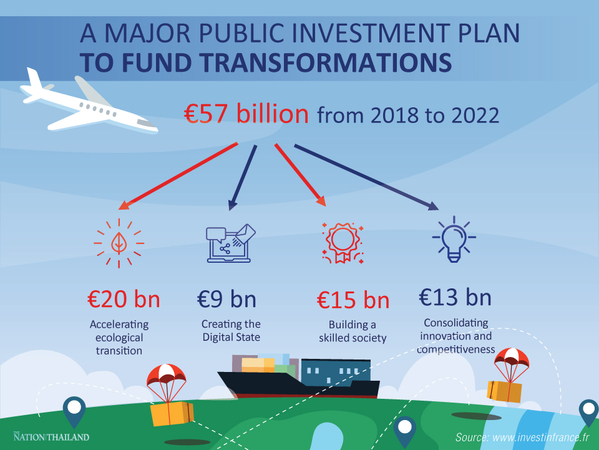
President Emmanuel Macron has initiated many reforms to boost the economy, reduce inequality and facilitate ecological transition. The corporate tax rate will be cut to 25 per cent by 2022 from 33.3 per cent in 2017, 31 per cent in 2019 for companies having revenue less than Euro 250 million, 28 per cent this year and 26.5 per cent next year, according to www.investinfrance.fr.

According to the CBRE’s quarterly study published in November 2019, Paris has knocked London off the top spot in the ranking of the world’s most attractive cities for foreign investment in real estate.

The British capital was downgraded to second place due to uncertainty surrounding Brexit.

Some large Thai corporates have already invested in France, for instances, Thai Union has modernised its existing canned seafood plant in Quimper and has established a European R&D Centre in French Brittany for its European subsidiaries while Indorama Venture has acquired companies in technical fibre and recycling business in Grand Est Region.

Double A, having invested in a paper plant in Normandy, has re-injected about Euro 40 million into a biomass power generation plant last year. SEA Value has announced expansion of its existing interest and new investment for 2020, according to the French Embassy in Bangkok.

Meanwhile, two Thai business executives have been invited to a business summit at the Palace of Versailles in Paris on January 20.

Regarding two-way trade, Thailand’s exports to France amounted to Euro 2.81 billion in 2018 while imports from France stood at Euro 1.87 billion, resulting in Euro 941 million of trade surplus for Thailand.


Recent news report suggested that the French government had made a concession on pension fund reform after unions’ protests nationwide.

Headwinds unabated, SCB analysts foresee 2.7% rise for Thai economy #ศาสตร์เกษตรดินปุ๋ย

#ศาสตร์เกษตรดินปุ๋ย : ขอบคุณแหล่งข้อมูล : หนังสือพิมพ์ The Nation

https://www.nationthailand.com/business/30380712?utm_source=category&utm_medium=internal_referral

Headwinds unabated, SCB analysts foresee 2.7% rise for Thai economy

Jan 17. 2020
Yunyong Thaicharoen

Yunyong Thaicharoen
By THE NATION

Siam Commercial Bank’s Economic Intelligence Centre expects the Thai economy to grow 2.7 per cent in 2020, representing a modest improvement from the 2.5 per cent projected for 2019.

Yunyong Thaicharoen, the centre’s chief economist, said on Friday (January 17) the expansion would be driven by an anticipated gradual recovery of merchandise exports following signs of restored health in global trade, which is due in part to the Phase 1 trade agreement between the United States and China.

Also supporting growth are more accommodative monetary and fiscal stimulus measures being enacted by many countries.

Nevertheless, the baht, which has appreciated by more than 24 per cent against other currencies in the past six years and is expected to maintain its strength, will continue to cut into exporter earnings and render Thai exports less competitive.

Tourism income is due for a decline with foreigners tending to spend less individually. The number of visitors is expected to rise, but Yunyong sees the rate of growth likely moderating.

Private domestic demand is projected to expand more slowly than last year. Even with exports expected to recover, private consumption and investment are forecast to cool further due to several adverse factors.

A decline in employment especially in manufacturing, deterioration of consumer confidence, a contraction in non-farm income, a reduction in farm income due to drought, and the high level of household debt will together choke household spending, particularly on durable goods, he said.

Private investment is expected to slow, in line with subdued domestic purchasing power.

Low capital utilisation and high inventory in the manufacturing sector will contribute to a deceleration in private investment in coming quarters.

In addition, the persistent contraction in consumer and commercial vehicle sales, as well as a decline in real estate construction due to LTV (loan-to-value) requirements from the previous period, will likely further weigh on domestic demand.

However, the government is expected to play a larger role in supporting growth in 2020 through the use of stimulus packages, short-term support for vulnerable groups and infrastructure investments.

It will also enable the private sector to take part in supporting growth, such as auctioning off 5G-spectrum licences, which should set in motion additional investments in telecommunications and related sectors.

With regard to domestic financial conditions, interest rates are expected to remain low throughout the year, while the baht should continue to face appreciation pressures.

Yunyong expects the Monetary Policy Committee to maintain an accommodative stance to lend support to economic recovery.

It will likely keep the policy rate unchanged at 1.25 per cent throughout 2020. The centre still sees the probability of a rate cut in the first half of 30 per cent on three possible conditions – weaker-than-expected growth, much higher non-performing loans and the baht’s continued appreciation.

Supported by a massive current-account surplus, the baht is expected to remain persistently strong, closing 2020 at 29.5-30.5 per US dollar.

Additional relaxation in capital outflows, both for overseas business operations and investment in foreign assets, will only marginally help ease pressure on the baht in the short run. More time is needed to tackle structural limitations such as financial literacy, foreign investment capabilities and impeding rules and regulations.

Only after that would capital outflow be sizeable enough to significantly mitigate appreciation pressures on the baht.

There are three key risk factors for the Thai economy in 2020 – trade war uncertainties, geopolitical risks and household and business financial vulnerabilities.

Despite completion of the Phase 1 trade deal between the US and China, many uncertainties remain around America’s protectionist policies that can impact global trade, such as the next phase of the negotiation, potential trade retaliations with Europe, and the decision to cut GSP privileges for many trading partners.

At the same time, geopolitical risks, especially from the conflict between the US and Iran, the prolonged protests in Hong Kong, and Brexit, will continue to pose challenges for global growth recovery.

Domestically, key risks to growth include financial vulnerabilities among households and businesses, particularly those with high debt and whose income suffers from the economic slowdown, technological disruptions and increasing competition.

World Bank lists steps for stalled Thailand to become high-income nation #ศาสตร์เกษตรดินปุ๋ย

#ศาสตร์เกษตรดินปุ๋ย : ขอบคุณแหล่งข้อมูล : หนังสือพิมพ์ The Nation

https://www.nationthailand.com/business/30380708?utm_source=category&utm_medium=internal_referral

World Bank lists steps for stalled Thailand to become high-income nation

Jan 17. 2020
By THE NATION

The Thai economy is projected to grow a modest 2.7 per cent this year thanks to recovering private consumption recovers and investment in large public infrastructure projects, the World Bank said in its “Thailand Economic Monitor” report released on Friday (January 17).

It said Thai growth slowed to about 2.5 per cent in 2019 from 4.1 per cent in 2018 due to both external and domestic factors.

Boosting productivity and reviving private investment will be essential if Thailand is to meet its goal of being a “high-income status” country by 2037, the report said.

Global economic growth is forecast to edge up to 2.5 per cent this year as investment and trade gradually regain strength, but risks persist.

These include a re-escalation of trade tensions and trade policy uncertainty, a sharper-than-expected downturn in major economies, and financial turmoil in emerging markets and developing economies.

“A continued deceleration of economic activity in China, the euro area and the United States could have adverse repercussions across East Asia through weaker demand for exports and the disruptions of global value chains,” said Birgit Hansl, World Bank country manager for Thailand.

“Financial investment, commodity and confidence channels could further weaken the global economy and adversely impact Thailand’s exports.”

In 2019, declining exports and weakening domestic demand were the main factors slowing Thailand’s growth.

Agricultural exports declined by 7 per cent in the first three quarters of 2019, led by sharp decreases in export volumes for major products such as rice and rubber.

Manufacturing exports declined by 6 per cent in the same period, with electronics exports hardest hit. Thailand’s strong currency, which has appreciated by 8.9 per cent since last year – making the baht the strongest it has been in six years – has also impacted foreign tourism and merchandise exports.

The government responded swiftly through accommodative monetary policies and a fiscal stimulus package to boost economic growth, the World Bank said.

The report recommends that it next consider policies to enhance the effectiveness of the stimuli by focusing on major public investment projects, improving efficiency in public-investment management and providing social protection coverage for vulnerable families.

The slowdown highlighted Thailand’s long-standing structural constraints with sluggish investment and low productivity growth.

Thai productivity growth has fallen to 1.3 per cent over 2010-2016 from 3.6 per cent over 1999-2007.

Private investment has halved, from 30 per cent of GDP in 1997 to 15 per cent in 2018, as foreign direct investments shrank and progress stalled on the Eastern Economic Corridor.

The report projects that, if current trends continue, with no significant pickup in investment and productivity growth, Thailand’s average annual growth rate will remain below 3 per cent.

To become a high-income country by 2037, it said, Thailand must sustain long-run growth rates above 5 per cent, which would require a productivity growth rate of 3 per cent and an increase in investment of to 40 per cent of GDP.

“Boosting productivity will be a critical part of Thailand’s long-term structural reform,” said Kiatipong Ariyapruchya, World Bank senior economist for Thailand. “Increasing productivity, particularly of manufacturing firms, will depend on increasing competition and openness to foreign direct investments, and improving skills.”

Sustaining higher productivity growth will require removing constraints that prevent new firms, especially foreign ones, and skilled professionals, from entering the domestic market.

These constraints include restrictive laws, particularly in the services sector, implementing the new Competition Act with clear guidelines related to state-owned enterprises and price controls, and developing policies to build the skills and human capital needed for an innovative knowledge-based economy.

Morgan Stanley adds exclamation point to banks’ winning week #ศาสตร์เกษตรดินปุ๋ย

#ศาสตร์เกษตรดินปุ๋ย : ขอบคุณแหล่งข้อมูล : หนังสือพิมพ์ The Nation

https://www.nationthailand.com/business/30380694?utm_source=category&utm_medium=internal_referral

Morgan Stanley adds exclamation point to banks’ winning week

Jan 17. 2020
By Syndication Washington Post, Bloomberg · Sridhar Natarajan 

Morgan Stanley fixed-income traders completed a clean sweep by Wall Street banks, surpassing analysts’ estimates and joining the rest of the industry in staging a roaring comeback.

Shares surged by the most in more than three years after Morgan Stanley joined rivals in reporting a massive surge in bond-trading revenue and boosted its profit target for the next two years. Fixed-income trading revenue more than doubled, helping lift annual profit to an all-time high. The firm also beat analysts’ estimates for merger advice and stock and debt underwriting.

The final three months of 2019 offered relief for banks stung by a years-long slump in the fixed-income market. Investors had been expecting a rebound from 2018’s especially terrible fourth quarter, and the big banks delivered. At Morgan Stanley, the figure advanced 126% to $1.27 billion. Analysts surveyed by Bloomberg had predicted a 67% rebound.

“Typically in the fourth quarter you see a slowdown after Thanksgiving, and we didn’t see that,” Chief Financial Officer Jonathan Pruzan said in an interview. “We are entering 2020 with a pretty constructive market backdrop and a healthy pipeline.”

The bank said it aims to earn a 13% to 15% return on tangible common equity in the next two years, and 15% to 17% over the longer term. The firm had an 11.5% to 14.5% goal over the past two years.

Shares of the company, which jumped 29% last year, advanced 6.6% to $56.44 at 9:39 a.m. in New York, the biggest intraday gain since November 2016. The surge pushed Morgan Stanley’s market capitalization to $91.5 billion, above Goldman Sachs’s $91.1 billion.

Morgan Stanley, the world’s biggest stock-trading firm, said revenue from that business was $1.92 billion, slightly below analysts’ estimates.

“The equity number of flat year-over-year is a disappointment (this is their core franchise),” said Adam Crisafulli, an analyst at Vital Knowledge Media. “The huge 125% FICC growth will probably receive a lot of scrutiny about how sustainable that run rate is.”

Investment-banking revenue increased 11% to $1.58 billion on the strength of its underwriting business. Analysts had been expecting declines for the deal-advisory unit and gains for underwriting.

“Firm-wide revenues were over $10 billion for the fourth consecutive quarter, resulting in record full year revenues and net income,” Chief Executive Officer James Gorman said in a statement Thursday.

Wealth-management revenue surpassed expectations with an 11% gain to $4.58 billion. The firm leans on managing money for wealthy individuals and clients for more than half its revenue.

Under Gorman, Morgan Stanley made expanding in wealth management its top priority in the years following the financial crisis. Some analysts now say that business has matured, meaning the trigger for more gains for the firm hinges on trading and other capital-market activity.

Other Key Results:

– Fourth-quarter net income jumped 46% to $2.24 billion, or $1.30 a share. Excluding a tax benefit, profit was $1.20, beating the $1.02 estimate of analysts surveyed by Bloomberg.

– Revenue for the year increased 3% to $41.4 billion.

– Client assets rose 17% from a year earlier to $2.7 trillion.

– Investment-management revenue almost doubled to $1.36 billion, driven by gains in one of the firm’s Asian private equity funds.

Trump hotel’s mix of GOP insiders and hangers-on helped give rise to impeachment episodes #ศาสตร์เกษตรดินปุ๋ย

#ศาสตร์เกษตรดินปุ๋ย : ขอบคุณแหล่งข้อมูล : หนังสือพิมพ์ The Nation

https://www.nationthailand.com/business/30380683?utm_source=category&utm_medium=internal_referral

Trump hotel’s mix of GOP insiders and hangers-on helped give rise to impeachment episodes

Jan 17. 2020
A view of the Grand Lobby of the Trump International Hotel in Washington in June 2017. MUST CREDIT: Washington Post photo by Linda Davidson

A view of the Grand Lobby of the Trump International Hotel in Washington in June 2017. MUST CREDIT: Washington Post photo by Linda Davidson
By The Washington Post · David A. Fahrenthold, Josh Dawsey, Jonathan O’Connell

Trump hotel’s mix of GOP insiders and hangers-on helped give rise to impeachment episodes. WASHINGTON – They are key locations in the drama that led to President Donald Trump’s impeachment: the steakhouse table where Trump’s private lawyer set out a nameplate, “Rudolph W. Giuliani, Private Office.” The upstairs hideaway, where Giuliani’s team planned its outreach to Ukraine.

And the expensive bar, where Giuliani’s team met an odd figure: Robert Hyde, a big-talking ex-Marine who claimed to have the U.S. ambassador to Ukraine under surveillance.

All three places are within 300 yards of each other, in the lobby of the Trump International Hotel.

For three years, President Trump’s hotel near the White House has been a loose, anybody-welcome hangout for Republicans: Candidates raise money in the ballrooms. Congressmen and lobbyists dine in the steakhouse. Hangers-on wait at the bar, taking selfies in “#americaslivingroom.”

That arrangement worked for Republicans, because it compressed a city’s worth of networking into one room. It worked for Trump, because he converted political allies into private customers.

But the hotel’s atmosphere of blurred lines – mixing the public interest with Trump’s private interests, and mixing the GOP’s leaders and its wannabe fringes – helped give rise to a scandal that threatens to overshadow Trump’s presidency.

Giuliani and his team didn’t just meet at the Trump hotel. They embodied its world.

“I spent two years going to Washington and I didn’t see the monuments,” said Lev Parnas, who was a central figure in Giuliani’s effort to pressure Ukraine to investigate Trump’s political rival, former vice president Joe Biden. “All I saw was the Trump hotel.”

Trump opened his hotel before he won the presidency, having spent more than $200 million to renovate the government-owned Old Post Office building near the White House. After he won, Trump kept his ownership of the hotel, operated under a federal lease.

But its business model had to change sharply, according to hotel employees.

Democrats wouldn’t stay in the hotel rooms. Many major corporations and associations wouldn’t rent the ballrooms, worried about alienating liberal customers.

They shifted to focus on the part of the business that was thriving: the lobby, with its bar and BLT Prime steakhouse.

The place where pro-Trump Republicans see and be seen.


“There were many, many of them that were just there, who we just happened to run into,” said Seth Morrison, executive director of the Orange County, California, Lincoln Club. Morrison said his group stayed at the Trump hotel last year on its biannual Washington trip, and encountered a slew of candidates and conservative TV personalities in the lobby. “Eric Bolling was there for like three days in the lobby,” Morrison said of the conservative commentator.

Instead of being a hotel with a lobby, the Trump property became a lobby with a hotel attached.

It raised prices at the lobby bar: Candied bacon went from $14 to $22. The most expensive cocktail on the menu had been $21. Then they added one for $100, with caviar in it.

The hotel also spent big on upgrades to the lobby and restaurant: $264,000 for new lobby furniture. An additional $24,000 on carpets in the first-floor hallways. And $15,000 for a new ice-cream maker for dessert specials, according to hotel documents obtained by The Washington Post. At the same time, the hotel had to shut down its outdoor patio because of anti-Trump protesters.

Just as Republican business was reshaping the Trump hotel, the Trump hotel was changing the GOP – by bottling up its top leaders with any wannabe who sat at the bar.

“POTUS doesn’t know, or maybe doesn’t care, but that hotel is the root of many of his problems,” said one Republican who is close to Giuliani and Trump, and spoke on the condition of anonymity to preserve relationships with them.

Trump himself has come to the hotel at least 18 times, including for three of his own campaign fundraisers, where he is both the candidate and the caterer.

In addition, top GOP-aligned lobbyists such as Brian Ballard and Jeff Miller also work the room. And Republican National Committee Chairwoman Ronna McDaniel convenes some of the party’s top operatives for a monthly “off-the-record dinner,” in a private room at the hotel. Over wine and steak – the price tag is about $3,000 per month and paid for by the RNC, officials say – party officials, lobbyists, White House aides, officials leading Republican super PACs and congressional political leaders meet to talk business.

“You’ve got top confidants of the president hanging out in the hotel lobby, and you can mingle with them for the price of a $20 glass of wine,” said Zach Everson, a journalist who chronicles the Trump hotel’s mixing of politics and business on the blog 1100 Pennsylvania. By Everson’s count, 25 people who have served in Trump’s Cabinet have visited the hotel, along with 30 of the 53 Republicans in the Senate.

No figure embodied that mixing better than Giuliani, the former New York mayor who has reinvented himself as a lawyer, fixer and off-the-books emissary for Trump.

“Rudy is probably the most senior person who’s readily accessible to the public for the price of a drink,” Everson said.

Giuliani claimed enormous private influence. But at the Trump hotel, he sat out in public, spending hours at his “private office,” a table in the lobby steakhouse’s bar. One former Trump hotel staffer said that Giuliani was so comfortable there that he sometimes left without paying – “like he was at home.” The restaurant often had to eat the bill, the former employee said – who spoke on the condition of anonymity to preserve relationships in the hospitality business.

At that table, Giuliani met repeatedly with Parnas and Igor Fruman, a pair of Soviet-born Americans who were seeking influence in Republican politics – and helping Giuliani pressure Ukraine to provide dirt on Biden. On the day Parnas and Fruman were arrested, charged with campaign-finance violations unrelated to Ukraine, they had previously had lunch at the Trump hotel.

“It was like a breeding ground at the Trump hotel,” Parnas told MSNBC’s Rachel Maddow in an interview Wednesday night. “You would see the same people every day, all the same congressmen that supported the president would be there, nobody else.”

When the group needed more privacy, Parnas told Maddow, they retreated to a private space: “our BLT office on the second floor.”

“At the Trump hotel?” Maddow asked.

“At the Trump hotel,” Parnas said.

Parnas also met with Trump in one of the hotel’s luxury suites, at a “roundtable” organized by the pro-Trump super PAC America First Actions, according to people familiar with the meeting. Parnas is now facing federal campaign-finance charges, and emerged as a key witness against Trump in the days before Trump’s impeachment trial begins.

If Giuliani was one of the most powerful Republicans in the lobby, then Hyde – the ex-Marine from Connecticut – was one of the least. But his story illustrates how the Trump hotel allows fringe characters to rise in influence, just by being in the right place.

Hyde is a Republican donor and long-shot congressional candidate who began hanging out at the hotel – along with other Trump properties – and posting photos of himself with GOP figures. He began to date Rabia Kazan, a onetime pro-Trump activist he met there.

“Trump is like a cult leader, and people go to the hotel to show their loyalty and love for him,” Kazan said. Their relationship ended after several weeks, Kazan said.

In the past year, Hyde was involuntarily committed to a psychiatric hospital in Florida, and was hit with a restraining order in Washington for allegedly harassing a former business associate, according to court and police records.

Hyde sent Parnas texts saying that he had Marie Yovanovitch – then the U.S. ambassador to Ukraine and a perceived obstacle to Giuliani’s plans – under surveillance in Kyiv. Hyde has since said he was joking.

Where did Parnas link up with somebody like that?

“At the Trump hotel,” Parnas told Maddow. “He was a regular at the bar.”

Toshiba says it built an algorithm that’s faster than a supercomputer #ศาสตร์เกษตรดินปุ๋ย

#ศาสตร์เกษตรดินปุ๋ย : ขอบคุณแหล่งข้อมูล : หนังสือพิมพ์ The Nation

https://www.nationthailand.com/business/30380680?utm_source=category&utm_medium=internal_referral

Toshiba says it built an algorithm that’s faster than a supercomputer

Jan 17. 2020
By Syndication Washington Post, Bloomberg · Pavel Alpeyev, Grace Huang, Shoko Oda

It’s a tantalizing prospect for traders whose success often hinges on microseconds: a desktop PC algorithm that crunches market data faster than today’s most advanced supercomputers.

Japan’s Toshiba Corp. says it has the technology to make such rapid-fire calculations a reality — not quite quantum computing, but perhaps the next best thing. The claim is being met with a mix of intrigue and skepticism at financial firms in Tokyo and around the world.

Toshiba’s “Simulated Bifurcation Algorithm” is designed to harness the principles behind quantum computers without requiring the use of such machines, which currently have limited applications and can cost millions of dollars to build and keep near absolute zero temperature. Toshiba says its technology, which may also have uses outside finance, runs on PCs made from off-the-shelf components.

“You can just plug it into a server and run it at room temperature,” Kosuke Tatsumura, a senior research scientist at Toshiba’s Computer & Network Systems Laboratory, said in an interview. The Tokyo-based conglomerate, while best known for its consumer electronics and nuclear reactors, has long conducted research into advanced technologies.

Toshiba has said it needs a partner to adopt the algorithm for real-world use, and financial firms have taken notice as they grapple for an edge in markets increasingly dominated by machines. Banks, brokerages and asset managers have all been experimenting with quantum computing, although viable applications are generally considered to be some time away.

Toshiba said its system is capable of calculating arbitrage opportunities for currencies in microseconds. The company has hired financial professionals to work on the project, and aims to complete a real-world trial by March 2021.

“Finance is the most familiar application,” Toshiba Chief Executive Officer Nobuaki Kurumatani said in an interview. “But there are so many uses. This is a technology with real potential.”

Toshiba’s algorithm seems to outperform rival approaches on mathematical benchmarks, but how it will perform on real-world problems is anyone’s guess. Access to the company’s backtesting in currency trading and portfolio optimization isn’t publicly available and adopting the technology to a new problem would likely require rebuilding the algorithm from scratch.

“There is a lot of talk about applications of quantum computing in finance, but it’s not very clear where it would be all that necessary,” said Takanobu Mizuta, a fund manager and senior researcher at Sparx Group Co. Optimizing a portfolio is not something that needs to be done in microseconds and calculations involved in high-frequency trading, where speed counts, are not very complicated, Mizuta said.

Toshiba may choose to use the algorithm for areas outside finance. Other applications could include things like plotting complex shipping and logistics routes and developing new drugs with molecular precision, according to the company.

The idea first arose in 2015, when senior research scientist Hayato Goto was exploring how the qualities of some complex systems can suddenly change with additional input, a phenomenon he describes as bifurcation. But it took him two years, he said, to realize the discovery could be used to craft algorithms that can efficiently sift through a huge number of possibilities — like a quantum computer without the onerous requirements to run one.

Goto partnered with Tatsumura, whose semiconductor expertise was crucial in making the calculations work on multiple processors in parallel.

“Because the two of us have completely different specialties, we were able to come up with something new,” Goto said.

Toshiba revealed its Simulated Bifurcation Algorithm in April, initially garnering little attention outside the scientific community. In October, the company announced that its model had identified potential arbitrage opportunities in currency trading in just 30 microseconds — fast enough, it claimed, to give it a 90% chance of making profitable trades. That triggered inquiries from financial institutions in Japan and abroad, Toshiba said.

Investment banks and brokerages have already begun eyeing quantum computing as an opportunity and a threat. Goldman Sachs Group Inc. has been building an in-house research team and late last year joined forces with startup WC Ware to speed up the search for a “quantum advantage.” Japan’s Nomura Holdings Inc. has partnered with Tohoku University to explore applications in asset management using a machine made by Canada’s D-Wave Systems Inc.

“Right now, what you can do with it is still hypothetical,” said Kazuyuki Takeda, a general manager at Mizuho-DL Financial Technology Co., a research arm of one of Japan’s biggest financial groups. “It will take quite a bit of time before we have practical uses of quantum computing. At least 10 years or so.”

In the meantime, Toshiba is hoping it will succeed in commercializing its technology — whether in finance or elsewhere — in order to fill that gap.

“We give ourselves about a one-year lead for the stuff that we release publicly,” Goto said. “The more cutting-edge knowledge we have internally gives us confidence that we won’t be easily caught up with.”

Nissan punishes more managers after 10,000-hour Ghosn probe #ศาสตร์เกษตรดินปุ๋ย

#ศาสตร์เกษตรดินปุ๋ย : ขอบคุณแหล่งข้อมูล : หนังสือพิมพ์ The Nation

https://www.nationthailand.com/business/30380679?utm_source=category&utm_medium=internal_referral

Nissan punishes more managers after 10,000-hour Ghosn probe

Jan 17. 2020
A company logo is seen through illuminations at the Nissan Motor Co. headquarters in Yokohama, Japan, on Jan. 9, 2020. MUST CREDIT: Bloomberg photo by Toru Hanai.

A company logo is seen through illuminations at the Nissan Motor Co. headquarters in Yokohama, Japan, on Jan. 9, 2020. MUST CREDIT: Bloomberg photo by Toru Hanai.
By Syndication Washington Post, Bloomberg · Gearoid Reidy, Masatsugu Horie 

Nissan has revealed more details of an exhaustive probe into Carlos Ghosn, a week after its fugitive former leader accused the Japanese carmaker of being behind the plot to have him arrested.

The report on the investigation, submitted to the Tokyo Stock Exchange on Thursday, found that many others were involved in improprieties besides its former chairman, with those involved located both in Japan and overseas. Three people in senior roles were punished for their involvement, though their names, titles and specific steps to discipline them were not revealed.

Nissan was required to submit the report after adjusting its past earnings following the arrest of its former chief executive officer and chairman for financial crimes in November 2018. That triggered turmoil within the automaker’s management ranks and destabilized its relationship with alliance partner Renault. Ghosn fled trial in Japan at the end of December, hiding in a black box for musical equipment and making his way to Lebanon via private jets.

While the timing of the report has little to do with Ghosn’s escape, it underscores the extent to which Nissan has had to reform its practices in the year after his arrest. Many of the steps outlined in the 33-page document, such as abolishing a CEO reserve fund and the restatement of Ghosn’s income, had already been disclosed or reported.

The misconduct outlined in the report was not just limited to acts allegedly committed by Ghosn and executive Greg Kelly, but included excess salary paid to Ghosn’s successor, Hiroto Saikawa, who was ousted as CEO in September. The report found six others also received excess compensation via stock appreciation rights, though did not identify them. The amount involved totaled 57.7 million yen ($525,000), though Nissan expects most of that amount to be repaid by March.

“A wide variety of misconducts had been committed over a long period of time,” the report said, noting that “many people were involved and the misconducts were committed not only in Japan but also in foreign countries.” Nissan will decide the punishment for others in due course, it said.

The investigation involved more than 10,000 hours of analysis, including the collection of 9 million documents and interviews with more than 70 people within the company. Ghosn and Kelly were not among them, Nissan said, citing the fact that the automaker is a co-defendant of the two former executives in a forthcoming criminal trial.

The report attacked Ghosn’s “personality cult” and accused him of isolating departments within Nissan that would have been able to discover his misconduct, describing Ghosn as turning them into a “black box.”

The investigation was aided by law firm Latham & Watkins, a company Ghosn last week slammed at his explosive press conference in Beirut. He described the firm as one of the actors “destroying Japan’s reputation on the global stage,” and in a separate statement derided Nissan’s investigation as “fundamentally flawed, biased, and lacking in independence from its inception.”

“Although Nissan is presenting this improvement report to the stock exchange and promising to rebuild its business and be more transparent, the current movements of Nissan’s management look like the exact opposite,” said Koji Endo, an analyst at SBI Securities Co. in Tokyo. “That’s the biggest problem.”

Among the steps the carmaker will take to improve its corporate governance is abolishing a system of having former directors become advisers and consultants.

This means Saikawa, who was reportedly planning to stay on at Nissan in some capacity after leaving the board at a shareholders’ meeting planned for Feb. 18, is now likely to leave the company entirely. By abolishing the adviser role, Nissan’s new CEO, Makoto Uchida, may be able to act more independently.

Renault director Pierre Fleuriot, set to join Nissan’s board following a shareholders’ vote in February, will also become a member of Nissan’s audit committee, which decides executive pay, Nissan said in a separate statement Thursday.

Lego sets its sights on a growing market: Stressed-out adults #ศาสตร์เกษตรดินปุ๋ย

#ศาสตร์เกษตรดินปุ๋ย : ขอบคุณแหล่งข้อมูล : หนังสือพิมพ์ The Nation

https://www.nationthailand.com/business/30380673?utm_source=category&utm_medium=internal_referral

Lego sets its sights on a growing market: Stressed-out adults

Jan 17. 2020
Cris McDonough, 57, of Connellsville, Pa. builds Legos during a BYOB adults-only build event at Brooke's Block Party, an event space. MUST CREDIT: Photo by Justin Merriman for The Washington Post.

Cris McDonough, 57, of Connellsville, Pa. builds Legos during a BYOB adults-only build event at Brooke’s Block Party, an event space. MUST CREDIT: Photo by Justin Merriman for The Washington Post.
By The Washington Post · Abha Bhattarai

Elisabeth Briggs finds calm in clicking small, interlocking bricks together and turning piles of multicolored plastic into something recognizable.

Sometimes she has a beer while playing with Lego bricks – at 37, she’s allowed – or watches TV. But she keeps the instructions close by, following them to the block.

For Briggs, this ritual has become a kind of guided meditation with a tangible reward at the end: a big city skyline, perhaps, or an iconic building she can display in her office. She picked up her first Lego building set, a 321-piece replica of the Eiffel Tower, for $35 after a trip to Paris, and now has nearly three dozen kits that mirror her travels, including Buckingham Palace, the Louvre and the Golden Gate Bridge.

“It’s fun to zone out and follow someone else’s instructions,” said Briggs, a math teacher at Olympic College near Seattle. “It wasn’t until I got older – and had a job and more money – that I saw value in that.”

Lego, the world’s largest and most profitable toy maker, is zeroing in on a growing demographic: Stressed-out adults. The 87-year-old Danish company increasingly bills its brightly colored bricks as a way to drown out the noise of the day and perhaps achieve a measure of mindfulness. The company’s newest kits – which include the Central Perk cafe from the sitcom “Friends” and a vintage 1989 Batmobile – tap into Gen X nostalgia, while its Ideas and Forma lines are being targeted to adults who want to occupy their hands but keep their minds loosely engaged.

Susan Lewis, 61, left, Lori Griffith, 43, center, and CJ Paxinos, 43, all of Connellsville, Pa., build with Lego bricks during an BYOB adults-only build event at Brooke's Block Party. MUST CREDIT: Photo by Justin Merriman for The Washington Post.

Susan Lewis, 61, left, Lori Griffith, 43, center, and CJ Paxinos, 43, all of Connellsville, Pa., build with Lego bricks during an BYOB adults-only build event at Brooke’s Block Party. MUST CREDIT: Photo by Justin Merriman for The Washington Post.

Adults have become a coveted market for toy makers confronting increased competition and waning sales growth, and it doesn’t hurt that they’re more likely to drop $800 on a 7,541-piece Star Wars Millennium Falcon set or $400 for the Harry Potter Hogwarts Castle on Briggs’s wish list.

“Adults with high-pressured jobs are telling us they’re using Lego to disconnect from the mania of the day,” said Genevieve Capa Cruz, Lego’s audience marketing strategist. “They’re looking for a relaxing, calming experience – and they like instructions because that’s what helps them be in the zone.”

The company spent the past five years revamping instruction manuals to make kits foolproof for frazzled adults, she said. Last year, Lego introduced a line of koi fish and shark models with soothing movements to appeal to builders in search of a “joyful creative challenge.”

Lego’s appeal, of course, has long spanned generations. Adult Fans of Lego – known colloquially as AFOLs – have inspired dozens of Facebook and Reddit groups and at least one “blocumentary.” A new book aims to teach older users how to use the bricks as a form of stress relief, not to create complicated models but to simply revel in the process. And a competition show, LEGO Masters, which premieres next month on Fox, pits adult builders against each other. (Think “The Great British Bake Off,” for Lego.)

But the toy giant is increasingly looking beyond die-hard hobbyists to court the casual builder in search of modern-day tranquility. “Need an escape?,” asked a recent Lego ad on Instagram. “Building with Lego bricks reduces stress and improves your well-being. It’s zen, in the shape of a brick.”

Zach Stephens, 38, of Connellsville, Pa., looks through a pile of Legos during an BYOB adults-only build event at Brooke's Block Party. MUST CREDIT: Photo by Justin Merriman for The Washington Post.

Zach Stephens, 38, of Connellsville, Pa., looks through a pile of Legos during an BYOB adults-only build event at Brooke’s Block Party. MUST CREDIT: Photo by Justin Merriman for The Washington Post.

Mindfulness is a meditative practice rooted in ancient Buddhism and Hinduism that focuses on the present without dwelling on the past or worrying about the future. It has been shown to alleviate stress and anxiety, improve sleep, and even lower blood pressure. In recent years, mindfulness has become a mainstream buzzword, with corporations like Apple, Nike and HBO adding meditation rooms for employees, and apps like Headspace and Calm promising to help the masses find peace. And Lego is hardly alone in latching on to it as a selling point: Companies now offer “mindful knitting” workshops, while a growing roster of books promises mindfulness through coloring, crosswords and crafting.

Any repetitive activity – embroidering, sweeping, or yes, clicking together Lego bricks – can help strike the right balance between mental engagement and relaxation, says Carrie Barron, Director of Creativity for Resilience at the University of Texas at Austin’s Dell Medical School. “To focus singularly on a task is a form of mindfulness.”

And, she added, Lego’s instruction booklets serve an important role, too: “We like to have structure and a clear path. The idea that ‘if you follow this, you’ll achieve that,’ is very appealing.”

– – –

Abbie Headon hadn’t touched a Lego for a good 20 years when the Danish toy giant called with an assignment: Write a book for stressed-out adults, like her, who hadn’t played with the blocks in decades. She bought a small bag of pieces and got to work.

“The point is to free your mind of other distractions and focus on play, even if you just have a handful of pieces,” said Headon, 44, who is based in England.

Her 160-page book, “Build Yourself Happy: The Joy of Lego Play,” was released in the United States last month. Chapters like “Be a Child Again” and “Builds to Help You Sleep” implore adults to play in new ways: Build something with your eyes closed. Create a rainbow. Build the tallest tower you can. There are also practical considerations: A chapter on “the life-changing magic of tidying your Lego bricks” offers suggestions on sorting and storage.

“The fun isn’t just, I’m going to build this and it’s going to be perfect,” Headon said. “That’s one of the great things about Lego: There’s no risk. You can always just take it apart and start again.”

These days Headon keeps a cardboard box of Lego pieces on her desk. They’re therapeutic, she says, even if she’s not actively playing with them.

“I like to have something in my hand when I’m thinking, so I’ll grab a few Lego pieces and click them together and apart,” she said. “It’s very satisfying.”

The earliest Lego bricks, introduced in Denmark in the late 1940s, consisted mainly of rectangular pieces in a handful of colors. Over the next decade, it added doors and roofs, as well as trees, bushes, road signs and curved plates, according to the online database Brickset. By the time it started exporting to the United States in 1961, sets had become more elaborate, replicating airplanes, boats and fire stations.

But by the late 1990s, the company was on rocky ground. The simple plastic brick had fallen out of favor as children became enthralled with video games, computers and fads like the Tamagotchi digital pet. Lego posted its first-ever loss in 1998.

The following year Lego forged its first licensing deal, with the “Star Wars” franchise, a move that “basically saved the company,” says industry analyst Chris Byrne. Annual sales jumped nearly 30% that year, as Lego shifted its focus away from open-ended play and toward more branded kits. Similar licensing agreements with Disney, Marvel Super Heroes and Harry Potter followed. Last year Lego posted a $1.2 billion profit on $5.4 billion in sales.

Even so, Lego is facing many of the same head winds as its rivals. Sales growth has held steady at about 4% since 2018, a sharp drop from the 17% a year average seen the preceding decade. Competition is growing – not only from other toy makers, but also smartphones and apps that are devouring a bigger portion of children’s allowances. Plus, analysts say, today’s parents would rather spend on experiences than stuff. U.S. toy sales fell about 5.5% in the first nine months of this year, according to NPD Group.

Selling blocks – or puzzles or action figures – to adults has become one way for toy makers to counteract the slowdown. Competitors like Playmobil are taking note too, by rolling out programs that they say will help corporate employees “find new business solutions.”

Zach Stephens, 38, of Connellsville, Pa., looks through a pile of Legos during an BYOB adults-only build event at Brooke's Block Party. MUST CREDIT: Photo by Justin Merriman for The Washington Post.

Zach Stephens, 38, of Connellsville, Pa., looks through a pile of Legos during an BYOB adults-only build event at Brooke’s Block Party. MUST CREDIT: Photo by Justin Merriman for The Washington Post.

“The rise of adult fans is driving the toy industry,” said Byrne, a New York-based consultant who bills himself as the Toy Guy. “Who do you think is buying the $499 Death Star or the $399 Hogwarts Castle? That’s all being made for adults who have their own money to spend.”

– – –

The submissions pour in by the dozens – and more often than not, they’re hankering for an earlier era.

Scroll through Lego Ideas, the crowdsourcing platform the company introduced in 2008, and you’ll see proposals for sets commemorating the 1964 musical “Mary Poppins” and “The Golden Girls,” the NBC sitcom that first hit airwaves in 1985. Lego fans vote on their favorites, and a panel green lights a handful of projects each year. Recent approvals include a “Ghostbusters” 30th anniversary set, a DeLorean Time Machine from the 1985 film “Back to the Future,” and a Beatles-inspired yellow submarine.

“There is so much nostalgia, especially among Gen X,” said Capa Cruz of Lego.

This generation of Americans, sandwiched between baby boomers and millennials, was the first to grow up with Lego, Byrne says. Now in their 40s and 50s, they are among a growing group of adults hoping to unplug from their phones and computers.

When Brooke Deason opened a block-building events space six years ago, she envisioned Lego-filled birthday parties, summer camps and youth leagues.

But she quickly found another group clamoring to play: parents.

She now hosts regular adults-only evenings where locals sip wine and put together “Doctor Who” sets and replicas of Frank Lloyd Wright’s Fallingwater. One group of dads has been working on a 1,366-piece Star Wars Imperial Star Destroyer for two years.

“It’s like a blast to the past, straight to our childhoods,” said Deason, 40, who lives in Connellsville, Pennsylvania. “It took me by surprise, but it makes sense: Life is so structured. But with Lego, you can do anything.”

Deason has a few million Lego pieces, which she organizes by type and color. The Star Wars and architecture sets, she says, are the most popular among adults, who almost always look for the instruction manuals.

“The younger kids come in and it’s all about their imaginations – playing pretend, building zombie towns,” she said. “But at some point that gets lost. The adults seem to value the final finished project. That’s where they get their satisfaction.


Nestle to spend up to $2.1 billion on recycled-plastic plan #ศาสตร์เกษตรดินปุ๋ย

#ศาสตร์เกษตรดินปุ๋ย : ขอบคุณแหล่งข้อมูล : หนังสือพิมพ์ The Nation

https://www.nationthailand.com/business/30380677?utm_source=category&utm_medium=internal_referral

Nestle to spend up to $2.1 billion on recycled-plastic plan

Jan 17. 2020
By Syndication Washington Post, Bloomberg · Corinne Gretler

Nestle plans to spend as much as 2 billion Swiss francs ($2.1 billion) in a plan to push the plastics industry to address the dearth of recycled packaging that’s safe to use for food.

The KitKat maker will earmark more than 1.5 billion francs to pay a premium for such plastic to encourage production, the company said Thursday. Recyclers have tended to neglect that market because of the difficulties in making non-toxic food-grade packaging.

“Food-grade recycled plastic is extremely expensive today, and nobody wants to pay — so nobody makes it and prices don’t come down,” Chief Executive Officer Mark Schneider said at a media event in Zurich. “We want to use our scale aggressively to build stable demand.”

Nestle said it has other projects in the field, including a 250 million-franc venture capital fund to develop packaging technology. The company said it will try to mitigate the impact of higher plastic costs through efficiencies.

Food and beverage makers have increasingly come under pressure from consumers and environmental groups for using too much plastic. Nestle has pledged to make all of its packaging recyclable or reusable by 2025, and it said aims to reduce use of newly made plastic by a third by the same year. That falls short of a goal for a 50% reduction at Unilever, which is testing refill stations for products like laundry detergent and shampoo.

Greenpeace, which has urged Nestle to focus on delivery systems based on containers that can be refilled and reused, said reducing single-use plastic should not lead to “false solutions” like recycled content and material substitution.

“If Nestle wants to stop polluting the world, it needs to end its reliance on plastic,” Matthias Wuethrich, senior campaigner at Greenpeace Switzerland, said in an e-mailed statement.

As of 2025, the European Union will require that at least 25% of the material in beverage bottles consist of recycled plastic.

Nestle opened a research site near Lausanne last year to develop packaging that’s less harmful to the environment, such as fully biodegradable paper-based water bottles and refillable containers.

Like rivals PepsiCo and Danone, the Swiss company is experimenting with water dispensers in an attempt to shift to selling beverages without bottles.

“The environmental issue will remain a topic in the next few years, and companies will have to back up words with real investments,” said Patrik Schwendimann, an analyst at Zuercher Kantonalbank. “The whole industry will face higher costs. The positive return is that companies will look good to the public.”

Nestle shares climbed as much as 0.9% in Zurich. They have gained 26% over the past year.