Yellen gets a shot to throw Treasury’s clout into climate fight #SootinClaimon.Com

#SootinClaimon.Com : ขอบคุณแหล่งข้อมูล : หนังสือพิมพ์ The Nation.

Yellen gets a shot to throw Treasury’s clout into climate fight (nationthailand.com)

Yellen gets a shot to throw Treasury’s clout into climate fight

InternationalDec 12. 2020Janet Yellen, former chair of the U.S. Federal Reserve, speaks during the American Economic Association and Allied Social Science Association Annual Meeting in Atlanta on Jan. 4, 2019. MUST CREDIT: Bloomberg photo by Elijah Nouvelage.Janet Yellen, former chair of the U.S. Federal Reserve, speaks during the American Economic Association and Allied Social Science Association Annual Meeting in Atlanta on Jan. 4, 2019. MUST CREDIT: Bloomberg photo by Elijah Nouvelage. 

By Syndication Washington Post, Bloomberg · Saleha Mohsin, Jennifer A. Dlouhy

Janet Yellen has promised to make fighting climate change a priority as Treasury secretary, spurring hope among activists she will put the issue at the center of U.S. economic policy for the first time.

Yellen, President-elect Joe Biden’s nominee to lead the Treasury Department, has already endorsed a tax on carbon dioxide emissions and urged countries to set up independent councils that can pursue aggressive climate policies without political interference.

Advocates are appealing for her to go even further if confirmed, seizing her role as one of the most powerful people in finance to wield fiscal policy in the campaign against global warming. Some have outlined plans for how Yellen could trigger tighter regulation of oil and gas company finances under the Dodd-Frank Act — even going so far as to require them to sell off fossil fuel assets.

“Yellen will have the power to help move trillions of dollars out of fossil fuels and trillions more into renewables,” said Jamie Henn, director of the non-profit advocacy group Fossil Free Media. “She could do more for the Green New Deal than nearly any other cabinet position.”

Yellen declined to be interviewed for this article. Biden’s transition team said the incoming administration intends to turn the threat of climate change into a way to bolster the economy and create jobs.

Yellen’s Treasury Department is expected to play a central role in that effort by helping shape stimulus spending to pull the U.S. out of recession and fulfill Biden’s promise to invest as much as $2 trillion on clean energy.

Both Biden and Yellen’s ambitions for big clean-energy spending could be constrained by Congress, where Republicans will hold at least 50 seats in the Senate. Conservatives have assailed congressional Democrats’ ambitions for a wave of spending to propel clean power and energy efficiency, including through expanded tax cuts and investments, as a socialist wish list.

Yellen’s interest in addressing climate change dates to her time in the Clinton administration, when she was the head of the Council of Economic Advisers. And she doesn’t mince words about the threat.

“It will have absolutely devastating consequences for humanity if we don’t address it, and time is running out to take the steps that are necessary,” she said in an October interview with Bloomberg News.

Climate change is already affecting energy investments, raising the risk that oil, gas and coal reserves will lose value or be barred from development as governments clamp down on the greenhouse gas emissions generated by burning fossil fuels. Even non-energy investments in commercial buildings and real estate are at greater peril with the encroachment of rising seas and more intense storms fueled by climate change.

Yellen “understands the critical links between the country’s economic health and climate change,” said Andrew Steer, president of the World Resources Institute. As Treasury chief, “Yellen would have strong authority to bring climate risks and opportunities more centrally into U.S. economic and financial systems.”

Progressive Democrats argue that enlisting the Treasury Department in the battle against climate change is consistent with Biden’s plan to take a whole-of-government approach to the issue.

“The private sector won’t take this seriously unless the government takes a stand,” said Rhiana Gunn-Wright of the Roosevelt Institute.

Critics of the approach say Congress — not the Treasury Department — should take the lead in addressing climate change and the financial risks it poses.

“Significant new policy, like that addressing climate, shouldn’t be set by financial policy or any other statute that was never intended to address such a major issue,” said Kyle Isakower, a senior vice president at the American Council for Capital Formation, a free-market think tank. With legislation specifically designed to address the risks of climate change, “financial policy can play an appropriate role.”

Any aggressive moves would invite conflict with the U.S. oil and gas industry, which is already bracing for the Biden administration to tighten environmental mandates on drilling and block development on federal lands.

Some options, such as greater capital holding requirements for banks that have fossil investments, are “a terrible idea,” said Norbert Michel, director of Heritage Foundation’s Center for Data Analysis.

“If we are going to talk about a climate disaster where the Earth burns up, a bank holding an extra 2% capital or not lending to certain companies isn’t going to change that,” Michel said.

The Treasury Department can have global influence by charting new climate finance strategies through the Group of 20, the International Monetary Fund and the World Bank. Financing can be directed toward emissions-lowering projects overseas, with the Treasury encouraging the phaseout of fossil fuels subsidies as well as increased funding focused on closing coal plants.

Yellen in October joined former Bank of England Governor Mark Carney in urging governments to establish climate change councils empowered to confront the problem. The G30 Working Group led by Yellen and Carney emphasized that the scale of the challenge “means that carbon prices alone are not enough,” and must be buttressed by investments in low-carbon infrastructure and clean energy research.

Yellen can start by simply addressing the issue — making the case to American workers and businesses that climate policies “can spur economic growth, ensure strong employment and resilient financial markets,” Duke University’s Tim Profeta and former White House officials Joseph Aldy and Himamauli Das wrote in a 24-page memo for the Biden-Harris transition.

“The secretary of the Treasury and the Treasury Department are crucial to the success of the administration’s efforts to move the U.S. and global economy to a low-carbon trajectory and to protect the economy from climate change shocks,” the three wrote in their blueprint for the agency.

Activists say one key platform Yellen will have is as head of the Financial Stability Oversight Council, which brings together the Fed, Securities and Exchange Commission, the Commodity Futures Trading Commission and other agencies. The panel can direct individual agencies and regulators to better address specific risks, such as global warming.

FSOC is “supposed to be a mechanism to force financial regulators to do their job” and address “emerging risks” and get “the entire financial system to focus on those, to regulate them better,” said Graham Steele, director of Stanford University’s Corporations and Society Initiative.

As Treasury chief, Yellen could push the council to develop recommendations for climate-focused financial regulatory reform and regulations. She also could encourage the FSOC to label oil and gas companies as non-bank systemically important financial institutions, or SIFIs, a designation that would trigger enhanced regulation and supervision by the Fed.

The Dodd-Frank Act requires the Fed to craft “enhanced prudential standards” for any designated non-bank SIFIs, and the council has the authority to recommend what the standards should be.

Applying such a designation could allow the Fed to require stress testing on the oil and gas industry — with company portfolios evaluated under scenarios involving strict greenhouse gas emissions limits or rapid global temperature change. The Fed could use the findings to set capital limits and restrict fossil fuel investments on the basis of their prospective risks to financial security.

The idea has gotten a boost from corporate watchdogs and environmental activists, including the Evergreen Action group founded by former aides to Washington State Governor Jay Inslee’s presidential campaign.

“The Treasury Department has the power to disentangle our financial system from fossil fuel investments which put us all at risk, make substantive green investments and stabilize our financial system,” Evergreen Action said in a policy memo.

The Federal Reserve Bank is taking steps to address the issue, with a Federal Reserve Bank of San Francisco conference last year, and in November, the Fed’s first-ever declaration that climate change poses a risk to financial stability.

Yellen, a former Fed chair who understands that governments and companies prefer certainty, said in the Bloomberg News interview that a “predictable path” is the best course.

It’s “not saying we need to tear down every power plant that still uses coal,” she said. “But when new power plants are built the incentives need to be there to do something that’s emits fewer greenhouse gases.”

China sends sanctioned official to AmCham dinner in Beijing #SootinClaimon.Com

#SootinClaimon.Com : ขอบคุณแหล่งข้อมูล : หนังสือพิมพ์ The Nation.

China sends sanctioned official to AmCham dinner in Beijing (nationthailand.com)

China sends sanctioned official to AmCham dinner in Beijing

InternationalDec 12. 2020A worker lowers a Chinese national flag in front of Tiananmen Gate in Beijing on Nov. 9, 2014. MUST CREDIT: Bloomberg photo by Tomohiro Ohsumi.A worker lowers a Chinese national flag in front of Tiananmen Gate in Beijing on Nov. 9, 2014. MUST CREDIT: Bloomberg photo by Tomohiro Ohsumi. 

By Syndication Washington Post, Bloomberg

Beijing sent a top official sanctioned by the U.S. to an AmCham China dinner, in a show of defiance that could feed criticism of the business group in Washington.

The Chinese government was represented at the annual American Chamber of Commerce event Thursday in Beijing by Wang Chen, a member of the Communist Party’s Politburo. Wang is also vice chairman of the National People’s Congress and among the 14 officials sanctioned by the U.S. on Monday over the body’s role in constraining freedoms in Hong Kong.

China often designates a representative with an economically focused portfolio, such as Vice Premier Hu Chunhua, the guest at last year’s dinner. Wang spent much of his career in various propaganda roles, including a stint as editor-in-chief of the People’s Daily, the party’s top mouthpiece.

“Other developments this week involved political considerations, of which we’re not a part,” AmCham China Chairman Greg Gilligan said in an e-mailed statement, referring to the tit-for-tat sanctions imposed on officials from both countries. “We are an independent organization that aims to be a commercial bridge on behalf of our members between the U.S. and China.”

The group’s members include some of the best known corporations in America, such as Walmart and the Coca-Cola.

A spokesperson for the U.S. Embassy declined to comment on Wang’s attendance, adding that no one from the embassy attended the event due to last-minute Covid-testing requirements.

Wang said Beijing would continue to create a favorable business environment for foreign companies and “treat all enterprises registered in China equally,” according to a report by state-run China Central Television. He said he hoped that AmCham could play an active role in facilitating two countries “re-launching dialogue, returning to normal tracks and rebuilding mutual trust.”

The move demonstrated how American executives operating in the world’s second largest economy have little say over what political figures they are required to deal with. The Trump administration has sanctioned dozens of Chinese officials in recent months, including two Politburo members, over their alleged roles in crackdowns on human rights in Hong Kong and the predominately Muslim region of Xinjiang.

Chinese Foreign Ministry spokeswoman Hua Chunying said Wang appeared at AmCham’s invitation and praised the group’s commitment to cooperation between the two countries. “This just shows that the so-called sanctions by the U.S. are unpopular and will not be supported by all sectors of the U.S.,” Hua told a regular news briefing Friday in Beijing.

The appearance by such an official at an AmCham event could feed criticism in Washington that the U.S. business community hasn’t sufficiently defended broader American interests while pursuing access to the Chinese market. Earlier this week, China censored a professor’s speech boasting about “‘China’s old friends’ on Wall Street, who had access and control over the D.C. politicians” after the remarks went viral in the U.S.

Wang made no mention of sanctions during his speech and the tone of his remarks was “totally friendly” said Henry Wang, president of the Center for China and Globalization. He added said sending a Politburo member “shows the high level of importance” with which China treats the event.

“We believe that fostering better communication between the people of our two countries is needed now more than ever,” said AmCham’s Gilligan.

Bond market’s great reflation trade upended by Fed intervention #SootinClaimon.Com

#SootinClaimon.Com : ขอบคุณแหล่งข้อมูล : หนังสือพิมพ์ The Nation.

Bond market’s great reflation trade upended by Fed intervention (nationthailand.com)

Bond market’s great reflation trade upended by Fed intervention

InternationalDec 12. 2020The Federal Reserve building in Washington, D.C., U.S., on Dec. 1, 2020. MUST CREDIT: Bloomberg photo by Stefani Reynolds.The Federal Reserve building in Washington, D.C., U.S., on Dec. 1, 2020. MUST CREDIT: Bloomberg photo by Stefani Reynolds. 

By Syndication Washington Post, Bloomberg · Vivien Lou Chen

The Federal Reserve is casting a long shadow over the world’s biggest bond market, derailing a classic recovery trade and underscoring how an era of central-bank intervention will reverberate for some time to come.

The mere hint that the Fed may take additional steps to hold down long-term rates is causing Treasury traders to scale back so-called steepener bets — a tried-and-true strategy that has generated big profits over the years as economic rebounds pushed yields higher. Barclays is keeping a lid on the size of its positions. Incapital is using options, rather than actual bonds, for a hedged — and more cautious — riff on the trade. And Nick Maroutsos of Janus Henderson Investors says some “could get flattened” by the wager.

It’s the latest example of how the Fed’s outsized presence in markets, which began with the 2008 financial crisis and shows no signs of ending, is distorting traditional trading strategies: It’s squelching volatility, adding fuel to a record-setting advance in stocks, leaving credit markets priced to perfection, and curbing Treasury yields at levels that no longer fully reflect market sentiment or investors’ belief in the economy.

Were it not for Fed policymakers frequently affirming that they’ll do whatever it takes to bolster the economy — comments that accentuate the commitment they made this summer to keep rates low for as long as they can — the 10-year yield would likely already have bounced back above 1%. Perhaps, well above it, some say. Instead, it’s edged lower every time it’s come close to that level since March, dragged down by traders worried the Fed could adjust its bond purchases as soon as next week’s meeting. Policymakers have said a hard cap on yields remains in their toolbox.

“It’s hard for a trader to have any conviction, when you are just one announcement away from the Fed crushing your trade,” said Patrick Leary, senior trader and chief market strategist for Incapital, a Chicago-based underwriter and distributor of corporate bonds. “You don’t want to put it all out there or ride a trade for too long.”

For months, investors have been trained to buy bonds on price dips, given the perceived readiness of the Fed to prevent an alarming increase in rates. Even when last week delivered one of the biggest daily spikes of 2020, 10-year Treasury yields failed to breach 1%. They’re now at about 0.9% — despite similar-maturity breakeven rates continuing to rise as stock and metals markets price in reflation. The yield curve from 2 to 10 years, after touching a three-year high above 80 basis points on Dec. 4, has also retreated.

Higher yields are a double-edged sword for the Fed. On the one hand, they can signal greater confidence in the recovery and, indeed, officials might even welcome them if they’re accompanied by rising inflation expectations. But the flip side is that rates that climb too much also raise long-term borrowing costs, which is one of the last things the economy needs with the pandemic raging and millions still out of work.

With market expectations for Fed action tamping down yields, traditional signals sent by those rates have become less reliable for interpreting investor sentiment. What’s more, low rates have diminished the returns from bonds that many investors count on to offset any equities losses, forcing them to seek new hedges.

“The Fed’s manipulation of the bond market is good in theory, but producing multiple reactions with unintended consequences,” said Larry Milstein, senior managing director and head of government debt trading at R.W. Pressprich & Co. in New York. “The Fed is the 800-pound gorilla in the room, and there’s a risk that it could step in at any time and flatten the curve.”

Speculation is rife that the central bank will either offer guidance on or adjust its bond-buying program as soon as its meeting on Dec. 15-16. The majority view is that it will ultimately shift its purchases — now totaling about $80 billion a month in Treasuries — more to longer maturities, if needed, to support economic bright spots such as housing as the pandemic rages on.

It’s certainly been a year in which the Fed has dug deep. From the initial rate cuts and emergency aid programs of March to its decision to place inflation at the heart of its monetary policy, the central bank has taken a proactive approach, with officials reiterating their sensitivity to markets. Fed Chair Jerome Powell has repeated that he’s “not even thinking about thinking about raising rates,” Richard Clarida — his deputy — has said yield-curve control is still part of the Fed’s tool kit, and Randal Quarles, vice chair for supervision, opened the door to unending quantitative-easing to support Treasury trading.

Still, that’s not stopped the likes of Bank of America Corp. and Societe Generale SA from recommending steepeners this year on expectations that stimulus by both the government and central bank will bolster the economy and boost yields. But Goldman Sachs Group Inc. has shifted to a more nuanced view, targeting a steeper curve via forward contracts instead of spot positions.

At Barclays, Kevin Walter — co-head of global Treasuries trading — says he’s holding a small position in bear steepeners when he would ordinarily have a bigger one to reflect his view that the economy is on the right track, given prospects for a vaccine and fiscal stimulus.

“One thing holding me back is the possibility that, as soon as this next FOMC meeting, the Fed could be extending WAM,” or the weighted average maturity, of its purchases.

If that happens, it would cause longer maturities to outperform, creating an opportunity to put on more bear-steepener trades from a better level, he says. Even so, he sees a policy shift by the Fed as more likely next quarter.

Maroutsos at Janus, which managed about $350 billion as of September, says he “tip-toed” into a mild steepener earlier this year, and refrained from adding more in the Absolute Return strategies he helps oversee, partly because he viewed it as a crowded trade that could unwind “fast and violently.”

“We weren’t firm believers the curve would steepen anyway, and it’s been hard for us to get on board,” he said. “There are too many extenuating circumstances that could result in that trade being hurt,” such as renewed lockdowns and the prospect that a fiscal package doesn’t get passed.

Many traders began paring steepener bets last month as they reassessed the potential for more support from the Fed.

Leary of Incapital says he pulled back on the popular trade to take profits in early November, when the 10-year Treasury yield approached 1%, and positioned instead for more flattening. He’s now expressing his optimistic views on the economy via a synthetic trade that mimics the steepener — buying puts on 10-year options and calls on 2-year options, which have built-in stop outs “if I get it wrong.” He sees the 10-year yield falling to as low as 0.65% to 0.75% if the Fed tweaks its bond buying this month.

The Treasury’s decision not to extend some emergency Fed lending programs past year-end increased expectations that policy makers will act soon. Yet recently, somewhat more optimistic comments about the economy from Powell seem to have removed some of that urgency.

Even if the central bank doesn’t act next week, the U.S. faces a tough stretch ahead with the pandemic. All else equal, that should bolster demand for Treasuries, lowering yields — and make steepeners a riskier place to be through at least the year-end.

Caution toward steepeners has “definitely been a topic of conversation” among portfolio managers at Insight Investment, which oversees about $945 billion, says Jamie Anderson, head of U.S. trading, adding that the Fed can’t be blamed for putting the economy above traders.

The steepener is “definitely a position that everyone loves,” Anderson says, but there’s a lot at stake over the next few weeks. “You could ultimately be right, but the events before you get there could be extreme and everyone has a limit somewhere.”

EU approves $2.2 trillion stimulus plan backed by joint debt #SootinClaimon.Com

#SootinClaimon.Com : ขอบคุณแหล่งข้อมูล : หนังสือพิมพ์ The Nation.

EU approves $2.2 trillion stimulus plan backed by joint debt (nationthailand.com)

EU approves $2.2 trillion stimulus plan backed by joint debt

InternationalDec 12. 2020Ursula von der Leyen, president of the European Commission, speaks during a news conference in Brussels Dec. 11, 2020. MUST CREDIT: Bloomberg photo by Geert Vanden Wijngaert.Ursula von der Leyen, president of the European Commission, speaks during a news conference in Brussels Dec. 11, 2020. MUST CREDIT: Bloomberg photo by Geert Vanden Wijngaert. 

By Syndication Washington Post, Bloomberg · Viktoria Dendrinou, Katharina Rosskopf, Andra Timu

European Union leaders meeting in Brussels resolved a standoff with two eastern member states that had threatened to delay a historic $2.2 trillion budget and stimulus package just as the latest wave of coronavirus infections ravages the continent’s economies.

A deal was agreed on Thursday with Hungary and Poland, which had angrily protested a mechanism tying funding to upholding democratic norms. The agreement paves the way for the EU to put into effect not just its seven-year budget but a 750 billion-euro ($909 billion) pandemic relief package that will be financed by joint debt.

The leaders also agreed to more aggressive cuts in greenhouse gas emissions over the next decade, paving the way for Europe to become the world’s first climate-neutral continent. The bloc will cut pollution by at least 55% by 2030, up from 40% previously.

“The agreement will help us provide a strong economic response to the crisis while preserving the rule of law,” European Commission President Ursula von der Leyen told reporters Friday morning after the all-night meeting, adding that the stimulus is a key component to the EU’s climate ambitions. “Today’s agreement puts us on a clear path toward climate neutrality in 2050.”

The German-brokered compromise on the budget offers reassurances over how the new conditions will be applied, but the rule-of-law provision will remain in place. The dispute was the culmination of years of clashes between Brussels and the two countries over everything from political meddling in the judiciary to LGBTQ rights.

Under the compromise, the conditionality will only kick in from Jan. 1 and relate to commitments under the new budget. Penalties, meanwhile, will only be enacted after the European Court of Justice has had its say, which could take months.

In truth, Hungarian Prime Minister Viktor Orban and Polish counterpart Mateusz Morawiecki had backed themselves into a corner by repeatedly decrying the linkage between EU financing and democratic standards. That mechanism, agreed on in the summer between the European Parliament and Germany — which holds the bloc’s rotating presidency — was supported by the rest of the EU, in particular states like the Netherlands that want more scrutiny over how cash is spent.

Morawiecki said he had no choice but to drop the veto, as in such a scenario “we could have ended up with a rule-of-law mechanism but without the money.”

Dutch Prime Minister Mark Rutte called the rule-of-law provision “historic.” The reaction was mixed in Budapest and Warsaw.

Gergely Gulyas, Hungary’s minister in charge of the premier’s office, said the deal prevents the budget being used for “political attacks” and includes all guarantees that Hungary and Poland requested. But the junior coalition party of Poland’s hardline justice minister, Zbigniew Ziobro, questioned whether the agreement will allow his country to remain “sovereign.”

Swedish Prime Minister Stefan Lofven said that the declaration that allowed for the agreement didn’t change the original rule-of-law mechanism that had been agreed by member states.

“There’s no compromise on the content, no compromise on the text,” Lofven told reporters in Brussels before the start of the summit. “We declared things we needed to declare.”

There was a lot at stake for Hungary and Poland. The pair are the biggest net beneficiaries of EU cash, helping their economies close the gap on their richer neighbors to the west, and are in line for at least 180 billion euros from this spending package.

Had they gone ahead with their vetoes, the EU would have switched to an emergency budget from 2021. That would have seen funding plunge in almost all areas and potentially put Poland and Hungary at the back of the line for even the limited development aid that would be available.

Investors cheered the deal, with the zloty and the forint among top performers against the euro on Thursday, marking a third day of gains.

Disney+ to get flood of new shows as subscriptions soar #SootinClaimon.Com

#SootinClaimon.Com : ขอบคุณแหล่งข้อมูล : หนังสือพิมพ์ The Nation.

Disney+ to get flood of new shows as subscriptions soar (nationthailand.com)

Disney+ to get flood of new shows as subscriptions soar

InternationalDec 12. 2020The Disney+ logo on a smartphone on Nov. 18, 2020. MUST CREDIT: Bloomberg photo by Gabby Jones.The Disney+ logo on a smartphone on Nov. 18, 2020. MUST CREDIT: Bloomberg photo by Gabby Jones. 

By Syndication Washington Post, Bloomberg · Christopher Palmeri

Walt Disney shares are poised to hit an all-time high after it issued a bold forecast for its new streaming services, projecting a Netflix-like trajectory that could bring the company as many as 350 million subscribers worldwide by 2024 thanks to an onslaught of programming from Marvel, Star Wars and Pixar.

In a presentation to investors Thursday, the world’s largest entertainment company outlined plans for dozens of new movies and TV shows from those major brands, with an eye toward becoming a streaming behemoth in four years. The company expects its program spending to reach $14 billion to $16 billion annually by then.

Disney+, the entertainment giant’s flagship streaming platform, also is getting a price hike. The U.S. monthly rate will climb $1 to $8 in a move that executives telegraphed earlier this year. In Europe, the price will rise 29% to 9 euros ($11) a month, although there it is getting additional content aimed at adults.

Shares of Disney rose as much as 8.6% to $168 in premarket trading Friday. If that holds in New York trading, it would mark an all-time high for the stock, which has about doubled since March on the strength of the streaming business.

“The enormous success of Disney+ inspired us to be even more ambitious,” Executive Chairman Bob Iger said at the event. “Our pipeline is much more robust than we initially anticipated,” he said, adding that the Disney+ cadence should soon hit 100 new titles per year.

Disney, like other Hollywood studios, is reorienting its film and TV business toward home entertainment, and has leapfrogged many competitors with its fast subscriber growth. Yet with its new subscriber goals — including hopes for as many as 260 million Disney+ customers — the company would surpass where industry pioneer Netflix Inc. is today.

As part of the presentation, Chief Executive Officer Bob Chapek said Disney+ has soared past 86.8 million subscribers in a little over a year. The company closed the last quarter with almost 74 million.

Disney executives, including new distribution head Kareem Daniel, outlined aggressive plans to stock the Disney+ service with new programming to keep the subscriber pipeline growing over the next few years. The Covid-19 pandemic forced many Hollywood studios to slow production this year.

Future plans include 10 series from the Marvel division, 10 Star Wars TV series, and another 15 programs from Disney live action, Disney animation and Pixar.

The programming slate also includes feature-length films, such as the Disney animation picture “Raya and the Last Dragon,” which will debut on Disney+ — at an extra charge — the same time as in theaters.

Chapek said that 80% of projects are now headed to streaming, rather than the big screen. But the company’s biggest films will be saved for theaters exclusively at first. That includes movies such as “Black Widow,” a Marvel film slated for May.

“Netflix may be forced to raise its content spending substantially (vs. $14 billion in 2019) after Disney unveiled an ambitious streaming strategy, which targets as many as 260 million Disney+ users in 2024. While Netflix’s investment thesis is still intact amid a global shift to streaming, greater competition from Disney and higher spending may drag on free cash flow,” Bloomberg Intelligence media analyst Geetha Ranganathan wrote.

While Disney is sending several films, including a live-action “Pinocchio” starring Tom Hanks, directly to its streaming service, theater owners may breathe a sigh of relief that many pictures — such as an upcoming Indiana Jones feature with Harrison Ford and a new Star Wars, which will be directed by Patty Jenkins — will still go to cinemas.

As the longtime king of the box office, Disney has been careful not to alienate theater chains — even as it sends more movies directly to streaming. Warner Bros. shook up Hollywood last week with its decision to make its entire 2021 slate of 17 movies available on HBO Max the same day they open in theaters. The decision angered many in the industry, including “Tenet” director Christopher Nolan, who said the studio doesn’t “understand what they’re losing.”

Hulu, the more adult-oriented streaming service, has added 2.2 million subscribers since the last quarter, and now has 38.8 million, according to the company. ESPN+ now counts 11.5 million, up 1.2 million from early October.

Executives at the presentation also announced that ESPN and ABC will become the home for the Southeastern Conference’s top football and basketball games under a 10-year deal starting in 2024, featuring teams like Alabama and Auburn. The company will pay in the low $300 million range each year on top of previous commitments, or more than six times what CBS currently pays, Sports Business Daily reports, citing unidentified people.

Disney executives also said they will launch the Star service in Europe in February and in Latin America in June. In Europe, it will be integrated with Disney+ and include R-rated content. It will be a stand-alone service in Latin America and feature live sports.

“We’re definitely still in launch mode as it relates to Disney+ — we’re still going into new markets,” Chief Financial Officer Christine McCarthy said. “And this is where we are at this point in time. This is a minimum amount of content that you will be seeing.”

Here’s what happened when a Georgia lawmaker scrutinized the Trump campaign’s list of allegedly illegal votes #SootinClaimon.Com

#SootinClaimon.Com : ขอบคุณแหล่งข้อมูล : หนังสือพิมพ์ The Nation.

Here’s what happened when a Georgia lawmaker scrutinized the Trump campaign’s list of allegedly illegal votes (nationthailand.com)

Here’s what happened when a Georgia lawmaker scrutinized the Trump campaign’s list of allegedly illegal votes

InternationalDec 11. 2020President Trump speaks during a rally he held in Valdosta, Ga., on Dec. 5, 2020. MUST CREDIT: Washington Post photo by Jabin BotsfordPresident Trump speaks during a rally he held in Valdosta, Ga., on Dec. 5, 2020. MUST CREDIT: Washington Post photo by Jabin Botsford 

By The Washington Post · Michelle Ye Hee Lee

When Georgia state Rep. Bee Nguyen, a Democrat, reviewed a list of voters who President Donald Trump’s campaign claimed cast illegal ballots in the state, three names caught her eye: two friends and a constituent.

For days, Nguyen pored over public records, spoke with voters by phone and even knocked on doors in person to vet the Trump list. She found that it included dozens of voters who were eligible to vote in Georgia – along with their full names and home addresses.

On Thursday, when a data analyst who compiled the list told a panel of state lawmakers that it proved thousands of voters cast ballots in Georgia who should not have, Nguyen was ready.

“I do want to share with you some of the things that I found that appeared to be incorrect to me,” the two-term lawmaker told Matt Braynard, whose research has been cited in numerous suits filed by Trump and his allies, several of which have been tossed out of the courts.

Nguyen’s 10-minute dissection of the data offered a rare real-time fact-check of the unsubstantiated claims of widespread fraud that the president’s allies have promoted in state hearings around the country, largely before friendly Republican audiences.

“If you are going to take the names of voters in the state of Georgia and publish their first, middle and last name, their home address, and accuse them of committing a felony, at the very minimum there should have been an attempt to contact these voters,” she said in an interview after the hearing. “There was no such attempt.”

Braynard said in an email to The Washington Post that he “appreciated her feedback and look forward to getting her records that are questionable. I was happy to make a statement and happy to hear feedback and questions.”

The episode shows how quickly the allegations by Trump and his supporters have fallen apart under scrutiny – particularly in courts, which have consistently rejected the assertions that rampant irregularities tainted the vote.

Yet in Georgia and elsewhere, many state Republicans have given Trump a platform to air the claims, holding legislative hearings on election integrity that have largely been used to recycle conspiracy theories and unsubstantiated allegations.

The president’s lawyer, Rudy Giuliani, appeared via video at the Georgia House’s investigative hearing into the election on Thursday, a day after being discharged from the hospital due to a coronavirus infection. During his testimony, Giuliani reiterated several claims that state election officials have repeatedly debunked since Election Day.

Giuliani called out several Black election workers in Fulton County, alleging that they were “passing around USB ports as if they were vials of heroin or cocaine.” He also referred to some election workers by name while questioning their actions – despite repeated pleas from state election officials to protect the safety of election workers.

The president’s legal team also questioned the security of the voting machines used in Georgia, repeating a widely debunked conspiracy theory.

At one point, as the lawyers played a video of an election official in Coffee County, Ga., Giuliani was heard saying off-camera: “This is really good stuff,” adding: “We should try to get this on Newsmax, on OAN,” referring to conservative media outlets.

House Governmental Affairs Committee Chairman Shaw Blackmon, a Republican, did not offer an opportunity for lawmakers to question Giuliani.

The forum was sharply criticized by officials with the secretary of state’s office, who have defended the integrity of the election and denounced efforts to undermine public faith in the outcome.

“Giving oxygen to this continued disinformation is leading to a continuing erosion of people’s belief in our elections and our processes,” Gabriel Sterling, Georgia’s voting information systems manager, said during a news conference Thursday afternoon.

Georgia certified its election results for the second time this week after a second recount of presidential ballots reaffirmed Joe Biden’s narrow victory in the state.

But the legal challenges have not abated.

The Republican National Committee on Tuesday filed a lawsuit claiming that some poll watchers could not observe the vote counting as closely in person as they had hoped, and challenging the use of ballot drop boxes, which were installed at the direction of election officials in Georgia.

In another lawsuit filed in recent days, the Trump campaign and Georgia Republican Party Chairman David Shafer alleged systemic irregularities and requested that the court decertify the election and prevent the state’s electors from casting their votes for Biden when the electoral college meets on Monday.

Legal experts said the court challenges have little hope of success.

“It seems, in any event, to be much ado about nothing,” said John Powers, a Georgia analyst at the voting rights group Lawyers’ Committee for Civil Rights Under Law. “It’s not clear what the end game is here, but it’s never been clear to me that there is a discernible end game.”

The Trump campaign’s 1,585-page lawsuit relies heavily on data analysis by Braynard, who worked on the Trump campaign in 2016 and who has led an outside effort to analyze voter records and other databases in search of signs that ballots may have been cast illegally.

“When just combining my findings alone, the number of ballots that are strongly indicated as illegally cast surpasses the margin of victory in the presidential election, thus making it impossible to know who the deserved winner is in Georgia,” Braynard said during the hearing.

He provided lists of voters’ personal information to back up his claim that there were thousands of individuals who had voted but were registered in another state. He said the lists showed voters who used a post office address to mask their true residences and that others voted in two states.

During the hearing Thursday, Nguyen countered Braynard’s analysis with her own research, based on a sampling of the exhibits included in the lawsuit.

Of the first 10 names on the list that were allegedly out-of-state voters, Nguyen said she found eight who were longtime Georgia residents and property owners by using public records.

Dozens of voters who the campaign suggested used P.O. boxes to vote illegally were actually residents of a single condominium building that had a mail center on the first floor – including Republicans and Democrats, she said.

“I wanted to do the research because these are real-life people and we cannot just be alleging that they are committing voter fraud and that they are committing a felony and not do our due diligence,” Nguyen said later.

Nguyen, who in 2017 filled the state legislative seat vacated by Stacey Abrams when she ran for governor, said the voters she contacted said they were not aware that their names and addresses were made public in the lawsuit.

After she presented her findings during the hearing, Braynard thanked Nguyen for her research.

“I actually want to thank you for helping to raise issues to help better validate data,” he said. “It’s only with strong scrutiny that we’re able to be completely confident in our findings.”

China advises flight attendants to wear diapers to avoid covid-19 risks in lavatories #SootinClaimon.Com

#SootinClaimon.Com : ขอบคุณแหล่งข้อมูล : หนังสือพิมพ์ The Nation.

China advises flight attendants to wear diapers to avoid covid-19 risks in lavatories (nationthailand.com)

China advises flight attendants to wear diapers to avoid covid-19 risks in lavatories

InternationalDec 11. 2020

By The Washington Post · Shannon McMahon

China’s transportation officials are recommending flight attendants wear disposable diapers and avoid restrooms at all costs on flights serving countries with high rates of coronavirus cases, according to documents from the Civil Aviation Administration of China (CAAC).

The recommendation to employ diapers and avoid in-flight bathrooms altogether applies on flights to and from countries with infection rates exceeding 500 cases per million people. The United States’ coronavirus case rate exceeds that limit as of Dec. 10, at more than 660 cases per million.

The guidance is part of a lengthy document detailing technical guidelines for preventing the spread of the coronavirus on planes, which also states that flight and cabin crew should, on lower-risk flights, designate their own private lavatory and sanitize it before and after every use. The document was issued on Nov. 25, according to CNN.

The advice to wear a diaper falls under a section covering recommended personal protective equipment.

“Personal protective equipment for cabin crew: surgical masks, double-layer disposable gloves, goggles, disposable nonwoven hat, disposable gown, disposable shoe covers. Flight attendants are advised to wear diapers,” the CAAC states. “Avoid using restrooms unless under special circumstances to decrease risk of infection.”

Studies in recent months have suggested that plane cabins are lower-risk coronavirus environments than previously thought when passengers wears masks. But doctors have also signaled that lavatories on long-haul flights are at a substantial risk of being contaminated with the coronavirus. According to reporting by The Washington Post, Boeing is developing airplane lavatories that can sanitize themselves in under three seconds.

David Freedman, an infectious-disease expert at the University of Alabama at Birmingham who frequently reviews travel-related covid-19 studies, told The Washington Post that passengers should avoid airplane bathrooms when possible. He says of the risks associated with long-haul flights: “Longer flights have more of a chance for bathrooms to become contaminated.” On shorter flights, more passengers are likely to skip the plane bathroom altogether.

Long trips, like 15-hour journeys between the United States and China, also introduce more exposure to others, doctors say. A recent study by New Zealand health officials found that an infected man on an 18-hour flight to the country spread the coronavirus to at least four other passengers, although the mode of transmission has not been verified.

Disturbed by the impact of trash on the planet, a couple opens a ‘zero waste’ store #SootinClaimon.Com

#SootinClaimon.Com : ขอบคุณแหล่งข้อมูล : หนังสือพิมพ์ The Nation.

Disturbed by the impact of trash on the planet, a couple opens a ‘zero waste’ store (nationthailand.com)

Disturbed by the impact of trash on the planet, a couple opens a ‘zero waste’ store

InternationalDec 11. 2020Nora Heidenhain, 22 months, embraces the leg of her mother, Sharayah Heidenhain, as Teresa Bruno rings up her purchase at Mason & Greens. MUST CREDIT: Washington Post photo by Matt McClainNora Heidenhain, 22 months, embraces the leg of her mother, Sharayah Heidenhain, as Teresa Bruno rings up her purchase at Mason & Greens. MUST CREDIT: Washington Post photo by Matt McClain 
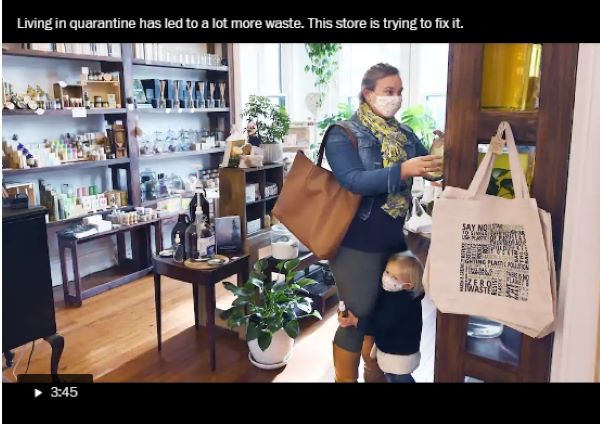
By The Washington Post · Jessica Wolfrom

Justin and Anna Marino’s journey to a zero-waste lifestyle began over pork sausages in Germany.

Anna, who had been looking into the health benefits of a vegan diet, told her husband that when they returned home from vacation, meat would be officially off the menu.

But eschewing animal products was just the beginning. Soon after, their attention turned to trash.

“It was kind of like a slow-moving coup on my part,” said Anna, 32, a former seller on the website Etsy, who started researching the meat industry and the zero-waste movement. Even though they were only a family of four – the couple have two children, ages 6 and 3 – they knew they needed to change their lives.

Paper towels and single-use napkins were the first to go. Then went the plastic. “We were generating about one or two tall kitchen trash bags full of garbage per week,” said Justin. “We would take it out to the curb and, you know, out of sight, out of mind, right? You don’t think about it. But then when you start thinking about it, that’s when things start changing.”

But as they traded traditional products for more eco-friendly items, they quickly realized that their reliance on online shopping was another problem.

“It almost defeats the purpose,” said Justin, 43, who previously worked in cybersecurity. “I’m ordering something to save the planet, but in order for it to get here, it’s creating a pretty nasty carbon footprint. . . . And so, we were like, well, there needs to be a store around here.”

Enter Mason & Greens, the Washington D.C. region’s first zero-waste store. The couple flung open the shop’s French doors in Old Town Alexandria, Va., in March, just as the coronavirus was exploding across the country.

The airy shop is equal parts organic grocer and minimalist boutique, selling items such as package-free shampoo bars, organic produce and drip-irrigated olive oil. Hanging plants and shelves lined with stainless steel containers and books titled “All You Need Is Less” offer shoppers a glimpse into the world of low-waste living.

Glass travel coffee mugs are among the many reusable items at Mason & Greens. MUST CREDIT: Washington Post photo by Matt McClain

Glass travel coffee mugs are among the many reusable items at Mason & Greens. MUST CREDIT: Washington Post photo by Matt McClain

Although the zero-waste movement, which looks to minimize garbage through reducing consumption, reusing materials and recycling residual waste, has been around for decades, it’s finding new prominence as concern about the environmental impact of trash – particularly plastic pollution – continues to grow.

“You know it’s a movement when you don’t know everything that’s going on,” said Gary Liss, vice president of Zero Waste USA, a nonprofit organization dedicated to reducing waste, who described the growing interest in low-waste living as a sea change in the relationship between people and things.

Americans throw away about five pounds of trash per person per day, according to the Environmental Protection Agency – 12 percent of which is plastics.

Although plastics have greatly enhanced daily life – extending the shelf life of food and improving medical care – they’ve grown ubiquitous, used to make products such as clothes as well as cars.

Some plastics are recyclable, but scientists estimate that up to 91 percent of plastic is never recycled, leaving the rest to burn in incinerators, clog landfills or degrade in the oceans. Scientists have even found microplastics in air, water and food.

“If we fail to act, by 2050, there will be more plastics in our oceans than fish,” said Sander Defruyt, who leads the New Plastics Economy initiative at the Ellen MacArthur Foundation, referencing a 2016 report.

The coronavirus pandemic has only increased reliance on disposable plastics. Billions of masks and gloves made from plastics and used by health-care workers, first responders and essential workers are being discarded every month, studies show.

Some retailers have been requiring customers to use plastic bags instead of reusable bags and have replaced bulk offerings with individually packaged goods. Multiple states rolled back bans on plastic bags to cope with heightened concerns around hygiene – all while greasy takeout containers, single-use shopping bags and packaging materials overflow trash bins across the country.

The plastics industry maintains that plastics in respirator valves, personal protective equipment, vaccine syringes and food packaging have been critical during the pandemic.

“Society has a plastic waste problem, not a plastic problem,” Joshua Baca, vice president of plastics for the American Chemistry Council, said in a statement.

As scientists have learned more about covid-19, the disease caused by the coronavirus, they’ve found that transmission is largely person-to-person and not through surfaces, although some studies found that the virus can live for prolonged periods on plastic surfaces.

“We’re conditioned that plastic is clean and that plastic is what everyone needs to use to make things sanitary,” said Justin, who expressed concern about the potential health effects of chemicals in plastics as they degrade.

“Ultimately, I think that the sort of paradox here is that these things that we think are sanitary and clean may possibly be leaching chemicals into the products that we consume . . . and then passing that load of chemicals when you’re done onto the planet,” he said.

Mason & Greens, which is based in part on the bulk model, makes a point of avoiding plastics at nearly every turn. Beans and grains come in gravity dispensers. Produce is package-free. Pomberry Kombucha and pinot noir stream from a tap. The spices are self-serve.

Customers aren’t required to bring their own bags or refillable containers, but the couple said many customers do. The shop employs a tare system that logs the weight of an empty container and then calculates the price of products by the ounce.

Bulk containers of dish soap and other items are displayed at Mason & Greens. MUST CREDIT: Washington Post photo by Matt McClain

Bulk containers of dish soap and other items are displayed at Mason & Greens. MUST CREDIT: Washington Post photo by Matt McClain

Pricing products this way reduces waste by allowing customers to purchase only what they need and in reusable containers, the couple said.

The couple welcomes newcomers into their waste-free world, but Anna routinely castigates vendors for their packaging practices – she is not above shaming suppliers who send items wrapped in plastic. “Everybody gets an email,” she said. “I have to go through so much to get a product into the store that’s zero-waste or low-waste.”

But living a waste-free life might soon become easier. As consumers demand more sustainable options, brands large and small are shifting to make sustainability central to their strategy. Major companies such as Unilever have pledged to halve the use of virgin plastics in packaging by 2025. Walmart, Target, CVS and other retailers are working to develop an environmentally friendly alternative to the plastic bag. And other companies are starting circular delivery services – an updated version of the 1950s milkman – where groceries and goods are packaged in reusable containers that are returned empty.

Max Cameron’s California-based zero-waste shop, Wild Minimalist, grew exponentially in April and May as customers stockpiled eco-friendly cleaning products and reusable food storage containers.

Business was brisk because the pandemic accelerated the e-commerce model, upon which Wild Minimalist depends, although Cameron also has a brick-and-mortar store in San Rafael. Millennials, who now wield hefty purchasing power, are acutely aware of the climate crisis – and that combination has made them Wild Minimalist customers, Cameron said.

“The change that we expected to see take place over a period of five years has happened in a period of three months,” he said of the pandemic’s effect on his business. “We’re basically riding that wave right now.”

Although Cameron acknowledges that shipping products all over the nation has environmental costs, he said the shop uses only recyclable or compostable packaging and tries to reuse shipping materials whenever possible.

In an ideal world, he said, “you want to see people bicycling to their zero-waste store every time they need something. . . . On the other hand, we’re in this economic climate right now where traditional retail is not where it’s at.”

Despite the challenges of brick and mortar right now, Mason & Greens is also growing. The Marinos opened their shop just days before Gov. Ralph Northam, D, issued Virginia’s first stay-at-home order, forcing them to lean on online shopping more than they had planned.

Business has been extraordinary, they said. The store opened for in-person shopping in June and has been “in the black” since they started, Justin said. The couple plans to open a second location, in D.C., sometime next year.

Mason & Greens owners Justin and Anna Marino at their store in Alexandria, Va. MUST CREDIT: Washington Post photo by Matt McClain

Mason & Greens owners Justin and Anna Marino at their store in Alexandria, Va. MUST CREDIT: Washington Post photo by Matt McClain

For customers who previously had to hopscotch among farmers markets, grocery stores and retailers to reduce their waste, Mason & Greens offers one-stop shopping.

“For me, living our values frees my mind,” said Daniela Ochoa González, 39, a D.C. resident and founder of an environmental consulting firm who is teaching her school-age children to live zero-waste lifestyles.

González said the shop’s bulk shopping model encourages her kids to touch, smell and explore. “It’s like a little school lab,” she said. “They can actually see what a grain looks like, quinoa looks like, what flour looks like.”

While bloggers Bea Johnson, the author of “Zero Waste Home,” and Lauren Singer, who famously fit all the waste she produced over four years into a 16-ounce Mason jar, have attracted devotees, adhering to a trash-free lifestyle can feel impossible.

“Basically, it’s unreasonable,” Cameron said. “It’s not true, first of all. There’s always upstream waste.”

The movement can also feel inaccessible to those without disposable income. González acknowledges that zero-waste shopping can cost more, but she sees it as an investment in her children’s future.

Although the Marinos say a Ziploc bag or plastic toothbrush may always be cheaper than their stainless-steel or bamboo alternatives, they view the benefits of reusable products as far outweighing the cost – and in the long run, they say, reusable products may even be less expensive because customers won’t have to replace items as frequently.

“We don’t sell products that will be trash in a week,” Anna said.

Even still, accessibility was important to the Marinos, who say their prices are competitive with those of major retailers. “You cannot make any progress with environmental issues if it’s not economical,” Justin said.

The Marinos hope Mason & Greens will have a ripple effect beyond its walls. Today, they estimate they fill a single trash bag about once every two weeks – which is pretty good, said Anna, if you consider they have seven employees and are open seven days a week.

“I think what we’re doing here in Old Town is that we’re actually opening up people to this new way of life,” said Anna, who hopes their shop can inspire others to do more good with less.

China’s soybean deal signals early jump into 2021 U.S. market #SootinClaimon.Com

#SootinClaimon.Com : ขอบคุณแหล่งข้อมูล : หนังสือพิมพ์ The Nation.

China’s soybean deal signals early jump into 2021 U.S. market (nationthailand.com)

China’s soybean deal signals early jump into 2021 U.S. market

InternationalDec 11. 2020Sacks of soybeans sit in a wholesale grains market in Shanghai on June 16, 2020. MUST CREDIT: Bloomberg photo by Qilai Shen.Sacks of soybeans sit in a wholesale grains market in Shanghai on June 16, 2020. MUST CREDIT: Bloomberg photo by Qilai Shen. 

By Syndication Washington Post, Bloomberg · Michael Hirtzer, Kim Chipman

China, the world’s top soybean importer, is getting an early jump on purchases from the U.S. for next year.

The Asian nation bought 126,000 metric tons for shipping after Sept. 1, the start of the next marketing year, U.S. Department of Agriculture data showed Thursday. That’s the earliest for a forward purchase since 2016 and confirms a Bloomberg report from Dec. 7.

Dry weather has threatened yield prospects in South America, potentially limiting available supplies from the harvest beginning in February. That may have prompted the earlier-than-usual deal for U.S. soybeans that won’t be planted until April. China’s imports rose to a record in November from a year earlier on demand for feed to bolster the domestic hog herd.

Soybean futures for March delivery rose 1.3% to $11.7825 a bushel at 10:03 a.m. on the Chicago Board of Trade after reaching $11.81, the highest for a most-active contract in more than a week. A monthly USDA report due at 11 a.m. may show tightening global inventory, according to a Bloomberg survey of analysts.

On Thursday, Brazil’s soybean-crop estimate was reduced by 0.4% to 134.5 million tons by state-run agriculture agency Conab. That was less than analysts expected and compared with 124.8 million in the latest season.

“The South American crop we already know will be a late crop, so China stepping into the market early shouldn’t be at all surprising.” Kevin Ross, chairman of the National Corn Growers Association and an Iowa farmer of soybeans, corn and cattle, said in a telephone interview. “They are covering their needs a little quicker.”

Wheat futures for March delivery rose 2.6% to $5.9825 a bushel in Chicago after reaching $5.99, the highest since Nov. 30.

USDA data confirmed a bulk cargo of U.S. white wheat was sold to China, and futures have climbed amid speculation that more deals loom.

U.S. crackdown on Facebook gets thumbs up from EU’s Vestager #SootinClaimon.Com

#SootinClaimon.Com : ขอบคุณแหล่งข้อมูล : หนังสือพิมพ์ The Nation.

U.S. crackdown on Facebook gets thumbs up from EU’s Vestager (nationthailand.com)

U.S. crackdown on Facebook gets thumbs up from EU’s Vestager

InternationalDec 11. 2020Margrethe Vestager, competition commissioner of the European Commission, during an interview in her office in Brussels on Feb. 25, 2020. MUST CREDIT: Bloomberg photo by Geert Vanden Wijngaert.Margrethe Vestager, competition commissioner of the European Commission, during an interview in her office in Brussels on Feb. 25, 2020. MUST CREDIT: Bloomberg photo by Geert Vanden Wijngaert. 

By Syndication Washington Post, Bloomberg · Aoife White

Margrethe Vestager, the European Union’s antitrust chief and scourge of tech giants, gave her seal of approval to U.S. antitrust action against Facebook Inc.

She told lawmakers in Brussels that the U.S. lawsuit shows how technology superpowers are increasingly facing tougher scrutiny around the world. Minutes after she spoke Thursday, German regulators started a fresh antitrust probe into Facebook’s Oculus virtual-reality headsets.

“It’s a sign that the debate on tech dominance has been shifting over the last couple of years,” Vestager said of the U.S. antitrust move in an online meeting with EU lawmakers. “You see that in almost every jurisdiction. You see it in Canada and Australia” as well as the recent U.S. case against Google.

The U.K. Competition and Markets Authority this week even proposed a specialist tech regulator with enhanced power to block deals.

European regulators are planning tougher rules on so-called internet gatekeepers next week that “will enable us to be so much quicker” in moving against companies that violate potential new rules for how they treat smaller rivals, she said.

Vestager, who has slapped Alphabet Inc.’s Google with huge fines, said the complaints filed by the U.S. Federal Trade Commission and state attorneys general took a different approach from the EU. She said her probes into advertising are “not as advanced.”

Germany’s antitrust authority, known as the Bundeskartellamt, opened an investigation Thursday into Facebook because using Oculus’ latest virtual-reality Quest 2 glasses requires a Facebook account. Oculus was previously operated separately from Facebook, it said, and existing Oculus accounts can no longer be used for the new hardware.

“We intend to examine whether and to what extent this tying arrangement will affect competition,” the authority’s president Andreas Mundt said in an emailed press release.

Oculus devices are not currently sold in Germany, a Facebook spokesperson said. The company “will cooperate fully with the Bundeskartellamt and are confident we can demonstrate there is no basis to the investigation.”