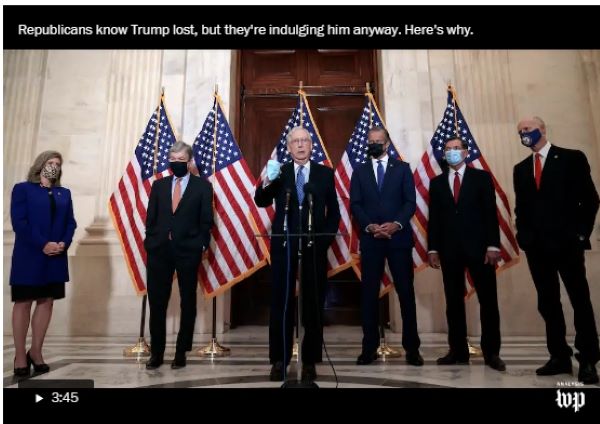
Detroit had more vote errors in 2016 when Trump won Michigan by a narrow margin. He didn’t object then. #SootinClaimon.Com

#SootinClaimon.Com : ขอบคุณแหล่งข้อมูล : หนังสือพิมพ์ The Nation.

Detroit had more vote errors in 2016 when Trump won Michigan by a narrow margin. He didn’t object then. (nationthailand.com)

Detroit had more vote errors in 2016 when Trump won Michigan by a narrow margin. He didn’t object then.

InternationalNov 24. 2020Election workers processes absentee ballots Nov. 4 at the TFC Center in Detroit. MUST CREDIT: Washington Post photo by Salwan GeorgesElection workers processes absentee ballots Nov. 4 at the TFC Center in Detroit. MUST CREDIT: Washington Post photo by Salwan Georges 

By The Washington Post · Kayla Ruble · NATIONAL, POLITICS, WHITEHOUSE

DETROIT – Republican Party leaders who are urging Michigan’s state canvassing board to hold off certifying the Nov. 3 election results when it meets Monday have cited what they described as “significant problems and irregularities” in Wayne County, home of Detroit.

The GOP officials have pointed to the number of “unbalanced” precincts, where there were small discrepancies between the number of ballots cast and the number of voters logged by election workers in the poll books. Party officials are calling on the board to conduct an audit before it certifies President-elect Joe Biden’s victory in the state.

“To simply gloss over those irregularities now without a thorough audit would only foster feelings of distrust among Michigan’s electorate,” Republican National Committee Chairwoman Ronna McDaniel and state GOP Chair Laura Cox wrote in a letter Saturday.

But state and county election data show that four years ago – when Donald Trump carried the state by a much narrower margin – twice as many Detroit precincts were out of balance.

At the time, the problems were widely condemned by Democratic leaders, including Garlin Gilchrist, now the state’s lieutenant governor, who called the city’s handling of the election “a complete catastrophe.”

But neither Trump nor the Republican Party questioned the validity of the election results – or demanded an audit to verify the vote tally.

In the fall of 2016, 392 Detroit precincts, or 59% of the total, had discrepancies of at least one ballot, accounting for at least 916 votes, the data show.

This fall, 179 Detroit precincts, or 28% of the total, had discrepancies of at least one ballot, accounting for at least 433 votes.

Democrats say that the GOP’s focus now on Detroit’s voting errors is simply an effort to undermine Biden’s victory.

“All of this ruckus that they’re raising, none of these issues are in a worse state than they were in 2016 when Hillary Clinton lost by a much smaller margin,” said Jonathan Kinloch, a Democratic member of the Wayne County Board of Canvassers.

“From Day 1, it has been their intention to try to discredit and try to remove the Black vote from this election,” Kinloch added. “They know that removing the Black vote in this election would change the outcome.”

President Trump attacked the voting process in key states around the country as corrupt and rigged in an unprecedented attempt to overturn the results.

He and his legal advisers have fixated on the predominantly Black city of Detroit, where 94% of the roughly 250,000 votes went for Biden. “It changes the result of the election in Michigan if you take out Wayne County,” Rudolph Giuliani, Trump’s personal attorney, said last week at a news conference in Washington.

GOP consultant Stu Sandler, who serves as legal counsel to the Michigan state Republican Party, acknowledged that Republicans did not request an audit in 2016. But he said what is at issue is not whether the GOP complained in the past, but chronic issues with the management of Detroit’s elections.

“There is no clear evidence that things have improved,” Sandler said.

Out-of-balance precincts can occur for several reasons. A machine may fail to scan the name of a voter on an absentee ballot envelope. A voter can make a mistake on a ballot and request a new one, or sign into the poll book but leave before casting a ballot.

After the high number of Detroit precincts that were out of balance in 2016, then-Republican Secretary of State Ruth Johnson and her Bureau of Elections conducted a post-election audit in the city of Detroit. The bureau concluded that almost half of the out-of-balance precincts could have been rectified if staff had taken prompt actions to address the imbalanced numbers on election night, or if the county canvassing board had been given more time to dig into the problems and reconcile the differences.

“[The Bureau of Elections] found no evidence of pervasive voter fraud, yet an abundance of human errors,” the bureau said in a 2017 report.

At the time, local officials, including Detroit Mayor Mike Duggan, D, acknowledged the need for improvements.

“We can’t have that happen again,” Duggan told the Detroit News at the time. “Everybody in the city knows it was terrible, and the good news was Michigan didn’t decide the national election because it would have shown a real spotlight.”

Trump, however, did not note the issue when he celebrated his win in the state.

“The Great State of Michigan was just certified as a Trump WIN giving all of our MAKE AMERICA GREAT AGAIN supporters another victory,” he tweeted in late November 2016.

The Trump campaign did not respond to a request for comment about why he did not object to the vote certification at the time.

In the run-up to this fall’s election, Wayne County officials vowed to reduce the number of errors. After Election Day, county Elections Director Gregory Mahar said that the number of votes that did not match the poll books amounted to 0.001% of the roughly 250,000 ballots cast in Detroit.

“Our canvassers really did a heck of a job,” Mahar said as he addressed the Wayne County Board of Canvassers meeting last week.

State officials agreed that the city’s error rate had improved.

“A review of data from the November 2020 Wayne County Canvass showed a substantial improvement in the percentage of [Detroit] precincts that were in balance and recountable as compared both to the August 2020 Primary and the November 2016 General Election,” the Michigan Bureau of Elections wrote in a memo on Friday.

However, Republican officials have continued to press the issue, focusing on an even narrower category: the percentage of unbalanced absentee counting boards – jurisdictions set up by the city election commission to count absentee ballots separately from Election Day precincts.

This month, 94 of those boards – 70% of the total – could not reconcile their numbers, affecting at least 263 votes. That is a similar rate found during the August primary, when 363 absentee counting boards – about 72% of the total – were unbalanced, affecting at least 914 votes.

The number of errors in the August primary drew bipartisan condemnation from state officials. “I find this whole thing appalling,” Julie Matuzak, a Democratic member of the state canvassing board said at a meeting after the primary.

Republican Senate candidate John James, who lost his challenge to Sen. Gary Peters, D, by more than 95,000 votes, cited the error rate at absentee counting boards in a letter he sent to the state board of canvassers last week requesting that they hold off certifying the vote for two weeks to conduct an audit.

“A 30% accuracy rate in any industry, whether its business, education, healthcare or manufacturing scores as failure,” James wrote. “While I don’t doubt that many of our poll workers and volunteers worked hard, we need to do better for our elections.”

Charles Spies, an attorney for the James campaign, said the absentee ballot board figures show Wayne County has not improved since August. He acknowledged, however, that the audit James is seeking will likely not change the results of either the Senate or presidential race. “That’s very unlikely,” he said.

Former Michigan GOP chair Jeff Timmer, who previously served as a member of the state canvassing board, said Republicans are failing to give an accurate picture of the election process – and Wayne County’s progress since 2016.

“They’re cherry picking and feeding into a public relations narrative, not exercising any analysis or judgment related to the conduct of elections,” said Timmer, who now serves as an adviser to the anti-Trump group the Lincoln Project.

Kinloch said the GOP is trying to “drive a false narrative that could jeopardize citizens’ faith in our elections.”

“They will not win in the end. Whether this election is certified on time or not, I know for sure that it will be certified,” he added. “We are a country of laws and we’re governed by them, whether we like it or not, whether we win or whether we lose.”

What the coronavirus successes of Taiwan and Iceland have in common #SootinClaimon.Com

#SootinClaimon.Com : ขอบคุณแหล่งข้อมูล : หนังสือพิมพ์ The Nation.

What the coronavirus successes of Taiwan and Iceland have in common (nationthailand.com)

What the coronavirus successes of Taiwan and Iceland have in common

InternationalNov 23. 2020

By Linda Hsieh and John Child
The Jakarta Post

Taiwan and Iceland have won praise for their effective responses to the coronavirus pandemic. They are among a group of countries that adopted a cooperative strategy early on in the pandemic, bringing together multiple organizations to tackle the challenges in containing COVID-19.

A cooperative strategy is when organizations try to achieve their goals through cooperation with other organizations. Our own recent synthesis of research explains the attraction of this approach. It can allow public authorities or companies to speed up their response to new challenges by partnering with other organizations that have complementary resources and expertise.

While other countries, including South Korea and Germany, have deployed a cooperative approach, it’s been a key part of both Taiwan and Iceland’s response to the pandemic.

Taiwan’s handling of COVID-19 has been exemplary. As of June 29, Taiwan, with a population of 23.8 million, had recorded only seven deaths linked to the virus, with 447 confirmed cases – 435 of which had fully recovered.

The Taiwanese government acted quickly to control its borders. It activated a Central Epidemic Command Centre (CECC) on Jan. 20 to coordinate cooperation across different government ministries and agencies, and between government and businesses. The CECC also coordinates big data analytics, testing, quarantine and contact tracing.

Taiwan’s National Health Insurance Administration and National Immigration Agency worked together to identify suspected cases for COVID-19 testing, integrating their databases of citizens’ medical and travel history. Since late March, all new arrivals have had to quarantine for 14 days.

The CECC also partnered with police agencies, local officials and telecom companies to enforce quarantine with the support of mobile phone tracking. Local officials would call quarantined citizens to ask about their health and bring them basic daily supplies if required. Along with a 24-hour helpline, Taiwan’s Center for Disease Control collaborated with two tech companies – HTC and LINE – to create a chatbot that allowed people to report their health status and get advice about the virus.

Taiwan can now test about 5,800 samples a day through a cooperative network of public and private testing centers and certified laboratories.

To avoid the panic buying of face masks, the government rationed their distribution and ramped up production. In February, the government partnered with the Machine Tool & Accessory Builders’ Association and manufacturers, investing in new machinery to produce surgical face masks. In return, manufacturers have to sell the masks back to the government at an agreed price.

This effective government-led cooperative strategy resulted in the establishment of 60 production lines in 25 days, something that would normally have taken several months. More production lines have been added, and Taiwan can now produce about 20 million masks a day.

The public can interact with the government on vTaiwan, a virtual democracy platform for open discussion to build consensus on policy solutions. A face mask map app grew out of a suggestion on vTaiwan and now provides real-time information on stock availability. The app was developed through collaboration between the Digital Ministry and a group of entrepreneurs and hacktivists.

Iceland provides another example of a country that used a cooperative strategy to manage the pandemic. As of June 29, Iceland had recorded 10 deaths and 1,838 confirmed COVID-19 infections, of which 1,816 had fully recovered. Its success can be explained by the government’s quick action in activating the National Crisis Coordination Center on Jan. 31 to coordinate the country’s response to COVID-19 through mass testing, quarantine and tracing close contacts of infected citizens.

A public-private partnership between the National University Hospital of Iceland and deCODE Genetics enabled Iceland to carry out aggressive testing from February.

Testing in Iceland was recorded by NUHI (National University Hospital of Iceland, The Department of Microbiology) and private firm deCODE Genetics.  

Similar to Taiwan, cooperation and coordination between Iceland’s government ministries and agencies have played a key role in quarantine and contact tracing.

The Directorate of Health worked with the Department of Civil Protection and Emergency Management to create a team of 60 contact tracers in February, drawn from police investigators and healthcare workers. In this collaboration, the police contributed their expertise in traditional detective methods and enforced quarantine rules.

These two departments also partnered with a group of companies to create the Rakning C-19 tracing app in consultation with Iceland’s Data Protection Authority.

The governments of both Taiwan and Iceland have secured high levels of public trust in their responses to coronavirus. In Taiwan, YouGov polls in May showed that public trust in the government and healthcare professionals on COVID-19 was very high – at over 80 percent. A combination of transparency and effectiveness may explain polling in April which suggested that 84% of Icelanders were willing to sacrifice some human rights if it helped to prevent the spread of the virus.

The example of these two countries shows how trust can be promoted by speedy government action to activate a crisis management and command center which is headed by medical experts rather than politicians. Its purpose should be to coordinate cooperation between government and business and to communicate transparently with the public. This fits with a general lesson from cooperative strategies: openness between all parties is crucial and is a foundation for collaborative trust.

———-

Linda Hsieh is a reader in Strategy and International Business, University of Birmingham

John Child is a professor of Commerce, University of Birmingham

This article is republished from The Conversation under a Creative Commons license. Read the original article here.

Chris Christie calls the conduct of Trump’s legal team a ‘national embarrassment’ #SootinClaimon.Com

#SootinClaimon.Com : ขอบคุณแหล่งข้อมูล : หนังสือพิมพ์ The Nation.

Chris Christie calls the conduct of Trump’s legal team a ‘national embarrassment’ (nationthailand.com)

Chris Christie calls the conduct of Trump’s legal team a ‘national embarrassment’

InternationalNov 23. 2020Former New York City mayor Rudy Giuliani, center, and former New Jersey governor Chris Christie, left, listen as President Donald Trump speaks during a news briefing Sept. 27 at the White House. MUST CREDIT: Washington Post photo by Salwan GeorgesFormer New York City mayor Rudy Giuliani, center, and former New Jersey governor Chris Christie, left, listen as President Donald Trump speaks during a news briefing Sept. 27 at the White House. MUST CREDIT: Washington Post photo by Salwan Georges 
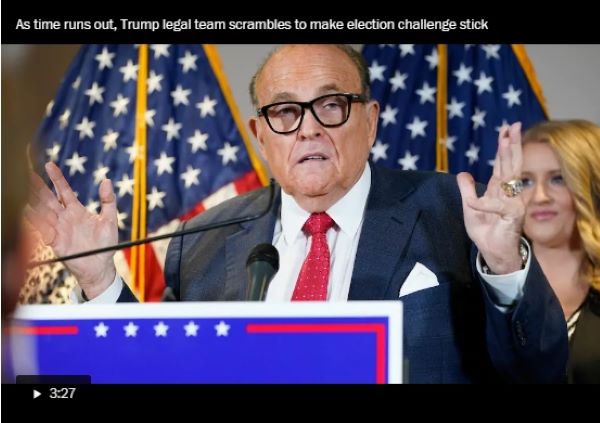
By The Washington Post · Paul Kane, Felicia Sonmez · NATIONAL, POLITICS, CONGRESS

WASHINGTON – Several prominent Republicans said President Donald Trump’s legal arguments had run their course, and called on him to allow the presidential transition process to begin.

https://www.washingtonpost.com/video/c/embed/e9bcd5ae-0bce-41f6-b2eb-3af067d0e5bf?ptvads=block&playthrough=false

Chris Christie, a Trump confidant who helped prepare the president for the debates, called the conduct of Trump’s legal team a “national embarrassment.” Sen. Pat Toomey, R-Pa., said Trump had “exhausted all plausible legal options,” and urged him to concede. Sen. Kevin Cramer, R-N.D., said it’s time to begin the transition.

The comments are the latest signs of dissent from within the president’s party, with increasingly more Republicans urging Trump to accept the results of the election and move on.

And they come as President-elect Joe Biden moved forward with his selection of key members of his administration, with incoming chief of staff Ronald Klain saying Biden’s first Cabinet picks will be revealed Tuesday.

https://www.washingtonpost.com/video/c/embed/5b2c19c0-b2fb-4e1c-83ee-b2616651e830?ptvads=block&playthrough=false

Klain and other Biden transition team members declined to say which positions will be announced.”If you want to know what Cabinet agencies they are and who’s going to be in those Cabinet agencies, you’ll have to wait for the president-elect to say that himself,” he said Sunday morning.

In an interview on ABC News’s “This Week,” Christie said the president should give up his legal strategy. “Elections have consequences, and we cannot continue to act as if something happened here that didn’t happen,” he said.

“The conduct of the president’s legal team has been a national embarrassment,” Christie added, noting that Trump’s lawyers have made a flurry of fraud allegations but have offered no evidence to back them up in court.

Christie criticized Trump’s lawyers for proffering false conspiracy theories at news conferences and other media appearances.

“They don’t do it in the courtroom,” the 2016 Republican presidential candidate said, suggesting that attorneys are fearful of making baseless arguments under oath before federal judges.

“It must mean the evidence doesn’t exist,” Christie said.

Christie said the Republican Party should focus on trying to win Georgia’s two runoff elections Jan. 5 to secure the Senate majority, rather than continuing with its unsuccessful legal challenges of the presidential election results.

“The rearview mirror should be ripped off,” Christie said.

Late Saturday night, after a federal judge threw out Trump’s legal attempt to invalidate millions of votes, Toomey congratulated Biden and Vice President-elect Kamala Harris on their victory and encouraged the president to accept that result.

“President Trump has exhausted all plausible legal options to challenge the result of the presidential race in Pennsylvania,” Toomey said in a statement, noting that the deciding judge, Matthew Brann, is a “longtime conservative Republican.”

This result, Toomey noted, followed Georgia’s certification Friday of Biden’s victory there and Michigan’s GOP legislative leaders rejecting efforts to block the certification of Biden’s clear victory in that state.

“I congratulate President-elect Biden and Vice President-elect Kamala Harris on their victory. They are both dedicated public servants and I will be praying for them and for our country,” Toomey said.

Senate Republicans have by and large avoided commenting on Trump’s actions, with more than 40 not responding to requests for comment Thursday and Friday about the president’s effort to have Michigan legislators reject the Biden victory there of more than 150,000 votes.

Republicans are aware that any perceived lack of loyalty to the president could prompt him to attack the defectors – just as Trump did Saturday night when he called Brann a “product of Senator Pat ‘No Tarriffs’ Toomey.”

“No friend of mine,” Trump tweeted.

Even some Trump backers who support pushing ahead with legal challenges said that Biden probably will take office and that the General Services Administration should allow the Democratic transition team access to the federal agencies and key briefings, as well as office space and millions of dollars in funding, so the administration can begin work Jan. 20.

“I just think that you have to begin that process, give the incoming administration all the time they need,” Cramer said Sunday on NBC’s “Meet the Press.”

Cramer said that transition process should have begun at least a week ago. But he added that the transition could begin even as Trump’s legal team continued to press its cases in the states.

This is, Cramer said, “just a simple legal process.”

The president-elect, meanwhile, has gone ahead with assembling his administration.

Biden last week announced several senior White House staff appointments and told reporters that he has decided on his choice to lead the Treasury Department, though he did not reveal the person’s name. Among the top candidates for the post is Federal Reserve Governor Lael Brainard, who served as a senior Treasury Department official in the Obama administration.

Klain said the Biden transition was “beating, in fact, the pace that was set by the Obama-Biden transition, beating the pace set by the Trump transition.”

Klain also echoed Biden’s recent comment that Trump’s efforts to hinder the transition have put American lives at risk by making it harder for the Biden team to coordinate with the current administration on pandemic planning.

“The president-elect, the vice president-elect are not getting the kind of intelligence briefings they’re entitled to,” Klain said. “Our transition isn’t getting access to agency officials to develop our plans, so there’s a lot of focus on that vaccine rollout plan that’s going to be critical in the early days of a Biden presidency. We have no access to that.”

Trump, meanwhile, is refusing to concede the election and continues to make false accusations of widespread voter fraud.

The president and his campaign legal team have largely failed in their efforts to challenge the election in the courts. Trump weighed in on the Pennsylvania decision in a Sunday morning tweet shortly before he arrived at his golf club in Sterling, Va., for the second day in a row.

“Other than politics, how do you lose a case where large numbers of voters, far more than you need to flip Pennsylvania, are disenfranchised? Vote Observers thrown out of counting rooms,” he tweeted, even though his campaign’s attorneys have acknowledged that Republican observers were granted access to polling locations.

Trump and some of his defenders have argued that Democrats sought to delegitimize his 2016 election by investigating his business interests and his campaign’s ties to Russia and voting to impeach him last year. Trump was later acquitted by the Senate.

Kate Bedingfield, Biden’s deputy campaign manager, on Sunday pushed back against that comparison, calling it “absurd” and “an apples-and-oranges comparison at best.”

“I don’t think that when a president gets elected that he is no longer held accountable as he moves through his administration,” Bedingfield said on “Fox News Sunday.” “I think that’s an incredibly different thing.”

Trump’s efforts to “overturn the will of the American people” will fail, she added, “because, again, Joe Biden overwhelmingly won this election – 306 electoral college votes.”

“The American people voted for Joe Biden to be sworn in on January 20, 2021, and he will be,” she said.

The president also on Sunday lashed out at Maryland Gov. Larry Hogan, a Republican who said earlier in an appearance on CNN’s “State of the Union” that he was “embarrassed that more people in the party aren’t speaking up” against Trump.

“Well, I just don’t think there are a lot of profiles in courage, frankly,” Hogan said. “I mean, we all know how vindictive the president can be, how powerful his Twitter account is, and how he can really pressure Republicans and go after them. Very few of us are willing to stand up.”

Soon after, Trump shared a link to a report on how Hogan spent $9.46 million on coronavirus tests from South Korea that turned out to be flawed. “This RINO will never make the grade,” the president tweeted. “Hogan is just as bad as the flawed tests he paid big money for!”

Later Sunday afternoon, Hogan took to the president’s favorite medium to return fire.

“If you had done your job, America’s governors wouldn’t have been forced to fend for themselves to find tests in the middle of a pandemic, as we successfully did in Maryland,” he tweeted at Trump. “Stop golfing and concede.”

Trump tries to nullify votes in Wisconsin recount #SootinClaimon.Com

#SootinClaimon.Com : ขอบคุณแหล่งข้อมูล : หนังสือพิมพ์ The Nation.

Trump tries to nullify votes in Wisconsin recount (nationthailand.com)

Trump tries to nullify votes in Wisconsin recount

InternationalNov 23. 2020Election worker Marion Fields, 86, sorts ballots on the first day of the recount in Milwaukee County on Friday. MUST CREDIT: Photo for The Washington Post by Taylor GlascockElection worker Marion Fields, 86, sorts ballots on the first day of the recount in Milwaukee County on Friday. MUST CREDIT: Photo for The Washington Post by Taylor Glascock 
By The Washington Post · Rosalind S. Helderman, Dan Simmons · NATIONAL, POLITICS

President Donald Trump’s campaign is seeking to use a recount of the presidential election in Wisconsin to attempt to invalidate tens of thousands of votes in the state, making sweeping challenges to whole categories of ballots cast in the state’s two Democratic-leaning counties in his last-gasp effort to reverse President-elect Joe Biden’s win.

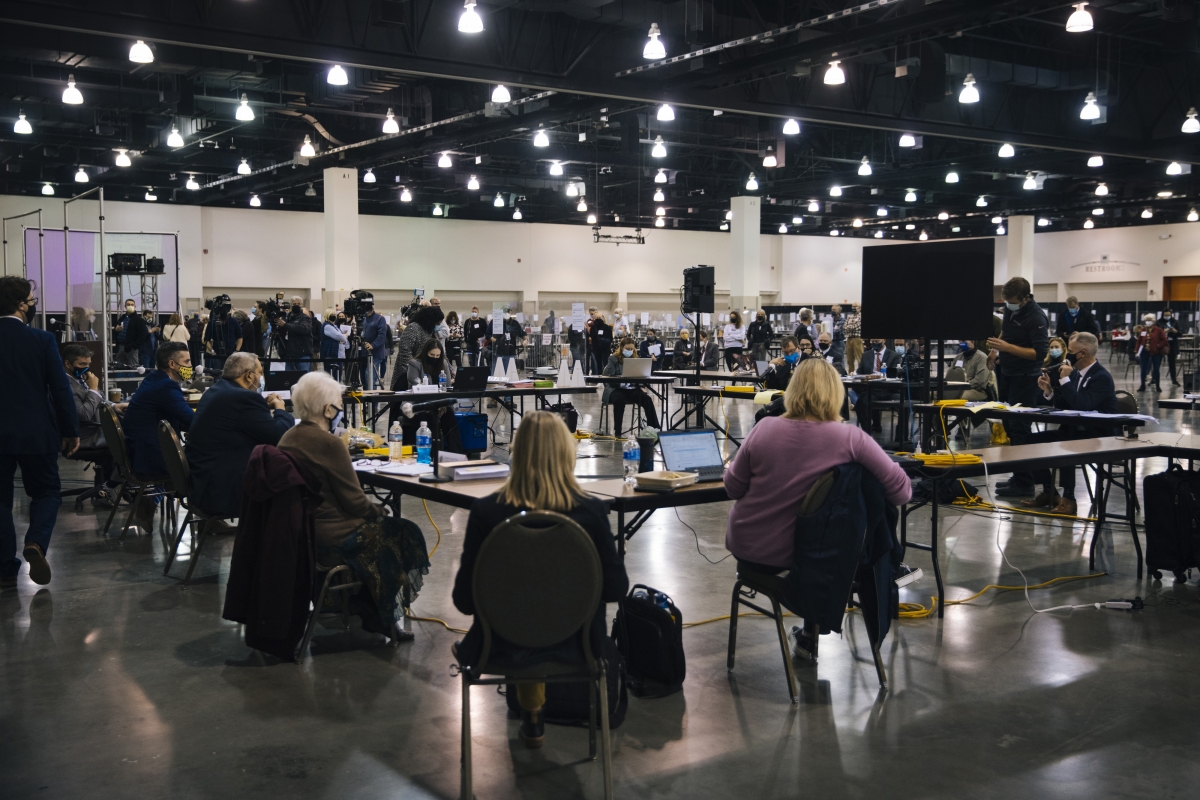
Counting at the Wisconsin Center in Milwaukee was temporarily put on hold Friday after objections from President Donald Trump's team about the distance of legal observers. MUST CREDIT: Photo for The Washington Post by Taylor Glascock
Counting at the Wisconsin Center in Milwaukee was temporarily put on hold Friday after objections from President Donald Trump’s team about the distance of legal observers. MUST CREDIT: Photo for The Washington Post by Taylor Glascock
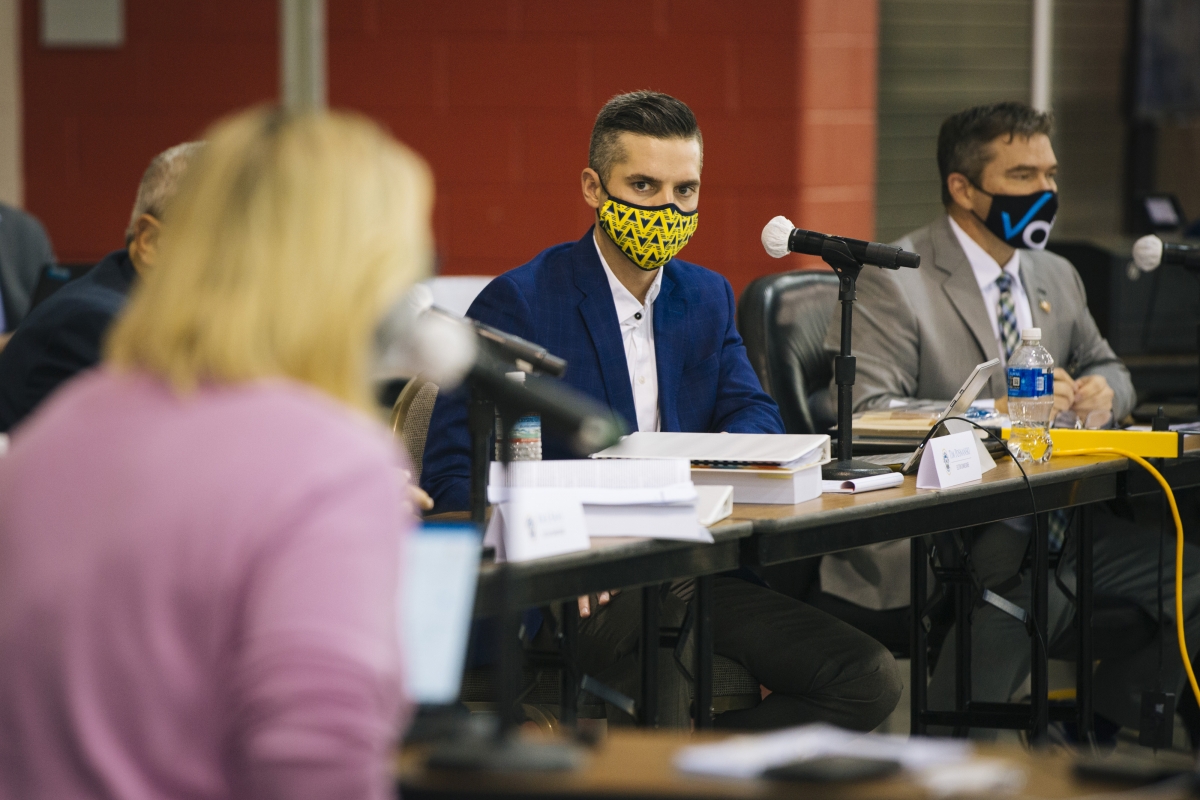
As a recount began on Friday in Dane and Milwaukee counties – home to the cities of Madison and Milwaukee – Trump lawyers argued that officials should not merely retabulate all the votes cast in the Nov. 3 election to reconfirm they’d been counted properly.

Instead, they argued that large batches of ballots had been improperly accepted and counted in the first place. In both Dane and Milwaukee, they sought to disqualify all absentee ballots that had been cast before Election Day in person, rather than by mail.

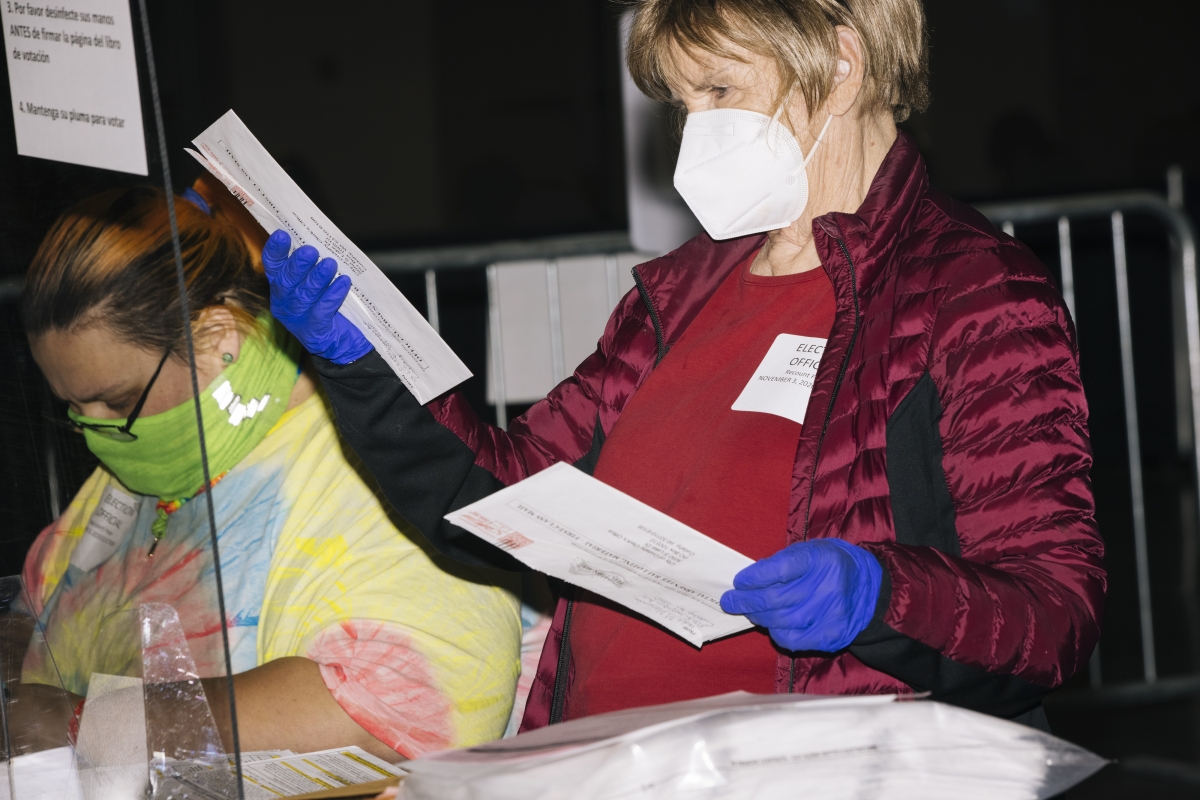
Election workers in Milwaukee examine ballots on Friday. MUST CREDIT: Photo for The Washington Post by Taylor Glascock

Election workers in Milwaukee examine ballots on Friday. MUST CREDIT: Photo for The Washington Post by Taylor Glascock

So far, their efforts have been rejected by the Democratic-majority boards of canvasses in both counties, which have denied attempts to set aside large categories of ballots and instead proceeded to a slow-moving process to retabulate all the votes.

The recount must conclude no later than Dec. 1, when the election is scheduled to be certified. At that point, the president’s campaign could file a lawsuit over its rejected challenges – potentially delaying certification.

Milwaukee Election Commissioner Tim Posnanski, center, listens to a question during recount proceedings. MUST CREDIT: Photo for The Washington Post by Taylor Glascock

Milwaukee Election Commissioner Tim Posnanski, center, listens to a question during recount proceedings. MUST CREDIT: Photo for The Washington Post by Taylor Glascock

Trump’s aggressive posture in Wisconsin comes as his efforts to undo Biden’s national victory with false claims of widespread fraud have met with defeat after defeat, including in a ruling Saturday by a federal judge in Pennsylvania, who rejected the campaign’s efforts to stop that state from certifying its election results. The Trump campaign filed an appeal Sunday.

The president’s team is scrambling to try to head off other states from finalizing their vote tallies, filing a request late Saturday for another recount in Georgia and calling on Michigan’s state board of canvassing not to certify the vote when it meets Monday.

In Wisconsin, as in other states, Trump’s effort appears futile. The unofficial tally shows Biden defeated Trump there by about 20,600 votes – a margin unlikely to change substantially in an ordinary recount. In 2016, when Green Party candidate Jill Stein requested a more extensive statewide recount, it resulted in Trump widening his victory in Wisconsin by a mere 131 votes.

This year, Democrats said the Trump campaign appears to be using the recount process to cynically target urban voters, particularly in Milwaukee. At one point on Friday, some of the tables where Milwaukee city ballots were being processed inside the city’s convention center were surrounded by multiple Trump campaign observers – forcing the Milwaukee County board of canvassers to clarify that the campaigns could have just one representative per table.

Milwaukee County Executive David Crowley said in an interview last week that he believed the Trump campaign’s decision to target for a recount only two counties – including Milwaukee, which has a large Black population – was no coincidence.

“It looks like he’s looking to pretty much everything he can to disenfranchise voters of color,” said Crowley, the first African American elected to the county post.

In a statement, Trump campaign legal adviser Jenna Ellis said, “Every American deserves to know that our elections are conducted in a legal manner, no matter who they are or where they live. That’s our only goal: to ensure safe, secure, and fair elections. That’s what our Constitution requires.”

The recounts are taking place in vast convention halls in Madison and Milwaukee to provide more room for large numbers of election workers, observers and media to crowd together indoors for hours on end amid the pandemic.

The process began on Friday, as hundreds of workers raised their right hands, most of them covered in blue surgical gloves, and recited their oath.

Trump campaign lawyer Stewart Karge almost immediately accused the newly sworn-in Milwaukee election workers of starting to open and look at ballot applications before the board of canvassers authorized it. “I’m just telling you what I’ve been informed,” he said to the board, citing no evidence.

Twice, Trump supporters erupted in cheers as he spoke, prompting an angry response from the board’s only Republican member.

“Ladies and gentlemen, we need this to be an orderly process,” thundered Rick Baas, staring down a group of Trump observers. “We will not be those other states!”

Other GOP officials in the state have pushed back against the president’s sweeping claims of fraud in cities.

Trump tweeted on Wednesday that Biden had received in Milwaukee a “dump of 143,379 votes at 3:42AM, when they learned he was losing badly. This is unbelievable!”

In fact, the late-reported batch of ballots that broke for Biden were absentee ballots cast by mail or in person before Election Day that election officials had long said would not be counted until after the polls closed.

The Republican majority leader of the Wisconsin State Assembly, Jim Steineke, posted a message on Facebook on Nov. 4 that the early-morning report was “NOT a surprise.”

“Them being reported late is NOT an indication of fraud,” he added.

Steineke did not respond to requests for comment.

On Sunday, Republican Robin Vos, speaker of the Wisconsin State Assembly, defended Trump’s right to seek a recount but noted that Biden’s margin was a “lot to overcome.”

“I assume Joe Biden is going to win, because I think it’s very unlikely that we’re going to find 20,000 cases of fraud,” he told Madison’s WKOW television station.

The count in Milwaukee proceeded slowly Saturday as county officials complained that Trump campaign observers appeared to be trying to stall the process.

“The Trump campaign is continually revisiting issues the commission has ruled on,” County Clerk George Christenson told reporters.

Christenson also complained about the behavior of Trump campaign inspectors, who fanned out at about 150 ballot-processing tables across the vast convention hall.

“The observers are disruptive, asking question after question” of the workers sorting and processing the ballots, he said. “It needs to stop.”

Trump representatives countered that they were not able to see every ballot adequately from the mandated three-foot distance and through the plexiglass shields that had been erected as a precaution because of the coronavirus pandemic.

Michael Maistelman, a Wisconsin election lawyer who has worked with Democratic candidates, said he believed the Trump campaign was issuing “frivolous, irrational objections” in Milwaukee to drag out the process.

Despite the president’s drumbeat of fraud claims, the Trump campaign has not alleged fraud was committed in Wisconsin.

Instead, the campaign has argued that election clerks statewide have adopted practices in soliciting and accepting absentee ballots that violate state law.

The largest category of ballots the Trump campaign has targeted were cast by voters who cast absentee ballots in person rather than by mail. Nearly 70,000 people cast absentee ballots in person in Dane County and another 108,000 in Milwaukee.

The campaign said that the paperwork filled out by people who voted in person did not constitute a proper application for a ballot, as required by state law.

“Wisconsin law expressly requires that absentee ballots may not be issued without receiving a written application requesting the ballot,” the campaign said in a statement, indicating that “despite this clear mandatory requirement, clerks uniformly issued absentee ballots without collecting a written application” from people who voted in person during a two-week period leading up to the election.

State officials have said voters who cast absentee ballots in person sign a document to certify their vote that also constitutes an application.

Such ballots were cast in the same way across much of Wisconsin – including counties that the president won.

But the Trump campaign is seeking only a recount in the two counties where Biden performed best: He won 75 percent of the vote in Dane and 69 percent of the vote in Milwaukee.

Trump was allowed to request a recount statewide, since Biden’s margin of victory – about 0.6 percent – is less than 1 percent. However, state law required that Trump pay for the recount upfront, and officials estimated a complete recount would cost $7.9 million. Instead, the Trump campaign opted to pay $3 million to recount the ballots only in two counties.

When the campaign filed a petition seeking the recount Wednesday, Jim Troupis, a lawyer for the Trump campaign in Wisconsin, said in a statement that the campaign believed the Wisconsin Elections Commission had provided “unlawful advice” and “repeatedly failed to follow the law” about how to conduct the election and as a result “disenfranchised voters and undermined the integrity of this election.”

He wrote that the campaign was confident that “when all of the legal ballots are counted and illegal ballots are not counted, President Trump will be proven the winner.”

A lawyer for the Biden campaign countered that the recount would only reaffirm Biden’s victory in Wisconsin and expressed confidence that the Trump campaign’s 11th-hour bid to toss tens of thousands of ballots would fail.

“They are not actually interested in recounting the votes,” Danielle Friedman, a lawyer for Biden’s campaign, told reporters. “They’re interested in changing the way the election was conducted – after the votes were already cast and counted.”

Even if courts agreed with the campaign’s interpretation of the law, they would likely be loathe to throw out tens of thousands of otherwise legally valid ballots cast by voters in good faith, legal experts said.

Jeffrey Mandell, an election lawyer and founder of the Law Forward, a nonprofit liberal law firm that focuses on election issues, said he believed courts would view the challenges “very skeptically.”

“The timing alone is hugely problematic,” he said, arguing that if the Trump campaign did not like Wisconsin’s practices, it should have challenged them before the election.

Even if a court agreed with the campaign’s legal argument, he said it was unlikely a judge would agree the proper remedy would be to ditch tens of thousands of ballots from voters who did nothing other than follow the instructions they’d been given.

“To hold that against the voter and take their vote away from them, when they’ve done nothing wrong, I think it’s contrary to fundamental principles of justice, to how most courts see their role and to Wisconsin law,” he said.

The campaign also objected to two other processes that have been more controversial in the state – but have also been in place since before the 2016 presidential election, which Trump won and did not contest.

In one, clerks are allowed to fix some mail-in ballots that arrive with a tiny error. In Wisconsin, mail-in ballots require a certification that is signed by both the voter and a witness. Both people must include their address. If the witness fails to include or complete his or her address and that information is readily available to election workers via voter rolls or other information, election officials are allowed to add it to the document. The process was established in mid-October 2016.

Likewise, the Trump campaign has challenged a process in place since 2011 in which voters who declare themselves “indefinitely confined” due to age or disability and do not have to submit a photo identification, a requirement for others.

While the number of people who took advantage of the provision rose this year due to the pandemic, the rules have not otherwise changed. In all, more than 68,000 people sought the status in the two counties in which the Trump campaign has requested a recount – out of 215,000 who did so statewide.

“Absentee voting is a privilege – it should not be abused,” Karge told the Milwaukee board Saturday in seeking to question the validity of the ballots. He added that the distinction created “a separate class of voters.”

Biden lawyer Stacie Rosenzweig replied that the effort amounted to a “bald attempt to disenfranchise” hundreds of thousands of voters. She said the increase in voters unable for health reasons to leave home was understandable during a pandemic and called Karge’s arguments “simply meritless.”

The board agreed. Both Democratic members voted to reject the challenge, and Baas, the Republican, voted present. “I don’t believe this to be the appropriate body” to decide the matter, he said.

Rick Esenberg, a conservative election law expert and president of the Wisconsin Institute for Law and Liberty, said he did not believe the Trump campaign would fare better on the issue in court.

While he said there are “legitimate” questions about the state’s rules for people to declare themselves indefinitely confined that the state might examine in the future, he did not believe a court would be inclined to throw out the ballots given that it would be difficult to determine quickly whether any specific voters had unfairly taken advantage of the provision.

“I think it’s highly unlikely that the issue could result in a change in the outcome,” he said.

Thanksgiving travels unravel college fears #SootinClaimon.Com

#SootinClaimon.Com : ขอบคุณแหล่งข้อมูล : หนังสือพิมพ์ The Nation.

Thanksgiving travels unravel college fears (nationthailand.com)

Thanksgiving travels unravel college fears

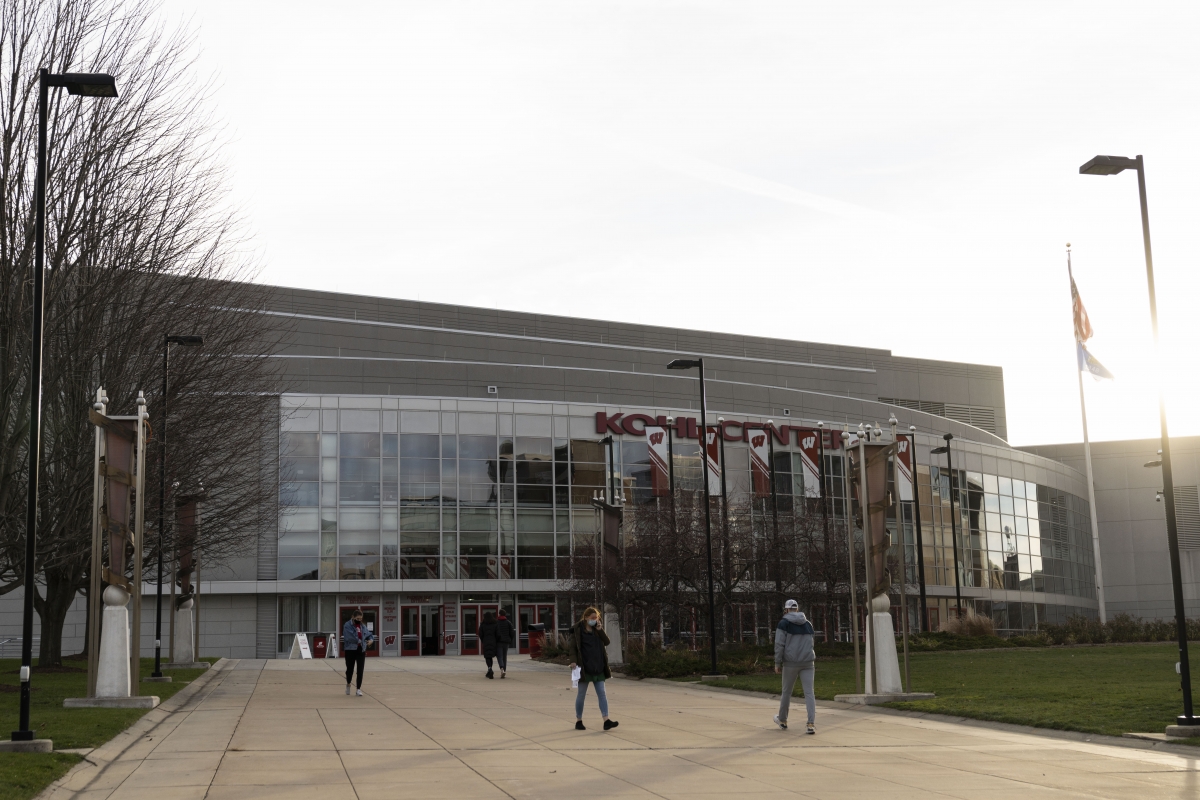
InternationalNov 23. 2020Maggie Pidto, 21, a senior at the University of Wisconsin at Madison, swabs inside her nose to test for the coronavirus at the Kohl Center arena, an on-campus testing site. MUST CREDIT: Photo for The Washington Post by Lauren JusticeMaggie Pidto, 21, a senior at the University of Wisconsin at Madison, swabs inside her nose to test for the coronavirus at the Kohl Center arena, an on-campus testing site. MUST CREDIT: Photo for The Washington Post by Lauren Justice 
By The Washington Post · Nick Anderson, Susan Svrluga · NATIONAL, HEALTH, EDUCATION, HEALTH-FEATURES

MADISON, Wis. – They have endured the strangest fall term in memory, cooped up in dormitories and apartments, taking classes mostly online, seeing professors in person only occasionally, if at all, hanging out with just a few close friends and imagining how this lakeshore capital in a state swamped by the coronavirus might someday recover its boisterous college vibe when the pandemic subsides.

The Kohl Center offers coronavirus testing for University of Wisconsin students and employees. MUST CREDIT: Photo for The Washington Post by Lauren Justice
The Kohl Center offers coronavirus testing for University of Wisconsin students and employees. MUST CREDIT: Photo for The Washington Post by Lauren Justice
Now thousands of University of Wisconsin students are making getaway plans, part of a mass pre-Thanksgiving exodus from campuses nationwide that could spread the dangerous pathogen in hometowns across the country if students and schools aren’t careful.

Maggie Pidto is careful. The 21-year-old Wisconsin senior stopped by the Kohl Center arena one recent afternoon to swab inside her nose for a viral test that came back negative, her seventh of the semester. She planned to do it again the next day to get ready for her trip home to West Hartford, Conn. She wants to protect her parents.

The virus infected one of her roommates this fall, who then had to isolate in their off-campus apartment. But so far, Pidto has dodged infection. “I’m constantly stressed about it,” she said.

Thanksgiving has become a pivotal moment for higher education as the pandemic intensifies. It casts a spotlight not only on the risk of student travel plans, but also on how a wildly unpredictable semester has unfolded and what might happen next.

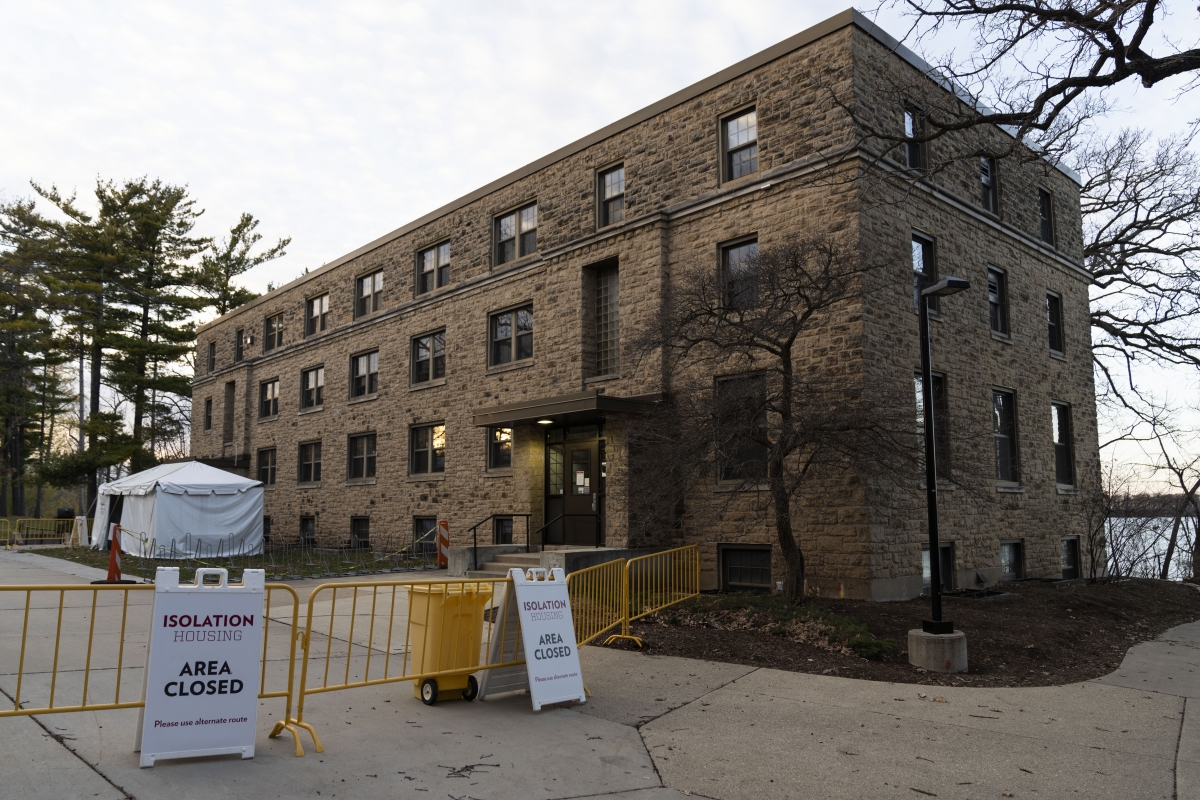
Isolation rooms are set aside for University of Wisconsin at Madison students who test positive. MUST CREDIT: Photo for The Washington Post by Lauren Justice

Isolation rooms are set aside for University of Wisconsin at Madison students who test positive. MUST CREDIT: Photo for The Washington Post by Lauren Justice

Many schools that brought large numbers of students back to campus are dispersing them for the rest of the year – discouraging back-and-forth holiday travel – and pondering how much they can resume operations in January. Faculty are debating the wisdom of housing students and teaching in person under such challenging conditions.

Students are weighing how to keep their education on track and stay safe. But they also are tired of masks, social distancing and other restrictions as they approach a holiday known for gatherings of friends and family.

That exhaustion worries medical experts as the national death toll from covid-19, the disease caused by the virus, has surpassed 250,000. The Centers for Disease Control and Prevention warned on Thursday that college students traveling home should be treated as “overnight guests” and take appropriate precautions. But many are unlikely to take the rigorous quarantine steps that public health experts advise.

“A lot of folks I think are reacting as if this is the last Thanksgiving we’ll ever have,” said Jill Foster, director of the division of pediatric infectious diseases and immunology at the University of Minnesota Medical School. Families with college students need to have honest conversations about risk, she said, and not let down their guard. “I say, ‘Picture Thanksgiving 2021, sitting around the table. We’ve had the vaccine. The pandemic is under better control. Who’s not going to be at that table because this year you’re not patient?’ “

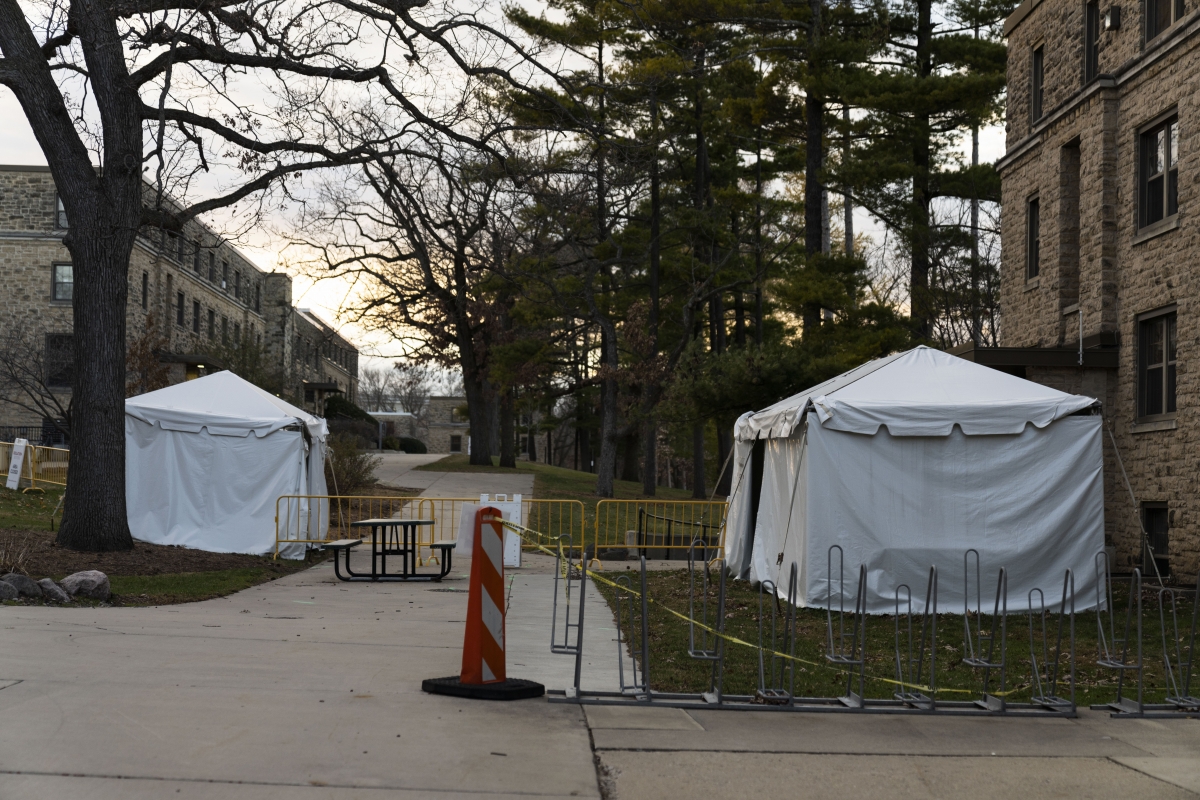
The tents are for items to be delivered to students who are being quarantined. MUST CREDIT: Photo for The Washington Post by Lauren Justice
The tents are for items to be delivered to students who are being quarantined. MUST CREDIT: Photo for The Washington Post by Lauren Justice
Amesh Adalja, a senior scholar at the Johns Hopkins Center for Health Security, said most college students who come home should be considered a potential carrier of contagion. That is true, he said, even if schools provide exit testing.

“If tests are available, that can somewhat decrease their risk, but it’s not ironclad,” Adalja said in a press briefing. “Think about who’s in your household. … Is this a multigenerational household,which has elderly people or individuals with high-risk conditions?”

At Ohio State University, where more than 4,700 students have tested positive this fall, officials urged preholiday testing and caution at every step of their travels. “Though you may head home with a negative test result, your COVID-19 status could change as you are interacting with others and celebrating the holidays,” the university told students. Ohio State ended most of its in-person teaching Friday evening.

Many colleges are not investing much in viral testing. But with high stakes for public health, experts say testing volume matters.

Harry Brighouse, a professor of philosophy at the University of Wisconsin at Madison, teaches an in-person class. Some remote students join the discussion through video on Brighouse's laptop. MUST CREDIT: Photo for The Washington Post by Lauren Justice

Harry Brighouse, a professor of philosophy at the University of Wisconsin at Madison, teaches an in-person class. Some remote students join the discussion through video on Brighouse’s laptop. MUST CREDIT: Photo for The Washington Post by Lauren Justice

In North Carolina, Duke University is testing 2,500 students a day, seven days a week, as the holiday approaches, said Thomas Denny, professor of medicine and chief operating officer of the Duke Human Vaccine Institute. The university has had fewer than 150 positive cases among students this semester. The goal now is to identify infections, trace contacts and quarantine those who were exposed, Denny said, “so we won’t send people back to their home communities positive.” Duke’s semester wraps up just before Thanksgiving.

At the University of Georgia, surveillance testing doubled in the two weeks before Thanksgiving to 1,000 people a day. Officials asked students to consider quarantining for two weeks before heading home and for two weeks more once there. Classes and exams will be held online after the holiday. Since August, the university has logged more than 3,600 positive cases among students. “Stay Georgia strong/Dawg strong,” officials urged, appealing to their school spirit with a nod to the Bulldog mascot.

Clemson University in South Carolina began testing all students on campus every week in early October. Dorms are at normal capacity. More than 4,900 students have tested positive since June. Most cases have been mild or asymptomatic; school officials aren’t aware of any that required hospitalization.

“You must test – the virus is with us, whether we pretend like it is or not,” said Corey Kalbaugh, an assistant professor of public health sciences who is the school’s leadepidemiologist. “At Clemson, we haven’t pretended.”

For Thanksgiving, he said, “I would be far more worried if we weren’t testing. … The virus is what it is. You can never catch 100 percent of positive cases, but we’ll try to catch every one we can before we send students home to their families.” Clemson, like Wisconsin and many other schools, is finishing the semester remotely after the holiday.

Here in Madison, the state’s flagship university of 44,000 students is requiring those who live on campus to get tested before the holiday and encouraging those who live off campus to do so as well. To meet the demand, officials added testing times on the weekend before Thanksgiving.

The university had a rocky start to the semester as viral cases spiked in early September. The school imposed a temporary quarantine on two large dorms and paused face-to-face teaching for two weeks. Those measures, coupled with ramped-up viral testing, helped stabilize operations, said Rebecca Blank, chancellor of the University of Wisconsin at Madison. In all, the university counts more than 4,200 positive viral tests among its students since the summer and more than 370 among employees. Those cases have led to one hospitalization, officials say, and no deaths. The university has set aside rooms in hotels and dorms to isolate those in campus housing who get infected and quarantine those who may have been exposed to the virus.

“We’re doing OK,” Blank said in a videoconference interview. “We have kept the campus reasonably safe from a health perspective. We’ve had no evidence of transmissions in our classrooms or laboratories.” That finding is echoed at many other schools.

In this regimented fall, Blank laments the loss of community rituals – the pep rallies with the Bucky the Badger mascot, and the afternoon crowds that would soak in sun and the sweeping vistas of Lake Mendota from the terrace of Memorial Union.

Some local authorities contend the university catalyzed regional health troubles when it opened dorms and classrooms in September. “There was a great surge in cases,” Dane County Executive Joe Parisi said. “It began on campus. There’s nothing that separates the campus from the greater community.”

Parisi, a Wisconsin graduate, is also the father of a student at the university. “If I had my druthers, it would all be virtual,” he said.

Blank disputes Parisi’s view. Positivity rates for the university’s viral testing, she said, are lower than rates for the county and the state. Even if the dorms had been closed, many thousands of undergraduates were living in apartments off campus. Opening the campus enabled the university to promote public health, she said. “If we simply were closed,” Blank said, “we would have no control whatsoever over their behaviors.”

Roughly 30 percent of classes this fall have had at least some face-to-face instruction. All courses with 50 or more students are remote. Much of the same teaching plan, with expanded viral testing, is expected in the spring term.

Professors are divided over the university’s strategy. Some say it would have been better for the health of students and the community to be entirely virtual from the start.

“It’s a mess,” said Sami Schalk, an associate professor of gender and women’s studies. “It’s been a hard semester and really scary.” Schalk said the stress on students, including those who hold part-time jobs in the city, has been enormous. While Schalk chose to teach her three courses remotely, she said some faculty have felt pressured to teach in person. She said she wants to return to the classroom when the conditions are right – and not before. “We just have to adapt to our moment and let go a little bit,” Schalk said.

Harry Brighouse, a professor of philosophy, teaches three face-to-face courses but totes a laptop around the classroom to help certain students who must participate online through video links. Those who can be there in person value the experience, he said, and are probably more risk-averse in their behavior. “I’ve had students tell me, ‘I’d be going to parties if I didn’t have an in-person class. It’s not worth it to me to jeopardize that,’ ” Brighouse said. He said he is “so grateful that it’s worked out.”

One afternoon last week, Brighouse donned a face mask to lead a class on the obligations of parents to children. More than 20 students joined him in a large circular lecture room, sitting at desks that appeared carefully spaced apart. In many ways, it seemed a lively but routine academic occasion. There was give and take, analysis of moral issues, small-group discussion of case studies. What was unusual: the Zoom connection for several remote students and the muffling effect that masks had on everyone’s speech. Brighouse concentrates on projecting his voice, getting students to speak up and keeping all engaged wherever they are. “Definitely requires more energy,” Brighouse said. “But it works.”

For Hannah Bounds, 20, a junior from Racine, Wis., this is her only in-person class. Hands down, she said, it is the academic highlight of her fall. Her remote courses often feel like a struggle in figuring out how to teach herself. “I’m not getting what I should out of those,” she said.

Bounds has felt the strain of the pandemic semester. She is a “house fellow” in a dorm, which means she lives with and helps guide freshmen through their first months of campus life. “First and foremost, it is kind of scary,” she said in a phone interview. “It’s scary to see residents test positive and know that I share the same living space.”

Every Monday, Bounds takes a viral test. So far, they have all been negative. She worries about the possibility of infecting her father, a motorcycle mechanic, or her mother, a medical-imaging technologist. But she plans to go home for Thanksgiving and afterward return to Madison to help the dorm wind down for any residents who remain through the end of the semester.

Yannis Pandiscas, 20, a junior from Aurora, Ill., hasn’t taken any viral tests since the semester started – “although I really probably should,” he said. He lives alone in a Madison apartment, studies mostly online, works out at a gymnasium, and shops and cooks for himself. He has no Thanksgiving getaway plan. He’ll stay here. His mother is immunocompromised, he said, and his father works in a casino.

“I am a little concerned for my family,” he said. “I can’t really know if I’ve been infected.” Even if he gets tested here and has a negative result, Pandiscas worries he could get the virus while riding a bus home. “I don’t want to bring it back,” he said.

Hannah Alpert, 19, a sophomore from Mill Valley, Calif., went home briefly in October to avoid a possible virus outbreak in her sorority house. Soon after she returned to Madison, she caught the virus herself. The sorority was not to blame, she said. There were no parties, and residents were careful to wear masks. After her positive test, Alpert went to a hotel room to isolate. Her symptoms are mild: She feels “run down,” she said, and has lost some sense of taste and smell.

“I do not want to expose my parents and sister in any sense,” Alpert said. But she has no regrets about coming here. “This semester has definitely been worth it,” she said. “By no means has it been easy. I couldn’t have predicted what happened, especially that I have coronavirus.”

Her mother feels the same. Madison was where her daughter wanted and needed to be this fall, Suzanne Alpert said. “She found her place last year, thriving academically and thriving socially,” the mother said. “So we decided to take the risk of letting her go back if she felt brave enough to go for it.”

Last week, the family was counting the days until Hannah could fly safely. “She won’t come home until we’re very sure that she’s not contagious,” Suzanne Alpert said.

With the virus surging, some students were reshuffling plans and leaving the week before Thanksgiving.

“Covid was getting a little crazy,” Olivia Moffitt said. “So I decided to come home early.” Moffitt, 18, a freshman from Chevy Chase, Md., said some students in her dorm had tested positive, and she didn’t want to risk getting exposed and then stuck in a Madison quarantine.

“It was mostly a personal choice, but my parents were definitely on board with it,” she said. Moffitt proclaimed herself happy with the first-year experience so far even though all her classes were online. “It was nice to meet new people, get out of my comfort zone and have a sense of normalcy,” she said. She spoke over the phone from the basement of her family house, quarantining there as she awaited results from yet another viral test.

G20 leaders close Riyadh summit with calls for coordinated response to coronavirus pandemic #SootinClaimon.Com

#SootinClaimon.Com : ขอบคุณแหล่งข้อมูล : หนังสือพิมพ์ The Nation.

G20 leaders close Riyadh summit with calls for coordinated response to coronavirus pandemic (nationthailand.com)

G20 leaders close Riyadh summit with calls for coordinated response to coronavirus pandemic

InternationalNov 23. 2020

By The Washington Post · Kareem Fahim · WORLD

ISTANBUL – Little was expected of this year’s Group of 20 Leaders’ Summit. It was a muted affair, presented virtually during a resurgent global pandemic. Its host, Saudi Arabia, was criticized by human rights groups for a record of abuses. And its most prominent participant was President Donald Trump, an ardent opponent of the kind of collective global action the summit set out to achieve, who leaves office in less than two months.

Even so, as the two-day conference ended Sunday, its organizers hailed it as a success. A final communique heralded achievements, including an offer of debt relief to developing nations and a commitment to ensuring equitable access to coronavirus treatments. But it also laid out a frightening litany of challenges facing economies and societies that the scaled-back summit, or any global gathering, would be hard-pressed to meet.

“We underscore the urgent need to bring the spread of the virus under control,” the leaders of the G-20 nations said in the communique. And throughout a summit, dominated by the pandemic and its ravages, they argued that only collective action could bring the crisis to heel.

The plea for a coordinated response reflected the struggles faced by countries such as France, India and Turkey as infection rates soar. It was also a retort to the Trump administration and its go-it-alone approach to international challenges ranging from the pandemic to climate change.

“We have seen very clear signs but also actions by the G-20 supporting multilateralism,” Mohamed al-Jadaan, Saudi Arabia’s finance minister, told a news conference at the summit’s conclusion. He mentioned the group’s support for institutions including the World Health Organization. The Trump administration gave a year’s notice of the U.S. withdrawal from the WHO in July; President-elect Joe Biden has said he would stop that process.

German Chancellor Angela Merkel said Saturday that “if we stand together worldwide, we can control and overcome the virus and its consequences.”

Trump confirmed his attendance at the summit the day before it began. In remarks to the group Saturday, he touted his administration’s record in combating the virus, saying it had “marshaled every resource.” He made no promise to expand the availability of U.S. vaccines. Then he played golf.

On Sunday, he addressed a summit session on the environment titled “Safeguarding the Planet.” His administration has weakened regulations intended to reduce pollution generated in the United States. He called his record on protecting the environment “historic” and attacked the Paris climate accord.

On the day after the election this month, the United States became the first and only nation to withdraw from the 2015 agreement to curb greenhouse gas emissions.

“The Paris accord was not designed to save the environment,” Trump told the summit. “It was designed to kill the American economy.”

Biden, who has called climate change “the existential threat to humanity,” has pledged to rejoin the Paris accord.

In the weeks leading up to the summit, the kingdom faced protests from Saudi and international human rights groups demanding that world leaders downgrade their representation or boycott the gathering altogether. They argued that the summit conferred respectability on a government accused of grave abuses, including jailing and torturing female activists and the killing of Washington Post contributor Jamal Khashoggi at the Saudi Consulate in Istanbul in 2018.

No invited world leader boycotted. But neither did the remote gathering, which participants attended by video link, provide Saudi Arabia with the kind of platform it had sought to showcase its accomplishments.

The World Bank has said the pandemic could drive as many as 150 million people into extreme poverty, reversing decades of progress. UNICEF has warned that unequal access to technology among students in poorer countries threatens to “deepen the global learning crisis.”

Collaborative, global efforts are needed to meet the “huge challenges” facing students and schools worldwide as they strain to adapt to distance learning, Hamad el-Sheikh, Saudi Arabia’s education minister, said Sunday.

Saudi Arabia, with virtually unmatched financial resources, has been able to dedicate satellite channels to distance learning, he said. The kingdom has partnered with Microsoft to boost server space for online instruction. Education that “blended” in-person and distance learning would become the norm, even after the worst ravages of the pandemic had passed.

“No one expected that 1.6 billion students will be outside of schools,” el-Sheikh said. He acknowledged that few countries have comparable resources to respond to such a crisis.

“Some countries don’t have the capability to launch satellite stations,” he said.

Trump administration exits Open Skies treaty #SootinClaimon.Com

#SootinClaimon.Com : ขอบคุณแหล่งข้อมูล : หนังสือพิมพ์ The Nation.

Trump administration exits Open Skies treaty (nationthailand.com)

Trump administration exits Open Skies treaty

InternationalNov 23. 2020

By The Washington Post · Paulina Firozi · NATIONAL, WORLD, NATIONAL-SECURITY

The United States has formally withdrawn from the Treaty on Open Skies, a decades-old pact meant to reduce the chances of an accidental war by allowing mutual reconnaissance flights by parties to the 34-nation agreement. The exit comes six months after President Trump first announced his intention to withdraw, saying Russia has been violating the pact.

“Today marks six months since the United States submitted our notice of withdrawal from the Treaty on Open Skies,” White House national security adviser Robert O’Brien said in a statement. “We are now no longer a party to this treaty that Russia flagrantly violated for years.”

O’Brien said Trump has “never ceased to put America first by withdrawing us from outdated treaties and agreements that have benefited our adversaries at the expense of our national security.”

Russia has denied violating the treaty and earlier this year chided the move as merely the latest abandonment by the Trump administration of major arms-control agreements.

The move risks sowing further divisions between the United States and European allies, some of which called on the administration to stay in the pact despite concerns about Russia.

In a statement in May, Joe Biden said that in announcing the intention to withdraw, Trump “doubled down on his short-sighted policy of going it alone and abandoning American leadership.”

“I supported the Open Skies Treaty as a Senator, because I understood that the United States and our allies would benefit from being able to observe – on short notice – what Russia and other countries in Europe were doing with their military forces,” his May statement added.

Actually, it makes perfect sense that Biden would get more votes than Obama #SootinClaimon.Com

#SootinClaimon.Com : ขอบคุณแหล่งข้อมูล : หนังสือพิมพ์ The Nation.

Actually, it makes perfect sense that Biden would get more votes than Obama (nationthailand.com)

Actually, it makes perfect sense that Biden would get more votes than Obama

InternationalNov 22. 2020

By The Washington Post · Philip Bump · NATIONAL, POLITICS 
VOTING-ANALYSIS: As part of a lengthy Twitter thread aimed at bolstering President Donald Trump’s wild and baseless allegations of electoral impropriety, cartoonist Scott Adams distilled a common argument about President-elect Joe Biden’s win.

“No one believes Biden got far more votes than Obama,” he wrote on Twitter on Friday.

This claim comes up a lot as Trump supporters like Adams seek to bolster the idea that somehow Trump was cheated out of a victory. How could Biden, a guy who barely drew any crowds, get more support than Barack Obama, whose 2008 campaign was historically popular? And if Biden didn’t get that many votes, why do national tallies say he did?

Simple. Biden outpaced Obama’s totals in 2008 and when he was re-elected in 2012 because: 

1. The country has gotten more populous

2. There was a lot of enthusiasm for voting this year, and 

3. Much of that enthusiasm from Democrats was targeted not at Biden, but at Trump.

In 2008, the population of the United States was about 299 million. Four years later, it was up to about 309 million. Now, it’s more than 330 million. The number of adult citizens – that is, those eligible to vote – has also increased, up an estimated 25 million since 2008.

Biden earned about 80 million votes. (This will increase given outstanding ballots in New York and California.) That’s 11 million more than Obama in 2008. Assume that two-thirds of the newly added adult citizens voted this year, and that’s an addition of 17 million more people to the voter pool, even ignoring issues of enthusiasm. Split that in half, and Biden would just need to find 2.5 million more votes somewhere.

We can look at the boost for Biden in another way. Biden’s total this year is about 15 percent higher than what Obama got in 2008 and 21 percent higher than his total in 2012. Trump’s total this year is 23 percent higher than what then-Sen. John McCain got in 2008 – and an equivalent 21 percent higher than what Mitt Romney got eight years ago.

Trump supporters will say that this is impossible, that Trump was clearly the focus of more enthusiasm. Given the president’s rallies, Biden should not have been able to keep pace.

But that’s wrong for two reasons. The first is that Trump’s rallies are being compared with Biden events that were specifically meant to be small. Why? Well, there’s a pandemic going on, as you’ve probably heard, and not everyone probably gained immunity to the novel coronavirus after an outbreak at their place of employment. Trump possibly did, and, given his indifference to the virus’s spread, he moved ahead with his large events.

The second is that rallies aren’t a great marker of enthusiasm anyway. That’s true generally because getting 20,000 people to turn out in a heavily partisan area is only a tiny fraction of the actual voting population (if those 20,000 people can all vote, which is unlikely). It’s also true because people can be enthusiastic about voting without going to a rally.

In 2020, the preliminary data suggests that turnout relative to the adult-citizen population was probably higher than at any point in the last century. Indicators that enthusiasm was high emerged soon after the 2018 midterms and carried into Gallup’s final polling on the question.

What’s important here is that Democrats were as likely to say they were more enthusiastic about voting than past elections as they were in 2008. Republicans were more likely to say that than they were in 2008, helping push the overall turnout rate even higher.

Democratic enthusiasm and Democratic votes were high in 2008, down in 2012, flat four years later and then back up. This wasn’t 2016. Polls showed that Democrats viewed the 2020 election much as they did Obama’s first – with a lot more voters in the mix.

Again, this was heavily because of Trump. The president’s focus on goading the left and delivering for his base over his time in office helped make him the most polarizing president on record. Republicans loved him and Democrats hated him, as polling repeatedly showed. When Fox News asked poll respondents why they were supporting Trump or Biden, 8 in 10 Trump voters said they were supporting him because they liked him. Four in 10 Biden voters said they were supporting Biden to oppose Trump.

In other words, even if Biden would not have matched Trump’s crowds had there not been a pandemic – which is probably generally true – it didn’t matter. A lot of the reason many Democrats saw the election as being so important was simply that they wanted Trump out of office, a motivation that was more important than the identity of the person who replaced him.

If any Trump supporter finds this dynamic hard to believe, that may be a function of the sort of isolation that Trump frequently suggests is a feature of his opponents. In 2016, it was red states in which people were the most likely to live in precincts with others who overwhelmingly voted the same way as them. In September, a Pew Research Center poll found that about 40 percent of both Trump and Biden supporters knew no one who was planning on supporting the other candidate. That was more true of Trump supporters who lived in more heavily Trump-supportive counties.

There are other likely factors, too. The expansion of mail-in and early voting made it easier to vote, probably meaning that some more infrequent voters cast ballots. After Trump’s narrow 2016 win, there were efforts introduced to encourage voting from Democrats who had stayed home. Georgia’s Stacey Abrams has been given a lot of credit for helping to overhaul the turnout operation in that state, which Biden won.

Given all of the above, the math becomes easy. Biden outperformed Obama because there were more voters from which to cull votes. At the same time, enthusiasm was similar among Democrats in 2008 and 2020, in part because Democrats were so eager to see Trump ousted – and in part to avoid what happened in 2016.

If no one Scott Adams knows believes that could be true, that’s a reflection of the bubble in which Adams apparently lives, not of the reality of politics this year.

Saudi minister highlights ‘huge’ strains on global education as G-20 tackles pandemic #SootinClaimon.Com

#SootinClaimon.Com : ขอบคุณแหล่งข้อมูล : หนังสือพิมพ์ The Nation.

Saudi minister highlights ‘huge’ strains on global education as G-20 tackles pandemic (nationthailand.com)

Saudi minister highlights ‘huge’ strains on global education as G-20 tackles pandemic

InternationalNov 22. 2020Saudi Education Minister Hamad al-SheikhSaudi Education Minister Hamad al-Sheikh 

By The Washington Post · Kareem Fahim · WORLD 
ISTANBUL – International efforts were needed to meet the “huge challenges” facing global educational systems as they strained to adapt to distance learning while accommodating children with special needs, Saudi Arabia’s education minister said Sunday at the Group of 20 summit in Riyadh.

His comments kicked off the second day of a summit that is being held virtually and has been dominated by discussions about the pandemic and its disastrous fallout.

“No one expected that 1.6 billion students will be outside of schools,” said Hamad al-Shaikh. “No education system in the world had expected that they will face a prolonged time where students are staying at home in lockdowns.” 

Leaders attending the summit represent nations that top the world in the rate of infections, including the United States, India, Brazil and France. 

On Saturday, the summit’s first day, most world leaders stressed the need for greater global cooperation to ensure that vaccines against the virus are affordable and widely distributed, including in developing nations. 

A notable exception was President Donald Trump, whose disdain for multilateralism has been a hallmark of his tenure. In perfunctory remarks to the group that he followed with a round of golf, Trump made no promise to expand the availability of U.S. vaccines and touted his administration’s record in combating the virus, saying it had “marshaled every resource.” 

On Sunday, Trump, who has weakened regulations designed to reduce pollution generated by the United States, addressed a summit session on the environment titled “Safeguarding the Planet.” He called his administration’s environmental protection record “historic” and attacked the Paris climate accord, from which the United States formally withdrew this month – becoming the first and only nation to do so. 

“The Paris accord was not designed to save the environment, it was designed to kill the American economy,” he said. 

Even before his comments, expectations were low for the summit, an annual gathering of leaders of the world’s largest economies. The meeting was expected to finalize a framework for granting poor nations debt relief and promoting international vaccine collaborations such as Covax, an effort linked to the World Health Organization that seeks to expand vaccine distribution to the developing world. 

The gathering also prompted protests from Saudi and international human rights groups,as well as some U.S. and European lawmakers, which called on world leaders to boycott or downgrade their representation over the kingdom’s abuses, including jailings of female activists and the killing of Washington Post contributor Jamal Khashoggi at the Saudi Consulate in Istanbul in 2018.

No world leaders boycotted, but neither did the remote gathering provide Saudi Arabia with the kind of platform it had sought to showcase its accomplishments. Crown Prince Mohammed bin Salman, the kingdom’s day-to-day ruler and a lightning rod for criticism over human rights, was expected to address the gathering later on Sunday. 

The World Bank has said the pandemic could drive as many as 150 million people into extreme poverty, reversing two decades of steady progress in alleviating the suffering of the world’s poorest people. UNICEF has warned that unequal access to technology among students in poorer countries threatens to “deepen the global learning crisis.” 

Saudi Arabia, with virtually unmatched financial resources, has been able to dedicate satellite channels to distance learning and partnered with Microsoft to boost server space for online instruction, said Sheikh, the education minister. Education that “blended” in-person and distance learning would become the norm, even after the worst ravages of the pandemic had passed. 

But “some countries don’t have the capability to launch satellite stations,” he noted. 

Panic buying returns on covid jump #SootinClaimon.Com

#SootinClaimon.Com : ขอบคุณแหล่งข้อมูล : หนังสือพิมพ์ The Nation.

Panic buying returns on covid jump (nationthailand.com)

Panic buying returns on covid jump

InternationalNov 22. 2020

By Syndication Washington Post, Bloomberg · Anne Riley Moffat, Carolina Gonzalez, Sarah McGregor · BUSINESS, RETAIL We’re out of toilet paper again.

Households across the U.S. are once again filling grocery carts brimful in a second round of panic buying as the virus surges and states clamp down on economic activity. Defensive purchasing is affecting everything from paper towels to bacon. Even the world’s biggest retailer is reporting shortages of high-demand items, including cleaning supplies, breakfast foods — and the most important commodity in any bathroom.

“It really does have everything to do with what’s happening with Covid cases in any particular community,” Walmart’s chief executive officer, Doug McMillon, said on an earnings call in the past week. “We’re going to be able to respond in this instance better than we did in the first half of the year, although we’re still — as a total supply chain — stressed in some places.”

The new wave of pantry stockpiling hits about eight months after the March boom, meaning makers of packaged food and household items have had some time to prepare. General Mills added 45 external production lines through contractors this year, while Campbell Soup spent $40 million to expand production of Goldfish crackers, a must for parents cooped up with toddlers. Still, at-home demand is surging, accelerated by a new wave of indoor-dining bans.

Cathy Smith had a pack of toilet-paper rolls in her cart at the checkout of a Ralph’s grocery in West Los Angeles at midday Friday with a few “last-minute” items to prepare her Thanksgiving meal, including a 16-pound turkey.”I’m not totally in panic mode yet,” she said. “I don’t watch the news, because it is too depressing, but my husband did and he warned me that things are getting worse. So I thought I’ll stock up.”

Over the last three weeks, demand for non-perishable items such as paper goods, canned goods, spices, broths and canned vegetables jumped 60-70%, according to Centricity Inc., a platform that tracks online activity like searches and e-commerce.

That’s on top of “meteoric” year-over-year increases for pantry staples, said Mike Brackett, Centricity’s chief executive officer.

Shoppers may start to see purchase limits again, said Jim Dudlicek, spokesman for the National Grocers Association. Consumers should shop earlier in the day to “have best pick from freshly stocked shelves, but to be mindful of their neighbors and take only what they need,” he said. Some grocers are using social media to provide updates on hot products, and at least one is providing bulletins on a radio program.

Kraft Heinz Co. CEO Miguel Patricio said in an interview last month that the company has been finding new partners and investing in the productivity and capacity of its factories to meet rising demand.

That means “new machinery, or even bringing back to life lines that we considered in the past as obsolete,” he said. The company is working on “all possible fronts to increase capacity and we’ve been able to increase it substantially. We increased capacity on average by 20% and that goes up to 56% on products where there’s a higher demand,” like Philadelphia Cream Cheese or macaroni and cheese, he said.

Mark Schiller, CEO of Hain Celestial Group Inc., said that the company, which makes Terra vegetable chips and plant-based Dream milks, was readier for this round of panic buying.

“We are far better prepared,” he said. “We have about 50 million more dollars of inventory on hand, of all the things that have the longest supply chain and the least amount of backups.”

Toilet paper is a tougher one to find, with consumers sharing on Twitter photos of bare shelves — and pleas to fellow shoppers to share the supply. “March 2.0,” observed one tweeter.

Kimberly-Clark Corp., maker of Scott and Cottonelle toilet paper, said it was cooperating with its clients and customers to keep tabs on supplies and fill inventory gaps. The company has accelerated production since the pandemic hit, including making fewer variants of products and finding capacity in its global paper supply network, said Arist Mastorides, president of the family care unit in North America.

Procter & Gamble Co. spokeswoman Jennifer Corso said the maker of Charmin continues “to work around the clock to produce product as quickly as possible.”

“Paper towel consumption is related to increased cleaning situations, as consumers are cleaning more frequently,” she said. “Toilet paper consumption is tied to the increased amount of time consumers are spending at home. For both, people are consuming more and stocking their pantries at a higher level than before the pandemic.”

Panic buying is also hitting another part of the consumables market.

Ben Kovler, CEO of Chicago cannabis company Green Thumb Industries Inc., said on an earnings call this month that while purchases aren’t yet back to March’s booming levels, it’s “marching back there slowly.”

Unlike at Walmart, where shoppers are coming less often but buying more, Green Thumb’s Rise stores are seeing more customers, he said. And unlike staples that get used at a steady rate, when people buy twice as much cannabis, they quickly use it. These are, after all, stressful times.

“They consume more,” Kovler said. “That’s not a bad thing for the business. We don’t think that’s a bad thing for the consumer.”