Impromptu celebrations pop up across Washington following Biden victory announcement
InternationalNov 08. 2020Revelers gather outside of the White House in Washington, after Joe Biden was projected to win Pennsylvania and become be the next president of the United States, MUST CREDIT: Photo for The Washington Post by Astrid Riecken
By The Washington Post · Marissa Lang, Joe Heim · NATIONAL, POLITICS
WASHINGTON – Horns blared, fireworks exploded and shouts of joy filled the air as supporters of Joe Biden and Kamala D. Harris spilled into the streets of Washington and its suburbs late Saturday morning to celebrate the breaking news that the pair had been projected to win the 2020 presidential election.
On a glorious fall day, it was news that the region, which voted overwhelmingly for Biden in the presidential contest, had been desperate to hear.
Around noon, an impromptu parade broke out on the streets of the nation’s capital to celebrate Biden’s victory. A brass band perched on the back of a truck played upbeat jazz as people spilled out of homes, shops and restaurants in downtown D.C. to join the march.
The crowd swelled quickly as the truck moved from the heart of Adams Morgan in the direction of the White House – first a dozen, then three dozen, and soon close to a hundred. A few policemen on motorcycles escorted the group as passing cars stopped to honk, their drivers cheering.
Celebrations erupted across the city. Cheers and clapping filled the air outside Eastern Market on Capitol Hill. A few blocks away near Third and Pennsylvania Avenue SE, “The Star Spangled Banner” blasted from speakers on a repeated loop.
A woman on a bicycle pedaled through Columbia Heights shouting, “it’s over!”
A man in Shaw stood on the curb with a stemmed glass of red wine, raising it to passersby.
“We won!” he shouted in Spanish. “We won!”
Fireworks exploded in bursts as neighbors emerged on porches with pots and pans to bang. Some simply stood there, raising their phones as if it were proof what they were seeing was real.
“The nightmare is over,” a man called to his neighbor, ambling out of a rowhouse just before noon.
On the city’s Columbia Heights neighborhood, Black, Hispanic and White residents honked their horns and cheered. People eating outdoors at restaurants pumped their fists and yelled in response.
Residents popped bottles of champagne on their front porches while Latin music – a mainstay in the neighborhood – blared in the background.
And in the middle of the cheers, an MPD police officer drove by and raised his fist out the window.
Outside the White House on Saturday afternoon, D.C. residents made themselves heard. Cars honked nonstop as drivers stuck their head out windows and waved Biden flags. Cyclists cheered as they sailed past, lifting fists in the air. Along 15th Street, where protesters had so many times marched against the outgoing president, a young Black woman stuck her head above the sunroof of her car, yelling: “FINALLY!”
In the leafy, quiet residential neighborhoods of upper Northwest Washington, where even the Halloween decorations featured Biden-Harris signs and “VOTE” themes, masked residents rushed to Connecticut Avenue to cheer, whoop and ring cowbells as cars and trucks drove by with signs hailing the election of the Democratic ticket.
Parents waved small American flags and held their children on their shoulders, and even a recycling truck blared its horn as scores of vehicles headed south on Connecticut Avenue toward the White House.
People flocked toward the White House on foot and by car, honking their horns, sticking solidarity fists out their windows and congratulating strangers on the street. They carried Biden-Harris signs, Black Lives Matter signs, American flags – the mood one of a party inside a sigh of relief.
The Trump hotel on Pennsylvania Avenue NW became a scene of beeping horns, middle finger waves and many expletive-laced goodbyes.
A car drove by with a poster-sized picture of Harris waving from the roof window. A biker shouted “Merry Christmas Donald Trump!”
Two runners stopped to pose in front of the hotel for a selfie.
“For the first time in four years, I feel like I have something to look forward to,” said Hannah, the runner in a Biden-Harris mask, who declined to give her last name because she works for a member of Congress.
“We’re going all the way to 1600!” her running partner said, before the two headed for the White House.
As Biden nears victory, world hopes for an end to American isolationism
InternationalNov 08. 2020Indian newspapers track the U.S. election. MUST CREDIT: Photo for The Washington Post by Joanna Slater
By The Washington Post · Shibani Mahtani, Miriam Berger · WORLD, POLITICS The world took its first steps from the Trump era to the presidency of Joe Biden on Saturday as he claimed victory in the presidential election. The focus among America’s friends and rivals around the world turned to predicting what a Biden administration would mean for their engagement with the United States.
U.S. allies and rivals looked ahead to a Biden presidency on Saturday as Biden crossed the 270-electoral vote threshold with a win in Pennsylvania. But the expected normal flood of congratulatory messages from world leaders might be muted by uncertainty over Donald Trump’s threats to challenge the outcome and the election process. Officials and media around the world lamented the polarization and dysfunction in one of the world’s oldest democracy. But shouts of “Biden” and cheers broke out in Berlin, London and other cities.
Many hope the period of American isolationism and country-first populism under President Trump will give way to an era of renewed U.S. global leadership and embrace of multilateralism to tackle common challenges.
“It’s good that there are finally clear numbers. We look forward to working with the next U.S. administration,” tweeted German Foreign Minister Heiko Maas. “We want to invest in cooperation for a transatlantic new beginning, a new deal.”
Frank Bainimarama, the prime minister of Fiji, was among the first to congratulate Biden outright even before the race was formally called, saying in a tweet that they must work together to confront a warming planet and rebuild the global economy.
“Now, more than ever, we need the USA at the helm of these multilateral efforts (and back in the #ParisAgreement – ASAP!),” he wrote.
Hours later, congratulations from world leaders and others – who were watching the vote count unfold – were finally uncorked as soon as U.S. media organizations declared Biden the winner. Leaders with diverse views and priorities – from Canadian Prime Minister Justin Trudeau and French President Emmanuel Macron to Zimbabwe’s President Emmerson Dambudzo Mnangagwa – were among the first to share their enthusiasm for working with Biden.
Though Trump has yet to concede, one of his key allies, British Prime Minister Boris Johnson, issued Biden his congratulations.
“While some of the processes are still playing out, it is now clear @JoeBiden has won,” tweeted British Foreign Minister Dominic Raab.
Nicola Sturgeon, the first minister of Scotland, hailed “President-Elect Joe Biden and the history-making Vice President-Elect Kamala D. Harris.”
“I want to congratulate the new President Elect of the USA @JoeBiden Joe Biden has been a true friend of this nation throughout his life and I look forward to working with him in the years ahead,” wrote Irish Prime Minister Micheál Martin in a nod to Biden’s Irish heritage.
“I heard a Pan-European sigh of relief, when Biden’s victory was called,” said a German member of European Parliament, Reinhard Bütikofer.
The editor of the conservative-leaning British newspaper the Evening Standard and former British Chancellor George Osbourne tweeted that “whether you’re on the left or right: moderation, integrity, seriousness and the mainstream are back.”
The news of Biden’s victory broke in Israel just as the Sabbath was lifting and crowds were gathering for what has become a weekly ritual: protesting against Prime Minister Benjamin Netanyahu outside of his Jerusalem residence. Some already carried signs reading ” Bibi you are next,” citing Netanyahu’s nickname.
Mehbooba Mufti, an opposition politician in India and former Minister of Jaamu and Kashmir, tweeted that “their win gives hope to rest of the world that right wing extremism & those who sow division & hatred will sooner or later be relegated to the pages of history like Donald Trump.”
Others continued to focus on the battered image of American democracy – sometimes with open glee.
The People’s Daily China, an official newspaper of the Central Committee of the Chinese Communist Party, pointed to Trump’s earlier comment that he had won with “HaHa” and a laughing emoji.
“Who’s the Banana Republic now?” Publimetro, a Colombian daily newspaper, asked on its front page.
While Trump clashed with many world leaders, he also cultivated close relationships with the populists and other allies in countries including Israel, India, and Hungary. Their leads had no immediate comment, though some opposition politicians were quick to reach out to Biden and Harris.
“It makes us proud that the first woman to serve as Vice President of the USA traces her roots to India,” tweeted India’s main opposition leader Rahul Gandhi.
“A White House without Trump should bring a less racist world,” tweeted Ahmad Tibi, an Arab member of the Israeli parliament. “
The Times of India, which anticipated Biden’s win with the headline “Bye Don, It’s Biden Finally,” said that H1-B work visas – allowing nonimmigrants to work in the United States – are unlikely to return in their previous scale or numbers, even if the Biden administration has a more favorable immigration policy. But it noted that the Democrats could be stronger on human rights violations in India. The newspaper also described celebrations in Harris’ ancestral village in southern India – the birthplace of her maternal grandfather – where residents were feeling festive ahead of the traditional Diwali celebrations.
In China, relations with the United States have plummeted to their lowest ebb in 40 years amid bitter disputes over trade, technology, human rights and the coronavirus pandemic. But hopes have been stirred that, despite fundamental differences, a Biden win might act as a circuit-breaker and offer a window for cooperation in certain areas.
From Beijing’s perspective, “a Biden presidency is more likely to put a floor under the current free-fall in relations, judging by his recent remarks on China and those of his foreign policy advisers,” wrote Wang Xiangwei, a columnist and editorial adviser at the Hong Kong-based South China Morning Post. Chinese officials, he said, are hoping for at least a short-term respite to the vitriol that has dominated Sino-U. S. relations under Trump.
Still, an op-ed in the nationalistic Global Times tabloid noted deep partisan divisions in the United States that it said would not be easily eased.
“The U.S. will remain united from outside but divided from within, no matter who is president,” wrote Zhang Jiadong, a professor at the Center for American Studies at Fudan University.
Iranian officials have largely avoided commenting on the election impasse and its possible implications for U.S. policies, such as the future of economic sanctions and the fate of the 2015 nuclear deal negotiated by the Obama-Biden administration. Trump withdrew from the pact two years ago and has stepped up sanctions on Tehran.
“For us, the individual and the party are not important; rather, what matters is the policies to be adopted by the U.S. government,” Iranian President Hassan Rouhani said Saturday. Rouhani has urged the U.S. to return to its commitments under the nuclear deal, known officially as the Joint Comprehensive Plan of Action, and rejected Trump’ calls to renegotiate it.
The Chairman of Tehran’s City Council, Mohsen Hashemi Rafsanjani, on Saturday congratulated the family of Qasem Soleimani, the former commander of Iran’s elite Quds Force, who was killed in a U.S. military drone strike in January near Baghdad. Rafsanjani said the targeted killing helped cause “Trump’s heavy defeat,” BBC Persian reported.
Iranians, battered by an economic crisis alongside the coronavirus, have been following the election with intense scrutiny. Aftab-e Yazd, an Iranian reformist newspaper, declared on its Saturday front page: “A world without Trump.”
The global pandemic added urgency to Biden’s pledge to reverse Trump’s approach, which has left the United States estranged from the World Health Organization and facing the highest numbers of deaths and new cases at home.
After Trump withdrew from the World Health Organization – in protest of what he claim was a bias toward China – Biden this summer pledged to rejoin the U.N.’s health agency on his first day in office. Biden is a “globalist at heart,” wrote Natasha Kassam, a research fellow at Sydney’s Lowy Institute political think tank, in the Guardian.
“When it comes to global public health,” she added, “America has literally left the building.”
– – –
With Trump still seemingly determined to contest the election results in court, some expressed fears for what he might unleash, even if he eventually concedes.
“The squatter” was the title of the Saturday cover of Der Spiegel, a leading German news magazine. A defiant, fatigue-clad Trump is depicted holding a rifle, barricaded in the Oval Office with a bullet-holed picture of a smiling Biden in the backdrop.
In Britain, the Guardian declared Trump in a “fight against reality,” but noted in an editorial that Biden would have his work cut out to “rebuild the U.S. government’s credibility after Trumpism hollowed out its institutions.”
“He will have to reassert America’s role as the global problem-solver,” it said. “Under Mr. Trump the ‘indispensable nation’ disappeared when it was needed the most.”
Others mocked Trump’s efforts to remain in power. “One small hand clinging to everything except reality,” read the front page of the Saturday Paper in Australia.
The Japanese government, meanwhile, warned its nationals in the United States that they may become caught up in election-related violence, and told people to take precautions, including “considering whether it is appropriate to travel to work while protests continue,” according to the Mainichi newspaper.
The Trump brand continued to find support among those on the far right who support Trump’s nativist-driven populism. Nigel Farage, who leads the U.K.’s Brexit party, wrote in an opinion piece that he believed Trump is right to “keep up the fight,” and repeated the president’s untruths that widespread postal voting is problematic and open to fraud.
In Japan, a burger outlet near a U.S. naval base followed a long tradition of naming a burger after every sitting American president by adding the Biden Burger to its menu. The owner began serving the Trump burger four years ago and wanted to be ready for the impending result as the vote count nears a conclusion, according to public broadcaster NHK.
The Biden Burger pays homage to his Scranton, Pa., roots. It comes with Philadelphia-style cheese and potato chips to represent Pennsylvania, a major chip producer. The Trump Burger has a dash of jalapeño, “supposedly reflecting Trump’s sharp tongue,” NHK wrote.
Trump activists gather in state capitals to protest Biden victory
InternationalNov 08. 2020Protests continue during another night of a Stop the Vote for President Donald Trump rally outside at the Clark County Election Department in North Las Vegas, Nev., on Nov. 6, 2020. MUST CREDIT: Photo for The Washington Post by Mikayla Whitmore
By The Washington Post · Nick Miroff · NATIONAL, POLITICS Pro-Trump activists were gathering in state capitals on Saturday to rally in support of a baseless campaign called “Stop the Steal” that was kicked off Facebook this week for spreading misinformation and posts inciting violence.
The protests are among several efforts by President Donald Trump and his supporters to delegitimize the election results by claiming, without evidence, that ballot counts favorable to President-elect Joe Biden are the result of a sprawling, multistate conspiracy to hijack the vote through fraud.
The group’s flyers call for “peaceful protests” in 50 state capitals and key cities, such as Philadelphia and Las Vegas, where ballots continue to be counted. The presence of powerful weapons at the rallies has left law enforcement officials edgy and election workers fearful that they could be targeted or attacked.
The “Steal” calls have been amplified on social media by Donald Trump Jr. and promoted by conservative activists such as Amy Kremer, a former congressional candidate in Georgia and co-founder of the group Women for Trump. Earlier in the week, Kremer used a Facebook page with more than 100,000 followers called Women for America First to channel traffic to the “Stop the Steal” group, which quickly collected more than 360,000 members before it was shut down Thursday for violating the site’s rules.
Other right-wing activists close to former Trump adviser Stephen Bannon also are promoting the rallies. They include Jennifer Lawrence, a spokesperson for the “We Build the Wall” campaign that raised $25 million to build border barriers using private donations. Bannon and three others affiliated with that group were arrested in August for allegedly defrauding donors of more than $1 million.
The “Steal” campaign’s social media posts rely on familiar conservative tropes and paranoias. “Last chance Americans: Fight on your feet or die on your knees,” reads one post by a We Build the Wall activist, Dustin Stockton. “Are you in for the fight against the theft of our American election? Let’s do this.”
In a statement Thursday, Facebook spokesman Andy Stone said the “Stop the Steal” group’s page was removed because it “was organized around the delegitimization of the election process, and we saw worrying calls for violence from some members of the group.”
On Friday, a “Stop the Steal” rally in Pittsburgh drew a small number of Trump supporters, as well as counterprotesters, and riot police were called in to separate the two sides. Another rally in the state’s capital, Harrisburg, was attended by a few dozen protesters.
On Saturday, social media posts showed a few dozen people gathering in Detroit. A much larger crowd gathered midday outside the statehouse in Lansing, Mich., where Republican lawmakers were meeting in a rare Saturday hearing to investigate GOP claims of election fraud.
Michigan, which gave Trump a razor-thin victory in 2016, fell decisively to Biden this year, 50.5% to 47.9%.
After decades, Biden earns a long-sought title: President-elect
InternationalNov 08. 2020Joe Biden greets supporters on Jan. 18 as he arrives to speak during a campaign stop at Simpson College in Indianola, Iowa. MUST CREDIT: Washington Post photo by Jabin Botsford.
By The Washington Post · Matt Viser, Sean Sullivan · NATIONAL, POLITICS Joe Biden, the son of a car salesman and a homemaker, the product of Catholic schools and public universities, the six-term senator and two-term vice president, has craved one title above all others in decades of trying and decades of failing. On Saturday, he won it: president-elect.
The man who was wrong for the moment in two previous presidential campaigns had enough longevity to convince voters that he was right for this one. And now the man who was once one of the nation’s youngest senators will become the nation’s oldest president.
Joe Biden greets supporters at his childhood home in Scranton, Pa., on Tuesday. MUST CREDIT: Washington Post photo by Demetrius Freeman.
Draping himself and his campaign in basic attributes like decency and empathy to try to salve a country shattered by a viral pandemic and economic collapse, Biden used a deliberately laid-back approach to slay the reelection hopes of a man he believed threatened the fabric of American democracy.
The unassuming candidate campaigned as the opposite of President Donald Trump – a combustible political force who thrived on chaos and division, and prized belligerent machismo above all. Biden’s instinct was not to fight on Trump’s terms but to showcase a seemingly bygone era that favored bipartisanship, unity and a willingness to show emotion in public.
His campaign throughout the tumult visiting the nation was consistent, his closing argument to voters nearly identical to his opening pitch. Even under a months-long assault from Trump and his allies, Biden grew more popular among Americans as time wore on, instead of less.
Biden so far has received more than 74 million votes, breaking the record for the most ever received by a presidential candidate.
But the margins were not big enough for the swift results that his campaign had hoped for, leading to a drawn-out decision and failing to offer the wholesale denunciation of Trump that many Democrats had desired. Biden also proved unable to lift Senate candidates to victory, imperiling the party’s chances of winning the Senate majority.
Now that Biden has won, his calls for unity in a deeply polarized country, his reputation for bipartisanship in a closely divided Congress and his attempts to keep his own party from splintering will face a more urgent test than at any moment in his nearly half a century in politics.
“I will work as hard for those who didn’t vote for me as I will for those who did vote for me,” he said Tuesday afternoon in a speech that reached for patriotic solidarity.
Biden’s political arc is one with few parallels in American history. He won the presidency 12,205 days after announcing his first run, in 1987, when he was introduced as “a young fella.” He has managed to be both a politician well past his prime and a man who hung around just long enough to find his future.
“He’s like a battery that kept running when others were turned off or advanced to other places,” said Douglas Brinkley, a historian and author of numerous books on past presidents. “It’s the ‘Steady Eddie’ approach to politics. There’s just never been a moment where Biden wasn’t in the mix, for decades. . . . He’s a survivalist in American politics.”
The president who triumphed four years ago on an outsider’s promise to “drain the swamp” ultimately lost to a quintessential creature of Washington. Biden first won a Senate seat when Richard M. Nixon was president – and got a call from the president weeks later, the day after his wife and daughter were killed in a car accident. (“You have the great fortune of being young,” Nixon told Biden, in an awkward minute-long conversation.)
He saw six more presidents come and go before he departed in 2009 to serve as vice president to Barack Obama – and over his 36 years in the Senate, he served with more than 15 percent of all the senators in American history.
Yet through many of those years he made a point of commuting home on the train each night to Delaware, a habit that became an enduring part of his political identity – the Beltway insider, yes, but with an unshakable devotion to his family that would be tested again in this campaign.
His long tenure inside the corridors of power, not least his upcoming presidency, was hardly preordained. Biden’s stutter was supposed to make it difficult for him to deliver a good speech. His middling grades never set him on the path toward academic prowess. The tragedy that met him when his wife and daughter were killed and, decades later, the death of his elder son from cancer made him question his purpose – and his faith.
But he had a bundle of ambition underneath a toothy smile and affable “hey, buddy” demeanor. He was a county councilor by age 28, a senator by age 30 and discussed as a presidential contender shortly after he reached the eligible age of 35. Now, he will become president at age 78.
A nun once recalled a 7-year-old Biden writing a paper declaring he wanted to be president. Shortly after meeting his first wife, Neilia, at a beach in the Bahamas, he told her that he wanted to be president, her friends later recalled.
Yet, while he never lost a race in Delaware, he had failed on the national level.
Felled by accusations that he’d plagiarized other politicians’ speeches, Biden ended his campaign for the 1988 nomination in September of 1987.
“There’ll be other presidential campaigns,” Biden said as he left, flashing a wide grin before a cluster of microphones. “And I’ll be there.”
Two decades later, a second campaign never gained traction. He was, frustratingly for him, overshadowed by candidates reaching for history – Hillary Clinton attempting to become the first female president and Obama running to be the first African American. Biden’s bid, never crackling in the first place, fizzled out completely on a cold January night after he finished a distant fifth in the Iowa caucuses. In a final speech to supporters, he vowed, just as he had 20 years earlier, that the country hadn’t seen the last of him.
“Let me make something clear to you: I ain’t going away,” Biden said.
He would get another chance when his former foe, a one-term senator in need of a running mate with Senate connections, placed him on the 2008 ticket and ushered in two terms as vice president.
That, too, looked to be the end of his ambitions, when after son Beau Biden’s death in 2015, Biden decided against running in 2016.
But after Trump’s win, even as he began giving speeches and retreating to a more private life for the first time since his 20s, Biden again began mulling his political future.
In the months after Trump’s inauguration, he would invite people to his home to weigh his political options. In May 2017, just four months after Trump took office, Sen. Robert P. Casey Jr., D-Pa. was among those who came to talk with Biden and Steve Ricchetti, one of Biden’s closest confidants.
“He was clearly preparing,” Casey said.
Biden also campaigned for Democrats during the 2018 midterms and saw potential clues for a presidential bid. While a great deal of attention went to the wins by liberals like Rep. Alexandria Ocasio-Cortez, D-N.Y., Biden spent much of his time campaigning for a broader swath of moderate Democrats who won in districts Trump carried in 2016.
Shortly after the midterms, Biden’s granddaughter Naomi utilized a Biden tradition that allows anyone to call a family meeting, bringing the grandchildren together to urge Pop to run.
But more than anything, according to those who spoke with him throughout the months before he got into the race, the chief motivation for Biden was Trump’s reluctance to offer a full-throated denunciation of white nationalism after the 2017 white-supremacist rally in Charlottesville.
“If there’s some parallel universe and Charlottesville never happened, I don’t know if Joe Biden runs,” said Greg Schultz, one of his senior advisers. “But after Charlottesville, 2020 became a possibility.”
Ted Kaufman, who has been with Biden since his 1972 campaign and filled his Senate seat when Biden became vice president, said Biden was deeply affected by the Charlottesville rally. “It was, ‘I know this is going to be hard, I know it’s going to be tough. But how can I not run? How will I feel if Donald Trump wins and I got the rest of my life thinking I could have beat him?’ “
Biden and his campaign aides met in the basement of a house he was renting in McLean, Va. – a Georgian-style home that, from the front, looked like a brick version of the White House – nearly two years ago to craft a campaign message that they rarely deviated from even amid frequent second-guessing from outside his close-knit circle.
They believed that Biden had one plausible path: to play to the center as the rest of the party moved further left, and to stay true to what he always was. He didn’t buy the advice from some in his frightened party that he respond to every Trump utterance or trolling. And he rarely bought into demands from some of the more-vocal liberal elements in his party.
“Joe Biden’s feeling was, ‘Whether people believe this unity message is right for the moment or not, it’s who I am,’ ” said Kate Bedingfield, a longtime adviser and deputy campaign manager. ” ‘It’s what I’ve always believed. I’m going to get in and run my race. And if it’s what the voters want, then I’ll be successful. And if it’s not, that’s OK, too.’ “
His campaign was far from risk-free. His party’s left wing, enraged by what it saw as dismissive treatment in 2016, was spoiling for a fight, and Biden was its antithesis. He carried significant baggage from a long career spent in the political center: He had touted how he worked with segregationist senators in the ’70s; he had pushed a crime bill in the ’90s that, while popular with Black politicians at the time, alienated rising Black voters, a politically potent party bloc. Some female Democrats recounted an uncomfortable familiarity on his part, for which he apologized. He was old, male and White in a party whose activists were increasingly young, female and diverse.
Those problems seemed to doom him in the first two voting states, with voters resoundingly rejecting him in Iowa and New Hampshire. The 18-day stretch between his New Hampshire drubbing and his South Carolina victory, however, bore witness to one of the biggest political comebacks in recent memory. He benefited from suburban women and Black voters, who sprang him out of South Carolina and into victories on Super Tuesday, and on toward the nomination.
“Trump has always been able to get people to play his game. And Joe Biden did not play his game,” said House Majority Whip Jim Clyburn, D-S.C., whose endorsement just before the South Carolina primary pushed the trajectory of the race toward Biden. “I just don’t see him being able to have gotten this far if he had tried to out-Trump Trump. You can’t out-Trump Trump.”
Biden also relied on voters focusing far more strongly on Trump, pushing the decision to be a referendum on his presidency. That became an even more urgent demand when the coronavirus began spreading late last winter, a scourge that so far has killed 236,000 Americans and foundered the economy. Biden had warned publicly of a pandemic, positioning himself as the opposite of a president who blustered that the virus would simply go away. He reinforced that position by constantly wearing a mask and practicing social distancing, even in dramatically curtailed campaign events.
“History has created his moment, which is the moment for someone stable, rational, caring, experienced,” said Sen. Richard Blumenthal (D-Conn.), who has known Biden for decades. “You know, in other moments, those same qualities might have relegated him the eighth or ninth also-ran. But the combination of an earth-shattering pandemic and an unhinged commander in chief has created a really strong appetite for comfort food. . . . It’s nutritious, it’s affordable, and has deep roots in our psyche. And we prefer it.”
– – –
Throughout much of his career, and particularly during the early presidential primaries this year, Biden’s campaign felt that his political acumen and broad-based appeal were too often overlooked. But he was deft in navigating party divisions and potential political perils such as demands to support defunding the police or adding more justices to the Supreme Court, and in dampening Trump’s advantages on the economy.
“Everybody talks about how Biden ended up being unexpectedly the best candidate for this moment in history,” said Anita Dunn, one of his top advisers. “He still is undervalued and underestimated, both in terms of his political instincts and also his governing instincts. His understanding of what being president means, and how to be president, is a huge part of the advantage he had from the day he got in this race.”
Biden’s personal attributes also stood out in comparison with an incumbent bent on division and insult. Throughout his career, Biden has interacted with legions of average Americans, with exchanges meant to be brief often taking much longer as he tested the stamina of much younger aides on the rope line. He has taken phone numbers of people in grief and cancer patients – as recently as Election Day – and followed up to check on their welfare. He’s invited stutterers to review his speech-writing process, sharing how he marks up the text so he can avoid tripping on words.
When Sen. Amy Klobuchar, D-Minn., delivered her first Senate floor speech to an empty chamber, her cellphone rang. It was Biden, extolling: “Great speech, kid!”
“Joe Biden has always shown random acts of kindness, almost every day, to people. That’s what he’s like,” she said. “People can say he’s going to be more boring than Donald Trump. Oh please, let that be true. I just think people have had it with all this drama.”
His personal touch has had a lasting effect on supporters like Christine Hunsinger, who was a 15-year-old high school student who volunteered for Biden in Manchester, N.H., when he first ran for president in 1987. She saw a grayer candidate two decades later, and has been anxious this time until recently, when she began to feel like, finally, Biden’s time had arrived.
“He is the person for this moment, and I can’t think of anybody else who is the right person for this moment,” said Hunsinger, who spent the past several days glued to her TV in Cranston, R.I., excited, anxious and eager for the election to be called for Biden.
In recent weeks, the weight of the moment has come over Biden, as he has reflected on the long arc of his career.
He stopped at his son’s grave in Wilmington, Del., and visited his childhood home in Scranton, Pa., on Tuesday morning, writing on a living room wall, “From this house to the White House with the grace of God. Joe Biden 11-3-2020.”
And he has engaged in a bit of gallows humor with advisers, recounting an old joke he and Obama shared as they confronted the depths of the financial collapse near the end of the 2008 campaign: “Is it too late to get out of this thing?”
The first chapter of Biden’s political career began with tragedy; after the deaths of his wife and daughter, he was sworn into office at the hospital bedside of his two surviving sons, Beau and Hunter. The last chapter will begin without a key character.
While much attention has gone toward Hunter – with Trump’s campaign pointing toward some of his foreign business dealings – it’s been Beau who has been a guiding light for his father.
On his left wrist, Biden wears the rosary Beau had when he died. He mentioned his late son at almost every stop. The fact that Sen. Kamala D. Harris (D-Calif.) had been a good friend of Beau’s – they served together as state attorneys general – helped ease her selection as Biden’s running mate.
During a campaign event last month, Biden drew a direct line from the end of Beau’s life to his decision to run for president. During one visit, Biden recalled in a solemn tone, Beau asked his wife to put their children to bed so he could speak to his father at the kitchen table.
“He said, ‘Dad, look at me,’ ” Biden recalled. “I said, ‘I’m looking at you, honey.’ “
“He said, ‘Dad, promise me.’ He said, ‘I’m going to be okay no matter what happens. I’m going to be OK. Promise me, Dad, promise me you’ll be okay,’ ” Biden said.
His son’s message, Biden said, was that he not step away from public life.
Trump’s bid to discredit election raise fears that he will undermine a smooth transfer of power
InternationalNov 08. 2020President Trump at the White House on Thursday. MUST CREDIT: Washington Post photo by Jabin Botsford.
By The Washington Post · David Nakamura · NATIONAL, POLITICS WASHINGTON – President Donald Trump’s bid to discredit the integrity of the U.S. election results and use legal action to block the completion of vote tallies in some states has raised fears, even among his own aides, that he will refuse to concede and seek to undermine a potential transfer of power after Joe Biden’s victory Saturday.
President Trump supporters gathered outside the Maryland State House in Annapolis, Md., to support the president’s baseless claims of electoral fraud in the wake of Joe Biden’s victory on Saturday. MUST CREDIT: Washington Post photo by Michael Robinson Chavez.
Trump associates have said privately that the president is unlikely to formally concede the race under any circumstances in the traditional manner of a concession speech and a phone call to Biden. And though some aides have suggested that they are hoping to convince him to publicly commit to a peaceful transition, experts warned that Trump could work to scuttle cooperation with Biden’s team in ensuring a smooth turnover of the management of the federal government on Inauguration Day come Jan. 20.
“I WON THIS ELECTION, BY A LOT!” Trump tweeted Saturday shortly before all major news organizations called the contest for Biden.
“Donald Trump is behaving like a tin-pot dictator who just lost power and refuses to accept the results,” presidential historian Douglas Brinkley said.
“Trump could be like Bartleby the scrivener and say, ‘I prefer not to leave the presidency.’ That is unprecedented in history,” he added, referring to a Herman Melville story about a legal aide who is forcibly removed after refusing to do his job.
Trump spent months impugning mail-in voting as fraudulent before, in the early hours after Tuesday’s election, falsely citing the ongoing counts in Pennsylvania and Arizona – which Biden flipped after Trump won them in 2016 – and Georgia, which is headed for a recount, as evidence that he was right. Public officials in those states have said the ballots were cast legally and there are no signs of fraud or abuse.
Trump has dispatched a team of lawyers and White House surrogates to the contested states to challenge the integrity of some ballots, halt the counting of others and seek statewide recounts. He delivered eviscerating remarks about the election system from the White House briefing room on Thursday – one laced with so many falsehoods that TV networks cut away from their live coverage while he was still talking.
White House spokesman Judd Deere emphasized that transition coordination with Biden’s team has been underway for months as required by federal law. Biden’s transition team already has been granted 10,000 square feet of office space at the Commerce Department.
Trump “will accept the results of a free and fair election,” Deere said. “The Trump Administration is following all statutory requirements.”
As of midday Saturday, however, there was no sign of an acknowledgment of Biden’s victory from Trump or the White House.
Biden and his aides have ramped up warnings that they will not wait for Trump to accept defeat. In remarks late Friday, Biden asked the nation to be patient as the votes were counted but made clear he was on track to victory.
“While we’re waiting for the final results, I want people to know we are not waiting to get to work done and start the process,” he added, noting that he and running mate Kamala D. Harris met a day earlier with public health experts to discuss the coronavirus pandemic, which has killed more than 236,000 Americans.
Biden campaign spokesman Andrew Bates was more pointed, reacting to reports that Trump would refuse to concede by saying that “the American people will decide this election. And the United States government is perfectly capable of escorting trespassers out of the White House.”
Transition experts said it will be crucial for Biden to gain quick and full cooperation from Trump’s team. Under the Presidential Transition Act of 1963, the formal transition would begin once Emily Murphy, the Trump-appointed head of the General Services Administration, ascertains that a winner has been determined.
That would greenlight a series of mandatory steps in which Biden’s transition would gain access to federal funding and additional federal office space, along with access to government agencies and briefing materials.
A team of about two dozen GSA officials, most of them career civil service workers, would help oversee the process, experts said.
In 2000, during the contested election between George W. Bush and then-Vice President Al Gore, the transition was delayed 36 days, launching in mid-December after Bush won a legal battle at the Supreme Court and claimed victory.
In a memo on the importance of a smooth transfer of power, the nonpartisan Center for Presidential Transition cited the Sept. 11, 2001, terrorist attacks during Bush’s first year in office and noted that his national security team was not fully in place until the late spring and summer of that year.
An expert who has worked closely on presidential transitions said that the challenge is particularly daunting given the coronavirus pandemic, citing federal efforts to help private companies develop, test and, ultimately, distribute a vaccine.
“The stakes are just incredibly high to have a smooth and peaceful transition. Our national security depends on it,” said this person, who spoke on the condition of anonymity because the election had not yet been called at the time the person was speaking.
“The tone at the top is really, really important,” said the person, adding of Murphy, the GSA administration head: “I think she’ll be in a tough position. She’ll see what the right thing to do is and have political pressure not to do it.”
House Democrats have criticized Murphy, who was unanimously confirmed by the Senate in 2017, over the GSA’s oversight of the Trump International Hotel, which is leased on federal property. Some raised questions over whether Trump had pressured GSA to scuttle plans to relocate the FBI headquarters out of the city and redevelop its property because the president was concerned that a new development would compete with his hotel. Murphy has said he was not involved in the decision.
Former GSA officials emphasized that the agency strives to be apolitical and that the staffing of career officials in the transition unit will help shield it from potential White House pressure.
But Trump allies have already taken to social media to baselessly accuse the president’s aides, including Cabinet officials, of illegally cooperating with Biden’s team.
Democrats expressed concerns that Trump, even if he ultimately leaves office peacefully, is intent on doing as much as possible to set back Biden’s presidency and make it more challenging for him to manage the government during an ongoing crisis.
“What’s interesting is that Trump is now the leader of the resistance,” said Simon Rosenberg, founder of the liberal NDN think tank. “He can do a lot to make it far more difficult under what is already very difficult circumstances because of covid. He’s going to create a powerful logic for a third to 40 percent of the country that Biden’s presidency is illegal from the start, and he’s working really hard to continue to build that narrative.”
InternationalNov 08. 2020Sen. Kamala Harris, D-Calif., makes a campaign stop at the University of Texas Rio Grande Valley in Edinburg on Oct. 30, 2020. Photo for The Washington Post by Julia Robinson.
By The Washington Post Chelsea Janes
A vice president-elect stepped forward on Saturday and for the first time in American history she was not a man.
Kamala Devi Harris, a daughter of Indian and Jamaican immigrants, is set to become the highest-ranking woman in the nation’s 244-year existence, as well as a high-profile representation of the country’s increasingly diverse composition.
Harris’s victory comes 55 years after the Voting Rights Act abolished laws that disenfranchised Black Americans, 36 years after the first woman ran on a presidential ticket and four years after Democrats were devastated by the defeat of Hillary Clinton, the only woman to win the presidential nomination of a major party.
Though her own run for president fell apart last year partly because of a lack of enthusiasm, Harris has since been embraced by Democrats, who saw in her a reflection of themselves – a party supported by women and, especially, Black women.
Sen. Kamala Harris speaks in Phoenix, Arizona, on Oct. 28, 2020. Photo for The Washington Post by Caitlin O’Hara
“To see the joy of what is happening in this important moment in American history, with African American, Indian, Asian, Latino women coming together and seeing it in one woman, we understand that her election . . . will not only benefit all women, but her perspective of being able to look at the world through a lens of color will bring inclusion and opportunity,” poet-activist Sonia Sanchez said.
Black women helped propel Harris and president-elect Joe Biden to victory by elevating turnout in places like Detroit, Milwaukee and Philadelphia. Those women will finally see themselves represented in the White House as Biden and Harris replace President Donald Trump, who started his political career by perpetuating a racist birther lie about President Barack Obama and has a long track record of making misogynistic comments.
Harris’s identity has revealed itself in ways both large and small. When she referred to members of her extended family circle as “chitthis” during her nomination acceptance speech, Indian Americans around the country cheered. When she questioned Trump nominees who might challenge abortion rights, women came to know her as an unrelenting advocate. A Howard University graduate, she was the first major-party nominee to hold a degree from a historically Black college or university and is a member of Alpha Kappa Alpha, the nation’s oldest Black sorority. She is the only Black woman in the U.S. Senate, and is the second elected to serve there – joining the body nearly 25 years after the first.
Harris, who steadily rose from a prosecutor to California attorney general to the U.S. Senate, has emerged as a cultural figure with reach beyond the political sphere. When she wore Chuck Taylors on the campaign trail, social media exploded, and supporters started wearing them to events and to the polls.
Harris has appeared with many of the highest-profile Black radio and digital media hosts and is impersonated by the popular comedic actress Maya Rudolph on “Saturday Night Live.” She popped into a Verzuz battle between R&B stars Brandy and Monica, which was watched by more than 1 million people, and did an Instagram Live with Lizzo. Harris’s facial expressions during congressional hearings were made into memes and pasted on T-shirts. While the vice-presidential nominee is usually a bland choice, Harris emerged as a presence of her own.
“I work in entertainment, and representation is always on my mind. Seeing someone like you on the screen is really powerful. But seeing someone like you in the White House feeds your soul,” said Nik Dodani, an Indian American actor and comedian. “We’re about to have Vice President Auntie. That is exactly the type of energy we need after four years of Mike Pence.”
Harris often bends down to speak to young girls at eye level, urging them to be themselves and aim high.Though she couldn’t hold big rallies because of the coronavirus pandemic, she drew crowds anyway: One day as she walked down the streets of a predominantly Black neighborhood in Philadelphia, a man – haircut not yet done, cape still on – ran out of a barbershop to shake her hand.Others crossed traffic to get close enough to wave and to see her wave back.
“She brought the names of Black women in history to the stage when she accepted her nomination,” said Glynda Carr, co-founder of the political advocacy group Higher Heights, which recruits and supports Black women in politics. “Maya Angelou used to say, ‘I come as one, but stand as 10,000.’ That is what she is going to do when she steps into the Oval Office with Joe Biden.”
Harris also endured racist attacks on the campaign trail, including when Sen. David Perdue (R-Ga.) intentionally mispronounced her name at a rally with Trump last month. She and Biden will now lead a deeply polarized nation that is grappling with a movement to end systemic racism, sparked by the deaths of numerous Black people at the hands of police in recent years.
As a vice-presidential candidate, Harris became a forceful voice for racial justice, speaking privately with Black activists nationwide and showing up to Black Lives Matter protests. She met with the family of Jacob Blake, a Black man shot seven times by a White police officer in Kenosha, Wis.
“When I talk to Senator Harris, I say, ‘You have to remember, Black people feel like there’s nobody in the federal government now trying to champion our cause for equal justice. We just feel like it’s all on us.’ We have to be champions for each other,” said attorney Ben Crump, who represents Blake’s family and several families of those killed by police.
“Right now, we’re championing her, and we fully expect that she will champion our cause – all those marginalized minority communities who are just so proud that we are close to having the first woman of color to be a heartbeat away from the presidency, from the leader of the free world,” he said.
Harris initially ran against Biden for president – a campaign that began with great energy and a massive rally in Oakland, Calif. – but ultimatelyended her bid months before the Iowa caucuses. Harris struggled to find a base of supportin a crowded primary field and faced criticism over her record as a prosecutor. One of her most memorable moments came when she unleashed a searing attack on Biden, her future running mate, for his past comments on school desegregation.
Now, Harris will take her place as the Democratic heir apparent to a president who will be 78 when he is inaugurated and has described himself as a transitional figure. It is a role likely to draw more scrutiny over Harris’s work, including from fellow Democrats who may see her as a rival for the Oval Office.
Born in Oakland, Harris spent years as a prosecutor in the Bay Area. She was elected San Francisco district attorney in 2003 and attorney general of California in 2010, high-profile jobs in the nation’s most-populous state – but not enough to build widespread name recognition.
She easily won a Senate seat in 2016 and soon made waves in Washington. A week after being sworn into office, she subjected John F. Kelly, Trump’s nominee to lead the Department of Homeland Security, to forceful interrogation. She established herself as an uncompromising critic of Trump appointees, particularly during confirmation hearings for Supreme Court Justice Brett M. Kavanaugh and Attorney General William P. Barr.
Although Harris did not emerge as a legislative force, she signed on to or introduced several bills that had little chance of passing but were nevertheless symbolic, including Medicare-for-all and other health-care reform plans. She introduced bills aimed at reducing racial disparities in health care, the economy and the criminal justice system.
Harris was just two years into her Senate tenure – but at the top of the candidate list – when Democrats started speculating about who would be best positioned to run against Trump in 2020. Then, at a moment when the Democrats were grappling with how best to represent their increasingly diverse coalition, many party members found a flaw in Harris, who – as a child of immigrants, an HBCU graduate and a woman – had seemed like a good fit.
Her record as a prosecutor became the subject of intense scrutiny, with key voting blocs – young Black men, older Black voters and far-left voters – concluding in significant numbers that she had not done enough to combat systemic racism in the criminal justice system when she had the power to do so.
Allies argued that Harris was ahead of her time in reducing marijuana convictions, creating a reentry program for nonviolent offenders and trying to use the San Francisco District Attorney’s Office to address other social issues like truancy.
Support flagged, pulled down by shifting campaign messages that never seemed to click with the candidate or voters. The energy around her campaign dissipated, and she could never dislodge deep-rooted Black support for Biden, which limited her ability to expand her base.
When her campaign ran out of money in early December, Harris abruptly withdrew from the race. Rep. James E. Clyburn (D-S.C.), who urged Biden to pick a Black woman as his running mate, said he “made it very clear that putting a Black woman on the ticket would be a great thing to do.” Harris was one of several Black women Biden considered, including Rep. Barbara Lee (D-Calif.) and former Georgia gubernatorial candidate Stacey Abrams.
When he chose Harris in August, the decision was met with tremendous enthusiasm. The campaign raised $34.2 million in the two days after she was added to the ticket.
In the months since, Harris and her husband, Doug Emhoff, have gained even more national prominence. Tuesday evening, hours before polls began to close, Harris and Emhoff joined an all-staff call with the Biden team from a campaign stop in Philadelphia. Harris was still bundled in the coat she’d been wearing all day. Emhoff, described by people inside the campaign as an unrelentingly, almost incomprehensibly enthusiastic surrogate, began to cry as he thanked his staff.
Harris patted him on the back, comforting the man who was so concerned with his wife’s well-being on the trail that he would often surveil the audience during her events, sometimes appearing out of nowhere to step between Harris and anyone who seemed to be moving toward her in the wrong way.
Emhoff is breaking ground, too. He will be the first Jewish person to be among the group of presidents, vice presidents and their spouses – and the first male spouse, ever. No one is even quite sure what he’ll be called in his role. For 2½ centuries, presidential and vice-presidential spouses were known as first and second ladies. Some floated a title of “second gentleman,” though he, too, is a first.
But it is Harris who will punch through the glass ceiling, raised there by decades of work by generations of women who could never quite reach it, but hoped someday someone would.
“I wake up in a different curl – you know how you curl up to go to sleep? During these past four years, I’ve curled up in a tight knot,” Sanchez, the poet and activist, said in an interview from her home in Philadelphia. “But I woke up this morning in a curl all over my bed. I had taken over the expanse of this big bed because one feels a breath, the possibility of progress and of teaching us the real idea of democracy.”
Trump may soon join history’s club of one-term presidents, rejected by Americans they led
InternationalNov 08. 2020George Bush is showered with confetti at a campaign rally in Cleveland on Nov. 1, 1992. Washington Post photo by Frank Johnston.
By The Washington Post Gillian Brockell
The counting continues but the race is over. former vice president Joe Biden was projected Saturday to defeat President Trump to become the nation’s 46th commander in chief. Now Trump joins history’s bitter club of one-term presidents – those who were elected, served one full term, and tried and failed to be reelected.
Some one-term presidents don’t qualify for this distinction. President John Tyler, for example, who took over after the death of President William Henry Harrison before losing reelection, does not count. Neither does President Lyndon B. Johnson, who declined to run for reelection in 1968. Three presidents – James K. Polk, James Buchanan and Rutherford B. Hayes – made and kept promises to serve only one term.
But Trump would join nine other presidents who were rejected by the American voters they’d led for four years.
– John Adams, 1797-1801. Our second president was the first to lose reelection. John Adams is remembered warmly as one of our founders, but his presidency was marred by clashes with Treasury Secretary Alexander Hamilton, Vice President Thomas Jefferson, France, German-speaking farmers and pretty much anyone who insulted him (see: Alien and Sedition Acts). In the 1800 presidential election, he came in third behind Jefferson and Aaron Burr.
– John Quincy Adams, 1825-1829. There wasn’t another one-term president for nearly 25 years. Amazingly, when it finally happened again, it was John Adams’s son, John Quincy Adams. The younger Adams was one of the most qualified men ever to be president, having previously served as a senator, diplomat and Secretary of State. But the manner in which he won doomed his presidency: He came in second in a four-way race, and the final decision was kicked to Congress. House Speaker Henry Clay was also the man in fourth place – he threw his support to Adams, and Adams was voted president. Then Clay became his secretary of state. The guy in first place, Andrew Jackson, did not appreciate this “corrupt bargain” and spent the next four years vowing to best Adams in a rematch, which he did.
– Martin Van Buren, 1837-1841. Martin Van Buren served Jackson faithfully during his eight years in office, first as his secretary of state, then as vice president. He was a natural choice to succeed Jackson in 1837. Unfortunately for Van Buren, the economy crashed a few months into his term. It was more Jackson’s fault than his, but everything Van Buren did to try to make it better made it worse. He was defeated four years later by William Henry Harrison after a truly bananas election.
– Franklin Pierce, 1853-1857. Franklin who? Yeah, we really had a president named Franklin Pierce, and he was also somewhat of an unknown to voters when they elected him in 1852. A New Englander who made a lot of concessions to Southerners in the run-up to the Civil War, the whole “Bleeding Kansas” episode happened on his watch. He had every intention of running for reelection, but his own party chose to nominate someone else.
– Benjamin Harrison, 1889-1893. Benjamin Harrison was one of the first to become president by losing the popular vote but winning the electoral college, ousting incumbent Grover Cleveland. His presidency was dominated by tariff issues (Trade Wars: Not easy to win!), and four years later he lost to Cleveland, making him the only president to succeed and be succeeded by the same person (or, in more technical terms, Cleveland made a Harrison sandwich).
– William Howard Taft, 1909-1913. Like Van Buren, William Howard Taft was the hand-picked successor to a popular president, in this case Teddy Roosevelt. He was a skilled administrator and got a lot of thankless tasks done (Three cheers for the Interstate Commerce Commission!), but he butted heads with the more progressive wing of the Republican Party. In fact, Roosevelt started a new Progressive party and ran against him in 1912. Neither man won. Taft later became Chief Justice of the Supreme Court, which he liked much better, once writing, “I don’t remember that I ever was President.”
– Herbert Hoover, 1929-1933. Herbert Hoover often makes it onto “worst presidents” lists, and, man, did he pack a lot of incompetence into a single term. The stock market crashed seven months into his administration, marking the beginning of the Great Depression. Like Van Buren, it wasn’t his fault, but his feckless response made it much worse. By the time he was voted out, millions of people made homeless by the economic collapse were living in shantytowns dubbed “Hoovervilles.” Yikes.
– Jimmy Carter, 1977-1981. Despite serving only one term, no one has had a post-presidency as long and active as Jimmy Carter. At 96 and counting, he is both the president with the longest lifespan and the president with the longest post-presidency (nearly 40 years). His presidency was plagued by economic problems and the Iran hostage crisis; his post-presidency has been devoted to human rights, diplomacy and alleviating poverty. He has even published poetry, negotiated for hostage release in North Korea and been awarded a Nobel Peace Prize.
– George H.W. Bush, 1989-1993. Like other one-termers, George H.W. Bush was the successor to a larger-than-life president, Ronald Reagan. His presidency saw the fall of the Berlin Wall and the end of the Cold War, and after a quick victory in the Persian Gulf War in 1991, Bush enjoyed 89 percent approval rating. But just over a year later, as a recession took its toll, Bush lost the White House to Bill Clinton. Bush also enjoyed a long post-presidency before his death in 2018, during which he occasionally teamed with other ex-presidents for humanitarian campaigns like tsunami relief.
By The Washington Post Matthew Cappucci, Jason Samenow
Former hurricane Eta has finally departed Central America, where the devastating storm left at least 57 dead and many more missing. Now, Eta has regained tropical storm strength as it churns through the Caribbean and is set to unload torrential rain and strong winds in Cuba and South Florida.
Tropical storm warnings have been posted for the Florida Keys and extreme South Florida, including Miami. Warnings are also in effect for the Cayman Islands, the northwest Bahamas and all but western Cuba (which is under a tropical storm watch).
Tropical storm watches expand farther north in South Florida, and include Naples and Cape Coral on the west coast and West Palm Beach, Port St. Lucie, and Titusville on the east coast.
Significant heavy rainfall and flooding are forecast in South Florida, where the National Hurricane Center predicts rainfall of 5 to 10 inches or more. Tropical-storm-storm force winds are also possible by Sunday night into Monday when the storm center makes its closest approach.
“Flooding is one of the greatest potential impacts from #Eta,” tweeted the National Weather Service forecast office in Miami. “This risk should increase this weekend into early next week due to periods of heavy rainfall.”
In South Florida, as well as the Florida Keys, a storm surge of 1 to 3 feet is also possible in coastal areas Sunday into Monday.
At 10 a.m. Saturday, the center of Eta was located 45 miles west-northwest of Grand Cayman on the Cayman Islands. Maximum winds were around 40 mph as the system barreled northeastward at 17 mph.
Still somewhat disheveled, the Hurricane Center noted the one-time Category 4 hurricane was becoming “a little better organized” Saturday morning. Currently, most of the heavy rainfall is found east of the center, the storm still rather lopsided.
After 3 to 6 inches on Friday, the Cayman Islands National Weather Service was calling for a broad 6 to 10 inches Saturday with a few more on Sunday. Some locales could approach 20 inches total. The group was also predicting “torrential rain and intermittent thunderstorms.”
Rain was just beginning to arrive along the south coast of central Cuba early Saturday, the precipitation set to increase in coverage and intensity late day and into the overnight. Bands of heavy downpours should last through the morning hours on Sunday, a widespread 5 to 10 inches falling with localized totals of 25 inches.
Sancti Spritus, Santa Clara, Morón, and Camaguey could all find themselves along the axis of heaviest rainfall.
Occasional rain showers, some heavy, are possible in South Florida throughout the weekend as Eta’s moisture is drawn northward.
Overnight Sunday into Monday, Eta is expected to slip north of Cuba and curl westward. That will yank it up the Florida Straits, likely over the Florida Keys before it meanders into the eastern Gulf of Mexico. The heaviest rain is likely to fall east of its track.
In South Florida and the Keys, a general 5 to 10 inches of rain is likely, with a few totals up to 15 inches. The bulk of it falls Sunday night through Monday, but intermittent, scattered downpours are possible starting Saturday and may linger into early Wednesday. A flood watch has been hoisted for the region until late Tuesday, a stalled cold front likely to help focus Eta’s downpours.
Miami’s 2020 rainfall is running 14 inches above average to date after persistent heavy rains soaked the area. Nearly a foot fell in October, the ground saturated and more prone to flooding.
Eventually, Eta will track north into the eastern Gulf of Mexico, but its future is highly uncertain. It appears unlikely to become a hurricane, since cooler waters and a disruptive change of wind speed and/or direction with height known as “wind shear” will serve as obstacles.
What remains of the system may get drawn into the northern Gulf Coast during the second half of the next week and ingested into a cold front sweeping across the eastern U.S.
Warren Buffett has gone from shunning stock buybacks to being one of the world’s biggest repurchasers.
The famed investor’s Berkshire Hathaway Inc. spent the third quarter buying back about $9 billion of its own stock, more than it had repurchased in any full year in its history. Buffett abandoned his long-held aversion to that use of capital a couple years ago as he struggled to find big deals and has ramped up the practice in 2020.
While many companies have stopped or slashed share repurchases to preserve capital during the pandemic, Buffett sees his own firm’s shares as a good investment at a time when he’s expressed concern about several other industries. Last quarter’s buying spree takes this year’s total buybacks to $16 billion, and the most recent pace would be the biggest of any U.S. company except Apple Inc., which happens to be Buffett’s largest investment.
“The forceful share buybacks suggest that at least one lever that can be pulled more forcefully as the price lingers is the one that he’s doing,” Thomas Russo, who oversees more than $9 billion including Berkshire shares at Gardner Russo & Gardner, said in a phone interview. “I’m delighted to see that kind of commitment.”
The buybacks allowed Buffett to chip away at Berkshire’s cash pile in the third quarter, with that war chest dropping slightly to $145.7 billion. The funds, which still give him plenty of capital to deploy into acquisitions, stock purchases or buybacks, have recently been accumulating faster than Buffett can put them to work in higher-returning assets.
The heightened buybacks could indicate more optimism in the conglomerate’s prospects, just months after Buffett told Berkshire shareholders at the annual meeting in May that repurchasing shares wasn’t more compelling than when the stock was much higher before the pandemic.
Berkshire stock climbed 20% in the third quarter, surpassing the 8.5% gain in the S&P 500 Index during the same period. The company accelerated its repurchases even as the shares climbed through the quarter. Still, Berkshire stock is overall cheaper than it was at the end of last year, with Class A shares down 7.6% through Friday’s close.
The conglomerate’s businesses have bounced back slightly from the depths of the slump in the second quarter. Profit at the railroad, while still down from a year earlier, was higher than the three months ended June 30, and Berkshire’s utilities posted its highest quarterly profit in more than a decade. Still, operating profit dropped 32%, hurt by the insurance unit’s first underwriting loss since the end of 2019.
Buffett’s businessses have been battered by the pandemic this year. Aerospace parts-maker Precision Castparts, which was hit by a $10 billion charge in the second quarter, reported an 80% drop in pretax earnings in the three months that ended Sept. 30. Retailers such as See’s Candies and Oriental Trading have experienced “significant declines” in earnings this year.
Berkshire’s board announced a policy change in July 2018 that allowed Buffett and his business partner, Charles Munger, to buy back stock when the price is below whatever they consider Berkshire’s intrinsic value. Previously, they couldn’t make repurchases if the price was more than 20% above current book value.
Buffett’s appetite for equities wasn’t limited to his own shares. After selling the most stocks on a net basis in more than a decade during the second quarter, Berkshire reversed course in the following months, purchasing $4.79 billion of stocks on a net basis during the third quarter.
The company’s investments delivered almost $25 billion in investment gains amid the market rally, helping net income almost double despite the drop in operating profit.
Trump berated and baffled European allies. They aren’t sad to see him go.
InternationalNov 08. 2020President Trump leaves after speaking in a press briefing room at the White House on Thursday. MUST CREDIT: Washington Post photo by Jabin Botsford.
By The Washington Post Michael Birnbaum, Loveday Morris
President Donald Trump called Europe a “foe.” He said the continent’s cities were migrant-ridden, dangerous “no-go zones.” He threw leaders into a panic with threats to withdraw from NATO.
And as Europeans watched the United States elect Joe Biden as its next president, many embraced his promises to respect long-standing alliances and regain the world’s trust in his country.
Few Europeans expect Inauguration Day to repair all the damage – the close election suggests Trumpism will endure in some capacity, and the divergence of U.S. and European interests is part of a long-term trend. But policymakers here say they will be glad for summits without Trump there to dominate the agenda and burn valuable face-time complaining that Russian President Vladimir Putin had not been invited.
“It has been like a roller coaster,” said Margot Wallström, who was Sweden’s foreign minister until last year, including when Trump mysteriously warned his supporters “you look at what’s happening last night in Sweden.”
“It’s erratic behavior from the president and his team,” Wallström said, “so you never know how this might end.”
Trump spent four years dismantling U.S. policies that many Europeans consider key to their security interests. Sometimes, policymakers here felt, he made decisions specifically because he knew it would infuriate them. They were shattered when he pulled the United States out of the Paris climate accords. They have spent years holding together the Iran nuclear deal, which has been faltering ever since he denounced it and slapped new sanctions on Tehran. They have been exasperated by his admiration for authoritarian leaders and his distaste for them.
And when they have been the target of his funhouse mirror approach to distorting the truth, they have found it deeply disconcerting, such as when Swedes found themselves searching for what, exactly had happened the previous evening in their country.
“When we heard it, we wondered, ‘What? What happened last night?'” Wallström said. Trump later said he was referring to a misinformation-filled segment about Swedish migration that he had seen on Fox News.
Trump is not universally disliked in Europe. His 2016 election gave a jolt of energy to the continent’s populists. The right-wing leaders of Poland and Hungary – who have been sanctioned by the European Union for dismantling courts and undermining their opponents – get along well with him. The far-right prime minister of Slovenia fired off a tweet this past week declaring Trump’s victory.
But most leaders here will be glad to see Trump’s back and eager to trade him in for a more conventional counterpart.
“You had people working in the White House, all the way up to the national security adviser, who would sometimes be completely surprised by decisions the president had taken,” said Boris Ruge, who was Germany’s deputy ambassador in Washington until last year.
Once, Ruge said, he was at the White House discussing Iran policy when there was a “substantial” announcement from the president on the Iran nuclear deal that people working on the file weren’t aware of. “At the end of the day, on a whole range of issues, you could not be sure of U.S. policy until you had heard it from the president himself,” he said. “That was different.”
Biden’s “first-day” promises alone could fill a European wishlist. He has said he will immediately rejoin the World Health Organization by executive order. Same for the Paris climate accord, only he says he wants to make it tougher.
“Day 1, if I win, I’m going to be on the phone with our NATO allies saying we’re back,” he told Phoenix TV station KPNX in July. “We’re back and you can count on us again.”
Biden wants to return to the Iran nuclear deal, too, though that may take more time.
But with Trump allies still in control of the Senate, at least for now, and making gains in the House and in state legislatures across the country, some Europeans say a Biden presidency may only offer temporary respite from a United States that is more permanently inward-looking and skeptical about global entanglements. And there is bipartisan agreement in Washington on issues ranging from the need for greater European defense spending to fears about China’s role in the world, issues that have fueled tensions in the Trump era and won’t go away in a Biden presidency.
“The relief that many people feel here should not crowd out the fact that those people are there. Trump has created a movement that will continue,” Ruge said. Given Europe will still have to work with both sides of the aisle, some of the more gleeful comments from Berlin have been “not well advised,” he said.
Still, few European policymakers are likely to miss contorting themselves to mollify Trump’s moods. At NATO, diplomats carefully choreographed their summits to reduce the chances that, in a huff, the U.S. president would pull out of the alliance.
U.S. diplomats “would ask us not to compliment him too much when we met him in person at the summit,” said Tomas Valasek, a Slovak lawmaker who was his country’s ambassador to NATO ahead of the first summit with Trump in 2017. “His own diplomats didn’t want him to know too much about what his own administration was doing for NATO and against Russia, because they didn’t think the president would approve.”
After Trump deliberately avoided mentioning the foundational all-for-one, one-for-all defense pledge at the 2017 summit, diplomats the following year signed on to a wide-ranging set of agreements ahead of a second summit so that Trump couldn’t derail them. He still nearly did, by threatening not to defend countries if leaders didn’t up their military spending on the spot.
By last year, the NATO summit had been shortened to half a day – the better to avoid Trump’s mischief – and moved to London, so he wouldn’t be infuriated by NATO’s expensive new headquarters in Brussels, diplomats said.
“We know his instincts are to take the United States out of NATO, so there is a sense of relief,” Valasek said. “Whatever the Biden era can throw at us will be better than the uncertainty of whether the alliances will be around at all.”
In Germany, a main target of Trump’s anger about trade and defense spending, the close U.S. vote put a damper on the cork-popping.
The election shows a country “more divided than ever,” said Norbert Röttgen, chairman of the foreign policy committee in the German parliament and a contender to take over Christian Democratic party leadership from Chancellor Angela Merkel. “Overcoming these rifts will take a lot of time and energy for the Biden administration,” he said.
He said he welcomed a return to “multinational cooperation” and that he expected changes in climate and foreign policy. “But there will be no return to the good old days,” he said.
Among leaders who have dealt with Trump and his subordinates, there is excitement about a return to more conventional diplomacy. At a meeting last year of foreign ministers of the Arctic Council, which is composed of countries that ring the Arctic, Secretary of State Mike Pompeo disrupted the proceedings when he refused to mention climate change in the routine declaration that gives diplomats their marching orders after such gatherings, said Wallström, the former Swedish foreign minister.
Climate change “was of course part of every discussion, it was part of every story about what life is like for people who live in the Arctic zone,” she said. “This was totally absurd.”
In the end, the meeting broke up without an agreement.
“It was an insensitivity that I have almost never experienced,” she said. “It was just horrible, just awful. They just imposed their power onto everyone else.”
– – –
Birnbaum reported from Riga, Latvia, and Morris reported from Berlin. Luisa Beck in Berlin also contributed to this report.

 Revelers gather outside of the White House in Washington, after Joe Biden was projected to win Pennsylvania and become be the next president of the United States, MUST CREDIT: Photo for The Washington Post by Astrid Riecken
  Indian newspapers track the U.S. election. MUST CREDIT: Photo for The Washington Post by Joanna Slater
  Protests continue during another night of a Stop the Vote for President Donald Trump rally outside at the Clark County Election Department in North Las Vegas, Nev., on Nov. 6, 2020. MUST CREDIT: Photo for The Washington Post by Mikayla Whitmore
  Joe Biden greets supporters on Jan. 18 as he arrives to speak during a campaign stop at Simpson College in Indianola, Iowa. MUST CREDIT: Washington Post photo by Jabin Botsford.
 President Trump at the White House on Thursday. MUST CREDIT: Washington Post photo by Jabin Botsford.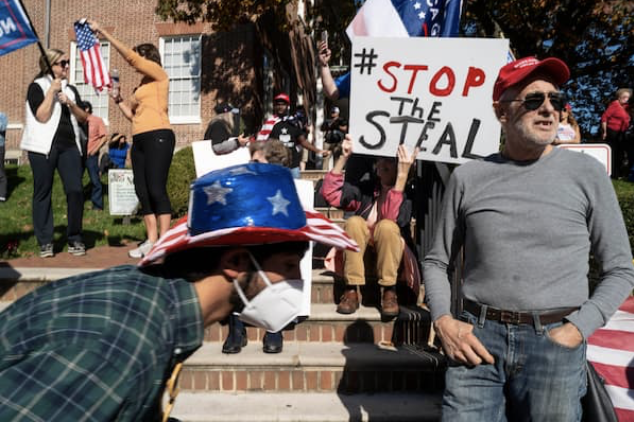
 Sen. Kamala Harris, D-Calif., makes a campaign stop at the University of Texas Rio Grande Valley in Edinburg on Oct. 30, 2020. Photo for The Washington Post by Julia Robinson.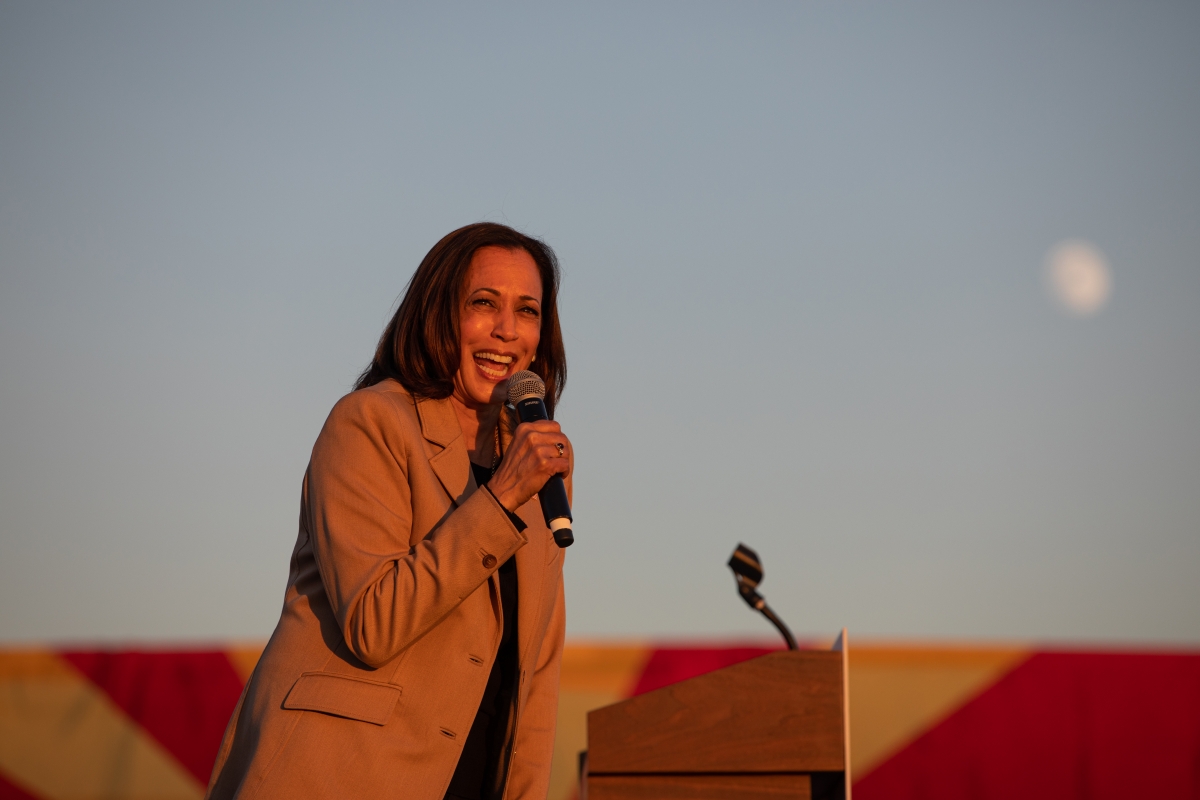
 George Bush is showered with confetti at a campaign rally in Cleveland on Nov. 1, 1992. Washington Post photo by Frank Johnston.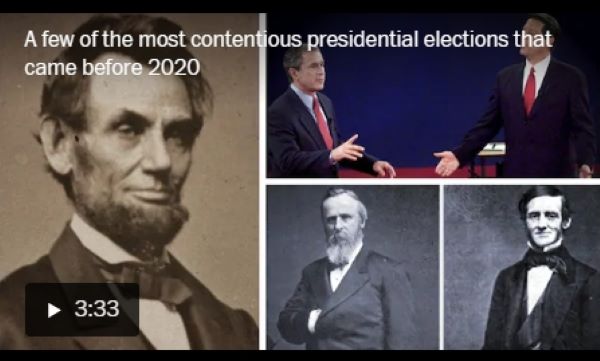


 President Trump leaves after speaking in a press briefing room at the White House on Thursday. MUST CREDIT: Washington Post photo by Jabin Botsford.
