
Biden takes lead in count in Pennsylvania and Georgia #SootinClaimon.Com

#SootinClaimon.Com : ขอบคุณแหล่งข้อมูล : หนังสือพิมพ์ The Nation.

Biden takes lead in count in Pennsylvania and Georgia

InternationalNov 06. 2020

By The Washington Post · John Wagner · NATIONAL, POLITICS 

Joe Biden overtook President Donald Trump in the count in Pennsylvania just before 9 a.m. as the state’s Democratic-leaning counties reported additional vote count totals.

President Trump departs after speaking in the James S. Brady Press Briefing Room at the White House on Thursday. MUST CREDIT: Washington Post photo by Jabin Botsford,

President Trump departs after speaking in the James S. Brady Press Briefing Room at the White House on Thursday. MUST CREDIT: Washington Post photo by Jabin Botsford,The count is ongoing. But Pennsylvania’s 20 electoral votes would put Biden over the 270 votes needed even with a handful of other states still too close to call.

Biden also took a small lead in Georgia early Friday, though vote counting is not yet complete. Thousands of requested overseas and military ballots may arrive by the deadline Friday, and there are provisional ballots left to count.

In Pennsylvania, Biden pulled ahead with the release of the vote count of mail-in ballots from heavily Democratic Philadelphia.

With the update, Biden leads Trump by more than 5,000 votes. If Biden win the state’s 20 electoral votes, he will have enough to claim an electoral college win.

Before the latest release, Biden had been trailing Trump by about 18,000 votes in Pennsylvania.

Pennsylvania was among the most hotly contested states of the cycle, with both Biden and Trump making regular trips to the state for most of the campaign.

Both candidates spent considerable time there in the final days of the race, with Biden holding a final rally in Pittsburgh the night before the election and making an additional two stops on Election Day.

The Trump campaign indicated Friday that it will continue to press legal challenges in four key states, despite losses in court a day earlier as two judges rejected its claims.

Republican National Committee Chairwoman Ronna McDaniel on Friday released a list of 12 political, legal and communications staff who will focus on Arizona, Georgia, Michigan and Pennsylvania. All but one person already worked for the Trump campaign, the RNC or state Republican parties, according to their LinkedIn and Twitter profiles.

“We will not give up on this process until every last issue has been resolved,” McDaniel said in a statement.

The Trump campaign has run into legal setbacks to its aggressive push to stop vote-counting in Michigan and Georgia. Judges in those states rejected the campaign’s lawsuits on Monday, and in Pennsylvania, a request to stop the count in Philadelphia was denied after a deal was struck to allow 60 observers from each party to watch the process.

Senate Majority Leader Mitch McConnell, R-Ky., advocated Friday that the election process continue to play out and that courts resolve disputes.

In a tweet, McConnell echoed Trump’s refrain about not counting illegal ballots but was silent on baseless conspiracies that Trump has pushed alleging widespread election fraud in states where Biden has picked up votes in counting since Election Day.

“Here’s how this must work in our great country: Every legal vote should be counted,” McConnell said. “Any illegally submitted ballots must not. All sides must get to observe the process. And the courts are here to apply the laws & resolve disputes. That’s how Americans’ votes decide the result.”

U.S. stocks were poised for an opening bell slide Friday as investors grapple with a maelstrom of uncertainty: record coronavirus infections, a weakening economic recovery and a yet-to-be called presidential race.

After mounting their sharpest rally since April, all major U.S. indexes were pointing lower in premarket trading as investors awaited October job numbers and the outcome of the presidential election. 

After unleashing a tirade from the White House briefing room Thursday night that was filled with falsehoods about the U.S. electoral system, Trump continued to air grievances overnight on Twitter and demanded that the U.S. Supreme Court intervene in the election.

One of Trump’s predawn tweets drew a warning label from Twitter for disputed and misleading content. In it, Trump falsely asserted that campaign observers were not allowed to do their job “in any way, shape, or form.”

“I easily WIN the Presidency of the United States with LEGAL VOTES CAST,” Trump claimed. “The OBSERVERS were not allowed, in any way, shape, or form, to do their job and therefore, votes accepted during this period must be determined to be ILLEGAL VOTES. U.S. Supreme Court should decide!”

There is no evidence of widespread fraud in this election. Officials in several states are still counting ballots that were legally submitted by mail and in person.

In his White House appearance on Thursday, Trump baselessly claimed that there was widespread fraud in states in which he was losing, but not in those he was winning. There is no evidence for his statements.

Trump’s broadsides have exposed tensions within his party, splitting GOP officials who spoke publicly on Thursday night into warring camps: those who defended the president and those who defended the U.S. election process. Many others, including Senate Majority Leader Mitch McConnell, R-Ky., have stayed silent.

Trump’s loyalists, including House Minority Leader Kevin McCarthy, R-Calif., and Sens. Lindsey Graham, R-S.C., and Ted Cruz, R-Texas, echoed Trump’s evidence-free claims of widespread fraud in Pennsylvania and other swing states that have been trending toward former vice president Joe Biden as more votes are counted.

China is awash with schadenfreude over U.S. election tumult #SootinClaimon.Com

#SootinClaimon.Com : ขอบคุณแหล่งข้อมูล : หนังสือพิมพ์ The Nation.

China is awash with schadenfreude over U.S. election tumult

InternationalNov 06. 2020

By The Washington Post · Gerry Shih · WORLD, ASIA-PACIFIC 
TAIPEI, Taiwan – “Hopeless America,” a columnist at China’s official Xinhua News Agency thundered.

“U.S. democracy now a joke,” the Beijing-backed Ta Kung Pao broadsheet pronounced.

“A bit like a developing country,” the Global Times sniffed as it contemplated the possibility of post-election violence erupting in the world’s most powerful democracy.

As the United States tallied votes in a presidential election that appears headed for a court battle and fractious final phase, Chinese commentators and state mouthpieces this week lined up to portray the cross-Pacific superpower – viewed with awe and envy by generations of Chinese – as a politically crumbling edifice in 2020.

The Chinese criticisms, while pointed, mirrored broad concerns among both U.S. allies and rivals as the United States wrestled with unfounded allegations of electoral fraud from President Donald Trump on Wednesday, an emerging legal showdown and the prospect of internal divisions that could endure well beyond Inauguration Day. Sizing up the situation, newspapers in South Korea and Japan this week questioned the “intrinsic value of democracy” while Britain’s former foreign secretary Jeremy Hunt warned about a potential “catastrophe for the worldwide reputation of democracy.”

But in China, state media and the commentariat followed the unprecedented scenes from the United States not with anxiety but schadenfreude. The country had been locked in an increasingly ideological confrontation with the Trump administration and has doubled down in recent years on promoting the legitimacy of Communist Party rule to its citizens.

In a piece in Xinhua’s China Comment magazine, Wang Pengquan, a state socialism researcher, chastised his compatriots for reflexively “kowtowing” to U.S. superiority and urged them to build a “modern socialist country.”

“America-worshippers exaggerate its political system’s ability to self-correct and tout its so-called freedom,” Wang wrote. “Facts speak louder than words. The vast majority of Chinese can see through the reality of U.S. political division, economic stagnation and social turmoil.”

No matter the outcome of the election, there is little hope for the United States to regain the global leadership it inherited at the end of World War II, wrote Xinhua editor Wang Jinwei in another piece as he described a country racked by racial tensions, economic inequality and unchecked coronavirus cases.

Criticisms of liberal democracy, to be sure, are nothing new from Beijing, where the Chinese Communist Party (CCP) holds power with an iron grip. China has rapped neighboring Taiwan and South Korea, for instance, when brawls have broken out in their parliaments. When the presidential election in 2000 between George W. Bush and Al Gore descended into controversy before being settled by the Supreme Court, state media noted mildly that the U.S. electoral system “is in fact not perfect.”

The tone was harsher this time.

“Democracy has not made America great again, nor has it saved Americans from the pandemic,” said Wang Wen, an executive dean at Renmin University in Beijing who wrote an essay earlier this year titled “the End of the American Century.”

“This is no longer the United States we knew in the past,” Wang told The Washington Post.

Freedom House, a nongovernmental, nonpartisan advocacy organization in Washington, D.C., released a report this year that included the United States among countries where democratic institutions have weakened.

But Sarah Cook, a China researcher at Freedom House, said the Chinese criticisms of democracies were “ironic” and a “typical part of the playbook” from its state media. Cartoons and memes mocking Trump and U.S. politicians have been widespread in China, but “any user posting anything even remotely irreverent of Xi Jinping faces severe punishment, including possible imprisonment,” she said, referring to the Chinese president.

“Those kinds of actions speak louder than words in terms of the deep level of insecurity behind the CCP and state media’s boasting of their own system.”

As vote totals climbed, many independent outlets on Chinese social media, which represent the most popular way for many Chinese to consume news, scrambled to provide readers detailed explanations on matters such as the U.S. electoral college, why absentee ballots could dramatically shift vote totals after polls closed, and the implications of Trump declaring an early victory.

Government censors, for the most part, stayed at arm’s length from discussions about U.S. politics as the topic racked up nearly 7 billion views on Weibo.

In Hong Kong, where Beijing has accused Washington of political interference, the Communist Party-controlled Ta Kung Pao newspaper seized on the election turmoil as an example of Washington’s “double standards.”

The U.S. government sided last year with Hong Kong pro-democracy protesters who demanded the right to choose the city’s leader rather than selecting from candidates prescreened by Beijing. Yet the U.S. president is also not selected simply by popular vote, the newspaper argued, while pointing out that the U.S. election could be mired in a legal challenge and that the White House is barricaded behind steel bars.

“What is infuriating is that Americans themselves reject so-called true universal suffrage but ask Hong Kong to promote it,” Ta Kung Pao opined. “The U.S. election is not a model of democracy, but an ugly demonstration of democracy. It’s a worldwide laughingstock.”

When the U.S. Embassy in Beijing also sought to explain the electoral college on Weibo as part of the State Department’s public diplomacy, it was also greeted with skepticism.

One Chinese user derided the state of democracy in the United States as “slipping to the level of Belarus or Venezuela.”

Another joked that America is so divided it should adopt China’s “one country, two systems” framework for governing Hong Kong: “You can have two governments and two presidents!”

Judges in two states reject Trump campaign lawsuits as the president continues to press unsubstantiated claims of fraud #SootinClaimon.Com

#SootinClaimon.Com : ขอบคุณแหล่งข้อมูล : หนังสือพิมพ์ The Nation.

Judges in two states reject Trump campaign lawsuits as the president continues to press unsubstantiated claims of fraud

InternationalNov 06. 2020President Donald Trump speaks in the briefing room at the White House on Thursday in Washington, D.C. MUST CREDIT: Washington Post photo by Jabin Botsford
President Donald Trump speaks in the briefing room at the White House on Thursday in Washington, D.C. MUST CREDIT: Washington Post photo by Jabin Botsford 

By  The Washington Post · Amy Gardner, Jon Swaine, Michelle Ye Hee Lee, Emma Brown · NATIONAL, POLITICS, COURTSLAW 
WASHINGTON – President Donald Trump and his allies pressed their claims Thursday that election officials have allowed ballot fraud to infect the counting process in the battleground states poised to decide the presidency, but they offered no evidence of irregularities and met with two immediate defeats in court.

In Georgia, a local judge in Chatham County, home of Savannah, denied the Trump campaign’s effort to disqualify about 50 ballots that a Republican poll watcher claimed may have arrived after the 7 p.m. deadline on Election Day. In court, the poll watcher offered no evidence that the ballots had arrived late, and county election officials testified that they had arrived on time.

And in Michigan, a Court of Claims judge said she would deny the campaign’s request for an emergency halt to the counting of votes in the state. She noted that the request made little sense, given that the counting has essentially been finished in the state, with former vice president Joe Biden ahead by about 150,000 votes. He has been declared the winner of the state by national news organizations. Michigan Attorney General Dana Nessel’s office described Trump’s request as an “attempt to unring a bell.”

Meanwhile, the Trump campaign announced its intent to file a lawsuit in another state where counting is continuing apace: Nevada. At a chaotic news conference in Las Vegas, campaign officials said that they plan to file a suit in federal court to stop the counting of what they called “improper votes.”

The threatened legal action was part of a barrage of lawsuits that the president’s campaign has filed since Election Day, seeking to slow the vote count as Biden’s totals steadily increase. So far, they have threatened legal challenges or demanded recounts in five states – Pennsylvania, Wisconsin, Georgia, Michigan and Nevada.

The campaign also joined in a lawsuit against Maricopa County, home of Phoenix, claiming that large numbers of Republican ballots were invalidated after voters used Sharpie pens to mark their choices. The complaint was filed on behalf of two voters, one of whom, the suit alleged, was denied a second ballot after a poll worker canceled the first one because a machine couldn’t read it. State and local election officials have said repeatedly that Sharpies are preferred for filling out ballots and that there is no evidence they cause difficulties in the scanning process.

The Maricopa County attorney’s office wrote to the state attorney general’s office Thursday saying that no ballots were rejected at the county’s voting centers and that when ballots cannot be read, voters are given the option of casting new ones.

In a call with reporters, Biden campaign attorney Bob Bauer accused Trump’s campaign of filing “meritless” lawsuits meant to misinform the public and disrupt the vote count.

“This is part of a broader misinformation campaign that involves some political theater,” he said, saying the Trump camp has provided no evidence of wrongdoing.

But the president repeated unsubstantiated claims about fraud throughout the day, pushing a line of attack he has pressed throughout the campaign.

“All of the recent Biden claimed States will be legally challenged by us for Voter Fraud and State Election Fraud,” he tweeted in a message tagged by Twitter as misleading. “Plenty of proof – just check out the Media. WE WILL WIN! America First!”

Trump’s supporters demanded that the count continue in Arizona, meanwhile, where Biden held a healthy lead Thursday but where hundreds of thousands of ballots remained uncounted. 

The president’s allies touted a minor legal victory in Pennsylvania, where a state appeals court on Thursday allowed GOP poll watchers to observe the counting of ballots from six feet away. The decision prompted election officials in Philadelphia to stop counting temporarily to accommodate the observers; the count had resumed by midafternoon.

The decision is unlikely to have an immediate impact on the vote count. Observers are not permitted to challenge the validity of ballots. The Trump campaign said in its brief that it was not trying to change this and “simply wants the right to observe.”

“Under the Constitution, the legislature has the right to make these laws, which they’ve made, and the judge just confirmed that they must be followed,” Trump campaign attorney Pam Bondi said at a news conference in Philadelphia. “So we plan on entering that building and legally observing the voting process.”

The legal jockeying drew competing rallies to the city streets: on one side, about 25 Trump supporters shouted, “Legal votes matter!” and “Trump!” Across the street, about 50 counterprotesters chanted, “Count every vote!”

The Trump team is engaged in half a dozen lawsuits in Pennsylvania, including those seeking to halt the counting of a small number of mail ballots whose voters were given the opportunity to correct errors. A new suit filed late Thursday seeks to disqualify 600 ballots in Montgomery County that had no secrecy envelopes as required by law. 

The president sought to intervene in a Pennsylvania case already filed at the U.S. Supreme Court seeking to reverse a state court’s decision to extend the deadline for receiving mail ballots from 8 p.m. on Election Day to 5 p.m. Friday.

Although the Trump campaign claimed that the case “may well dictate who will become the next president,” the Democrats said that “is not remotely clear at this juncture.”

The Trump campaign said it would open another front in its legal war in Nevada. At a news conference Thursday morning at the Clark County elections department headquarters, Adam Laxalt, a former Nevada attorney general and co-chair of the Trump campaign in the state, claimed without providing evidence that ballots from deceased people had been counted, and that “thousands” of people had voted despite moving out of Clark County during the pandemic. As of late afternoon Thursday in Las Vegas, no such lawsuit had been filed.

Laxalt ignored reporters’ questions asking for examples of the fraud he described. About 100 Trump supporters swarmed the news conference waving Trump flags and carrying signs reading “Stop the Steal.”

Trump’s efforts to block the counting of votes coincided with a painstaking process in four battlegrounds – Arizona, Nevada, Georgia and Pennsylvania – that will determine the next occupant of the White House. In Georgia and Pennsylvania, Trump is ahead, but his lead has diminished with each new update of counted votes.

Top Biden campaign officials, while calling for patience as final ballots are being counted, continued projecting confidence that their candidate will soon be declared the winner of the presidential election.

“We are absolutely confident that Joe Biden will be the next president of the United States,” campaign manager Jen O’Malley Dillon said on a call with reporters, which included slides on how campaign officials think they will win at least four of the most hotly contested remaining states.

In Georgia, for instance, Trump’s lead had narrowed to fewer than 10,000 votes by early Thursday evening, with roughly 19,000 ballots left to count statewide. Biden was winning the late-counted ballots by large margins in part because they were concentrated in Democratic enclaves around Savannah and metro Atlanta, and also because they were mail ballots, which Democrats had used in greater numbers than Republicans.

The tightening margin in Georgia may lead to a recount request. If the margin is less than or equal to 0.5 percent of the certified results, a candidate can request a recount. There is no automatic recount in the state, and a candidate must request a recount within two business days after the certification, which is scheduled to take place by Nov. 20.

The president’s allies, meanwhile, appeared poised to open up a new front in their effort to secure the election for Trump. Conservative talk radio host Mark Levin urged Republican-controlled state legislatures to prepare to override the popular vote in their states and appoint their own slate of electors.

“REMINDER TO THE REPUBLICAN STATE LEGISLATURES, YOU HAVE THE FINAL SAY OVER THE CHOOSING OF ELECTORS, NOT ANY BOARD OF ELECTIONS, SECRETARY OF STATE, GOVERNOR, OR EVEN COURT,” Levin tweeted. “YOU HAVE THE FINAL SAY.”

Federal law empowers state legislatures to step in and appoint electors if an election has “failed” to produce a result. But what constitutes a “failed” election is the subject of much dispute – and would most certainly wind up in court if lawmakers in Arizona, Georgia or Pennsylvania – the three states with GOP legislatures – declared the election a failure.

Even if Republicans did appoint Trump electors in any of these states, state election officials could seat Biden’s electors on the basis of the popular vote. In that case, an obscure federal law called the Electoral Count Act would leave it to Congress to decide which set of dueling electors to seat.

If Congress deadlocks, as it might, given Republican control of the Senate and Democratic control of the House, the electors seated by a state’s executive branch – its governor or secretary of state – would prevail over those seated by the state legislature (though that scenario, too, would be likely to prompt litigation).

World watches with unease as drawn-out, contested election batters America’s global image #SootinClaimon.Com

#SootinClaimon.Com : ขอบคุณแหล่งข้อมูล : หนังสือพิมพ์ The Nation.

World watches with unease as drawn-out, contested election batters America’s global image

InternationalNov 06. 2020Mary Alice Phillips opens absentee ballots and prepares them for scanning In the Pre-Tabulation Room at the Dekalb County Voter Registration and Elections Office in Atlanta on Nov. 4, 2020. MUST CREDIT: Washington Post photo by Kevin D. LilesMary Alice Phillips opens absentee ballots and prepares them for scanning In the Pre-Tabulation Room at the Dekalb County Voter Registration and Elections Office in Atlanta on Nov. 4, 2020. MUST CREDIT: Washington Post photo by Kevin D. Liles 

By The Washington Post · Simon Denyer, Rick Noack, Adam Taylor, Siobhán O’Grady · WORLD
As the world reckoned with another day of uncertainty over the result of the U.S. presidential election, Trump’s premature victory claim, unsubstantiated allegations of voter fraud and the threat of legal challenges continued to overshadow the drawn out vote count, from which no clear winner has emerged. The indecision was met with deep unease around the globe over what lies ahead for the U.S. political process – and more than a little glee from America’s traditional adversaries.

Here are the latest developments:

– “I think the whole world waits for the final outcome in the United States,” New Zealand Prime Minister Jacinda Ardern told reporters Thursday. “We have faith in the institutions in the United States and of course faith that those final votes will continue to be counted and there will be a final result declared.”

– “STOP THE COUNT!” Trump tweeted Thursday. “IT’S CALLED DEMOCRACY!” former Italian Prime Minister Enrico Letta wrote in response.

– Trump’s strong showing has left many foreign observers bewildered – and asking whether Trumpism is here to stay.

– Stock markets around the world held up on Thursday despite the uncertainty. Asian markets closed up across the board Wednesday, and European indexes broadly advanced.

– – –

Amid the slow count, America’s global image as a model for other democracies to emulate has taken yet another battering, especially among its allies around the globe.

In Canada, lawmakers have been relatively silent on the aftermath of the vote, but election coverage continued to dominate the country’s largest newspapers, to the point that they nearly resembled U.S. dailies.

The Toronto Star described a “nagging, palpable sense of dread” that no matter who prevails, Canada has never felt “so far apart” from its southern neighbor. An editorial in the Globe and Mail, meanwhile, commented on Trump’s litigiousness.

“Better an army of lawyers than an army of Proud Boys,” the paper wrote. “Americans suing Americans? Yawn. Have at it.”

After Trump falsely declared victory before the votes were counted on election night, he spent much of Wednesday and Thursday leveling allegations of electoral fraud without evidence. His campaign has since announced legal challenges to determine which votes will count. Days of court battles and political uncertainty lie ahead. Many fear violence.

Lawmakers from the Organization for Security and Cooperation in Europe who had observed the U.S. election said Trump’s comments were “baseless” and “harm public trust in democratic institutions.”

– – –

The U.S. push for global human rights and democracy – while the country’s political system is so affected by moneyed influence and apparent electoral problems, and its foreign policy record so marked by support for dictators and its own economic interests – has long carried more than a whiff of hypocrisy for many observers abroad. But the idea of U.S. democracy still has the power to inspire.

“America has represented optimism, looking forward and ideas,” said Tatsuhiko Yoshizaki, chief economist at the Sojitz Research Institute in Tokyo. “And yet, over the past four years, we have come to see the dark side in the United States.”

The same sentiment was echoed in Europe on Thursday, where Germany’s left-leaning Der Spiegel newsweekly compared Trump to a “late Roman emperor” who has “set a historic standard for voter contempt.” One of the paper’s conservative competitors, Die Welt, chose a similar comparison.

France, though, offered a hopeful assessment on Thursday. “I have faith in U.S. institutions validating the results of the election,” French Foreign Minister Jean-Yves Le Drian told Europe 1 radio.

In Britain, some commentators responded with disgust – with the left-leaning Daily Mirror calling Trump “a liar and a cheat until the bitter end” – while other papers turned to humor, especially over the slow pace of the vote count. The front page of the Metro newspaper read: “Make America Wait Again.”

Without weighing in directly, some world leaders appeared to react to Democratic candidate Joe Biden’s emerging lead in electoral votes. Irish Deputy Prime Minister Leo Varadkar privately told lawmakers Wednesday that a Biden presidency would allow the European Union to secure a better trade agreement with Britain, “because the Democrats watched our backs on Brexit,” the Irish Times reported.

Mick Mulvaney, U.S. special envoy for Northern Ireland and former White House chief of staff under Trump, tried to calm nerves when he appeared at an online panel run by the Dublin-based Institute of International and European Affairs. “American elections can be a sloppy, ugly thing,” he said, according to an Irish reporter watching the panel. “We describe it like making sausages, no one wants to see it happen but you enjoy the final product.”

Some U.S. officials did not attempt to shy away from partisan efforts to project reassurance. “Pres Trump had done an awesome job,” U.S. Ambassador to Kenya Kyle McCarter, a Trump appointee, wrote on Twitter. “The only ones to be shamed are those to break the law and cast illegal votes.”

JJ Omojuwa, a blogger in Nigeria’s capital, Abuja, has been live-tweeting the election’s aftermath to his 1 million followers – and growing increasingly concerned. “It is just sad that dictators elsewhere will be emboldened by Trump’s antics,” he said, “and unlike the United States, there will be no strong institutions to check their antics.”

Mathias Hounkpe, a pro-democracy activist in Senegal who has helped monitor elections across West Africa over the years, said he had never seen anything like what Trump supporters were doing Wednesday night in Arizona. Some had come armed to a protest outside an election office in Maricopa County.

“We can’t believe that people are taking guns to where votes are being counted,” said Hounkpe, who is from Guinea. “Even in Africa we do not see that.”

– – –

Governments across Asia have largely refrained from meaningful comment, in the absence of an outcome. But newspapers and analysts were not so circumspect.

Trump’s speech prematurely declaring victory as ballots were still being counted sparked alarm in India, the world’s most populous democracy.

The move marked a “distinctly authoritarian turn” that overshadowed a “relatively peaceful election exercise in the world’s oldest democracy,” the Hindu, a newspaper, wrote in an editorial.

To some in Asia, the U.S. divisions served as a warning. In Indonesia, social media was abuzz with Trump’s false declaration of early victory, a move reminiscent of an Indonesian presidential hopeful, Prabowo Subianto, who lost last year’s election but continued to claim victory and encouraged his supporters to protest. The retired army general is now the defense minister.

And in South Korea, a U.S. ally, the division on display in the United States held up a painful mirror to its own democracy, which has also become extremely polarized. “The chaos in the so-called advanced democracy of the United States sparks concerns that we are not much different,” the Seoul Shinmun newspaper wrote in an editorial.

In New Zealand, where progressive leader Jacinda Ardern just secured a second term after effectively stamping out the coronavirus in the country, commentators were baffled by the narrow race.

Trump’s surprising strength is a sign that the United States is “splintering into two distorted, mirror images,” the website Newsroom added in an op-ed, written by a U.S. journalist based in the country.

New Zealand’s government recorded a surge in interest on how to move to the country this week, prompting warnings that disappointed American voters should not get ahead of themselves. “Fleeing Americans bound for disappointment at NZ border,” Newsroom warned its readers.

In the event of a Biden victory, newly appointed Japanese Prime Minister Yoshihide Suga would likely travel to the United States after inauguration next year, the Japan Times reported this week. But if Trump were to win, Suga might visit sooner, the paper reported. The pair have not met since Suga took over his role in September. He told lawmakers this week that he plans to forge a “firm” relationship with the White House regardless of who wins.

In China, a number of publications used the election to highlight shortcomings of the American system.

U.S.-style democracy is a “joke” with clear “double standards,” said an editorial in the Ta Kung Pao newspaper in Hong Kong, controlled by China’s liaison office in the city.

“One can feel the anxiety for potential chaos seeing metal fences and security being hastily installed around the White House,” the editorial said.

Still, China’s vice foreign minister, Le Yucheng, voiced hopes on Thursday about repairing bilateral relations after the election. “I hope the new U.S. administration will meet China halfway,” he said, according to CNBC.

Meanwhile, Russian President Vladimir Putin is expected to hold “an international telephone conversation” on Thursday evening, the Tass news agency cited Kremlin spokesman Dmitry Peskov as saying. It was unclear with whom Putin would speak, but the announcement was seen as unusual by Kremlin observers.

Ethiopia conflict escalates as army sends more troops to Tigray region #SootinClaimon.Com

#SootinClaimon.Com : ขอบคุณแหล่งข้อมูล : หนังสือพิมพ์ The Nation.

Ethiopia conflict escalates as army sends more troops to Tigray region

InternationalNov 06. 2020

Ethiopia

Ethiopia

By The Washington Post · Lesley Wroughton, Carol Morello · WORLD, AFRICA 
Ethiopia’s dispute with the northern Tigray region escalated Thursday with reports of heavy shelling and the army’s deputy chief declaring that the country had entered into “an unexpected war” and was sending more troops to the area.

The intensifying conflict drew an urgent international response, with the United Nations dispatching a special envoy to Ethiopia’s capital, Addis Ababa, and the International Crisis Group warning that the conflict could spread beyond Ethiopia’s borders.

“Our country has entered into an unexpected war. The war will not come to the center. It will end there,” in Tigray, the deputy chief of the Ethiopian National Defense Force, Birhanu Jula, said on state television.

A statement attributed to the regional government on Tigray TV claimed government fighter jets had bombed the outskirts of the region’s capital, Mekele, but those reports could not be confirmed. Communications, including Internet and phone connections, were cut in the region this week.

Ethiopia’s government has not commented on the bombing allegations, and a spokeswoman for Prime Minister Abiy Ahmed did not respond to a request for comment.

Clashes erupted in Tigray on Wednesday after Abiy, the 2019 Nobel Peace Prize winner, sent troops into Tigray province and declared a “military confrontation” after the regional government attacked a federal military base. Abiy accused the Tigray People’s Liberation Front (TPLF), which for decades was the dominant political force in the country’s multiethnic ruling coalition, of attempting to steal artillery and other military equipment during the attack.

A senior State Department official, who spoke on the condition of anonymity to comment frankly on the volatile conflict, said he had heard “wildly contradictory” reports about events on the ground in Tigray. He said he had heard of military casualties but said that communications network had been cut and that it was difficult to confirm reports.

The official confirmed that international efforts to de-escalate tensions were underway and said that the United States wanted to be “as helpful as possible to promote a peaceful resolution.”

The official pushed back at suggestions that Ethiopia was engaged in a war, saying that “it is not one sovereign state fighting against another sovereign state.”

Debretsion Gebremichael, president of the Tigray region, told reporters that “we are in position to defend ourselves from enemies that waged war on the Tigray region. . . . We are ready to be martyrs.”

Human Rights Watch called on Abiy’s government to immediately restore communications to the region, saying it hampered critical reporting of events affecting people’s health and safety in Tigray.

“It also undermines their rights to question the government’s account of events,” Mausi Segun, Africa director at Human Rights Watch, said in a statement.

Biden renews call for patience as Trump campaign launches more legal fights over ballots #SootinClaimon.Com

#SootinClaimon.Com : ขอบคุณแหล่งข้อมูล : หนังสือพิมพ์ The Nation.

Biden renews call for patience as Trump campaign launches more legal fights over ballots

InternationalNov 06. 2020Former Vice President and presidential nominee Joe Biden speaks Thursday in Wilmington, Del. MUST CREDIT: Washington Post photo by Demetrius Freeman
Former Vice President and presidential nominee Joe Biden speaks Thursday in Wilmington, Del. MUST CREDIT: Washington Post photo by Demetrius Freeman 

By The Washington Post · Matt Viser, Toluse Olorunnipa · NATIONAL, POLITICS, COURTSLAW, WHITEHOUSE 
WASHINGTON – Joe Biden insisted Thursday that he was on the verge of winning the presidency, urging calm and patience as the final votes were methodically counted. As he did, President Donald Trump made frantic legal claims and promoted unfounded allegations about voter fraud in a number of states that he was losing or seeing his lead swiftly diminish.

With tension high in states that remained too close to call, weary election officials continued tallying results, at times with police protecting them from protesters as the presidency hung in the balance of final tabulations in a handful of states.

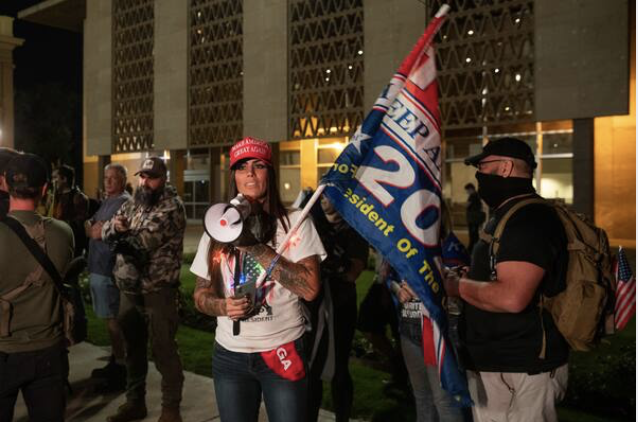
A far right protester is seen at the Arizona Capitol in Phoenix, Ariz, on Nov. 4, 2020. MUST CREDIT: Photo for The Washington Post by Caitlin O'Hara

A far right protester is seen at the Arizona Capitol in Phoenix, Ariz, on Nov. 4, 2020. MUST CREDIT: Photo for The Washington Post by Caitlin O’Hara

Biden remained in the lead, with 253 electoral votes to Trump’s 214 and a number of pathways toward winning the 270 needed to secure the presidency.The former vice president maintained his leads in Arizona and Nevada, while Trump’s advantages were diminishing in both Georgia and Pennsylvania. 

Officials in Pennsylvania, the biggest electoral prize and a state that would given Biden enoughelectoral college votes to be declared the winner, said they were ahead of schedule and may have enough ballots tallied by Thursday night to declare a winner.

On Thursday afternoon, Trump’s campaign issued a statement from him using exclamation points and all-caps lettering to drive home a baseless charge of election rigging.

“IF YOU COUNT THE LEGAL VOTES, I EASILY WIN THE ELECTION!” Trump said in the statement. “IF YOU COUNT THE ILLEGAL AND LATE VOTES, THEY CAN STEAL THE ELECTION FROM US!”

Minutes later, Biden wrote on Twitter: “Be patient, folks. Votes are being counted, and we feel good about where we are.”

Biden’s campaign has expressed increasing optimism that a victory was imminent, creating a website to promote the work of his transition team. Biden and his running mate, Sen. Kamala Harris, D-Calif., on Thursday held a briefing at a theater in Wilmington, Del., with a team of health and economic advisers to discuss the ongoing coronavirus crisis. 

It was a visible sign of what his campaign hoped to project: Biden soberly preparing to transition into the White House. Trump, meanwhile, has not been seen publicly since the early morning hours of Wednesday, when he gathered with supporters at the White House and declared he had won. He spoke Thursday evening.

“Democracy is sometimes messy. Sometimes it requires a little patience, as well,” Biden said Thursday afternoon following his briefing.

“We continue to feel very good about where things stand. And we have no doubt that when the count is finished, Senator Harris and I will be declared the winners,” he added. “So I ask everyone to stay calm – all people to stay calm. The process is working. The count is being completed. And we’ll know very soon.”

Biden campaign manager Jen O’Malley Dillon displayed several slides to reporters earlier in the day, demonstrating how they think Biden will win at least four of the remaining six competitive states. She said their calculations showed Biden’s lead might narrow in Arizona and Nevada, particularly as results from more pro-Trump rural areas are counted, but they remained confident that returns from urban strongholds would help protect their lead. 

“We don’t really care which state takes us over the top. We just want to keep going and make sure the counts get done,” O’Malley Dillon said. “We know that it’s going to take a little bit of time and we support that, and we’re just going to stay calm and be patient.”

Biden and other Democrats got a bit of good news Thursday, as Sen. David Perdue, R-Ga., fell below the 50% mark in his bid for reelection. If that holds once counting is completed, it would trigger a runoff in January. A second Georgia Senate race is already expected to lead to a runoff.

Democrats lost multiple Senate races on Tuesday, and their chances of drawing a 50-50 split in the Senate would rest on winning both of those races.

The legal wrangling also continued on Thursday, with Trump’s campaign attempting to sow doubt in the election results in a way that could both seek to change the results as well as produce an explanation for a loss. 

Biden campaign attorney Bob Bauer accused Trump’s campaign of engaging in a series of “meritless” lawsuits meant to misinform the public and disrupt the vote count.

“This is part of a broader misinformation campaign that involves some political theater,” he said, adding that the Trump camp has provided no evidence of wrongdoing.

“All of this is intended to create a large cloud that, it is the hope of the Trump campaign, that nobody can see through,” he added. “But it is not a very thick cloud. It’s not hard to see what they’re doing. We see through it. So will the courts, and so do election officials.”

Offering no specific evidence, several Trump allies have claimed that voter irregularities have impacted the tally in states including Pennsylvania, Wisconsin, Georgia and Nevada. The campaign has filed lawsuits in several of those states attempting to halt or alter the vote-counting process.

“These magical sacks of ballots that keep popping up in corrupt and crooked localities that are run by partisan Democrats – we’re going to have eyes on them,” Trump campaign senior adviser Jason Miller told reporters Thursday, making broad accusations with no specific evidence. “And we’re going to make sure they’re not able to pull a fast one on the American people.”

The campaign touted a legal ruling in Pennsylvania that allowed Republican operatives to get a closer look at the ballot-counting process. A judge in Georgia dismissed a separate lawsuit filed by the Trump campaign on Thursday. The lawsuit alleged voter fraud in a few dozen ballots but lacked evidence.

For his part, Trump remained behind closed doors for a second straight day, tweeting his displeasure from the White House.

“STOP THE FRAUD,” he tweeted Thursday afternoon, providing no specifics in a comment deemed by Twitter as misleading. Hours earlier he tweeted “STOP THE COUNT.”

Trump and his allies took issue with the counting of mail-in ballots after Election Day, claiming that the standard process of tallying those votes was a sign of voter fraud.

“ANY VOTE THAT CAME IN AFTER ELECTION DAY WILL NOT BE COUNTED!” Trump wrote on Twitter, another tweet that the social media platform hid after determining it was false or misleading.

In reality, election officials commonly take days, if not longer, to count ballots cast by mail. This year those mail-in ballots had to be counted after Election Day in part because Republican state lawmakers in Michigan, Wisconsin and Pennsylvania blocked election officials from getting a head start on processing and sorting ballots before then. In states that allowed early processing, such as Republican-led Ohio, mail-in votes were tallied on Election Day.

The Trump campaign on Thursday did secure a ruling in Pennsylvania that allowed them access to watch votes be counted in the state, as long as the observers are six feet away and wear masks in accordance with health guidelines during the pandemic.

Several of their other lawsuits were quickly shot down by judges. 

A judge in Chatham County, Ga., denied a Trump campaign suit alleging that ballots had been improperly counted because ballots that arrived after the 7 p.m. deadline may have been mixed in with eligible ballots. The judge determined that the poll watcher cited by the Trump campaign could not provide evidence for the claim. 

A judge in Michigan, which was called for Biden on Wednesday, told lawyers for the Trump campaign that she would deny the campaign’s request for an emergency halt in the counting of votes in the state.

Trump campaign advisers held a news conference in Nevada in which they made unsubstantiated claims that dead people and nonresidents had been voting in large numbers. Shortly after the event, Biden’s narrow lead in Nevada widened.

By early Thursday evening, after a new batch of votes was tabulated, Biden had a lead of more than 11,000. There were still tens of thousands more votes left to be counted, including about 63,000 mail ballots and 60,000 provisional ballots in Clark County, the state’s largest county and a Democratic stronghold.

The numbers could grow further, since election officials in Nevada must count any mail ballot that was postmarked by Election Day and arrives by Nov. 10. 

“Our goal here in Clark County is not to count fast. We want to make sure that we’re being accurate,” said Joe Gloria, the county’s registrar of voters, warning final counts might not be done until this weekend. “Obviously, we are going to be very important to the entire country and that is our number one goal.”

If the remaining states remain extremely tight, calling the race could be further complicated because tens of thousands of ballots were caught in U.S. Postal Service processing facilities until the day after Election Day, according to new data filed in federal court.

In Pennsylvania, 6,877 ballots were processed on Nov. 4. That number was 5,915 in North Carolina, 9,037 in Nevada and 1,706 in Georgia. Those votes – which could count in some states but not others depending on local ballot deadlines – could loom large in tightening races.

The Postal Service processed close to 150,000 ballots nationwide on Wednesday, with a 94.5-percent on-time rate, an improvement over recent days, but still below the 97 percent that postal and voting experts expect of the agency.

But in the nine postal districts spanning five swing states yet to be decided – Arizona, Nevada, Pennsylvania, North Carolina and Georgia – the ballot on-time rate was 84.6 percent. That means roughly 15 out of every 100 ballots in processing plants were not sorted – or delivered – on time.

In filing the data, Justice Department lawyers representing the Postal Service in U.S. District Court for the District of Columbia cautioned that the figures were not reliable. The data does not include “first mile” and “last mile” handling steps, which could add time to delivery, and only accounts for items the agency was able to successfully identify as ballots. 

The Postal Service also encouraged post offices to cull local ballots by hand and deliver them directly to vote counters, bypassing the regional facilities that account for processing scores, though the agency cannot say how widely that practice was being employed.

Police officers accused of killing George Floyd to be tried together, in Minneapolis #SootinClaimon.Com

#SootinClaimon.Com : ขอบคุณแหล่งข้อมูล : หนังสือพิมพ์ The Nation.

Police officers accused of killing George Floyd to be tried together, in Minneapolis

InternationalNov 06. 2020Flameless candles are illuminated after being placed at the memorial for George Floyd outside Cup Foods to celebrate what would have been Floyd's 47th birthday on Oct. 14 in Minneapolis. MUST CREDIT: Washington Post photo by Joshua Lott.Flameless candles are illuminated after being placed at the memorial for George Floyd outside Cup Foods to celebrate what would have been Floyd’s 47th birthday on Oct. 14 in Minneapolis. MUST CREDIT: Washington Post photo by Joshua Lott. 

By The Washington Post · Holly Bailey · NATIONAL, COURTSLAW, RACE 
MINNEAPOLIS – The former police officers charged with killing George Floyd will be tried together next March in a downtown Minneapolis courthouse, though the judge overseeing the criminal case said he would reconsider a change of venue motion if security or other issues arise.

In a series of rulings filed Wednesday but made public Thursday, Hennepin County District Court Judge Peter Cahill denied defense motions for separate trials in which the former officers’ attorneys claimed their clients will be presenting “antagonistic defenses” that could jeopardize their right to a fair trial. Such defenses could include individual officers arguing that they are not responsible for Floyd’s death but alleging that other officers should take responsibility for the slaying.

Cahill denied those motions, arguing in a 51-page ruling that evidence against the former Minneapolis officers – Derek Chauvin, J. Alexander Kueng, Thomas Lane and Tou Thao – “will substantially overlap” and that separate trials would be complex and place an “undue burden” on state prosecutors and the court system.

Citing security threats, the judge also ruled that jurors in the case will be publicly anonymous – their names, addresses and other identifying information known only to the court and involved attorneys until after the trial. He also ruled that jurors will be partially sequestered; they will be allowed to sleep in their own homes, but the Hennepin County Sheriff’s Office will transport them to the courthouse from a remote meeting point each day to maintain their privacy.

Cahill also decided that there can be audio and video coverage of the trial – against prosecutors’ wishes – because of the anticipated need to maintain social distancing during the ongoing covid-19 pandemic.

In a separate ruling, the judge also declined to move the trial out of Hennepin County, rejecting defense concerns about the ability to seat an impartial jury given the intense media coverage of the case and the possibility of protests that could threaten the safety of participants, including jurors. Cahill wrote that a “fair and safe trial” can be held in Minneapolis and pointed out that “no corner of the state of Minnesota has been shielded from pretrial publicity regarding the death of George Floyd.”

Minnesota Attorney General Keith Ellison, whose office is overseeing the prosecution, said he was “satisfied” by the court’s decisions and believes the case should go forward as planned.

“The murder of George Floyd occurred in Minneapolis, and it is right that the defendants should be tried in Minneapolis,” Ellison said. “It is also true that they acted in concert with each other and the evidence against them is similar, so it is right to try them in one trial.”

Floyd died May 25 while handcuffed and restrained facedown on a South Minneapolis street as police investigated a 911 call about a counterfeit $20 bill that had been passed at Cup Foods, a local convenience store. During a struggle with police, Floyd was placed on the ground, where Chauvin pressed his knee into the man’s neck for approximately nine minutes as Floyd repeatedly complained of struggling to breathe. Floyd ultimately lost consciousness and lost a pulse while subdued.

The former officers have offered various defenses. Through their attorneys, Kueng and Lane, who were rookies who had been on the job full time for less than a week, have sought to shift blame to Chauvin, a 19-year veteran of the Minnepolis Police Department who was the senior officer at the scene. Chauvin has blamed Kueng and Lane, suggesting they were in control of the scene and did not do enough to de-escalate the situation with Floyd. Thao, who was handling crowd control, has said his job was to be a “human traffic cone” and that he was not paying close attention to the scene behind him as he kept onlookers at bay.

Floyd’s death sparked a nationwide movement for social and racial justice, with protests emerging in cities from coast to coast along with a renewed and widespread push for police reform. Some of the protests have pitted social justice activists against those backing law enforcement officers.

Chauvin is facing second-degree unintentional murder and manslaughter charges; Kueng, Lane and Thao are charged with aiding and abetting.

During a pretrial hearing in September, defense attorneys for all four former officers pressed the judge for separate trials, arguing that their defenses, including who was in charge of the scene, would be “antagonistic” and risk their clients’ rights to a fair trial.

“I am not just dealing with prosecutors,” Robert Paule, an attorney for Thao, told the judge. “I am dealing with three other attorneys who are defending their clients.”

But in his ruling, Cahill rejected that argument, saying the former officers had only hinted that they will be pursing antagonistic defenses but have not informed the court formally that that’s what they intend to do. The judge said that under Minnesota law, he could not “assume defenses will be antagonistic unless and until antagonistic defenses have actually been asserted.”

Cahill said the officers have signaled that they will pursue similar defenses. He pointed to recent filings by Chauvin, Lane and Thao in which their attorneys said they would seek to defend their conduct as authorized use of force permitted under state law. The officers also have indicated they will argue Floyd’s death was caused by not their behavior but preexisting health conditions and drug use.

An attorney for Kueng, one of the rookies, told the judge in September his client’s defense would put him at odds with Chauvin’s because he planned to include evidence of the training his client had received from Chauvin, who had been his field training officer. But the judge noted that Kueng had not yet filed a formal notice of his planned defense.

Cahill also rejected claims from the defense that a joint trial would result in “classic finger-pointing” between the former officers. He noted that prosecutors, in their charges, are not seeking to prove that any of the defendants “restrained Floyd with the intent to kill him” but are instead seeking to prove Chauvin’s actions caused Floyd’s death and that the other three officers knew Chauvin was committing a crime.

All the officers, Cahill wrote, “thus have an interest in mounting common defenses, rather than adversarial defenses seeking to blame each other.”

Floyd’s death sparked a nationwide movement for social and racial justice, with protests emerging in cities from coast to coast, along with a renewed and widespread push for police overhauling. Some of the protests have pitted social justice activists against those backing law enforcement officers.

Chauvin faces second-degree unintentional murder and manslaughter charges; Kueng, Lane and Thao are charged with aiding and abetting.

As Election Day drags into Election Week, the waiting is the hardest part #SootinClaimon.Com

#SootinClaimon.Com : ขอบคุณแหล่งข้อมูล : หนังสือพิมพ์ The Nation.

As Election Day drags into Election Week, the waiting is the hardest part

InternationalNov 06. 2020Biden supporters on Election Night, waiting in their car outside the Chase Center in Wilmington, Del. MUST CREDIT: Washington Post photo by Demetrius Freeman
Biden supporters on Election Night, waiting in their car outside the Chase Center in Wilmington, Del. MUST CREDIT: Washington Post photo by Demetrius Freeman 

By The Washington Post · Marc Fisher · NATIONAL 
The rhetoric, on the streets and in the White House, has gone triple exclamation point, with shouts about stolen elections and all manner of imagined shenanigans. Tense gatherings of partisans outside – and even inside – vote-counting centers threaten to get physical. And in millions of homes across the country, a gnawing impatience is eating away at what’s left of American nerves.

Wait, says Joe Biden’s camp – just count the votes. Wait, say President Donald Trump’s allies – let the courts decide. Wait, say elections officials: We’re working as fast as we can.

But many Americans have had it with waiting. Waiting for the all-clear to go back to work and school. Waiting for the vaccine. Waiting for a decision on the country’s future. The message from people across the political and cultural divide is united, for once: It’s too much.

Now, as Election Day – one of the country’s grandest instant gratification traditions – stretches into a third day and a fourth day and who knows how many more, many people just want it to stop.

The impatience is contributing to some curious scenes. On Wednesday, Trump supporters in Michigan, where Biden was leading, chanted, “Stop the count!” while Trump supporters in Arizona, where the president was trailing, chanted “Count the votes!” On Manhattan’s Fifth Avenue, a man watching anti-Trump marchers as they shouted, “Count every vote,” reared back and delivered his own retort: “They’re counting, you idiots!”

“This is kind of like an acid flashback,” said Jean Elliott Smith, who should know: Twenty years ago, in South Florida, she spent day after day recounting ballots in the 2000 version of this week’s nail-biter election extension. In an elections office in West Palm Beach back then, Smith, a Democrat, sat alongside Republican observers and county employees, lifting up individual ballots to figure out whether each voter intended to choose George W. Bush or Al Gore as president.

“It was such a distressing time,” recalled Smith, now retired in New Hampshire. “There was intimidation, suppression, bullying and a challenge over nothing. It was like a rehearsal for right now.”

The waiting is worse than the wanting, some voters say. And Americans in particular are an impatient bunch, according to psychologists who study patience and self-control.

“Americans have a hard time waiting,” said Dominik Guess, a psychology professor at the University of North Florida. “Immediate gratification is an important part of our culture. Children are taught to expect things right away. And it’s especially hard to wait when something is highly important and we’ve invested our values in it.”

Guess has studied differences in patience across cultures and has found that people in highly individualistic societies like the United States have more trouble waiting than people who grew up in collectivist cultures that put more emphasis on teaching children to wait for rewards.

Anxiety over the wait has brought hardcore partisans on both sides into the streets. In Durham, N.C., on Wednesday, about a thousand anti-Trump demonstrators accompanied by a drum corps marched to the local elections board to demand that every vote be counted.

“My people know patience,” said Rabbi Salem Pearce, executive director of Carolina Jews for Justice. “We wandered in the desert for 40 years. We can wait a few days for election results.”

But many people say they are losing sleep, unable to work, or falling into stress-eating to get through to a final result.

“We have lost some of our capacity to wait,” said Sarah Schnitker, a psychologist at Baylor University who studies patience. “A lot of waiting is about expectations and, with new technologies, our expectations have definitely changed about how much uncertainty we should have to tolerate.”

That website is supposed to load instantly. That answer should be in the first page of search results. And that election is supposed to end on Election Day. 

The pandemic has left patience in even shorter supply, Schnitker said. “This whole year, our expectations have been violated. About how science works and how quickly we should be able to solve the virus. And now the election on top of that.”

Impatience, Schnitker said, can arise from interpersonal stressors, such as an annoying person at work; from life hardships, such as chronic illness or racism; or from daily hassles, such as being stuck in traffic or waiting in a queue.

The delayed election result “is a mixture of all three categories,” she said. “It’s quite interpersonal – a lot of us have people in our lives who we argue over politics with. Political decisions are life and death to us – very basic life hardships. And this also feels like a daily hassle, waiting for the next update every hour.” 

The trick to getting more comfortable with the wait is to figure out what you’re feeling, think about how other people see the same situation, and understand why you care so much about this, Schnitker said.

“Don’t just sit there and stew,” she said. “Imagine the situation in a new way. Americans can call upon our care for our country and think about how to help it live up to our ideals. And do something that puts you in a flow state – absorbing work, a hobby, meditation, a challenging video game. Watching TV does not get you there.” 

Even in an impatient culture, some people are better at waiting than others – and those who are confident that their guy is going to prevail are having a somewhat easier time of it this week. Those who have been through this before say the final result can be worth the wait.

As much as Smith shudders to recall that fall of 2000, Brad Card, who was on the other side of the Florida recount, said the seemingly never-ending Bush-Gore faceoff “made me proud to be an American.”

“We have a peaceful process where you can challenge votes, and you let the process work and then you have a winner,” he said. “We’re an incredibly resilient country, and I was amazed how quickly we were able to move on from that bitter and divisive process.”

Card, now a Washington lobbyist but then a Republican observer of vote recounts in Jacksonville and West Palm Beach, said he doesn’t mind waiting as long as it takes to get every vote counted this time. But he has enough PTSD from 2000 to argue that there should be some limits.

“I don’t think we should subject the country to prolonged litigation just to muck up the system,” Card said. “When the decision is final, the loser should accept it and respect it. I don’t know if President Trump would do that – I hope so – but Al Gore really set the tone, walking away and helping America heal after being as close as you can be to the presidency.” 

Biden’s lead in the last remaining battlegrounds could be large enough to avert the painstaking examination of individual ballots that dominated TV screens that November.

As the 2000 wait stretched into its fourth week, Washington Post TV critic Tom Shales wrote that it was “so horrible, so dreadful, so terrible, and yet you can’t look away. It’s the Florida Chain Saw Election.” A month into the count, a CNN poll found that 62% of Americans agreed that the whole mess had “gone on too long.”

Richard Cheney, who was waiting to become either vice president or nothing, told reporters in the midst of the wait that all he did was “sit around and watch television all day.” And then he had a heart attack, his fourth, a mild one.

“Sometimes, there’s just too damn much news,” Cheney said.

The country was different in those days. Gore and Bush were able to seclude themselves at home, refraining from public comment for days on end.

Similarly, in 1960, when the presidential race between John F. Kennedy and Richard Nixon also turned out to be a nail-biter, Nixon decided on the morning after Election Day to quit his Los Angeles campaign headquarters and fly to Key Biscayne, Fla., leaving his allies in Washington to spend their days hollering on his behalf about election fraud while Nixon took long walks on the beach.

Biden has gone on TV twice to express his confidence that he will prevail, and Trump has kept up a rapid-fire assault of tweets alleging fraud without evidence. In a blast email seeking donations to his legal campaign to stop vote counts in several states, Trump, who has described himself as an impatient man, said: “The Democrats are trying to STEAL the Election. We will never let them do it. They will try to drag this Election out for as long as possible.”

The candidates and their staffs at least have jobs to do while they wait. For many voters stuck at home during the pandemic, the wait feels like a wrong turn into purgatory. 

“Is this what it’s like to watch/care about sports?” tweeted novelist Taffy Brodesser-Akner. “If so, why would you ever do it on purpose?”

Military ballots could take on outsize role in key states #SootinClaimon.Com

#SootinClaimon.Com : ขอบคุณแหล่งข้อมูล : หนังสือพิมพ์ The Nation.

Military ballots could take on outsize role in key states

InternationalNov 06. 2020Dan Beeton, center, brings up the rear as scores of marchers took to the streets on Nov. 4, 2020, in Pittsburgh, Penn. Several progressive and union groups met near the Pittsburgh City-County Building and marched and chanted for several blocks with vote counting fairness being one of the major causes for the march. MUST CREDIT: Washington Post photo by Michael S. WilliamsonDan Beeton, center, brings up the rear as scores of marchers took to the streets on Nov. 4, 2020, in Pittsburgh, Penn. Several progressive and union groups met near the Pittsburgh City-County Building and marched and chanted for several blocks with vote counting fairness being one of the major causes for the march. MUST CREDIT: Washington Post photo by Michael S. Williamson 

By The Washington Post · Missy Ryan, Alex Horton · NATIONAL, POLITICS, COURTSLAW, WHITEHOUSE

WASHINGTON – Votes cast by military personnel could assume greater importance as the race between President Donald Trump and former Vice President Joe Biden narrowed to a handful of battleground states that accept service members’ ballots after Election Day. 

Authorities in Georgia, North Carolina, Nevada, Arizona, Pennsylvania and Alaska on Thursday continued to count ballots and wait for others yet to arrive, including those cast by uniformed troops and their families stationed away from their homes.

“We anticipate military ballots could play a decisive role in this election given that these ballots are some of the latest to arrive and be counted,” said Jack Noland, a researcher at the nonpartisan group Count Every Hero, an initiative of anti-corruption advocacy group RepresentUs.

Scrutiny of ballots that were not counted or received until after Election Day has intensified as Trump’s campaign mounted legal challenges in at least three states and the president tried to stoke doubt about the validity of continuing vote tallies. 

“STOP THE COUNT!” Trump tweeted Thursday morning. In another tweet that was flagged by Twitter as potentially misleading, he also said: “ANY VOTE THAT CAME IN AFTER ELECTION DAY WILL NOT BE COUNTED!”

While Trump also has made unsubstantiated allegations in recent days of fraud and raised questions about a “mail-in ballot dump,” his campaign has said there “are and should be exceptions” for troops stationed overseas. 

U.S. troops have been voting by mail since the War of 1812 and, in larger numbers, the Civil War. In 2016, troops and their families sent more than 630,000 ballots. About 20,000 of those were rejected, mostly because they arrived too late. This year, military authorities urged troops to vote early because of postal delays related to the coronavirus pandemic. 

How military mail-in ballots are treated varies by state. According to research compiled by Count Every Hero, 28 states and the District of Columbia allow military ballots to be counted after Election Day. Among the states that are still counting, military ballots can be received up to 15 days after that date. Some states allow troops to vote by email or fax. 

In Arizona, state rules require that military ballots must be received by Election Day. Georgia, meanwhile, permits the processing of military ballots that are postmarked by Election Day and received by Nov. 6. In Nevada, they must be postmarked by Election Day and received by Nov. 10. 

Pennsylvania requires them to be signed by Nov. 2 and received by Nov. 10. North Carolina requires them to be sent by 12:01 a.m. on Election Day and received by Nov 12. Finally, Alaska allows military ballots that are postmarked by Election Day. For those coming from within the United States, the deadline is Nov. 13; for those coming from overseas that are received by Nov 18.

In a call Thursday organized by Count Every Hero, retired Gen. George Casey, who served as Army chief of staff during the George W. Bush and Obama administrations, asked state officials to include assurances when they certify state votes that all service member ballots have been counted. “We ask so much of them, they deserve to know that their voices are heard,” he said. 

It was unclear Thursday how many more military ballots could arrive in battleground states, or how they could be affected by legal challenges. 

Some critical states have seen larger numbers of military absentee voters this year compared with the number in 2016. In North Carolina, 14,550 service members requested absentee ballots, with 9,750 returned as of Wednesday, said Caroline Myrick, a data analyst with the state board of elections. The number of ballot requests was thousands more than for the last presidential election, she said.

Some of the 4,200 remaining will be tabulated as they come in, but Myrick said the number doesn’t account for service members who requested mail-in ballots but later decided to vote in person on Election Day.

In Pennsylvania around 4 p.m. Thursday, more than 340,000 mail ballots remained to be counted. The state did not provide an immediate breakdown surrounding military votes that have been received or information about those that might be still in the mail. 

Officials in Georgia said on Thursday afternoon that 47,000 votes remain to be counted in that state, but that did not appear to include those that might be yet to arrive by Friday’s deadline for military ballots. According to the Atlanta Journal Constitution, an official in pivotal Fulton County, where Atlanta is located, said Thursday that all absentee-by-mail votes had been counted, leaving only provisional ballots and an “undetermined” number of military ballots. 

The military does not conduct electoral polling, and it is unknown how active-duty troops will vote this year. Traditionally, military personnel have tended to skew Republican politically.

Veterans for Trump, an online coalition, has seized on the president’s allegations of impropriety and asked members to mobilize to observe ballot counting. The group did not return a request for comment, but a recorded phone message said volunteers were needed “to ensure election integrity” in Wisconsin, Michigan, North Carolina and other states with close vote margins.

The Biden campaign did not return requests for comment.

The history of pollsters blowing it decades before Trump vs. Biden #SootinClaimon.Com

#SootinClaimon.Com : ขอบคุณแหล่งข้อมูล : หนังสือพิมพ์ The Nation.

The history of pollsters blowing it decades before Trump vs. Biden

InternationalNov 05. 2020

By The Washington Post · Gillian Brockell · NATIONAL, POLITICS, HISTORY 
George Gallup had something to prove: Straw polls were useless.

The typical method for a straw poll in the 1930s went like this: A newspaper or magazine printed a sample ballot in its pages, and readers would fill it out and send it in. Based on all of the responses, the newspaper would make a prediction.

Gallup, who had pursued a PhD in psychology and worked in ad research, thought straw polls were nonsense. Really, you were just surveying the type of people who read the newspaper, cut something out and mailed it. Not exactly representative of the electorate.

Rather than measure the opinion of a large number of the same type of person, Gallup developed a system of “quota sampling” – surveying a small cross-section of Americans who mirror the demographics of the entire population – to get a supposedly more accurate measure. In the United States, he calculated that could be done with 3,000 people from different regions and of different ages, races, educational backgrounds, etc.

That’s how Gallup ushered in the modern era of polling – a method that failed to predict Donald Trump’s victory over Hillary Clinton in 2016 and got the strength of the president’s support against Democratic challenger Joe Biden wrong again this week.

While the nation waits for an outcome in the agonizingly close 2020 election, it’s worth examining how we came to rely on polls.

As historian Jill Lepore explained in the New Yorker in 2015, the word “poll” used to mean “head,” as in, the thing being counted when voting “involved assembling (all in favor of Smith stand here, all in favor of Jones over there).” The term “straw poll” evolved from an old expression about throwing hay into the air to see which way the wind was blowing, according to William Safire.

In the mid-1930s, Gallup got an important ally to help prove his theory. In her memoir “Personal History,” Washington Post publisher Katharine Graham wrote about her father, then-publisher Eugene Meyer, taking interest in his new polling method. At the time, Gallup’s “polls weren’t taken very seriously,” she wrote, but “ever the logical thinker, and having always put a premium on the importance of research, my father signed the first contract with Gallup and ran his polls on the front page.”

By the 1936 election between President Franklin D. Roosevelt and his Republican challenger, Kansas governor Alf Landon, the best-known straw poll was conducted by the magazine Literary Digest. Its method wasn’t exactly scientific. The digest would randomly select millions of addresses in the phone book and car registration data, and then send postcards to those addresses asking for whom the recipient planned to vote.

Gallup spotted a big problem with this method: by only polling people with cars and phones, they had no input from the poor, who couldn’t afford either. And poorer voters largely broke for Roosevelt.

Using his quota sampling system and in-person interviews, he predicted that Roosevelt would win reelection. Not only that, he predicted what the Literary Digest would predict – a win for Landon with 56% of the vote – and explained why the magazine would be wrong.

Roosevelt was reelected, and Gallup prevailed; though, in a bit of foreshadowing, he was way off on the margin of victory.

Literary Digest was also wrong about its prediction of 370 electoral votes for Landon. He got eight. The magazine went out of business soon afterward.

Twelve years later, Gallup was the head of a polling empire with offices in 11 countries. His political polls were carried in more than 100 newspapers, and he had spawned competitors, primarily pollsters Elmo Roper and Archibald Crossley.

In May of 1948, the pollster was treated to a gushing profile in Time Magazine, which described him as a “big, friendly teddybear of a man” who “loves children and animals” and whose “fondest dream is that Congress will someday abolish the Electoral College.”

In the last poll published before the election, Gallup had Dewey beating Truman by five percentage points. So sure was he of Dewey’s victory, the firm had stopped polling two weeks before the election and simply ignored the 14% of voters who said they were undecided.

What happened, of course, is best encapsulated by the famous photo of Harry S. Truman, grinning broadly, and holding up a copy of the Chicago Daily Tribune erroneously headlined “Dewey Defeats Truman.” In fact, Truman beat Dewey by 4½ percentage points.

Katharine Graham, by then a controlling owner of The Post with her husband Phil Graham, described in her memoir how they handled the embarrassment of having predicted Truman’s loss: “When it became clear that Truman had indeed fooled the pundits and pulled off a political miracle, Phil . . . sent off a telegram to the president, which he printed on Page 1 of the morning-after paper:

“You are hereby invited to attend a ‘crow banquet’ to which this newspaper proposes to invite newspaper editorial writes, political reporters and editors, including our own along with pollsters . . . The main course will consist of breast of tough old crow en glace (You will eat turkey.) Dress for guest of honor, white tie; for others – sack cloth.”

Truman responded magnanimously: “I have no desire to crow over anybody or to see anybody eating crow . . . We should all get together now and make a country in which everybody can eat turkey whenever he pleases.”