Suspicious robocall campaign warning people to ‘stay home’ spooks voters nationwide #SootinClaimon.Com

#SootinClaimon.Com : ขอบคุณแหล่งข้อมูล : หนังสือพิมพ์ The Nation.

Suspicious robocall campaign warning people to ‘stay home’ spooks voters nationwide

InternationalNov 04. 2020

By The Washington Post · Tony Romm, Isaac Stanley-Becker · NATIONAL, TECHNOLOGY, POLITICS

A wave of suspicious robocalls and texts bombarded voters as they began to cast their ballots on Tuesday, sparking fresh concerns about the extent to which malicious actors might harness Americans’ smartphones to scare people from the polls.
Across the country, voters have received an estimated 10 million automated, spam calls in recent days telling them to “stay safe and stay home,” according to experts who track the telecom industry. In Michigan, government officials on Tuesday said they had witnessed additional attempts to deceive their state’s voters in particular, including one robocall campaign targeting the city of Flint that inaccurately told people to vote tomorrow if they hoped to avoid long lines today.

The origins of the each of the calls and texts remain unclear, reflecting the sophisticated tactics that robocallers typically deploy in order to reach Americans en masse across a wide array of devices and services. State election officials have scrambled to reassure voters in response, with Michigan Gov. Gretchen Whitmer, a Democrat, pledging Tuesday to “work quickly to stamp out misinformation.” The FBI also has opened an investigation into the Michigan robocalls, a Trump administration official said.

The reach and timing of the “stay home” calls similarly caught the attention of state and federal government leaders, including New York Attorney General Letitia James, a Democrat, who said she had already sent subpoenas to investigate the source of the intrusion. Data prepared for The Washington Post by YouMail, a tech company that offers a robocall-blocking app for smartphones, shows that the calls have reached 280 of the country’s 317 area codes since the campaign began in the summer. The country’s top telecom carriers believe the calls are foreign in origin.

While the robocall did not explicitly mention the 2020 presidential election or issues that might affect voters’ well-being, including the coronavirus pandemic, it still created the potential for widespread panic or confusion. And it illustrated lingering, worrisome vulnerabilities in the country’s phone system, said Alex Quilici, YouMail’s chief executive.

“If you wanted to cause havoc in America for the elections, one way to do it is clearly robocalling,” he said. “This whole thing is exposing (that) it can be very difficult to react quickly to a large calling volume campaign.”

When Zach McMullen received a call Monday telling him it was “time to stay home,” he assumed the warning was related to the coronavirus. His co-workers at an Atlanta bakery had received the same message, and they initially figured it was the city government enforcing its public health guidelines.

But the “robotic voice” gave McMullen pause, as did the second call – and then the third, and the fourth – delivering the same monotone message on the same day.

“I think they mean stay home and don’t vote,” the 37-year-old concluded.

The torrent of calls illustrated the wide array of technologies that voters say are being used to convince and confuse them in the closing days of a dizzying presidential campaign. Four years after Russian agents exploited social media to spread divisive messages, Americans have come to expect similar efforts everywhere – including on their phones.

Robocalls long have represented a national scourge: Scammers contributed greatly to the 4 billion automated calls placed to Americans just last month, outwitting years of efforts by Washington regulators to crack down on the spam. But these tactics – dialing Americans en masse, sometimes illegally and without their consent – have taken on greater significance given the contentiousness of the 2020 presidential race. The same tools that have helped candidates and their allies reach their supporters properly also represent new avenues for falsehoods to spread widely and without much visibility.

“Election Day itself is the most vulnerable time for those kinds of suppressive efforts to really show up,” said Chris Deluzio, policy director at the University of Pittsburgh’s Institute for Cyber Law, Policy, and Security.

On Tuesday morning, Michigan Attorney General Dana Nessel warned local voters about a suspicious calls and texts that sought to sow confusion about the voting process. One text said a “typographical error” meant that people who are “intending on voting for Joe Biden” instead had to select President Trump, and vice versa. The text, which Nessel’s office shared with The Washington Post, attributed the information to the “Federal Berue (sic) of Investigation.”

“Dearborn voters, text messages are reportedly being sent to trick you into thinking there are ballot sensor issues,” Nessel tweeted. “Do not fall for it, it’s a trick!”

A senior official at the Department of Homeland Security said Tuesday that the FBI is investigating the robocalls, operating through its “normal criminal process.” The official added that he’d expect to see more such efforts, noting that prior elections have been occasions for similar tactics.

The Federal Communications Commission, which regulates the country’s telecom giants, declined to say if it is probing the matter. AT&T, Verizon and T-Mobile did not respond to requests for comment. In New York, the state’s attorney general pledged to hold perpetrators accountable “to the fullest extent of the law.”

“Attempts to hinder voters from exercising their right to cast their ballots are disheartening, disturbing, and wrong,” James said in a statement. “What’s more is that it is illegal, and it will not be tolerated.”

The “stay home” robocall appears to have bombarded Americans since the summer, sometimes yielding a roughly estimated half-million calls each day, according to data collected by YouMail. They all feature the same short, recorded message: A computerized female voice says it is a “test call” before twice encouraging people to remain inside. The robocalls have come from a slew of fake or unknown numbers, peaked in October and affected some other countries as well.

USTelecom, a trade association for AT&T, Verizon and other telecom giants, has sought to trace and combat the campaign in recent days, according to Brian Weiss, the group’s spokesman. He said early evidence suggests that the calls are “possibly coming from Europe,” though they are sometimes routed through other foreign telecom providers.

The unidentified actor behind the robocall campaign also appears to have relied on additional sophisticated tactics to ensure that the companies behind the country’s phone systems could not easily stop it, according to USTelecom and other robocall experts. That includes cycling through phone numbers, often using a number similar to the one owned by the person they are trying to dial, a practice known as spoofing.

Unlike most robocall scams, which seek to swindle Americans into returning the calls and surrendering sensitive information, the “stay home” campaign also has raised suspicions because the calls include no such effort.

“They’re usually threatening you to provide your Social Security number or something will happen to you,” said Giulia Porter, the vice president of marketing at TelTech, which owns the smartphone blocking app RoboKiller. “From this robocall, we can’t see anything that is indicating they’re actually trying to get something from you.”

The nature of the message raised alarms Tuesday with some state election officials, who sought to reassure local voters that their local polling places are safe. “Our voters and our poll workers will be kept safe,” said Robert Evnen, the secretary of state for Nebraska, in a tweet warning people about the robocall.

The concerns that they expressed – that it might succeed in turning people off from voting – reflect long-standing fears that the pandemic could undermine participation in the 2020 election. Numerous states have expanded opportunities to vote by mail in response to safety concerns, and election administrators have taken pains to retrofit in-person voting for the coronavirus, supplying hand sanitizer and other safeguards.

“My reaction was this is likely an attempt to get people not to vote,” said Kevin Porman, a 40-year-old living outside Indianapolis.

For some recipients, there was no risk of that.

Laurie Chiambalero, a nurse in Philadelphia who has a Boston area code, said she answered the call out of a belief that it might be a friendly public health reminder.

“But when I got it a second time,” she said, “it really felt like it was telling me to stay indoors the next few days because of the election.”Chiambalero, however, said she’d already cast her ballot. “They’re not intimidating me,” she announced.

Polls close in Virginia as three competitive congressional seats hang in the balance #SootinClaimon.Com

#SootinClaimon.Com : ขอบคุณแหล่งข้อมูล : หนังสือพิมพ์ The Nation.

Polls close in Virginia as three competitive congressional seats hang in the balance

InternationalNov 04. 2020Voters check in to get their ballots at the Philomont Volunteer Fire Department in Philomont, Va., on Tuesday. MUST CREDIT: Washington Post photo by John McDonnellVoters check in to get their ballots at the Philomont Volunteer Fire Department in Philomont, Va., on Tuesday. MUST CREDIT: Washington Post photo by John McDonnell 
By The Washington Post · Gregory S. Schneider, Meagan Flynn, Laura Vozzella · NATIONAL, POLITICS

RICHMOND – Virginia voters turned out steadily Tuesday at the climax of an unusually long balloting season that will test the limits of the state’s new blue identity in a time of pandemic and uncertainty.

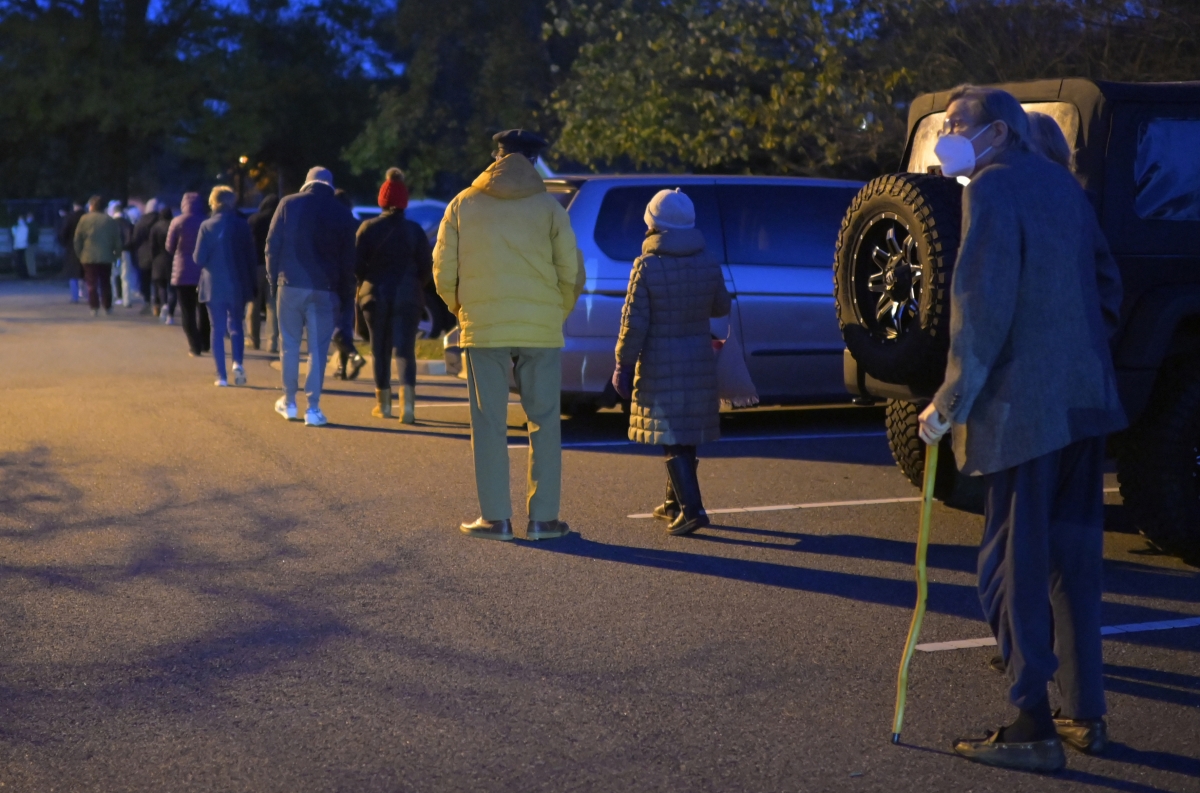
A long line of voters stretches through the parking lot just as the polls open Tuesday at the Hollin Hall Center in Alexandria, Va. MUST CREDIT: Washington Post photo by John McDonnell

A long line of voters stretches through the parking lot just as the polls open Tuesday at the Hollin Hall Center in Alexandria, Va. MUST CREDIT: Washington Post photo by John McDonnell

Turbocharged by nearly four years of a Republican president who has proved deeply unpopular in the state, Democrats hoped to deliver a resounding win for former vice president Joe Biden over President Donald Trump and extend their gains in congressional seats.

Democratic majorities in the state legislature expanded absentee voting this year, leading to a deluge of early ballots over the past 45 days that could lead to historic overall levels of turnout despite concerns about spreading the novel coronavirus.

Results began to roll in shortly after polls closed at 7 p.m., but it was too early to tell whether outcomes would become clear Tuesday or take several more days because of the huge number of early ballots.

More than 2.7 million Virginians had already voted in person or by mail, according to state data – nearly 69 percent of the total number (3.98 million) who turned out for the 2016 contest, and nearly five times the 566,948 who voted early four years ago.

From the eastern suburbs that are gaining influence to the rural western towns that fear losing it, Virginia voters of every persuasion expressed anxiety about the weight of this year’s election.

“I felt like it was a choice between democracy and fascism, so it was an easy choice for me,” said Thomas Elmore, a retired CIA and naval officer voting for Democrats in a hotly contested suburb of Richmond.

But in the same precinct, Dale Harvey – a nurse in her 40s – and husband Cliff voted a straight Republican ticket “because we believe in the Constitution.”

Elections officials said late Tuesday afternoon that voting was playing out smoothly around the state, with no reports of voter harassment or intimidation at any polling places and only minor incidents around the need to wear masks indoors because of the pandemic. In Norfolk, however, authorities said they arrested a 63-year-old man for allegedly threatening to bomb a polling place.

While the presidential race dominated, the ballot also contained choices for all 11 of the state’s U.S. House seats, in addition to the Senate race. Three of the congressional districts are particularly competitive, with Democrats hoping to hold on to two they picked up in 2018 and possibly gain one more.

Voters were also deciding on two proposed constitutional amendments – one to create a bipartisan redistricting commission, the other to exempt disabled veterans from personal property tax on a car or truck.

While state law allowed registrars to process early votes as they came in, they could not be counted until after polls closed. All early ballots will be tabulated in the districts where they were cast and reported as absentee votes.

The state Department of Elections has instructed registrars to stop counting by 11 p.m. and report totals to that point. If the results are incomplete, counting will resume Wednesday morning – though final numbers will not be reported until Friday.

That could leave some outcomes temporarily in doubt. Tens of thousands of absentee ballots arrived by mail on Tuesday, and any ballot postmarked by Election Day can be accepted as late as noon on Friday. Officials said it could take several days to count those, with larger localities such as Fairfax County potentially pushing into Monday.

Virginia election officials will certify the results on Nov. 10.

A recent Post-Schar School poll of Virginia voters showed that a majority of early ballots had been cast for Democratic candidates and that people planning to vote on Tuesday were more likely to favor Republicans.

At the Spring Hill Recreation Center in McLean, Cory Mills, 40, wore a Trump hat as he voted for Republicans all down the ballot. He said that Operation Warp Speed, the Trump administration plan to produce vaccines, was “unprecedented” and that the Trump administration did the best it could in the early days of the pandemic.

But in Warrenton, Lauren Parker – who usually votes Republican – was undecided about her presidential vote until she got to her polling place. Thinking about Trump’s handling of the novel coronavirus, she wound up making a last-minute switch to Biden.

“I just thought that leadership is what’s most important to me right now,” said Parker, a 38-year-old teacher.

Virginia’s presidential preference has seemed predictable this year, with polls showing Biden holding a significant lead over Trump. The state has only become more blue since becoming the only former member of the Confederacy to support Hillary Clinton in 2016, and neither presidential campaign spent significantly here this year.

Democratic U.S. Sen. Mark Warner has held a significant lead over Republican challenger Daniel Gade in both polling and fundraising. Warner has raised almost $13.3 million compared with about $4 million for Gade, an Army veteran who lost a leg in combat in Iraq.

At the Kempsville library polling place in Virginia Beach, Carol Harrison, 59, voted early for the Democratic ticket and stayed to hand out party literature to other voters.

“I’m going to lose sleep if Trump wins,” she said.

By 5:20 a.m., there were already 30 people in line waiting to vote. When polls opened at 6, the line stretched a hundred yards down the side of the building and into the parking lot.

The scene was quieter at Lynwood Elementary School in Springfield several hours after polls opened. Democratic voter Steve Chozick, 52, who works in IT for the city of Arlington, said he was “terribly” anxious about the results of the election. He said that he is invested in Democratic policies, but his anxiety isn’t rooted in having the opposite party in power. It’s more about Trump specifically.

“I could live through another Republican administration,” Chozick said. “Not another administration that isn’t interested in governing.”

The real drama on Virginia’s ballot this year involved three congressional races: In the 7th and 2nd congressional districts, where Republicans were trying to reclaim seats they lost to Democrats in 2018, and the 5th, which became surprisingly competitive after incumbent Republican Rep. Denver Riggleman lost his bid for re-election to Bob Good in a GOP nominating convention.

In central Virginia’s 7th District, analysts predicted that Republican Nick Freitas, a state delegate, would have trouble overcoming the increasingly blue vote in the western Richmond suburbs, where the district is anchored. Voters in Chesterfield and Henrico counties had carried Democratic Rep. Abigail Spanberger to victory in 2018, part of a suburban revolt against Trump.

Spanberger presented herself as a moderate willing to stand up to Democratic Party leadership while focusing on issues affecting rural Americans: broadband access, soil conservation, prescription drug prices.

Freitas, meanwhile, pitched himself as a strict fiscal conservative seeking less government intervention in health care, supporting school choice and opposing virtually all gun restrictions. He launched a series of attack ads depicting Spanberger as leaning too far left for the district.

One voter who lives just outside Richmond, 40-year-old Amber Vitaliano, said she was so repulsed by harsh anti-Spanberger TV ads that the choice was easy.

“I saw the anti-ads that were bashing her and I said, ‘OK, that’s who I want to vote for,’ ” she said. “Negative ads just have the opposite effect. I question them.”

In the Virginia Beach-area 2nd District, Democratic Rep. Elaine Luria’s rematch against former congressman Scott Taylor turned bitter as smear ads and accusations of lying and scare tactics flew back and forth between them.

One voter in Virginia Beach, Josh Velazquez, 39, who said he historically has voted Republican, said he voted for Taylor in 2018 but decided to support Luria this time.

“I’ve been seeing her do a lot more for everybody,” he said. “If you’re making a difference, we’re going to hear about it and know about it. And that’s what I’ve been seeing a lot.”

Both Luria and Spanberger voted to impeach Trump in January, acknowledging that those votes could put them at risk in their red districts.

At the Robious polling place outside Richmond, Cliff Harvey, 56, said Spanberger’s vote to impeach Trump belied her pledge to work with both parties.

“We need the lies out,” he said. “Trump might not be a great person, but he seems to keep his promises.”

But Elmore, a former Republican who over the last decade has gravitated toward Democrats, thought Spanberger had done a good job of reaching across the aisle.

“She held all these town halls. She was very engaged,” said Elmore, 65, who last voted for a Republican for president in 2008, when fellow Naval Academy graduate John McCain was on the ballot. “I think she’s doing her best to be inclusive.”

The most unexpectedly tight race played out in the rural 5th District outside Charlottesville, with Democrat Cameron Webb showing strength against Good, the Republican nominee who ousted incumbent Riggleman and left Republicans divided.

Good, a former Campbell County board supervisor, ran on a far-right platform as a religious conservative, pledging unwavering support for Trump’s “America First” agenda. Trump won the district by 11 points in 2016 – but lingering bitterness over Riggleman’s ouster, and Webb’s made-for-the-times background, allowed Webb to put the race in play.

Webb, who, if elected, would become the first Black doctor in Congress, made his experiences as a physician a central part of his campaign, describing himself as a doctor working at the “intersection of social justice.” He also regularly spent time treating coronavirus patients on the overnight shift, expertise that some voters found especially attractive during the pandemic.

Donna Rowse, a 54-year-old voter in Charlottesville, said she voted for Webb because she trusted him to handle the health care issue.

On the presidential ticket, she said she would take “anyone” over Trump – but was glad it was Biden. “I want a president we don’t have to be ashamed of,” she said, “a president that isn’t going to divide the country, who cares about all of us, not just some of us.”

Virus trails economy as voters’ top issue, according to exit polls #SootinClaimon.Com

#SootinClaimon.Com : ขอบคุณแหล่งข้อมูล : หนังสือพิมพ์ The Nation.

Virus trails economy as voters’ top issue, according to exit polls

InternationalNov 04. 2020Jennifer Bretsch waits to wipe down surfaces at the Charles Houston Recreation Center in Alexandria, Va., on Election Day, Tuesday, Nov. 3, 2020. MUST CREDIT: Washington Post photo by Matt McClainJennifer Bretsch waits to wipe down surfaces at the Charles Houston Recreation Center in Alexandria, Va., on Election Day, Tuesday, Nov. 3, 2020. MUST CREDIT: Washington Post photo by Matt McClain 

By The Washington Post · Lenny Bernstein, Joel Achenbach · NATIONAL, HEALTH, POLITICS, HEALTH-NEWS

WASHINGTON – The virus that has confined many Americans to their homes for much of 2020 trailed the economy as the leading issue for voters, who cast ballots in huge numbers by mail and in person, early exit polls showed Tuesday.

About 2 in 10 voters said the pandemic that has killed more than 232,000 Americans and upended life around the globe was the most important issue on their minds as they selected a president and other officials to lead the United States out of its more than nine-month public health crisis. About the same number cited racial inequality, according to the data collected by Edison Research, a consortium of television networks.

But about one-third said they were primarily motivated by the economy, including 6 in 10 of the voters who supported President Donald Trump.

A slight majority of voters said it is more important to contain the coronavirus now, even if the necessary measures hurt the economy. About 4 in 10 said the economy is more important, even if restoring the nation’s economic health impedes efforts to limit the spread of the virus.

Amid the resurgence of the coronavirus in much of the United States, preliminary exit polling showed that voters are closely divided on whether U.S. efforts to contain the virus are going “well” or “badly.” But roughly twice as many voters say efforts to control the pandemic have gone “very badly” than say they have gone “very well.”

Millions of voters who cast ballots in person Tuesday were braving the worst stretch of the pandemic to do so. Nearly 88,000 new infections were reported Tuesday, bringing the U.S. total to more than 9.3 million cases. The virus continued its surge through the Midwest and Plains states. Seven states set records for hospitalizations of patients with covid-19, the disease caused by the coronavirus, including Indiana, Iowa, Ohio and Wisconsin.

Control of the White House and the Senate was up for grabs Tuesday, circumstances not lost on voters whose families and finances have been battered by the coronavirus.

“It’s very personal to me, because it’s right in my immediate family,” said Betty Sullivan, 59, as she stood in line to vote in Jackson, Miss., on Tuesday morning.

Two of Sullivan’s sons and three of her grandchildren have contracted the coronavirus. Her oldest son, who is 36 and lives in Atlanta, tested positive after going to a bar. Her youngest son, 32, apparently was infected by a co-worker. Her grandchildren, ages 6, 8 and 14, contracted the virus after being in day care and school in the past three weeks, she said.

“I think in the past, we’ve not really thought too much about voting; we’ve kind of been really, really casual about it sometimes, but, just with everything with the virus, with the pandemic, with the political climate, everybody now really realizes how important it is to get out, to come out and vote,” Sullivan said.

Regardless of the election outcome, the recent staggering increase in coronavirus cases has set the country on a difficult course for the next several weeks. A sharp rise in hospitalizations, already underway, follows the jump in infections, and a subsequent surge in deaths is expected in the weeks after that.

“The trajectory that we’re on is one that we should expect to be on for the coming weeks,” said Jennifer Nuzzo, senior scholar at the Johns Hopkins Center for Health Security. “We should expect to be hunkered down for the coming weeks.”

Stopping a surge in the pandemic, experts said, is extremely difficult.

“The virus doesn’t know elections, doesn’t know borders, doesn’t know demographics,” said Ali Mokdad, a University of Washington epidemiologist. “Unfortunately, the virus is taking its course irrespective of what happens today.

“The election is not going to change the virus,” Mokdad added. “Our behavior, our response to the virus, hopefully will change.”

Barring a major change in behavior, meaning much more widespread adoption of masks, social distancing and other mitigation measures, Mokdad said “some states, a large number of states, will have to do a hard stop, lockdown” by December or January.

Although mortality rates have improved thanks to better medical techniques and drugs, the key driver of the pandemic is rampant community spread in much the country.

“Even a vaccine won’t flick any switch. There will be the hard work of actually vaccinating people,” William Hanage, an epidemiologist at Harvard University’s T.H. Chan School of Public Health, said in an email Tuesday.

Columbia University epidemiologist Jeffrey Shaman said part of the problem is that human behavior is not easily changed. There is “huge inertia,” he said, and that will make it difficult for officials to slow outbreaks in many parts of the country.

And if the United States follows Europe and enters a new phase of restrictions, there probably will be growing pressure for another large relief package, something Congress has been unable to agree on since the first one expired.

“There’s growing evidence about the need for providing resources to help people comply with public health recommendations,” Nuzzo said. “I fear we have focused on increasing number and type of tests, but have not eliminated the disincentives that people may experience about getting tested. Lost income, in particular.”

Michael Osterholm, director of the Center for Infectious Disease Research and Policy at the University of Minnesota, said he hopes that after the election “we can come together as a country and collectively fight the virus and not each other. There are no longer red and blue states, counties or cities. They are all covid-colored.”

Crowd gathers outside White House as voters continue to cast ballots #SootinClaimon.Com

#SootinClaimon.Com : ขอบคุณแหล่งข้อมูล : หนังสือพิมพ์ The Nation.

Crowd gathers outside White House as voters continue to cast ballots

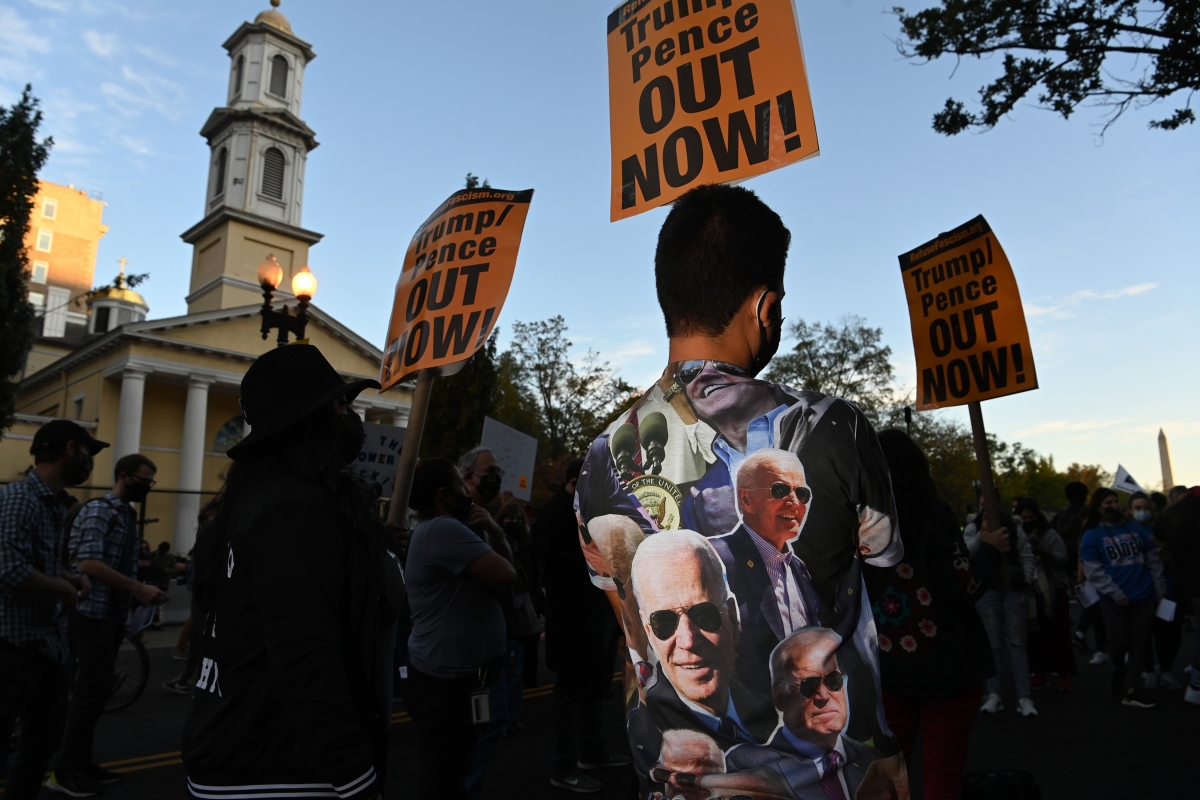
InternationalNov 04. 2020A mask of President Donald Trump is seen as people gather near the White House on Election Day. MUST CREDIT: Washington Post photo by Matt McClainA mask of President Donald Trump is seen as people gather near the White House on Election Day. MUST CREDIT: Washington Post photo by Matt McClain 
By The Washington Post · Joe Heim, Justin Jouvenal · NATIONAL, POLITICS

WASHINGTON – Voters were still casting ballots across the country, but by Tuesday evening hundreds of people had already gathered outside the White House for what one hoped would become “a going-away party for Trump.”

Rodrigo Moreno of Austin, Texas, wears a shirt with images of Democratic presidential nominee Joe Biden as people gather Tuesday at Black Lives Matter Plaza in Washington. MUST CREDIT: Washington Post photo by Matt McClain

Rodrigo Moreno of Austin, Texas, wears a shirt with images of Democratic presidential nominee Joe Biden as people gather Tuesday at Black Lives Matter Plaza in Washington. MUST CREDIT: Washington Post photo by Matt McClain

A drum line pounded out a steady beat, dancers waved flags while weaving to the music, and backers of Democratic presidential nominee Joe Biden occasionally chanted “Vote him out!” at Black Lives Matter Plaza. A handful of President Donald Trump’s supporters also were there.

Millie Landis, 19, and Cecelia Edwards, 20, sophomores at American University, compared the protest to a farewell to Trump. “We want him gone,” Landis said.

In the early evening hours the atmosphere was relaxed and peaceful, a far cry from the potential unrest local and federal officials have been bracing for in the nation’s capital in the wake of a bitter and unprecedented presidential election.

Several dozen District of Columbia police officers casually kept an eye on the scene and even mingled with the crowd. There was a tussle between police and a man who was at the plaza, though it was not immediately clear what prompted it.

The National Park Service had erected a tall fence around the White House in preparation for potential violence. City officials also opened an Emergency Operations Center and increased police and fire staffing to handle any issues. Two federal agencies said they had personnel on standby if needed.

Despite the preparations, D.C. Department of Homeland Security and Emergency Management Agency Director Chris Rodriguez told WAMU on Tuesday morning that the city had not heard of any concrete plans that might incite violence.

“We don’t have any specific or credible threats to the District of Columbia in the election period,” Rodriguez told the radio station. “However, we are concerned, and we did see violence of course over the summer from some of the First Amendment demonstrations that were here in the city. We are watching for that.”

Some downtown businesses had boarded up shops in anticipation of problems on Election Day or the days that follow.

Roughly a half-dozen groups had applied for and received permits to demonstrate near the White House and other downtown locations on or around Election Day, while others were still being processed. They include social justice and religious organizations.

A group called Shutdown DC, which has been active in the movement for racial justice over the summer and has protested Trump administration actions, organized the Tuesday evening event at Black Lives Matter Plaza. It was slated to go until midnight.

Martha Wilson, of Washington, said she came to the protest because she went to the first Women’s March the day after Trump’s inauguration and “wanted to bring it full circle.”

She rode her bike to the demonstration and wore a mask that read, “All will be well.”

“I hope I’m right,” she said.

Kehinde Ogun wore a bright red shirt with MAKE AMERICA GREAT AGAIN emblazoned on the front. Ogun, who is Black and said he is homeless, said he came to the gathering “to show support for my president.”

Ogun said he backed Trump because of the president’s push for prison reform.

Though the vast majority of the crowd supported Biden, Ogun said he had not heard any criticism or name-calling directed his way.

“Today has been very peaceful, thank God,” he said.

Journalists from Italy, Germany, South Korea and other countries converged on the plaza, interviewing demonstrators and broadcasting home to viewers closely following the U.S. election.

Lex Louffler garnered attention for his sign that read, “my kitten died today and Trump is still worse.” In an interview, Louffler said his kitten, Midnight, died this morning and showed a reporter a photo of the cat from earlier this week.

Louffler, who lives in northern Virginia, said he was demonstrating “as a reminder to Trump that we the people decide, not him.”

Almost everyone in the crowded street wore masks, and organizers offered hand sanitizer and masks to those who wanted them.

Personnel from the Federal Bureau of Prisons and U.S. Marshals Service have been readied for any potential unrest in D.C. and other cities across the country, officials familiar with the matter said.

The U.S. Marshal Service confirmed it was prepared if needed, saying in a statement, “While the US Marshals Service generally does not discuss any potential enforcement activities, we can confirm that deputy US Marshals stand ready to respond to violent acts of civil disobedience in the District of Columbia and other locations around the nation,” the agency said in a statement.

The area near the White House was the scene of major protests over the summer in the wake of George Floyd’s death in the custody of Minneapolis police. Some of the protests turned violent.

The Trump administration was widely criticized for sweeping protesters away from Lafayette Square near the White House on June 1, ahead of a photo op by Trump outside a nearby church.

Biden takes nostalgic journey amid search for votes #SootinClaimon.Com

#SootinClaimon.Com : ขอบคุณแหล่งข้อมูล : หนังสือพิมพ์ The Nation.

Biden takes nostalgic journey amid search for votes

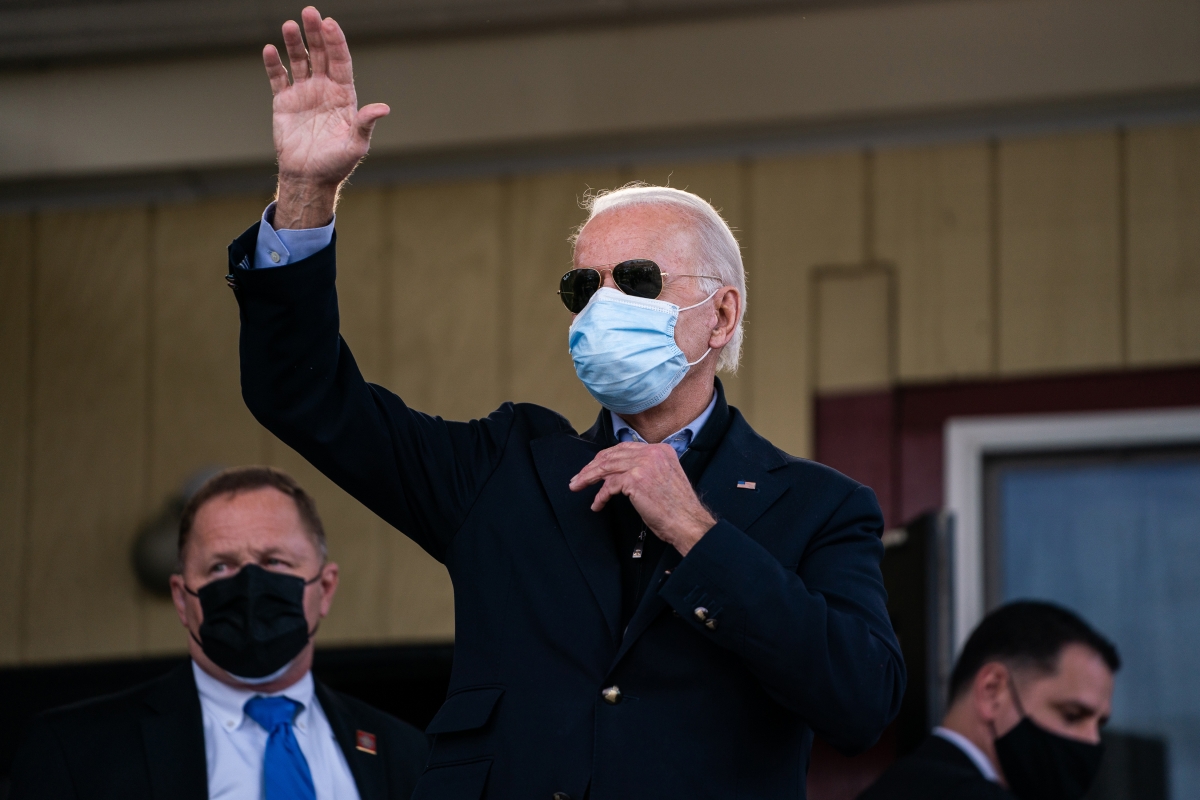
InternationalNov 04. 2020Former vice president Joe Biden greets supporters at his childhood home in Scranton, Pa., on Tuesday, Nov., 3, 2020. MUST CREDIT: Washington Post photo by Demetrius FreemanFormer vice president Joe Biden greets supporters at his childhood home in Scranton, Pa., on Tuesday, Nov., 3, 2020. MUST CREDIT: Washington Post photo by Demetrius Freeman 
By The Washington Post · Sean Sullivan · NATIONAL, POLITICS

WASHINGTON – Joe Biden took a final lap through all-important Pennsylvania on Tuesday, seeking to generate one last burst of excitement in his 18-month pursuit of the presidency as his campaign braced for an uncertain conclusion to the most tumultuous race in modern history.

Former vice president Joe Biden stops by a restaurant in Philadelphia on Tuesday, Nov., 3, 2020. MUST CREDIT: Washington Post photo by Demetrius Freeman
Former vice president Joe Biden stops by a restaurant in Philadelphia on Tuesday, Nov., 3, 2020. MUST CREDIT: Washington Post photo by Demetrius Freeman

As he prepared to address the nation in his hometown of Wilmington, Del., on Tuesday night, the 77-year-old former vice president sought to crystallize the choice between voting for him and voting for President Donald Trump in the most crucial swing state on the map, wagering that another visit could give him an edge in a competitive landscape.

“Everybody knows who Donald Trump is,” Biden said in Philadelphia, echoing the themes he has emphasized throughout his third run for the White House. “He needs to know who we are. We choose hope over fear. We choose truth over lies. And we choose science over fiction.”

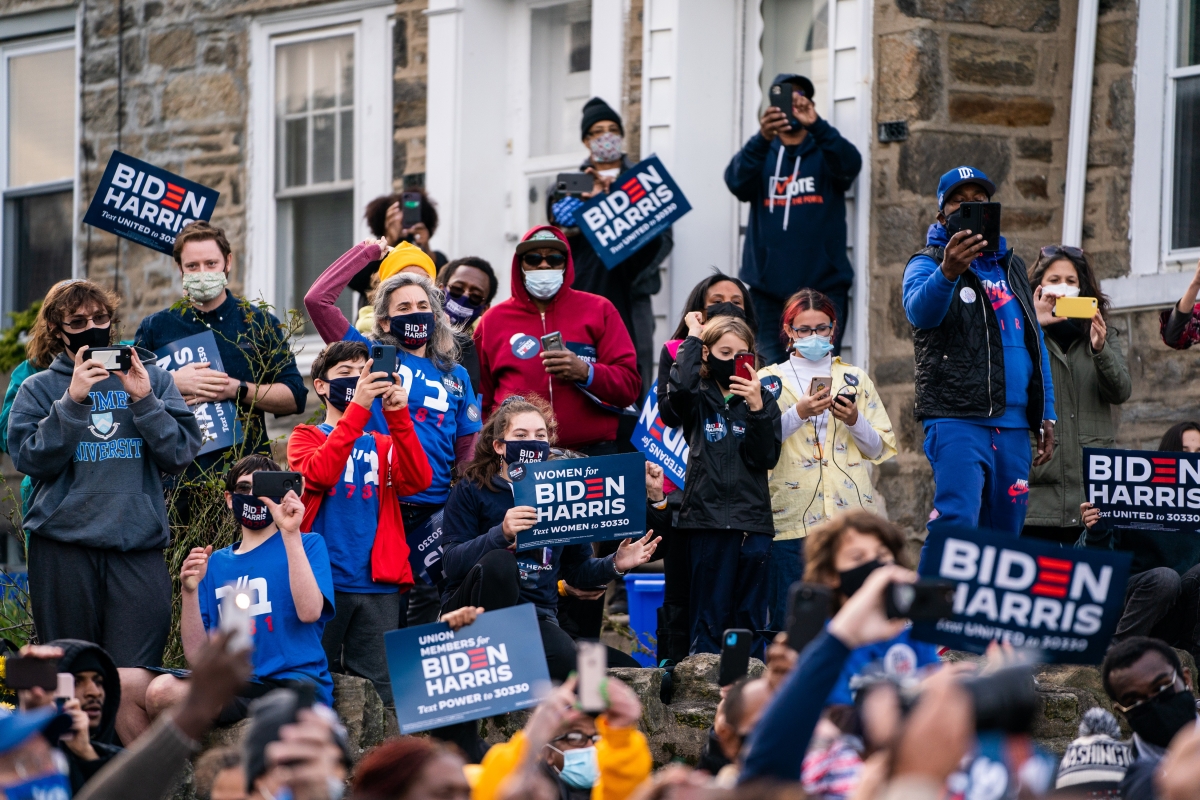
Supporters listen to former vice president Joe Biden at a campaign stop in the West Oak Lane neighborhood of Philadelphia on Tuesday, Nov., 3, 2020. MUST CREDIT: Washington Post photo by Demetrius Freeman

Supporters listen to former vice president Joe Biden at a campaign stop in the West Oak Lane neighborhood of Philadelphia on Tuesday, Nov., 3, 2020. MUST CREDIT: Washington Post photo by Demetrius Freeman

Biden carried with him the hopes of millions of Americans who seeking put an end to the chaotic Trump presidency. Once seen as a gaffe-prone and past-his-prime politician whose place in his own rapidly changing party was uncertain, Biden’s brand of moderation and espousal of unity earned him the trust of an anti-Trump coalition that prized electability above all else. But in a sharply divided country he also stood as the source of great disdain for millions of others determined to propel Trump to a second term.

The most consequential day of Biden’s decades-long political career hit many personal notes. As the sun rose over Wilmington, Biden attended Mass and visited the cemetery where his first wife and two of his children are buried. Then he flew to Scranton, where he stopped by the house he lived in as a child.

“It’s good to be home,” Biden said, greeting a few dozen supporters outside a local carpenters union hall. He told them he had won the handful of votes in the famed New Hampshire hamlet of Dixville Notch, where polls open just after midnight. “Based on Trump’s notion, I’m going to declare victory tonight,” Biden quipped, drawing laughs from the crowd.

But with Trump and his allies raising baseless concerns about fraud in mail-in voting and vote counting, Biden campaign officials were taking seriously the possibility that Trump might offer a misleading portrayal of the election results.

Asked whether he will respond if Trump claims victory prematurely, Biden insisted that voters would determine the outcome.

“Presidents don’t decide what votes are counted and not counted,” he said. “Voters determine who’s president. No matter what he does, no matter what he says, the votes are going to be counted.”

Biden campaign adviser Bob Bauer called GOP voting lawsuits “patently failing” and “meritless” and said they were “designed to generate the appearance of a cloud over the election.”

Pennsylvania and its 20 electoral votes stood perhaps the most coveted prize on Tuesday, though many observers did not expect a winner to be declared there right away, due to the ongoing tally of mail-in ballots that arrived in large numbers from voters concerned about showing up to the polls during a pandemic.

Both candidates spent much of their time in Pennsylvania during the closing days of the campaign, a reflection of its influence in the race to 270 electoral votes. Trump won Pennsylvania by less than a percentage point in 2016, and this year’s pre-Election Day polls showed a close contest there. Although Biden nominally led, Democrats had been nervous about his standing in Pennsylvania as the race neared the finish line.

“Pennsylvania’s going to pick the president,” said Lt. Gov. John Fetterman, a Democrat supporting Biden. Like many Pennsylvania Democrats, Fetterman was concerned about the prospect of high turnout among Trump supporters in White, rural counties across the state, similar to those who had pushed him over the top in 2016.

Final public polling showed Biden leading in most key battlegrounds. His campaign officials were upbeat Tuesday, voicing confidence that anger with Trump’s mismanagement of the pandemic was the dominant topic on the minds of voters and the one that would help propel Biden to the presidency. They said they had several ways to win, both with and without Pennsylvania.

“When we look to today, we feel like it is clear that we are winning,” said Biden campaign manager Jen O’Malley Dillon. “All the data that we’re looking at really underscores how many pathways believe we have to victory and how few Trump has.”

Across the country, Biden’s allies were also sounding cheery. In Michigan, where Trump won narrowly in 2016, Rep. Andy Levin, D-Mich., said voting was smooth at local polling places and Democratic enthusiasm was high.

“I’m like a 10-year-old kid about to walk into a huge room of presents or something,” Levin said excitedly in an afternoon phone interview. Levin, who represents a district in the suburbs of Detroit that incudes a county that flipped from President Barack Obama to Trump, added that “2020 is going to take its place along with 1932 and 1980 as a very rare moment when our country changes directions in a fundamental way.”

Biden, too, was upbeat as he whisked around his nostalgic tour of Pennsylvania. Before stepping into his childhood home in Scranton, he pointed to an older woman standing across the street. “She’s lived there since I was a kid!” he exclaimed.

Once inside the home, where a supporter named Anne Kearns now lives, Biden wrote a message on a living room wall: “From this house to the White House with the grace of God. Joe Biden 11-3-2020.” He had signed a bedroom wall when he ran for vice president in 2008.

The visit stirred excitement in the neighborhood. “He’s right there!” blurted out Mardan Daurilas, 19, a first-time voter who said he cast his ballot for Biden on Friday. More than a hundred people lined the streets to catch a glimpse of the Democratic nominee.

For a candidate who has limited his public appearances down the stretch compared with Trump, the stop in Scranton was reminiscent of pre-pandemic appearances Biden frequently made. But there were still blunt reminders of the coronavirus and its resurgence across the country. Biden wore a mask as he spoke. And the hugs and high-fives that were staples of Biden’s earlier campaigning were replaced by elbow bumps, in accordance with medical guidance during the pandemic.

Biden’s campaign aides have embraced the visible contrast the Democrat has struck with Trump, trumpeting his mask use and social distancing as proof to voters that as president he would be much more responsible about combating the virus than the Republican has been. Trump has frequently disregarded the advice of experts and continues to hold crowded political events in defiance of their guidelines.

At an afternoon restaurant stop in Philadelphia where Biden made a pitch to a crowd dominated by Black voters, some greeted the Democrat as “President Biden” and asked him to come closer to them.

“They won’t let me!” he said, staying at least 30 feet from the crowd.

“You’re your own man! Come over here and shake my hand!” one woman said to him, prompting some laughter in the crowd.

While in Philadelphia, Biden sat for a round of remote TV interviews with outlets in various swing states and greeted more than 100 supporters at a canvass kickoff.

“Turnout’s been incredible,” he told them. “Look: The country is ready. We’re going to have more people come this year than any time in American history,” he predicted.

He added, “I wont let you down.”

Biden received plenty of visible and vocal encouragement during his last day on the trail, which included some emotionally charged moments. At one point, a supporter asked him whether he would call a family friend dying of cancer.

But the reminders of the opposition he faced were also there. At a hoagie shop, a man in a red Trump 2020 hat was nearby.

A reporter asked Biden on Tuesday morning whether he had spoken with Trump.

“No, I haven’t,” Biden said.

Trump tones down bombast on Election Day #SootinClaimon.Com

#SootinClaimon.Com : ขอบคุณแหล่งข้อมูล : หนังสือพิมพ์ The Nation.

Trump tones down bombast on Election Day

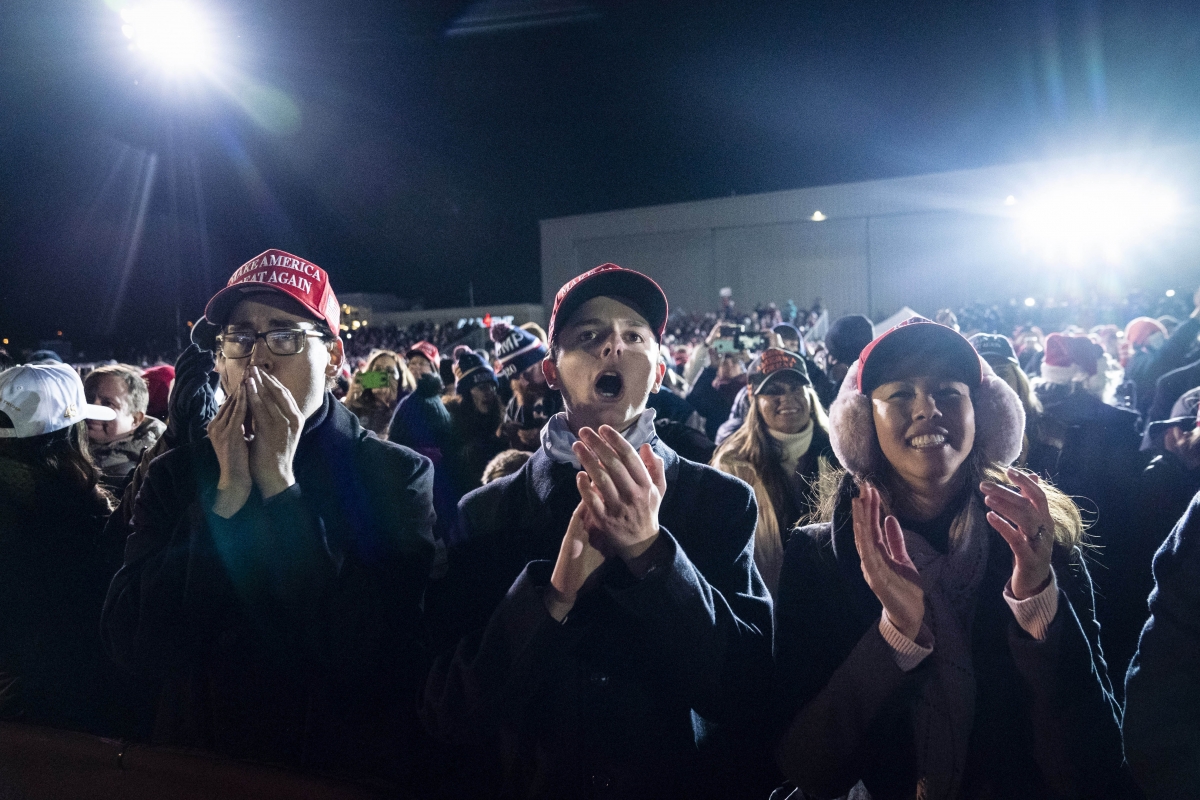
InternationalNov 04. 2020President Donald. Trump departs with Vice President Mike Pence after speaking during a rally at Gerald R. Ford International Airport in Grand Rapids, Mich., early Tuesday, Nov. 3, 2020. MUST CREDIT: Washington Post photo by Jabin BotsfordPresident Donald. Trump departs with Vice President Mike Pence after speaking during a rally at Gerald R. Ford International Airport in Grand Rapids, Mich., early Tuesday, Nov. 3, 2020. MUST CREDIT: Washington Post photo by Jabin Botsford 
By The Washington Post · David Nakamura, Josh Dawsey · NATIONAL, POLITICS

WASHINGTON – President Donald Trump woke up on Election Day – if he went to sleep at all – working on just a few hours of rest after returning to the White House in the early morning from a marathon day of campaign rallies. His first order of business: a call to “Fox & Friends” for a pep talk with the friendliest of news outlets.

Supporters cheer as President Donald Trump speaks during a rally at Gerald R. Ford International Airport in Grand Rapids, Mich., early Tuesday, Nov. 3, 2020. MUST CREDIT: Washington Post photo by Jabin Botsford

Supporters cheer as President Donald Trump speaks during a rally at Gerald R. Ford International Airport in Grand Rapids, Mich., early Tuesday, Nov. 3, 2020. MUST CREDIT: Washington Post photo by Jabin Botsford

But on the line with a trio of fawning news anchors, Trump did not strike his usual level of bombast. His voice was raspy, his tone more subdued.

Reporters speculated that he was fatigued after holding 14 rallies in three days, or that he was coming off the high of the campaign trail to confront the cold, hard reality of the polling numbers that showed him consistently trailing Democrat Joe Biden.

Asked about reports he would seek to declare an early victory before all mail-in votes were tallied, Trump demurred – he would only do so “when there’s victory. If there’s victory. I think we’ll have victory.”

“There’s no reason to play games,” added a president who for months has sought to erroneously discredit widespread mail-in voting as rife with fraud. He has vowed to dispatch his legal team to blitz swing states with lawsuits to freeze local election boards – a strategy that could portend a bitter, drawn-out dispute over the outcome stretching for days or weeks.

During the interview, Trump repeated falsehoods about the dangers of mail-in ballots, played down the threat of the novel coronavirus and insulted Democratic leaders. But he also sounded, in a few stray moments, almost reflective or wistful as the clock counted down to determine his political fate.

“There’s so much love at those rallies,” Trump said of the events, which drew tens of thousands of supporters who crowded closely together and eschewed masks despite the risks of the pandemic. “They even say, many of them, ‘We love you. We love you. We love you.’ “

For Trump, the question was whether the love of the MAGA die-hards would translate to another come-from-behind upset. The final day of the campaign meant a final chance for the president to rally the faithful, making private calls to key allies and flooding his Twitter feed with videos encouraging supporters to vote.

He also had planned a viewing party at the White House with campaign donors and supporters, a use of the complex for electioneering activities that drew rebukes from government ethics watchdogs. Trump’s campaign responded that the move to the White House was necessitated because a planned reception at Trump International Hotel a few blocks away would have violated the local District of Columbia government’s coronavirus safety regulations limiting crowd sizes.

Confined to the White House, a president who has barnstormed through swing states in the final weeks of the campaign was suddenly far more isolated. Workers had erected new security fences to keep the public farther away and create a broader ring of protection around the complex amid concerns about potential election night unrest.

As Biden traveled to Philadelphia to rally supporters with a megaphone in a state both campaigns viewed as crucial, Trump’s day was punctuated by a quick motorcade excursion across the Potomac River to the Republican National Committee’s campaign headquarters in Arlington, Va.

The president – accompanied by White House Chief of Staff Mark Meadows, press secretary Kayleigh McEnany and senior adviser Jared Kushner, his son-in-law – conferred with aides and greeted staffers who were dressed in blue and red MAGA masks, with Make America Great Again signs lining their cubicles.

“I feel very good. After doing that many rallies, the voice gets a little bit choppy, I think,” Trump said, drawing laughs and sounding more upbeat than he did on Fox News. “God did not design it for that much.”

Trump again criticized mail-in voting and railed against a Supreme Court order allowing ballots in Pennsylvania to be counted until three days after the election. Analysts have said Democrats are voting by mail in significantly higher numbers than Republicans in this election cycle.

“A lot of shenanigans, a lot of bad things happen with ballots when you say, ‘Oh, let’s devote days and days,’ and all of a sudden the ballot count changes,” Trump said. “You have to have a date [for the election], and the date happens to be November 3, and we should be entitled to know who won on November 3.”

Asked if he had prepared remarks, win or lose, Trump said: “I’m not thinking about concession speech or acceptance speech yet. Hopefully we’ll be only doing one of those two. And, you know, winning is easy. Losing is never easy. Not for me, it’s not.”

Though Biden has maintained a polling lead higher than Hillary Clinton’s advantage over Trump in the final days of the 2016 campaign, Trump and his team have maintained that a real path to victory remained.

Campaign officials were closely watching balloting in Pennsylvania and Arizona, which they viewed as the most likely to help the president clear 270 electoral college votes and win a second term. Privately, the officials were bullish on Trump’s chances in several other swing states – Florida, Georgia, North Carolina and Ohio.

Trump told associates that he felt confident that he would hold Florida, which he won in 2016.

“We believe this will be a tight race. It’s going to come down to turnout,” Trump campaign manager Bill Stepien told reporters on a conference call in the early evening. “We believe we are better prepared for that.”

The president’s political team had taken the unprecedented step of setting up a campaign war room in the Eisenhower Executive Office Building, a federal building next to the White House. Tim Murtaugh, a campaign spokesman, said the campaign was paying for the setup.

“Every piece of equipment, including WiFi and computers, was paid for by the campaign, and no White House staff is involved,” he said. “The arrangement has been approved by White House counsel.”

Stepien suggested that Biden’s Tuesday visit to Philadelphia, where he rallied supporters on the street with a megaphone, was a sign of late desperation.

By early evening, the president was ensconced at the White House, where he would presumably stay put for the night, watching along with the nation and the world as the results came in.

“My number last time was 306,” Trump said on “Fox & Friends” about his electoral college total in 2016. (His final total was technically 304 because two “faithless electors” refused to cast their electoral votes for him.)

“That was a big number,” he said. “And I think we’ll top it.”

Oil gains most in a month as OPEC+ hints at delay to output hike #SootinClaimon.Com

#SootinClaimon.Com : ขอบคุณแหล่งข้อมูล : หนังสือพิมพ์ The Nation.

Oil gains most in a month as OPEC+ hints at delay to output hike

InternationalNov 04. 2020

By Syndication The Washington Post,  Bloomberg · Andres Guerra Luz

Oil advanced the most in a month in New York as broader markets rallied and OPEC+ inched closer to delaying a planned easing of output cuts.

U.S. benchmark crude futures climbed as much as 4.1%, extending gains from Monday’s rally. Oil took its cue from stronger equities as millions of Americans headed to vote on election day. A weakening dollar also boosted the appeal for commodities priced in the currency, with the Bloomberg Dollar Spot Index falling as much as 0.7%.

OPEC and its allies will “accelerate” the recovery in oil markets at their next meeting, the group’s top official said, in another hint about a potential delay to a production hike scheduled for January. Algeria said that — along with Saudi Arabia, Russia and Iraq — it’s trying to persuade the rest of OPEC+ to extend current supply cuts, state-run news agency APS reported.

“This big selloff last week was a wake-up call to the OPEC+ group,” said John Kilduff, a partner at Again Capital. “The renewed shoulder-to-the-wheel type of action that appears to be emerging is helping to support prices.”

West Texas Intermediate for December delivery rose $1.47 to $38.28 a barrel at 10:02 a.m. in New York. Brent for January settlement advanced $1.31 to $40.28 a barrel.

Americans are voting in a presidential election that could reshape U.S. policy on a slew of energy-related areas such as fracking and how to address climate change. All the while, a swiftly evolving coronavirus situation in Europe is raising new threats to oil’s spotty demand recovery. Demand is recovering “at a very slow speed,” according to the Organization of Petroleum Exporting Countries’ Secretary-General Mohammad Barkindo.

“All eyes will be on the U.S. election today and tomorrow,” said Bjarne Schieldrop, chief commodities analyst at SEB AB. On the possible change of course by OPEC+, he said it would be “a relief for the market if it did not have to worry about an additional 1.9 million barrels a day of supply coming.”

The forward curves for both Brent and WTI show some underlying strength beyond the rally in headline prices. The spread between Brent’s nearest contracts is heading for a close at its tightest contango structure in a week, as is the prompt spread for WTI.

Sweden fights ‘very serious’ Covid resurgence with new curbs #SootinClaimon.Com

#SootinClaimon.Com : ขอบคุณแหล่งข้อมูล : หนังสือพิมพ์ The Nation.

Sweden fights ‘very serious’ Covid resurgence with new curbs

InternationalNov 04. 2020Pedestrians pass shops in Stockholm, Sweden, on Sept. 21, 2020. MUST CREDIT: Bloomberg photo by Mikael Sjoberg.
/Photo by: Mikael Sjoberg — Bloomberg
Location: Stockholm, SwedenPedestrians pass shops in Stockholm, Sweden, on Sept. 21, 2020. MUST CREDIT: Bloomberg photo by Mikael Sjoberg. /Photo by: Mikael Sjoberg — Bloomberg Location: Stockholm, Sweden 

By Syndication The Washington Post, Bloomberg · Niclas Rolander

Swedes face a new wave of restrictions after daily coronavirus cases hit a record, with the government warning of a grim winter ahead.

Prime Minister Stefan Lofven, speaking to reporters on Tuesday, said his country is now facing a “very serious situation” that requires tougher measures if the virus is to be fought back.

The resurgence of Covid-19 across Europe has caught the region off guard after a summer that left many countries assuming they’d brought the virus under control. But as citizens grew complacent and temperatures dropped, the pandemic has returned with a vengeance.

Lofven warned that the latest development is putting Sweden’s health-care system under pressure, as more intensive care beds get filled.

“The brief respite that we got during the summer is over,” he said. “How we act now will determine what kind of Christmas we will be able to celebrate, and who will be able to take part.”

At no point since the pandemic started has Sweden imposed a lockdown, relying instead on voluntary social distancing. That’s led to higher infection and mortality rates than in the rest of the Nordic region, but so far with few signs that Sweden has developed herd immunity.

Sweden’s new coronavirus cases hit a record of 4,062 on Friday. As of Tuesday, a total of 134,532 Swedes had been infected with the virus, with 5,969 fatalities.

Critics have called Sweden’s approach reckless. Those in charge of the policy say it will work better in the long run, and argue that sudden lockdowns aren’t a tenable way to fight a virus that’s likely to be around for years.

But there are signs Sweden’s government is ready to adopt a tougher approach as the country heads into an uncertain winter.

Anders Tegnell, Sweden’s state epidemiologist, said on Tuesday that “overall, the development is moving in the wrong direction in many different ways.” He added that “the main issue now is to really limit close contact to the immediate family.”

Sweden’s latest measures still take the form of recommendations, meaning people don’t face legal consequences if they ignore them. But Lofven said he wasn’t just handing out “some kind of friendly, general advice.”

“It is expected that everyone who is subject to these recommendations will follow them all day, every day,” he said.

As of Tuesday, Swedes in seven of the country’s 21 regions — representing roughly 70% of the population — will be required to:

–Avoid physical contact with people besides those with whom they share a home

–Avoid indoor spaces in which crowds can form

–Avoid parties, weddings, funerals and similar events

–Employers should ensure that staff who can work from home do so

Election Day voting opens with some lines, scattered glitches and ample anxiety across the nation #SootinClaimon.Com

#SootinClaimon.Com : ขอบคุณแหล่งข้อมูล : หนังสือพิมพ์ The Nation.

Election Day voting opens with some lines, scattered glitches and ample anxiety across the nation

InternationalNov 03. 2020Voters line up outside the Hialeah John F. Kennedy Library in Hialeah, Fl., on Tuesday. MUST CREDIT: Washington Post photo by Michael Robinson Chavez
/Photo by: Michael Robinson Chavez — The Washington PostVoters line up outside the Hialeah John F. Kennedy Library in Hialeah, Fl., on Tuesday. MUST CREDIT: Washington Post photo by Michael Robinson Chavez /Photo by: Michael Robinson Chavez — The Washington Post 
By The Washington Post · Amy Gardner 

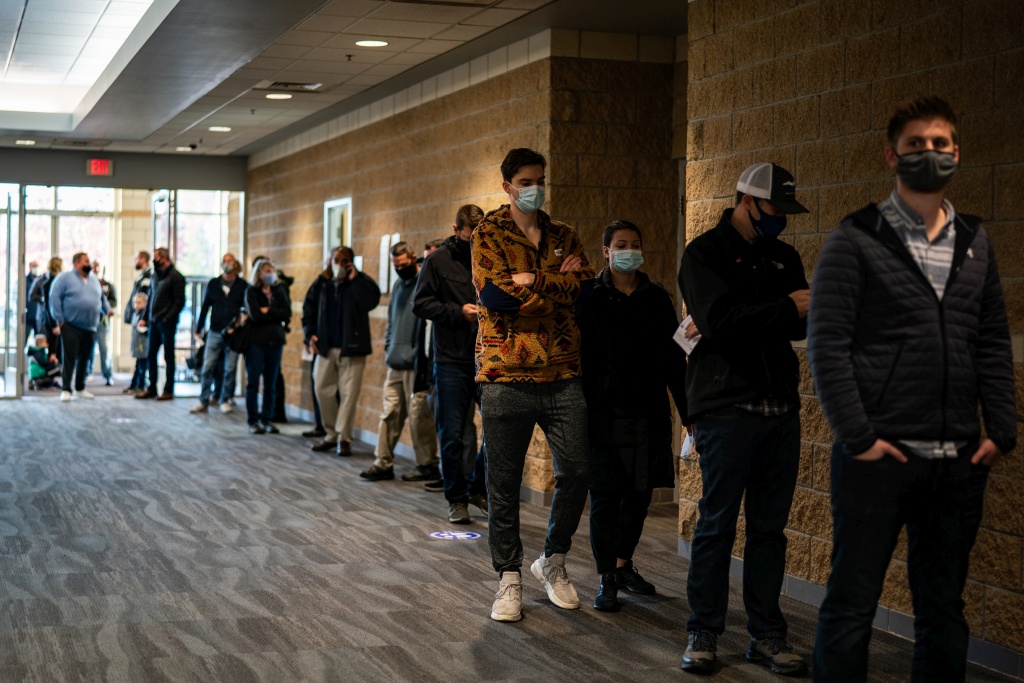
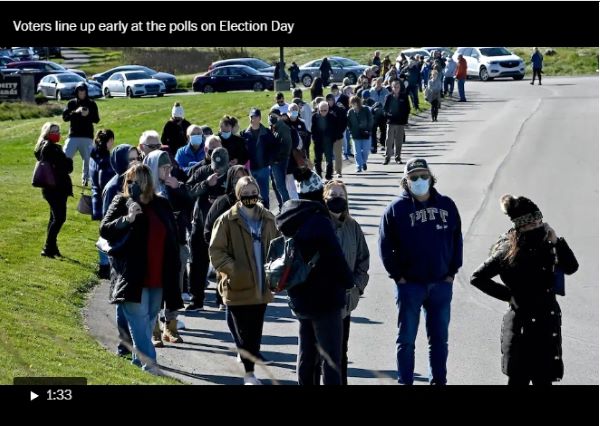
Americans lined up for a long election season’s final day of voting Tuesday, breezing through cavernous facilities in some cities and waiting by the hundreds in others, and contending with only few scattered glitches in the first hours of Election Day.

https://www.washingtonpost.com/video/c/embed/21083cb5-c45b-4ca7-ac22-560b781fd748?ptvads=block&playthrough=false

Nearly 100 million people had already cast ballots as voting got underway, a stunning figure that underscored how the coronavirus pandemic has transformed this year’s election, as a record number of Americans voted early or by mail to avoid the risk of infection.

Early turnout was light in Miami, Dayton, Atlanta and Louisville, prompting a tentative sigh of relief for election officials who have spent months preparing for complications arising from the pandemic. But long lines formed in other places, including New York City, Las Vegas, Green Bay, Wis., and St. Petersburg, Fla. – a reminder of the historic surge of interest in this year’s race for the White House between President Trump and former vice president Joe Biden.

“We don’t normally see lines this long, this early,” said Jonathan Kipp, an election administrator in Londonderry, N.H., where 563 people voted over the first hour. “Isn’t it great, though? People are looking to vote.”

Voters encountered a handful of obstacles Tuesday, including a snow quall in Manchester, N.H., and a few problems with machines and voter check-in systems in cities such as Columbus, Oh. and Philadelphia.

Voters wait in line at a polling location inside Ada Bible Church in Ada, Mich., on Tuesday. MUST CREDIT: Washington Post photo by Salwan Georges/ Photo by: Salwan Georges — The Washington Post Location: Ada, United States

Voters wait in line at a polling location inside Ada Bible Church in Ada, Mich., on Tuesday. MUST CREDIT: Washington Post photo by Salwan Georges/ Photo by: Salwan Georges — The Washington Post Location: Ada, United States

In many cities, the physical and economic toll of the coronavirus itself was on vivid display. In Kenosha, Wis., Angela Van Dyke waited along with about 100 other others in chilly temperatures as the sun rose Tuesday morning, despite her worries about exposure to the virus.

“It’s a civic duty to show up, even in the midst of a massive surge” of infections, said Van Dyke, who moved back to her home state from California after losing her job in architecture because of the pandemic. She accused Republican leaders in Wisconsin of being “lazy” in their management of the crisis, and she was apprehensive about safety protocols in her polling station as she stood in line.

In Omaha, nurse McKenna Hoffman, 33, stood in line to vote in part, she said, because of Trump’s poor management of the pandemic. Nebraska Gov. Pete Ricketts, R, a Trump ally, opposed a mask mandate in the state, and on Monday, the state set a record for hospitalizations, according to Washington Post data. During her shift in an intensive care unit Monday, McKenna said just three beds remained open.

“It’s worse now than it was in March,” she said. “It will come down to who to intubate.”

In a sign of what is expected to be an expanded electorate this year, first-time voters were among those at the front of the lines Tuesday.

Brian Dalley, 60, arrived at the Ada Bible Church in Cascade, Mich., before the sun rose and even before many of the election workers arrived. He was the first in a line of about 70 voters that stretched along the edge of the parking lot, under a waning moon, their faces illuminated by phones and their hands cradling hot coffee.

Dalley, who has never voted before, said he has been upset by the unrest this year, including protests against Trump, which he said were unpatriotic.

“You’re supposed to get behind your president,” he said, adding that it inspired him to vote for Trump – and straight Republican down the ticket.

In some states, Tuesday also marked the start of processing and counting the mountain of absentee ballots that election offices must contend with. Election officials in Pittsburgh announced the removal of ballots from a locked storage facility to begin what is expected to be a days-long process determining the final vote in Pennsylvania.

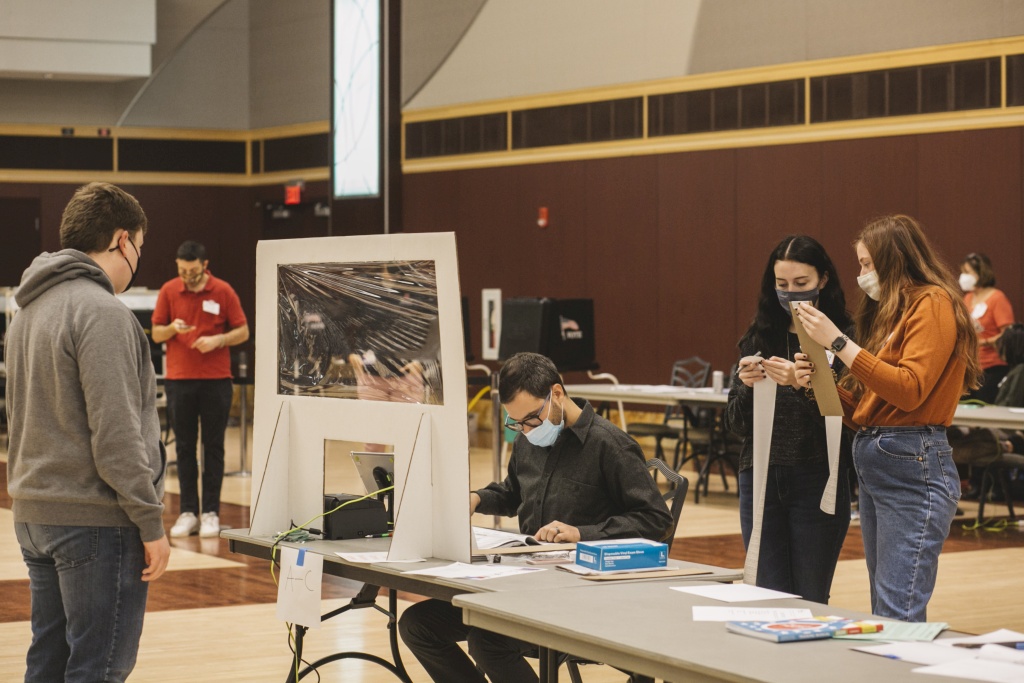
A few glitches also marked the first hours of voting. In Columbus, the Franklin County Board of Elections was checking voters in using paper poll books after technical difficulties sidelined an electronic check-in system, but officials said the move was not slowing down actual voting.

In Kansas City, police said they were investigating messages spray painted on the city’s iconic National WWI Museum overnight, including “Don’t Vote.” The building is serving as a polling station Tuesday.

Voters check-in on the campus of Ohio State University in Columbus, Ohio, on Tuesday. MUST CREDIT: Photo for The Washington Post by Andrew Spear /Photo by: Andrew Spear — for The Washington Post

Voters check-in on the campus of Ohio State University in Columbus, Ohio, on Tuesday. MUST CREDIT: Photo for The Washington Post by Andrew Spear /Photo by: Andrew Spear — for The Washington Post

One precinct in Philadelphia struggled with glitchy machines and briefly resorted to provisional ballots, but the machines were running by midmorning.

The Ohio secretary of state’s communications team announced Tuesday morning in a tweet that the Franklin County Board of Elections is checking voters in using paper poll books after not being able to upload all early in-person voting data into its electronic check-in system.

At least three states – Texas, Hawaii and Montana – exceeded their total 2016 turnout with early and mail voting this year, but other states have seen lower turnout that could foretell heavier Election Day traffic. Among battlegrounds, Pennsylvania had reached only about 40% of its 2016 levels by Monday, Ohio had hit 60%, and Michigan was also at 60%.

In other states, election officials who had encountered huge numbers of voters in the past several weeks said they were not sure what to expect Tuesday.

In Georgia, 3.9 million people had already voted as of Monday evening – edging close to the 4.2 million who turned out in 2016. The majority of the state’s 10 most populous counties had returned more than two-thirds of their mail ballots as of Saturday, according to the U.S. Elections Project.

On Monday, Fulton County Elections Director Richard Barron said that in some precincts in his county, home to downtown Atlanta, more than 80% of registered voters had cast their ballots either by mail or in person.

“This turnout has been amazing,” Barron said. Like other election administrators, Barron cautioned that Tuesday could still bring a crush of voting – and long wait times – but said that the upside was likely to be record-setting overall turnout, brought on by heavy interest in the race for the White House between President Donald Trump and former vice president Joe Biden.

“June taught us how difficult it is to run an election in the middle of a pandemic, but I think it also helped us to be prepared for what lies ahead,” Barron said. “It has made us better.”

Advocates remained nervous about the volume of mail ballots requested but not yet returned – and about fresh reports Monday of mail service delays in several battleground states. In Homestead, Fla., south of Miami, Postal Service executives announced that 62 ballots were found in a backlog of 180,000 pieces of mail over the weekend. All the ballots except one have now been delivered.

An estimated 27.2 million requested ballots had not been returned by Tuesday morning, according to the U.S. Elections Project, and the campaigns were urging their supporters to return ballots immediately to make sure those votes count.

In many cases, voters requested absentee ballots but then changed their minds about voting by mail, election officials said.

In Harris County, Tex., for instance, home of Houston, about half of the 90,000 ballots that haven’t been returned were surrendered by voters who chose to cast their ballots in person instead.

And in Florida, where 1.35 million mail ballots had not yet been returned, Republican consultant Rick Wilson estimated that voters planning to cast ballots in person accounted for about half of those.

In some states, however, it is more difficult for voters to change how they cast their ballots. In South Carolina, where about 35,000 mail-in ballots had not been returned by Monday afternoon, anyone who requested and received one will not be allowed to vote in person Tuesday. Those South Carolinians must instead return their mail-in ballots by 7 p.m. or cast a provisional ballot if they attest to never receiving their ballot in the mail.

Strategists from both parties said it was likely that more Republicans than Democrats got cold feet about voting by mail after months of attacks from Trump, who claimed without evidence that it would invite fraud. Polls have also indicated that a majority of Republicans planned to vote on Election Day, whereas most Democrats said they planned to vote early, either by mail or in person.

In the states that track voters by party registration, early-voting data reflected an advantage for Democrats, although in some states, notably Florida, that advantage had narrowed dramatically by the time early voting ended Sunday.

– – –

The Washington Post’s Michelle Ye Hee Lee in Washington, Brent Griffiths in Omaha; Kim Bellware in Kenosha, Wis.; Annie Gowen in Kansas City, Mo.; Keith O’Brien in Manchester and Londonderry, N.H.; Ryan Slattery in Las Vegas; Kayla Ruble in Detroit and Moriah Balingit in Cascade, Mich. contributed to this report.

‘This is how democracy crumbles’: Melanie Campbell on the fight to defend Black votes #SootinClaimon.Com

#SootinClaimon.Com : ขอบคุณแหล่งข้อมูล : หนังสือพิมพ์ The Nation.

‘This is how democracy crumbles’: Melanie Campbell on the fight to defend Black votes

InternationalNov 03. 2020“My mission in life is to do my part, but also to lift others along the way, make sure Black women are not invisible,” said Campbell, at right. MUST CREDIT: Washington Post photo by Melina Mara 

By The Washington Post · Vanessa Williams · NATIONAL, POLITICS, CONGRESS, WHITEHOUSE 
Melanie Campbell would love to be in Georgia, where a diverse coalition of activists has never been closer to flipping the state from red to blue. Or Florida, her home state, one of the top battlegrounds in the fierce fight for the presidency.

Instead, after a rough bout with covid-19, Campbell will spend this consequential election at home in Northern Virginia, directing and supporting Black female activists working to turn out Black voters across the South and in the critical swing states of Michigan and Pennsylvania.

Campbell is the convener of the Black Women’s Roundtable, one of the largest networks of women focused on using civic engagement to improve the lives of Black women, their families and their communities – improving access to health care, ending systemic racism, reforming the criminal justice system, lifting people out of poverty. The Roundtable was prepared to do double duty this year, making sure Black people participated in both the census and the national election. But the pandemic has created new challenges.

Instead of mobilizing voters by going door to door, the Roundtable is connecting with voters digitally on smartphones and tablets. When in-person early voting began, the women donned masks and worked the long lines at polling places, passing out water and snacks to keep people comfortable while they waited to cast their votes.

Now, with Election Day here, Campbell is worried about a Republican legal campaign to attack pandemic-related rule changes and limit access to the ballot. 

“There is a lot of concern – like this real concern – that there is such a systematic approach to suppressing people’s votes,” she said in a recent interview. “This is how democracy crumbles.”

The Black Women’s Roundtable is nonpartisan and does not endorse candidates. But Black voters overwhelmingly vote Democratic, and President Trump is deeply unpopular with them. In a Washington Post-Ipsos poll of Black adults this summer, 88% disapproved of the way Trump has handled his job, with 76% strongly disapproving. 

In 2016, more than 94% of Black women voted against Trump, more than in any other group of voters. This year, many are hoping to both boot Trump and make history by electing Sen. Kamala Harris, D-Calif., the first Black female vice president. 

Campbell has been talking with voting rights groups about to how defend the count. As she told organizers on a Zoom call a few weeks ago: “We will do what we have to do . . . . We know what’s going on – that folks are trying to just steal our vote from us – and we’re not going to have it on our watch.”

Campbell grew up in Mims, Fla., a small town on the Atlantic Coast. Her parents were educators and active in the local NAACP chapter. One of her earliest childhood memories was the night she huddled on the floor with her mother and sisters while her father and other men took up posts in trees and under houses to await a visit from the Ku Klux Klan, which was still active in Florida during the 1950s.

The youngest of six children, Campbell followed her older brothers and sisters to Atlanta, where she enrolled in Clark Atlanta University and took a corporate job upon graduation. But she soon found herself missing the action of the movement, and went to work for Maynard Jackson, then the mayor of Atlanta and one of the country’s highest-profile Black political leaders. While running the mayor’s office of youth services, she hired an outspoken student leader from Spelman College named Stacey Abrams, who had publicly questioned Jackson’s understanding of the frustrations of young people.

By 1995, Campbell had moved to Washington to work for the National Coalition on Black Civic Participation, where she found a mentor in Dorothy I. Height, a founding board member. Campbell became the coalition’s executive director in 2000 and president and CEO in 2011. 

“My mission in life is to do my part, but also to lift others along the way, make sure Black women are not invisible,” Campbell said. 

Oleta Fitzgerald is Southern regional director for the Children’s Defense Fund, based in Jackson, Miss. She said Campbell has helped to elevate the voices and stories of Black women in the rural South. 

“Not only does she say, ‘Come to the meeting,’ she puts you in the news conference. She talks about your report,” said Fitzgerald, who also works with the Southern Rural Black Women’s Initiative. “She’s a builder and makes space for people.”

Fitzgerald credited Campbell with helping Black female activists in Alabama influence the 2017 special election in which Democrat Doug Jones beat Republican Roy Moore for the U.S. Senate. Jones is unlikely to win reelection Tuesday in heavily Republican Alabama, but Campbell says she believes that over time the Roundtable can help loosen the GOP’s grip on the levers of power in the South. A large contingent of Roundtable women in Georgia is working to help turn that state blue.

“The majority of Black people live there,” she said of Southern states. “As a leader of an organization that focuses on Black civic engagement and empowerment and power-building for Black people, the South is key to that.”

This spring, Black voters in South Carolina resuscitated former vice president Joe Biden’s presidential campaign and set him on a path to capture the Democratic presidential nomination. A week later, the Black Women’s Roundtable held its annual meeting in Northern Virginia. The gathering pulsed with energy. 

Once again, Black women had flexed their political muscle. They were eager to talk about next steps. 

Within days, however, the nation began to shut down in the face of the coronavirus pandemic. Like many organizations, the Roundtable was forced to move its operations online. 

Through the summer, Campbell joined forces with other Black women leaders to push Biden to select a Black woman as his running mate. When Harris gave her acceptance speech at the Democratic National Convention in August, Campbell celebrated with friends at a virtual watch party.

Then Campbell attended a family funeral over Labor Day weekend. Despite taking precautions, she was infected with the coronavirus. After she struggled to get admitted to a hospital, a close friend connected her with a doctor who was able to get her into George Washington University Hospital, where she spent most of September. 

Salandra Benton, a Roundtable convener and executive director of the Florida Coalition on Black Civic Participation, has lost eight relatives to covid-19. She was terrified when she learned that Campbell, who she has known for more than 20 years, had fallen ill. 

With Campbell’s support, Benton had been able to help restore voting rights for Florida felons who had been released from prison. Last month, Benton partnered with the Florida Rights Restoration Coalition to host “Free the Vote” rallies around the state, aimed at encouraging felons to take advantage of their newly restored right to vote. 

“We’re doing everything we possibly can do, so that when Election Day comes we can say we left nothing on the table,” Benton said.

Latosha Brown, a Georgia organizer who also grew up under Campbell’s wing, said Black women are being asked to do too much. Brown is co-founder of the organization Black Voters Matter, which had to sue the state of Alabama to expand absentee voting so people could safely cast ballots during the pandemic.

“Black women are out here leading the charge of registering people to vote. Comforting voters at the polling sites. Advocating to make sure people are not being marginalized in the process – all those things that a government in a functioning democracy would normally have,” Brown said. 

“If Black women ever decide we don’t believe in democracy anymore, it’s over for this country,” she added. “It’s a wrap.”

On Sunday, Campbell held a virtual gospel hour, featuring music, prayer and a call to arms. 

“We know what’s up, we hear the drumbeat. We know what they’re trying to do,” she told the gathering. “So many of us are so worn out and tired. We needed this moment – I know I did – to remind ourselves that we are not in this alone. God is in control. 

“But He told us to work, work, work,” she said. “And that’s what we’re going to do.”