Need a new monitor for your computer? You can wear one on your face. #SootinClaimon.Com

#SootinClaimon.Com : ขอบคุณแหล่งข้อมูล : หนังสือพิมพ์ The Nation.

https://www.nationthailand.com/tech/40006718


Forget settling down in front of a computer monitor at work – someday, you might strap on a headset instead. That might sound a bit like a 90s cyberpunk fantasy, but its not really all that outlandish.
Beyond having more screens to work with for multi-tasking, there’s another benefit to wearing your computer’s screen(s) on your face: no one else can look at them. If you frequently work with sensitive files or data, the last thing you’d want is for a nosy neighbor on a plane or at a coffee shop peering over your shoulder. But these kinds of headsets can be cumbersome and in some cases could leave you feeling queasy.

More than a few tech companies are convinced that sophisticated screens shoved into glasses could represent the future of work. But they have different visions for how a screen you wear on your face should work.

Microsoft has built a chunk of its business around the HoloLens, which can display 2-D or 3-D content in the physical space workers occupy. Facebook is pushing new tools to turn virtual reality headsets like the Oculus Quest into tools employees can use to meet and collaborate in a virtual world. Meanwhile, a crop of headsets from companies like Lenovo and TCL are trying something a little more practical. Rather than thrust you into a world of conferences populated by 3-D avatars, these smart glasses try to replicate the experience of sitting in front of a computer monitor. (Or in some cases, lots of computer monitors.)

To be clear, these kinds of specialized gadgets are still far from hitting the mainstream.

ADVERTISEMENT

“The people who are getting these now are technophiles who are willing to say ‘Hey, I’m going to take it, warts and all,'” said Ramon Llamas, a research director at market research firm IDC. “It’s probably not going to be until the third or fourth revision that we start seeing more mass-market interest.”

– How do they work?

Most of the headsets that fall into this category have a lot in common. They generally don’t have any processing power of their own, so they need to be connected to a proper computer – or a smartphone – to get anything done. So far, that means they rely on long USB cables, though companies like chipmaker Qualcomm are working to embed powerful mobile processors directly in these glasses so future models can go cord-free.

But what makes these headsets interesting are how they show you your work. Essentially, they put a tiny screen in front of each your eyes, positioned in just the right way to make each little display look like one big one. (If you’ve ever gone birdwatching with a pair of binoculars, you’ve seen this technique in action!) Assuming everything is plugged in correctly and working the way it’s supposed to, you’re able to just pop those glasses on and have a look around.

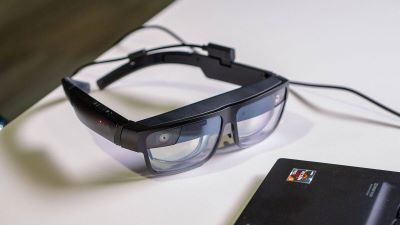
They might not look like it, but these glasses can act like a full-size computer monitor. PHOTO CREDIT: TCLThey might not look like it, but these glasses can act like a full-size computer monitor. PHOTO CREDIT: TCL

– What can you do with them?

These headsets aren’t meant to lock you in some strange virtual conference room – instead, they basically act as secondary screens you wear instead of putting them on your desk.

TCL, a Chinese company best known for producing televisions, makes one such headset. Its Nxtwear glasses can connect to one of the company’s compatible smartphones, which offers a view of a familiar, desktop-like interface where you can browse the Web, watch videos, or fire off emails. (If you do that, the phone’s screen also becomes a big trackpad for moving a mouse cursor around.)

When connected to a computer, like a MacBook Pro, the glasses effectively become a replacement monitor that looks much bigger than a typical laptop screen. You could certainly make it your main display, but because the glasses are screens propped up to the top of your line of sight by a set of big nose pads, you’d still be able to easily glance at your laptop.

Some models like Lenovo’s ThinkReality A3 PC Edition, offer a more immersive approach. Hooking it up to a compatible computer with a USB-C cable lets you view and rearrange up to five different screens in a sort of virtual “space” in front of you. As you move your head around, each of those monitors will come into view depending on how you’ve configured them. It’s as though you’re sitting in front of a desk you’ve meticulously arranged multiple monitors on, except you didn’t have to lug those monitors around in the first place.

The catch? Because the Lenovo’s headset is designed to show you multiple screens at the same time, it requires a lot more horsepower to work correctly, and not every computer will do. For now at least, you would have to already own – or buy – a compatible, Lenovo Thinkpad laptop if you ever wanted to try building a virtual workstation with the ThinkReality glasses.

– Where do we go from here?

These headsets are here, and they work, but let’s be honest: they’re still far from ideal.

For one, the companies that make these headsets haven’t completely conquered the issue of comfort. Because they have so many components and sensors packed into them, this current generation of smart glasses just can’t be nearly as flexible as, say, a regular pair of glasses. That could mean people with bigger heads may literally feel the pinch when they try to strap on a wearable display.

And while these headsets aren’t all that heavy – Lenovo’s is about a third of a pound – they can still feel cumbersome to use. But as the constellation of component makers continues to shrink their parts, that may change before too long.

“If these can be lightweight and comfortable and offer sufficient image quality where I can be productive on multiple screens, that’s the litmus test,” said Ross Rubin, principal analyst at market research firm Reticle Research. “I could see a path to that in the next maybe three years.”

Until then, headset makers have something else to tackle: price. Lenovo’s headset costs about $1,500, which is a big ask even if it’s meant for work – and especially one that requires other equipment to work. (Then again, maybe companies will eat the cost to make its workforce more productive; we’ll have to see.) Meanwhile, TCL’s glasses aren’t on sale in the U.S. yet, but models available elsewhere cost the equivalent of about $680.

That will change over time, too, as the technology matures and the cost of parts become more reasonable. Until then, though, many of us will just have to make do with the computer monitors we have now.

Published : September 28, 2021
From staying in touch to sleep tracking, how to get the most out of your smartwatch #SootinClaimon.Com

#SootinClaimon.Com : ขอบคุณแหล่งข้อมูล : หนังสือพิมพ์ The Nation.

https://www.nationthailand.com/tech/40006665


Whether you ever thought about it or not, some of the biggest tech companies in the world are duking it out for a spot on your wrist. But should you actually offer it to Apple, Google or Samsung?

The answer to that will be shaped by your life, your priorities and the relationship you want with the companies that make these things. For now, though, let’s start with the most basic truth about smartwatches: not everyone needs one. For the most part, they make some things you’d normally whip out your phone for – like checking your messages, controlling your music and taking quick calls – more convenient.

But there’s plenty of depth available if you need more than just the basics. Over the years, smartwatches have become sophisticated tools for exercise and health tracking and they can run versions of many of your favorite apps to glance at on the go.

I wear a smartwatch every day because I like being able to glance at my (many) incoming Slack messages, though I could pretty easily live without it.

Whether a smartwatch actually makes sense for you really depends on what you care about as a person. And if you already have a smartwatch, how do you make the most of it? To that end, we’ve put together a guide to help you figure out if one of these wrist-worn gadgets could fit into your life, sorted by personal priority.

If you don’t already have a smartwatch, there are a few things you’ll have to keep in mind. First up: compatibility.

IPhone owners can use the Apple Watch, along with smartwatches like the Fitbit Sense and Garmin’s Forerunner models, but are not compatible with watches that use Google’s Wear OS software. The reverse is also true, so Samsung and other Android phones aren’t compatible with the Apple Watch. (Fitbits and Garmins are a-okay, though.)

ADVERTISEMENT

The other thing to think about is privacy – after all, these wearables live on your body and, among other things, track your personal health information. One of the best resources we’ve seen for figuring out how potentially problematic wearables can be is Mozilla’s Privacy Not Included guide, but if you’re really concerned about your privacy, the best bet might be to not wear a smartwatch at all.

If all you really want is to stay on top of your incoming messages and notifications, then you’re in luck – that’s one thing every smartwatch out there can do. In fact, you might not even have to go with a full-blown smartwatch at all, since many fitness trackers (like Fitbits and Garmin’s Vivosmart series) can also alert you when someone texts or calls you.

Just beware: looking at your watch to check your new messages while talking to someone can look ruder than glancing at your phone.

That said, Apple Watch and wearables that use Google’s Wear OS software are more sophisticated with how they manage notifications compared to, say, a basic Fitbit. Let’s say you’re a news junkie: if you have The Washington Post app installed on your smartwatch, you can configure your watch to display news alerts you’d normally see on your phone. That same can be said for just about any app you use that creates notifications on your phone, but be aware: that can lead to an avalanche of notifications on your wrist. Here’s how you can make sure you only get the ones you want:

For Apple Watches:

– Open the Apple Watch app on your iPhone

– Tap the “Notifications” button

– Toggle notifications on or off for the apps listed under “Mirror iPhone alerts from”

For Google Wear OS watches:

– Open the Wear OS app on your Android phone

– Scroll to the “Settings” section and tap “Notifications” then “change watch notifications”

– Tap an app to allow or disable notifications

This is another thing that nearly all smartwatches can do to some extent, but exactly how they track your exercise depends on what kind of software your watch has.

Apple Watches are well-known for their three rings, a quick visual indicator that lets you know how close you are to meeting your daily step, exercise and stand goals. But there’s a lot more to the exercise experience than just that: using the built-in Fitness app, you can tell the watch to track different kinds of workouts, from long walks, to weight training to Tai Chi. No matter what type of exercise you’re doing, the Apple Watch will show you your current workout duration, heart rate and calories burned.

Samsung’s Galaxy Watches, which only work with Android phones, offer many of the same workout tracking features. But there’s a twist. Let’s say you’re in the gym lifting weights: unlike the Apple Watch, which only gives you the basic stats I mentioned earlier, Samsung’s watches also offer guidance on the correct form for exercises like bicep curls, as well as count your reps for you.

But there’s another question at play here: if tracking exercise is your main concern, do you really even need a smartwatch? That’s debatable. You can find a slew of wearables for $100 or less designed solely to count your steps, monitor your heart rate and even compete with your friends – Fitbit’s new Charge 5 quickly springs to mind.

At the end of it, it all boils down to the level of sophistication you’re after. If your big priority is just being generally more active, you could easily get away with a cheap Fitbit. But for deeper insight into your workouts, a smartwatch is a better bet. And if you’re a really serious athlete – say, an avid runner or triathlete – you might want to consider a more specialized smartwatch like one of Garmin’s Forerunners.

Many companies have crammed a bevy of sophisticated sensors and features into smartwatches so they can help you keep tabs on your well-being. Here are a few you might find in your next (or first) smartwatch:

– Optical heart sensor: These basically use light to measure your blood flow and are used to help show you how fast your heart is beating. (Available in all versions of the Apple Watch, all versions of Samsung’s Galaxy Watch, all of Garmin’s Forerunner smartwatches, and Fitbit’s Versa 2, Versa 3 and Sense watches.)

– Electric heart sensor: Instead of just tracking your heart rate, these are used to take electrocardiograms and can help flag irregularities in your heart beat. (Available in Apple Watch Series 4-7, Samsung’s Galaxy Watch Active 2, Galaxy Watch 3 and Galaxy Watch 4, and the Fitbit Sense.)

– SpO2 tracking: This feature often relies on a smartwatch’s optical heart sensor to figure out how much oxygen is in your blood. In general, healthy people have oxygen saturation levels between 90 and 100 percent. If your readings are consistently lower than that, consider seeing a doctor. (Available in Apple Watch Series 6 and 7, Samsung Galaxy Watch 3 and 4, and the Fitbit Sense.)

– Fall detection: Nearly all smartwatches use sensors called accelerometers inside to measure movement, but only a few use those sensors to tell when you’ve taken a hard fall. If a watch with this feature senses one, it will give you options to contact emergency service or loved ones. That said, this feature can be very hard to trigger – even when you’re specifically trying to set it off. (Available in Apple Watch Series 4 and newer, and Samsung’s Galaxy Watch Active 2, Galaxy Watch 3 and Galaxy Watch 4.)

When it comes to your health though, just be sure to keep one thing in mind. Smartwatches, even really sophisticated ones, don’t always have approval from the Food and Drug Administration for some of the health features they offer. That’s often thanks to a well-known loophole: If a smartwatch maker markets something as a “wellness” feature instead of a tool for medical diagnosis, it doesn’t need the FDA to sign off on it. Blood oxygen tracking is a good example of a feature that generally doesn’t have to be cleared, but all watches with electrocardiogram features in the United States have been evaluated by the FDA.

According to the Centers for Disease Control and Prevention, around 70 million Americans suffer from chronic sleep problems. If you’re one of them, a smartwatch might be able to help you understand why. Many popular options offer sleep tracking features that keep an eye on troublesome sleep behaviors you might not be aware of.

The Apple Watch Series 3 and newer can, for example, detect how long you were asleep and track your breathing throughout the night. And that’s just the tip of the iceberg.

Most of Garmin’s Forerunner smartwatches monitor your blood oxygen levels while sleeping, and your respiration, too. It’ll even attempt to measure how much time you spent in different sleep phases – light, deep or REM (rapid eye movement) – in order to give you a sleep “score” in the morning, plus some advice on how easy you should take it that day.

Fitbits were among the first fitness trackers out there to support sleep tracking and the company’s smartwatches – like the Fitbit Sense – continue to carry that torch. The Sense features all of the same tracking tricks that Garmin watches do, but with one helpful addition: a “smart wake” mode that will wake you up to 30 minutes before your alarm if it thinks you aren’t sleeping deeply anymore.

Meanwhile, Samsung’s new Galaxy Watch 4 can monitor blood oxygen and track your progression through different sleep stages like the other, but it also has a sleep tracking trick we haven’t seen in a wearable before: snore detection. That might sound a little silly, but it’s more helpful than you might think. If your stats say you’ve been snoring and your blood oxygen levels are unusually low, you may want to see a specialist – those might be signs of a disorder like sleep apnea.

Tips for getting the best sleep data:

– Make sure your watch band is as snug as it is comfortable. That helps ensure the sensors that work while you’re asleep are in a good position to take readings.

– Charge your smartwatch before bed. You’re not going get any good sleep info if your watch dies before you wake up.

– Turn off notifications for the night. Most Samsung smartwatches have a “Good night mode” that mutes all notifications except alarms. Apple Watch owners can set up and enable “Sleep mode” on their iPhones, which also turns on Do Not Disturb. On a Fitbit smartwatch, swipe your home screen to the left and tap the moon icon to enable “Night mode.” Meanwhile, Garmin Forerunner owners have to turn on Do No Disturb.

Be aware of your watch’s specific foibles. For example, some of the sleep features mentioned above aren’t enabled by default on Samsung’s Galaxy Watch 4, so you need to turn them on manually. And Garmin says you need to be wearing its watches for two hours before sleeping to get the best data.

Many common wearables – Apple Watches, Samsung’s Galaxy Watches, Fitbits like the Sense and Versa and more – can pull double duty as tiny speakerphones when you don’t want to pull out your smartphone. Call quality can vary depending on what kind of watch you’re wearing, but it’s generally good enough for quick conversations. (Talking into your wrist can look a little silly, but if Dick Tracy can pull it off, so can you.)

But again, proper smartwatches have an edge if you want to do more than just take phone calls. The Apple Watch has a neat, built-in Walkie Talkie feature that lets you trade quick voice messages with other Apple Watch owners. (Even better, you have to specifically request someone’s consent – and vice versa – before you can swap voice memos).

Samsung’s latest Galaxy Watch 4 offers a similar feature, but with a catch: it only allows you to share voice messages with other people whose watches run the latest version of Google’s Wear OS software, and there aren’t very many of those available right now.

Published : September 26, 2021

NASA looks to a future that includes flights to the moon and Mars as it reorganizes #SootinClaimon.Com

#SootinClaimon.Com : ขอบคุณแหล่งข้อมูล : หนังสือพิมพ์ The Nation.

https://www.nationthailand.com/tech/40006465


With SpaceX now responsible for flying cargo and astronauts to the International Space Station, NASA is reorganizing to put a new emphasis on deep space, including setting up a new directorate to develop the technologies needed to pursue what would be some of the most ambitious missions NASA has ever attempted, including building a permanent presence on the moon and eventually Mars.

In an interview with The Washington Post, NASA Administrator Bill Nelson said the new directorate, known as Exploration Systems Development, will oversee the development of new tools, from habitats to rovers and propulsion systems, to help NASA push new frontiers.

The success of the agency’s partnership with a growing commercial space industry allows “NASA to get out of low Earth orbit and go explore,” Nelson said.

NASA is scheduled to announce the creation of the new directorate at a noon town hall meeting with agency employees. Jim Free, a former associate NASA administrator, will run the new directorate. Kathy Lueders, who leads the agency’s current Human Exploration and Operations Mission Directorate, will run a second new directorate, to be known as Space Operations. It will oversee programs once they transition out of development, such the space station, the commercialization of low Earth orbit, and in the years to come, operations on the moon, NASA said in a statement.

A reorientation of NASA operations has been anticipated, hastened by the success of SpaceX, which has been delivering cargo and supplies to the space station for years. Then last year, SpaceX flew the first mission of NASA astronauts to the space station, demonstrating that NASA no longer was the only player in getting astronauts to low Earth orbit. That reality was cemented last week, when SpaceX, the venture founded by Elon Musk, successfully flew four civilians on a three-day mission orbiting the Earth without any NASA involvement.

ADVERTISEMENT

In addition to SpaceX, Northrop Grumman flies cargo to the station. And Boeing is under contract to fly astronauts there, though it has stumbled badly with the development of its Starliner spacecraft and is years behind schedule.

The ability to depend on commercial enterprises for low-Earth undertakings frees NASA to devote more attention to more ambitious missions.

“If you look out over the next two decades, what we have is a string of programs,” Pam Melroy, NASA deputy administrator, said in an interview. “We’re talking habitats, transportation systems like rovers. We’re talking infrastructure like power, communications, resource extraction. … The scope of what we have stretching out ahead of us, it’s very different than what we’ve done in the past.”

Nelson said the changes were made because the enterprise, from flying astronauts to the space station, to its Artemis program to get astronauts to the moon and then eventually to Mars, “got too big. One person can’t do it all.”

Free said the two directorates will work together, but that he will be looking ahead to future missions and harnessing the technology that would make them happen, from new forms of propulsion to in-space manufacturing and mining.

But first the agency must be focused on returning humans to the moon under the Artemis program, Free said during the town hall.

“That’s our focus, that’s our responsibility,” he said.

“There’s so much new technology that has to be developed for the moon and Mars, as well as cultivating the international partnerships that are going to be with us,” Nelson said.

The change is unlikely to be greeted enthusiastically by all, especially in an enterprise where mistakes can be deadly. Critics are likely to say that the move creates another level of bureaucracy, requiring a separate budget and new channels to lawmakers, industry leaders and international partners, as well as the potential for competition between the two directorates.

Nelson said the changes are not a diminishment of Lueders’s responsibilities but rather “an enhancement of the tremendous success that she’s already achieved.”

Lueders oversaw the contract to build a spacecraft capable of landing astronauts on the moon that NASA awarded to SpaceX earlier this year. Jeff Bezos’s Blue Origin, which had bid $6 billion or twice as much as SpaceX and lost out on the contract, has alleged the procurement was badly flawed. It protested the decision to the Government Accountability Office, lost, and has since filed a lawsuit in the Court of Federal Claims. (Bezos owns The Post.)

The litigation has forced NASA to stop work on the contract.

At the town hall, she said she was looking forward to working with Free. “I can’t tell you how excited I am to have a partner here,” she said. “I keep thinking two heads are better than one and, and this is going to be a lot of fun.”

The Artemis moon program has already seen several delays and getting astronauts to the surface by 2024, NASA’s goal, is not likely to happen. But Nelson said that the first mission of the program, known as Artemis I, is on track to launch the Orion spacecraft, without any astronauts on board, that would orbit the moon later this year or early next. The mission would be the first flight of NASA’s massive Space Launch System, which also has suffered years of delays.

The second flight, Artemis II, would be a crewed mission around the moon by the end of 2023, or early 2024, he said. But he was less confident about the timeline for landing astronauts on the surface.

“Obviously there have been delays,” Nelson said. “We’re in the middle of a legal cat fight right now. And who knows what’s going to happen after the federal judge rules. So, am I still holding 2024 as a goal? Yes. Oh, but I’m also realistic to know that there are a lot of things beyond our control.”

Published : September 22, 2021

All-amateur astronaut crew splashes down in Atlantic, another successful SpaceX mission #SootinClaimon.Com

#SootinClaimon.Com : ขอบคุณแหล่งข้อมูล : หนังสือพิมพ์ The Nation.

https://www.nationthailand.com/tech/40006350

All-amateur astronaut crew splashes down in Atlantic, another successful SpaceX mission


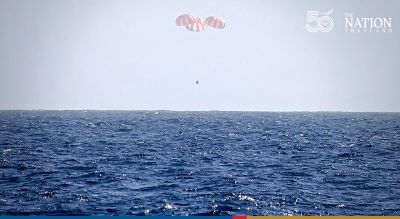
The quartet of amateur astronauts onboard the SpaceX Dragon spacecraft splashed down in the Atlantic Ocean Saturday evening, completing the first all-civilian mission to orbit the Earth and setting the stage for more privately funded missions to come.

The crew of the Inspiration4 spent three days in orbit, circling the globe at 17,500 mph, before coming back to Earth in a flight designed to raise money for St. Jude Children’s Research Hospital.

The splashdown came at 7:07 p.m. Eastern time in calm waters, a SpaceX live stream of the event showed. The astronauts emerged from the capsule, which had been hoisted aboard a recovery ship, less than 50 minutes after the splashdown.

That brought a successful end to a historic flight funded by the mission commander, Jared Isaacman, a 38-year-old billionaire entrepreneur and aviation enthusiast. Never before had a group of amateurs flown to orbit before. While NASA had overseen the development of the Falcon 9 rocket and Dragon spacecraft that flew them to space, the agency was not directly involved in the mission.

“That was a heck of a ride for us, and we’re just getting started,” Isaacman said.

In a post-flight press conference Todd “Leif” Ericson, an Inspiration4 mission director, said, “Welcome to the second Space Age. … This is opening up a whole new chapter in spaceflight.”

ADVERTISEMENT

Before the flight, Elon Musk’s SpaceX had flown three sets of professional, government-trained astronauts to the International Space Station, and the company has another mission for NASA scheduled for next month. But Musk founded SpaceX with the goal of opening space to the public and eventually building bases on the moon and Mars, and the Inspiration4 mission fit that goal. The company already has booked more private astronaut flights, including one tentatively scheduled for 2023 that would take a Japanese billionaire on a trip around the moon in the company’s still-under development Starship spacecraft.

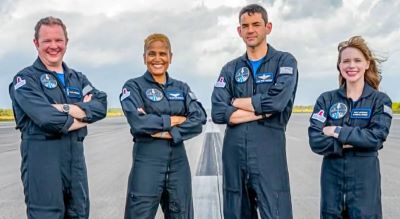
During its three days in orbit, the Inspiration4 crew – which included the mission pilot, Sian Proctor, 51, a college professor from Arizona; Chris Sembroski, a 42-year-old father of two from Everett, Wash.; and Hayley Arceneaux, a 29-year-old from Memphis who works as a physician assistant – virtually rang the bell of the New York Stock Exchange and spoke to patients at St. Jude, one of whom asked if there any cows on the “moooooon.” They also spoke with actor Tom Cruise, who has been in talks to fly on a later SpaceX flight to the International Space Station, as well as U2’s Bono.

In an interview with CBS News, Scott “Kidd” Poteet, SpaceX’s Inspiration4 mission director, said there was a “minor waste management issue that the crew and mission control were required to troubleshoot. But honestly, this did not impact the mission.”

At the news conference, Ericson said there was a problem with a fan. “As in most exploratory adventures like spaceflight there’s always been one or two little hiccups along the way,” he said. “But this was dealt with amazingly by the SpaceX team.”

Benji Reed, SpaceX’s senior director of human spaceflight, said, “We couldn’t have asked for a more successful mission.”

When planning the flight, Isaacman asked SpaceX about the feasibility of flying at an altitude even higher than the International Space Station, which orbits the Earth at about 240 miles above the planet’s surface.

After SpaceX engineers deemed it safe, the Inspiration4 crew hit an altitude of about 367 miles, which is also higher than the Hubble Space Telescope and most space shuttle flights, and it set a record for SpaceX’s Dragon spacecraft. Views of Earth from that height reportedly were amazing, especially since SpaceX added a curved window at the top of the spacecraft so the travelers could spend time gazing at the stars and earth below, almost as if they were outside the craft.

At a press briefing before the flight, Isaacman said that he wanted the mission to push the envelope. “If we’re going to go to the moon again, and we’re going to go to Mars and beyond, we’ve got to get a little outside our comfort zone and take the next step in that direction,” he said.

For the first day or so, there was limited information about what the crew was up to or how they were doing. Images and video were not made public.

On Friday, though, the mission’s Twitter account posted a photo of the astronauts, all smiling and looking healthy. “The crew of #Inspiration4 had an incredible first day in space! They’ve completed more than 15 orbits around planet Earth since liftoff and made full use of the Dragon upola.”

Then it posted the video of the crew speaking with patients at St. Jude. And on Friday afternoon, the crew hosted a live broadcast showing viewers around the capsule and giving them a sense of how they had been spending their time.

The lack of information was not a surprise, especially given that the crew is made up entirely of amateurs whom had never been to space before, said Brian Weeden, the director of program planning at the Secure World Foundation, a think tank.

“I would not be surprised to find out that they had some ‘adjustment’ challenges with orbital spaceflight. Something like half of all people who have been in space have experienced initial bouts of nausea and space sickness as their body adjusts,” he said.

“Also, keep in mind that these people are spending three days in very close proximity to each other and are probably having to figure out everything from sleeping and eating to using the toilet with very little privacy. I’m not surprised they’re a bit reluctant to broadcast that to the world.”

The crew spent a fair amount of time conducting experiments to measure the effect of weightlessness on the human body. Arceneaux, the crew’s medical officer, took ultrasound readings on her fellow astronauts to measure how their bodies were reacting. Sembroski, an engineer at Lockheed Martin, played his ukulele. And Proctor, a professor at a community college, brought art supplies and drew a picture of their Dragon spacecraft.

Isaacman placed the first bet from space, a $4,000 wager that the Philadelphia Eagles would win the Super Bowl. MGM, which announced the bet, said it was contributing $25,000 to St. Jude.

The menu for the Inspiration4 crew was varied – pasta and meatballs, salami, bacon and cheddar, pasta Bolognese. For snacks, there were granola bars, peanut butter cups, apricots and M&Ms, which are good for shooting around in the weightless environment of space.

Proctor reportedly was especially fond of pizza. SpaceX founder Elon Musk apologized on Twitter that the Dragon capsule hadn’t come equipped with a way to heat it up.

“Sorry it was cold!” he wrote. “Dragon will have a food warmer & free wifi next time.”

Published : September 19, 2021

Facebook announces new policy against coordinated social harm that may lower the bar on who gets banned #SootinClaimon.Com

#SootinClaimon.Com : ขอบคุณแหล่งข้อมูล : หนังสือพิมพ์ The Nation.

https://www.nationthailand.com/tech/40006250

Facebook announces new policy against coordinated social harm that may lower the bar on who gets banned


Facebook on Thursday announced a new enforcement policy for groups that coordinate online to spread misinformation, hate and “social harm” but do not violate traditional company standards against “inauthentic” content.

Facebook immediately used its new policy against “coordinated social harm” on Thursday to shut down large portions of a German online network pushing the Querdenken conspiracy theory, which has fueled resistance to government health restrictions related to the covid-19 pandemic.

Thursday’s action moves Facebook beyond its long-standing reliance on “inauthenticity” as the key marker of forbidden behavior on the platform.

The company typically uses the term – which has been widely adopted within the industry – to describe deceptive behavior, in which social media users attempt to manipulate others while disguising their identities and actual views.

Most Facebook takedowns of disinformation operations in recent years – both by foreign actors and domestic ones – relied on Facebook’s designation of a group as engaging in “coordinated, inauthentic behavior,” a term so commonly used that the company often referred to it by the acronym “CIB.”

But the term long has been problematic because companies struggled in many cases to determine who users were and what they believed. Existing prohibitions against hate speech, harassment and incitements to violence already allowed Facebook to act against individual accounts that violated such policies. Facebook also had a policy as well that called for sanctions against “dangerous organizations,” a designation typically applied to extremist groups that foment violence.

ADVERTISEMENT

Company officials said Thursday they needed a new policy to take action against movements that intentionally caused social harm – including violence – but didn’t rise to the designation of “dangerous organization.”

“We recognize that, in some cases, these content violations are perpetrated by a tightly organized group, working together to amplify their members’ harmful behavior and repeatedly violate our content policies,” said Nathaniel Gleicher, Facebook’s head of security policy, in a blog post announcing the change. “In these cases, the potential for harm caused by the totality of the network’s activity far exceeds the impact of each individual post or account.”

Gleicher said the new policy allows Facebook to more easily act against the “core network” of a group that commits widespread violations.

Facebook officials said the German Querdenken group, whose name translates as “lateral thinking,” has used duplicate accounts and other coordination techniques to spread covid misinformation, hate speech and incitements to violence on a broad enough scale that it merited systemic enforcement action, though it stopped short of banning the group outright. Facebook did not say how many accounts and pages it removed but said the number was “relatively small” – less than 150 on both Facebook and its subsidiary Instagram.

Published : September 17, 2021

SpaceX launches Inspiration4 flight of all-civilian crew #SootinClaimon.Com

#SootinClaimon.Com : ขอบคุณแหล่งข้อมูล : หนังสือพิมพ์ The Nation.

https://www.nationthailand.com/tech/40006228

SpaceX launches Inspiration4 flight of all-civilian crew


CAPE CANAVERAL, Fla. – Four amateur astronauts lifted off from Kennedy Space Center here Wednesday evening, making history by becoming the first all-civilian crew to reach orbit in a fully commercial mission operated by Elon Musks SpaceX and paid for by a billionaire entrepreneur.

The launch, dubbed Inspiration4, was the first step in what is planned to be an audacious three-day journey in orbit around Earth by a group of people who just months ago didn’t know each other and didn’t expect to fly to space.

Just before launch, Jared Isaacman, the billionaire businessman who financed the trip and is its commander, urged action. “Inspiration4 is go for launch,” he said. “Punch it, SpaceX.”

The flight marks a new expansion in the growth of the commercial space industry and another leap forward by Musk’s SpaceX, which has vowed to open the cosmos to ordinary people, not just professionals trained by the government, in a quest ultimately to land humans on Mars.

Civilians have in the past joined professional astronauts on trips to the International Space Station. And Richard Branson’s Virgin Galactic and Jeff Bezos’ Blue Origin are working to fly paying customers on suborbital flights that would touch the edge of space before falling back to Earth. (Bezos owns The Washington Post.)

But never before has a crew made up entirely of civilians – two of whom won their seats through a competition and sweepstakes – reached orbit.

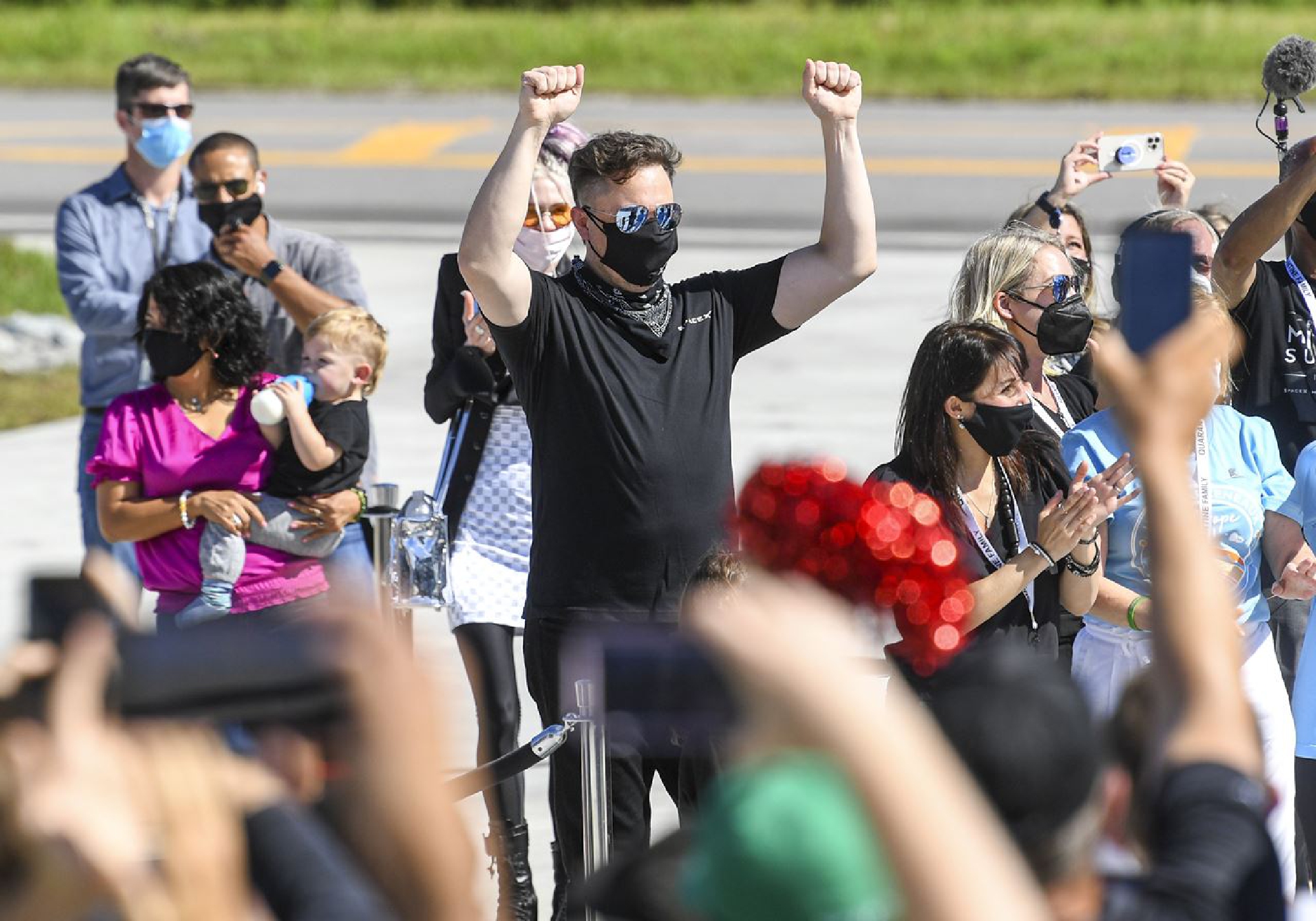
SpaceX founder, Elon Musk, pumps his fist as the Insiration 4 crew leaves the hanger on their way to launch on Sept. 15, 2021. MUST CREDIT: Washington Post photo by Jonathan NewtonSpaceX founder, Elon Musk, pumps his fist as the Insiration 4 crew leaves the hanger on their way to launch on Sept. 15, 2021. MUST CREDIT: Washington Post photo by Jonathan Newton

ADVERTISEMENT

Isaacman, a 38-year-old father of two, made his fortune by founding Shift4 Payments, a payments processing company. He’s an accomplished pilot who flies fighter jets in aerobatic competitions. He paid an undisclosed sum for the mission, though he told Axios it was less than $200 million, and turned it into a fundraiser for St. Jude Children’s Research Hospital.

His first pick to accompany him on the flight was Hayley Arceneaux, a 29-year-old from Memphis who works as a physician assistant. As a child, she was treated for bone cancer at St. Jude and made it her goal to work there and help others. As a result of her cancer, she had a rod placed in her leg, making her the first person with a prosthesis to go to space.

The other crew members, Sian Proctor and Chris Sembroski, won their seats. Proctor, 51, a licensed pilot who is also an artist, poet and college professor from Phoenix, won a competition by using Shift4′s software to build an online store and create a video outlining her space dreams. In it Proctor, who was a finalist for the NASA astronaut program in 2009, read a poem calling for what she called a JEDI future, which she described as Justice, Equity, Diversity and Inclusion.

In a briefing for reporters before the launch, she said she was honored to be the fourth African American woman to go to space and the first to serve as the pilot of a mission.

“It means that I have this opportunity to not only accomplish my dream, but also inspire the next generation of women of color and girls of color and really get them to think about reaching for the stars,” she said.

Pictures is the SpaceX launch of the Inspiration4 crew manned by civilian astronauts, Jared Isaacman, Sian Proctor, Hayley Arceneaux and Chris Sembroski on Sept. 15, 2021. MUST CREDIT: Washington Post photo by Jonathan NewtonPictures is the SpaceX launch of the Inspiration4 crew manned by civilian astronauts, Jared Isaacman, Sian Proctor, Hayley Arceneaux and Chris Sembroski on Sept. 15, 2021. MUST CREDIT: Washington Post photo by Jonathan Newton
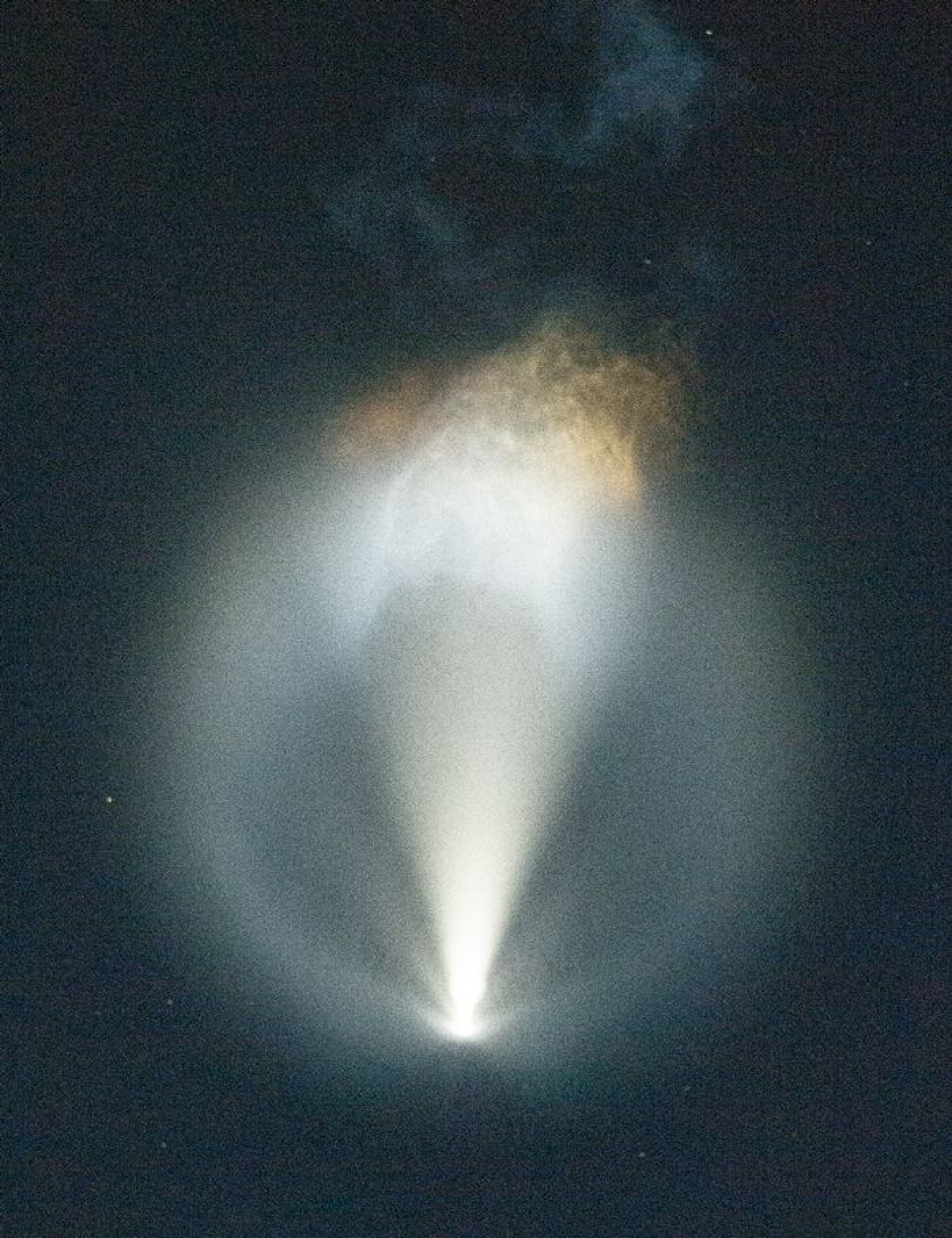
Sembroski, a 42-year-old father of two from Everett, Wash., won by donating to the St. Jude fundraiser. A friend of his was initially selected for the seat but backed out and offered it to Sembroski, who works at Lockheed Martin and served in the Air Force.

The Falcon 9 rocket that propelled the crew into space and the Crew Dragon spacecraft that will be their home until they splash down off the coast of Florida are owned and operated by SpaceX, not NASA. But the space agency has over the years invested heavily in the system, awarding SpaceX billions of dollars of contracts so the company could fly cargo and its astronauts to the station.

For this mission, however, NASA was merely a bystander.

The Falcon 9 lifted off at 8:02 p.m. from iconic pad 39A, which SpaceX leases from NASA and was host to the Apollo 11 moon launch as well as many space shuttle launches.

The rocket cackled and roared as it streaked through the darkening sky, reverberating across a Florida Space Coast that is witnessing a resurgence of launches, reminiscent of the early days of the space program, when astronauts including John Glenn, Alan Shepard and Neil Armstrong took to the skies.

The crew of the Inspiration4 mission stands in stark contrast to those men – all White, all trained by the military and then chosen by NASA for their bravery and aptitude for the “right stuff.”

Upon reaching orbit, Isaacman said, “The door is opening now, and it’s pretty incredible.”

The Inspiration4 crew looks more like a slice of America then those NASA pioneers, from different walks of life, of different ages and with different experiences, whose voyage to space was as much happenstance as design.

With this mission, SpaceX will be pushing the limits. The flight is scheduled to reach an altitude of about 360 miles, higher than the International Space Station and the Hubble Space Telescope.

In a Netflix series documenting the mission, Isaacman and his team ask SpaceX about the feasibility of flying above the space station. An unnamed SpaceX employee responded by saying, “Intuitively going slightly above would not present a problem.” But he added that it “will start to stretch our margins. And there may be other problems that I’m not aware of in other subsystems.”

Another employee warned, “Yeah, it’s not one particular thing, it’s just opening Pandora’s box.”

At the preflight media briefing, Isaacman said he wanted the mission to push the envelope. “If we’re going to go to the moon again, and we’re going to go to Mars and beyond, we’ve got to get a little outside our comfort zone and take the next step in that direction,” he said.

The SpaceX launch of the Inspiration4 crew took place Wednesday, Sept. 15, 2021, at the Kennedy Space Center in Florida. MUST CREDIT: Washington Post photo by Jonathan NewtonThe SpaceX launch of the Inspiration4 crew took place Wednesday, Sept. 15, 2021, at the Kennedy Space Center in Florida. MUST CREDIT: Washington Post photo by Jonathan Newton


Benji Reed, SpaceX’s senior director of human spaceflight programs, said his engineers studied the flight trajectory, looked at risks such as micro-meteorites and debris and radiation exposure, and the amount of propellant on the spacecraft, and determined it was something they could do.

“Ultimately it’s about safety and reliability,” he said. While it is a different flight path from the ones it has been flying for NASA, “that’s not to say that you can’t go and do more, and you should go and do more when you can. . . . Certainly, Dragon is capable of doing it. We did all the risk analysis to make sure that we’d fly safely.”

But the flight won’t be easy.

Even professionally trained astronauts suffer from “space sickness” once they reach orbit, finding the weightless environment so disorienting many throw up. And while the crew has been trained in emergency procedures, it’s not clear how they’ll react if something goes wrong – whether they’ll be cool in the moment, or panic.

Though the launch went well, the crew still has three days inside a cramped spacecraft, where they’ll live, sleep and even go to the bathroom in proximity to each other. Then there’s the return. To get home, the spacecraft will have to slam back through the atmosphere, generating extreme temperatures that will engulf the capsule in a fireball.

In an interview last year, Musk acknowledged the risks anytime you put people on top of a rocket loaded with thousands of gallons of highly combustible propellant.

“It’s a scary thing to be launching people,” he said. “We’ve done everything we can to make sure that the rocket is safe and the spacecraft is safe. But the risk is never zero when you’re going 25 times the speed of sound, and you’re circling the Earth every 90 minutes.”

But if they are able to successfully complete the mission, it would go down as a historic flight and demonstrate that there is a growing business in space.

The flight precedes other planned private astronaut missions. Axiom Space, a Houston-based company is chartering flights for customers who are paying around $55 million for a little over a week on the space station. But on those missions, the private astronauts would be accompanied by a former NASA astronaut.

Ultimately, SpaceX and other companies hope the prices will come down and that space will be open not only to the super wealthy – or lucky. Isaacman said the Inspiration4 mission, then, is a first step in that direction.

“It’s just getting started,” he said. “This is just the beginning.”

Published : September 16, 2021

Nikola showcases German plant nearing first production of electric trucks #SootinClaimon.Com

#SootinClaimon.Com : ขอบคุณแหล่งข้อมูล : หนังสือพิมพ์ The Nation.

https://www.nationthailand.com/tech/40006200

Nikola showcases German plant nearing first production of electric trucks


Nikola Corp. offered the public a look at the production line the company is counting on to start delivering trucks to customers in the wake of its founder being charged with securities fraud.

The U.S. manufacturer hosted an event Wednesday in Ulm, Germany, where its partner Iveco — the commercial-vehicle unit of CNH Industrial — is preparing to start series production of Nikola Tre heavy-duty trucks by year-end. The first battery-electric models will be delivered to customers in the U.S. early next year, with a fuel cell version slated to follow by the end of 2023.

Nikola is looking to turn the page on a tumultuous period after it went public by combining with a blank-check company in June of last year. Shares of the truckmaker with virtually no revenue initially skyrocketed, briefly making the company worth than Ford Motor Co. The stock came crashing down after a short seller accused founder Trevor Milton of misleading investors. He stepped down as executive chairman in September and pleaded not guilty to fraud charges in July.

The company is keen to deliver a message of “focus and execution,” Chief Executive Officer Mark Russell said during an interview in Ulm. “In spite of all of the challenges like Covid and supply disruptions, here we are.”

Nikola shares rose as much as 8.8% before the start of regular trading and were up 3.6% to $10.27 as of 7 a.m. in New York. The stock has plunged almost 90% from its peak in June 2020.

Russell followed Milton to Nikola from metals manufacturer Worthington Industries Inc., which acquired one of Milton’s earlier business ventures. Last month, the CEO cut Nikola’s projection for initial deliveries this year to 25 to 50 trucks, citing shortages of semiconductors and other parts. Although scarce supplies of chips could render the vehicles ineligible for sale, Nikola still plans to deliver them to customers for testing and charge for them once they’re retrofitted with missing parts.

ADVERTISEMENT

Next year, the Ulm facility will build as many as 100 trucks, with demand “far exceeding capacity,” Iveco CEO Gerrit Marx said. The plant will eventually be able to make 3,000 trucks annually across three shifts. Nikola plans to open its second site in Coolidge, Arizona, next year to produce fuel cell-powered trucks.

Nikola and Iveco have invested 40 million euros ($47 million) to upgrade the latter company’s chassis engineering hub in Ulm for final assembly of the Tre. The heavy-duty truck with a driving range of 560 kilometers (348 miles) is designed for shorter trips such as moving freight within industrial ports or garbage collection. It will be built off an Iveco platform with modules from the manufacturer’s factories in Spain.

Nikola is handling vehicle controls, including driver-facing software, and proprietary technology related to designing the Tre’s 4.5-ton battery pack.

In addition to unveiling their joint-venture facility on Wednesday, Iveco and Nikola announced an agreement with the Hamburg Port Authority to test up to 25 battery-electric Tre trucks starting next year.

Iveco has stood by Nikola while other big-name partners have pulled back. General Motors dropped a tentative plan to take a stake in the company and produce an electric pickup called the Badger. Their remaining agreement for Nikola to use GM’s hydrogen fuel cell technology in its trucks now appears to be in limbo — Nikola announced earlier this month it will source fuel cell systems from German supplier Robert Bosch.

“There were enough reasons to stop all of this — the last 24 months would have equipped us with enough reasons, everybody would have understood,” Iveco’s Marx said. “But we never even considered it.”

Published : September 16, 2021

Facebook risks for young people add to bipartisan backlash #SootinClaimon.Com

#SootinClaimon.Com : ขอบคุณแหล่งข้อมูล : หนังสือพิมพ์ The Nation.

https://www.nationthailand.com/tech/40006199

Facebook risks for young people add to bipartisan backlash


Facebook is facing renewed fury from Washington after reports suggested the company knew, but didnt disclose, that its Instagram platform could pose risks to teenagers.

The report from the Wall Street Journal citing Facebook’s own internal research gives fuel to politicians who have pledged to hold social media companies accountable for their impact on mental health, civil discourse and democracy. While previous rounds of outrage over issues such as the Cambridge Analytica privacy scandal haven’t dented Facebook’s business model or profitability, this backlash could bring Chief Executive Officer Mark Zuckerberg and other company executives back to testify before Congress about the shortcomings.

Sens. Richard Blumenthal, D-Conn., and Marsha Blackburn, R-Tenn., the chair and ranking member of the Senate consumer protection subcommittee, said they have been in contact with a Facebook whistle-blower and “will use every resource at our disposal to investigate what Facebook knew and when they knew it.”

The senators said Tuesday they planned to seek further documents and speak with witnesses as part of the investigation. The Senate Commerce Committee has the power to issue subpoenas for records and witness testimony.

“It is clear that Facebook is incapable of holding itself accountable,” the senators said. “The Wall Street Journal’s reporting reveals Facebook’s leadership to be focused on a growth-at-all-costs mindset that valued profits over the health and lives of children and teens.”

This is a common complaint from lawmakers of both parties. Washington Rep. Cathy McMorris Rodgers, the ranking Republican on the House Energy and Commerce Committee, opened a March hearing with Zuckerberg and other tech executives by saying their platforms are her “biggest fear as a parent” — a complaint she echoed Tuesday.

ADVERTISEMENT

Sen. Ed Markey, a Massachusetts Democrat, also said he’ll be “demanding answers” about the Journal report.

When asked for comment about the statement from Blumenthal and Blackburn, a Facebook spokesperson referred to an earlier blog post from Karina Newton, Instagram’s head of public policy, about what internal and external research found regarding social media’s impact on young people.

“The question on many people’s minds is if social media is good or bad for people,” Newton wrote. “The research on this is mixed; it can be both. At Instagram, we look at the benefits and the risks of what we do.”

The Journal story focuses on the mental health risks such as anxiety and depression for young people, especially girls, who use Instagram, the photo-sharing app. The article references a letter that Blumenthal and Blackburn sent to Facebook last month seeking more information on how the company’s internal research informs products designed for children and teens.

But Facebook’s reply to the senators didn’t include the company study detailed in the article.

“When given the opportunity to come clean to us about their knowledge of Instagram’s impact on young users, Facebook provided evasive answers that were misleading and covered up clear evidence of significant harm,” the senators said.

Published : September 16, 2021

Apple unveils new iPhone 13, iPads and Apple Watch Series 7 at its fall event #SootinClaimon.Com

#SootinClaimon.Com : ขอบคุณแหล่งข้อมูล : หนังสือพิมพ์ The Nation.

https://www.nationthailand.com/tech/40006148

Apple unveils new iPhone 13, iPads and Apple Watch Series 7 at its fall event


Apple chose style over substance on Tuesday, when it announced a lineup of surprise-free upgrades that didnt quite live up to the high video production of its pre-recorded stream.

The star, if there was one, was a slate of camera improvements for its new iPhone 13 lineup, as well as something far less visible people have been clamoring for: a bigger smartphone battery.

The iPhone announcement was one of a handful of incremental updates the company made to its most popular mobile products. In addition to the new iPhone 13 devices, Apple showcased a new Apple Watch Series 7 that sports a larger screen but familiar features and a pair of new iPads, including a long-awaited update for the iPad mini.

The virtual event featured a mix of well-lit executives, high-production value advertisements, dramatic drone footage, and celebrity guest appearances. But behind the gloss of Tuesday’s product launch, Apple is facing multiple headwinds including antitrust concerns, unhappy developers and security and privacy holes.

Though Apple’s stock was down slightly Tuesday, the company’s strategy of offering only incremental improvements to its devices has paid off in recent quarters. Apple CEO Tim Cook said during the event that iPad sales were up 40% this year and in its most recent securities filing, Apple reported 50% year-over-year growth in iPhone sales. While Apple’s device features stay the same, its stock valuation – now at $2.45 trillion – continues to go up.

ADVERTISEMENT

After a temporary slump in sales last summer due to the pandemic, Apple’s business has been reinvigorated, with $66 billion in iPhone sales during the holiday quarter, up nearly $10 billion from the previous year.

Keeping it simple may also prove to be a good strategy in a year plagued by a semiconductor shortage and supply chain disruptions that have left retailers in short supply in many product categories including consumer electronics. According to market research firm Strategy Analytics, Apple has sold 78 million phones that carry the iPhone 12 name this year. To produce that many devices, every tiny change Apple makes to its devices becomes a heavy lift for its suppliers.

Apple also had little to say about its services offerings. Despite lengthy presentations touting already-announced subscription products like Apple TV+ and Apple Fitness+, the company’s services strategy is working. It earned $17.5 billion this past quarter from all of its digital fees, including commission on mobile game transactions and iCloud Photos storage. Just four years ago, Apple brought in only $7.3 billion in quarterly revenue for that category.

“As an Apple customer, you have to accept that most features other than, say, the camera are going to be lagging edge,” said Patrick Moorhead, an analyst at Moor Insights & Strategy. He said cameras offered by Samsung and Huawei are better than those on the iPhone. “There’s not a big enough reason to change over.”

– – –

Arguably, the highlight of Apple’s September event was a slew of new smartphones: the iPhone 13, 13 mini, 13 Pro, and 13 Pro Max, all with changes that were more routine than revolutionary.

Consider the $699 iPhone 13 mini and $799 iPhone 13. Compared to last year, both phones pack slightly brighter screens, so they’ll be easier to see under harsh sunlight. Their notches – the big, dark camera cutouts at the top of iPhone screens – are about 20% smaller. The pair of cameras on both phones’ backs should take slightly better photos in low light. And both models sport Apple’s latest, high-powered processor for improved performance, though you would probably be hard-pressed to see a difference if you already bought last year’s model.

Meanwhile, Apple’s premium phones – the $999 iPhone 13 Pro and the larger, $1,099 13 Pro Max – are slightly more powerful than the standard iPhone 13s, and feature screens designed to look smoother and brighter to boot. Smartphone photographers can take extreme close-ups with the Pro iPhones’ new macro feature, and will notice slightly better photos when shooting in low light. And would-be movie makers have access to tools that replicate camera techniques seen in classic films.

As ordinary as some of these updates seem, one feature found in all of these phones is worth celebrating: improved battery life. Compared to last year’s models, each of Apple’s new iPhone 13s should last at least an hour and a half longer on a single charge.

– – –

One of the biggest surprises during Tuesday’s show was the new, $499 iPad mini, which received its first major redesign in years.

Now, Apple’s smallest slate looks like a pint-sized version of the iPad Pro and iPad Air, albeit with an 8.3-inch screen. The company’s redesign brought 5G to the mini for the first time, as well as a USB-C port for connecting accessories like keyboards, monitors and external hard drives in addition to charging. And despite its small stature, the iPad mini might actually be more powerful than the iPad Air released last year, thanks to its new A15 processor.

Apple also updated its cheapest iPad, which sells for $329. This ninth-generation tablet now uses the same processor as Apple’s iPhone 11, and comes with double the storage compared to last year’s base model. Meanwhile, the dinky, 1.2-megapixel camera Apple used last year has been replaced with a 12-megapixel camera that plays nice with a feature to keep you centered in your video calls.

– – –

The Apple Watch is getting its biggest redesign in years, but you’ll have to look closely to see it. The screen on the Series 7 watch is 20% larger than last year’s model – and 50% larger than the third-generation model, thanks to shrinking borders. So what would a larger screen do for you? Apple says it redesigned a lot of buttons to make them bigger and can fit 50% more text on the screen. There’s even now a full keyboard available for pecking out texts and emails.

Other changes are minimal. There’s a more durable, dust-resistant screen, and it should charge 33% faster – though Apple said nothing about improving the battery life. Apple didn’t add any new health or body sensors like it did last year.

– – –

The name of the event was “California Streaming,” but the actual announcement was short on details about its various streaming services. Cook touted popular Apple TV+ shows, which include Emmy-nominated conversation pieces such as “Ted Lasso,” but did not drill down to viewership numbers.

Apple had a lot more to say about Apple Fitness+, the company’s answer to Peloton. The $10-a-month workout service is adding a few new types of exercises, including Pilates workouts and guided meditations. You can see a live video of their face in the corner of your screen while streaming a workout, and add up to 32 people.

Overall, the event checked all the boxes for an annual listing of updates. That’s likely enough for people who already own Apple devices and are just ready to upgrade.

Published : September 15, 2021

They could be your neighbors and theyre going to space. SpaceX gets ready to fly the Inspiration4 crew. #SootinClaimon.Com

#SootinClaimon.Com : ขอบคุณแหล่งข้อมูล : หนังสือพิมพ์ The Nation.

https://www.nationthailand.com/tech/40006088

They could be your neighbors and theyre going to space. SpaceX gets ready to fly the Inspiration4 crew.


None of the crew has ever been to space before. Not the spacecrafts commander, a high school dropout. Not the pilot of the mission. The medical officer is a childhood cancer survivor who has a prosthetic in her leg. The fourth crew member lucked into the seat after a friend backed out.

This unorthodox mix of would-be explorers, all strangers until just a few months ago, from different walks of life, will make history as early as Tuesday evening as the first all-civilian group of astronauts. Their mission is scheduled to last longer than John Glenn’s Mercury mission and to soar higher than any human spaceflight since the Apollo era. And for this flight, NASA is just a bystander.

If all goes to plan, the Inspiration4 flight would usher in a new era of human space exploration. It is yet another sign of the growth of the commercial space industry and the rapid erosion of governments’ long-held monopoly on spaceflight.

While the rocket will blast off from NASA’s Kennedy Space Center, the space agency that put men on the moon and helped build a space station that has orbited Earth for two decades won’t be involved in what will be the first fully commercial spaceflight to orbit the earth.

The rocket and autonomous spacecraft are owned and operated by Elon Musk’s SpaceX, not NASA. The endeavor is being funded by billionaire entrepreneur Jared Isaacman, not the government. The soon-to-be astronauts have trained for months, not years. And they did it at SpaceX’s facilities in Hawthorne, Calif., instead of Houston, where for decades NASA’s astronauts have endured a gauntlet of tests and training before being allowed to board a rocket to space.

Two of the Inspiration4 crew were chosen by winning a sweepstakes that was publicized through a commercial that ran during the Super Bowl this year.

ADVERTISEMENT

While several private citizens have launched to orbit before, they have always had professional astronauts to guide them, or take over in the event of an emergency. Not on this flight. The crew of Inspiration4 will be on its own, spending three days inside SpaceX’s Crew Dragon capsule, which has about as much room as a big SUV.

“The flight marks a transition in human spaceflight from public to private,” said John Logsdon, professor emeritus of George Washington University’s Space Policy Institute and a space historian. “It’s like somebody going out and renting a self-steering yacht and sailing off into space.”

It is a mission far more daring, and dangerous, than the recent suborbital space tourism missions that billionaires Richard Branson and Jeff Bezos recently flew. Those barely scratched the edge of space before falling back to earth after spending just a few minutes in a weightless environment and traveling about Mach 3, or three times the speed of sound. (Bezos owns The Washington Post.)

The Inspiration4 crew will reach orbit, traveling at 17,500 mph circling the globe every 90 minutes. They’ll also reach an altitude of about 360 miles, higher than the International Space Station, higher than the Hubble Space Telescope and higher than any human spaceflight mission to Earth orbit except for Gemini 10 and 11 in 1966.

“It should afford the Inspiration4 crew a truly inspiring view – one only rivaled by two Gemini crews and the 24 Apollo moon-bound astronauts,” said Robert Pearlman, the editor of collectSPACE.com, a space history news site.

The purpose of the flight, at least in part, goes to the essence of exploration – to show it can be done. To prove that a group of nonprofessional astronauts can board a private spacecraft and blast off into orbit for three days. And to prove that a private company can ferry them safely to and from orbit, as if they were crossing the Atlantic.

The flight, which is also the subject of a series airing on Netflix, has been designed to raise money for the St. Jude Children’s Research Hospital. Isaacman, 38, who has not disclosed how much he paid for the mission, kicked off the campaign with a $100 million donation and is hoping to raise as much as double that.

A high school dropout who started his company at age 16, Isaacman became a billionaire with Shift4 Payments, a payments processing behemoth. He’s a lifelong aviation enthusiast who started flying at an early age and soon grew from flying Cessnas to jets to even fighter jets. He’s competed in aerial acrobatic competitions and founded Draken International, which provides fighter jet training for the military and defense industry customers.

The first member he picked to be part of the mission is Hayley Arceneaux, a 29-year-old from Memphis who works as a physician assistant. As a child, she was treated for bone cancer at St. Jude and made it her goal to work there and help others. As a result of her cancer, she had to have a rod put in her leg, making her the first person with a prosthetic to go to space.

When told she was chosen for the mission, she asked, “Are we going to the moon?”

The other crew members, Sian Proctor and Chris Sembroski, won their seats through competitions. Proctor, 51, an artist, poet and college professor from Phoenix, won by using Shift4′s software to build an online store and create a video outlining her space dreams. Sembroski, a 41-year-old father of two from Everett, Wash., won by donating to the St. Jude fundraiser. A friend of his was initially chosen for the seat but backed out and offered it to Sembroski.

To prepare for the flight, the Inspiration4 crew flew a Zero-G flight, an airplane that flies in parabolic arcs that create weightlessness for a few minutes at a time. They spent time in a centrifuge to get accustomed to the excessive gravitational forces they’ll experience during the flight. And to bond, they went on a camping trip on Mount Ranier. “We are going to work on getting comfortable being uncomfortable,” Isaacman said before the climb.

And they have spent many hours at SpaceX headquarters going over emergency procedures and familiarizing themselves with the controls of the spacecraft.

But if all goes well, the Dragon spacecraft will fly itself. The cargo version has been doing that for years, autonomously meeting and docking with the International Space Station before coming back to Earth. And the Crew Dragon version has now flown three sets of astronauts to the station. During the first test flight with a crew on board, NASA astronauts Bob Behnken and Doug Hurley took controls to test them out. But for the most part, the vehicle has flown unpiloted.

The Inspiration4 crew is not the first nongovernment trained people to go to space, of course. In the early days of the space shuttle, NASA expected to fly so frequently that it would be able to accommodate ordinary people. It decided that first a teacher should fly, then a journalist and then possibly an artist.

Before people from those professions could fly, a couple of congressmen went first, then-Sen. Jack Garn, R-Utah, and then-Rep. Bill Nelson, D-Fla., who now serves as the NASA administrator.

Finally, in 1986, NASA flew the teacher it had selected, Christa McAuliffe, from Concord, N.H. She quickly became an inspiration to school kids across the country and was a source of optimism that soon many others like her would get the chance to go to space.

But she and the six other members of her crew were killed when the space shuttle Challenger exploded shortly after lifting off from the Kennedy Space Center. NASA ended its “spaceflight participant program” and never flew the journalist or the artist.

In the 2000s, eight wealthy individuals paid $20 million or more for rides to the space station, flying on Russian spacecraft, since NASA prohibited the practice. The space agency has since changed course and is now allowing private citizens to book rides to the station on SpaceX and Boeing, the two companies that hold the contracts to fly crewed missions there. A Houston-based company known as Axiom Space has seized the opportunity and has already booked a few private astronaut flights to the space station, the first coming as soon as January.

On those missions the customers, who are paying about $55 million each for about a week stay on the station, would be accompanied by a former NASA astronaut to help guide them and serve as a commander.

The flights all mark an important new chapter in the history of human spaceflight, said Alan Ladwig, who ran NASA’s spaceflight participant program in the 1980s, and wrote a book, “See You in Orbit?” about the history of private spaceflight.

“It’s important because finally after almost 70 years of discussion of how it wouldn’t be long before we could all fly in space, it is finally happening for civilians,” he said.

For now, though, it remains something only the very wealthy can do. Even the suborbital tourists missions that Bezos’s Blue Origin space company and Branson’s Virgin Galactic are pricey. One person paid $28 million in an auction to fly on Blue Origin’s New Shepard rocket, though regular ticket prices have not been announced. Virgin Galactic is charging $450,000 a seat.

But the Inspiration4 mission is of particular importance because three of the crew members are not wealthy, Ladwig said.

“They’re not billionaires,” he said. “They are people that could be our neighbors, people you went to school with, people you work with. And for them to get this opportunity is pretty fantastic.”

Published : September 14, 2021