Anyone with an iPhone can now make deepfakes. We aren’t ready for what happens next. #SootinClaimon.Com

#SootinClaimon.Com : ขอบคุณแหล่งข้อมูล : หนังสือพิมพ์ The Nation.

https://www.nationthailand.com/edandtech/30404141

Anyone with an iPhone can now make deepfakes. We aren’t ready for what happens next.

Mar 26. 2021
By The Washington Post · Geoffrey A. Fowler

I’ve made George Washington sing disco and Marilyn Monroe blow me a kiss. With just a photo and an iPhone app, I can create a video of any face saying, or singing, whatever I want.
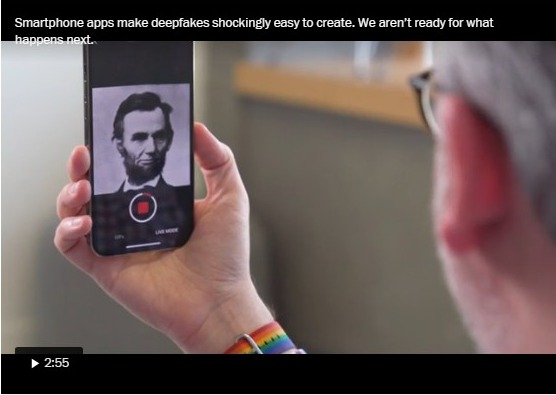
And now so can you. The technology to create “deepfakes” – videos of people doing things that never really happened – has arrived on smartphones. It’s simple, fun . . . and also troubling.

The past few months have brought advances in this controversial technology that I knew were coming, but am still shocked to see. A few years ago, deepfake videos – named after the “deep learning” artificial intelligence used to generate faces – required a Hollywood studio or at least a crazy powerful computer. Then around 2020 came apps, like one called Reface, that let you map your own face onto a clip of a celebrity.

Now with a single source photo and zero technical expertise, an iPhone app called Avatarify lets you actually control the face of another person like a puppet. Using your phone’s selfie camera, whatever you do with your own face happens on theirs. Avatarify doesn’t make videos as sophisticated as pro fakes of Tom Cruise that have been flying on social network TikTok – but it has been downloaded more than 6 million times since February alone. (See for yourself in the video I made on my phone to accompany this column.)

Another app for iPhone and Android devices called Wombo turns a straight-on photo into a funny lip-sync music video. It generated 100 million clips just in its first two weeks.

And MyHeritage, a genealogy website, lets anyone use deepfake tech to bring old still photos to life. Upload a shot of a long-lost relative or friend, and it produces a remarkably convincing short video of them looking around and smiling. Even the little wrinkles around the eyes look real. They call it “Deep Nostalgia” and have reanimated more than 65 million photos of people in the past four weeks.

These deepfakes may not fool everyone, but it’s still a cultural tipping point we aren’t ready for. Forget laws to keep fakes from running amok, we hardly even have social norms for this stuff.

All three of the latest free services say they’re mostly being used for positive purposes: satire, entertainment and historical re-creations. The problem is,we already know there are plenty of bad uses for deepfakes, too.

“It’s all very cute when we do this with grandpa’s pictures,” says Michigan State University responsible-AI professor Anjana Susarla. “But you can take anyone’s picture from social media and make manipulated images of them. That’s what’s concerning.”

So I spoke to the people making deepfake apps and the ethics experts tracking their rise to see if we can figure out some rules for the road.

“You must make sure that the audience is aware this is synthetic media,” says Gil Perry, the CEO of D-ID, the tech company that powers MyHeritage’s deepfakes. “We have to set the guidelines, the frameworks and the policies for the world to know what is good and what is bad.”

The technology to digitally alter still images – Adobe’s Photoshop editing software – has been around for decades. But deepfake videos pose new problems, like being weaponized, particularly against women, to create humiliating, nonconsensual fake pornography.

In early March, a woman in Bucks County, Pa., was arrested on allegations she sent her daughter’s cheerleading coaches fake photos and video of her rivals to try to get them kicked off the squad. Police say she used deepfake tech to manipulate photos of three girls on the Victory Vipers squad to make them look like they were drinking, smoking and even nude.

“There’s potential harm to the viewer. There’s harm to the subject of the thing. And then there’s a broader harm to society in undermining trust,” says Deborah Johnson, emeritus professor of applied ethics at the University of Virginia.

Social networks say deepfakes haven’t been a major source of problematic content. We shouldn’t wait for them to become one.

It’s probably not realistic to think that deepfake tech could be successfully banned. One 2019 effort in Congress to forbid some uses of the technology faltered.

But we can insist on some guardrails from these consumer apps and services, the app stores promoting them and the social networks making the videos popular. And we can start talking about when it is and isn’t okay to make deepfakes – including when that involves reanimating grandpa.

– – –

Avatarify’s creator, Ali Aliev, a former Samsung engineer in Moscow, told me he’s also concerned that deepfakes could be misused. But he doesn’t believe his current app will cause problems. “I think the technology is not that good at this point,” he told me.

That doesn’t put me at ease. “They will become that good,” says Mutale Nkonde, CEO of the nonprofit AI For the People and a fellow at Stanford University. The way AI systems learn from being trained on new images, she says, “it’s not going to take very long for those deepfakes to be really, really convincing.”

Avatarify’s terms of service say it can’t be used in hateful or obscene ways, but it doesn’t have any systems to check. Moreover, the app itself doesn’t limit what you can make people say or do. “We didn’t limit it because we are looking for use cases – and they are mainly for fun,” Aliev says. “If we are too preventive then we could miss something.”

Hany Farid, a computer science professor at the University of California at Berkeley, says he’s heard that move-fast-and-break-things ethos before from companies like Facebook. “If your technology is going to lead to harm – and it’s reasonable to foresee that harm – I think you have to be held liable,” he says.

What guardrails might mitigate harm? Wombo’s CEO Ben-Zion Benkhin says deepfake app makers should be “very careful” about giving people the power to control what comes out of other people’s mouths. His app is limited to deepfake animations from a curated collection of music videos with head and lip movements recorded by actors. “You’re not able to pick something that’s super offensive or that could be misconstrued,” Benkhin says.

MyHeritage won’t let you add lip motion or voices to its videos at all – though it broke its own rule by using its tech to produce an advertisement featuring a fake Abraham Lincoln.

There are also privacy concerns about sharing faces with an app, a lesson we learned from 2019′s controversial FaceApp, a Russian service that needed access to your photos to use AI to make faces look old. Avatarify (also Russian) says it doesn’t ever receive your photos because it works entirely on the phone – but Wombo and MyHeritage do take your photos to process them in the cloud.

App stores that distribute this technology could be doing a lot more to set standards. Apple removed Avatarify from its China App Store, saying it violated unspecified Chinese law. But the app is available in the United States and elsewhere – and Apple says it doesn’t have specific rules for deepfake apps aside from general prohibitions on defamatory, discriminatory or mean-spirited content.

Labels or watermarks that make it clear when you’re looking at a deepfake could help, too. All three of these services include visible watermarks, though Avatarify removes it with a $2.50-per-week premium subscription.

Even better would be hidden watermarks in video files that might be harder to remove, and could help identify fakes. All three creators say they think that’s a good idea – but need somebody to develop the standards.

Social networks, too, will play a key role in making sure deepfakes aren’t used for ill. Their policies generally treat deepfakes like other content that misinforms or could lead to people getting hurt: Facebook and Instagram’s policy is to remove “manipulated media,” though it has an exception for parodies. TikTok’s policy is to remove “digital forgeries” that mislead and cause harm to the subject of the video or society, such as inaccurate health information. YouTube’s “deceptive practices” policy prohibits technically manipulated content that misleads and may pose a serious risk.

But it’s not clear how good of a job the social networks can do enforcing their policies when the volume of deep fakes skyrockets. What if, say, a student makes a mean joke deepfake of his math teacher – and then the principal doesn’t immediately understand it’s a fake? All the companies say they’ll continue to evaluate their approaches.

One idea: Social networks could bolster guardrails by making a practice out of automatically labeling deepfakes – a use for those hidden watermarks – even if it’s not immediately obvious they’re causing harm. Facebook and Google have been investing in technology to identify them.

“The burden here has to be on the companies and our government and our regulators,” Farid says.

– – –

Whatever steps the industry and government take, deepfakes are also where personal tech meets personal ethics.

You might not think twice about taking or posting a photo of someone else. But making a deepfake of them is different. You’re turning them into a puppet.

“Deepfakes play with identity and agency, because you can take over someone else – you can make them do something that they’ve never done before,” says Wombo’s Benkhin.

Nkonde, who has two teenagers, says families need to talk about norms around this sort of media. “I think our norm should be ask people if you have their permission,” she says.

But that might be easier said than done. Creating a video is a free-speech right. And getting permission isn’t even always practical: One major use of the latest apps is to surprise a friend.

Permission to create a deepfake is also not entirely the point. What matters most is how they’re shared.

“If someone in my family wants to take my childhood picture and make this video, then I would be comfortable with it in the context of a family event,” Susarla says. “But if that person is showing it outside an immediate family circle, that would make it a very uncomfortable proposition.”

The Internet is great at taking things out of context. Once a video is online, you can quickly lose control over how it might get interpreted or misused.

Then there’s a more existential question: How will deepfakes change us?

I discovered deepfake apps as a way to play with my nephew, livening up our Zoom chats by making him look like he’s doing goofy things.

But then I started to wonder: What am I teaching him? Perhaps it’s a useful life lesson to know that even videos can be manipulated – but he’s also going to need to learn how to figure out what he should trust.

Aliev, from Avatarify, says the sooner everyone learns videos can be faked, the better off we’ll all be. “I think that the right approach is to make this technology a commodity like Photoshop,” he said.

Ethicists aren’t so sure.

“What really worries me is what you saw happen over the last few years where any fact that is inconvenient to an individual, a CEO, a politician, they just have to say it’s ‘fake,'” Farid says.

And at the risk of sounding obvious: We don’t want to lose sight of what’s real.

Some people have shared on social media that reanimating the dead with MyHeritage’s videos made them weep with joy. I am sympathetic to that. D-ID says that in its own analysis, only 5% of tweets about the service were negative.

But when I tried it with the photo of a friend who died a few years ago, I didn’t feel good at all. I knew my friend didn’t move like that, with the limited range of these computer-generated mannerisms.

“Do I really want these people and this technology messing with my memories?” says Johnson, the Virginia ethicist. “If I want ghosts in my life, I want real ones.”

Deepfakes are also a form of deception we’re using on ourselves.

Robot butlers may take over your household chores, but it will be years before then #SootinClaimon.Com

#SootinClaimon.Com : ขอบคุณแหล่งข้อมูล : หนังสือพิมพ์ The Nation.

https://www.nationthailand.com/edandtech/30404047

Robot butlers may take over your household chores, but it will be years before then

Mar 24. 2021Misty Robotics created a droid to take users' temperatures. It was designed for homes and offices. MUST CREDIT: Photo by Misty RoboticsMisty Robotics created a droid to take users’ temperatures. It was designed for homes and offices. MUST CREDIT: Photo by Misty Robotics

By The Washington Post · Dalvin Brown

For at least a decade, robotics and AI firms have flexed their ability to create machines that can complete various practical household tasks. Last month, Boston Dynamics showed its Spot robot dog picking up clothing.

Miso Robotic’s Flippy has been flipping burgers for years. Other start-ups have demonstrated laundry-folding machines. The list goes on. More recently, news broke that Amazon may be closer to introducing a home robot capable of carrying things and following its owner’s commands.

But how probable is it that you’ll ever be able to own a true robotic butler?

Robots are getting more complex. As AI continues to advance, it allows machines to figure out more complex problems and reliably chat with humans. Still, robotics and AI firms say you’ll have to wait quite some time before you’re able to own anything remotely similar to Rosey the Robot from “The Jetsons.”

In fact, companies are having a hard time commercializing anything more complex than a robot vacuum – which has been cleaning houses for 20 years.

“We’ve been talking about home robots coming for a long time, and all we have so far is the vacuum cleaner,” said Jeff Burnstein, president of the Association for Advancing Automation. “You see demos, but taking it from a demo to something that actually works, then something you can afford, that’s the issue right now.”

Chore robots are doing well in factories where there’s plenty of space, no small kids around and employees wearing protective gear. They’re really good at completing a single repetitive task, such as screwing on a wheel.

But imagine introducing machinery with legs and lifting capabilities into your home where things can and do go wrong. What if it falls on someone, or a software update causes it to go haywire? It’s funny on “The Jetsons,” but it would not be so comical if your grandmother were on the receiving end.

That’s a significant challenge.

The biggest problem is safety, according to Marc Raibert, chairman and former CEO of Boston Dynamics, a robotics pioneer responsible for agile, animallike robots.

“The more complicated the robot, the more safety concerns. If you have a robot in close proximity to a person, and anything that goes wrong, that’s a risk to that person,” Raibert said.

Things have gone wrong on the job. In 2015, a 22-year-old man was killed while helping to set up a stationary robot at a Volkswagen plant in Germany. The robot pushed him against a metal plate and crushed him. In another case that year, a robot’s arm malfunctioned, and it hit and crushed a woman’s head in a Michigan auto plant.

It’s not that the safety issues at home cannot be solved. It’s that they have not been solved yet, robotics companies say. And making elaborate machines more household-friendly will raise the price.

Today’s mobile robots for factories can cost twice as much as an average new car. Take the robotic dog Spot. It runs for about $75,000 without the arm attachment that makes it useful for transporting things. Without the arm, it’s basically a mobile surveillance machine. A humanoid robotic butler capable of autonomously completing a variety of tasks today could easily cost 10 times as much.

And robotics experts say people on the market for such a thing would not be willing to pay more than a few thousand dollars. It might be cheaper to pay a human to do the job. And humans might do it better.

In 2020, Walmart pulled its inventory robots from the floor after reportedly finding that humans can scan products more simply and more efficiently than bulky six-foot-tall machines.

Robots also have a dexterity problem. Most can pinch, grasp or use suction to hold an object. Meanwhile, humans can manipulate things that come in various shapes and textures. Robotic limbs with humanlike flexibility do exist, but they cost tens of thousands of dollars to produce.

“The age of grasping is still a long way away,” said Tim Enwall, CEO of Misty Robotics, a hardware company that builds personal robots for homes and offices. “It is a very hard problem to solve at a mass consumption price point.”

Another challenge is that robots do not know much about the world they’re operating in. You can teach them what an object looks like, but robotic butlers would also need to understand where in your home it’s located.

Take, for example, a simple task such as putting a drink into the fridge. A machine would need to understand your command and be capable of autonomously navigating your home’s layout without spilling anything. It also needs to understand which room in your house is the kitchen.

That type of data requires collaborative input from consumers, and it’s something iRobot is working on by letting Roomba users mark where things are in their homes.

“The reason why iRobot doesn’t sell a robot with an arm is because we don’t know where anything is,” said Colin Angle, chairman and founder of iRobot. “We’re trying to get a better idea of what you actually want to do. That’s useful for your cleaning robot, but it’s imperative for whatever next robot you’re interested in buying.”

So when will something more advanced than a smart vacuum cleaner actually make an impact? Most say it’ll be decades from now.

Amazon reportedly is investing in its “Vesta” home robot project. (Amazon founder Jeff Bezos owns The Washington Post.) Robots probably will continue to crop up in new places as firms lay the groundwork for something more advanced to come along.

You’ll see more delivering food, carrying packages, cleaning surfaces and toting groceries.

“I do think we’ll find uses for home robots in the next eight to 10 years,” Raibert said. “Someone will pioneer a lower-cost mechanism that does a useful set of things. I do believe it; it’s just not tomorrow.”

Uninstall Android System WebView if your Android apps keep crashing #SootinClaimon.Com

#SootinClaimon.Com : ขอบคุณแหล่งข้อมูล : หนังสือพิมพ์ The Nation.

https://www.nationthailand.com/edandtech/30404030

Uninstall Android System WebView if your Android apps keep crashing

Mar 23. 2021Photo Credit: 9to5google.comPhoto Credit: 9to5google.com

By The Nation

Many users of Android devices have recently been encountering app shutdowns, especially Gmail, and some have found that uninstalling the Android System WebView can stop these crashes.

Though it is not affecting all users, it is pretty widespread across Pixel and other devices.

This issue starts with the device throwing up prompts that warn of apps “closing”. This also affects background apps as well as those that are not open.

This bug appears to be affecting all Android apps that use the WebView system component, which is responsible for showing web content and is updated alongside Chrome every few weeks. This includes Gmail and several other third-party applications.

Google has acknowledged the problem and says it is actively working on a fix.

“We are aware of an issue with WebView causing some apps on Android to crash. We are currently working to fully validate the scope and a fix is in progress,” a Google spokesperson said.

Photo Credit: 9to5google.com

Photo Credit: 9to5google.com

Meanwhile, the immediate solution to this problem is:

• Launch the Google Play Store and go to My apps & games

• Open the “Installed” tab and select Android System WebView

• Tap Uninstall

• Confirm “Uninstall”

• Reboot device

If that does not work, another course of action is going to Settings > Apps & notifications > See all apps > Android System WebView > tap the three-dot overflow menu in the top-right corner > Uninstall updates > OK.

These instructions are for Android 11 on Pixel phones but should be a similar process on other OS versions and OEM devices.

Following those steps should stop crashes, with Samsung support recommending the same course of action today.

Apple’s HomePod mini Has a secret sensor waiting to be switched on #SootinClaimon.Com

#SootinClaimon.Com : ขอบคุณแหล่งข้อมูล : หนังสือพิมพ์ The Nation.

https://www.nationthailand.com/edandtech/30404007

Apple’s HomePod mini Has a secret sensor waiting to be switched on

Mar 23. 2021Apple's HomePod mini speaker is unveiled during a virtual product launch on Oct. 13, 2020. MUST CREDIT: Bloomberg photo by Daniel Acker.Apple’s HomePod mini speaker is unveiled during a virtual product launch on Oct. 13, 2020. MUST CREDIT: Bloomberg photo by Daniel Acker.

By Bloomberg · Mark Gurman

Apple’s HomePod mini speaker launched last November with new features such as a home intercom system. But one part of the device has remained secret: a sensor that measures temperature and humidity.

The Cupertino, California-based technology giant never disclosed this component and the device currently lacks consumer-facing features that use it. The company has internally discussed using the sensor to determine a room’s temperature and humidity so internet-connected thermostats can adjust different parts of a home based on current conditions, according to people familiar with the situation. The hardware could also let the HomePod mini automatically trigger other actions, say turning a fan on or off, depending on the temperature.

If Apple eventually enables the sensor, it would bolster a smart-home strategy that has sometimes lacked focus and trailed those of rivals. Amazon’s latest Echo speakers have temperature sensors, while Google’s Nest sells sensors that can be placed around homes and connect to its thermostats to adjust the temperature of each room.

The new capabilities would be a particular boon to an Apple software system called HomeKit that controls thermostats, lights, locks, plugs and other devices in the home. HomeKit works with fewer gadgets than similar software from Amazon and Google and Apple doesn’t make its own smart-home hardware beyond the HomePod and Apple TV streaming box. However, there are about 40 thermostats featured on Apple’s website that are compatible with HomeKit.

The sensor, measuring 1.5 by 1.5 millimeters, is buried in the bottom edge of the HomePod mini’s plastic, fabric-wrapped case near its power cable. The component’s location was confirmed by iFixit, which took apart one of the speakers after an inquiry from Bloomberg News. The sensor is made by Texas Instruments and is called the HDC2010 Humidity and Temperature Digital Sensor, according to TechInsights, a firm that analyses components inside of electronics.

The part is situated relatively far from the device’s main internal components, meaning it is designed to measure the external environment rather than the temperature of the speaker’s other electronics. Many mobile devices include sensors that can trigger the device to slow performance or disable features to stop components overheating.

While rare, this isn’t the first time Apple has slipped a dormant piece of technology into its devices. The 2008 iPod touch had a Bluetooth chip, but support for Bluetooth connectivity was enabled the following year via software. Apple typically releases major HomePod software updates annually in the fall. It’s unclear if or when Apple will switch on the temperature sensor, but its presence in HomePod mini units that have already sold suggests that this is just a matter of time. An Apple spokeswoman declined to comment.

Apple didn’t have a serious offering in the smart-home market until 2018 with the original HomePod. That device was discontinued recently after lackluster sales. Some decision makers at the company worry it may be too late for Apple to make a strong entry in the sector, especially as it focuses on other new categories such as virtual and augmented-reality headsets and electric autonomous cars. Others believe the company can take its time and customers will still be interested.

Some insiders blame the lack of progress thus far in the home on Siri, Apple’s voice-recognition service that, while improving, is still considered behind Google Assistant and Amazon’s Alexa. Whatever the reason, no unifying strategy has emerged so far, one of the people familiar with the situation said. The people asked not to be identified discussing sensitive issues. This comes after Apple sought to revamp its smart home efforts with a new team it began forming in 2019.

Apple continues to chip away at this opportunity through updates to individual devices. Before the discontinuation of the larger HomePod, the company had been working on an updated version for release in 2022. It has also been developing new speakers with screens and cameras, but such a launch isn’t imminent. Apple is also working on an update to the Apple TV set-top box. Until that time comes, Apple will likely try to unlock the most functionality from the HomePod mini.

Trump plans to launch his own social network in two to three months #SootinClaimon.Com

#SootinClaimon.Com : ขอบคุณแหล่งข้อมูล : หนังสือพิมพ์ The Nation.

https://www.nationthailand.com/edandtech/30404006

Trump plans to launch his own social network in two to three months

Mar 23. 2021Former US President Donald TrumpFormer US President Donald Trump

By The Washington Post · Cat Zakrzewski

A top adviser to Donald Trump has confirmed the former president is building his own social network after major tech companies suspended his accounts in the fallout of the Jan. 6 Capitol attacks.

“I do think that we’re going to see President Trump returning to social media in probably about two or three months here, with his own platform,” Trump senior adviser Jason Miller told Fox News on Sunday. “And this is something that I think will be the hottest ticket in social media, it’s going to completely redefine the game, and everybody is going to be waiting and watching to see what exactly President Trump does.”

Miller predicted the new platform will be “big” once it launches, suggesting he would bring tens of millions of people to the new service. He also said Trump has been having “high-powered meetings” at Mar-a-Lago regarding the venture, and that “numerous companies” have approached the former president.

Trump has largely been muzzled online since Twitter permanently banned him in the aftermath of the Jan. 6 riots. YouTube and Facebook have also suspended Trump’s accounts, but they’ve left open the possibility he could return to their services. Facebook’s independent oversight board has accepted Trump’s case, and it will make a binding decision in the coming weeks on whether he can return to the platform. YouTube CEO Susan Wojcicki has said Trump will remain suspended until the company can determine the risk of violence has decreased.

Ever since, Trump has pushed out his messages largely through news releases, giving news organizations far more discretion over when to amplify his message. He also has given interviews on news programs that have a record of being friendly to his policies, including with Fox News host Maria Bartiromo, One America News Network and Newsmax.

Miller made his announcement just days before the CEOs of Facebook, Google and Twitter are scheduled to testify in front the House Energy and Commerce Committee. It will be the social media executives’ first appearance on the Hill since the Capitol attacks, and the Democratic-led committee has said the hearing will focus on the proliferation of disinformation on their platforms. However, it also will be Republicans’ first opportunity to publicly grill the CEOs about their decisions to suspend Trump’s accounts, which reignited claims tech companies were too powerful and biased against conservatives.

From Alex Stamos, the director of the Stanford Internet Observatory, and former Facebook chief security officer: “At least the congressional hearings with social media CEOs will get a bit more exciting.”

Trump previously teased plans for his own social network in January, and experts said it would be a costly and time-consuming endeavor.

Even if he were to successfully launch the service, it would be practically impossible for him to regain the reach he once enjoyed on mainstream social networks, which are used by hundreds of millions of people around the world. He had nearly 90 million followers on Twitter at the time of his suspension, and his inactive Facebook page has 32 million “likes” and 35 million followers.

“Twitter gave him access to every reporter in the country and the ability to troll the libs and get on cable news within minutes,” said Nu Wexler, a communications consultant who previously worked for Facebook, Twitter and Google, told me. “I don’t think he would get that on his own social network. It would be an echo chamber of just his supporters.”

China eyes 6G as next tech frontier #SootinClaimon.Com

#SootinClaimon.Com : ขอบคุณแหล่งข้อมูล : หนังสือพิมพ์ The Nation.

https://www.nationthailand.com/edandtech/30403945

China eyes 6G as next tech frontier

Mar 21. 2021

By Cheng Yu and Zheng Yiran
China Daily

China is pushing forward the use of informatization within the 14th Five-Year Plan period (2021-25) with 6G technologies being a top priority, as the country boosts development of the digital economy as a new economic driver, government officials and industry experts said on Friday.

China’s innovation capabilities have continued to improve with major growth in 5G usage and coverage, artificial intelligence, quantum computing and other fields

“China will accelerate the research and development of 6G technologies, the construction of the large-scale 5G network, as well as the large-scale application of Internet Protocol version 6-the latest worldwide modality aimed at making the internet bigger, faster and more secure,” Yang Xiaowei, deputy head of the Cyberspace Administration of China, said at a news briefing in Beijing.

“More efforts will also be made to fully release the vitality of data through speeding up the building of systems and standards to accommodate data flow, cross-border data transmission and data security protection. The digital economy can truly play its critical role nationwide,” Yang said.

The digital economy is a key focus in the 14th Five-Year Plan, and China aims to increase the share of the output of core industries in the digital economy in the country’s GDP to 10 percent by 2025.

ALSO READ: 5G royalties expected to help Huawei sustain big R&D spends

“China will pay more attention to high-quality digital development in the coming years,” said Li Chao, chief economist at Zheshang Securities Co Ltd.

Li added that the latest government directive also singles out “digital China” as a standalone objective, reaffirming the nation’s strong determination to develop the digital economy to provide fresh economic impetus.

The comments came ahead of the 4th Digital China Summit, which will run from April 25-26 in Fuzhou, Fujian province, under the theme of “New Potential for Data and New Journey of Digital China”.

The summit will be held both online and offline. The online exhibition will incorporate more virtual and interactive products such as 5G ultra-high-definition video and holographic projection.

“With one main forum and a record high 20 sub-forums, the summit will serve as a platform to announce informatization development policies, showcase the latest achievements and share the experiences and practices of new digital China construction,” said Fujian’s Vice-Governor Guo Ningning.

According to the Cyberspace Administration of China, the country has made considerable progress in developing the digital economy over the past five years, during which the number of internet users in the country surged from 688 million to 989 million, and the internet penetration rate increased from 50.3 percent to 70.4 percent.

READ MORE: Huawei reveals royalty rates for 5G tech

The country’s innovation capabilities have continued to improve with major growth in 5G usage and coverage, artificial intelligence, quantum computing and other fields. From 2015 to 2020, China’s ranking in the World Intellectual Property Organization’s Global Innovation Index jumped from 29th to 14th place.

Robot teaching assistant from Chula wins two prestigious global awards #SootinClaimon.Com

#SootinClaimon.Com : ขอบคุณแหล่งข้อมูล : หนังสือพิมพ์ The Nation.

https://www.nationthailand.com/edandtech/30403900

Robot teaching assistant from Chula wins two prestigious global awards

Mar 19. 2021

By The Nation (sponsored news)

A new robot teaching assistant created by Chula inventors could be a game-changer for the learning environment after being rubber-stamped by two prestigious global awards.

For kids, playing games and learning will no longer be two separate things, promise the creators of the “Avatar” robot teaching assistant.

Avatar, a 25-centimetre robot made of resin, is the fruit of the “TARAL: Teaching Assistant interactive Robot for Active Learning” research project run by Chulalongkorn University’s Faculties of Education and Engineering.

“We developed the robot teaching assistant from a robot teddy bear, which became the first-generation robot that we submitted to a contest in South Korea,” said Professor Naowanit Songkram, Department of Educational Technology and Communications.

Prof Dr Naowanit Songkram (left) and Assoc Prof Dr Krerk Piromsopa (right)

Prof Dr Naowanit Songkram (left) and Assoc Prof Dr Krerk Piromsopa (right)

The prototype was fine-tuned with co-developer Assoc Prof Krerk Piromsopa of the Department of Computer Engineering before being entered in the International British Innovation, Invention, Technology Exhibition (IBIX) 2020, where it won the Gold Medal and the Innovation Excellence Award.

“The highlight of the Avatar TA robot is the new feature that will transform the boring learning environment into fun lessons that learners will enjoy, including raising their Avatar robot with QR Codes received from answering quizzes,” Prof Naowanit explained. “This process is called Gamification because it evokes a sense of enjoyment so that learners may even forget that they are studying.

“We applied the Learning Management System (LMS) in growing Avatar. The more learners answer quizzes, the more Avatar grows, so learning and playing are pretty much the same thing.”

Avatar is also equipped with Moodle open-source LMS, which allows teachers to add and modify content and teaching materials as needed, be they animations, electronic books, or URL links.

“The quizzes may include fill-in-the-blank or full-sentence-answer types. Evaluation and summary of the results is also done in real-time.”

Avatar is currently under patent application.

Facebook reveals plan to let users control augmented reality with their thoughts #SootinClaimon.Com

#SootinClaimon.Com : ขอบคุณแหล่งข้อมูล : หนังสือพิมพ์ The Nation.

https://www.nationthailand.com/edandtech/30403874

Facebook reveals plan to let users control augmented reality with their thoughts

Mar 19. 2021Facebook is looking into new ways of interacting with augmented reality. MUST CREDIT: Image by FacebookFacebook is looking into new ways of interacting with augmented reality. MUST CREDIT: Image by Facebook


By The Washington Post · Dalvin Brown

Facebook is researching how to take minute nerve movements in users’ arms and turn them into gesture controls for gadgets. The idea announced Thursday would help the social networking giant launch augmented reality (AR) glasses, which would rely on new ways to control computers and interact with the virtual world.

Picture this: Your home assistant asks if you’d like to play your favorite podcast, and a flick of your fingers in the air lets you select play. Or, you’re wearing AR glasses that display images over the real world, and you scroll through your text messages in midair while your smartphone stays in your pocket.

Those are the scenarios Facebook has in mind if it were ever to deploy a muscle-sensing wristlet.

“We’re developing natural, intuitive ways to interact with always-available AR glasses because we believe this will transform the way we connect with people near and far,” Facebook said in a blog post. But to launch such a product, the social media behemoth would also need access to a new type of data: Your thinking.

Facebook says the wristband product would rely on a “neural interface” that adapts to you and your environment.

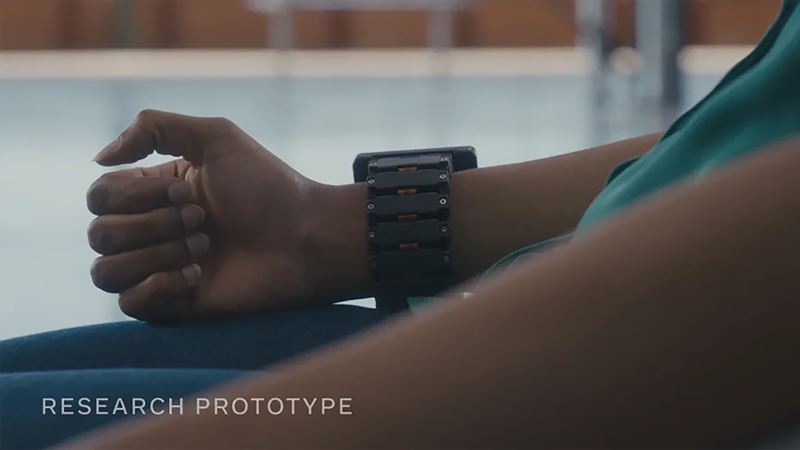
In demonstration videos, the prototype looks like a thick, black iPod strapped around the wrist. In theory, sensors on the device would be able to pick up what hand movements you intend to make through a technique for recording nerve signals known as electromyography, or EMG.

“If you send a control to your muscle saying ‘I want to move my finger,’ it starts in your brain. It goes down your spine through motor-neurons, and this is an electrical signal. So you should be able to grab that electrical signal on the muscle and say, ‘Oh, OK. The user wants to move the finger,’ ” says Nathalie Gayraud, a research scientist at Facebook Reality Labs, in a video.

Rolling out nerve sensing gadgets would enable Facebook to reinvent the computer “click.” So instead of using a mouse or tapping on your phone, you’d think about moving a finger to trigger a reaction in AR.

It’s too soon to tell whether the device will ever come to market. Facebook says that the research is in the early phases, and that any type of consumer product would be years away. It is not the first company to imagine a world where futuristic glasses enhance the real-world with digitized imagery.

Facebook is working on a wrist band that can react to nerve signals. MUST CREDIT: Image by Facebook

Facebook is working on a wrist band that can react to nerve signals. MUST CREDIT: Image by Facebook

Google Glass, a $1,500 pair of spectacles, flopped with consumers in 2014. The search conglomerate gave them a facelift and remarketed them for businesses. Snap also tried with its Spectacles for Snapchat, a $150 pair of snazzy glasses equipped with cameras, audio and microphones. Those also did not make much of a mark.

Facebook is going after your wrist because that’s where people are used to donning wearables. People have used Fitbits for over a decade and Apple Watches for half as long. Your wrist is also close to your hands, which people typically use to control devices.

“It’s located right next to the primary instruments you use to interact with the world – your hands. This proximity would allow us to bring the rich control capabilities of your hands into AR, enabling intuitive, powerful and satisfying interaction,” Facebook says.

The Mark Zuckerberg-led company insists that data privacy is a top concern, as it should be with a device that takes personalization to a whole new level. Facebook notes that information would be stored locally on the device rather than sent into a cloud. The only information meant to be collected is the intent for you to move your hand, Facebook says.

The development comes two years after the social media company bought CTRL-Labs, a startup developing a wristband capable of turning brain impulses into computer input. The acquisition was reportedly worth between $500 million and $1 billion. The firm was absorbed by Facebook’s Reality Labs, which develops Oculus VR headsets.

Controlling devices through thoughts has been shown to work. BrainCo developed a headband with sensors that lets people move items with their mind. The company later developed robotic limbs that detect and react to muscle signals.

Facebook’s research news is part of a trio of announcements related to the company’s push into immersive technologies.

Last week, it said it’s working on a “stylish” pair of glasses to replace a computer or smartphone. Its next such announcement will come this year and has something to do with an all-day wearable, “soft robotics” and haptic gloves, Facebook says.

University entrance exams will be held as scheduled: TCAS #SootinClaimon.Com

#SootinClaimon.Com : ขอบคุณแหล่งข้อมูล : หนังสือพิมพ์ The Nation.

https://www.nationthailand.com/edandtech/30403808

University entrance exams will be held as scheduled: TCAS

Mar 17. 2021

By The Nation

The date for university entrance exams will not be changed, Chulalongkorn University president Prof Bundhit Eua-Arporn said in his capacity as chair of the Council of University Presidents of Thailand.

Also read: Thai education authorities refuse to budge as students bow under burden of exams

This was in response to students’ plea that entrance exams under the Thai University Central Admission System (TCAS) for this year be rescheduled as they overlap their school-leaving tests.

He said TCAS cannot reschedule the exams because it will affect the 300,000 students waiting to take the O-Net test on March 27-28 for admission to high school.

Bundhit also pointed out that students had at least three years to prepare for these exams, so there should be no reason to change the date.

Thai businesses increasingly opt for Google Cloud to enhance efficiency #SootinClaimon.Com

#SootinClaimon.Com : ขอบคุณแหล่งข้อมูล : หนังสือพิมพ์ The Nation.

https://www.nationthailand.com/edandtech/30403804

Thai businesses increasingly opt for Google Cloud to enhance efficiency

Mar 17. 2021

By The Nation

Google Cloud not only supports Thai businesses in their digital transformation strategies as they accelerate their shift to digital solutions, but also helps them grab unique opportunities amid changing customer demands, the US cloud service said in a press release, adding that firms such as Big C, HomePro, Siam Cement Group and Krungthai Bank have already jumped on the cloud bandwagon.

Helping retailers ‘grow their business, not their overheads’

Covid-19 has ushered in a dramatic increase in awareness for the ease and convenience of online shopping.

And it is none other than grocery and general merchandising retailer Big C, which has opted for Google Cloud to run critical systems – a wise decision as the pandemic spread to Thailand.

Running its ecommerce website in Google Cloud enabled Big C to maintain services as customers ramped up online purchasing, innovate quickly and introduce additional promotions and features without disruption.

The business also relies heavily on Google Cloud’s in-depth defence to block threats and secure systems, data and people, the service said.

Local home improvement centre HomePro has also stepped up its search engine and digital marketing performance by shifting its website and e-commerce platform from on-premises infrastructure to Google Cloud, enabling the business to control costs and assign resources efficiently, the press release said.

Helping take the friction out of financial services

Banks also have an important role to play in the post-pandemic economic recovery.

These institutions can help by providing businesses access to critical loans and funding so they can reopen their doors and implement new safety measures post-lockdown, while also offering consumers more personalised services and digital channels that are accessible to all, even those who may find it difficult to bank online.

Krungthai Bank is one example. It has accelerated a digital reinvention programme that aims to increase revenue and deliver value-added capabilities to customers through its Krungthai Next mobile banking app. Built with Google Cloud, it can not only scale the mobile app to a growing customer base, but also leverage cloud artificial intelligence and machine learning to unlock user insights to better serve evolving needs.

Helping enterprises migrate their mission-critical workloads

An SAP (systems applications and products in data processing) environment is often at the very centre of an enterprise’s operations, and moving SAP workloads to the cloud is rarely simple or easy. Many IT organisations struggle to manage the short-term cost, complexity and risk that come with SAP cloud migrations. As a result, some organisations hesitate to move ahead in this area.

However, Siam Cement Group (Cement-Building & Materials – Distribution) is migrating their SAP workloads to Google Cloud, enabling them to optimise their IT resources while building on their reliable local infrastructure to innovate.

“By implementing their SAP S/4HANA on Google Cloud, they can leverage our highly scalable and reliable platform and improve the overall efficiency and security of internal platforms,” the service said.

Investing in connectivity in Thailand to benefit cloud customers

“We are proud to provide a cloud platform that supports businesses in Thailand and beyond. To continue to serve the demands of our Cloud customers and their users, we’re building local points of connectivity in Bangkok. Customers will be able to connect to True IDC in the coming weeks, with CSL the Cloud following later this year,” the service said.

“We will also install a full network edge to give customers and end-users access to a range of Google Cloud products and services they can use to innovate, create efficiencies and contribute to the broader Thai economy,” the press release added.