Marriott Bangkok lines up great Easter brunch

ศาสตร์เกษตรดินปุ๋ย : ขอบคุณแหล่งข้อมูล : หนังสือพิมพ์ The Nation

http://www.nationmultimedia.com/detail/tasty/30367389

Marriott Bangkok lines up great Easter brunch

tasty April 09, 2019 11:30

By The Nation

4,352 Viewed

The JW Marriott Bangkok’s JW Cafe is doing an Easter Sunday Brunch on April 21 with cold dishes and fresh seafood on ice.

There’ll be classic smoked salmon and redcurry smoked salmon along with premium cold cuts and international cheeses.

Top up on Caesar salad and pasta, indulge in panseared foie gras, and help yourself at the carving counter to Easter ham, roast beef and lamb and baked whole Atlantic salmon.

In the buffet line will be Japanese sashimi and sushi and Chinese dishes like roast duck.

And for desserts, sweets from BBCO will include Easter chocolates in different shapes and hotcross buns by executive pastry chef Chotipat Laisuwan, last year’s “Iron Chef” champion.

Easter Sunday brunch costs Bt2,400plus and starts at noon.

Reserve a table at (02) 656 7700 or http://JWMarriottBangkok.com/newsandpromotions2.

A true taste of Japan

ศาสตร์เกษตรดินปุ๋ย : ขอบคุณแหล่งข้อมูล : หนังสือพิมพ์ The Nation

http://www.nationmultimedia.com/detail/tasty/30367227

  • Zuwei Kani

A true taste of Japan

tasty April 06, 2019 01:00

By Kupluthai Pungkanon
The Nation Weekend

2,334 Viewed

Open less than a year, Hinoki already has a reputation for offering some of the freshest fish in town

TUCKED AWAY in Naknivas Road Soi 45, premium Japanese restaurant Hinoki welcomes diners as if they were all close friends gathering at home for a meal. The menu is more varied than in a private home, though, featuring such dishes as sashimi and sushi sets, hamachi usuzukuri, unaki don, shirauo tempura and spicy sashimi salad, all served in very generous portions and at prices that won’t break the bank.

Opened last year, Hinoki is the brainchild of young entrepreneur, Pisith Ua-tarnpisith and chef Rungarun Linkaew. Both have a passion for Japanese food and a wealth of experience in importing raw ingredients for many of Thailand’s Japanese restaurant chains, an advantage that makes Hinoki stand out from its peers.

 Chef Rungarun Linkaew and Pisith Uatarnpisith

“I used to deal with many suppliers in Japan and that allows me to manage and control the costs of bringing in our raw ingredients. This is reflected in our prices and the size of our offerings. To me, the most important thing about Japanese food is the level of freshness. We believe in admitting that we have run out of a certain fish rather than serving one that it is not as fresh as it should be. That’s why Hinoki operates on a first-come first served basis.” Pisith explains.

Unagi Don

He became enamoured with Japanese food as a young child when his mother ordered Unagi don – grilled eel on rice – for him. It cost about Bt500 at a time when gold was selling for Bt4,000 per ounce. “I now realise that the ridiculously high price had much to do with the cost of leftover food that most Japanese restaurants had to throw away when the fish passed its freshest point. At Hanoki, we emphasise freshness and hygiene. The kitchen is very well organised, the sashimi cabinet is washed every day, the chopping wood is cleaned with hot water, and the knives sharpened every morning. I admire the Japanese ways and they have also changed how I look at things,” he says.

Hinoki is decorated in a cosy and homely Japanese style with genuine pine trees – the name means auspicious pine – and furnished with oak tables and chairs. Its logo bears infinite graphic lines and fish to represent abundance. There is also a Zen-style garden with a small pond and carp where young children can play while their parents enjoy the food.

Take Sashimi Set

Chef Rungarun recommends us to try the Take Sashimi Set (Bt698), which features various types of fresh fish such as maguro (tuna), salmon, hamachi (yellowtail), octopus, prawn, and hotate (seashell). The thinly sliced Hamachi Usuzukuri (Bt488) is particularly fresh and sweet.

Sushi sets are deliciously well balanced. We try the Aburi Sushi Set (Bt498) and happily nibble on Hamachi, Hotate, Salmon, Foiegras, Engawa (fin of flatfish), Anago (salt-water eel), Unagi (fresh water eel), and Ebi (shrimp) sushi.

Hamachi Usuzukuri

Pisith says the salmon eggs have been fermented in Sake (Japanese rice alcohol) or shoyu (soy sauce) for a sweet and aromatic flavour. The foie gras sushi is imported from France while the eel comes from a farm in Japan, which Pisith has personally visited. His Unagi Don (Bt268) melts in the mouth and come with dried Hoba leaf.

Shirauo Tempura

One of the best-selling dishes is tempura, with the Shirauo (Bt168) and Mixed Prawn (Bt198) versions favourites with both adults and kids. A recently added item is Hotate Tempura (Bt328), where the shirauo or icefish is stretched then deep-fried. All are served with two different sauces, typical tempura sauce and Rungarun’s creative mix of matcha powder and lime.

Spicy Sashimi Salad

The Thai palate gets its kicks with Spicy Sashimi Salad (Bt238) served with Thai-style sweet, sour, and spicy dressing that’s not as strong as the original seafood sauce.

Meltique Beef Steak (Bt498) is cooked with high quality wagyu and served on a hot plate. Choices of traditional Sake are also available.

Meltique Beef Steak

After placing their orders, diners are served three appetisers including a free bowl of Miso soup and a plate of sweet Japanese melon is given to everyone after dinner in lieu of dessert.

SENSATIONAL SASHIMI

Hinoki Restaurant is at 355,Naknivas Soi 45 Road, Lat Phrao District.

It’s open Monday to Friday from 11.30am to 2pm and from 5-10.30pm, while on weekend and national holiday, meals are served from 11.30am to 10.30pm.

Book a table at (02) 297 0251 or follow it on Facebook/Hinoki.sushi and Line @hinoki.sushi.

Haoma continues to climb

ศาสตร์เกษตรดินปุ๋ย : ขอบคุณแหล่งข้อมูล : หนังสือพิมพ์ The Nation

http://www.nationmultimedia.com/detail/tasty/30366979

Haoma continues to climb

tasty April 02, 2019 12:30

By The Nation

Following up its recent success of being selected as one of BK Magazine’s elite 30 Top Tables Champions, Haoma has been ranked #13 in the Official Selection, continuing the restaurant’s dramatic rise on the local culinary scene.

Located on a serene patch off Sukhumvit 31 in Bangkok, Haoma – a two-storey house with a backyard garden lush with edible greens – is named for a divine plant from Persian mythology. This is indeed a green destination, where the zero-waste principle is pursued and all the ingredients have been raised free of pesticides and antibiotics. In addition to the beautiful backyard, the owners also have a four-rai farm in Chiang Mai.

Fruit and vegetables are served about 48 hours after harvest in the belief that that’s primetime for their component nutrients. They come from small, local producers whose methods are certified as environmentally and ethically responsible.

Here, diners are taken on a unique culinary journey in harmony with the seasons and rhythms of the earth, using the freshest local ingredients, ingenuously reimagined. The menu combines produce sourced mostly from the hanging onsite garden, and high-quality sustainable meats, created with techniques and flavours inspired by Indian roots of the restaurant’s co-founder/chef Deepanker Khosla, aka DK.

“We are extremely honoured to have been ranked at #13 on one of Bangkok’s most referred to lists by local foodies, the Top Tables by BK Magazine,” says Khosla. “Last year we did not have any presence on the list but likely due to a good reason. Like any young and ambitious restaurant we were still finding our way, but have since worked hard to achieve a vision in which we can deliver a unique experience for our diners. We believe the results of Top Tables 2019 is a reflection of our achievements so far. We will continue to grow and improve as long as we’re operating, and will keep the passion alive.”

Haoma’s impressive ranking came from receiving a score of 85 on a scale of 1 to 100, which averages the five-star scores given by a panel of 30 mostly Bangkok-based expert foodies, just over half of whom are Thai, with the rest comprised of various nationalities.

For details, call (02) 258 4744 or visit http://www.Haoma.dk.

Iron Chef ready to ‘pop up’ a banquet

ศาสตร์เกษตรดินปุ๋ย : ขอบคุณแหล่งข้อมูล : หนังสือพิมพ์ The Nation

http://www.nationmultimedia.com/detail/tasty/30366917

Iron Chef ready to ‘pop up’ a banquet

tasty April 01, 2019 13:25

By The Nation

The Spice Market, a Thai-food restaurant at the Anantara Siam Bangkok Hotel, is serving “popup dinners” from April 25 to 27 prepared by Tammasak “Noi” Chootongto of “Iron Chef Thailand TV” fame.

Noi will bring his modern interpretation of Thai flavours to a six-course feast that will be served to only 40 guests per evening.

With more than 20 years’ experience, Noi has worked at top restaurants in Europe, including Michelin-starred Top Air, the award-winning Taku in Germany and on board the Queen Elizabeth II cruise liner.

He also developed the Thai restaurant Saffron, which has branches at 10 Banyan Tree hotels and resorts.

In 2010 he realised a dream of opening his own restaurant, Suay in Phuket, which is renowned for its innovative contemporary Thai and Western dishes.

At the Spice Market, Noi’s opening number will be Thai royal leaf wrap with foie gras and tamarind sauce, followed by blackened tuna loin with wasabi ice cream, pomelo salad with grilled scallops and crispy shrimps, and betel-leaf curried tempura with assorted seafood and salmon caviar.

Also on the menu will be tom yum lobster bisque, lobster croquette and sriracha aioli, a set of entrees such as braised beef cheek in mussamun curry, coconut gnocchi and edamame bean salsa or charcoal-grilled black cod fillet, coriander beurre blanc, palm heart salad and seaweed.

Dessert will be a mango sticky-rice spring roll with black-sesame ice cream. A complementing wine-pairing menu is also available.

The six-course dinner costs Bt3,500-plus for the food only. Chow time is 6.30pm. The Spice Market is on the first floor of the hotel (BTS: Ratchadamri).

Reservations are recommended at (02) 126 8866, extension 1232, or spicemarket.asia@anantara.com.

Nurturing foods from the North

ศาสตร์เกษตรดินปุ๋ย : ขอบคุณแหล่งข้อมูล : หนังสือพิมพ์ The Nation

http://www.nationmultimedia.com/detail/tasty/30366740

Nurturing foods from the North

tasty March 30, 2019 01:00

By Khetsirin Pholdhampalit
The Nation Weekend

Chiang Mai restaurant Ginger Farm Kitchen opens its first branch in Bangkok

THE NEW mixed-use complex 101 The Third Place in Bangkok run by Magnolia Quality Development Corporation is offering a wide choice of dining options, many of them brand-new or known brands launching their first outlets in the city.

Among the latter is Ginger Farm Kitchen – the first branch of the Chiang Mai eatery that grows its own organic rice and vegetables in addition to offering local cuisine in outlets both at the farm and on trendy Nimmanhemin Road.

Chiang Mai’s Ginger Farm Kitchen opens its first Bangkok outlet serving Northern-style cuisine cooked with ingredients fresh from its own farm.

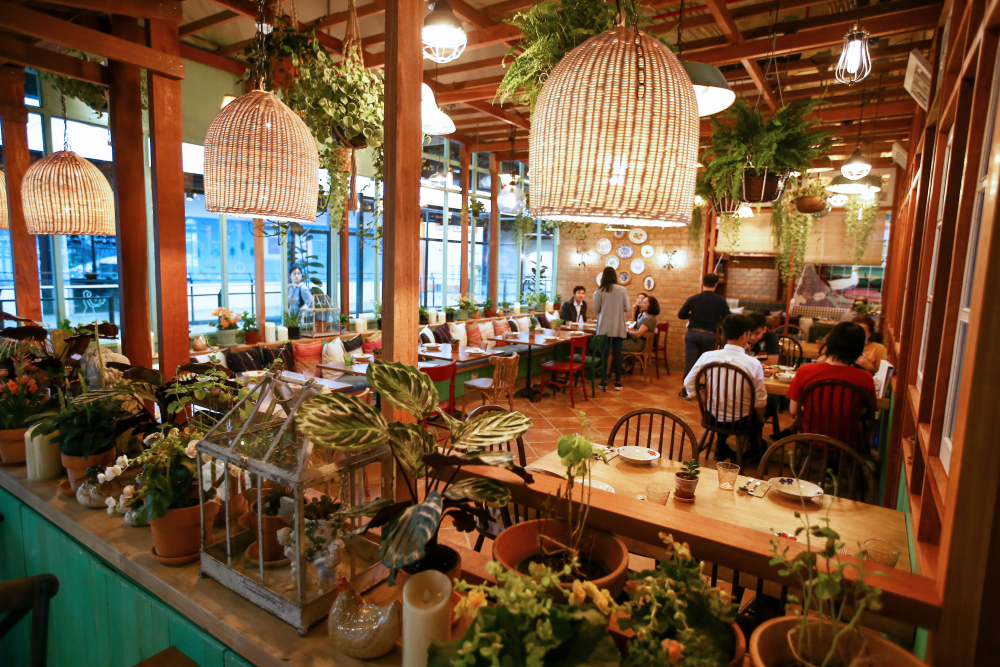
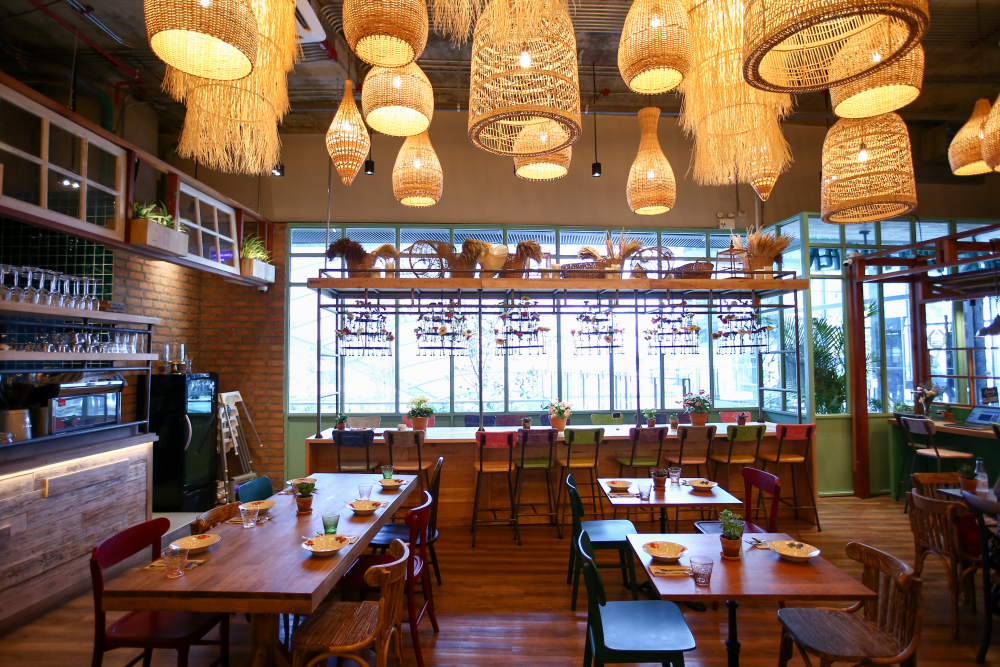
Located on the third floor of the project, Ginger Farm Kitchen’s Bangkok branch is decked out in a similar rustic style to that of its Chiang Mai sibling. The interior is inviting with plenty of wood that replicates a classic Thai-style house with old wooden windows, beams and hanging flowerpots. Thai traditional fishing tools are used as ceiling lamps. It can accommodate about 100 diners at any one sitting.

“Our dining concept is ‘From Farm to Table’ and no MSG is ever added to our dishes. Many ingredients are organically planted at our own farm in Chiang Mai’s Saraphi district and the rest are sourced from our network of sustainable food suppliers,” says restaurant manager Jaran Keankham.

The dishes are identical to Ginger Farm’s Chiang Mai outlets although the prices are slightly higher. The portraits of the food suppliers who help stock the kitchen also feature in the menu. The dinnerware is retro-style with white ceramic plates and bowls and enamel trays with floral patterns.

“Our farm covers more than 20 rai and we grow organic vegetables and rice. We also have free-range chickens. The farm serves as a learning centre where visitors can learn how to plant and harvest rice, collect eggs from free range chickens, cultivate vegetables and even ride a buffalo,” he adds.

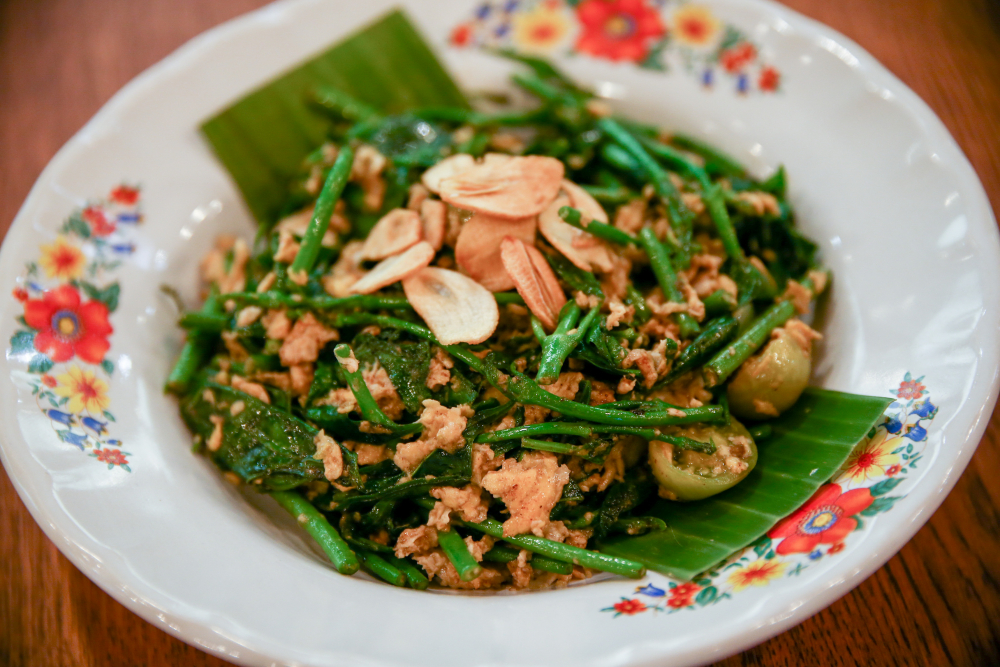
Stir-fried chiang da leaves with egg

Those who like their comfort food will enjoy stir-fried chiang da – a local plant grown largely in the North – with egg (Bt135), which bursts with flavour thanks to the crispy freshness of the vegetable.

“This is a traditional dish cooked almost in every home in the North because chiang da grows easily along a fence. It has a slightly bitter taste but when stir-fried with egg. the two flavours complement each other,” says chef Tanakit Tasak.

Nurturing foods from the North

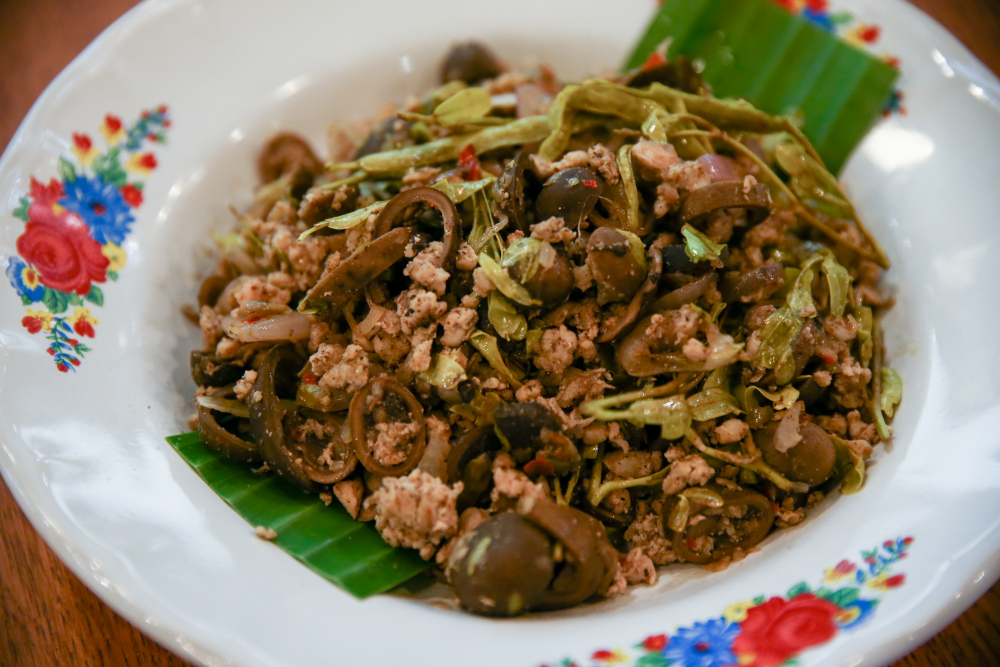
Dry stir-fried hed tob mushroom with minced pork, shrimp paste and young tamarind leaves

Northern-grown fungi hed tob (puffball mushrooms) are dry stir-fried with minced pork, shrimp paste, young tamarind leaves, dried chilli, garlic and ginger. Only young mushrooms are chosen and they are sliced in half to make them easy to eat. A plateful goes for Bt220.

Nurturing foods from the North

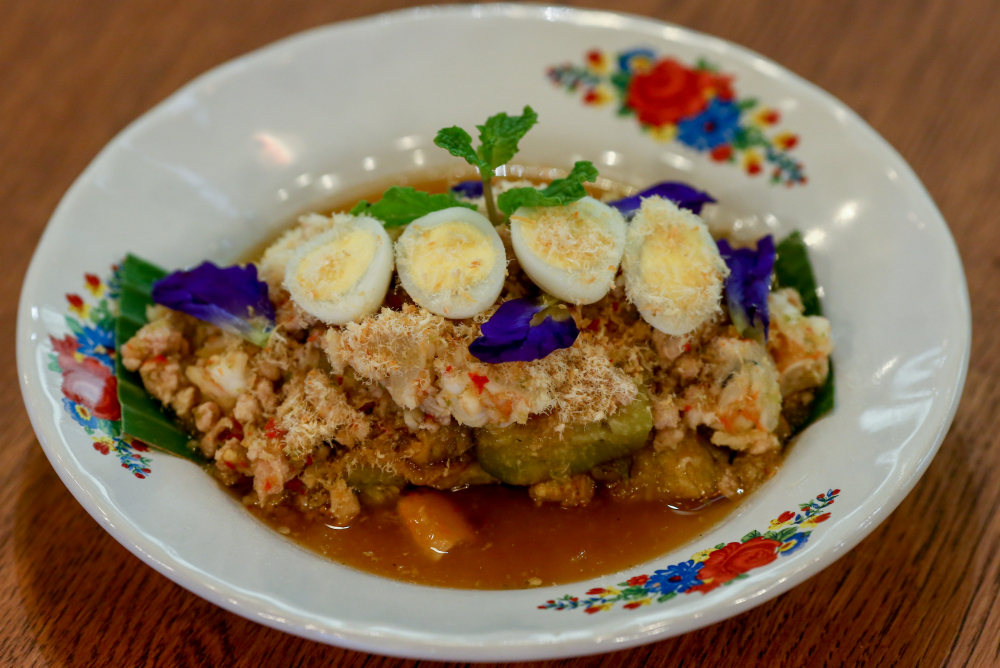
Grilled organic aubergine salad with prawn

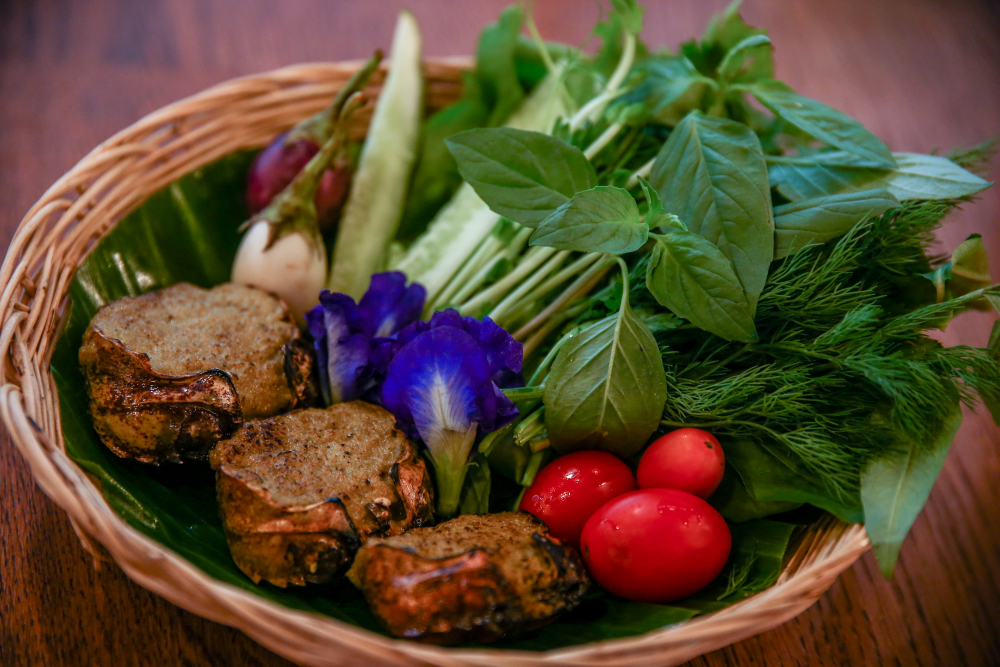
Also fresh from the farm is organic aubergine, which is first grilled, then the skin peeled away before cooking it for a spicy salad with prawn and minced pork. The dish is topped with quail eggs, pounded dried shrimp and edible butterfly pea flowers. It costs Bt225.

Nurturing foods from the North

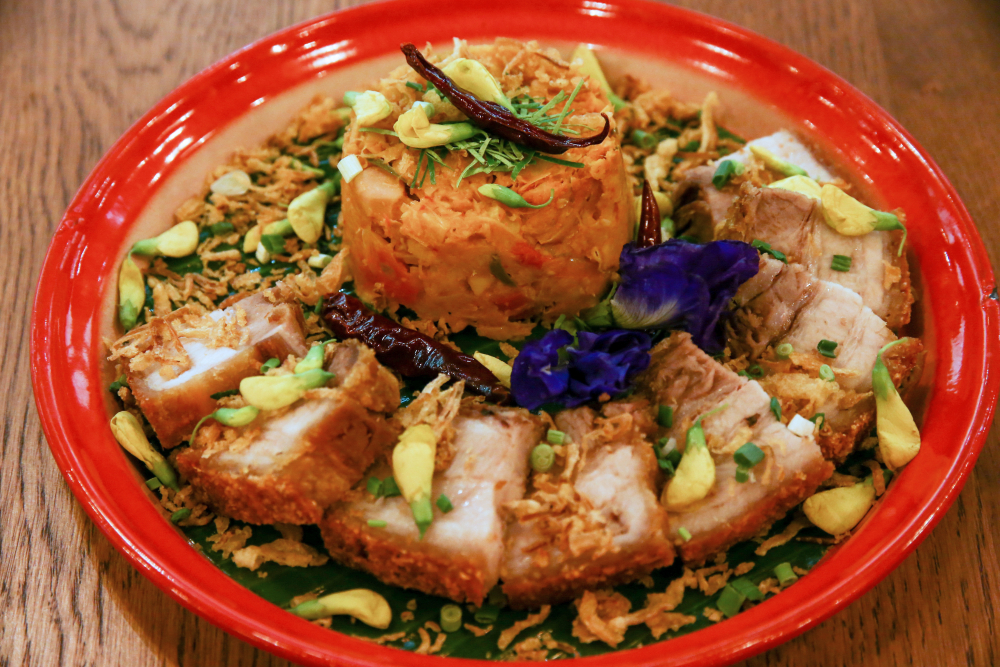
Pound young jackfruit salad with crispy pork belly

Another recommended dish is Northern-style young jackfruit salad served with crispy fried pork belly (Bt225).

“We cook the flesh of jackfruit, which mustn’t be too mature or too young, in a Northern-style curry made from ma kwaen seed powder (Northern spice), dried chilli, garlic, lemon grass and shrimp paste.

“The Northern people eat spicy jackfruit salad with pork crackling, but we’ve opted for crispy fried pork belly instead,” the chef continues.

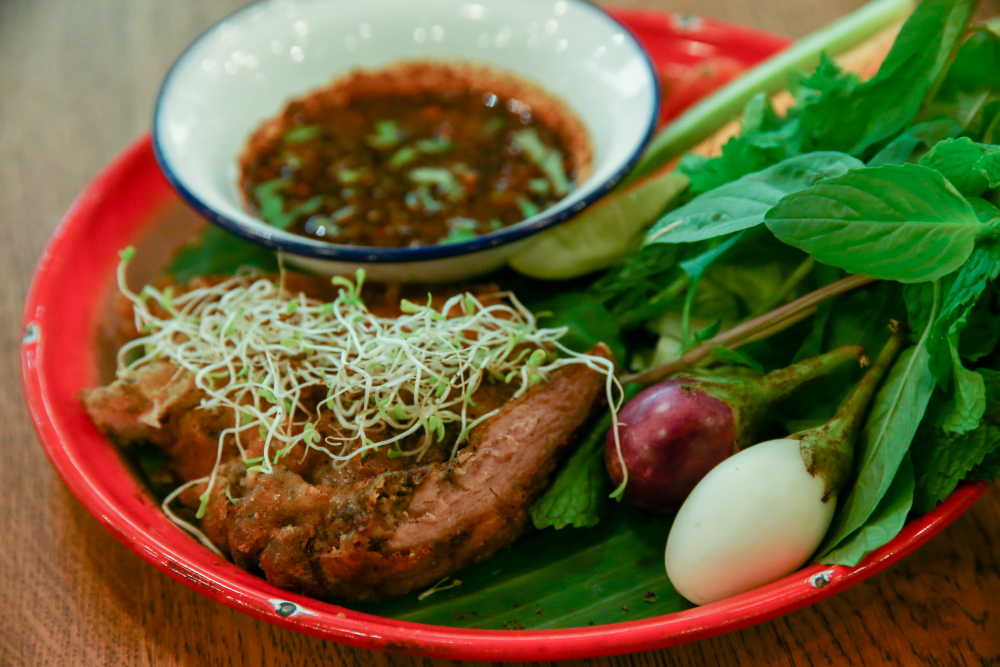
Deep-fried pork marinated with the Northern spice ma kwaen 

The distinctive flavour of ma kwaen powder is also used to marinate pork before deep frying (Bt185). It is served with Isaan-style jaew dipping sauce and fresh seasonal vegetables.

“The Northern-style dip normally has a slightly salty taste, but we’ve adapted it with a tangy flavour similar to jaew to please the Bangkok palate,” he adds.

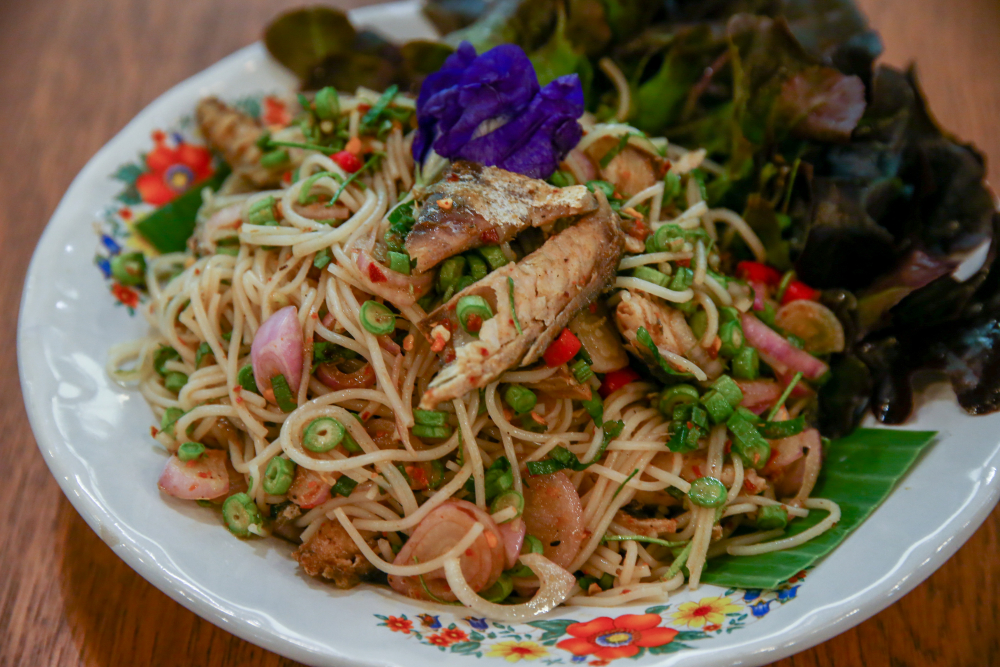
 Spicy brown rice noodle salad with fried mackerel

One flavourful dish not to miss, particularly if you love the taste of pla ra (fermented fish), is spicy brown rice noodles salad with fried mackerel (Bt175). It’s well seasoned with boiled pla ra sauce, chopped long bean, red onion and dried chilli and complemented with fresh salad leaves.

Northern-style grilled crab paste

Northern-style pu-ong or crab paste has an aromatic flavour and creamy texture (Bt135). The fat from paddy-field crabs found on the farm is mixed with egg and seasoned with garlic, salt and pepper. The fat is then put into the crab shell and grilled over low heat until the crab fat is dry and aromatic. It’s served with fresh seasonal vegetables.

Organic pak waan leaves soup with fried fish

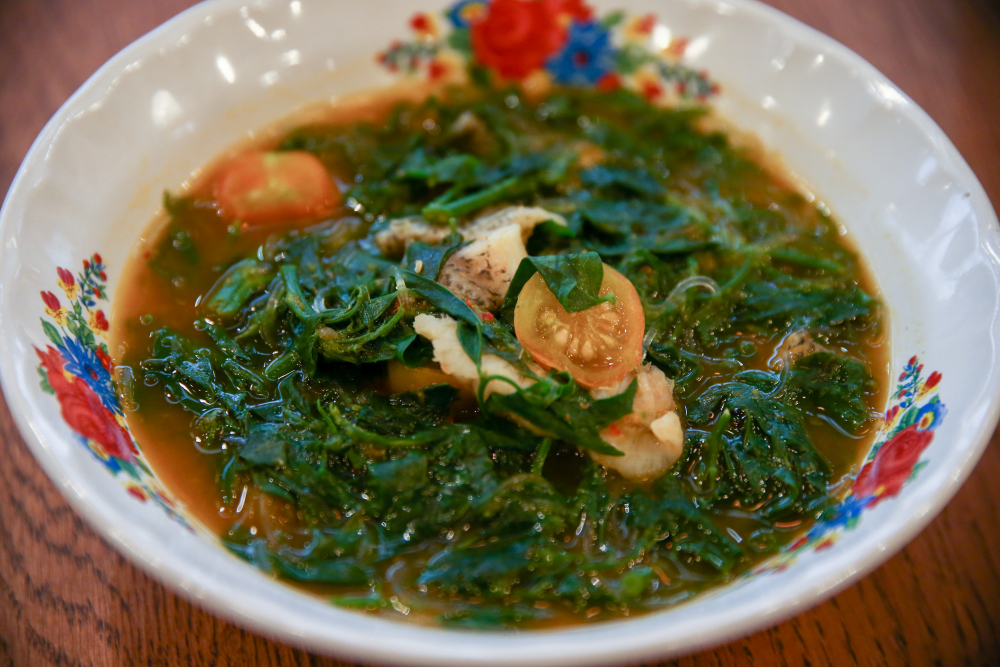
For something more liquid, sample the Northern-style organic pak waan leaves with boneless salid fish, glass noodles and tomato (Bt225).

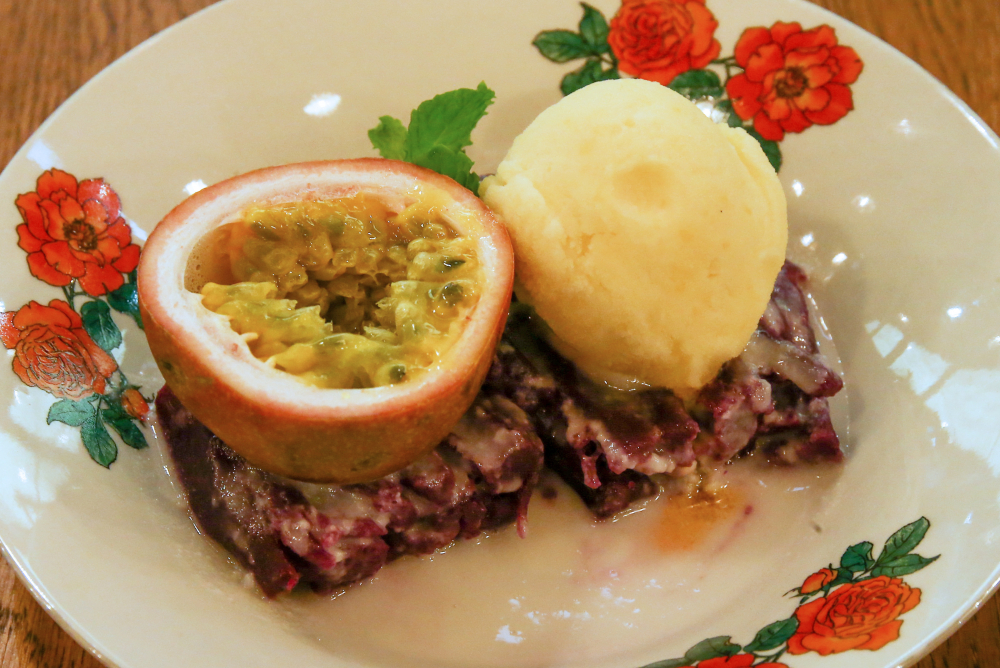
Sweet potato with passion fruit and mango sorbet

End the meal with a refreshing dessert of sweet potato in coconut milk topped with passion fruit and mango sorbet (Bt155).

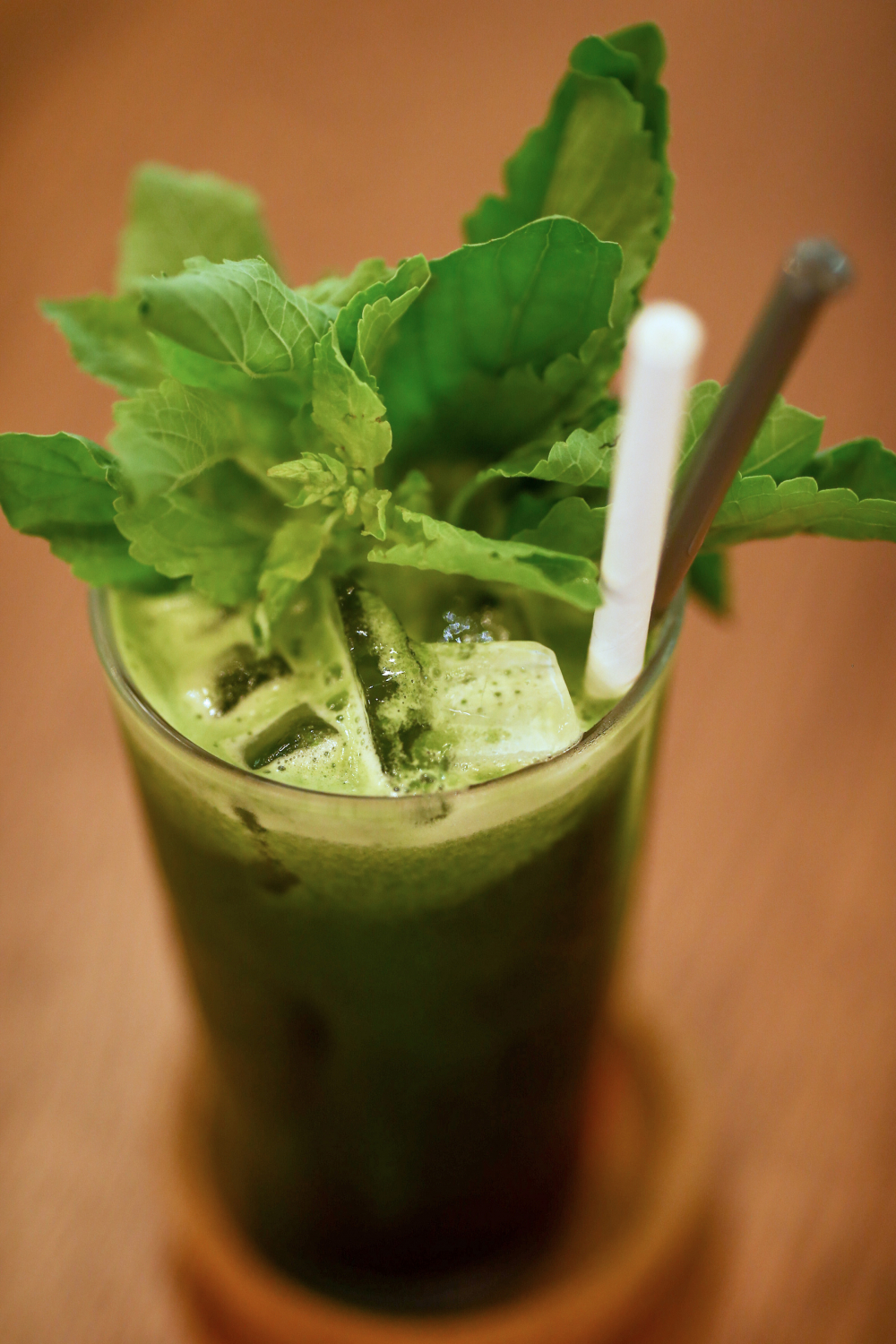
Forest Harmony

Ginger Farm Kitchen also offers a wide choice of cold press juices and tea (Bt120 each). Among the choices are Juicy Guava – a mixture of guava, cucumber, apple and ginger, and Forest Harmony – a concoction of butterfly pea tea, pineapple juice, honey, lime juice, celery juice, spinach and basil.

LUSCIOUS LANNA

Ginger Farm Kitchen’s Bangkok outlet is on the third floor of 101 The Third Place, next to Sukhumvit Soi 101.

It’s open daily from 10am to 11pm.

Call (02) 010 5235 or go to “Ginger Farm Kitchen” on Facebook.

Tastes from the top

ศาสตร์เกษตรดินปุ๋ย : ขอบคุณแหล่งข้อมูล : หนังสือพิมพ์ The Nation

http://www.nationmultimedia.com/detail/tasty/30366335

  • Chu Toro Nigiri with Caviar
  • Iberico Pork Steak Secreto
  • Executive chef Alexandre Castaldi
  • Seen Taco

Tastes from the top

tasty March 23, 2019 01:00

By Kupluthai Pungkanon
The Nation Weekend

High above the Chao Phraya River, Seen Bangkok lives up to its promise of being a place to see and be seen

PERCHED ON the 26th and 27th floors of the Avani Riverside Bangkok Hotel, Seen Restaurant and Bar offers a magnificent view of both the city’s skyline and the Chao Phraya River below.

The brainchild of Olivier da Costa, one of Portugal’s most successful chefpreneurs and social scene doyen, Seen Bangkok joins its siblings in Sao Paulo and Lisbon as the place to see, be seen, sin and escape from it all. Adding to the ambience are the bold cocktails dreamt up by award-winning mixologist Mochammad Fadli.

The rooftop restaurant and lounge framed by floor-to-ceiling windows and designed by M&J London boast a 1980’s-meets-Art Deco hideaway of indoor and outdoor spaces with seating for up to 185 guests. The rooftop sky bar, meanwhile, has bold graphics, a flowing form, and a starry surface underfoot that creates a surreal and intimate setting for up to 64 guests. Daybeds face out over what must be one of the best views of the Chao Phraya with beats in the background spun by a roster of jet-setting DJs.

Executive chef Alexandre Castaldi, 26, showcases his talents with an extensive menu of artisanal tapas, cold cuts and cheeses, seafood and sushi. Signature dishes include the truffled lobster salad and beef tenderloin with da Costa’s original sauce. High quality ingredients from around the world add a foreign flair to the wealth of locally sourced and organic produce.

Every dish is well balanced with hints of acidity and sweetness, and impressive textures and crunchiness. And the a la carte menu is definitely made for sharing.

Organic Beetroot Carpaccio

Highlights include the interesting Organic Beetroot Carpaccio (Bt490) featuring Feta cheese, orange and caper vinaigrette, dill, and sweet macadamia. Equally tasty is the Seen Taco (Bt620) filled with Alaskan king crab, mango, guacamole, red cabbage, tobiko roe, pomegranate, and spicy mayo.

“Our concept is about sharing and that’s especially appropriate for Thailand, where diners want to sample every dish. Chef Olivier designed the menu and each dish is light with a balanced taste,” says Castaldi, who hails from France.

“I like the idea of carpaccio. Our salad menu is light with different textures, crunchiness and a slightly sour kick from the mayonnaise, the squeeze of lime and pomegranate. The taco has many textures too. The concept is kind of European, with recipes that originated in Lisbon. But we also have Brazilian dishes and sushi, which is very important to our concept as we get the best parts of really fresh salmon, Chu Taro, Blufin Tuna and Hamachi yellow tail, and scallops from Japan.”

The recommendations on the sushi menu include Chu Toro Nigiri with Caviar (Bt790), which features Bluefin Tuna belly, caviar, and golden flakes and Truffed Gunkan (Bt560), another interesting plate of salmon, soft shell crab, quail egg confit, black truffle and sesame seeds for added crunch.

Among the main courses, Sea Food Rice (Bt790) has biodynamic rice sauteed Western style with lobster, shrimp, fish, tiger prawn, seabass, crunchy calamari and bisque.

For the meat eaters, there’s wagyu (Bt1,390). “We use rump steak grilled on the outside to make it crispy while the inside is medium rare and juicy.We serve it with truffle spaghetti, and parmesan cheese on top. Our Iberico Pork Steak Secreto (Bt1,120) is from Spain. It’s the part behind the neck and is very tender, even when cooked medium well. We serve with it pineapple for a sweet and sour taste,” Castaldi adds.

Hokkaido Scallop Gratin

Hokkaido Scallop Gratin (Bt990), meanwhile, boasts a delicious leek, mushroom and truffle bechamel.

For dessert, Seen proudly presents “White Bomb”, a milk ice cream with marinated berries, and Banana and Peanuts, a creamy banana cake with peanut toffee. Both are Bt290.

At the bar, Fadli – he prefers to be called a bartender than a mixologist – puts his 20 years of experience to good use. A regular on the awards circuit and recognised for his weird and wonderful concoctions, the Indonesia-born Fadli has graced the counters of award-winning bars from Palmer & Co in Sydney to 1515 West in Shanghai.

For Seen, he offers concoctions from the Old and New World, adding contemporary Thai twists. The cocktails include the Sin to be Seen – Thailand (Bt400), a blend of jackfruit sous-vide plantation rum, citrus, sweet basil, peach bitter, and vegetal cucumber tonic water.

Award-winning mixologist Mochammad Fadli

Black Diamond – Portugal (Bt495) features cheddar cheese, Fermand cognac, Tio Pepe fino, and Madeira chocolate and can be enjoyed both before and after the meal. It has a dry taste with a hint of cheese.

“The cocktail concept is about the Seen bar, which appears on three continents – Asia, Europe, and South America. We have nine signature cocktails, all unique to our brand. Sin to be Seen uses local jackfruit rum, adding basil for a Mediterranean flavour and gets it bitter taste from the cucumber tonic. It’s refreshing and suitable for any occasion. The cocktail really has unique flavours particularly the jackfruit fragrance. It is very rare for a bartender to use this fruit. We have also created a Durian cocktail. Black Diamond is very strong and the cheese is European style. It’s dry and bitter, slightly chocolatey in the palette,” he adds.

“At Seen we are able to create any kind of drink that guests are looking for.”


EYES WIDE OPEN

>> Seen is open daily from 6 to 10pm. Spaces are also available for private events from product launches to weddings.

>> Make a reservation at (02) 431 9120 or visit http://www.SeenRooftopBangkok.com.

Sakura afternoon tea in bloom at Okura Bangkok

ศาสตร์เกษตรดินปุ๋ย : ขอบคุณแหล่งข้อมูล : หนังสือพิมพ์ The Nation

http://www.nationmultimedia.com/detail/tasty/30366149

Sakura afternoon tea in bloom at Okura Bangkok

tasty March 22, 2019 01:00

By THE NATION

The Up & Above Bar at the Okura Prestige Bangkok marks Japan’s much-loved sakura festival with a Sakura Afternoon Tea set for two from April 1 to June 30.

Diners can enjoy tantalising savoury delights including smoked ham and karashi sandwiches with smoked pickle, shrimp and apple salad choux, traditional cucumber sandwiches, egg and basil salad with fried quail egg, and warm poached egg with truffle and potato espuma.


They are perfectly paired with the Sakura Afternoon Tea redolent of the fragrant flavours of spring.

Those with a sweet tooth will be delighted with sakura chocolate praline, sakura mont blanc, choux cream cherry blossom, white peach & lychee verrine, lychee & peach chesse cake, cherry blossom macaron, pickled sakura scones and a selection of jams, marmalade and artisan clotted cream.


Rounding off the afternoon of indulgence is a refreshing peach sorbet.

All go exceptionally well with specially crafted Sakura Mariage Freres tea or freshbrewed Illy coffee.

The tea set is priced at Bt1,290-plus, inclusive of premium coffee or tea for two.

Book a seat at (02) 687 9000 or email upandabove@okurabangkok.com.

Subcontinental splendour

ศาสตร์เกษตรดินปุ๋ย : ขอบคุณแหล่งข้อมูล : หนังสือพิมพ์ The Nation

http://www.nationmultimedia.com/detail/tasty/30366166

Subcontinental splendour

tasty March 20, 2019 01:00

By THE NATION

Organised as a way of drawing attention to Bangkok’s premium culinary experiences, the Top Tables Champions is taking place at restaurants around town for two weeks. Popular eatery Haoma has been selected to join the elite 30 Top Tables Champions.

The restaurant is a pioneer in sustainable finedining, and proud to offer a ninecourse “Neo-Indian” local menu, on offer from March 22-24 and 26-30 for Bt1,990-plus.


A tranquil eco-oasis tucked down Sukhumvit Soi 31, Haoma charts every guest on a unique culinary journey in harmony with the seasons and rhythms of the earth, using the freshest local ingredients, ingenuously reimagined. Haoma’s goal of becoming the world’s first certified carbon-neutral restaurant by 2020 is spearheaded by co-owner and chef Deepanker “DK” Khosla. The menu combines produce sourced mostly from the hanging onsite garden, and high-quality sustainable meats, created with techniques and flavours inspired by DK’s Indian roots.


Highlights of the nine subcontinent-inspired dishes include Galauti Cornets, wild mushrooms given a 21spice salute and packing a citrus punch; and the traditional street food Golgappa, an indulgence classically enjoyed around 4pm that packs several explosions into every bite, with chick peas, potatoes, mint, tamarind and homemade yoghurt mingling and tingling in a whole wheat crisp.

For an optimal flavour experience, these dishes are best eaten with your hands.

Make a bookings at https://toptables.asiacity.com/champions/restaurants/haoma.

A perfect slice

ศาสตร์เกษตรดินปุ๋ย : ขอบคุณแหล่งข้อมูล : หนังสือพิมพ์ The Nation

http://www.nationmultimedia.com/detail/tasty/30366084

A perfect slice

tasty March 19, 2019 12:40

By The Nation

KiSara Restaurant at the Conrad Bangkok celebrates its re-opening with a range of culinary delights, among them the delicious the Kuroge Wagyu Hidagyu Houbayaki.

Every gourmand in the world knows wagyu beef, the highest quality meat available in Japan. And no one who enjoys fine quality steak should go without trying it.

With a grading of A5, this is the highest quality beef found anywhere. Special care is taken with every single animal to produce such incredibly tender and well-marbled meat, and some of the techniques are still kept secret, giving rise to various rumours ranging from massage to diets of beer!

In KiSara, this extraordinary beef sirloin is thinly sliced and, to ensure that diners absolutely satisfied, is cooked table-side in Houba leaf and sweet miso.

Kuroge Wagyu Hidagyu Houbayaki is served with vegetables and available now for only Bt2,500-plus per person.

KiSara restaurant is open for lunch daily from 11am to 2.30pm and for dinner 6-10.30pm on the 3rd floor of Conrad Bangkok.

Make a reservation by calling (02) 690 9999.

Thailand has all the taste it needs

ศาสตร์เกษตรดินปุ๋ย : ขอบคุณแหล่งข้อมูล : หนังสือพิมพ์ The Nation

http://www.nationmultimedia.com/detail/tasty/30365893

  • Chilli dip with puffy-fried smoked fish
  • Taan restaurant takes sustainably-sourced local ingredients for twisted Thai dishes.
  • Charred prawns tossed with chilli and tamarind dressing

Thailand has all the taste it needs

tasty March 16, 2019 01:00

By Khetsirin Pholdhampalit
The Nation Weekend

3,430 Viewed

Chef Thep Monthep at Bangkok restaurant Taan uncovers amazing possibilities using only local ingredients

TAAN AT the Bangkok design hotel Siam@Siam is among the increasing number of restaurants in Thailand pursuing the admirable trend of procuring ingredients from sustainable local sources rather than importing what they need.

When your fly in farm produce and other goods, of course, it arrives all sooty from your carbon footprint.

And the local stuff usually tastes better, anyway. Thailand’s four regions grow and raise products that have their own distinctive qualities and, in the hands of a good chef, the authentic flavour comes through.

Taan restaurant takes sustainably-sourced local ingredients for twisted Thai dishes.

The name Taan comes from the more formal Thai term for eating. Replacing posh French restaurant La Vue on the hotel’s 25th floor, it feels a little formal at first. But before you enter the 42-seat dining area, have a glance at the portraits on the wall by the bar near the entrance. Those are all the food suppliers who help stock the kitchen.

On the menu, too, the ingredients of each dish are accredited to their origins, complete with the distance from Bangkok in kilometres.

The free-range pork comes from Nan, the wagyu beef from Suphan Buri, the organic chicken and eggs from Nakhon Pathom, the edible flowers from Chiang Mai and most of the seafood from the Fisherfolk project in the South, a collective of small-scale fishermen.

Executive chef Monthep “Thep” Kamolsilp was visiting the village of Hin Lad Nai in Chiang Rai when he got the notion to open Taan.

“I was watching people from the Pga K’nyau hilltribe using the old farming technique of ‘slash-and-char’ to re-nourish the land,” he says. “They set the fire but smother it within a certain time, and the lower temperature and oxygen level produce charcoal instead of ash, enhancing the soil’s productivity.

“This was the power of nature and it gave me even more respect for the local wisdom that people in all regions possess to improve their products.”

Thep came up with a lively name for his dining concept – “hyper local innovative Thai cuisine”. What it means is that small-scale Thai producers grow and raise everything he uses in the kitchen. He wants the genuine flavours intact, but applies complicated techniques and adds twists in the presentation.

 Chef Monthep “Thep” Kamolsilp 

“My travels all around Thailand have inspired the dishes, but I adapt and reinterpret them for the more complex palates of urban diners.”

Thep, who’s worked at Normandie at the Mandarin Oriental Bangkok and the Eugenia Bangkok and at La Terrasse at Domaine de Divonne in France, adores gai gor lae, for example – southern-style charcoal-grilled and marinated chicken.

But he uses wagyu beef shanks instead of chicken and presents the plate with charred pineapple and pickled, spicy galangal. And he swaps the sugar that sweetens the original with dried longan, a natural sweetener.

All dishes are available both a-la-carte and in set courses (sam rub in Thai). The nine-course sam rub for both lunch and dinner costs Bt1,700-plus. A nine-course tasting menu at dinnertime is Bt2,100-plus.

The sam rub are designed to be shared, in the Thai manner. Each set includes two starters, a dip, soup, four main courses and a dessert. Mine came

with the amuse-bouche of the day – a bite-sized crispy crepe filled with seasoned minced chicken.

Charred prawns tossed with chilli and tamarind dressing

The first starter was pla goong kam kram yang, charred brackish-water prawns tossed with fresh chillies and home-made chilli oil, tamarind dressing and herbs. It’s served with the crisp-fried head of a prawn that’s had the fatty tissue scooped out and replaced with beef-bone marrow.

Isaan-style chicken sausage 

For the second starter, sai grok isaan gai baan is a grilled Isaan-style fermented sausage containing breast of organic chicken. This comes with pounded chillies and a puffy-fried smoked catfish.

Chilli dip with puffy-fried smoked fish

The twist to the nam prik long rue dip is in the variety of morsels assembled on the platter. Stir-fried chilli is combined with sea catfish. Shrimp paste is topped with flakes of salted egg yolk. A chunk of deep-fried grouper rests on puffy-fried smoked fish. Alongside are seasonal sour plants like garcinia and bilimbi leaves.

Dried fish broth with pork ribs 

Tom khlong nam kati leng is a broth of dried fish cooked with braised, organic pork back-ribs and crisp-fried pork belly. It’s seasoned with pounded chillies and tamarind leaves. The coconut milk is frothed up to enhance the creaminess and tone down the fire.

Fried grouper fish with clotted coconut milk

The main courses begin with pla gao tod kamin, which is fillets of grouper marinated overnight with turmeric and coated with rice before frying. The crunchy result is served with rice crackers and clotted coconut milk seasoned with pounded turkey berries, lemongrass, coriander root, chilli and garlic.

Southern-style gor lae with wagyu beef

Next up is the transformed gor lae. Nuea nong lai gor lae has those wagyu beef shanks that have been marinated with salt, turmeric and garlic overnight. Then they’re roasted at low temperature for two days until beautifully tender. As mentioned, this arrives with charred pineapple and pickled, spicy galangal.

Stir-fried pork with holy basil and torchginger

The classic dish of pad gapao – stir-fried meat with leaves of holy basil and chilli – is similarly transformed with stunning results. Thep is unfazed by purists who demand that pad gapao contain only holy basil and nothing else (no long bean, onion, corn or carrot). His version has long bean, shredded torch-ginger, lemongrass and white popinac seeds right in there with the holy basil.

“We should be concerned about using too much soy sauce and oyster sauce for the seasoning, not about too many vegetables,” says the chef. “I prefer to season this dish with southern budu fish sauce mixed with sugarcane – it’s light and delicious.”

Chicken massaman curry

Massaman gai baan features organic chicken braised for six hours and then further cooked with massaman curry. You also get pickled lotus root, garlic clove, papaya and turnip to overcome any sense of oiliness.

Thai tea ice cream, goat milk simmered with millet, and sweetened egg yolk threads

Thai tea ice cream made with fresh cow’s milk makes a nice end to the meal, as do goat milk simmered with millet and foi thong (poached egg-yolk threads) topped with wild honey.

Re-Re-Khao-San

The cocktails are also made with local ingredients. Re-Re-Khao-San (B330), named after the popular Thai children’s game, is rum infused with roasted rice and coconut water, topped with sticky rice syrup.

Um-Daeng

Um-Daeng (Bt220) adds to classic Thai iced tea pomegranate juice and ginger syrup plus lime and pounded ginger together.
SOLE SOURCE FOR FLAVOUR

Taan is on the 25th floor of the Siam@Siam Design Hotel Bangkok (BTS: National Stadium).

It’s open daily, though lunch is served only on weekdays.

Book a table at (065) 328 7374 or http://www.TaanBangkok.com.