Big Tech is gearing up for a massive fight with Modis India #SootinClaimon.Com

#SootinClaimon.Com : ขอบคุณแหล่งข้อมูล : หนังสือพิมพ์ The Nation.

https://www.nationthailand.com/tech/40002826

Big Tech is gearing up for a massive fight with Modis India


India is growing increasingly assertive in its efforts to control online communications, challenging Twitter and Facebooks practices and threatening to set a precedent that could extend far beyond its borders.
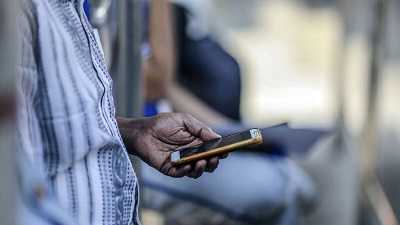
A man uses a smartphone in Mumbai on Feb. 15, 2020. MUST CREDIT: Bloomberg photo by Dhiraj Singh.

The largest U.S. internet firms are fighting new Intermediary rules issued by Narendra Modi’s government in February that they say curtail privacy and free speech. Officials have demanded Facebook and Twitter take down hundreds of posts this year, divulge sensitive user information and submit to a regulatory regime that includes potential jail terms for executives if companies don’t comply.

While the administration’s push to exert more control over user data and online discourse reflects efforts globally to come to grips with tech giants and their enormous influence, the stakes in India are particularly high for internet firms because — shut out of China — it’s the only billion-person market up for grabs. Unlike authoritarian regimes such as Beijing, critics fear actions taken by the world’s largest democracy could offer a template for other governments to encroach on personal privacy in the name of domestic security.

“India has introduced draconian changes to its rules,” the Electronic Frontier Foundation wrote in April. They “create new possibilities for government surveillance of citizens. These rules threaten the idea of a free and open internet built on a bedrock of international human rights standards.”

Holding internet companies responsible for content posted — and in some cases, executives personally liable — goes beyond what many countries demand and is a key point of dispute. Caught in this tug-of-war are hundreds of millions in India whose way of engaging with the internet now hangs in the balance. Facebook’s WhatsApp is in court arguing the new rules would circumvent its encryption, a key feature the company has touted in global marketing.

Modi’s administration has trained its sights on Twitter in recent months, given its role as the social platform of choice for politicians and celebrities. Cabinet ministers have accused the U.S. company of defying orders and suggested it should be stripped of its intermediary status — making it directly accountable for content posted by its users. In May, Twitter slapped a “manipulated media” label on tweets from several accounts linked to Modi’s party. Police investigators have since called on senior executives and its offices, placing business in the world’s second most-populous nation at risk.

“Twitter is in a no-win situation here,” said Mike Masnick, founder of tech policy blog Techdirt. “Giving in to excessive government demands not only suppresses important speech, but opens the company up to even further pressure to silence critics of the government in India and elsewhere.”

Representatives for the Ministry of Electronics and Information Technology (MEITY) that oversees regulation did not respond to several calls and emails seeking comment. WhatsApp and Twitter representatives declined to comment beyond past statements that they will aim to comply with government regulations.

India has said it welcomes criticism and dissent and its new rules are aimed at safeguarding public order and preventing harmful content such as child pornography and abuse videos. The country in recent years has grappled with an explosion of fake news across social media, much of it targeted at a largely first-time internet audience unaccustomed to sifting through online falsehoods. It came into conflict with Facebook in 2018 when the government asked WhatsApp to curb the spread of messages in connection with two dozen lynchings. Facebook’s response then was to restrict the forwarding of messages and label them as “forwarded.”

WhatsApp has more than 530 million users in India, YouTube has about 450 million and Facebook has over 410 million users, making it the biggest market for all three. Twitter, a comparative minnow with 17.5 million users, counts India among its fastest-growing territories. But that limited reach makes it vulnerable in a nation that showed itself willing to outlaw popular foreign services a year ago when it banned TikTok — which had signed up 200 million users in the country — WeChat and hundreds more China-made apps after a violent clash on the disputed border between the two countries.

As in the U.S., however, Twitter wields influence disproportionate to its size. It’s vital to political discussion in India and Modi himself is an avid user and enjoys a following of more than 69 million, showing its international reach. While ministers have tweeted belligerently about Twitter, none have yet openly voiced the threat of banning it.

Even while clashing with China, India may still draw inspiration from its neighbor’s experience, where the void left by foreign social platforms blocked for opposing stringent censorship created room for homegrown alternatives to develop. In fact, Modi’s colleagues have been actively touting Koo, a local micro-blogging rival.

“I have to imagine that Modi is looking at China and thinking they can have economic prosperity while also exercising a lot of authoritarian control over speech and communications,” said Katie Harbath, a former Facebook public policy director who worked with the country’s officials between the fall of 2013, ahead of Modi’s first election as prime minister, until earlier this year. “So the big question is what direction will India go?”
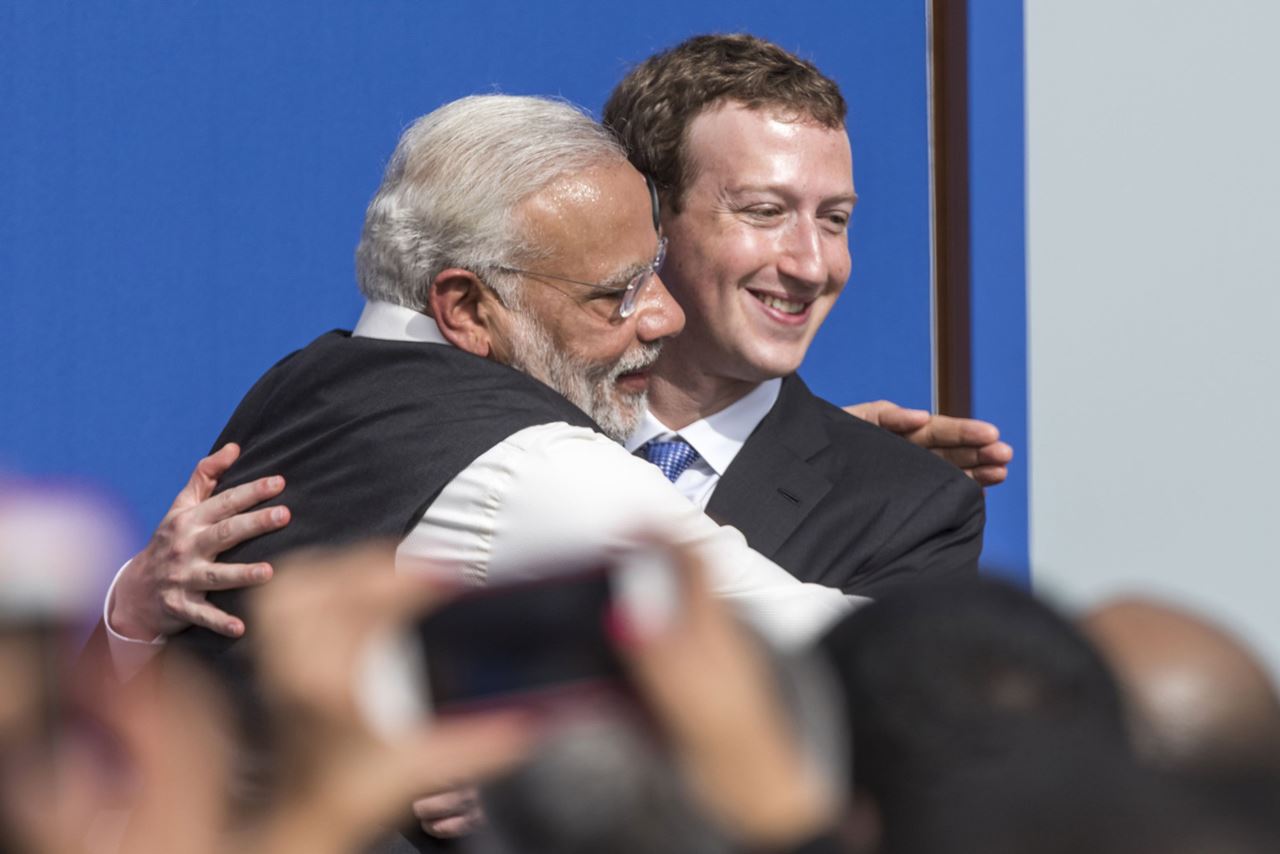
Narendra Modi, India's prime minister, left, and Mark Zuckerberg, chief executive officer of Facebook, embrace at the conclusion of a town hall meeting at Facebook headquarters in Menlo Park, Calif., on Sept. 27, 2015. MUST CREDIT: Bloomberg photo by David Paul Morris.

Much of the current rancor stems from the government’s push to control the conversation around farmer protests that have been going on since November, centered on proposals to tax agricultural inputs and remove minimum price support. The administration compelled Twitter to block some popular figures expressing support for the protesters — such as Punjabi singer JazzyB, whose account has 1.2 million followers but can’t be accessed within India — though the company hasn’t enacted all of its requests.

U.S. and EU lawmakers should be paying closer attention to the South Asian country, Harbath said. Like Masnick, she sees few good options for private companies to oppose laws handed down from above, and it would be up to the international community to steer India back toward a more liberal path.

The U.S. has embraced India in recent years as a counterweight to China, boosting defense cooperation as part of the four-nation Quad group that also includes fellow democracies Japan and Australia. For its part, Modi’s administration has sought to attract firms seeking to diversify supply chains away from China — giving it an incentive to maintain good relations with the Biden administration and the American business community at large.

Relations with American social platforms were much warmer and more collaborative in the early years of the Modi government. Facebook founder Mark Zuckerberg hosted Modi for a town hall event at the company’s headquarters in 2015. The two men embraced and smiled for the cameras. But, Harbath said, whenever the administration’s popularity has slipped since then — after moves such as the sudden currency demonetization in 2016 — it has grown more aggressive in trying to steer the public narrative.

Most recently, Modi’s government has come under fire on Twitter from critics who say it bungled efforts to fight Covid-19. In response, it has sought to block recent criticism on Twitter, where the anger and disappointment in India’s leader are manifest.

“Silicon Valley’s social media platforms have a huge base in India and the confrontation is over who controls these users,” said Delhi-based Tarun Pathak, research director at Counterpoint. “In the next three to five years, some 300 million new users equaling the population of the U.S. will get online in India, shifting the balance of power eastward for these companies.”

Twitter appointed an interim compliance officer two weeks ago, long after its peers had assigned permanent representatives, and that person reportedly quit the position. A company spokesperson declined to confirm or comment on the reasons.

Late last month, the head of MEITY, Ravi Shankar Prasad, had his Twitter account briefly locked due to a complaint of alleged copyright infringement, according to the company. Upon regaining access, the frequent Twitter antagonist wrote that its “actions indicate that they are not the harbinger of free speech that they claim to be but are only interested in running their own agenda.” Twitter declined to comment further but pointed to its original statement that Prasad’s account was briefly locked for copyright violation.

“U.S. tech companies want to operate in India, make big money in India but want to be governed by U.S. laws,” Prasad said at the India Global Forum virtual event on Wednesday. “You have to be accountable to the constitution and the laws of India.”

Twitter was recently cited alongside journalists and opposition party leaders by police in Uttar Pradesh for hosting a video that provoked communal discord, according to local reports. Delhi police also said they were investigating another complaint against Twitter India chief Manish Maheshwari related to that video, which purported to show majority Hindus assaulting a minority Muslim man. The company has since removed the offending clip, offering no comment beyond its statement about complying with local laws. The Uttar Pradesh government has petitioned India’s Supreme Court to revoke a lower court’s protection of Maheshwari from arrest.

Without pressure on India to dial back its online powers — which the Washington Post’s editorial board called for last month — companies like Twitter will have to carefully weigh their decisions so as not to be ousted from a vast market while still upholding the principles they espouse, Harbath said.

It’s a delicate dance that’s becoming more common around the world. Countries as far afield as Australia, Poland and Nigeria are cracking down on social platforms, alleging they have excessive power to determine what is acceptable speech and are meddling with domestic affairs. Nigeria barred Twitter this month and Germany’s hate speech rules will require platforms to speedily take down illegal content or face penalties.

“It’s complicated. A decision taken by these companies in India will not be for India alone,” said Bangalore-based Prateek Waghre, a research analyst at the Takshashila Institution who studies the governance of digital platforms. “What they do here will serve as a template for the rest of the world.”

Published : July 05, 2021

By : Syndication Washington Post, Bloomberg · Saritha Rai, Vlad Savov
Widespread ransomware attack likely hit thousands of companies on eve of long weekend #SootinClaimon.Com

#SootinClaimon.Com : ขอบคุณแหล่งข้อมูล : หนังสือพิมพ์ The Nation.

https://www.nationthailand.com/tech/40002799

Widespread ransomware attack likely hit thousands of companies on eve of long weekend


A sprawling ransomware attack that hit hours before the beginning of of the July Fourth holiday weekend has already affected hundreds of business and likely hit many more, researchers said.

On Saturday morning, information technology company Kaseya confirmed it had been hit by a “sophisticated cyberattack” on its VSA software – a set of tools used by IT departments to manage and monitor computers remotely. The company said only around 40 customers had been hit.

But since Kaseya’s software is used by large IT companies that offer contracted services to hundreds of smaller businesses, the hack could have spread to thousands of victims. Kaseya warned all of its nearly 40,000 customers to disconnect their Kaseya software immediately. Cybersecurity firm Huntress Labs said they had tracked 20 IT companies, known as managed service providers, that had been hit. Over 1,000 of these companies’ clients, mostly small businesses, had been hit by the hack too, Huntress Labs said on Reddit.

“I wouldn’t be surprised if it was thousands of companies,” said Fabian Wosar, chief technology officer of Emsisoft, a company that provides software and advice to help organizations defend against ransomware attacks. “We just don’t know yet because of the long weekend in the U.S.”

A major grocery chain in Sweden said Saturday that its IT provider had been hit by an attack, meaning its cash registers were locked up. It had to shut down hundreds of stores, the company, Coop Sweden, said on its Facebook page.

Because of the sheer number of companies potentially affected, the attack could prove to be one of the biggest in history. Researchers said REvil, the same hacker group that attacked JBS Meats earlier this year, was behind the attack.

The assault could ratchet up tensions between the U.S. and Russia, as it comes just weeks after President Joe Biden met with Russian President Vladimir Putin in Geneva, warning him that the United States would hold Moscow accountable for cyber attacks that emanate from Russia. Many cybersecurity threat analysts believe that REvil operates largely out of Russia. The recent spate shows underscores the challenge facing the Biden administration in deterring ransomware attacks conducted by criminals given safe harbor in countries like Russia.

Instead of a careful, targeted attack on a single large company, this hack seems to have used managed service providers to spread indiscriminately through a huge network of smaller companies. Unlike most ransomware attacks, it doesn’t look like REvil tried to steal sensitive data before locking out its victims, Wosar said.

“At this point, at least it seems it was more a spray and pray attack, they didn’t try to exfiltrate data from all the victims,” he said. “It was more like carpet bombing.”

“We believe that we have identified the source of the vulnerability and are preparing a patch to mitigate it,” Kiyesa CEO Fred Voccola wrote in a statement Friday night.

Researchers said cybercriminals were sending two different ransom notes on Friday – demanding $50,000 from smaller companies and $5 million from larger ones.

The U.S. Cybersecurity and Infrastructure Security Agency urged companies in a statement to follow Kaseya’s advice and said it is “taking action to understand and address the recent supply-chain ransomware attack.”

“It is absolutely the biggest non-nation state supply-chain cyberattack that we’ve ever seen,” Allan Liska, a researcher with cybersecurity firm Recorded Future, said Friday. “And it’s probably the biggest ransomware attack we’ve seen, at least the biggest since WannaCry.”

He noted it could be the largest number of companies one ransomware attack has hit. The companies affected could be a wide range of small to large firms, and many are likely to be small to midsized businesses that use managed IT services. Kaseya also counts a number of state and local governments as customers, Liska said.

The WannaCry computer worm affected hundreds of thousands of people in 2017. The National Security Agency eventually linked the North Korean government to the creation of the worm.

Ransomware attacks increased significantly in frequency and severity during 2020. A report from a task force of more than 60 experts said nearly 2,400 governments, health-care systems and schools in the country were hit by ransomware in 2020. Organizations paid attackers more than $412 million in ransom payments last year, according to analysis firm Chainalysis.

After a May attack on Colonial Pipeline – which spurred panicked lines at gas pumps and empty fuel stations – the U.S. government increased its emphasis on addressing cybersecurity issues, and urged corporate America to strengthen its computer security.

Ransomware attacks have been on the rise as hackers band together and form cybercriminal gangs to extort companies for payment. The attacks are often carried out by attackers in Russia and Eastern Europe.

Hackers gain access to a company’s computer system using tactics such as sending “phishing” emails, which are designed to trick employees into inadvertently installing malware on their computers.

Once inside, cybercriminals will lock down parts of the companies’ networks and demand payment to release them back to the owner. Additionally, hackers often steal private company information and threaten to leak it online if they are not paid.

It is still unclear how attackers gained access to Kaseya’s system. The company has been a popular target of REvil, Liska said, probably because it serves so many other organizations as customers.

The attackers included a ransom note directing victims to a website to pay a ransom, although Liska said the site had been down all afternoon and evening.

Kaseya spokesperson Dana Liedholm said its investigation of the incident is ongoing, and pointed to the company’s earlier statement.

Published : July 04, 2021

By : The Washington Post · Gerrit De Vynck, Rachel Lerman

Thai Air Force launches 2nd observational satellite #SootinClaimon.Com

#SootinClaimon.Com : ขอบคุณแหล่งข้อมูล : หนังสือพิมพ์ The Nation.

https://www.nationthailand.com/tech/40002767

Thai Air Force launches 2nd observational satellite


The Royal Thai Air Force (RTAF)s Napa 2 satellite was aboard a SpaceX Falcon 9 rocket that launched from Cape Canaveral in Florida on Thursday. The satellite will be released into Earth orbit in the next 19 days.

Napa 2 is the second RTAF satellite sent into space after the Napa 1 satellite launched from Guiana Space Centre in French Guiana on September 3 last year.

The Napa 2 will view the Earth via multispectral imaging and false colour composite systems to help with natural disaster forecast and analysis.

RTAF said it was applying space technologies to support operations that will assist disaster victims.

Published : July 02, 2021

By : The Nation

Great Wall Motor Presents First All New HAVAL H6 Hybrid SUV from Thailand-based Production Line to HRH Princess Maha Chakri Sirindhorn #SootinClaimon.Com

#SootinClaimon.Com : ขอบคุณแหล่งข้อมูล : หนังสือพิมพ์ The Nation.

https://www.nationthailand.com/tech/40002710

Great Wall Motor Presents First All New HAVAL H6 Hybrid SUV from Thailand-based Production Line to HRH Princess Maha Chakri Sirindhorn


Her Royal Highness Princess Maha Chakri Sirindhorn is a goodwill ambassador. She has made outstanding contributions to the Thai – Chinese relations in terms of diplomacy and bilateral cooperation in various aspects.

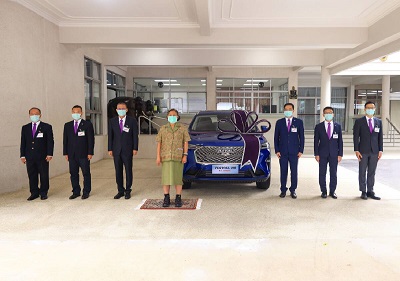
Her Royal Highness Princess Maha Chakri Sirindhorn granted the royal audience for Great Wall Motor (GWM), represented by Elliot Zhang, President of Great Wall Motor ASEAN and Thailand and other high-level executives, along with Wang Liping, Minister Counselor for Economic and Commercial Affairs of the Chinese Embassy in Thailand, to present the first All New HAVAL H6 Hybrid SUV from GWM’s Thailand-based production line with the 1.5-liter turbo engine (HEV), as a part of her Charity Affairs Division for her royal command.

GWM previously opened its “Smart Factory”, which is also its second full-production manufacturing facility outside China and unveiled the first All New HAVAL H6 Hybrid SUV from its production line here. In the latest move, GWM was granted a royal audience from Her Royal Highness Princess Maha Chakri Sirindhorn at the Chaipattana Building, Suan Chitralada, for presenting the vehicle on June 23, 2021. The presentation aims at promoting Thai – Chinese ties as well as the supports on the usage of new energy vehicles to ease pollution for the better environment.

Great Wall Motor Presents First All New HAVAL H6 Hybrid SUV  from Thailand-based Production Line to HRH Princess Maha Chakri SirindhornGreat Wall Motor Presents First All New HAVAL H6 Hybrid SUV from Thailand-based Production Line to HRH Princess Maha Chakri SirindhornElliot Zhang, President, Great Wall Motor ASEAN and Thailand, said during the royal audience that, “The Thai – Chinese relations have long been close, with regular exchanges of visits at all levels. Thai royals’ trips to China are key to the forging of closer ties and cooperation between the two nations. They also lead to friendship and mutual understanding among Chinese and Thai peoples on a sustainable basis. GWM executives in China and Thailand feel very grateful to Her Royal Highness Princess Maha Chakri Sirindhorn for her royal works that benefit the two countries as well as their peoples. High-level executives in China have been granted royal benevolence on several occasions during the Princess’ trips to China. Today, we are especially delighted that the Princess has granted us this royal audience as well.”

China has been Thailand’s No. 1 trade partner and the second biggest market for Thai exports. Thailand, meanwhile, has been China’s third-biggest trade partner in the ASEAN region. At the heart of Thai – Chinese ties is economic cooperation. The trade ties between the two nations have become especially close after the ASEAN–China Free Trade Agreement got an upgrade in 2019.

Wang Liping, Minister Counselor for Economic and Commercial Affairs of the Chinese Embassy in Thailand, said, “Her Royal Highness Princess Maha Chakri Sirindhorn is a goodwill ambassador. She has made outstanding contributions to the Thai – Chinese relations in terms of diplomacy and bilateral cooperation in various aspects. China is pleased to foster its cooperation with Thailand further for friendship and harmony under ‘China and Thailand are One Family’ concept.”

GWM, as the “Global Mobility Technology Company”, has recognized the importance of Thailand and has full confidence in the country’s potential. Thailand is well ready in all dimensions for the future of automotive industry especially in regard to electric vehicles (xEV). GWM has invested in Thailand’s next-generation automotive industry and making moves to acquire and operate its own production facility in Rayong province. Earlier in August 2000, this Rayong plant also got the honor to be inaugurated by Her Royal Highness Princess Maha Chakri Sirindhorn. Therefore, GWM is honored to have acquired and used this facility and plan to upgrade into a smart factory to serve as a major manufacturing base of the right-hand-drive vehicles especially electric vehicles in ASEAN region. It will operate based on “New Energy”, “New Intelligence”, and “New Experience” concept to help upgrade Thailand’s automotive industry into the next-generation automotive industry. Boasting modern technologies, smart work processes, and environmentally friendly innovations that reflect a strong focus on social responsibility, this plant will also create jobs and empower Thais through knowledge and skill development. New business models and new experiences, at the same time, will roll out for Thai consumers as GWM seeks to bring Thailand’s customer experiences to the new height and bolster Thai economy.

Marking the official start of its production in Thailand, GWM has found it an auspicious honor to present the first vehicle from the Thai’s production line to Her Royal Highness Princess Maha Chakri Sirindhorn for her royal command.

After the car’s presenting, Her Royal Highness Princess Maha Chakri Sirindhorn took a look around the vehicle and officially accepted the All New HAVAL H6 Hybrid SUV and listed it on her Charity Affairs Division’s fleet for her royal command later.

All New HAVAL H6 Hybrid SUV combines a 1.5-liter turbo engine with a 130-kW electric motor, resulting in integrated power output of 179 kW (243 hp) and integrated torque of 530 Nm. Featuring the LIFE+ intelligent system, this car model complements driving experiences – making journeys fun and safe. The official launch of All New HAVAL H6 Hybrid SUV and its price announcement took place recently on June 28, 2021.

Published : July 01, 2021

Throwable military robots sent to assist with Florida condo collapse #SootinClaimon.Com

#SootinClaimon.Com : ขอบคุณแหล่งข้อมูล : หนังสือพิมพ์ The Nation.

https://www.nationthailand.com/tech/40002690

Throwable military robots sent to assist with Florida condo collapse


First responders on the ground at the Miami Beach-area condo that partially collapsed last week have used several tech tools to aid the treacherous search-and-rescue effort.

Teledyne Flir’s 5-pound FirstLook Robot. MUST CREDIT: Teledyne Flir.

Rescuers deployed sonar and camera equipment early on as officials scoured the rubble for survivors. Heavy machinery was brought in to remove some bits of the pancaked building materials. Yet, nearly 150 people remain unaccounted for. And officials still have a tedious mission ahead as teams try to avoid falling debris and other unforeseen obstacles.

Does that mean it is time to send in the robots? It depends. Scouting robots might not be as susceptible to smoke inhalation and can snake through tight corridors in deadly conditions. But they also pose technical challenges, and are not always as helpful as they are designed to be when navigating complex environments at a moment’s notice, experts say.

The Miami-Dade Fire Department has at least two robots in its arsenal that the Massachusetts-based robotics company Teledyne Flir overnighted to assist with the Surfside, Fla., rescue effort. The gadgets are designed to operate where it is nearly impossible for humans to go.

“They can also go where humans shouldn’t go,” said Tom Frost, Teledyne Flir’s vice president of unmanned ground systems. “In a collapse situation like this, the pile is structurally unsound and constantly vulnerable to shifting. It’s much safer to have a robot crawl deeper into a void than to have a person crawling into that void.”

It is unclear if first responders have used the devices, however.

Teledyne Flir’s machines have some features that could come in handy as rescuers search through a mound of collapsed concrete. One of its microrobots can be tossed onto unstable rubble and will then roll into crevices humans cannot see or fit into. The company also sent a 50-pound automated machine with an arm to pick up and move around objects.

Teledyne Flir was formed last month after Teledyne Technologies, a $15 billion aerospace electronics firm, bought out Flir, a 42-year-old software company, in an $8 billion deal. The combined companies develop tech meant for deep sea, space and military missions.

The firm’s devices sent for use in the condo incident are equipped with thermal sensors, cameras and two-way radios built to aid during high-stakes missions. The tech was deployed at the World Trade Center collapse in 2001 and has since been used by law enforcement agencies during barricade situations.

The throwable “FirstLook” robot weighs about five pounds, is about the size of a brick and is built to withstand 16-foot drops onto concrete. It looks like a tiny military tank, sits on track wheels and has two arms to climb small obstacles. The arms also enable it to turn itself upright when flipped over, according to the company.

“You can take this robot and throw through a window or throw it on a roof, and get to really hard to access places,” Frost said.

The larger robot, “PackBot,” is about the size of a suitcase. It is designed to roll over rubble, navigate narrow passages and tote loads under about 40-pounds. They are both built to run semi-autonomously, which means some features are automated, while others require a teleoperator.

Tossable robots are not exactly new. The scouting and surveillance tools have been used by law enforcement and military personnel for years. Still, there are limitations.

Radio signals might not be able to penetrate deeply into the rubble. There might not be any useful places on-site for the robots to go. And robots can get stuck, causing yet another problem.

That is what happened in 2010 when rescuers in New Zealand tried finding 29 miners trapped inside a coal mine. The nation’s defense force sent in a camera-equipped robot to search for signs of human life, and it ended up short-circuiting and holding back the mission.

“You don’t want a robot to fail in the one spot that would block any other robot or person from getting in,” said Robin Murphy, a professor of computer science and engineering at Texas A&M. She worked on robotics-related recovery missions during 9/11, Hurricane Harvey and various other disasters. “We’ve got to make sure the robots are actually helping.”

Published : July 01, 2021

By : The Washington Post · Dalvin Brown

Big Techs car obsession is all about taking eyes off the road #SootinClaimon.Com

#SootinClaimon.Com : ขอบคุณแหล่งข้อมูล : หนังสือพิมพ์ The Nation.

https://www.nationthailand.com/tech/40002527

Big Techs car obsession is all about taking eyes off the road


At first glance, the forays Apple, Google and other technology giants are making into the world of cars dont appear to be particularly lucrative.

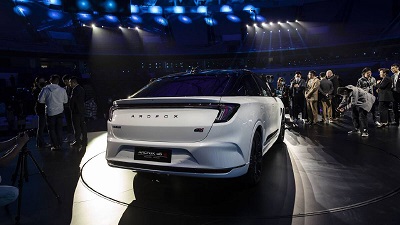
BAIC Group’sArcfox Alpha-S electric sedan, manufactured by BAIC Group’s BAIC Motor Electric Vehicle Co. and equipped with Huawei Technologies Co.’s HI smart car platform, during an unveiling event in Shanghai on April 17, 2021. MUST CREDIT: Bloomberg photo by Qilai Shen.

Building automobiles requires factories, equipment and an army of people to design and assemble large hunks of steel, plastic and glass. That all but guarantees slimmer profits. The world’s top 10 carmakers had an operating margin of just 5.2% in 2020, a fraction of the 34% enjoyed by the tech industry’s leaders, data compiled by Bloomberg show.

But for Apple and other behemoths that are diving into self-driving tech or have grand plans for their own cars, that push isn’t just about breaking into a new market – it’s about defending valuable turf.

“Why are tech companies pushing into autonomous driving? Because they can, and because they have to,” said Chris Gerdes, co-director of the Center for Automotive Research at Stanford University. “There are business models that people aren’t aware of.”

A market projected to top $2 trillion by 2030 is hard to ignore. By then, more than 58 million vehicles globally are expected to be driving themselves. And Big Tech has the means – from artificial intelligence and massive data, to chipmaking and engineering – to disrupt this century-old industry.

What’s at stake, essentially, is something even more valuable than profitability: the last unclaimed corner of consumers’ attention during their waking hours.

The amount of time people spend in cars, especially in the U.S., is significant. Americans were behind the wheel for 307.8 hours in 2016, or around six hours a week, according to the latest available data by the American Automobile Association.

That’s a fair chunk of someone’s life not spent using apps on an iPhone, searching on Google or scrolling mindlessly through Instagram. Any company that’s able to free up that time in a meaningful way will also have a good chance of capturing it.

The world’s inexorable shift toward intelligent cars that are better for the environment is impossible to miss. If governments haven’t already declared plans to be carbon neutral by, in some cases, the end of this decade, there’s plenty of research that shows combustion-engine cars are going the way of the dinosaurs.

BloombergNEF’s annual Electric Vehicle Outlook, published earlier this month, sees global oil demand from all road transport peaking in just six years, assuming no new policy measures are introduced. By 2025, EVs hit 10% of global passenger vehicle sales, rising to 28% in 2030 and 58% in 2040. Eventually, autonomous vehicles will reshape automotive and freight markets entirely.

Against that backdrop, it’s unsurprising that after years of chipping away at self-driving cars, tech companies have been stepping up their activities and investments in earnest.

Autonomous cars are only as good as the human drivers they learn from – so the people who teach these systems need to be excellent drivers themselves.

Over the past several months, Apple has prioritized plans for the “Apple Car” after previously focusing on making an autonomous driving system, Bloomberg has reported. That’s fueled intense speculation over which automakers and suppliers the company behind the iPhone may partner with to realize its vision. While Apple has recently lost multiple top managers on the project, it still has hundreds of engineers in its larger car group.

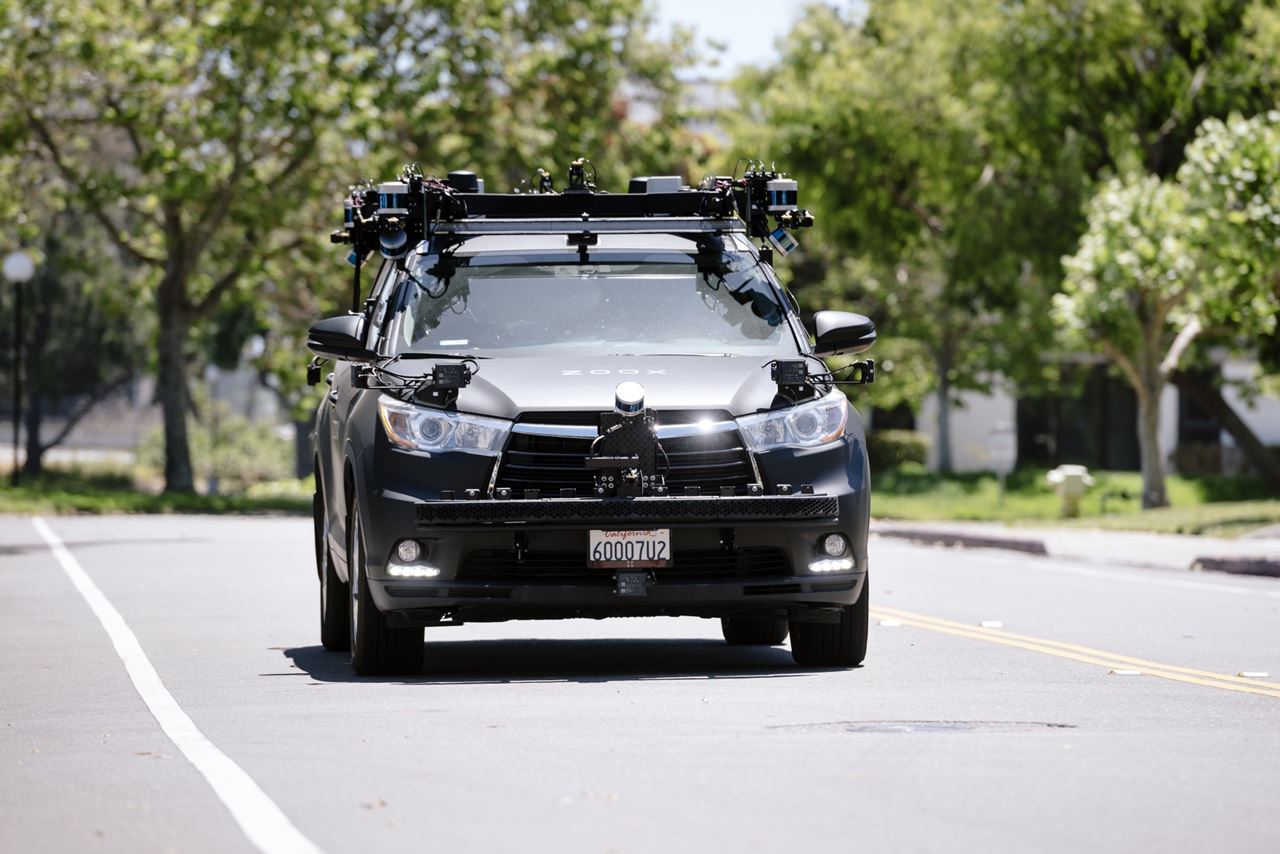
A Zoox self-driving car is operated outside the company's headquarters in Foster City, Calif., on May 27, 2020. MUST CREDIT: Bloomberg photo by Michael Short.

There’s also Waymo, which is in talks to raise as much as $4 billion to accelerate its efforts. Founded in 2009, the business that was formerly Google’s self-driving car project was the first to have a fully autonomous ride on public roads. It became an independent company in 2017 under Google parent Alphabet Inc., launched an autonomous ride-hailing service in Phoenix in 2018 and last year began testing self-driving trucks in New Mexico and Texas.

Microsoft, too, is backing several autonomous initiatives, partnering with Volkswagen on self-driving car software, possibly with a view to creating offices-on-the-go.

Amazon.com, meanwhile, has thrown its weight behind Rivian Automotive Inc., which is making electric trucks, and last year bought driverless startup Zoox Inc. It may look to include autonomous rides as part of its Prime membership program.

“Each of these companies, including Facebook, want to be a part of or even control and dominate, every part of citizens’ lives,” said Professor Raj Rajkumar, who leads the robotics institute at Carnegie Mellon University. “From their business point of view, if you don’t, somebody else can and probably will, and eventually your current domain of influence fades away.”

ADVERTISEMENT

Although Apple has dominated phones, tablets and smartwatches and put up a decent fight over computers for the past few decades, it’s been a laggard in the artificial intelligence, voice and smart-speaker spaces, areas now led by Google and Amazon.

The company would benefit from the release of a breakthrough new product. While it’s had successes with the watch, released in 2015, and services, such as Apple TV, Apple Arcade and Apple Music, which are now a major new source of revenue, nothing has come close to the success of the iPhone, which has redefined entire industries and become Apple’s most lucrative product since its 2007 release.

At Google, executives have long framed investments in autonomous cars, along with moonshots in biotech and drones, as risks that venture capital and less deep-pocketed firms don’t, or won’t, take. Waymo has discussed potential business models around taxi services and long-haul logistics.

The onslaught has automotive incumbents girding for battle. Industry titans such as Ford, General Motors and Toyota have stepped up their own rival efforts in self-driving. The Japanese automaker is building an entire city around autonomous driving at the base of Mount Fuji while South Korea’s Hyundai Motor Co. is committing $7.4 billion to make EVs in the U.S. and develop unmanned flying taxis.

In China, it’s the biggest tech companies throwing their hats in the ring. Giants from Huawei Technologies Co. to Baidu Inc. have pledged to plow almost $19 billion into electric and self-driving vehicle ventures this year alone. Smartphone giant Xiaomi Corp. and even Apple’s Taiwanese manufacturing partner Foxconn have joined the fray, forging tie-ups and unveiling their own carmaking plans.

ADVERTISEMENT

Automakers defending their turf is understandable but Takehito Sumikawa, a partner at McKinsey & Co.’s Tokyo office who advises on future mobility, says it’s a “natural extension” for tech providers to enter the autonomous driving space. “They’re betting they can do a better job at disrupting the industry.”

The existing businesses of Amazon, Apple and Google already require them to become proficient at AI, handling massive amounts of data and designing complex systems. Essentially, they’ve made the upfront investment in core technologies needed to design and build driverless cars, and they now have legions of engineers eager to solve more complex problems, not to mention an appetite for disruption.

But perhaps one of the clearest examples of a tech company with the ability to change up its own stomping ground is Amazon. The web retailer would benefit hugely from the lower costs of delivering packages to homes using cars that drive themselves.

Amazon also has a habit of transforming its own tools into businesses that can be sold to a wider swath of customers, much like it did with cloud computing, which was originally created to support the company’s online retail operations. Having morphed it into a computing and data-storage platform used by Netflix Inc., the U.S. government and others, Amazon Web Services is now a $45.4 billion enterprise.

While the coronavirus pandemic put a temporary damper on consumers’ appetite for new cars, demand has roared back. A semiconductor shortage means many traditional players can’t keep production lines moving fast enough. This year alone, the global automotive market is projected to rebound by 9.7% to $2.7 trillion, according to IBIS World.

“Even for companies like Apple and Google, this is a massive market,” Rajkumar said. “CFOs and CEOs literally drool, since first movers are likely to have a major edge. Each of these companies wants to be the predator, and not become the prey.”

Published : June 28, 2021

By : Syndication Washington Post, Bloomberg · Reed Stevenson, Mark Gurman

Renault nears battery-supply deals for French electric-car hub #SootinClaimon.Com

#SootinClaimon.Com : ขอบคุณแหล่งข้อมูล : หนังสือพิมพ์ The Nation.

https://www.nationthailand.com/tech/40002435

Renault nears battery-supply deals for French electric-car hub


Renault is closing in on a pact with a unit of Chinas Envision Group to produce batteries for its future electric-vehicle manufacturing hub in northern France, according to people familiar with the plan.

Renault nears battery-supply deals for French electric-car hub

The partnership with Envision AESC is part of a broader plan, to be outlined by President Emmanuel Macron on Monday, that could see Renault also take a stake in French battery start-up Verkor, said the people, who asked not to be named before the information is made public.

Renault is also still talking to ACC – a venture of rival Stellantis and TotalEnergies – about a potential third battery deal, the people said.

Representatives for Renault, Envision, Verkor and ACC declined to comment.

Renault’s jostling for batteries adds to evidence that the race among European automakers to ensure adequate supplies for their electric cars is gathering pace. Porsche and Volvo Car Group on Monday announced plans to produce batteries, and Peugeot maker Stellantis will update investors on its EV strategy next month. Volkswagen made a massive bid for the pole position in March when it unveiled a multi-billion-euro plan for six European battery factories.

Envision AESC’s factory would be located at Douai, where Renault is developing a hub to make EVs, including the future Renault 5 model. It will have a capacity of 43 gigawatt-hours by the end of the decade, with just over half earmarked for the French carmaker, according to a building permit application.

The cost of the project could reach as much as $2.9 billion depending on its timeline, according to James Frith, an analyst at BloombergNEF.

Renault’s decision to buy batteries from Japan-based Envision AESC can be traced to its ties with Nissan Motor Co., which sold a controlling stake in its AESC battery operations to Envision in 2018 but retained a 20% holding.

The project would represent welcome foreign investment into France’s beleaguered industrial sector and come amid a European Union push to increase the region’s battery output, a sector that has long been dominated by China’s Contemporary Amperex Technology and South Korea’s LG Energy Solution.

The Douai vehicle assembly plant is one of three sites Renault plans to combine and turn into an EV hub capable of churning out some 400,000 cars a year.

The so-called ElectriCity is a key part of Chief Executive Officer Luca de Meo’s strategy to turn around Renault. With the French state as its most powerful shareholder, Renault has come under pressure to preserve jobs and keep EV technology in the country.

ADVERTISEMENT

The carmaker currently buys batteries from LG Energy Solution in Poland for its Zoe model, an arrangement that’s expected to carry over to the upcoming Megane EV lineup planned for next year.

Published : June 25, 2021

By : Syndication Washington Post, Bloomberg · Tara Patel

Five things to know about Microsofts Windows 11 #SootinClaimon.Com

#SootinClaimon.Com : ขอบคุณแหล่งข้อมูล : หนังสือพิมพ์ The Nation.

https://www.nationthailand.com/tech/40002432

Five things to know about Microsofts Windows 11


Microsoft just moved your Windows Start button. But dont worry, you can move it back.

Five things to know about Microsofts Windows 11

The redesign of the iconic Windows menu, now in the center of the screen rather than the corner, is just one of a slew of changes that Microsoft announced Thursday for the next version of the software that runs your home PC or the laptop you’ve been assigned to use at work or school.

With Windows 11, which will arrive later this year, Microsoft is giving its old-faithful operating system a facelift and trying to make it more relevant to a post-pandemic world where we work and communicate differently. Microsoft’s video chat service Teams is built right in – and, in a first, you’ll also be able to use some of the Android apps previously just available on phones and tablets.

This upgrade, the first new flagship version of Windows in six years, is a sign that Microsoft is on the defensive. It is still by far the most popular laptop and desktop computer software, with Windows 10 used by some 1.3 billion people. But in recent years, it lost market share to computers running Google’s Internet-focused Chrome OS – particularly in schools – and even to Macs made by longtime rival Apple.

In the first quarter of this year, Windows dropped to 75% of the global market for computers from more than 80% in 2020, says IDC analyst Linn Huang. The decline is partly due to covid-19 supply constraints on Windows PCs, but it also shows Windows has a long-term challenge in appealing to consumers beyond corporate IT systems. In the past decade, smartphones have become the most important devices in most people’s lives – and Windows doesn’t run on any of them.

Windows 11 has been tweaked to work better on touch-screen computers that double as mobile tablets. And under the hood, Windows 11 will also run on computers with a kind of processor known as ARM, seen on mobile devices and used in Apple’s latest computers, which are more power-efficient and get less hot.

As much as Microsoft wants customers to love Windows, a large contingent likely isn’t interested in new bells and whistles; they just don’t want Microsoft to break what’s already working.

Microsoft squeezed a lot into a 45-minute online launch presentation filled with hyperbole about making Windows feel like “home” and partly derailed by streaming challenges. So we took a step back and picked the five most important things to know about Windows 11.

1. Move over Start menu.

It’s the end of an era: The Start menu is no longer at the bottom left of your PC desktop.

The new Start menu sits at the bottom middle and allows you to quickly see pinned apps, as well as a few recommended apps based on what you’ve used before. (Not to worry though – if you don’t like it in the middle, there’s a setting that lets you move it back to the corner.)

Windows 11 also comes with new, if basic, productivity shortcuts. If you tend to have multiple apps and windows going at once, you can hover over any window to reveal different options for organizing your screen. Maybe it’s two windows side by side, or one big window with a few smaller ones floating next to it. Click on the configuration you want, and your windows will “snap” into that shape.

People who want to jump between entirely different desktops can do that, too. Not only can you have different desktops for home, school and work, but they’ll also follow you around to whatever Windows 11 computer you’re using. Your different computers can sync up over the cloud: Leave work, open your laptop at home, and your screen should be just how you left it – windows, tabs and all. The Start menu even saves your most recent files, so you don’t have to click around to reopen them.

2. The Windows app store gets Android apps.

For the first time, you can get Android apps on your Windows PC, which is a big plus if your favorite apps have clunky Web versions like Instagram or no Web version at all, like Google Home. Now, Android apps will be downloadable in the Windows 11 app store, though you’ll have to jump through a few hoops. The Android apps actually come through a partnership with the Amazon app store (used by Amazon’s own Fire tablet devices), which you’ll have to log into separately with an Amazon account.

(Amazon CEO Jeff Bezos owns The Washington Post.)

It remains an open question how much people want Android apps on a PC. Past attempts to port Android apps into Windows have been technically tricky and largely unpopular. Partnering with Amazon to deliver Android apps could help – although Microsoft’s last collaboration with Amazon, when it combined its Cortana voice assistant with Amazon’s Alexa, was a flop.

The security implications of Android apps on Windows 11 also aren’t clear. Can Microsoft catch and stop any malware that might arrive hidden inside Android apps? Microsoft said it couldn’t give any answers yet, since the companies are just beginning their partnership.

Microsoft is also trying to bolster its Windows app store by offering developers financial incentives not available on Apple’s rival app store. Apple has alienated developers by taking large cuts of the revenue from in-app purchases; Microsoft announced it will give developers 100% of their earnings in many situations.

3. Windows gets live-updating widgets – and its own news feed.

Windows 11 also introduces a whole new screen of info. A panel of so-called widgets, which you access by swiping in from the left edge, makes Windows feel a bit more like a phone or tablet – and will offer up all sorts of new distractions. Widgets are like apps that include live updates, like weather, stocks and your calendar. You can pick the ones you want, and Microsoft says eventually it hopes to include more from content creators.

(Longtime Windows PC owners may remember an earlier version of these called Microsoft Gadgets in the earlier, little-loved version called Windows Vista.)

The new widgets screen will also include its own feed of news articles, kind of like Facebook’s algorithmically generated news feed. Microsoft says it will choose the news it presents using artificial intelligence that learns your preferences from what kinds of articles you interact with most often in the widget.

4. Teams is built in for video calls and chats.

For many of us, the must-have communication apps during the pandemic were Zoom and Slack. But Microsoft also made inroads with its Teams service, which combines video conferencing and chat into one.

Now Microsoft is integrating Teams right inside Windows 11. You’ll be able to contact and start chats with people directly from the Start menu. If those people aren’t on Teams, you can message them over SMS instead, which sounds . . . confusing? We’ll reserve judgment until we see how it works.

It’s a bold move for Microsoft. First, Teams might cause some confusion for people who have grown accustomed to Skype, a different video chat and communication app also owned (and promoted) by Microsoft. Second, Microsoft has also been accused by Slack of using Teams for corporate bullying. Will Slack get the same ability as Teams to integrate directly into Windows 11?

“We absolutely are going to run Slack great on Windows 11,” Microsoft’s corporate vice president, Yusuf Mehdi, told us.

5. You can download Windows 11 as a free update later this year.

ADVERTISEMENT

Think of it as Santa’s little upgrade. Microsoft was a little squishy on specifics, but a finished version of Windows 11 should be available around the 2021 holiday season. It will be a free update to owners of Windows 10 PCs – at least the newer ones that can run it.

How will you know if your PC is fast enough? There are some hardware requirements, such as a newer processor, four gigabytes of RAM and at least 64 gigabytes of storage. Microsoft has a PC-checker tool you can use.

And the good news is Windows 11 is built on the same basic code base as Windows 10, so older apps and drivers mostly shouldn’t break (like with the notorious Windows Vista).

Finally, what happens if you don’t upgrade? Microsoft says it will continue to support Windows 10 until Oct. 14, 2025.

Published : June 25, 2021

By : The Washington Post · Geoffrey A. Fowler, Tatum Hunter

Worlds top Bitcoin mining-rig maker halts sales as clients flee #SootinClaimon.Com

#SootinClaimon.Com : ขอบคุณแหล่งข้อมูล : หนังสือพิมพ์ The Nation.

https://www.nationthailand.com/tech/40002393

Worlds top Bitcoin mining-rig maker halts sales as clients flee


Bitmain Technologies has suspended sales of machines for spot delivery globally, aiming to prop up local prices after crypto miners fleeing Beijings crackdown dumped used mining rigs on the market.

Worlds top Bitcoin mining-rig maker halts sales as clients flee

The world’s biggest maker of Bitcoin machines told the local mining community Wednesday it has stopped selling new equipment after prices for top-tier rigs plunged by about 75% since April. By postponing sales, it could help miners exiting the industry get better prices for their machines. Bitmain could also benefit if the reduced supply buoys prices over the longer term for new machines.

The firm said it will continue to sell gear for future delivery of devices used to mine smaller altcoins. A company spokesman confirmed the decision, which was reported earlier by local blogs, without saying when business will resume.

In May, China’s State Council — its cabinet — called for a renewed crackdown on Bitcoin trading and mining activities. Local governments in places from northern Inner Mongolia to hydro-rich Sichuan acted quickly to sever power for mining facilities. The unprecedented crackdown is spurring more major miners to uproot or abandon their operations, a growing exodus that’s rocking cryptocurrencies globally while flooding the domestic market with cheap machines. The Bitcoin network’s computer power has suffered a plunge in recent weeks amid the disruption.

On the second-hand market, top-tier mining machines developed by companies including Bitmain and rival Whatsminer are now sold at around 150 yuan ($23) per THash/second — the reference unit for their computing power — down from 600 yuan in April when bitcoin hit an all-time high of $64,870, according to Arthur Li, founder of Bitmain-backed mining startup Sai Technology.Last week, Bitmain hosted a closed-door event with hundreds of miner clients at a Chengdu Hotel. The firm pledged to serve as a matchmaker to help miners hook up with data centers in countries like the U.S. and Kazakhstan.

Canaan Inc., a much smaller Bitmain competitor, said Wednesday it would start to mine Bitcoin by itself as a way to optimize revenue and strengthen inventory management.

ADVERTISEMENT

Published : June 24, 2021

By : Syndication Washington Post, Bloomberg · Zheping Huang

Facebooks Oculus gets swift pushback against VR advertising #SootinClaimon.Com

#SootinClaimon.Com : ขอบคุณแหล่งข้อมูล : หนังสือพิมพ์ The Nation.

https://www.nationthailand.com/tech/40002334

Facebooks Oculus gets swift pushback against VR advertising


Facebook is already getting blowback for its plan to place advertisements in games on its Oculus virtual reality headset.

Facebooks Oculus gets swift pushback against VR advertising

Blaston, the futuristic shooter game by Resolution Games, has pulled out of the test days after Facebook announced it, citing complaints. Blaston was the only game Facebook confirmed had agreed to its test, though it said other developers were on board.

“After listening to player feedback, we realize that Blaston isn’t the best fit for this type of advertising test,” the gamemaker said in a statement on Twitter. “Therefore, we no longer plan to implement the test.”

Blaston followed up by saying it might apply a “small, temporary” Facebook ads test to a free game called Bait! but didn’t commit to doing so. Facebook has been pushing ads in virtual reality in an attempt to generate more revenue from its costly-to-produce hardware line. Its headsets are more affordable in order to drive swifter adoption.

A Facebook spokesperson said in a statement that creating new revenue streams for developers will help the company “unlock new types of content on the Oculus platform and offer products at consumer-friendly prices.”

Published : June 23, 2021

By : Syndication Washington Post, Bloomberg · Naomi Nix