Chula’s “smart hospital beds” innovation can help prevent falls
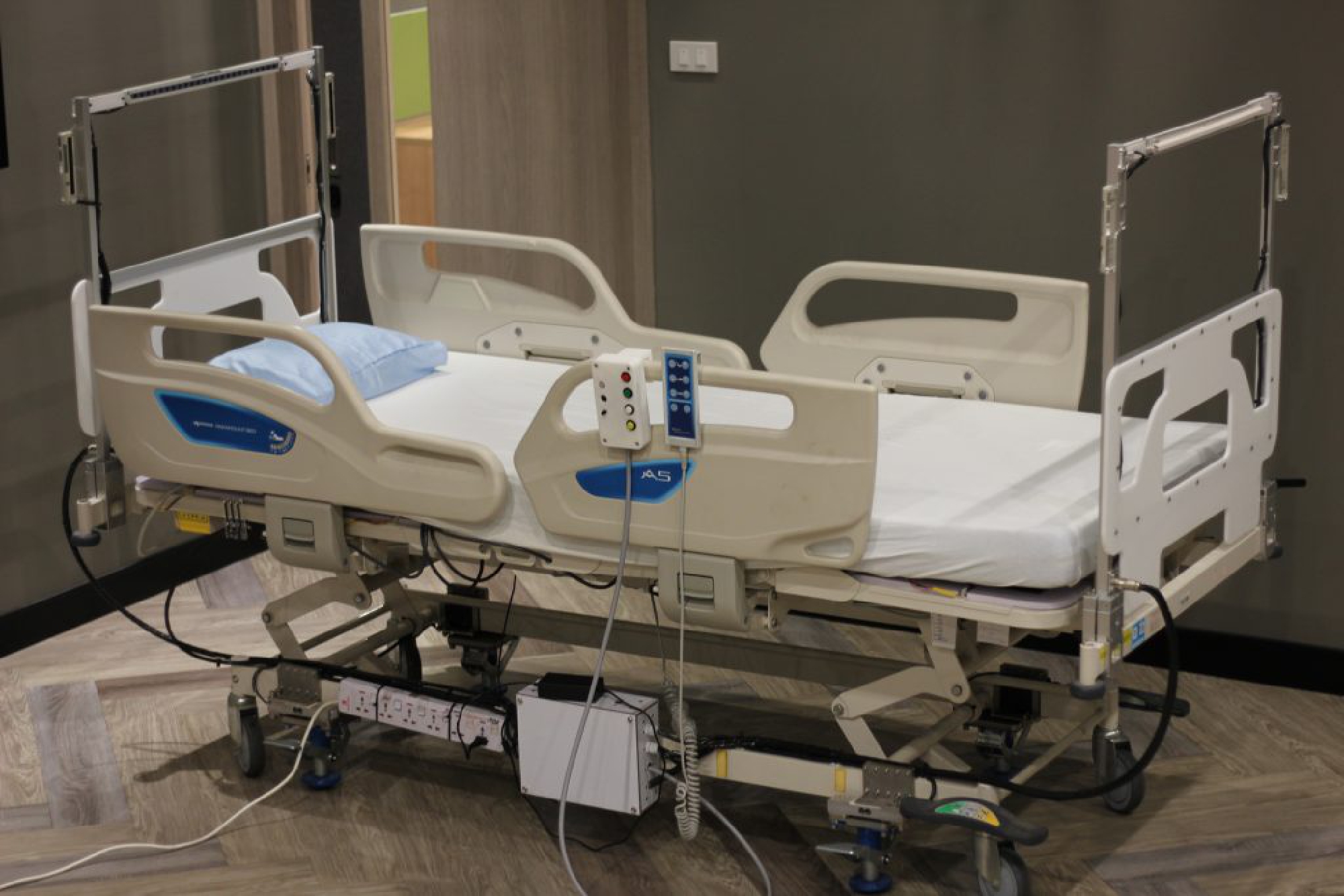
5G smart beds, a prototype innovation to prevent elderly patients from falls in both hospitals and homes was showcased jointly by Chula Engineering, True Group, and King Chulalongkorn Memorial Hospital and Thai Red Cross Society.
Falls are the most common accidents involving the elderly and hospital beds, posing serious problems for their children and caregivers. This problem is especially serious in elderly patients with limited mobility who do not have caregivers at their bedside at all times.
Chula Engineering, and King Chulalongkorn Memorial Hospital and Thai Red Cross Society have jointly created “smart hospital beds” to reduce the risk of accidents for the elderly, they said.
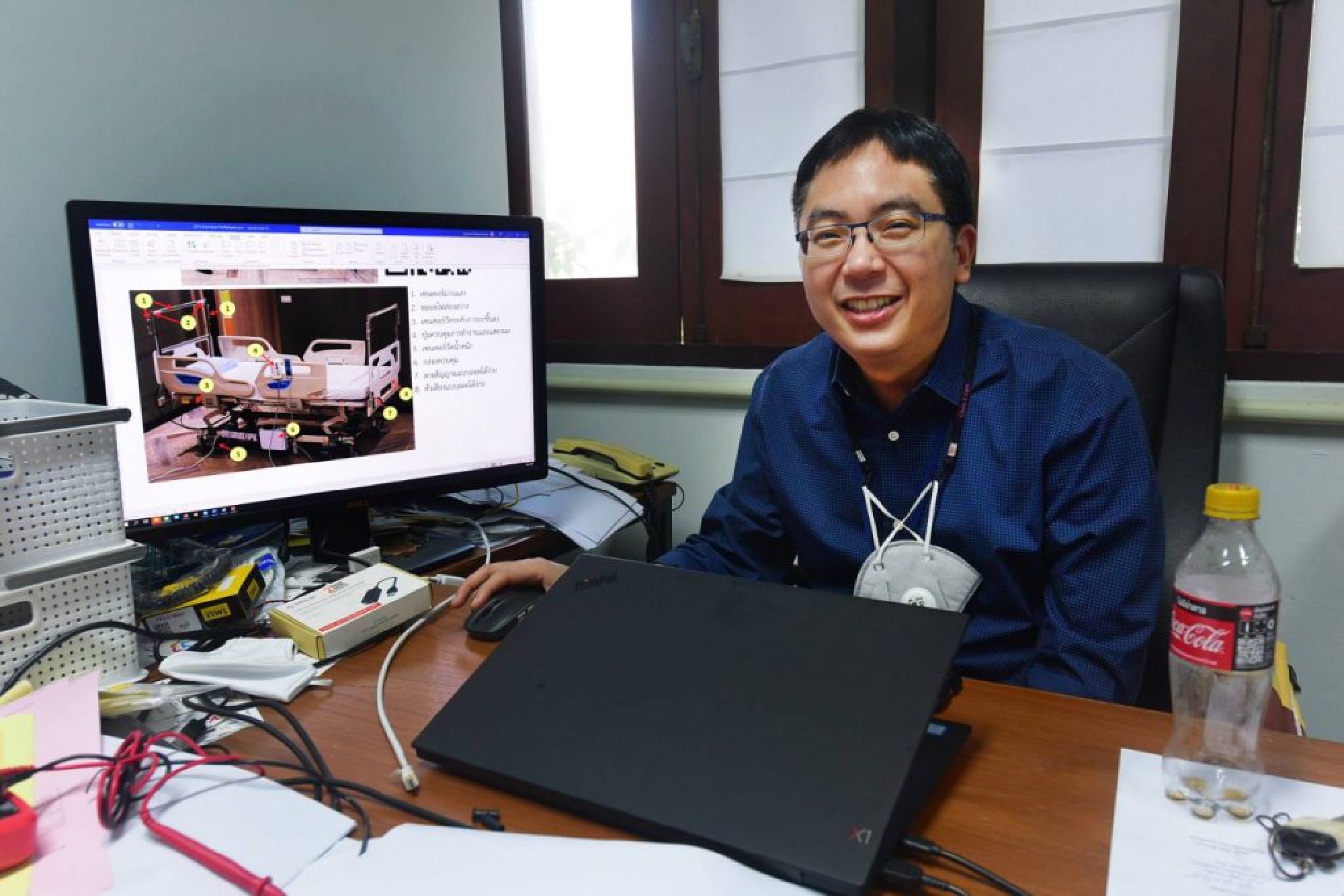
“Current hospital beds are pressure-pad type consisting of foam and spring, and can only sense the presence of the patients on the mattresses. The alarm only sounds after the patients have fallen off,” Asst Prof Dr Gridsada Phanomchoeng, Department of Mechanical Engineering, Chulalongkorn University said while introducing the “smart beds”.
Chula’s “smart hospital beds” innovation can help prevent falls
“The keys to the smart beds are their 5G sensors monitoring patients’ movements on the beds while trying to sit or get off the beds. Warning signals will sound, so caregivers can come to their aid right away.”
Gridsada, who heads the research team, elaborated that the smart beds are equipped with strain gauge sensors to monitor the pressure points and patients’ weight. These sensors would monitor the positions of the patients to determine if they are at risk of falling off. Light curtain sensors accurately and instantaneously monitor patients’ movements while headboard-positioning adjustment sensors monitor their gestures.
“All the sensors are connected and controlled by 5G technology. Processed data is sent to the cloud that is connected to the monitoring centre and mobile phones of doctors and nurses, so they can keep watch on patients’ movements and positions in real-time, and can provide immediate assistance if need be,” he said.
Grisada added that these devices were designed to be adaptable to a wide range of hospital beds. They are also easy to disassemble and install while being very affordable.
Currently, the Smart Hospital Bed innovation is under the patent registration process with the Intellectual Property Institute. Chula Engineering and True Group are delivering these smart beds to King Chulalongkorn Memorial Hospital for field testing. In the future, they will be used in all hospital wards.
Facebook now has to ask permission to track your iPhone. Heres how to stop it.
If you havent already, youll see a surprising message pop up on your iPhone from Facebook in the next few weeks: Do you give it permission to track you?
To make your iPhone more private, tap “Ask App not to Track.”
Do not tap “Allow,” unless you love creepy online ads.
To prevent this same pop-up from appearing for lots of different apps – and to limit some of the other digital tracking in your life – you also should change two settings right now. I have instructions below.
What’s going on? With a software update that arrived this week called iOS 14.5 and iPadOS 14.5, Apple is finally forcing apps to come clean about a kind of surveillance they’ve been conducting on us for the past decade. Behind the scenes, apps can probe your phone for personal information that helps them target you with ads or even sell data about you to others. Now marketers and data brokers can’t access a valuable way to identify your phone unless you explicitly say it’s OK.
Some apps, such as The Sims, Venmo and Shake Shack have been seeking permission to track for a few weeks now. Facebook and its sister app Instagram began asking permission on Monday and the company says it will roll out the pop up – and a screen arguing why you should allow it to track – over the next few weeks.
Facebook and other apps that make money by collecting our data and showing us hyper-targeted ads aren’t happy about having to ask permission. Mark Zuckerberg and friends have deluded themselves into thinking people enjoy feeling as though Facebook is eavesdropping on their conversations. (It doesn’t really need to because it’s already spying on our apps and websites.)
I think Apple should have gone even further, making “Don’t track me” the default for everyone. But even if the new pop-ups are more work and more confusing than they ought to be, this is still a win for our privacy.
– What tracking really means
Apps gobble up all sorts of information about you, all the time – as I’ve written, even while you sleep. Now the software that runs your iPhone and iPad is putting up some roadblocks to collecting one particularly valuable piece of data: a way to identify your device.
Picture it: You’re walking down the street, and at every business you enter you leave a little sticky note saying you’ve been there. Someone who spotted enough sticky notes could connect the dots about who you are. Flower shop, jewelry store and tux rental? Someone is about to get married.
The app equivalent of that sticky note is a code hidden in your iPhone called the Identifier for Advertisers, or IDFA. Although this ID doesn’t contain your name, it does look the same to every app. Many apps report your ID back to companies including Facebook and Google, allowing the advertising firms to connect the dots about what you do on your phone.
With iOS 14.5, an app simply can’t access your phone’s IDFA unless you tell the operating system it’s OK. And if you ask not to be tracked, apps also aren’t supposed to pass other kinds of personal information to marketing companies and data brokers. That includes your email address, location and other sneaky ways to identify your phone. Apple says it’s going to police that policy through its App Store review process. We’ll have to see how well Apple does this. The company has begun requiring app makers to fill out what essentially are privacy nutrition labels to explain how they gather your data – but in my tests these aren’t necessarily always useful or even accurate.
Facebook says by tapping “Ask App not to Track,” you are hurting small businesses and free apps that depend on its targeted advertising. In addition to targeting your interests, tracking also helps advertisers learn whether their ads work.
I’ve listened to Facebook’s argument, and I’m not buying it. Nobody but you should know what you do on your phone. Aside from being invasive, this data can be used to manipulate us as consumers, citizens and voters.
Small businesses managed to thrive and reach customers before this kind of invasive tracking. Facebook already has more than enough information about us to show us relevant ads based on what we intentionally post, where we check in, and who our friends are. It should never have had the right to spy on what we do outside of Facebook, too.
The Washington Post is updating its apps for iOS 14.5 so that it no longer collects or uses the IDFA, says company spokeswoman Shani George.
Facebook is right about one point: The decision to fight app tracking now is pretty self-serving on the part of Apple. The iPhone maker has a financial interest to push apps to make money from subscriptions rather than advertising, because it gets to take a percentage cut of any in-app purchases. But at least Apple is finally responding to a privacy problem its own design of the iPhone helped create.
– How to stop tracking
You’ll have to take action to be protected. When an app prompts you, tap the button labeled “Ask App not to Track.”
Unfortunately, the muscle memory in our fingers has been trained to tap “Allow” on app prompts. When app data company AppsFlyer recently studied how people responded to the privacy pop-up on 300 kinds of apps that launched it early, 41 percent of the time people tapped “allow” to permit the tracking.
If you messed up and accidentally gave an app permission to track, you can make a new choice one app at a time under Settings, then Privacy, then Tracking.
If you have more than one Apple device, such as an iPad, you’ll have to say no on each device.
If an app isn’t asking you for permission to track, that means either the app has gotten out of the tracking business, or the app’s maker hasn’t posted an update yet. Until the app updates and asks for permission, iOS 14.5 won’t allow it to access your phone’s ad-tracking identifier, the IDFA.
– Also do this
Here’s an even better idea: You can adjust one setting that tells all apps not to track you, so you won’t keep being prompted by different apps. Go to Settings, then Privacy, then Tracking, then make sure “Allow Apps to Request to Track” is switched to off.
The virtual button should be on the left, and you shouldn’t see any green. Yes, this is extra confusing.
Now, a warning: Just because you say an app can’t track you for marketing purposes, you could still be exposing sensitive information to them. So think extra hard when an app asks for your location, contacts or camera.
– Facebook members should change this setting, too
While we’re adjusting settings, there’s one more I highly recommend for Facebook members. Tell the social network to stop using your “off-Facebook activity.”
Here’s why: Even after you tell the Facebook app not to track your iPhone, the social network still will try to collect lots of information about what you do elsewhere – such as on your laptop or when you make a purchase at a store. Although Facebook has done this for years, in 2020 it gave members the ability at least to ask it to stop using this information.
Of course Facebook really buried this setting, too. In the Facebook app, tap on the three lines in the right bottom corner, then scroll down and tap on “Settings & Privacy,” then tap on “Privacy Shortcuts.” Then scroll down to and tap on “View” or clear your off-Facebook activity.
You’ll see a creepy page that shows you all the apps, websites and other businesses where Facebook has been tracking you. You can tap “Clear History” once (like clearing your history in a Web browser). Or even better, tap “More Options,” and then “Manage Future Activity,” and then toggle “Future Off-Facebook Activity” to off.
App MorChana playing critical role in Covid-19 contact tracing
Since the beginning of this year the contact-tracing application, MorChana (Doctors Win), has alerted 46,272 people who were at risk of Covid-19 infection, the Digital Economy and Society Ministry said on Sunday.
The ministry’s permanent secretary, Atcharin Pattanapanchai, said the application is playing an important role in tracking and investigating Covid-19.
She added that with GPS and Bluetooth, the application could inform people to beware of entering areas at risk of Covid-19 infection and enable them to see disease investigation officers as soon as possible.
“Therefore, we would like to ask people to download the MorChana app to prevent risk of Covid-19 infection,” she said.
“We are ready to expand space on cloud storage to support more users, while the Department of Disease Control alone can view user information, so people do not have to worry about safety of personal information.”
She added that the MorChana app was dowloaded 9.84 million times with over 7 million users nationwide.
“The five provinces with the highest MorChana app users are Bangkok, Chonburi, Samut Prakan, Nonthaburi and Pathum Thani,” she added.
DTAC provides free Wi-Fi, boosts mobile network to support field hospitals
To support the fight against Covid-19, DTAC is deploying fixed wireless broadband service, dtac@Home, to offer Wi-Fi internet free of charge at several field hospitals in Thailand.
Total Access Communication Plc (DTAC) chief executive officer Sharad Mehrotra attended a meeting with Digital Economy and Society (DES) Minister Chaiwut Thanakhamanusorn and Dr Supaporn Kornluck, representing the Centre for Covid-19 Situation Administration (CCSA), at the Ministry of Digital Economy and Society to discuss the response plan for Covid-19 situation.
DTAC has committed dtac@home Wi-Fi solutions to be distributed and installed at selected field hospitals.
This is aimed at facilitating the work of health professionals and keeping the patients connected to what matters most to them.
DTAC said it has been boosting its mobile network to support high-traffic demand and ensure uninterrupted connectivity in and around every field hospital from their first day of operation.
Chaiwut said: “The ministry realises the important role of connectivity in this challenging time, especially those who are in need — health workers at the frontline of service and patients at field hospitals.
Recently, mobile operators have joined forces with the state-owned National Telecom to facilitate connectivity services via Wi-Fi, IP Phone and CCTV cameras.”
Dr. Supaporn, who is deputy director of the Medical Service Department, said: “Close contact tracing is a key strategy for interrupting chains of transmission of Covid-19-associated symptoms, which involve body temperature, blood pressure and blood oxygen level measurements.
“While social distancing is being practised strictly, connectivity plays a vital role in this humanitarian mission, keeping health workers safe to relief patients from suffering at field hospitals in particular.
In addition, it also helps them to connect with their loved ones, improving their personal connection in this challenging time.”
Mehrotra said: “As the pandemic lingers on and continues to impact all parts of society, the best way we can support is by ensuring that people on the frontline, including patients, can remain connected to what matters most to them. We are committed to continuously providing relevant support to fight against this crisis in collaboration with dedicated partners.”
EU funds international mycobiomics project involving Thailands Biotec
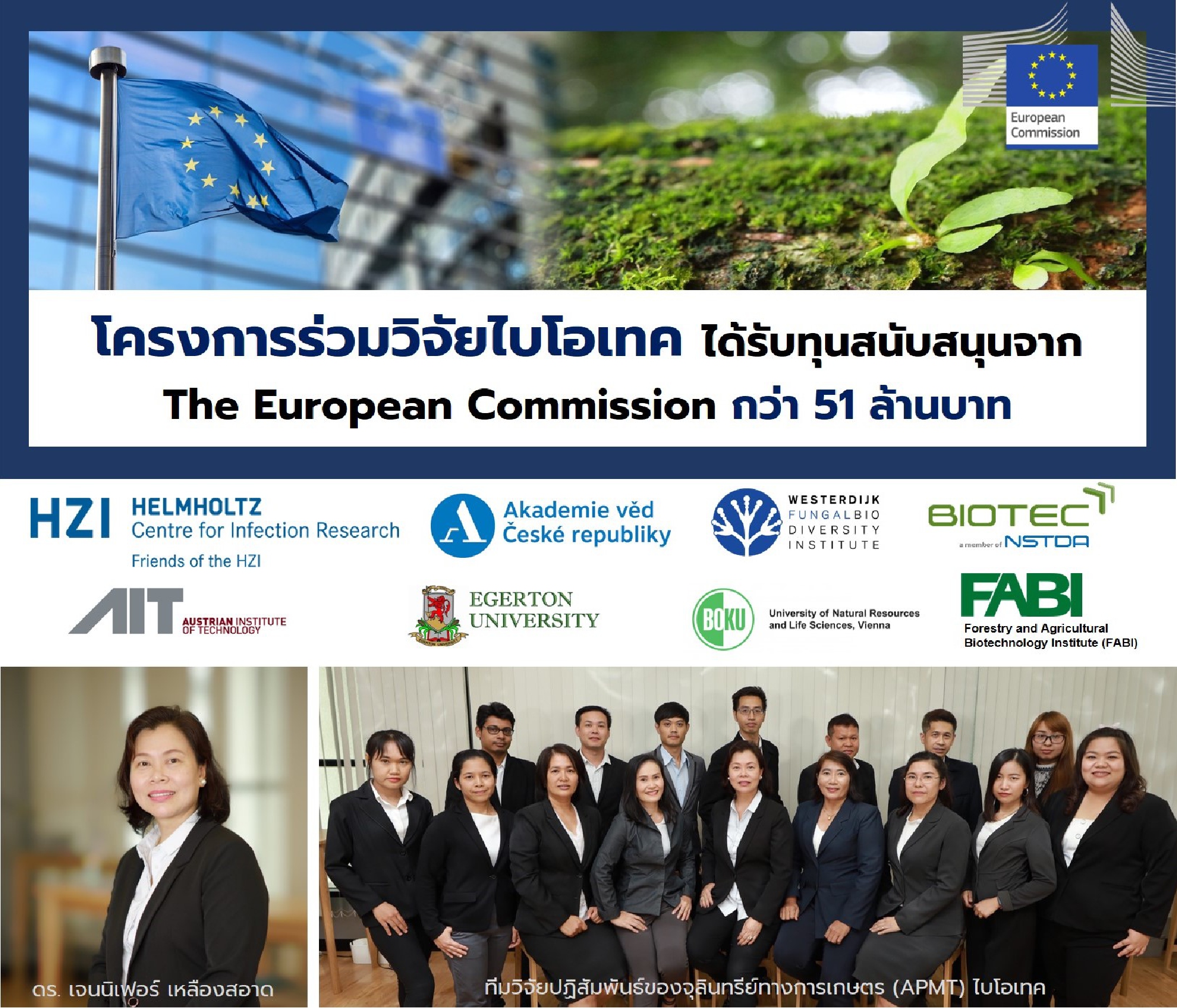
The European Commission has awarded Thailand’s National Centre for Genetic Engineering and Biotechnology (Biotec) €1.37 million (Bt51.5 million) for interdisciplinary research and transnational mobility in a mycobiomics project involving eight institutes from seven countries.
The project, to “exploit the mycobiota of Asia, Africa and Europe for beneficial metabolites and potential biocontrol agents using Omics techniques (mycobiomics)”, is led by Prof Marc Stadler of the Helmholtz Centre for Infection Research, Germany, in cooperation with Dr Jennifer Luangsa-ard, leader of the Plant Microbe Interaction Research Team, and research institutes from Europe and Africa.
Mycobiomics focuses on both basic and applied mycology to explore beneficial secondary metabolites for the development of antibiotics and eco-friendly alternatives to conventional pesticides through an international network of research organisations and staff exchange.
“Mycobiomics embarks upon our success of the H2020-MSCA-Rise project, the Golden Mycological Triangle, joining forces to exploit mycological biodiversity for novel anti-infectives and other beneficial metabolites [GoMyTri],” explained Dr Luangsa-ard, Thailand’s co-principle investigator.
Since 2014, GoMyTri has laid the groundwork for interdisciplinary collaboration among leading research institutes from Germany, the Netherlands and Thailand.
“Our previous collaborative research, transnational mobility and cross-sector training have resulted in several co-publications in high impact factor journals and the development of project management skills for project members,” she said.
Mycobiomics, as a result, continues to solidify the consortium and diversify know-how by involving prestigious research institutes and universities from Austria, the Czech Republic, Kenya and South Africa.
“We will implement Omics technologies to expand the focus of Mycobiomics research on fungal biodiversity and ecology, and potential applications of fungi in biotechnology by using genomics, molecular biology and transcriptomics to discover novel useful secondary metabolites and identify candidates for anti-infective drugs,” she elaborated.
Furthermore, mycobiomics aims to explore two distinctive fungal genera that are crucial in global agriculture – fusarium spp and trichoderma spp.
“The knowledge and technology shared within our consortium will enable scientists to tackle health and agricultural issues posed by detrimental fungi and how to combat them,” she added.
Mycobiomics is a four-year interdisciplinary project with eight research institutes and universities from seven countries:
* The Helmholtz Centre for Infection Research – Braunschweig, Germany
* Institute of Microbiology, Czech Academy of Sciences – Czech Republic
* Westerdijk Fungal Biodiversity Institute – The Netherlands
* University of Natural Resources and Life Sciences – Vienna, Austria
* Austrian Institute of Technology – Austria
* National Centre for Genetic Engineering and Biotechnology – Thailand
* Egerton University – Kenya
* Forestry and Agricultural Biotechnology Institute, University of Pretoria – South Africa.
Blue Origin tests rocket that may carry people someday
Apr 15. 2021
By Dalvin Brown The Washington Post
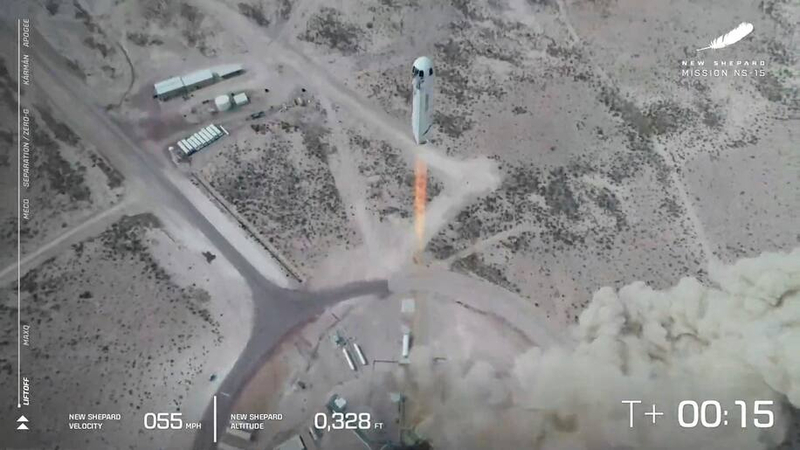
Blue Origin, the rocket venture founded by Amazon’s Jeff Bezos, executed what it called an “astronaut rehearsal” of its suborbital New Shepard rocket Wednesday, launching the craft to the edge of space after having employees board as if they were going to travel with it, then disembarking before liftoff.
It was the second time this year that the rocket had launched successfully as Blue Origin prepares for what it hopes one day will be missions carrying paying passengers. The demonstration took place at Blue Origin’s launch site in West Texas. (Bezos also owns The Washington Post.)
“As part of today’s rehearsals, our stand-in astronauts went through the exact same movements as future customers will experience on launch day,” the company said. The company live-streamed the event, including images of the capsule’s landing in a cloud of dust.
Before the launch, the “stand-in astronauts” climbed the launch tower, stepped into the crew chamber, buckled their harnesses and performed a communications check with the command center. They briefly closed the hatch, before exiting the crew quarters atop the 60-foot-tall rocket.
Instead of having actual people on board during the mission, Blue Origin sent up a test dummy named “Mannequin Skywalker.”
New Shepard took flight shortly before 1 p.m. Eastern time, shooting more than 60 miles into the air toward the Karman line, widely recognized as the point where space begins. The boosters then separated from the crew capsule and glided back to a soft vertical landing on Earth.
Detached from the engine system, the crew capsule hovered in microgravity before parachuting to the ground a few minutes later. Total trip time: just over 10 minutes.
Blue Origin’s stand-in astronauts were then driven to the crew chambers to rehearse recovery procedures such as opening the hatch and exiting the capsule.
The practice run dubbed “NS-15” was the company’s 15th test flight since 2015. The company promises the vehicle will carry passengers to space “soon.”
New Shepard is designed to carry six passengers and has large windows to allow the people aboard to see out. The vehicle is named for Alan Shepard, the first American to fly in space in 1961.
After decades as a government monopoly, human space flight may soon become a private venture. SpaceX is planning to carry the first all civilian crew to space, perhaps this year. Virgin Galactic, founded by British entrepreneur Richard Branson, also is working to conduct suborbital flights to the edge of space.
“There will be many players in this human endeavor to go to space to benefit Earth,” Blue Origin says on its website. “We will go about this step by step because it is an illusion that skipping steps gets us there faster. Slow is smooth, and smooth is fast.”
How high-tech robotic surfboards could change our understanding of the Gulf Stream
Apr 14. 2021Saildrones. MUST CREDIT: Saildrone Inc.
By The Washington Post · Matthew Cappucci
The Gulf Stream, the warm water current that weaves a serpentine path from the west Atlantic to the United Kingdom, routinely brews some of the most extreme winter storms in the northern hemisphere, disrupting shipping and marine commerce while affecting weather throughout the globe.
The Gulf Stream is also an enormous absorber of carbon dioxide, trapping greenhouse gases and preventing the pace of climate change from accelerating further.
Scientists are now hoping to gain a better understanding of what makes the Gulf Stream tick by launching “saildrones” – or surfboard-like “uncrewed surface vehicles” – that will ride the waters and transmit observations for up to a year. Developed by the Saildrone company in Alameda, Calif., they are used to survey weather and ocean observations and can cover thousands of square miles with no carbon footprint.
“We had a competition where we asked what people would do if they had a Saildrone for a month,” said Anne Miglarese, Saildrone’s program executive officer for impact science. Jaime Palter, a professor of oceanography at the University of Rhode Island, said she would “stick it in the Gulf Stream,” Miglarese recalled.
Saildrone was enthusiastic about the proposal. It loaned Palter a unit that was launched from Newport, R.I., on Jan. 30, 2019. Palter’s aim was to better understand how currents like the Gulf Stream fit into the global carbon cycle and how much of a net carbon sink, or absorber, they are. Humans routinely emit more than 35 billion tons of carbon dioxide annually, about a third of which is believed to immediately end up in the oceans.
Recent Saildrone missions in the Antarctic have shown that the ocean’s role in the carbon cycle may not be as well understood as once believed, which could result in significant changes in how scientists model and research the dynamics of climate change.
“We circumnavigated the Antarctic last year on another philanthropic mission focused on monitoring carbon,” Miglarese explained. “The scientific consensus [at the time] was that the Antarctic was a sink for carbon. Our science showed it was a source part of the year.”
According to the paper published with the data, “observing the Southern Ocean is challenging due to its size, remoteness, and harsh conditions,” a problem that is also inveterate to the North Atlantic during winter.
The challenges of collecting data from the Gulf Stream motivated Saildrone to work with partners to explore the current’s role in the sequestration and release of CO2. They’re partnering with NOAA, along with Palter, to analyze the findings once obtained.
“We need a more accurate global carbon budget, and missions like this one will support that and help test our assumptions,” Miglarese said.
With the help of a roughly $1 million investment from Google, Saildrone will be launching a half dozen of its drones to roam the North Atlantic. The company has three sizes of drones and is choosing its 23-foot Explorer model for this mission.
The drones resemble enormous surfboards with fins and have a 16-foot sail on top that is used as a mast for weather instruments, solar panels and a camera. It can travel at speeds of three knots on missions lasting up to a year at a time.
The drones are powered by sunlight and wind and wirelessly transmit compressed data back to shore. Some Saildrones are equipped to monitor populations of sharks and other fish and algae.
The design builds upon the last iteration of the Saildrone Explorer, which was used in Palter’s 2019 study. During that mission, a strong gust of wind tore the wing from the Saildrone – but that didn’t halt the project.
“The wing ripped in half, but the drone continued to operate for about 10 days,” said Miglarese. “They got more data than they’ve ever gotten before. After that mission, Richard, [an engineer], redesigned the wing. Now they are meant specifically for this work.”
The new “hurricane wings” will be added to Saildrones that the National Oceanic and Atmospheric Administration will place in the tropics during hurricane season as part of a later project.
Saildrone’s latest endeavor will investigate more than just dissolved carbon concentration. The drones will collect weather and water temperature data in a part of the Atlantic largely bereft of weather buoys. That could prove enormously beneficial in improving the accuracy of weather forecasts.
The European Centre for Medium-range Weather Forecasts, or ECMWF, hosts the most powerful weather model in the world and is often considered the most accurate. It hopes that data provided by the Saildrones will improve forecasts made for Europe.
“We will ingest some of the data from the Saildrones, but not all,” Philip Browne, a data scientist at the ECMWF, wrote in an email. “In particular we will use the surface pressure data operationally, and that will go straight into the weather forecasts we produce.”
That could bring model improvements as soon as the data starts flowing.
Ocean current data from the Gulf Stream will be vetted and used only internally at first because scientists at the ECMWF need to make sure the data is processed and handled by computers correctly.
“The many other sensors and observation types carried by the Saildrones have different routes into the system,” Browne said. “For example, the sea surface temperature measurements will end up in our forecasts.”
He explained that sea surface data is first taken in by the United Kingdom Met Office, which produces a global sea surface temperature analysis, which is fed into the ECMWF model.
“The data should be available for all weather centres to use if they can,” Browne wrote.
In the meantime, Miglarese said she is excited for what’s ahead for Saildrone and is looking to the rollout of its biggest model yet – the Saildrone Surveyor.
“We just launched a 72-foot drone that does bathymetric measurements,” she said. Bathymetry describes the shape, depth and topographic features of the sea floor. “It’s a big vessel. It’s pushing a lot of power.”
Thai space agency counting down to satellite launch, new era
Apr 14. 2021Pakorn Apaphant Photo Credit: GISTDA
By The Nation
Construction of a small satellite by Thai engineers under the THEOS-2 project will be completed by the end of this year, the Geo-Informatics and Space Technology Development Agency (GISTDA) said on Tuesday.
THEOS-2 is a joint project being undertaken by GISTDA and Surrey Satellite Technology of the United Kingdom.
GISTDA executive director Pakorn Apaphant said the project was more than 65 per cent complete.
He explained that THEOS-2 consists of two parts: development of geoinformatics software and the construction of two satellites.
“A large satellite is currently being assembled and tested, while a small one is currently undergoing system checks before its environment test,” he said.
“Once checks on the small satellite are complete, it will be sent to the satellite assembly, integration and testing building in Chonburi’s Sri Racha district.”
Photo Credit: GISTDA
The joint project is also designed to give Thai engineers knowledge of space technology so Thailand can conduct space missions independently in the future, said Pakorn.
“This small satellite will be responsible for taking high-resolution pictures of the Earth’s surface, like other satellites under GISTDA,” he said.
He added that the small satellite will be sent into space next year and remain operational for at least three years.
Apple working on combined TV box, speaker to revive home efforts
Apr 13. 2021An Apple TV 4K and remote control sits on display inside a store in San Francisco, California, on Sept. 22, 2017. MUST CREDIT: Bloomberg photo by David Paul Morris
By Syndication Washington Post, Bloomberg · Mark Gurman
Apple has been a laggard in the smart-home space, but a versatile new device in early development could change that.
The company is working on a product that would combine an Apple TV set-top box with a HomePod speaker and include a camera for video conferencing through a connected TV and other smart-home functions, according to people familiar with the matter, who asked not to be identified discussing internal matters.
The device’s other capabilities would include standard Apple TV box functions like watching video and gaming plus smart speaker uses such as playing music and using Apple’s Siri digital assistant. If launched, it would represent Apple’s most ambitious smart-home hardware offering to date.
The Cupertino, California-based technology giant is also mulling the launch of a high-end speaker with a touch screen to better compete with market leaders Google and Amazon.com, the people said. Such a device would combine an iPad with a HomePod speaker and also include a camera for video chat. Apple has explored connecting the iPad to the speaker with a robotic arm that can move to follow a user around a room, similar to Amazon’s latest Echo Show gadget.
Development of both Apple products is still in the early stages, and the company could decide to launch neither or change key features. The company often works on new concepts and devices without ultimately shipping them. An Apple spokeswoman declined to comment.
The new offerings may help revive Apple’s fortunes in the smart-home category. The company held 2% of the TV streaming device market in 2020, according to Strategy Analytics, while the HomePod has had less than 10% of the smart speaker market for most of its existence.
An Amazon.com Echo Show is displayed at CES 2020 in Las Vegas, Nevada, on Jan. 9, 2020. MUST CREDIT: Bloomberg photo by Bridget Bennett.
In March, Apple discontinued its high-end HomePod, while the Apple TV box hasn’t been updated for more than three years. Last year, the company launched the HomePod mini, which has fared better due to its lower price.
Apple combined its HomePod and Apple TV engineering groups in 2020 and unified the underlying software that runs on both devices. That was an early hint that Apple may eventually integrate the hardware lines.
A combined speaker and TV box isn’t a product category that Google and Amazon have seriously addressed yet, though Facebook Inc. sells a Portal video chat device that uses a TV as its display and Amazon sells the Fire TV Cube box with a small speaker. Amazon does however lead the Smart Displays category, the term for smart speakers with screens.
Amazon first popularized smart speakers with screens in 2017 with the launch of the original Echo Show. Alphabet’s Google offers 7- and 10-inch versions of its Nest Hub, which pairs the Google Assistant with a speaker and screen. Amazon is also working on a new speaker with a screen for a user’s wall that can serve as a smart home hub. In March, Bloomberg News reported that Apple was exploring new smart speakers with displays and cameras.
Apple’s HomeKit software — which lets third-party devices be controlled by iPhones, iPads and HomePods via an app or Siri — supports fewer products than rival systems from Amazon and Google. New Apple devices won’t change that alone, but could give both Apple and potential partners new reasons to invest in the larger Apple smart-home ecosystem.
Internet usage soars as pandemic compels change in lifestyle: survey
Apr 11. 2021
By The Nation
The Covid-19 pandemic has pushed Thais into a full digital life with internet usage rising to 11 hours and 25 minutes.
Chaichana Mitrpant, executive director of Electronic Transactions Development Agency (ETDA), said that Thailand has been moving to a full digital era each year.
Various online activities, including online transactions, increased by leaps and bounds which created economic value and a digital society.
Thai people are now more familiar with technology and the Internet as the pandemic has driven the use of digital tools and internet, a recent survey said. This is one of the ways to prevent infection according to the principle of social spacing.
The 2020 Thailand Internet User Behaviour Survey reflected the behaviour change and future trends.
According to the latest survey in 2020, Thai people used the internet on average for 11 hours and 25 minutes a day, an increase of an hour and three minutes from 2019.
In terms of generations, Gen Y (age 20-39 years) made the most use of the internet with 12 hours and 26 minutes, followed by Gen Z (younger than 20) – 12 hours 8 minutes; Gen X (age 40-55) – 10 hours 20 minutes; and Baby Boomer (age 56-74) – 8 hours 41 minutes.
Overall, the number of internet hours used for school/work increased. This was partly due to the Covid-19 outbreak that led to closure of schools, and most offices having a work-from-home arrangement.
The most popular online activities are social media such as Facebook, Line, Instagram. They accounted for 95.3 per cent, followed by watching TV/watching clips/watching movies/listening to music online (85.0 per cent), searching for information (82.2 per cent), communicating online both phone calls and chat (77.8 per cent), email (69.0 per cent) and online shopping (67.3 per cent).
Social media that have continued to dominate the hearts of Thai people are Facebook (98.29 per cent), YouTube (97.5 per cent) and LINE (96.0 per cent), while the new platform TikTok has gained 35.8 per cent popularity.
The most popular online shopping platform is Shopee 91 per cent, followed by Lazada 72.9 per cent, Facebook Fanpage 55.1 per cent, Instagram 42.1 per cent, and Line 41.6 per cent.
The No. 1 popular TV and clip viewing platform is YouTube 99.1 per cent, Netflix 55.6 per cent, and Line TV 51.9 per cent.

 Chula’s “smart hospital beds” innovation can help prevent falls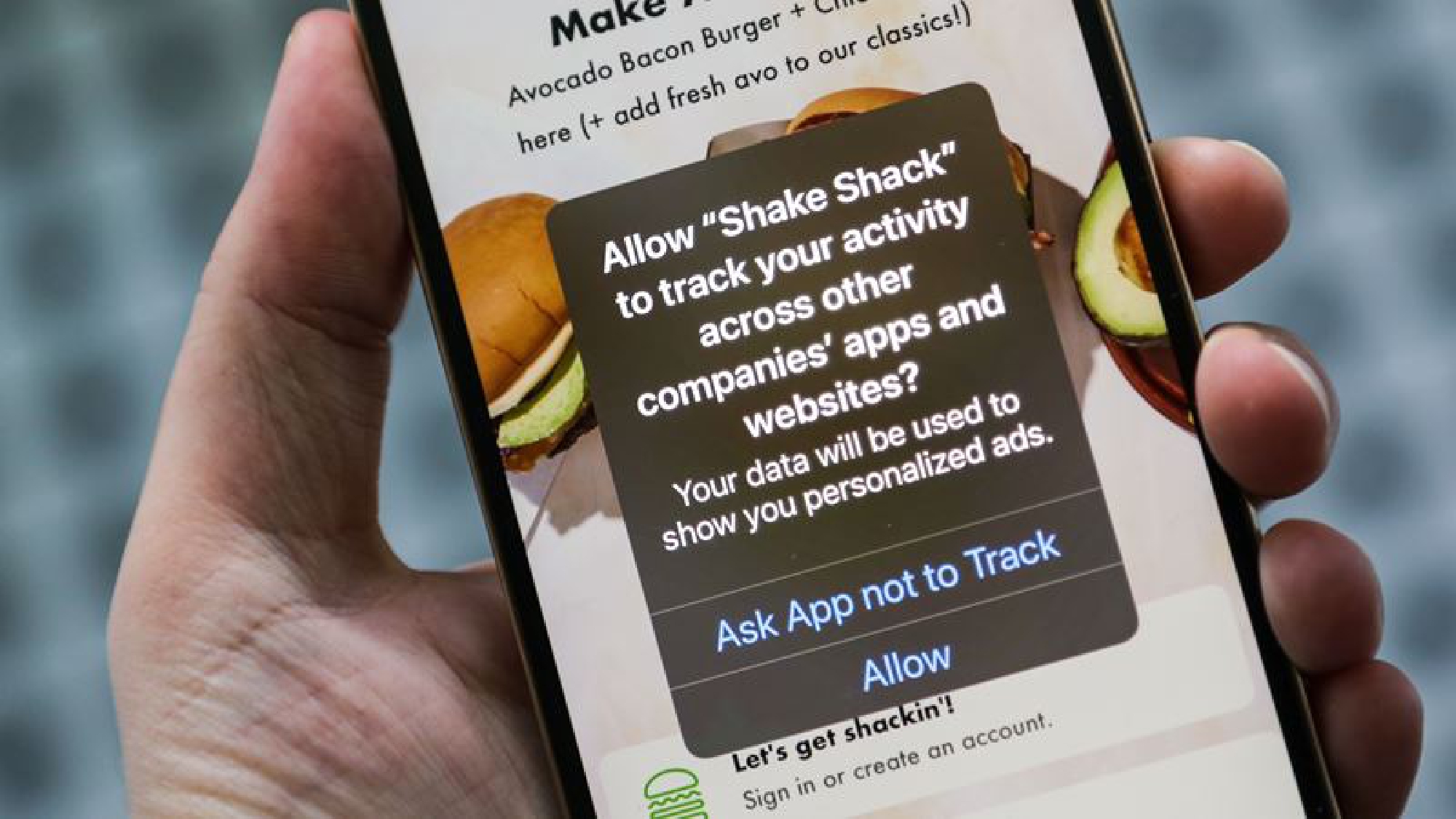


 Saildrones. MUST CREDIT: Saildrone Inc.
 Pakorn Apaphant Photo Credit: GISTDA
 An Apple TV 4K and remote control sits on display inside a store in San Francisco, California, on Sept. 22, 2017. MUST CREDIT: Bloomberg photo by David Paul Morris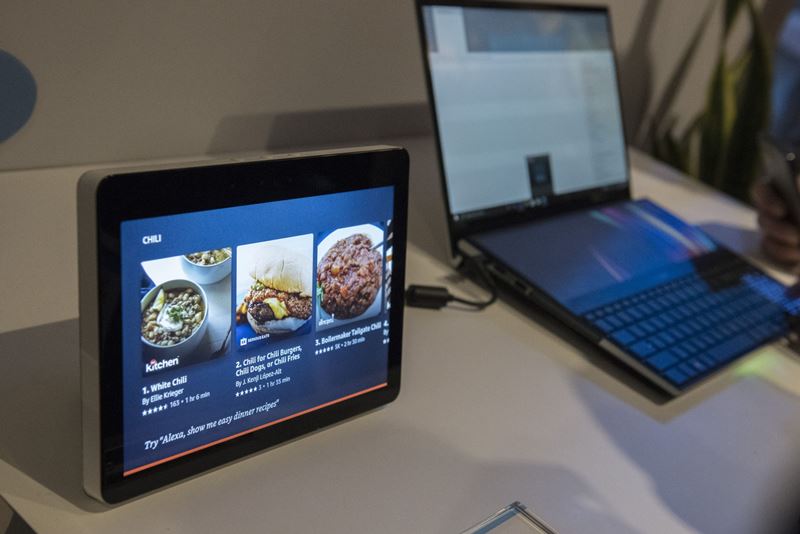

 SootinClaimon.Com