
NASA’s Mars rover, Perseverance, aims for dicey landing to search for ancient life #SootinClaimon.Com

#SootinClaimon.Com : ขอบคุณแหล่งข้อมูล : หนังสือพิมพ์ The Nation.

NASA’s Mars rover, Perseverance, aims for dicey landing to search for ancient life

Feb 17. 2021NASA's Perseverance rover fires up its descent stage engines as it nears the Martian surface in this illustration. MUST CREDIT: NASA illustration handoutNASA’s Perseverance rover fires up its descent stage engines as it nears the Martian surface in this illustration. MUST CREDIT: NASA illustration handout

By The Washington Post · Joel Achenbach, Ben Guarino, Christian Davenport

They call it the “seven minutes of terror,” which doesn’t do justice to the weeks of anxiety, troubleshooting, second-guessing, sleepless nights – the mental cataloguing of all that could go wrong and all that must go exactly right. One cataloger is Matt Wallace, deputy project manager for NASA’s Perseverance rover mission. He has a simple way of describing what the space agency expects him and his fellow engineers to do: “Land a car on Mars.”

This is one of the hardest technological feats human beings have ever attempted. The spacecraft carrying Perseverance, which launched from Earth at the end of July, is expected to arrive on Thursday at Mars at 12,000 miles per hour – six times faster than a bullet shot from an M16 – in what amounts to a controlled collision. Somehow, that velocity has to reach zero, with the rover deposited lovingly on the surface inside a crater named Jezero.

Hitting the 4.8-mile-wide landing site targeted by NASA after a journey of 300 million miles is akin to throwing a dart from the White House and scoring a bull’s eye in Dallas.

This is one of NASA’s most important endeavors, the first multibillion-dollar Mars mission in nine years and the initial phase of a three-mission campaign to return samples of Martian soil to Earth. The rover is poised to land just days after two other robotic spacecraft, launched by China and the United Arab Emirates, reached Mars and went into orbit.

Perseverance will do more than probe the surface: It will also test technologies that someday could be used on Mars by astronauts, including a system for converting atmospheric carbon dioxide to oxygen. NASA’s human spaceflight program aims for a return mission to the moon in coming years, but Mars remains the horizon goal.

NASA describes this as an astrobiology mission. Perseverance has instruments that might detect structures consistent with ancient life on the Red Planet. Or those instruments might detect nothing remotely suggestive of life. Either way, NASA wants the soil samples back for study in laboratories, hoping to answer fundamental questions about life in the solar system and beyond. Finding a second data point for life would be one of the greatest discoveries in the history of science.

But first the engineers have to pull off the EDL – the entry, descent and landing. It is the hardest part of the mission, fraught with opportunities for what aerospace engineers call “a bad day.” The EDL requires a heat shield, a parachute, rocket thrusters and a sky crane that finally lowers the rover to the surface. All these things have to work with exquisite precision and entirely autonomously.

“We’re basically watching the spacecraft disassemble itself as it’s hurtling toward the ground,” Wallace said. “Success depends on everything going right, down to fractions of a second. There’s no go-back, no retry.”

Humans have been exploring Mars robotically for more than half a century, and roughly half the missions (including those operated by other countries) have failed. Spacecraft have simply vanished. Still, NASA has been on a roll with its rovers in recent years – first with Spirit and Opportunity, which landed in 2004, and then with the heftier Curiosity, which is still chugging along. When Curiosity touched down softly in 2012, the video of the “seven minutes of terror” and the wild high-fiving celebration at the Jet Propulsion Laboratory earned viral traffic on the Internet.

Past success does not guarantee future success. This time, the rover landing will be different in two key respects. First, there are more cameras involved, and it will be visually more appealing. Engineers will have multiple angles (with some time delay because of the 11 minutes it takes for a signal to reach Earth at the speed of light) on what the rover is experiencing as it lands on Mars.

Second, this is a much harder target. Curiosity in 2012 landed on flat terrain, the equivalent of a massive empty parking lot. Perseverance will attempt to touch down inside Jezero Crater, a 30-mile-wide basin crammed with boulders, gullies, cliffs and, most enticingly, the remnants of an ancient river delta with sediments that scientists hope will contain evidence of past life on Mars.

From a science perspective, that’s a great target. Engineers view it differently.

“When I look at it from a landing perspective, I see danger,” Allen Chen, the 41-year-old leader of the EDL team, said.

The spacecraft will have to use a new system, packed with artificial intelligence, to scan the terrain and match it with maps of Mars to try to pick out a landing spot. If all goes well, the autonomous decision-making of the spacecraft will ensure it is not stuck in deep sand, or dangling over a cliff, or perched on top of a boulder.

Or upside down.

“Landing upside-down is a bad day,” Chen said.
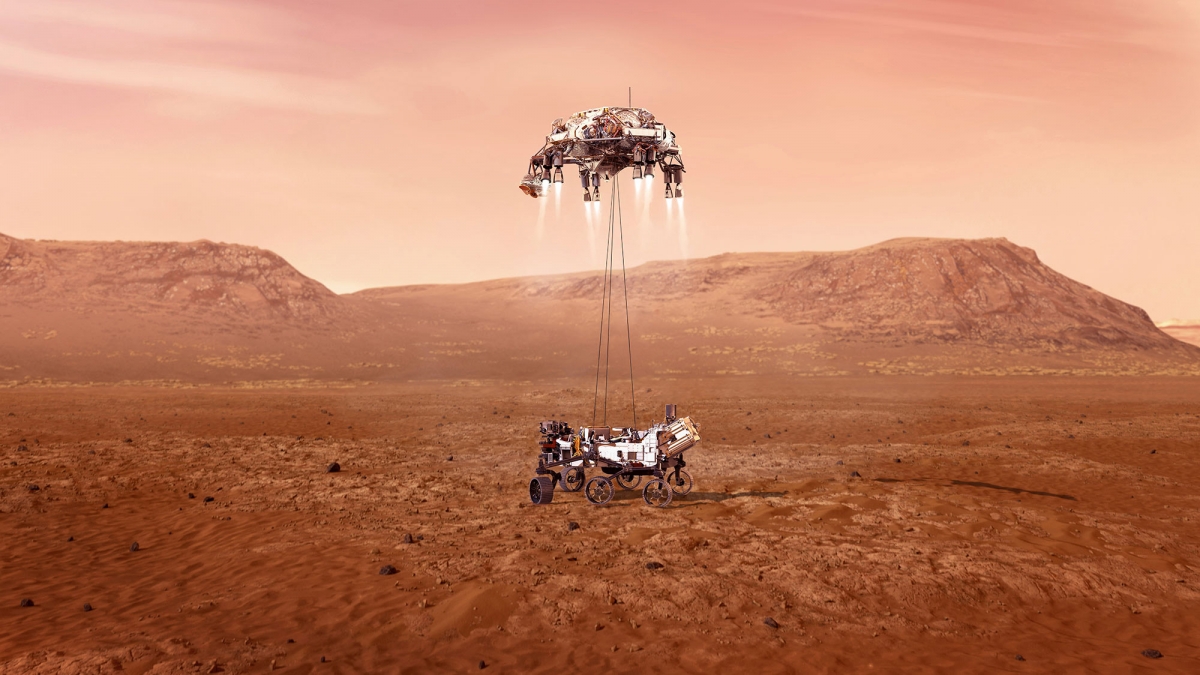
NASA's Perseverance nears the Martian surface in this illustration. MUST CREDIT: NASA illustration handout

NASA’s Perseverance nears the Martian surface in this illustration. MUST CREDIT: NASA illustration handout

NASA engineer Swati Mohan and her colleagues developed the terrain relative navigation system after asking themselves: How do you give a robot a brain like the one in the skull of Apollo 11 astronaut Neil Armstrong? When Armstrong descended to the moon in the lunar module, the Eagle, he peered out the window to steer his spacecraft by the landmarks spotted below, dodging boulders and craters that could have spelled disaster.

The features of Jezero Crater that appeal to scientists – cliff faces, slopes, sand pits, rocks – “are the exact things that the engineers don’t want to see in the landing site,” Mohan said.

Like Armstrong, who memorized lunar maps, the robot is flying to Mars prepped with information and the ability to react.

“That’s exactly the smarts that we put on board Perseverance. She can do it completely on her own during that entry, descent and landing,” said Mohan, who during the landing will be at a microphone in mission control and calling the play-by-play.

As Perseverance descends, it will be guided by images taken by NASA’s satellite, the Mars Reconnaissance Orbiter. The navigation system will kick in as the spacecraft is about 2.6 miles above the surface: A black-and-white camera will snap away, and the images will be compared against the set of maps loaded into Perseverance. Safe spots have been marked on the preloaded satellite map.

The space agency tested part of the camera system by strapping it to a helicopter flying over Death Valley, Calif., a decent analog to the Martian surface. This is the first time NASA will use this tool on another planet.

“My paranoia level is growing exponentially the closer we get to landing,” Mohan said.

Mars is not a stationary object in the heavens – it orbits the sun, like any planet, and so it’s a moving target for the spaceship.

“You have to have a good understanding of exactly where Mars is, and you have to have a good understanding of where the vehicle is,” Wallace said.

Mars has a fiendishly unhelpful atmosphere – too thin to be of much use in slowing down a spacecraft but thick enough to cause problems with turbulence and overheating. The spacecraft will come screaming into the Martian upper atmosphere and use a heat shield to deflect the heat of entry.

That soon gets jettisoned but not before the spacecraft deploys a parachute that must open in less than a second. The parachute is the size of a Little League baseball infield, Chen said. The deployment is so violent that there’s a risk the parachute will be shredded.

“You can turn into a confetti machine,” Chen said. “That would be a bad day for us.”

There is no backup chute. There is no backup heat shield. There is no backup descent engine, no backup sky crane, no backup rover.

The scientific mission will unfold once the engineers have achieved their initial goal of landing a car on Mars. Jezero Crater was selected as the landing site because of the dried-up river delta that protrudes into the crater. Such terrain memorializes the era when Mars was warmer and wetter, and had flowing water at the surface.

The scientists want the rover to clamber up and down the hilly terrain of the river delta and eventually drive all the way out of the crater to get a view from the rim, a traverse of 15 miles. All of this will be in service of a still-more-ambitious project: the Mars sample return.

Perseverance has tubes for caching samples of Martian soil and rock. NASA hopes to stage a second mission to gather the samples and launch them into orbit, followed by a third mission to haul them back to Earth for study in laboratories. The latter two missions have yet to be fully authorized.

Landing in the crater is a high-risk, high-reward plan. Mars rovers have limited life spans – the planet’s wild temperature swings rapidly age electronics. Earlier machines used up to two-thirds of that precious time moving to areas of scientific interest. Perseverance will land surrounded by interesting spots. NASA plans for the robot to cache sections of the delta deposits as well as hydrated silica, which on Earth can capture signs of ancient microscopic life.

After a successful landing, Perseverance will detach an autonomous helicopter from its belly, perhaps in the springtime. The helicopter, named Ingenuity and the size of a chihuahua, has a straightforward mission: It is essentially a “30-day tech demo to show that you can fly a helicopter on Mars,” said Jennifer Trosper, a deputy project manager for the Mars 2020 mission.

If its rotors lift the tiny copter off the ground, Ingenuity will be the first vehicle to achieve powered flight on another planet – an extraterrestrial Wright Brothers moment.

The list of countries that have successfully landed a working long-lasting probe on Mars remains at one – the United States. That is about to change, in all probability.

Perseverance is facing something of a traffic jam around Mars. Two spacecraft – one from the United Arab Emirates, the other from China – that have been hurtling toward Mars for months hit the brakes to slow themselves down enough to enter Mars’s orbit in recent days. The UAE’s Hope spacecraft arrived Tuesday, followed by China’s Tianwen-1 the next day.

The missions were a first for a pair of countries in the midst of beefing up their space programs, hoping to become forces in a space race long dominated by the United States. Though there have been a dozen landing attempts on Mars, the United States remains the only country to land and operate a spacecraft on the Martian surface.

NASA’s track record is extraordinary – eight attempts with only one failure, the Mars Polar lander in 1999. Meanwhile, the European Space Agency is zero for two and Russia is zero for three, although in 1971, the Soviet Union’s Mars 3 spacecraft landed on the surface and transmitted data for several seconds before going silent.

China, however, is becoming adept at landing spacecraft on faraway celestial bodies. In the past few years, China has deposited three spacecraft on the moon, including on the far side, which had never been done before. It also intends to launch the first modules of a new space station this year.

Tianwen-1 is its first Mars mission and consists of a spacecraft that would stay in orbit around the Red Planet and a rover that would land in the coming months. The rover is equipped with radar that would search for pockets of water under the surface.

The United Arab Emirates in recent years has built up its space program, hoping to diversify an economy long dependent on oil, inspire a new generation of scientists, and provide stability and hope in a region rocked by violence and turmoil.

Last year, the UAE sent its first astronaut to space, Hazza Al Mansouri, who spent eight days on the International Space Station and became a symbol of pride and the country’s ambitions in space.

Its most ambitious project – the launch of the Hope spacecraft to Mars last year – reached the Red Planet on Feb. 9 and will study the Martian atmosphere. The spacecraft will not attempt a landing.

It is a big step for the UAE’s space agency, which is partnering on the mission with scientists from the University of Colorado at Boulder’s Laboratory for Atmospheric and Space Physics.

“We entered into this wild experiment,” Sarah bint Yousef Al Amiri, the chair of the UAE Space Agency and the minister of state for advanced technology. “It was something completely new for us.”

mu Space, Airbus join hands to drive satellite and space technology in Thailand #SootinClaimon.Com

#SootinClaimon.Com : ขอบคุณแหล่งข้อมูล : หนังสือพิมพ์ The Nation.

mu Space, Airbus join hands to drive satellite and space technology in Thailand

Feb 12. 2021

By THE NATION

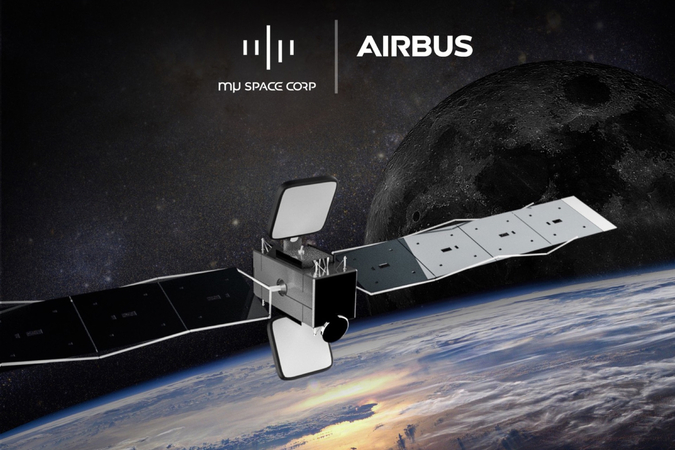
An advanced space technology company, mu Space, has signed a cooperation agreement with Airbus Defence and Space, a global leader in aeronautics, space and related services, to cooperate on spacecraft and space technology in Thailand.

The memorandum of understanding creates a path for mu Space to embark and have an impact on global satellite business and technology, the company said.

It marks the beginning of an evolution of future small satellite missions, which includes Earth-observation, Space Situational Awareness, Low Earth Orbit satellite constellations, science and technology and planetary missions.

The cooperation between Airbus and mu Space is expected to significantly influence Thai space and the satellite industry, to support future Thai satellite missions and push forward mu Space as a strong and reliable space company in the region.

mu Space’s founder and CEO, James Varayuth Yenbamroong, said: “In the next 2-3 years, technology is expected to mature commercially worldwide, mu Space needs to establish new revenue streams in the long term, and added that “Based on this agreement, mu Space and Airbus will act as partners to support satellite component and space technology development, which will influence the satellite and space industry in the near future.”

The collaboration between mu Space and Airbus is a great opportunity for Thailand to receive support and cooperation from a global leader in aeronautics and space in terms of sharing and exchanging experience, know-how, and relevant processes of manufacturing, including contributing to drive Thai’s space industry to international standards.

“Airbus remains fully committed to the Thailand 4.0 initiative and we are excited at this joint development opportunity with mu Space to further the country’s space goals. Airbus has been supporting Thailand’s space industry since the early 2000s, with the development and launch of Theos-1 in 2008 and production on-going for the Theos-2 Earth observation satellites. As a world leader in turnkey Earth observation systems with unrivalled expertise across the space value chain, we are well-positioned to offer our support in the development of the Thai Space economy,” said Johan Pelissier, Head of Asia Pacific, Airbus Defence and Space.

Carekoon launched as Thailand’s first ride-hailing/healthcare app #SootinClaimon.Com

#SootinClaimon.Com : ขอบคุณแหล่งข้อมูล : หนังสือพิมพ์ The Nation.

Carekoon launched as Thailand’s first ride-hailing/healthcare app

Feb 10. 2021

By The Nation

Thai firm Solarwatt111 has launched the country’s first mobility app combining ride-hailing and telemedicine.

Carekoon is designed to boost access to services and healthcare, especially for seniors and people with disabilities who are vulnerable to Covid-19.

“The proportion of elderly people in the population is forecast to reach 30 per cent in the next 10 years. Many of them are more likely to live alone or with only a spouse or partner, and have limited access to travel for running errands, to market, other healthcare services during Covid-19 pandemic. The intention behind Carekoon App is to integrate transportation and healthcare service to unlock this barrier,” said Kannika Jarusuraisin, president of Solarwatt 111 and founder of Carekoon.

Piloted in Phitsanulok at the end of last year, the app is a collaboration with the local Naresuan University.

As well as a ride-hailing service, Carekoon also provides access to food delivery and online health services including Mor-Rujak-Khun by Naresuan university hospital, Health Dome telemedicine, KJ pharmacy, Herbal Expert by Mayuree, Kanok Physio Rehab Clinic, Saiyaisampan Nursing Home and the Health Academy e-learning platform.

“Customers can select on-demand cars, motorcycles, campus shuttle bus, and food delivery service on Carekoon,” said Asst Prof Ananchai Ukaew, head of mechanical engineering at Naresuan University and Carekoon Project adviser. “This will lead to a new mobility ecosystem in other services such as tourism, mobile health units, mobile shopping vans etc, which can help boost the local and national economy.”

Naresuan University's EV Bus promotion with Carekoon

Naresuan University’s EV Bus promotion with Carekoon

The Phitsanulok-based platform is expanding to other areas of the country and is offering interested businesses free membership for three months at www.carekoon.com.

Will holograms be the next innovation in the post-pandemic workplace? #SootinClaimon.Com

#SootinClaimon.Com : ขอบคุณแหล่งข้อมูล : หนังสือพิมพ์ The Nation.

Will holograms be the next innovation in the post-pandemic workplace?

Feb 10. 2021ARHT Media brings holographic speakers from Australia, Greece and Germany together on one stage. MUST CREDIT: ARHT Media/ImverseARHT Media brings holographic speakers from Australia, Greece and Germany together on one stage. MUST CREDIT: ARHT Media/Imverse

By The Washington Post · Dalvin Brown

It’s a pressing question that has yet to be answered: Once the pandemic passes, what will the return to work look like for millions of Americans?

Some tech companies have said people can continue to work from home indefinitely. Surveys suggest that most others are contemplating hybrid workspaces where staffers rotate between working remotely and coming into the office. The possible post-coronavirus situation has some companies envisioning a future where people can collaborate in more interactive and engaging ways, whether they’re on-site or at home. One novel approach is to use 3-D holograms.

Last month, Canada-based ARHT Media launched HoloPod, a 3-D display system that beams presenters into meetings and conferences they otherwise wouldn’t be able to attend. That same month, the 3-D graphics company Imverse was recognized at the global tech conference CES for software that enables hologram collaboration within virtual meeting rooms. Last year, Spatial enabled holographic-style virtual meetings on Oculus Quest.

Others are racing to develop similar Web conferencing capabilities under the notion that holograms are more engaging to work with than tiles of faces on a computer screen. On the fringe for years, workplace holograms would enable employees to virtually re-create in-person meetings whether they’re at home or in the office.

“As you look to that hybrid model, companies are going to have to innovate around that interplay between the remote employee experience and in-office employee experience,” said Lisa Walker, the vice president of brand at Fuze, a teleconferencing service. “The technologies that can solve for that are going to pop.”

A January workplace survey by PWC found that most executives and employees expect a hybrid workplace reality to kick off in the second quarter of this year. A separate survey by the National Association for Business Economics found that only 11 percent of the employees are expected to return to their pre-pandemic working arrangements. Corporate travel is expected to remain slashed.

Holograms might not be the next big thing, but start-ups in the 3-D space are positioning their offerings just in case.

The three-dimensional light projections have primarily been seen re-creating musicians onstage in recent years. Companies have wanted to bring them into homes, but the projection hardware is still too expensive for most people to afford. Companies, on the other hand, have larger budgets. And now software advancements are unlocking ways to use laptops, computers and smartphones to engage with and stream holograms emitted elsewhere.

In December, ARHT media showed what a hologram-enabled conference could look like as it beamed an executive from Los Angeles to Singapore to speak at an innovation summit. The event brought together a “small group” of attendees and was broadcast live to a larger audience online.

Traditionally, setting up high-definition holograms requires a team of projection technicians. However, ARHT’s HoloPod was designed to be a quick-setup, plug-and-play system that’s simpler to deploy.

On the remote side, a presenter would stand in front of a green screen, looking at a shot of the audience on a monitor. Meanwhile, cameras capture the speaker from all angles. At the worksite, someone could roll the HoloPod out of a closet, turn on a computer and connect to a live stream.

ARHT’s software strings it all together and will enable presenters to respond in almost real time. People would then see the illusion of the presenter projected onto a reflective mesh.

In video demonstrations, the $20,000 suite of hologram technology lacks some clarity. You can look at it and tell it’s not a real person.

Still, the company enables people to engage with life-size, three-dimensional representations of people who aren’t actually there.

“When you see traditional streaming services like Zoom, it’s typically just a headshot. You’re missing 50 percent of their body language,” said Larry T. O’Reilly, CEO of ARHT Media. “However, when you see somebody in a live hologram, and they appear to be 3-D without the need of 3-D glasses, your brain is telling you to run the room.”

Another company is working to bring holograms closer to living rooms without all the bulky hardware.

The 3-D imaging company Imverse developed software to remotely generate holograms using the latest smartphones or inexpensive depth cameras. The idea is to eventually replace 2-D video calls with 3-D virtual conversations.

“Imagine being able to insert yourself into the same virtual spaces with your colleagues. You can interact with or collaborate around virtual objects and 3-D whiteboards,” said Ivo Petrov, executive chairman at Imverse.

The start-up’s software reads information from depth cameras and converts the images into volumetric pixels that can produce holograms in real time. Imverse focuses on the software, while big tech companies have to decide how to deploy it; some have already expressed interest, according to Javier Bello, the company’s CEO.

The digital clones could surface in a variety of ways.

If they’re using a smartphone camera, you could video-chat with a colleague on a computer and use your mouse to zoom in or pan around their virtual room. If you’re both wearing VR headsets, you could beam yourselves into a virtual office or bring them into your living room to collaborate.

It would take a trio of cameras to enable 360-degree virtual views of your whole body, while eight cameras would enable your hologram to emit from TVs such as Sony’s latest $5,000 spatial reality display.

Imverse, which joined Microsoft’s start-ups program last year, says it will launch its collaboration service later in 2021.

Krungsri worst-hit by IT crashes in 2020, BOT data shows #SootinClaimon.Com

#SootinClaimon.Com : ขอบคุณแหล่งข้อมูล : หนังสือพิมพ์ The Nation.

Krungsri worst-hit by IT crashes in 2020, BOT data shows

Feb 05. 2021

By The Nation

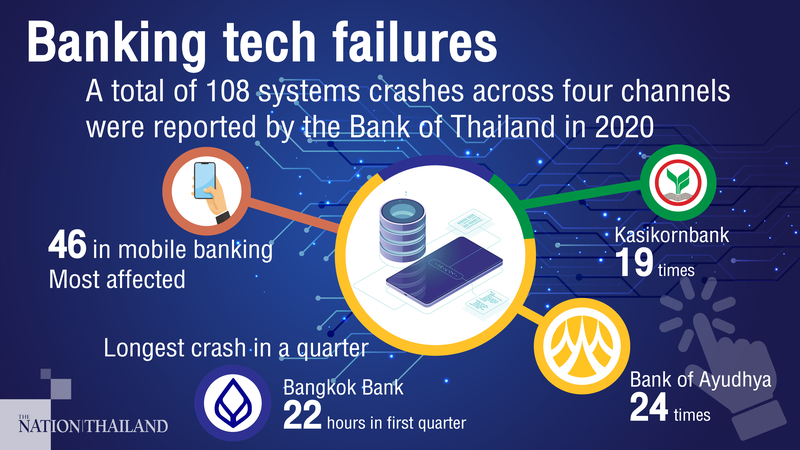
There were 108 times when banks suffered IT systems failures across all channels, includung 46 via the mobile banking channel.

The statistics of system disruptions affecting services through important channels, whether on mobile banking, Internet banking, ATM, EDC and via branch channels in the fourth quarter and entire last year were revealed by the Bank of Thailand (BOT).

Bank of Ayudhya (BAY) suffered the most disruptions in 2020, with 24 breakdowns comprising mobile banking 8 times, ATMs, EDC machines 7, internet banking 7 times, and branches twice.

Next was Kasikornbank, with a total of 19 system crashes: 8 – mobile banking, 8 – Internet banking, and 6 – ATM/EDC.

Bangkok Bank (BBL) followed with a total of 13 crashes of which mobile banking was 11 times.

The only bank without any system interruption in 2020 was Thanachart Bank.

The bank that suffered the longest system failure in 2020 was Bangkok Bank, whose operations were disrupted for 22 hours in the first quarter of 2020.

BOT assistant governor Sirithida Phanomwan na Ayutthaya said the rate of crashes, or the problem of disruption of the information technology system, has continued to decline after banks raised the level of digital services to support rapidly increasing digital transactions.

IsWhere joins Huawei Cloud to help retailers grow via its digital marketing platform #SootinClaimon.Com

#SootinClaimon.Com : ขอบคุณแหล่งข้อมูล : หนังสือพิมพ์ The Nation.

IsWhere joins Huawei Cloud to help retailers grow via its digital marketing platform

Feb 04. 2021

By THE NATION

Singapore-based IsWhere is partnering with Huawei to launch a self-service digital marketing platform to help merchants grow their business and attract new customers.

The year of Covid-19 lockdowns and restricted movement have left shops and small businesses struggling to cope.

Using IsWhere’s location-based mobile technology powered by Huawei Cloud, brick-and-mortar merchants can boost their customer relationship management by launching promotions and advertising their products. This way, they can reach potential customers who are in their vicinity through their mobile devices.

In Thailand, IsWhere has collaborated with Huawei Cloud to launch the “Digital Temple Thailand” project in partnership with the Thailand National Office of Buddhism.

Under this collaboration, 42,000 temples in Thailand can promote activities on smartphones of people in their vicinity.

Also, more than 4,700 local tourist attractions have registered on the platform to promote safe domestic travel in the era of Covid-19.

In addition to promoting safe temple visits and location-based searches, IsWhere is also working with AIS Business, Teleinfo Media, the Office of National Buddhism, as well as the Commerce Ministry, Tourism Council of Thailand and the Thai Coffee Association who have invited their merchant members to use IsWhere to promote their businesses.

Nicholas Ma, chief executive officer of Huawei International, said: “The Huawei-IsWhere partnership supports the rapid digitalisation of retail business and consumer marketing to help retailers rebuild and grow their businesses. We are working closely with our partners to ensure that their customers can transform and scale their business during these challenging times.”

The integration of Huawei Cloud’s artificial intelligence (AI) engine with IsWhere’s platform allows merchants to profile consumer behaviour and provide recommendations for food, shopping and attractions that are in the vicinity.

Through global positioning service (GPS), merchants can locate customers within a few kilometres of their store and communicate with them using a real-time translator that translates text from source to target languages running on Huawei Cloud.

With auto-scaling, IsWhere can adjust its bandwidth to ensure that backend computing performance can support the website and application to ensure a successful rollout.

“The IsWhere platform is designed to help consumers make an informed choice easily and safely, without leaving the comfort of their home. Even though restrictions are easing, we still want our customers and shoppers to be safe.

“Through this platform, consumers can run a simple search and discover the best available promotions nearby for food, shopping and many other local services before heading directly to the stores to make their purchase,” said Terence Mak, founder of IsWhere.

With this partnership, IsWhere aims to leverage Huawei’s extensive network to accelerate growth across more local communities and be able to launch it in other countries with other partners this year.

Over 570 million Huawei device users will benefit from the IsWhere app to locate curated promotions and deals that are closest to them.

The IsWhere app is available for free, while merchants can register at iswhere.com/c-us.php or contact Metee Veerapat at metee@iswhere.com or call (098) 641 5144.

Thai scientists unveil saltwater Covid-19 disinfectant device #SootinClaimon.Com

#SootinClaimon.Com : ขอบคุณแหล่งข้อมูล : หนังสือพิมพ์ The Nation.

Thai scientists unveil saltwater Covid-19 disinfectant device

Feb 04. 2021

By The Nation

Scientists at Prince of Songkla University (PSU) have unveiled a breakthrough in the battle to prevent the spread of Covid-19 and other diseases.

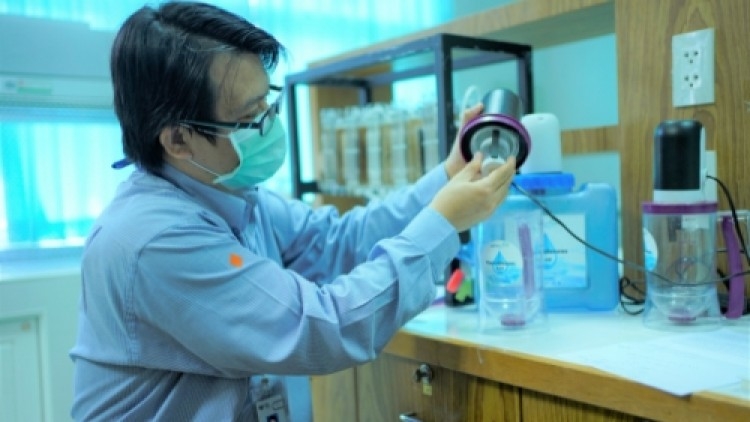
A PSU Faculty of Science research team has developed a device that uses simple technology to produce hypochlorous acid and hypochlorite to disinfect any surface.

The device uses only water and salt, making it a convenient and almost free way of producing a constant supply of disinfectant.

PSU has handed the research knowledge to government agencies and schools in nine southern provinces – Surat Thani, Nakhon Si Thammarat, Phatthalung, Trang, Satun, Songkhla, Pattani, Yala and Narathiwat.

The device is designed to replace regular disinfectants, including relatively expensive alcohol-based cleansers.

Dr Warakorn Limbut, a PSU chemical scientist, said the new disinfectant device uses electrodes immersed in a container of salt and water (sodium chloride solution). When an electric current is passed through the solution, the positive electrode produces hypochlorous acid with a pH level 4.0 to 6.5 – a weak acid that is highly effective in destroying bacteria and viruses. Meanwhile the negative electrode produces sodium hydroxide with a pH of 8-14 – the main ingredient of bleach.

Warakorn hailed the commitment of Faculty of Science students, who worked for one year to develop the device. He said knowledge from the project will now be used for commercial applications to help society.

“In future, we will work with businesses to develop more efficient use of hypochlorous acids and hypochlorites in a larger machine.”

The research was part of PSU’s efforts to prevent the spread of disease and protect the health of Thai people, he added.

Smart shopping carts on the rise as stores adapt to pandemic era #SootinClaimon.Com

#SootinClaimon.Com : ขอบคุณแหล่งข้อมูล : หนังสือพิมพ์ The Nation.

Smart shopping carts on the rise as stores adapt to pandemic era

Jan 30. 2021Kroger is testing out 20 smart carts by Caper. MUST CREDIT: Caper.Kroger is testing out 20 smart carts by Caper. MUST CREDIT: Caper.

By The Washington Post · Dalvin Brown

Kroger is the latest retailer to embrace automation at a time when shoppers are more thoughtful about who they come in face-to-face contact with.

Last week, the grocery store chain revealed it has partnered with artificial intelligence firm Caper to deploy computer vision-enabled shopping carts at a supermarket in Cincinnati. If the test run is successful, the retailer will add connected buggies to more of its stores around the country.

Kroger now has 20 branded smart carts built to know what customers place inside. The wireless buggies can tally up your total, make recommendations and allow you to pay for groceries directly on the cart. The gadgets eliminate the need to stand in line around strangers or pass off items to a salesclerk.

For the past few years, connected shopping carts were billed as a way to cut down on labor costs, get customers to spend more cash and shift patrons out of stores more swiftly. However, according to Caper, the pandemic has pushed more companies to check out the trend to reduce face-to-face interactions amid the ongoing pandemic.

“In response to the COVID-19 pandemic, the demand for autonomous checkout technology is driving grocers and retailers to innovate and adopt new technologies that keep shoppers safe and streamline checkout,” Lindon Gao, CEO and co-founder of Caper, said in a statement.

Smart carts drive customers to spend more cash since the baskets can tally up totals in real-time and expose people to more marketing materials while shopping, the AI company claims. For instance, if you buy cereal, it might recommend that you buy milk as well. The firm says an average shopper’s checkout total increases 18% when using its product.

The new ways to shop don’t come cheap. Smart carts can cost retailers between $5,000 and $10,000 per unit, according to Sylvain Charlebois, a professor of food distribution and policy at Canada’s Dalhousie University who has studied smart carts. The devices require a lot more maintenance and upkeep compared to simple shopping carts, which tend to cost retailers under $100 each. Caper says most of its smart cart partners recoup their investment within a year.

Caper, which has raised more than $14 million in funding, claims its tech isn’t meant to replace jobs but free up more frontline grocery store workers to maintain the aisles or offer customer service. The data generated from smart carts enable the tech firm to improve its product recommendations. Its tech can provide dietary suggestions based on what grocery customers have purchased in the past and recipe recommendations based on what shoppers have in their cart. Caper also shares shopper information with the partnering retailer so the store can better manage inventory and gleaning where people are going.

Caper says it doesn’t share shopping data beyond the partnering retailer.

Kroger operates more than 2,700 stores, and it’s the third national retail chain to pick up the startup’s smart carts over the past 12 months, Caper says. The startup founded in 2017 didn’t have permission to reveal its other partnering retailers’ names yet. However, in 2019, it kicked off a pilot with the Canadian grocery chain Sobeys. The brand has also worked with Foodcellar Market, an organic produce spot in New York, for over two years.

Caper isn’t the only company pushing out the advanced checkout counters on wheels. The Seattle-area startup Veeve unveiled its touch screen shopping cart in 2019. And last summer, the Tel Aviv-based firm Traxcpoint brought its smart cart software to North America, promoting it as a way transform generic shopping carts into intelligent self-checkout machines. The Kroger collaboration comes months after Amazon launched a competing product. (Amazon founder Jeff Bezos owns The Washington Post.)

Last year, Amazon introduced its smart Dash Carts to one of its stores in Woodland Hills, Calif. Customer feedback was so positive that Amazon added them to five more locations in California and an Amazon Fresh store in Naperville, Ill.

“They’ve been so popular that we’ve added more Dash Carts to many of our Fresh stores just to keep up with demand,” an Amazon spokesperson said.

Amazon’s smart carts require customers to download an app to their personal smartphone, while Caper’s does not. Amazon’s tech also requires stores to have a system of sensors in place to monitor what patrons are doing. With Caper, everything is built into the cart itself.

At Kroger, the automated carts are lined up alongside traditional shopping buggies near the entrance, so shoppers can still choose ordinary carts if they want.

The supermarket’s “KroGO” carts utilize computer vision and artificial intelligence to recognize groceries placed inside the basket. The carts have three cameras that capture what an item looks like from various angles. Then, on the back end, Caper’s software generates a 3D model and compares that to a database of product images to determine what the grocery item is.

The price is then displayed on the screen. When a customer removes an item from the cart to put it back on the shelf, their checkout total adjusts accordingly, Caper says. The gadgets also have an on-board scale to measure foods sold by weight and the tech allows shoppers to scan loyalty cards and view coupon offers.

The grocer launched the pilot with a 5 percent discount for shoppers who use its new “limited contact” method.

What’s holding up the next test of SpaceX’s Starship? Elon Musk blames the FAA #SootinClaimon.Com

#SootinClaimon.Com : ขอบคุณแหล่งข้อมูล : หนังสือพิมพ์ The Nation.

What’s holding up the next test of SpaceX’s Starship? Elon Musk blames the FAA

Jan 29. 2021SpaceX CEO Elon Musk. MUST CREDIT: Washington Post photo by Jonathan NewtonSpaceX CEO Elon Musk. MUST CREDIT: Washington Post photo by Jonathan Newton

By The Washington Post · Christian Davenport

SpaceX’s Starship was on the launch pad Thursday, apparently ready to fly in the latest iteration of the spacecraft SpaceX hopes will take people to Mars. The spacecraft, known as SN9, or serial number 9, was filled with propellant, letting off plumes of steam on the launch pad, as fans waited.

But it didn’t fly. Instead, SpaceX founder Elon Musk took to Twitter to bash the Federal Aviation Administration, which licenses space launches and is charged with protecting people and property on the ground.

“Unlike its aircraft division, which is fine, the FAA space division has a fundamentally broken regulatory structure,” he wrote. “Their rules are meant for a handful of expendable launches per year from a few government facilities. Under those rules, humanity will never get to Mars.”

The tweet revealed the tension between SpaceX’s Starship program and the government’s primary regulator of what gets into the air.

Starship’s most recent test flight, last month, was quite a show, with the silo-resembling spacecraft traveling several miles into the air, executing a twisting midair maneuver called a bellyflop to position itself for landing, refiring its engines to attempt a soft landing, and then, in a dramatic ending, crashing to the ground in a fireball that Musk calls an RUD or “rapid unscheduled disassembly.” Musk called the flight “an awesome test.”

This time, SpaceX said it would livestream Starship’s flight from its facility at the southern tip of Texas to the legions of fans who faithfully follow every step of Musk’s exciting company and were hoping to see a successful landing – or another fireball.

Musk has never been shy about calling out regulators or authorities he sees as unfair. He sued the Air Force over the right to compete for national security launch contracts – and secured a settlement that allowed SpaceX to do so. And after he was fined $20 million for allegedly misleading investors of his Tesla car company, he told 60 Minutes “I do not respect the SEC. I do not respect them.”

On Thursday, in a statement to The Post, the FAA said, “We will continue working with SpaceX to resolve outstanding safety issues before we approve the next test flight.”

People gather before SpaceX CEO Elon Musk gives a presentation on his Starship rocket at its Boca Chica spaceport launch facility in southern Texas. MUST CREDIT: Washington Post photo by Jonathan Newton

People gather before SpaceX CEO Elon Musk gives a presentation on his Starship rocket at its Boca Chica spaceport launch facility in southern Texas. MUST CREDIT: Washington Post photo by Jonathan Newton

An official close to the FAA’s thinking pushed back against Musk’s allegations and said the agency had been in constant contact with SpaceX over the flight and was very close to issuing the modification to the license required for the flight.

The agency is “not purposefully slowing the process down,” the person said, speaking on condition of anonymity in order to discuss internal processes. The FAA has “a responsibility to the American people and particularly those who live in the southern Texas area to make sure they are not put at undue risk.”

The person said the FAA was rather “pedaling very fast” and “doing everything to speed things up to become more efficient and more effective and agile while still maintaining public safety.”

The person said it expected to have the approval ready soon and that it was already working on the license for the test flight after that.

As for Musk’s tweet, the person said: “I don’t find it helpful.”

SpaceX prides itself on doing what had long been considered impossible by space scientists, returning rockets to soft landings on Earth instead of ditching the boosters into the ocean, as NASA has done for decades. SpaceX now routinely lands its Falcon 9 rockets after launch.

If the company can perfect the technology for Starship, it will be “critical to landing Starship at destinations across the solar system where prepared surfaces or runways do not exist, and returning to Earth,” the company says on its website. “This capability will enable a fully reusable transportation system designed to carry both crew and cargo on long-duration, interplanetary flights and help humanity return to the Moon and travel to Mars and beyond.”

E-scooter companies innovate to avoid sidewalk problems #SootinClaimon.Com

#SootinClaimon.Com : ขอบคุณแหล่งข้อมูล : หนังสือพิมพ์ The Nation.

E-scooter companies innovate to avoid sidewalk problems

Jan 29. 2021Ford-owned Spin is bringing remotely operated e-scooters to cities this year. MUST CREDIT: Photo by SpinFord-owned Spin is bringing remotely operated e-scooters to cities this year. MUST CREDIT: Photo by Spin

By The Washington Post · Dalvin Brown

E-scooter companies are flipping the switch on more advanced monitoring tools meant to fix a major issue plaguing the micromobility industry: sidewalk clutter.

Almost as soon as the dockless rides came to the nation’s metro areas in 2018, electric scooters by companies such as Bird and Lime wound up in parts of town that frustrated homeowners and public officials. Many of the early scooters were prone to break down and often ended up blocking sidewalks and roadways. Some e-scooter oppositionists and vigilantes tossed them into rivers and lakes as the last-mile convenience turned into a micromobility mess.

More than three years later, after government crackdowns and pedestrian collisions rattled scooter companies, e-scooters are being innovated. Companies are deploying pay-per-minute vehicles meant to keep people from abandoning them all over the place.

On Wednesday, Spin announced new tiny wheeled rides that allow scooter operators to remotely move the vehicles if they end up somewhere they are not supposed to be. The company chose Ninebot-Segway to build the bikes and the autonomous technology start-up Tortoise for the software. The companies say the development is key to creating more order in city streets.

“There has been a lot of fanfare around the potential of remote-controlled e-scooters, but this partnership marks a turning point . . . to bring them to city streets,” Ben Bear, chief business officer at Spin, said in a statement.

Spin has been expanding and investing in new tech since Ford bought it in 2018 for a reported $100 million. Tortoise, a mobility software company founded in 2019, has regulatory approval to operate in 14 cities including an Atlanta suburb where it began testing last year. Segway, as a provider to Bird and Lime, says it has 70% of the global e-scooter hailing market.

Spin, Bird and Set are set to launch a pilot program in Boise, Idaho, where up to 250 three-wheelers can roam around town without a rider this spring. The test could lead to a future ride-hailing service with which people can use an app to summon an unmanned e-scooter to their doorstep, Spin says. The partnership was also created to address people littering public spaces with abandoned scooters.

The project follows product announcements from other micromobility companies seeking to solve the problem. On Monday, two Irish firms, Luna and Zipp, teamed up on next-generation rides that “know” whether they were parked improperly. The collaboration is meant to reduce insurance costs and municipal fines, the companies said. This month, TIER partnered with the mapping firm Fantasmo on a new scooter parking system that will allow users to end rides only within a specific area.

The companies are vying to inject more monitoring and safety into an industry beset by collisions and vandalism.

E-scooters sent 29,600 riders to the emergency room in 2019, up from 15,500 the year prior. Scores of people do not like them. They’re at the center of content posted on an Instagram account dubbed “Bird Graveyard,” where hundreds of photos and videos show people vandalizing e-scooters in public. The account has almost 100,000 followers.

Some e-scooter companies pay third-party firms to round up stray scooters each night and put them back in designated zones. Spin says it hopes its new remote-controlled fleet will cut back on operational costs associated with maintaining and repositioning e-scooters, which are worth a few hundred dollars apiece.

Despite setbacks, the industry shows promise. Estimated at $18.6 billion in 2019, the e-scooter market was projected to hit $20 billion in 2020. The pandemic held things up. But cities eventually closed off more streets to automobile traffic, making the rides part of their social distancing response and setting the groundwork for what could be a stronger e-scooter market in the years to come. The District of Columbia unveiled new legislation in October allowing the number of electric scooters and bicycles to double to 20,000 units by Oct. 1, 2023. San Francisco added another 500 approved Spin scooters this month to the 1,500 already allowed to whiz about town.

Spin’s new three-wheeled scooters were built with enhanced suspension, machine learning capabilities and a set of cameras, the company says. The scooters weigh 77 pounds, and the third wheel is intended to avoid tipping, Spin says.

The vehicle’s design, computer vision and connectivity enable Tortoise teleoperators to park the scooter in a higher-trafficked area immediately after a trip ends. If the e-scooter is abandoned on the sidewalk, the operator can use the camera feed to steer to a nearby spot that’s less likely to cause a problem. Under Tortoise’s control, the scooters can travel up to 3 miles per hour and have a 40-mile battery range.

Eventually, battery depleted scooters will automatically go to the nearest Spin charging station for a power boost, Spin says.

It’s unclear how the public will respond to scooters roaming around seemingly uncontrolled.

“That’s one of the things we’re excited to see,” Bear says.

Spin hopes its remotely operated rides will enable the company to launch a scooter-hailing service by the end of 2021. The move would allow customers to request an e-scooter through an app. The announcement represents its latest attempt to innovate as it expands to new markets. In December, it announced plans to boost e-scooters with software that alerts pedestrians of sidewalk riders and plans to deploy them in New York this spring. Its parent company is also invested in software that will enable scooters to communicate with cars on the road through Bluetooth to cut down on accidents.