Police across Laos cracked down on drug traffickers in 2022 and seized hundreds of kilograms of different types of narcotics. Given below are details of 10 major drug busts throughout the year.
No.10: On June 21, police officers of Khammuan province, together with the local authorities, surrounded and arrested Adsomvang, 30, and his wife, Yengyang, 18, of Homyen village in Pakkading district of Borikamxay province. They were allegedly carrying 24 bags of cannabis weighing 939 kg to be sent to neighbouring countries.
No.9: On September 6, Borikhamxay provincial police officers found a truck carrying 90 bags of compressed dry cannabis weighing 1,600 kg mixed with incense. Four men were detained in Phonchaleun village of Pakkading district in Borikhamxay province for prosecution in the case according to the law.
No.8: On December 21, police officers from Khamkeuth district in Borikhamxay Province, in cooperation with Khounkham District Police from Khammuan province, intercepted a car carrying cannabis that was driving through a checkpoint. The driver managed to escape. After inspecting the truck, police found 44 bags of cannabis weighing 1.669 kg.
No.7: On June 8, police arrested Vattana, 29, and Mekthala, 30, in Xokyai village of Xaysettha district with 100,000 amphetamine pills weighing 10.8 kg, a phone, three modified guns and 21 bullets.
No.6: On September 26, a Vigo car was moving from Vientiane at high speed when it hit a motorcycle. The driver tried to escape but was arrested by authorities. The occupants of the car were identified as Buapha, 26, a resident of Viengkham village in Pakkading district, and Soutchai, 18, from Huayhoy village in Viengthong district. A search of the car revealed 866 packets of coffee mixed with drugs.
No.5: On January 30, police officers of Oudomxay province arrested Chueyiwa at Kiewhear village in Xay district of Oudomxay province with 72 bundles of amphetamine containing 144,000 pills. Further searches at three other locations led to the arrest of 30-year-old Chengwa, from Phousavan village in Xay district, with 97,000 pills, a bag of powder mixed with pills, a total of 241,464 pills, and other related materials.
No.4: On October 15, police officers from Tonpheung district on Bokeo province found a Vigo vehicle parked on the side of the road. They found middleware hidden in the driver’s compartment and the trunk of the car had 14 bags containing 350 packs of 3,500,000 amphetamine pills weighing 385 kg. The persons transporting the drugs escaped.
No.3: On August 6, police officers in Bokeo province arrested 45-year-old Phon and 43-year-old Mon at Sibonheuang village in Tonpheung district. They were involved in drug trafficking. A subsequent inspection of a house revealed 6,608,000 amphetamine pills weighing 733 kg, one kilogram of crystal meth, and three cars. In addition, 80,000,000 kip, 4,109,000 baht and 10,000 yuan were seized.
No.2: On June 4, police in Bokeo province solved a major drug case and arrested Toumong, 30, from Xay Oudom village in Pha- Oudom district, and Phomma, 29, from Nateuy village in Luang Namtha province. More than 12,000,000 amphetamine pills were seized from them.
No.1: On September 23, the police in Bokeo province solved a major drug case and arrested four persons with 33,500,000 amphetamine pills and 500 kg of crystal meth.
Pakistan to shut malls, markets early in energy saving plan
WEDNESDAY, JANUARY 04, 2023
Pakistan’s government has ordered all malls and markets to close by 8:30 p.m. among other measures in a new energy conservation plan, the defence minister said on Tuesday, as the country grapples with an economic crisis.
Pakistan’s foreign exchange reserves barely cover a month’s worth of imports, most of which are accounted for by energy purchases from abroad, with funds expected under an International Monetary Fund (IMF) programme having been delayed.
Khawaja Asif told journalists the cabinet-approved measures to shut markets, including restaurants, aimed to save the cash-strapped country about 62 billion Pakistani rupees ($273 million).
He said additional immediate measures included shutting wedding halls by 10 p.m. daily. He added that some market representatives had pushed for longer hours, but the government decided that earlier closure was needed.
However, traders refused compliance saying their businesses would be ruined, and the shops were open in the capital in Islamabad till 10:30 p.m.
In Lahore, the capital of Punjab province and Karachi, the capital of Sindh province the markets were open till late at night.
Asif also said Prime Minister Shehbaz Sharif had ordered all government departments to reduce electricity consumption by 30%.
The move comes as Pakistan struggles to quell default fears in domestic and international markets, with a $1.1 billion IMF bailout tranche stuck due to differences over the ninth programme review, which should have been completed in November.
Other critical multilateral and bilateral financing avenues are also linked to the IMF programme, which means the South Asian nation of 220 million people is hard-pressed to meet external financing needs of over $30 billion up until June 2023, including debt repayments and energy imports.
Pakistan’s total liquid foreign exchange reserves stood at $11.7 billion – $5.8 billion with the central bank – as of late last month, having fallen 50% in 2022.
Asif said the energy conservation plan also included banning the production of energy-inefficient bulbs and fans from February and July respectively.
He added Pakistan’s peak summer electricity usage was 29,000 megawatts (MW) compared with 12,000 MW in the winter, mainly due to the use of fans in hotter months.
Half of the street lights across the country will remain switched off as a “symbolic” gesture, the minister said.
Most of Pakistan’s electricity is produced using imported fossil fuels, including liquefied natural gas, prices of which have sky-rocketed over recent months.
The government has tried to stabilise the economy by containing imports and decades-high inflation. A fast-depreciating currency has made imports more expensive while consumer prices saw a 25% year-on-year rise in the first half of the current fiscal year.
Republican McCarthy loses third US House speaker vote
WEDNESDAY, JANUARY 04, 2023
Hardline Republicans in the US House of Representatives on Tuesday repeatedly blocked fellow Republican Kevin McCarthy’s bid to become the chamber’s powerful speaker, leaving the chamber leaderless and plunging their new majority into turmoil.
In the first day of what could prove to be a brutal showdown between about 20 hardliners and the other 202 members of the Republican caucus, McCarthy failed in three ballots to achieve the 218 votes needed to become speaker, a role second in line to the Oval Office after the vice president.
It was a disconcerting start for the new Republican majority and highlights the challenges the party could face over the next two years, heading into the 2024 presidential election. Their slim 222-212 majority gives greater clout to a small group of hardliners, who want to focus on dealing a defeat to Democrats and pushing investigations of President Joe Biden’s administration and family.
Louisiana representative Steve Scalise nominated McCarthy to stand in the third round of voting, making an impassioned speech for action on issues important to working Americans.
“We’ve attempted to bring bills on this floor to address inflation, to lower the cost of goods,” Scalise said. “Those bills were rejected by the previous majority. And I use that term for a reason. The previous majority, because we won a majority talking about fixing those problems. But we can’t start fixing those problems until we elect Kevin McCarthy as our next speaker.”
McCarthy, 57, from California, knew he faced an uphill climb heading into Tuesday’s vote and had vowed to continue to force votes, but the chamber on Tuesday evening voted to adjourn until noon ET (1700 GMT) on Wednesday (January 04), a move that would give Republicans time to discuss other candidates.
Popular conservative Representative Jim Jordan, 58, from Ohio, won 20 votes in the last ballot of the day, far from the 218 thresholds to become speaker but enough to stop McCarthy.
A protracted speaker election could undermine House Republicans’ hopes of moving forward quickly on investigations and legislative priorities that include the economy, US energy independence and border security.
The chamber’s top Democrat, House Minority Leader Hakeem Jeffries, bested McCarthy in all three votes. In the day’s final tally, Jeffries led McCarthy 212 to 202 votes. A majority of those voting, not a plurality, is needed to determine a speaker.
A standoff would leave the House largely paralyzed and could force lawmakers to consider another Republican candidate. In addition to Jordan, incoming Majority Leader Scalise, 57, was seen as a possibility.
The last time the House failed to elect a speaker on the first ballot was 1923.
No additional Covid rules for arrivals from China: Hun Sen
TUESDAY, JANUARY 03, 2023
Cambodia will not follow in other countries’ footsteps in imposing any additional restrictions towards arrivals from China, amid concerns that soaring Covid-19 cases there could drive the emergence of new and potentially more dangerous variants of the novel coronavirus.
This comes as China moves to reopen to inbound and outbound tourism on January 8, while the Kingdom plans to capture pent-up travel demand, welcoming an estimated two million mainland Chinese visitors this year, according to the premier.
This would come near the all-time annual record of almost 2.362 million tallied in 2019, which was up 16.67 % from the 2.024 million logged a year earlier, according to the Ministry of Tourism.
Hun Sen was speaking at a groundbreaking ceremony for a Mekong River bridge and connecting road in Kratie province that are due to be built in part with a concessional loan from the Chinese government.
“We’ve all seen the unfortunate but frightening propaganda about the Covid-19 epidemic in China. Those who will be strict when it comes to China, let them do so since that’d just benefit Cambodia,” he said.
“Let’s say that [a Chinese traveller] wants to go to some country, but it requires Chinese people to do this or that.
Cambodia won’t have such requirements,” the premier explained, issuing an invitation for mainlanders to “come to travel [to the Kingdom] as per normal”.
“If any country wants to do anything [in terms of additional Covid restrictions for arrivals from mainland China, they have the right to do so. But Cambodia will instead invite the Chinese over,” he stressed.
He suggested that Thailand and Singapore would also hold back from imposing Covid restrictions on travellers from mainland China, “benefiting a lot” from doing so, and remaining “more attractive and convenient destinations” for them.
Although remarking that the agricultural, industrial and non-tourism service sectors have shown steady growth despite global economic pressures, Hun Sen underscored that greater numbers of Chinese tourists would spur near-term and longer-term growth in the Cambodian economy.
Painting a broader picture, the premier opined that “four-to-five million” international arrivals in 2023 could translate to a meaningful all-round boost for the economy, estimating the 2022 figure at about 2.2 million, echoing an earlier prediction made by the tourism ministry.
At any rate, he called on Cambodians to get vaccinated against Covid-19 as instructed by the Ministry of Health.
In an interview with The Post on January 2, Cambodia Chinese Tour Guide Association president Tea Kileng expressed delight at Beijing’s reopening to tourism and the local government’s decision not to impose Covid restrictions on arriving mainlanders.
Before Covid hit, Chinese tourism created tonnes of jobs and income for the local industry, and greatly raised the profile of the Kingdom’s ancient temples and other historical tourist sites on the international scene, he claimed.
“Despite the news that the Covid-19 pandemic is re-emerging in China, we’re still elated for them to visit Cambodia, taking into account that all members of our association have been vaccinated against Covid-19,” he said.
Pacific Asia Travel Association Cambodia Chapter chairman Thourn Sinan described Chinese travellers collectively as a key recovery engine for the local industry and reasoned that Hun Sen’s announcement could catalyse additional tourism and investment inflows from the mainland.
“Chinese tourists can be considered strategic visitors, with their numbers a dominant promoter of tourism in Cambodia, as well as many other countries,” he said.
Cambodia welcomed more than 1.914 million international visitors in the first 11 months of 2022, down 67.55 % compared to the same period of record-breaking 2019, according to the tourism ministry. Mainland China accounted for 90,648, down 95.84 % from the same time in 2019.
Singapore explores underground space to protect nation against rising sea levels
TUESDAY, JANUARY 03, 2023
National water agency PUB will explore the use of underground space to defend Singapore against rising sea levels amid climate change and more intense rainfall.
Responding to queries from The Straits Times, the agency said last Thursday that a study to assess the feasibility of using an underground drainage and reservoir system to combat inland and coastal flooding will start in 2023.
By the end of this century, the average sea level surrounding Singapore could rise by up to 5m due to the combined effects of climate change and other factors such as storm surges and tidal activity.
This means about 30 % of Singapore will be vulnerable to going underwater.
Findings from the study will complement ongoing and planned studies looking at how different segments of Singapore’s coastline can be better protected from going underwater.
These could support future coastal pumping stations, PUB said. Such stations pump flood waters accumulated in low-lying areas into the sea.
The study, which relies on available geological and engineering data, will be completed in 2025, the agency said, noting that no fieldwork is expected to take place.
PUB did not give details on where the integrated underground reservoir system will be located.
The ambition to build the underground system to expand the island’s water storage capacity and free up surface space was announced in 2015.
Such subterranean facilities, advocated by experts to combat the effects of climate change, will enhance Singapore’s resilience during droughts by storing excess water and releasing it when needed.
Cecilia Tortajada, an adjunct senior research fellow at the Lee Kuan Yew School of Public Policy’s Institute of Water Policy, said the initiative is similar to other such underground projects already in place in other countries to mitigate the threat of climate change and flooding.
Tokyo, for example, has massive underground structures to store excess flood waters and release them once the danger of flooding has passed, she said.
Tortajada added that for Singapore to build such massive underground water retention structures, it would need to ensure that the quality of water stored can be preserved over long periods to avoid contamination.
PUB’s proposed integrated system will likely have three key components: tunnels to channel stormwater, underground reservoir caverns for water storage, and a hydropower system that will run on clean energy to pump water back to the surface when needed. This power will come from potential energy harnessed from the flow of surface water to the caverns.
Currently, there is an underground tank at the Singapore Botanic Gardens that can contain stormwater equivalent in volume to 15 Olympic-size pools from drains in Holland Road during heavy downpours.
PUB expects the completion of a similar tank in Jalan Besar in 2025.
Poipet casino buildings gutted by fire demolished by machinery
TUESDAY, JANUARY 03, 2023
Officers from the Banteay Meanchey provincial land management department – in collaboration with engineers and construction workers hired by Grand Diamond City Hotel and Casino – have carried out the demolition operation on one of the buildings that was destroyed by fire on December 28.
Poipet town governor Keat Hul told The Post on January 1 that search and rescue operations at the hotel and casino were completely finished on December 30 after a 39-hour search-and-rescue operation was carried out following the extinguishing of the fire earlier.
Poipet authorities announced a final death toll of 26 with 57 injured, a number they did not anticipate would rise further.
The joint commission also assessed that all of the casino buildings were too damaged by fire to possibly repair and needed to be demolished immediately.
“Now we see the engineers and construction workers on-site are moving heavy machinery into place to dismantle and demolish the casino buildings,” he said.
According to Hul, authorities used a total of 1,009 police officers and firefighters from 14 different units along with 221 additional rescuers from Thailand. There were 58 ambulances and fire trucks on the scene to render medical aid and put out the multi-story blaze.
Of the four buildings the fire spread, three of them consisting of five stories each are considered a total loss, including one that boasted a pedestrian bridge that stretched over the border at the entrance of the Poipet International Border Checkpoint.
The cause of the fire has yet to be determined and is not likely to be known until the property damage is fully surveyed by the demolition crew.
Of the 26 victims killed in the fire, 17 were Thai, one Chinese, one Nepali and one Malaysian. The other six have not been identified yet because their bodies were burnt.
“In this incident, not a single Cambodian employee was killed that we know of, but we are awaiting the results of the autopsies. They will examine the bodies of the six victims who were burnt and use DNA to identify them later,” Hul said.
Prime Minister Hun Sen called the incident one of the worst tragedies to occur in recent memory anywhere in Cambodia and a truly sad way to end 2022.
At the same time, he said the government will equip some equipment that can be used to intervene to rescue in high-rise buildings when there is a fire by providing trucks that can put out fires in those structures.
Hun Sen also called for the use of more powerful fire engines at all locations that have high-rise buildings present due to the need for powerful hoses with water pressure that can hit the upper floors of those buildings with enough water.
Poipet authorities used the Ministry of Interior’s fire trucks as well as fire engines from Thailand to put out the blaze before it spread to other buildings, but the lack of appropriate fire engines already stationed in Poipet and under the town hall’s control may have delayed matters.
Hul also thanked the Thai side for participating in the firefighting operation and rescuing more than 1,000 patrons and more than 500 staff members during the emergency response.
On December 30, Ichitomo Taninai, deputy chief of mission at the Japanese embassy in Phnom Penh, also sent this condolence message on behalf of his government and the Japanese people.
“I am deeply saddened to learn of the fire at the casino in Poipet. [We] would like to express our deepest condolences to the families of the deceased and wish the injured a quick recovery. May the souls of the deceased rest in peace,” he wrote on his official Facebook page.
๋Local govt official in Japan makes tarts to boost industry
TUESDAY, JANUARY 03, 2023
To promote Tochigi Prefecture’s agricultural products, a government official with a sweet tooth has been making tarts using locally sourced fruits and vegetables in cooperation with farmers and uploading them on social media.
Mikihisa Shiratori, 37, director of the prefectural economy and distribution division of the prefectural government, holds tart-baking events at various farms in the prefecture. Utilizing both policies and sweets, he hopes to boost the area’s agricultural industry.
Instagrammable info
Colourful and vibrant tarts made using pears, strawberries and mangos are all over Shiratori’s Instagram account(@tarte892). However, his homemade fruit tarts are not the only photos on his social media account. He also posts photos of his vegetable tarts made using nira garlic chives, asparagus, rice and other nontraditional dessert ingredients.
One might think the tarts are just made to attract attention, but they are also “delicious as a sweet snack,” he said.
Shiratori, a native of Miyagi Prefecture, joined the Agriculture, Forestry and Fisheries Ministry in 2009 and was temporarily transferred to Tochigi Prefecture’s agricultural policy department in April 2021.
As he is in charge of branding agricultural products and advising agricultural groups, he regularly visits farms to discuss ways to develop sales channels and expand production.
In November 2021, Shiratori visited Abe Nashien pear orchard in Utsunomiya. Shiratori said he came up with the idea of making a pear tart after seeing how the fruit was harvested.
When he served the tart to the orchard employees and others, he received positive feedback. He thought it would be interesting if he could use the tart to promote the prefecture’s farmers and products.
Farm events
Since then, Shiratori has been visiting farmers in various parts of the prefecture about once a month to ask them to donate some of their harvests and allow him to hold a tart-baking event on their farm.
He usually makes a tart crust measuring between 21 and 27 centimetres in diameter at home and brings it to the event. The tarts made at these events are served to farmers and other guests, and the photos are posted on his Instagram and Twitter accounts.
Shiratori held an event at Abe Nashien last year and made fruit tarts using such seasonal pears as the Nikkori variety and Western pears.
“[Making tarts] helps us promote the farm and also gives us an idea of how we can sell processed products in addition to direct sales,” said Hideo Abe, 45, a representative of the orchard.
Shiratori said he has become better acquainted with the farmers through making tarts, and as a result, has received more requests for advice on management, production and sales.
He is now getting busier as he has started receiving event requests from farmers outside the prefecture who have seen his social media accounts.
“I would like to create effective policies based on the feedback from the farmers, as well as continue to work with them in interesting ways to provide information regarding the production sites,” Shiratori said.
Vegetable dessert
With the help of farmers in Kanuma, the No. 1 production area of nira garlic chives in the prefecture, Shiratori made a nira tart using the prefecture’s original Yumemidori variety, which has thick leaves and a sweet taste.
He placed boiled nira on top of a yoghurt-based cream to cut through the bitterness and added honey gelatin to add a bit of sweetness.
On the day of the event, he invited his friends from agricultural organizations and the Agriculture, Forestry and Fisheries Ministry from Tokyo to show where Yumemidori is grown and to promote the brand, he said.
North Korea’s Kim sacks No 2 military official amid nuclear, missile push
MONDAY, JANUARY 02, 2023
North Korea has sacked Pak Jong Chon, the second most powerful military official after leader Kim Jong Un, state media reported on Sunday.
Pak, vice chairman of the Central Military Commission of the ruling Workers’ Party and a secretary of the party’s Central Committee, was replaced by Ri Yong Gil at the committee’s key meeting last week, state-run television KRT’s news reader said.
KRT footage showed Pak sitting in the front row of the podium with his head down during the meeting while other members raised their hands to vote on personnel issues. His seat was later shown unoccupied.
Pak’s dismissal comes despite Kim mostly lauding the military’s advances in weapons development during the meeting, unlike other areas where he pointed out some faults and called for improvement.
‘No place to rest’ – Thousands stranded at Philippines airport after power outage
MONDAY, JANUARY 02, 2023
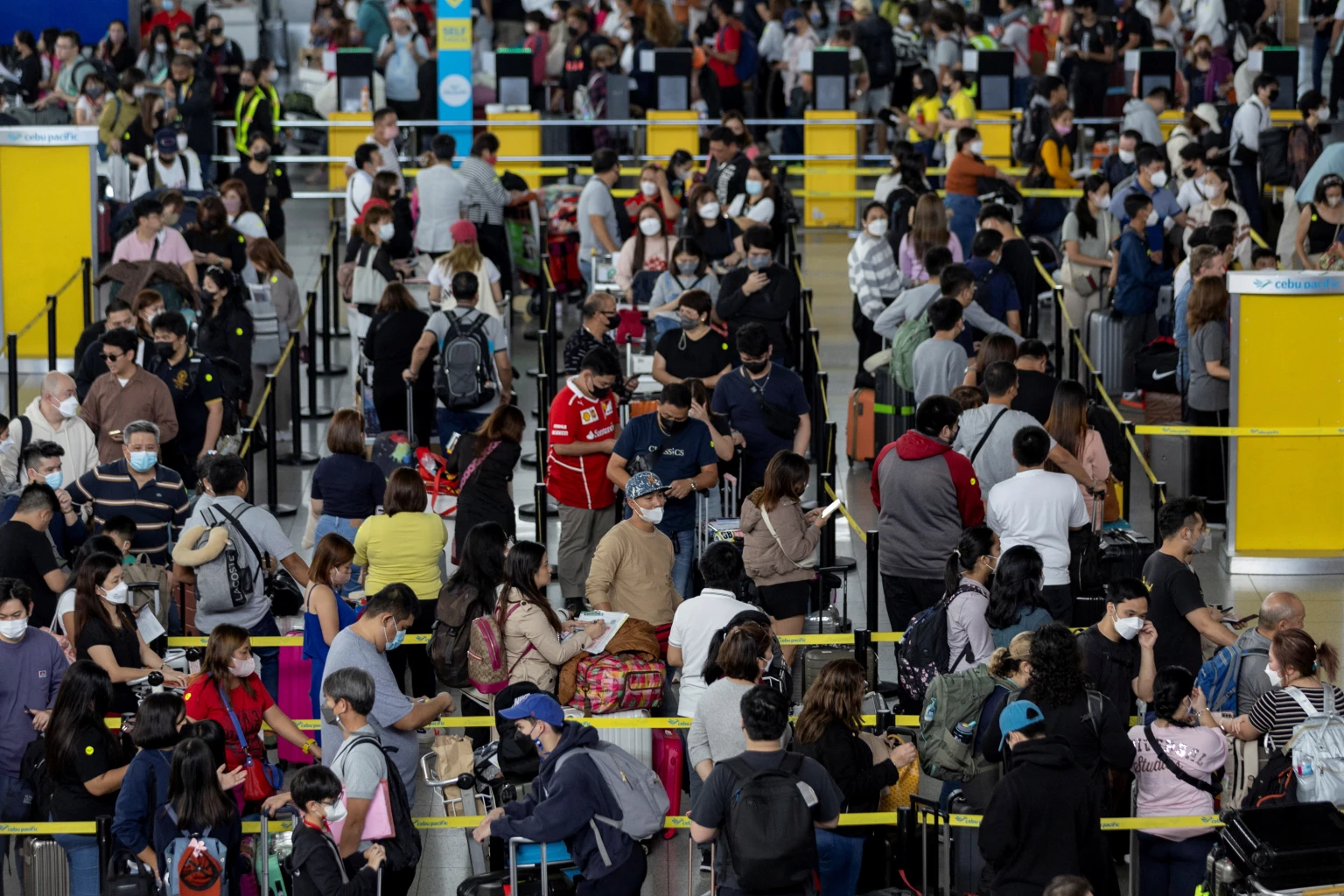
Thousands of exhausted passengers on Monday remained stranded outside the ageing Ninoy Aquino International Airport in Manila after a New Year power outage caused hundreds of flight cancellations.
“In the 24 hours that we’ve been waiting, we are now very exhausted from lack of sleep. My body is aching from all the waiting,” Kirana Mangkabong, a 32-year-old overseas worker, told Reuters. “There’s no place to rest, we just find random corners where we can rest.”
Long queues were seen forming at crowded airport terminals by passengers waiting to rebook their flights.
Cesar Chiong, general manager of the Manila International Airport Authority, said the airport was early on Monday handling a maximum of 15 arrivals per hour compared to 20 during normal operations.
The outage was the result of the unprecedented failure of both primary and secondary power supplies, he said, adding it will take around 72 hours for airlines to normalise their operations.
About 65,000 passengers were affected after 361 flights were either delayed, cancelled or diverted to other regional airports on Sunday, while numerous other flights were forced to re-route to avoid Philippine airspace.
Flag carrier Philippine Airlines said it was arranging recovery flights out of the United States, Singapore and Malaysia, and diverting some flights to domestic airports. Budget carrier Cebu Pacific cancelled 54 domestic flights on Monday.
The Ninoy Aquino International Airport has previously been ranked among the world’s worst international gateways, with flight delays a regular occurrence, and a history of upgrades being delayed or abandoned due to disputes between the airport and contractors.










 SootinClaimon.Com