Tech dream still alive at TED gathering despite Facebook debacle

ศาสตร์เกษตรดินปุ๋ย : ขอบคุณแหล่งข้อมูล : หนังสือพิมพ์ The Nation

http://www.nationmultimedia.com/detail/Startup_and_IT/30343145

x

Tech dream still alive at TED gathering despite Facebook debacle

Tech April 14, 2018 08:46

By Agence France-Presse
Vancouver

A month after news of the data fiasco at Facebook dampened enthusiasm for the idea that innovation can cure all ills, the tech dream was still alive at the big-ideas TED Conference this week.

TED attendees were keenly aware of recent tech troubles, from Facebook being called before Congress over user privacy to a self-driving Uber car’s accident that killed a woman pushing a bicycle across a street.

“The beautiful story we told ourselves that if we just connected the world together everything would get better is not working out,” TED curator Chris Anderson told the gathering which ends Saturday.

But even if the dream has been shaken, it is not broken, according to many of those attending the week-long deep-thinker conference.

“Our situation with technology is complicated, but the big picture is rather simple,” Massachusetts Institute of Technology professor Max Tegmark said in a TED talk.

“We can either be complacent about the future, drift in a rudderless ship to our own obsolescence or be ambitious and think of how we want to steer our technology to an age of amazement.”

Jaron Lanier, an author and technologist credited with pioneering virtual reality, contended that it was clear decades ago that “we were facing a knife-edge future” where the technology we love could be our undoing.

“We have a challenge,” Lanier said during a talk on the TED stage. “We have to create a culture around technology that is so beautiful, so meaningful, so deeply filled with infinite potential that it draws us away from committing mass suicide.”

Even amid the gloom of recent weeks, some TED speakers remained upbeat over the prospects for artificial intelligence to help improve the democratic process; for satellite technology to save marine life; and medical tech that delivers new mechanical limbs and organs.

Free model in question

Lanier said there needs to be more discussion on the current model of the internet in which free social networks and search engines rely on advertising, with targeting techniques growing increasingly precise.

“What started out as advertising became behavior modification,” Lanier said.

“I can’t call these things social networks any more; I call them behavior modification empires.”

Lanier and others at TED saw promise in titans such as Facebook and Google shifting to subscription models that have proven successful for Netflix and Amazon, with subsidies for those who need them.

He advocated a subscription model with financially strapped people provided subsidies and all users paid for personal data that could be valuable to technology firms.

“I am certain that the Googles and the Facebooks would do better in this world,” Lanier said.

There was strong support for the idea of a “digital bill of rights” enshrining in law how people and their data should be treated in a technology-driven world.

Keen attention was being paid to a new data protection standard, the General Data Protection Regulation, set to take effect in May in Europe, with a hope it would blaze a path for others.

The standard gives web users much greater control over how their personal information is stored and used, with big fines for companies that break the rules.

The upbeat view

Steven Pinker, a Harvard professor who has gained notoriety for an upbeat view of progress in the world, told the conference that feelings of gloom about the fate of humanity are misguided.

“You can always fool yourself comparing dramatic headlines of the present with rose-tinted views of the past,” said Pinker, whose recent book “Enlightenment Now” makes the case that prosperity and other measures of well-being are on the rise, in large part due to technological innovation.

“During the decades when the world has gotten happier and healthier, news has gotten darker,” Pinker said.

“The unsolved problems facing the world today are gargantuan, but we must see them as problems to be solved and not inevitable outcomes.”

Here’s why you shouldn’t believe all the copycat claims on the internet

ศาสตร์เกษตรดินปุ๋ย : ขอบคุณแหล่งข้อมูล : หนังสือพิมพ์ The Nation

http://www.nationmultimedia.com/detail/Startup_and_IT/30343121

Here’s why you shouldn’t believe all the copycat claims on the internet

Tech April 14, 2018 01:00

By Philippine Daily Inquirer
Asia News Network

2,746 Viewed

These days it’s easy to plagiarize just about anything through technology. It is also easy to make people think that something is true, when it isn’t. It wouldn’t even be a surprise if you have encountered works that were plagiarized blatantly and yet, people behind it are still proud of it.

But then again, not all claims can be considered true. Take for example this case back in 2016. Blogger
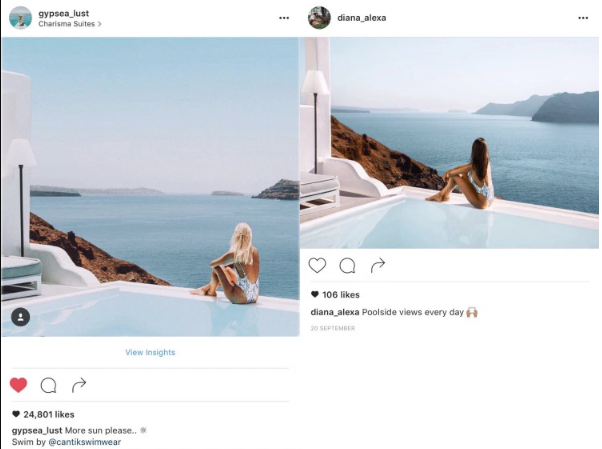
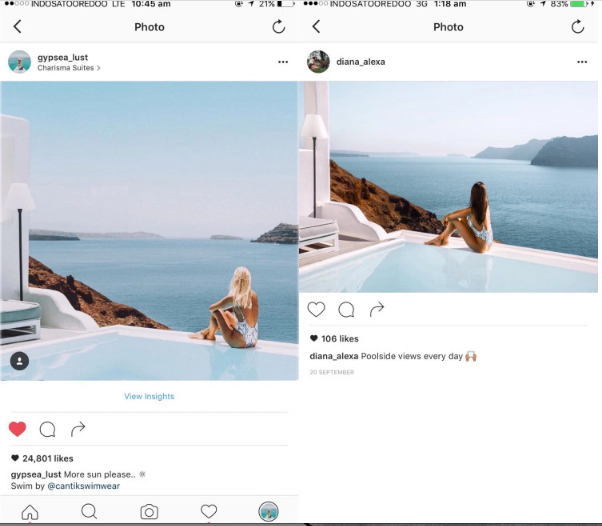
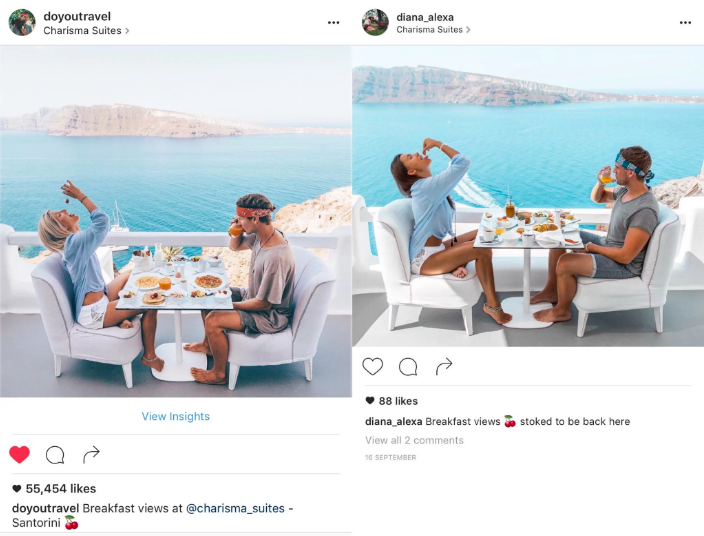
But the Blogger Lauren Bullen claimed that someone is copying most of her Instagram photos. The copycat was very meticulous that it was already creepy. Everything was copied — the location, clothes, pose, and even the captions.

Lauren Bullen, Instagram, copycat, 2016

Lauren Bullen, Instagram, copycat, 2016

Lauren Bullen, Instagram, copycat, 2016

Image source

Lauren Bullen, Instagram, copycat, 2016

But something was problematic about the whole scenario: why would someone go to great lengths of following after her, buying the same set of clothes, and going to the exact locations she went just to copy her Instagram photos?
That’s absurd, and well, very expensive.  It would have been more convincing if she just stole Bullen’s photos and pretended it to be her. That happens more often on the internet and let’s admit it, it’s easier to do and less expensive. The alleged copycat does not even have a lot of followers on her account that it will make you wonder why she would bother spending a lot of money just to copy someone’s photos.

Interesting, right? Some thought so too. They tried to look into the matter and an interesting theory came up. Since they cannot scrub any other information about the alleged copycat, someone found a cached data that indicates the relationship of Diana with Bullen.
In the cached data of Diana’s Twitter account, she listed Bullen’s email and blog (gypsea_lust) that made people conclude that the two were actually associated. After all, Bullen did say that she settled things with Diana after discovering the plagiarized photos (the account has since been made private).

Though Bullen defended that the whole incident wasn’t a hoax, the evidences remain circumstantial.

A word of advice then: don’t believe everything you see on the internet. Verify, research, and take everything with a grain of salt.

Key points from Facebook-Zuckerberg hearings

ศาสตร์เกษตรดินปุ๋ย : ขอบคุณแหล่งข้อมูล : หนังสือพิมพ์ The Nation

http://www.nationmultimedia.com/detail/Startup_and_IT/30343063

Facebook co-founder, Chairman and CEO Mark Zuckerberg smiles at the conclusion of his testimony before the House Energy and Commerce Committee in the Rayburn House Office Building on Capitol Hill April 11, 2018 in Washington, DC./AFP

Key points from Facebook-Zuckerberg hearings

Tech April 12, 2018 14:36

By Agence France-Presse
Washington, United States

2,536 Viewed

Facebook chief Mark Zuckerberg testified for nearly 10 hours over two days on Facebook’s privacy and data protection issues before committees of the Senate and House on Tuesday and Wednesday. Here are key points:

Protecting the platform

“It’s clear now we didn’t do enough,” Zuckerberg said on the protection of private user data and to prevent the hijacking of data on millions by Cambridge Analytica.

Zuckerberg said Facebook was built as “an idealistic and optimistic company” to help people connect but failed “to prevent these tools from being used for harm… that goes for fake news, for foreign interference in elections, and hate speech, as well as developers and data privacy.”

He said that by the end of the year Facebook would have 20,000 people working on security and content review and would also step up use of artificial intelligence to weed out fake accounts and inappropriate content.

Regulation

Zuckerberg said regulation of social media companies is inevitable, but warned that rules could also hamper the industry’s growth.

“The internet is growing in importance around the world in people’s lives, and I think that it is inevitable that there will need to be some regulation,” he told lawmakers.

“But I think you have to be careful about putting regulation in place. A lot of times regulations put in place rules that a company that is larger, that has resources like ours, can easily comply with, but that might be more difficult for a smaller startup company.”

Zuckerberg said the EU’s General Data Protection Regulation (GDPR) to come into effect on May 25 was more stringent than what was currently in place at Facebook and suggested it could serve as a rough model for US rules in the future.

Facebook is implementing the GDPR standards for European users next month, and some of its rules will be extended to US and other users later, he confirmed.

“The GDPR requires us to do a few more things and we are going to extend that to the world,” he said.

Facebook model

Zuckerberg maintained that Facebook users deserve protection of private data but appeared to argue that its controls make it possible to determine how information is shared.

He claimed that “there’s a very common misperception… that we sell data to advertisers,” adding that “we do not sell data to advertisers. We don’t sell data to anyone.”

But he maintained that advertising enables Facebook to offer a free service and that targeted ads based on user categories were more acceptable to users, even if they could opt out.

Zuckerberg also said the company believed in an ad-supported business model, but appeared to leave open the possibility of a paid version.

“There will always be a version of Facebook that is free,” Zuckerberg told the hearing.

Russian manipulation

The 33-year-old CEO said Facebook was in a constant struggle to guard against Russian manipulation of the Facebook platform to influence elections in the US and elsewhere.

“There are people in Russia whose job it is to try to exploit our systems and other internet systems and other systems as well,” he said.

“So this is an arms race. They’re going to keep getting better and we need to invest in getting better at this too.”

Zuckerberg has previously acknowledged the social network failed to do enough to prevent the spread of disinformation during the last US presidential race.

“One of my greatest regrets in running the company is that we were slow in identifying the Russian information operations in 2016,” he said.

“We expected them to do a number of more traditional cyber attacks, which we did identify and notify the campaigns that they were trying to hack into them. But we were slow at identifying the type of — of new information operations.”

He added that Facebook is cooperating with the special counsel investigation into Russian interference in the 2016 election.

“Our work with the special counsel is confidential. I want to make sure in an open session I don’t reveal something that’s confidential,” he said.

US approves artificial-intelligence device for diabetic eye problems

ศาสตร์เกษตรดินปุ๋ย : ขอบคุณแหล่งข้อมูล : หนังสือพิมพ์ The Nation

http://www.nationmultimedia.com/detail/Startup_and_IT/30343033

x

US approves artificial-intelligence device for diabetic eye problems

Tech April 12, 2018 06:58

By Agence France-Presse
Washington, United States

US regulators Wednesday approved the first device that uses artificial intelligence to detect eye damage from diabetes, allowing regular doctors to diagnose the condition without interpreting any data or images.

The device, called IDx-DR, can diagnose a condition called diabetic retinopathy, the most common cause of vision loss among the more than 30 million Americans living with diabetes.

Its software uses an artificial intelligence algorithm to analyze images of the eye, taken with a retinal camera called the Topcon NW400, the FDA said.

“A doctor uploads the digital images of the patient’s retinas to a cloud server on which IDx-DR software is installed,” said the agency in a statement.

The answer comes back that the patient’s eye problem is “more than mild” and they should seek treatment from a specialist, or it is negative for diabetic retinopathy and the patient can be rescreened in a year.

“IDx-DR is the first device authorized for marketing that provides a screening decision without the need for a clinician to also interpret the image or results, which makes it usable by health care providers who may not normally be involved in eye care,” said the FDA.

A clinical trial of the device’s effectiveness — based on images from 900 patients with diabetes — found it could correctly identify more than mild diabetic retinopathy 87 percent of the time, and patients who did not have more than mild diabetic retinopathy 90 percent of the time.

Use of the device is not recommended for people with a history of laser treatment, surgery or injections in the eye; those with persistent vision loss, blurred vision, floaters; or certain retinal disorders.

It is also not recommended for pregnant women because diabetic retinopathy can progress very rapidly and “IDx-DR is not intended to evaluate rapidly progressive diabetic retinopathy,” the FDA said.

Malvina Eydelman, director of the division of ophthalmic, and ear, nose and throat devices at the FDA’s Center for Devices and Radiological Health, said the device may help millions of people with diabetes, about half of whom do not see their eye doctor yearly.

“Today’s decision permits the marketing of a novel artificial intelligence technology that can be used in a primary care doctor’s office,” she said.

#ZuckerBowl without a clear winner as Facebook hearings end

ศาสตร์เกษตรดินปุ๋ย : ขอบคุณแหล่งข้อมูล : หนังสือพิมพ์ The Nation

http://www.nationmultimedia.com/detail/Startup_and_IT/30343032

Facebook co-founder, Chairman and CEO Mark Zuckerberg testifies before the House Energy and Commerce Committee in the Rayburn House Office Building on Capitol Hill April 11, 2018 in Washington, DC./AFP

#ZuckerBowl without a clear winner as Facebook hearings end

Tech April 12, 2018 06:55

By Agence France-Presse
Washington

4,715 Viewed

Facebook founder Mark Zuckerberg emerged largely unscathed Wednesday from two days of high-stakes hearings that saw US lawmakers grill the billionaire over how the online giant feeds users’ data to advertisers and chide him over privacy rights.

The marathon 10 hours of questioning was one of the biggest spectacles in Congress in recent memory, followed blow by blow on social media under the hashtags #ZuckerBowl and #ZuckUnderOath.

Channeling public anger over data privacy lapses — including most spectacularly the leak of personal information from 87 million Facebook users to a political consultant — lawmakers in both House and Senate raised the specter of regulations to bring online firms to heel.

The 33-year-old CEO conceded that some regulation of social media companies is “inevitable,” while offering a laundry list of reform pledges at Facebook and vowing to improve privacy and security.

But he stiffly defended Facebook’s business model — specifically the way it uses data and postings from the 2.2 billion users of its free platform — calling it necessary to attract ad revenue the $480 billion company depends on.

In the wake of the massive leak of user information to Cambridge Analytica, which worked for Donald Trump’s 2016 campaign, Zuckerberg reiterated that the company had shut down the pipeline that allowed data — including his own — to slip without consent into the hands of third parties.

A day earlier Zuckerberg took personal responsibility for the data breach.

Yet in his testimony to the House Energy and Commerce Committee, he was also steadfast in arguing that Facebook’s users themselves are choosing to make their data available, and that the company’s “opt-in” provisions offered them sufficient control.

“Every time that a person chooses to share something on Facebook, they’re proactively going to the service and choosing that they want to share a photo, write a message to someone.”

“Every time there is a control right there,” Zuckerberg said.

‘Real trust gap’

Zuckerberg faced tougher questions from House lawmakers over Facebook’s stance than during Tuesday’s five-hour session in the Senate, where his defense of data sharing was weakly challenged.

“It strikes me that there’s a real trust gap here. Why should we trust you?” asked Democratic Representative Mike Doyle.

“The only way we’re going to close this trust gap is through legislation that creates and empowers a sufficiently resourced expert oversight agency, with rulemaking authority to protect the digital privacy and ensure that companies protect our users’ data.”

A path forward

Some analysts said Zuckerberg’s appearance suggests a new path forward for social media under closer scrutiny.

“Zuckerberg’s testimony demonstrated that the company has matured over the last decade, in particular in his acknowledgement that Facebook is responsible for the content shared on its platform,” said University of Delaware communications professor Dannagal Young.

“Acknowledging responsibility for the content shared on the platform changes how Facebook ought to engage in gatekeeping and fact-checking, and how the government might go about regulating the industry.”

Syracuse University professor Jennifer Grygiel called the hearings “an important milestone.”

“This is a first step in the process of writing much needed regulation,” she said.

“It is clear from congressional testimony that self-regulation alone is not working and that regulatory oversight is needed in the United States in order to ensure safe social media.”

– ‘Glaring gaps’ in understanding –

Noting that a European data protection standard due to come into effect on May 25 was more stringent than what was currently in place at Facebook, Zuckerberg suggested it could serve as a rough model for US rules in the future.

Facebook is implementing the General Data Protection Regulation (GDPR) standard for European users next month, and some of its rules will be extended to US and other users later, he confirmed.

“The GDPR requires us to do a few more things and we are going to extend that to the world,” he said.

By one measure, Zuckerberg succeeded in his Washington appearance. Facebook shares rose five percent on Tuesday and added another 0.78 percent Wednesday in what was seen as a sign of confidence in the company after steep losses in recent weeks.

“To me, he came across as very conciliatory, especially when he took full responsibility for the mistakes of his company,” said Jessica Vitak, head of the University of Maryland’s Privacy and Education Research Lab.

“This seems to be a relatively new approach for the company and I believe at least in part responding to critique of Facebook’s slow and somewhat tone-deaf response to prior breaches that have led to user outrage.”

Others noted however that lawmakers had demonstrated little knowledge of how Facebook works — potentially complicating any regulatory effort.

“Perhaps the most important revelation of Zuckerberg’s testimony are the glaring gaps in our lawmakers’ understanding of the internal logic and business model of Facebook,” Young said.

“No one is going to be able to sufficiently regulate’ Facebook until lawmakers are adequately educated about how it works.”

$666m lost in massive cryptocurrency fraud in HCM City

ศาสตร์เกษตรดินปุ๋ย : ขอบคุณแหล่งข้อมูล : หนังสือพิมพ์ The Nation

http://www.nationmultimedia.com/detail/Startup_and_IT/30342997

Headquarters of the Modern Tech JSC Co at 68 Nguyễn Huệ Street, District 1, HCM City. — Photo nld.vn

$666m lost in massive cryptocurrency fraud in HCM City

Tech April 11, 2018 17:03

By Viet Nam News/ANN

2,432 Viewed

HCM CITY – As many as 32,000 people have fallen victim of an alleged cryptocurrency fraud in HCM City, involving a sum of up to US$666 million.

HCM CITY — The State Bank of Vietnam (SBV) was closely following an alleged cryptocurrency fraud in HCM City, to which as many as 32,000 people could have fallen victim, involving a sum of up to VNĐ15 trillion (US$666 million), a bank official said.

Nguoi Lao Dong (The Labourer) newspaper on Tuesday cited SBV HCM City Branch deputy director Nguyễn Hoàng Minh saying that the bank would co-operate with police to investigate the case.

On Sunday afternoon, dozens of people gathered at the headquarters of the Modern Tech JSC Co at 68 Nguyễn Huệ Street, District 1, carrying banners saying “biggest digital money fraud in history” to protest against the company.

The location, however, was a ghost address. No activities of the company took place there.

According to the protesting citizens, Modern Tech advertised the cryptocurrency iFan to potential investors, promising them huge monthly interest of at least 48 per cent, in cash, and four months as the maximum time for full payback. Those who could invite others to buy the digital currency would also enjoy a commission of 8 per cent.

The only condition for the investors was that they had to buy at least $1,000 worth of the digital money.

For many, the lucrative offer was too tempting to decline. More than 32,000 investors poured some VNĐ15 trillion into buying virtual money.

However, Modern Tech changed their policy following a global cryptocurrency crash late last year which caused iFan’s value plummeted to about 1 US cent per iFan.

The company no longer paid interest and principle back to the investors in cash, but in iFan currency. Modern Tech set iFan’s value at $5, much higher than the market price, causing losses to the customers.

Victim Lê Thị Hương said that a group of high-level investors in the pyramid-structured company used to organise meetings and deliver speeches to attract more investors, but they started denying their involvement with the company when the cryptocurrency market collapsed in 2017.

All their Facebook accounts disappeared in January this year, Hương said.

“It was only then that we truly understood what we had refused to believe before. Our money is all lost,” she said.

Minh said that cryptocurrency was not legally recognised by the SBV and hence it would be very difficult to protect the rights of digital money owners.

Police are investigating the case.

Social media site telling users if they were hit by illegal data sharing

ศาสตร์เกษตรดินปุ๋ย : ขอบคุณแหล่งข้อมูล : หนังสือพิมพ์ The Nation

http://www.nationmultimedia.com/detail/Startup_and_IT/30342996

Facebook users will receive notifications telling them whether they were among those affected by the improper sharing of information with Cambridge Analytica, nearly three weeks after news of the scandal broke. PHOTO: FACEBOOK

Social media site telling users if they were hit by illegal data sharing

Tech April 11, 2018 16:56

By The Straits Times/ ANN

SINGAPORE – This marks the first time users will know if their account information was shared improperly or not, almost three weeks since news of the scandal first broke.

If you are among the 65,000 Facebook users in Singapore whose data was shared improperly with Cambridge Analytica, you are in the process of being told about it.

Facebook has started reaching out to all its account holders – including the 87 million worldwide whose data was shared improperly – to let them know whether they were affected.

This marks the first time users will know if their account information was shared improperly or not, almost three weeks since news of the scandal first broke.

Those with affected accounts will see a notification at the top of their Facebook News Feed, informing them how they are affected.

The social media website had told tech news site The Verge in a report that ran early yesterday morning that “the notification is rolling out over the course of today”.

Affected users will see one of two notifications, with both saying that the thisisyourdigitallife app was banned by the company for misusing Facebook information.

Users could have had their data compromised either because they logged into the app on their own account, or one of their friends did so.

“We did this because the app may have misused some of your Facebook information by sharing it with a company called Cambridge Analytica,” the notifications read.

Furthermore, all of Facebook’s 2.2 billion users will also see a prompt at the top of their News Feed that gives them quick access to check which apps and websites they are currently sharing data with.

Users can then choose to remove these apps and websites from their account, which stops them from accessing further data from the users’ profiles.

These notifications are part of Facebook’s attempts to deal with the global scandal where information about its users was accessed improperly by third-party companies.

The process seems to be taking its time. A mock-up of the notification being sent to users was first posted on a blog post by Facebook’s chief technology officer Mike Schroepfer last Wednesday, which stated that Facebook users would start seeing it on Monday.

However, according to international reports, most Facebook users had not received the notifications even on Monday night.

The social media company revealed last week that 65,009 Facebook users here had their information shared inappropriately with Cambridge Analytica, which exploited the data for commercial and political use.

The thisisyourdigitallife app was a personality quiz administered by data scientist and academic Aleksandr Kogan from Cambridge University, who paid hundreds of thousands of users to take it for academic research purposes.

However, the app also collected information on the test-takers’ Facebook friends, leading to a data pool of more than 80 million users.

Facebook banned the app in 2015, but the data collected was not destroyed, in violation of Facebook’s personal data policy.

Netizens set up fan page on Facebook to car pool

ศาสตร์เกษตรดินปุ๋ย : ขอบคุณแหล่งข้อมูล : หนังสือพิมพ์ The Nation

http://www.nationmultimedia.com/detail/Startup_and_IT/30342995

Netizens set up fan page on Facebook to car pool

Tech April 11, 2018 16:52

By Sin Chew Daily/ANN

KELANTAN, Malaysia – While tickets for public transport are selling like hot cakes the moment polling date was announced, creative netizens started fan page to car pool so that everyone gets to vote and reduce travelling cost at the same time.

Election Commission of Malaysia has fixed 9 May as polling day for its 14th General Election.Flight tickets are not cheap to fly home on polling day. Netizens launch `car pool to return home for ballot” instead, right after polling date was announced yesterday.The campaign named ` Jom Balik Undi’ (Car pool to return home for ballot) has more than 4,000 netizens joining as members.

The slogan of this fan page is: You are not alone, let’s car pool to return home for ballot!The administrator of the fan page called for every voter, especially those who are working outstation to cast their votes in deciding the fate of the country.“The car pool plan connects those working outstation, reduce travelling costs and to unite those from the same home town to decide on the future of the country.”

Lee Cooper posted his message of intending to return to Kuala Lumpur from Singapore and the idea of car pool would not be too taxing for him financially.“I have four seats. If I manage to fill up all the seats I should be off (from work) on 9 May. I start driving at 10 pm the night before.

“I would be waiting at the Johor checkpoint. Those keen please PM (private message) to discuss.”

Another netizen said election as is near, tickets for all types of public transport are sold out. Various state constituencies should plan how to ferry voters home and send them back to work. Voters from Kelantan who work outside the state are complaining the sudden surge in air ticket prices. The price of air ticket to Kota Bharu was less than RM100 (USD$25.6) in the morning but soared to between RM200 (USD$51.28) and RM300 (USD$76.92) the moment polling date was announced.

Liu De Ming, a voter from Kota Bharu spent RM600 (USD $153.85) for return tickets for two persons. He hoped everyone can return home to cast their ballot. Mo Shun Yi, another voter from Kota Bharu, said a ticket from Kuala Lumpur to Kota Bharu on 8 May (one day before polling day) also cost more than RM300 (USD$76.92)

IBTE enters into apprenticeship partnership with 3 telcos

ศาสตร์เกษตรดินปุ๋ย : ขอบคุณแหล่งข้อมูล : หนังสือพิมพ์ The Nation

http://www.nationmultimedia.com/detail/Startup_and_IT/30342993

IBTE enters into apprenticeship partnership with 3 telcos

Tech April 11, 2018 16:49

By Borneo Bulletin/ANN

BANDAR SERI BEGAWAN – The Institute of Brunei Technical Education (IBTE) entered into an apprenticeship partnership with three telecommunication companies with the signing of a Memorandum of Understanding (MoU) yesterday at the Lecture Theatre of the School of Aviation, IBTE Sultan Saiful Rijal Campus.

The agreement will see 14 IBTE students enrolled under the institute’s HNTec Apprenticeship Scheme for Telecommunications and Information Technology programme undergo on-the-job training at DST Communications Sdn Bhd, Progresif Cellular Sdn Bhd or Telekom Brunei Berhad (TelBru) during the course of their study programme.

The MoU was signed by Munirah Atirah binti Dato Paduka Haji Othman, Acting Chief Executive Officer (Corporate) of IBTE; David J Holliday, Chief Executive Officer (CEO) of TelBru; Paul Treston Taylor, CEO of Progresif Cellular Sdn Bhd; and Ramlah binti Haji Rabaha, Assistant General Manager of DST Group Human Resources on behalf of DST Communications Sdn Bhd.

Present to witness the signings was Haji Shariful Bahri bin Haji Sawas, Acting Deputy Commissioner of Labour, Ministry of Home Affairs.

Prior to the ceremony, Lim Kian Boon, Deputy CEO (Development) of IBTE in his capacity as the Acting CEO of IBTE, shared in his welcoming remarks that 46 apprentices have enrolled in the HNTec Apprenticeship Scheme since May 2014.

“This apprenticeship scheme, I believe, will help foster a long term partnership with the industry to help train students and produce skilled technicians to fill the gaps that exist in the telecommunications sector,” he said.

Lim added that through the apprenticeship schemes, IBTE is able to produce graduates with relevant occupational skills needed by the industry.

“As with Germany’s Dual System Apprenticeship, IBTE’s Dual System Apprenticeship programme allows the students to concurrently earn while they learn.

“The Dual System Apprenticeship provides an effective means of bridging the gap between school and the real working world by exposing students to a real-world work environment during their training,” he said.

The deputy CEO said workplace-oriented training programmes help in producing a highly skilled and job-ready workforce, allowing the apprentices to develop their skills to meet the needs of the industry and the labour market.

The collaboration between IBTE and the three telecommunications firms, Lim added, will provide an avenue for the students to acquire valuable industry experience and training, thus enhancing their employability upon completion of the programme.

“From the apprenticeship programme, the students will have the opportunity to maximise their learning experience and put theory to practice in a real working environment, as the programme combines institution-based training with on-the-job training which allows the students to understand both the practical and theoretical aspects of their jobs,” Lim said.

Recognizing scientific excellence with the Asian Scientist 100

ศาสตร์เกษตรดินปุ๋ย : ขอบคุณแหล่งข้อมูล : หนังสือพิมพ์ The Nation

http://www.nationmultimedia.com/detail/Startup_and_IT/30342906

[https://www.asianscientist.com]
[https://www.asianscientist.com]

Recognizing scientific excellence with the Asian Scientist 100

Tech April 10, 2018 15:02

These early career scientists and veteran researchers of the Asian Scientist 100 are making waves in diverse sectors of academia and industry, shedding light on natural phenomena and developing new technologies for a better world.

AsianScientist (Mar. 8, 2018) – Now into its third consecutive year, the Asian Scientist 100 (2018 edition) is a handpicked selection of 100 prize-winning Asian researchers, academicians, innovators and business leaders from across the Asia Pacific region. To be acknowledged on this list, honorees must have received a national or international prize in 2017 for their scientific research. This prize must involve a competitive selection procedure. Alternatively, in the same period, the honoree could have made a significant contribution in scientific discovery or leadership that has benefited either academia or industry. Spanning a diverse range of industries in science and technology, this year’s selection comprises honorees from China, India, Japan, Singapore, South Korea, Malaysia, the Philippines, Taiwan, Thailand and Vietnam. While the AS100 is by no means exhaustive, it showcases the exciting science taking place in Asia and raises the profile of researchers that are making invaluable contributions to their fields. “The quantity and quality of research coming out of Asia has increased significantly in recent years. In showcasing the best and brightest that Asia has to offer the world, we hope that the AS100 list will inspire young scientists across Asia,” said Dr. Juliana Chan, the founder and editor-in-chief of Asian Scientist Magazine. “Because science is an increasingly global and networked endeavor, this list also opens up opportunities for international collaboration.” The list, in no order of merit, is available online here.

Scientists featured on the Asian Scientist 100 (2018 edition):

1. S. Suresh Babu 2. Jitendra Nath Goswami 3. Rogel Mari Sese 4. Min Aung 5. Rajan Man Bajracharya 6. Hari Krishna Dhonju 7. Chandra Siddaiah Nayaka 8. Kalvakuntla Chandrasekhar Rao 9. Sheetal Sharma 10. Hiroshi Uchino 11. Chen Wen 12. Amit Dutt 13. Tamao Endo 14. Tatsushi Toda 15. Deepak Gaur 16. Edward Holmes 17. Sir David Lane 18. Li Jingmei 19. Mario Antonio Jiz II 20. V. Narry Kim 21. Tadamitsu Kishimoto 22. Michael Ming-Chiao Lai 23. Seiji Ogawa 24. Paik Soonmyung 25. Shimon Sakaguchi 26. Paul Kwong Hang Tam 27. Tu Youyou 28. Tehemton Erach Udwadia 29. Yu Nam-Kyung 30. Lucille V. Abad 31. Pimchai Chaiyen 32. Pussana Hirunsit 33. Kim Myung-hwan 34. Ganpathi Naresh Patwari 35. Long Ran 36. Phan Thanh Sơn Nam 37. Mitsuo Sawamoto 38. Xiaoliang Sunney Xie 39. Sanghamitra Bandyopadhyay 40. Cha Hyung Joon 41. James C. C. Chan 42. He Jinliang 43. Jang Jin 44. Anchalee Manonukul 45. Neelesh B. Mehta 46. Takashi Mimura 47. Lanndon A. Ocampo 48. Pack Sangheon 49. Chandrakant Pithawa 50. Tang Ching Wan 51. Jackie Y. Ying 52. Kenneth Mei-yee Leung 53. Jeffrey S. Perez 54. Yan Ning 55. Aletta Concepcion T. Yñiguez 56. Shigeiki Goto 57. Tanzima Hashem 58. Narayana Murthy 59. Wu Jianping 60. Chang Meemann 61. Lam Khin Yong 62. Ajoy Kumar Ray 63. Jenny Huey-Jen Su 64. Subra Suresh 65. Phillip A. Alviola 66. Upinder Singh Bhalla 67. Varodom Charoensawan 68. Sanjeev Das 69. Tetsuya Higashiyama 70. Deepak Thankappan Nair 71. Shigetou Namba 72. Marisa Ponpuak 73. Shi Yigong 74. Son Young-Sook 75. Yasuhiko Arakawa 76. Napida Hinchiranan 77. Lee Jong-heun 78. Aloke Paul 79. Justin C.W. Song 80. Toshimitsu Yokobori 81. Zhao Zhongxian 82. Zhu Yanwu 83. Gan Wee Teck 84. Ritabrata Munshi 85. Sum Nguyễn 86. Xu Chenyang 87. Chen Shiyi 88. Choi Sookyung 89. Gao Weibo 90. Vinay Gupta 91. Nathaniel Hermosa II 92. Nissim Kanekar 93. Pan Jianwei 94. David Ruffolo 95. Fumihiko Takasaki 96. Adeeb Hayyan 97. Li Junfeng 98. Ng Wun Jern 99. Felycia Edi Soetaredjo 100. Xie Zhenhua