SET expected to see fluctuation amid mixed signals
The Stock Exchange of Thailand (SET) Index rose by 8.61 points, or 0.56 per cent, to 1,552.89 on Friday morning.
The SET Index closed at 1,544.28 on Thursday, down 7.59 points or 0.49 per cent. Transactions totalled THB78.14 billion with an index high of 1,553.90 and a low of 1,543.75.
Krungsri Securities forecast the index on Friday would fluctuate between 1,535 and 1,555 points amid mixed positive and negative sentiments.
It predicted the index would be under pressure after the US Federal Reserve signalled it would reduce its quantitative easing programme, the falling oil price and ongoing anti-government protests in Thailand.
“However hopes of the lockdown being eased, as domestic Covid-19 cases stabilise, and the improving vaccination rate would help boost the index,” Krungsri Securities said.
ADVERTISEMENTx
It recommended selective buying as an investment strategy:
▪︎ HANA, KCE, TU, CPF, GFPT, ASIAN, EPG and NER, which benefit from the weakening baht.
▪︎ PSL, TTA and RCL, which would benefit from a rise in the freight rate.
▪︎ AOT, CPN, CRC, HMPRO, AAV, BA, MINT, CENTEL, AMATA and WHA , which would benefit from the country’s reopening.
Exporters sale of dollars checks bahts slide despite strengthening US currency
The baht opened at 33.35 to the US dollar on Friday, unchanged from Thursday’s closing rate.
The Thai currency is likely to move between 33.30 and 33.45 during the day, Krungthai Bank market strategist Poon Panichpibool said.
Poon explained that the baht had not weakened in proportion with the strengthening of the dollar, as exporters continued to sell dollars, while investors were short-selling the Thai currency as the Covid-19 situation has almost reached its worst point.
He said the baht was likely to fluctuate and weaken due to the Covid-19 crisis and the rising dollar, amid demand for safe-haven assets and the Federal Reserve’s likely decision to reduce quantitative easing (QE) this year.
Investors’ stocks might be affected if the Fed decides to decrease liquidity support or QE. Investors will temporarily decrease their investments in Asian emerging markets, as they might be worried about the effects of a reduction in QE, such as the QE Taper Tantrum incident in 2013.
ADVERTISEMENTx
He expected the key resistance level would be between 33.40 and 33.50 to the US dollar, as exporters are waiting to offload more dollars.
He said the key support level would be around 33.00 to the dollar, which is the price range importers are waiting for before they make purchases. If there are large transactions, the baht might be volatile on Friday.
Toyota cuts show chip shortage ravages even best supply planners
Toyotas efforts to stockpile enough chips and other key components to ride out supply disruptions only protected the company so long before it too succumbed to the shortages eviscerating automakers.
The manufacturer will suspend production at all of its 14 Japanese assembly plants for various lengths of time through next month. The impact of these cuts will be harshest in September, with Toyota slashing its production plan by 40%, though risks will carry forward beyond next month.
It’s the latest sign even the best supply-chain planning is proving no match for a pandemic that virtually ground the auto industry to a halt a year ago and has plagued efforts to restore production. Toyota and BMW — two manufacturers least scathed by the semiconductor shortage in the first half — have now warned of significant blows to their operations in the coming months.
“This isn’t a Toyota-only problem,” said Tetsuo Seshimo, a fund manager at Saison Asset Management Co. “But the fact that this is happening at Toyota means that recent worries about the supply chain in Asia being disrupted by the spread of the coronavirus are materializing. There are a lot of companies manufacturing goods in Asia that could be impacted.”
ADVERTISEMENTx
Toyota said 27 assembly lines in Japan will be impacted, affecting production of models including the RAV4, Corolla, Prius, Camry and Lexus RX. The news — first reported by the Nikkei — took the market by surprise, with investors sending Toyota shares down 4.4%, their biggest daily drop since December 2018.
“Especially in Southeast Asia, the spread of Covid and lockdowns are impacting our local suppliers,” Kazunari Kumakura, the chief officer of Toyota’s purchasing group, said Thursday. Going forward, the company will look at ways to further diversify its supply chains to not focus on one region and is attempting to find replacement parts from suppliers in other regions.
Production cuts had been factored into previous forecasts, so Toyota is maintaining its plan to produce 9.3 million vehicles for the fiscal year ending in March. The company maintained its annual operating profit projection earlier this month at 2.5 trillion yen ($22.7 billion) for the fiscal year through March, below analysts’ average projection for 2.95 trillion yen.
Early on in the chip shortage that began late last year, Toyota was lauded for its supply-chain savvy. The company has an intricate system in place to monitor its vast network of suppliers and has an early-warning system for shortages.
That may be no match for a pandemic that’s confounding scientists, governments and public-health officials, sparking fresh lockdowns around the world and wreaking more havoc on a vast array of industries.
BMW recently warned of uncertain months ahead as the global chip shortage worsens. After saying early this year it had ordered enough semiconductors and expected its suppliers to deliver, the luxury-car maker now expects production restrictions in the second half.
Volkswagen also has flagged worsening supply woes, while Daimler dialed back its delivery expectations due to the shortage.
According to research by Susquehanna Financial Group, the amount of time it’s taking for chip-starved companies to get orders filled has stretched to more than 20 weeks, indicating the shortages that have held back automakers and computer manufacturers are getting worse.
“Companies were saying it was a problem for the first half, but it’s astonishing what kind of strong figures they reached,” said Frank Schwope, an autos analyst at NordLB in Hanover. “But now, the chip shortage is coming in dramatically, showing that there must be some serious problems.”
Published : August 20, 2021
By : Syndication Washington Post, Bloomberg · River Davis, Craig Trudell
Biden administration faces big choices as economic calamity hangs over Afghanistan
Afghanistans economy faces calamity in the aftermath of the Taliban capture of Kabul, with the United States freezing the countrys financial reserves, residents unable to withdraw their money from bank accounts and billions of dollars of international aid put on hold.
The dangerous economic climate poses a major dilemma for the Biden administration as it tries to maintain leverage over the Taliban without exacerbating the severe economic conditions that threaten to immiserate millions of Afghan citizens. Biden administration officials are monitoring the situation closely and have said they will resume the flow of humanitarian aid, but they have not signaled how they plan to proceed.
Senior officials in Afghanistan’s toppled government have warned in recent days that parts of the nation’s economy are on the brink of devastation, given the country’s high dependence on international funding. Acting central bank governor Ajmal Ahmady, who recently fled the country, said in an interview that the nation’s economy faces severe strains as foreign capital and aid are choked off.
ADVERTISEMENTx
Similarly, Wahid Majrooh, the acting minister of public health in Afghanistan, told The Washington Post that he is “deeply, deeply concerned” about cuts in international aid and funding for the Afghan government’s national health-care system. Majrooh said in an interview that he is already facing shortages of critical medical supplies such as bandages, sutures, syringes, catheters and other “basic supplies for emergency rooms.” He said he is pleading with international officials to maintain public health funding for Afghanistan, despite the Taliban takeover, but has largely not yet received a clear response.
The threat to the broader economy also appears serious. Exports and imports are reported to have cratered as major borders close to traffic. A half-dozen people in communication with Afghan residents reported dramatic price increases and shortages in grocery stores. Fears are also mounting about the impact of a failure for the Afghan government to pay its workforce – the largest employer in the country – when paychecks are due this month.
“The situation will be dire,” Majrooh said.
Ahmady, the former central banker fled in recent days, warned of a surge of refugees if the economic devastation is prolonged. “There will be a restructuring of the economy, with the currency depreciating, inflation rising, and real incomes declining. It’s going to cause a significant economic impact,” he said.
The warnings come as the Biden administration faces critical decisions over how to maintain leverage over the Taliban without allowing the country to tip into an economic disaster that would likely hurt everyday Afghans.
ADVERTISEMENT
President Joe Biden vowed in his public address earlier this week that aid to the Afghan people would continue, despite the U.S. withdrawal from the country. That pledge may prove difficult to keep in practice, given the prospect of the Taliban standing between international donors and the intended recipients of the money. The U.S. is also not expected to want to lift financial restrictions on the Afghan government until the White House sees how the Taliban governs the country, posing a further logistical hurdle.
On Sunday, the U.S. Treasury Department froze Afghan central bank assets kept in the U.S. The move will prevent the Taliban from accessing the bulk of the $9 billion in central bank reserves held by the Afghan government, but could exacerbate the financial crisis feared by many experts.
The administration is also grappling with how to handle existing sanctions on the Taliban that may chill the flow of international aid and funds into the country. Roughly 80 percent of the Afghan government’s budget comes from international grants and aid, according to PGIM Fixed Income, a global income manager. Billions of dollars in existing congressional appropriations to Afghanistan – primarily in the form of military support – are expected to cease flowing.
The International Monetary Fund also announced this week that Afghanistan would not have access to hundreds of millions of dollars in emergency funds that were scheduled to be disbursed to the country next week. IMF spokesman Gerry Rice in a statement said the payments could not be made due to the “lack of clarity within the international community regarding recognition of a government in Afghanistan.”
While Biden administration officials and other international groups faced pressure to cut off the international funds after the Taliban took power, the economic consequences of doing so on Afghanistan’s population could be difficult to unravel, experts said.
ADVERTISEMENT
“The last thing the Afghan people need right now is an economic crisis on top of a political and security crisis. The challenge for Washington is squaring that increasingly urgent need for cash and access to international reserves with the desire to not empower the Taliban,” said Elizabeth Threlkeld, senior fellow and deputy director of the South Asia Program at The Stimson Center, a foreign policy think tank. “That’s the fundamental tension.”
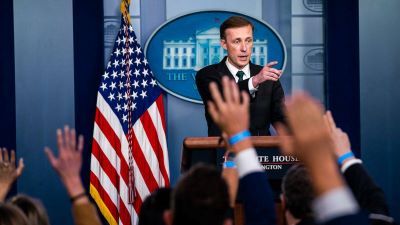
White House National Security adviser Jake Sullivan reiterated to reporters on Tuesday that the U.S. has means of delivering aid to those in need in a way that bypasses other governments.
“I don’t want to get into hypotheticals, but I would point out that there are a range of different diplomatic relationships the United States has with countries around the world, including some in very difficult or nonexistent relationships with governments where we still provide forms of aid to people,” Sullivan said. “And I will leave it at that, because we’re not at a point yet where we can speak directly to how things will play out in Afghanistan.”
White House and State Department officials say the U.S. will continue to provide aid to Afghanistan as it has in other countries where it has strained relations, such as Venezuela or Yemen. “Whatever course we take will not prevent humanitarian aid,” said a senior administration official.
But in those countries, the U.S. provides funding to aid organizations working there rather than payments directly to the government. In the case of Afghanistan, Congress appropriates billions of dollars in direct government aid.
Now that a designated terrorist group is in charge of the government, U.S. officials are prohibited from transferring funds to the Afghan government in the absence of a new U.S. license. Given the Biden administration’s profound disagreements with the Taliban it has to determine what aid it is willing to continue. However, the administration has been explicit that it does not yet recognize the Taliban as the official government of Afghanistan, which may mean the sanctions do not yet affect funding for the Afghan government.
It has stressed the importance of unifying its approach with other world powers and international institutions. That is likely to prove at least as difficult as getting world powers on the same page for simply recognizing the Taliban diplomatically.
China and Russia have both issued warm statements about the Taliban in recent days but have stopped short of formally recognizing its rule. Canadian Prime Minister Justin Trudeau said his government had “no plans” to recognize Taliban rule.
The European Union’s top diplomat, Josep Borrell, said the trade bloc would open a channel of communication with the Taliban but stop short of recognition. “The Taliban have won the war, so we will have to talk with them,” he said.
On Wednesday, Deputy Secretary of State Wendy Sherman said “each country, of course, makes its own decisions,” but said Secretary of State Antony Blinken had begun talks with his Chinese and Russian counterparts “try to all head in the same direction.”
The State Department has said the manner in which the Taliban governs the country will be the central factor in determining recognition. But even if the Taliban rules as inclusively as it says it will, untangling aid-limiting terrorism sanctions on the militant group will require an international effort as many are enshrined in resolutions approved by the United Nations Security Council resolutions, said experts.
The U.S. may continue to provide aid to Afghanistan without going through the Taliban through organizations that continue a presence in the country despite the fighting. The United Nations High Commissioner for Refugees remains operational in about two-thirds of the districts in the country with a staff of about 200, said Chris Boian, a spokesman with the organization. He says his organization will stay as long as it safely can, but the need is great.
“Violence and insecurity have prompted the displacement of more than half a million Afghan civilians this year,” Boian said. “Many of them are women and girls.”
The impact of the withdrawal on Afghanistan’s economy may be mitigated by a few factors. The country has a relative lack of dependence on the international financial system, as most Afghanis do not have a bank account and largely operate outside the traditional economy.
Jehanzaib Zafar and Hamza Kamal, analysts at AKD Securities Ltd, told Bloomberg that other regional powers such as China, Iran, and Pakistan could help the Afghan economy and maintain peace.
“The integrated economic interests of major powers in the region will help bring these players closer and work together and potentially bring peace and economic prosperity,” they said.
But signs of danger are mounting. Afghan’s currency, the Afghani, fell dramatically this week, with its value dropping by about 5 percent to 86 per dollar, according to Bloomberg. Germany has suspended approximately $300 million in aid budgeted for Afghanistan.
Majrooh, the health minister, said Afghanistan’s two major health care systems – one funded by international donors, the other by the Afghan central government – are now both under threat. He said they are already in need of oxygen, oil, fuel, and food for patients.
“Economically, this is likely to be a disaster unless they can figure out a way to keep the development aid going and the international support going,” said Matthias Luecke, senior researcher at the Kiel Institute for the World Economy and a former official at the International Monetary Fund. “It will be close to complete breakdown of the state and the economy. It is scary.”
On Sunday, security personnel at banks around the country fired at the “literally hundreds and hundreds of people even at the minor branches of minor banks” seeking to withdraw cash, said Zuhra Bahman, Afghanistan country director at Search for Common Ground, an international NGO. Afghans have been unable to purchase phone cards to enable them to make calls. International organizations and local NGOs have shut down as they decide whether to work in a country controlled by the Taliban, Bahman said, and layoffs have been reported in the transportation and service industries, among other sectors.
“The economy is collapsing. We need help,” said Bahman, who is currently based out of Dubai but in contact with numerous people inside Afghanistan. “We need the international community to meaningfully engage with the Taliban to ensure the already fragile economy does not further deteriorate.”
The Taliban’s likely loss of access to international disbursements to the military and Afghan government budget will amount to a loss of $750 million per month, said Alex Zerden, who led the U.S. Treasury Department’s office in Kabul from 2018 to 2019. That will immediately hamper the Taliban’s ability to pay government and military salaries, a destabilizing outcome in a country with a weak private sector.
“A lot of people are reliant on government salaries. One salary can feed a large family in some places so there’s a multiplier effect,” Zerden said.
Halema Wali, 30, co-founder of Afghans For A Better Tomorrow, said her relatives in Afghanistan in recent days have told her about dramatic increases in the price of rice, flour, oil, and other basic goods. She said more affluent Afghans have stockpiled cash and food, but ATMs were quickly emptied and others fear their ability to access financial help.
“Much of the economy was propped up by U.S. and international aid. That is a major concern of my family in Kabul, who are worried the economy might crash completely due to the pull out and the uncertainty of it at all,” Wali said. “Folks are incredibly worried.”
Published : August 20, 2021
By : The Washington Post · Jeff Stein, John Hudson
Oil slides to lowest since may after Fed signals intent to taper
Oil extended its drop to the lowest level since May after the U.S. Federal Reserve on Wednesday signaled it was set to start tapering asset purchases within months, hurting commodities and lifting the dollar.
West Texas Intermediate futures fell as much as 4.3%, declining for a sixth straight day and sinking in tandem with equities and other raw materials like copper and iron ore. The Fed delivered a fresh blow to crude, which had already been struggling as the delta coronavirus variant menaces Asia, leading to worsened demand indicators including a slip in China refinery output.
“The dollar is seeing considerable strength as the Fed moves to cool the economy,” said John Kilduff, a partner at Again Capital. “Oil was already seeing downward pressure as the market reeled from softened demand coming out of China, and waning commodities appeal is encouraging the slump further.”
To cushion the U.S. economy from the blow inflicted by the pandemic, the Fed has been buying $120 billion of assets every month, buoying commodities. The minutes of the bank’s July meeting showed a potential pullback in its monthly bond purchases, as most participants now judged it could be appropriate to start reducing the pace of stimulus.
Oil’s rally in the first half of the year has lost momentum since July amid the threat to demand posed by the spread of the delta variant. Gains in the dollar in recent weeks have also weighed on crude, making commodities priced in the U.S. currency more expensive. At the same time, OPEC+ has pushed ahead with gradually restoring supplies.
WTI for September delivery fell $2.46 to $63 a barrel by 11:12 a.m. in New York. It slipped as much as 4.3% earlier.
Brent for October settlement declined $2.42 to $65.81 a barrel.
The Bloomberg Dollar Spot Index extended gains.”Economic growth concerns, stronger dollar and a risk-off environment are not helping oil,” said Giovanni Staunovo, an analyst at UBS Group. “Demand will continue to recover in an uneven way over the coming weeks and the oil market remains under-supplied. So that should still support prices down the road.”
Published : August 20, 2021
By : Syndication Washington Post, Bloomberg · Ari Hawkins
U.S. initial unemployment claims drop for fourth straight week
Applications for U.S. state unemployment benefits dropped for a fourth consecutive week, a trend that suggests labor market conditions are improving as the economy recovers.
Initial unemployment claims in regular state programs dropped 29,000 to 348,000 in the week ended Aug. 14, a pandemic low, Labor Department data showed Thursday. Economists in a Bloomberg survey had called for a decline to 364,000.
Continuing claims for state benefits fell to 2.8 million in the week ended Aug. 7, also the lowest since the pandemic began.
The decrease in initial claims points to strengthening business and fewer dismissals as economic activity improves. That said, a pickup in initial filings in the next few weeks could point to labor market weakness as the delta variant of Covid-19 spreads.
Some states and cities have reintroduced mask mandates in recent weeks in response to coronavirus variants, and businesses have pushed back their return-to-office plans. But there’s little evidence so far to suggest the delta variant has resulted in layoffs, especially because restrictions haven’t been put on restaurants, bars and entertainment venues.
Texas and Illinois posted the largest declines in initial claims last week. Virginia posted the largest increase, followed by New Mexico and California.
More than 20 governors have prematurely ended federal unemployment programs — including an extra $300 weekly payment — put into place during the pandemic, hoping that removing the enhanced payments would incentivize workers to look for jobs. Lawsuits in some of those states challenging the governors’ legal authority to end the aid could restore the halted benefits until they officially expire in early September.
The initial claim figures coincide with the survey week for the Labor Department’s monthly job report.
Continuing claims in all programs declined to 11.7 million in the week ended July 31. That compares to a high of about 32.8 million in June 2020.
Published : August 20, 2021
By : Syndication Washington Post, Bloomberg · Olivia Rockeman
FTC refiles antitrust case against Facebook, argues no social network comes close to its scale
WASHINGTON – The Federal Trade Commission on Thursday refiled a bolstered version of its antitrust case against Facebook in a last-ditch effort to save what has been described as its most important competition lawsuit in decades.
Seeking to overcome a judge’s stunning dismissal of its original lawsuit because the FTC had not presented ample evidence that Facebook is a monopoly, the FTC argues in its new filing that Facebook is in a class of its own and shouldn’t be compared to popular apps such as TikTok, Twitter and Pinterest, which attract a public-facing audience. The complaint argues that Snapchat, with tens of millions fewer monthly users than either Facebook or Instagram, is the company’s next-closest competitor.
“Without meaningful competition, Facebook has been able to provide lower levels of service quality on privacy and data protection than it would have to provide in a competitive market,” the FTC said in the complaint.
ADVERTISEMENTx
Facebook spokesman Christopher Sgro said in a statement that it was “unfortunate” that the FTC decided to proceed with the case. “There was no valid claim that Facebook was a monopolist – and that has not changed,” he said. “We fight to win people’s time and attention every day, and we will continue vigorously defending our company.”
It remains to be seen whether this renewed argument will be enough to persuade the judge, in a legal battle that will be an early and much anticipated assessment of FTC Chair Lina Khan. Khan is under immense political pressure to score a victory in the case, as Facebook’s reputation in Washington has deteriorated dramatically in recent years following privacy and other scandals.
“I don’t think there’s a fundamental change in the structure of the complaint, other than to say that this doesn’t just hurt competition but also consumers,” said George Hay, a professor at Cornell Law School who served in the Justice Department’s antitrust division in 1970s.
Although the filing does not offer profoundly new evidence, it provides a more detailed description of the company’s history alongside an explicit explanation of how Facebook’s alleged behavior harms consumers. It notably expands on an argument that Facebook’s platform, which allows people to maintain relationships with family and friends online, is singular and a wide range of companies that aim to distribute content to strangers should not be considered competitors.
Launched by Khan’s predecessor, who was appointed by President Donald Trump, the case is expected to be a years-long, costly battle, and its outcome will be a demonstration of the new chief’s ability to use her position to follow through on promises to impose boundaries on the business practices of Silicon Valley giants. The Facebook case is the most high-profile challenge that the agency has brought against a tech company in decades, and it’s being watched as a bellwether, not just of the FTC and Khan’s performance, but of the growing movement in Washington to curb concentration in the tech industry.
ADVERTISEMENT
In the suit, the agency seeks to prove that Facebook attempted to control prices and exclude competition, through strategic moves to acquire and neutralize rivals, rather than innovating on their practices.
“In navigating its own transition from small start-up to business behemoth, Facebook’s leadership came to the realization – after several expensive failures – that it lacked the business talent required to maintain its dominance amid changing conditions,” the suit says. “Unable to maintain its monopoly by fairly competing, the company’s executives addressed the existential threat by buying up new innovators that were succeeding where Facebook failed.”
Following U.S. District Judge James Boasberg’s assertion that the FTC’s initial complaint did not fully define the company’s market share, the new filing argues that Facebook’s competition is limited to social platforms that connect users with people they already know. Notably, the agency says that TikTok, which according to one survey overtook Facebook in number of downloads, is not its competition.
Industry-backed groups criticized the FTC’s definition of the social networking market, arguing that it defied logic to exclude TikTok and Twitter as rivals of Facebook. Carl Szabo, vice president and general counsel of NetChoice, which represents tech companies including Facebook, argued that when politicians criticize social media, they’re usually referring to many companies beyond Facebook.
“Never do they say social media is only Facebook,” he said. “They’re complaining about all of them because they are interchangeable, because they’re competitors.”
ADVERTISEMENT
Charlotte Slaiman, the competition policy director at the consumer group Public Knowledge, said the new filing was a “really strong complaint” and included the data and details needed to respond to the judge’s initial concerns about the case.
“It’s got those additional details to go further toward proving the case that Facebook has a monopoly,” Slaiman said.
This is the latest development in a saga that began in December, when the FTC first filed the suit challenging the company’s pattern of acquiring or crushing smaller rivals. Brought under then-FTC Chair Joseph Simons, the suit received bipartisan support as the agency sought to force the company to divest from WhatsApp and Instagram, as well as to prevent Facebook from imposing anticompetitive conditions on software developers.
This widespread support – as well as the fact that state attorneys general from both parties signed on to a related lawsuit – underscored how the company’s relationship had deteriorated with both Republicans and Democrats, amid a pandemic and the intense political polarization in the fallout of the 2020 election.
The lawsuit was refiled on a party-line vote, with the commission’s two Republicans voting against the case. They both also voted against the initial case under Simons. Republican Commissioner Christine Wilson said in her dissent that she thought it was “bad policy” for the agency to challenge Facebook’s previous deals, particularly its acquisitions of Instagram for $1 billion in 2012 and WhatsApp for $19 billion in 2014, both deals the government might have blocked but did not.
Facebook vowed to vigorously defend itself against the agency’s allegations, and subsequently brought a motion to dismiss the agency’s suit, which the company said failed to clearly support its claim that Facebook has monopoly power.
Boasberg sided with the company, but he allowed the agency to refile its complaint with additional supporting details.
The decision underscored the strength of the legal resources of the $1 trillion tech behemoth and the challenges ahead for the FTC, especially in a court system that has for decades held a relatively narrow view of antitrust harms. It also sparked calls from lawmakers in both parties to pass legislation to ensure that competition challenges could be brought more easily against tech giants.
Sen. Amy Klobuchar, D-Minn., chairwoman of the House Judiciary antitrust subcommittee, praised the agency for advancing its case. “Facebook’s long history of anticompetitive behavior is no secret,” she said in a statement. “I’m glad the FTC is taking renewed action to stop Facebook’s anticompetitive behavior and I encourage them to continue to consider all available options under the law to hold Facebook accountable.”
Khan’s allies praised the refiled suit as a signal of the more aggressive antitrust enforcement under Khan, who has promised to crack down on what she says is widespread abuse of corporate power in the tech world.
“It also sends a clear message: Under the leadership of Chair Khan, the agency will no longer be bullied by corporate titans,” Sarah Miller, executive director of the American Economic Liberties Project, said in a statement.
The praise comes as President Joe Biden has elevated several Big Tech critics to key roles in his administration. Most recently, he nominated Jonathan Kanter, who has challenged large tech companies including Google in court, to serve as the head of the Justice Department’s antitrust division. The Kanter nomination awaits confirmation in the Senate. Biden also named Tim Wu, another prominent tech critic, to serve on the National Economic Council.
Facebook has sought the recusal of Khan from the case, given her criticism of the company and other tech industry giants in academic writing and previous jobs. However, the FTC said in a blog post on Thursday that it had dismissed the petition.
“The FTC’s Office of General Counsel carefully reviewed Facebook’s petition to recuse Chair Lina M. Khan,” the agency said in a statement. “As the case will be prosecuted before a federal judge, the appropriate constitutional due process protections will be provided to the company.”
Stocks fluctuate in volatile session; dollar gains
Stocks resumed gains in a volatile session ahead of Fridays options expiration. Treasuries and the dollar rose. Commodities sank.
The S&P 500 rose, with technology and defensive industries such as consumer staples and utilities climbing. The Cboe Volatility Index was on track for its biggest weekly surge since January. An earlier equity slide was driven by anxiety over the withdrawal of Federal Reserve stimulus, the virus spread and global supply chains. Metals prices slumped as part of a selloff that extended to agriculture, oil and natural gas.
Investors are bracing for the withdrawal of unprecedented liquidity as the developed world looks to mass vaccinations to keep the recovery on track. However, the persistent spread of coronavirus and slowing China growth raise questions about whether the global economy can absorb the winding down of stimulus. For Lindsey Bell, chief investment strategist at Ally Invest, even when the Fed starts tapering, there’s still going to be “a lot of money” in the market.
“Today might be finally the day when we’re starting to buy the dip,” said Bell. “But also, don’t forget, it’s summer and volumes are a lot lower. That adds more volatility to the marketplace.”
Nvidia Corp., the largest U.S. chipmaker by market value, rallied after reporting a surge in earnings and giving predictions that exceeded even rosy Wall Street estimates. Robinhood Markets Inc. sank after warning cryptocurrency-driven trading that fueled quarterly revenue may quickly fade. Chinese stocks listed in the U.S. endured another day of selling after officials unleashed a fresh round of proposed regulations. Tencent Holdings Ltd. and Alibaba Group Holding Ltd. each tumbled more than 6%.
ADVERTISEMENTx
Some of the main moves in markets:
Stocks
The S&P 500 rose 0.1% as of 4 p.m. EDT
The Nasdaq 100 rose 0.5%
The Dow Jones industrial average fell 0.2%
ADVERTISEMENT
The MSCI World index fell 0.7%
Currencies
The Bloomberg Dollar Spot Index rose 0.5%
The euro fell 0.3% to $1.1676
The British pound fell 0.9% to $1.3635
ADVERTISEMENT
The Japanese yen was little changed at 109.79 per dollar
Bonds
The yield on 10-year Treasurys declined two basis points to 1.24%
Germany’s 10-year yield was little changed at -0.49%
Britain’s 10-year yield declined three basis points to 0.54%
Commodities
West Texas Intermediate crude fell 2.2% to $64.02 a barrel
Gold futures were little changed
Published : August 20, 2021
By : Syndication Washington Post, Bloomberg · Rita Nazareth, Vildana Hajric
Krungthai Bank’s Compass Research Centre has cut its forecast of Thai GDP growth this year from 0.9 per cent to 0.5 per cent.
The cut was in response to the longer-than-expected Covid-19 crisis, the research house said, citing the high number of daily infections.
Thailand’s daily caseload has risen above 20,000 in recent weeks.
Exports continue to expand at a monthly average of 14 per cent while the tourism boost over the last two months would help support 0.5 per cent growth this year, said the centre.
However, it warned the Thai economy is still highly vulnerable to the virus situation. As such, the manufacturing sector requires careful handling to maintain production during the epidemic so that demand from the global market could be met, it added.
Thai GDP to shrink 1.1% this year if virus crisis worsens: CIMBT
CIMB Thai Bank (CIMBT) forecasts Thailand’s GDP will expand about 1 per cent (0.7-1.3 per cent) this year as long as the Covid-19 situation does not worsen.
The forecast comes after the bank cut its GDP projection for next year from 4.2 per cent to 3.2 per cent.
However, Thai GDP could shrink by 1.1 per cent this year and not expand next year if the Covid-19 situation worsens, warns CIMBT’s chief economist Amornthep Chawla.
The bank also cut its forecast for GDP growth in July from 1.3 per cent to 0.4 per cent, following the surge in Covid-19 infections.
Figures for the second quarter of this year show Thailand’s economy grew 7.5 per cent from the same period last year but only 0.4 per cent from the previous quarter.
ADVERTISEMENTx
Amornthep warned the economy might expand slower than expected in the second half amid the worsening outbreak and restrictions on business activities. Economic activities may increase in the fourth quarter but not in the service industry and tourism, he said, citing low vaccination rates and the Delta-driven outbreak as a deterrent to travel.
Meanwhile, private-sector consumption is down on last year, he added.
However, exports offered hope for the Thai economy amid rising demand from the US, Europe and China. Export growth is being seen in automotive parts, electronics, chemicals, processed agricultural products, and processed foods.
The Covid-19 threat to export factories could be minimised by limiting the workforce and continuous testing, said CIMBT.
Turning to the real estate market, Amornthep said demand for new properties is slowing, especially in the condominium market. This would cause property developers to switch focus to horizontal projects.
He proposed that the government borrow another 1 trillion baht to boost the economic recovery in two ways – by investing in public utilities and increasing liquidity among debt-crippled businesses.
He said the Bank of Thailand could also cut its policy rate by 0.25 per cent.
Amornthep said the baht should also be allowed to weaken to 33.50/US dollar if the US Federal Reserve tapers its quantitative easing programme in the third quarter.
The baht could be allowed to strengthen to 33 per dollar when the Covid-19 situation improves in the fourth quarter, which would attract foreign investors and tourists next year, he added.









 SootinClaimon.Com