PTTEP donates Robots to End-to-End field hospital in the fight against COVID-19
PTTEP stands strong with Thai people. The company has supported innovations and earmarked over 63 million Baht to hospitals, educational institutions and various organizations in the fight against COVID-19
PTT Exploration and Production Public Company Limited (PTTEP) donated 10 CARA Robots, to assist medical personnel in delivering medical and food supplies, an Xterlizer UV Disinfection Robot and additional funds to support PTT Group’s End-to-End field hospital. The CARA and the Xterlizer are jointly developed by AI and Robotics Ventures Co., Ltd. (ARV), a subsidiary of PTTEP, and its partners to facilitate medical personnel and reduce the risk of infection.
Amidst the ongoing COVID-19 pandemic, PTTEP stands strong with Thai people. The company has supported innovations and earmarked over 63 million Baht to hospitals, educational institutions and various organizations in the fight against COVID-19 such as negative pressure transfer beds and wheelchairs, mobile negative pressure boxes, the development of COVID-19 test kit diagnostics, ambulance and ventilator, IoT cold chain monitoring alert system for COVID-19 vaccine storages, Oxygen High Flows, Medical Supplies and Food Delivery Robots, and Xterlizer UV Disinfection Robots.
Refineries opt for advanced technologies to address global warming issue
Following such the success of energy saving and enhanced environmental protection, IRPC won Thailand Energy Awards 2020 and also represented Thailand in the Asian Energy Awards 2021 contest.
Being alert to the world’s agenda on climate change, oil refineries in Thailand are striving to employ advanced and proven technologies to reduce greenhouse gas emission and energy consumption derived from the operations. The undertaking is part of their efforts to lend meaningful contributions to address the global warming problems.
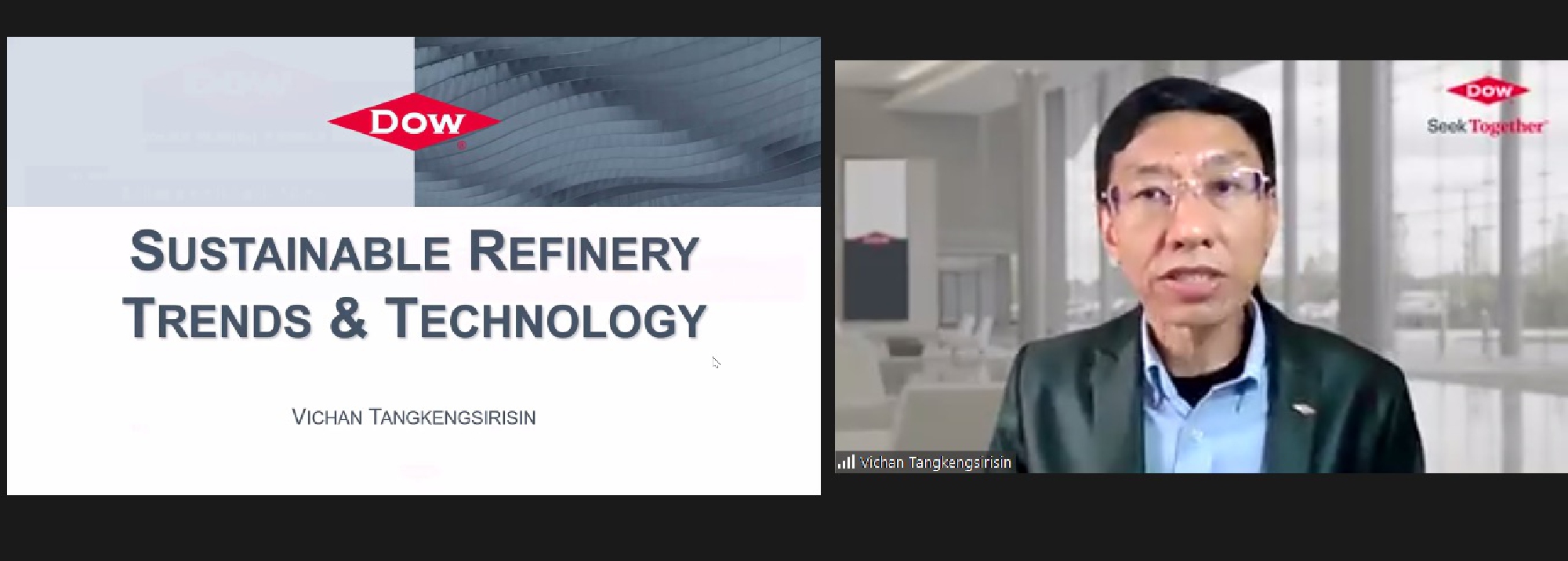
At the recent webinar entitled “Sustainable Refinery Trend and Technology” organized by the Petroleum Institute of Thailand (PTIT), representatives from Dow Thailand, leading materials science company, spoke to the audience about the proven, reliable and affordable technology invented to cope with the refinery efficiency and environmental issues while a speaker from IRPC Public Company Limited shared to participants about its experience in applying that solution to achieve energy saving and environmental protection.
ADVERTISEMENTx
Refineries opt for advanced technologies to address global warming issue
Vichan Tangkengsirisin, Asia Pacific Commercial Director, Dow Industrial Solutions, said in the webinar that world population are awakening to climate change crisis. Many countries are attempting to succeed carbon neutral target and aiming for net zero emission of GHG in 2050, in order to achieve the goal of the Paris Agreement that limit global temperature increase to well below 2 degrees Celsius, while pursuing efforts to limit the increase to 1.5 degrees. Considering that GHGs are emitted from combustion of fossil fuels such as oil and coal, global trend is now lowering reliance on fossil fuels and moving to clean energy. However, the transition is still going on and relying on fossil fuels which can’t be cut off immediately. The answer to this situation is finding out “how to use energy efficiently and reduce GHG emission at the same time”
Vichan has also pointed out to six current trends in the refinery industry those are: 1. Improving asset utilization rate to resolve bottle neck in the operations; 2. The number of quality crude oil sources has declined. Therefore, refinery plants turn to use crude oil from sources that have more sulfur content. 3. More stringent sulfur specification in refinery products such as the marine fuels required by the International Maritime Organization (IMO). 4. Tightened sulfur dioxide emission standard 5. Having sustainability target that involves lower emission of sulfur dioxide and carbon dioxide. 6. Reduction of energy consumption.
“What refineries are looking for now is the proven, reliable and affordable technology that will help to improve operation efficiency through reducing energy consumption as much as possible, minimizing unplanned shutdown or turnaround, lessening corrosion, providing longer equipment operational lifecycle, extending catalyst life and environmental protection will absolutely be improved consistently. Meanwhile, these all advantages have to come with no large additional capital investment needed.”
Refineries opt for advanced technologies to address global warming issue
To cope with those refinery’s expectations, Dow has developed the UCARSOL as the latest innovative gas treating solution to capture GHG emitted by sizable industrial factories such as oil refinery, gas separation plant, electricity generating plant and fertilizer production factory, to achieve both improved efficiency and environmental protection.
Chee Pin San, APAC Technical Leader, Energy Segment, Dow Industrial Solution, and Wichai Sriprasertkarnka, Account Manager, Dow Industrial Solution, told the audiences at the seminar that around 1,500 organizations in the world apply UCARSOL solvent at their operations, around 380 of which are refineries. In Asia, UCARSOL solvent has more than 80 installations at oil refinery and gas separation facilities.
Refineries opt for advanced technologies to address global warming issue
UCASOL solvent can help reduce gas emission to the environment while assist in reducing corrosion and minimize energy consumption. Dow also provides Amine Management Program that is a comprehensive service program designed for refineries and users. Users of UCASOL solution include refinery in South Korea and power plant in Japan have successfully retrieve their energy consumption and GHG emission goals.
Nattapon Pumwisate, Senior Engineer, IRPC Plc, said IRPC has successfully adopted UCARSOL technology at its operations and lower steam consumption with result to saving value at THB41.5 million per year, the company can also minimize gas emission to the environment. He added that IRPC is the 1st in Asia and 4th in the world succeed in UCARSOL installation project.
Following such the success of energy saving and enhanced environmental protection, IRPC won Thailand Energy Awards 2020 and also represented Thailand in the Asian Energy Awards 2021 contest.
THAI Operates Domestic and International Flights in August – October 2021
Thai Airways International Public Company Limited (THAI), recently said that in response to the current demands for air travel on both domestic and international routes, THAI has arranged and adjusted its flight schedules as per the latest COVID-19 control measures during August – October 2021
Mr. Nond Kalinta, Chief Commercial Officer, Thai Airways International Public Company Limited (THAI), recently said that in response to the current demands for air travel on both domestic and international routes, THAI has arranged and adjusted its flight schedules as per the latest COVID-19 control measures during August – October 2021 with details as follows:
Domestic (one-way flight):
1. Twice weekly flights from Bangkok to Phuket
• Flight TG922 departs from Bangkok every Thursday.
• Flight TG916 departs from Bangkok every Friday.
Remark: These flights will be operated during September – October 2021 according to announcements of the Civil Aviation Authority of Thailand (CAAT).
Flight operations in support of the Phuket Sandbox campaign:
1. Bangkok – Phuket – Frankfurt (v.v.): one flight per week every Thursday.
2. Bangkok – Phuket – London (v.v.): one flight per week every Friday.
3. Bangkok – Paris – Phuket – Bangkok: one flight per week every Thursday.
4. Bangkok – Zurich – Phuket – Bangkok: one flight per week every Friday.
Intercontinental (return flights):
1. Bangkok – London: twice weekly flights every Wednesday and Sunday.
2. Bangkok – Frankfurt: twice weekly flights every Saturday and Sunday.
3. Bangkok – Copenhagen: twice weekly flights every Tuesday and Saturday.
(Remark: These flights will be operated only on Saturday in September.)
4. Bangkok – Sydney: twice weekly flights every Wednesday and Sunday.
Regional (return flights):
1. Bangkok – Singapore: one flight per week every Wednesday (in October 2021).
2. Bangkok – Osaka: twice weekly flights every Thursday and Saturday.
3. Bangkok – Tokyo (Narita): three flights per week every Tuesday, Thursday and Saturday.
4. Bangkok – Tokyo (Haneda): twice weekly flights every Tuesday and Saturday.
5. Bangkok – Nagoya: twice weekly flights every Thursday and Sunday.
6. Bangkok – Seoul: twice weekly flights every Thursday and Sunday.
7. Bangkok – Taipei: twice weekly flights every Wednesday and Friday.
8. Bangkok – Jakarta: one flight per week every Wednesday.
ADVERTISEMENTx
THAI Operates Domestic and International Flights in August – October 2021For more information about flight schedules, reservations and ticketing services, please visit our website at www.thaiairways.com, call THAI Contact Center at (+66) 2-3561111, 24 hours a day, or contact THAI local ticketing offices.
Arapat Sangkharat unveils investment vision for Thailand
Maybank Kim Engs incoming leader reveals big plans for new era
Maybank Kim Eng Securities (Thailand) is a familiar name among Thai investors, having held the number one market share for 16 consecutive years from 2002-2017. The leading securities company now enters a new era under the leadership of Arapat Sangkharat, deputy chief executive officer, who was appointed Officer in Charge on July 1.
Arapat joined the company on August 17, 2020, as deputy chief executive officer and regional head of transformation of Maybank Kim Eng Group. He arrived with more than 20 years of experience in the banking business at leading companies both domestic and international, including Siam Commercial Bank, BNY Mellon, American Express and Citigroup.
ADVERTISEMENTx
In a recent interview with Krungthep Turakij, Arapat revealed his views on the securities business, including the operational plans and goals of Maybank Kim Eng over the next 5 years (2021-2025).
He said the company has set long-term goals to democratise investment by helping more Thais to access investment as a wealth management tool for financial stability. Previously, such services in Thailand were limited to wealthy customers, while in other countries investment diversification is accessible to all investors. Maybank Kim Eng also wants the new generation to pay attention to investment and be given easier access to investment options.
Arapat said this was not possible in the past because securities companies had cost limitations. But today’s technology has cut the cost of reaching customers via digital channels. The company is now investing in a new customer service system supported by Maybank Group, one of the largest banks in Asean.
In addition to using artificial intelligence (AI) to analyse individual customer risks, said Arapat, the challenge is how to leverage the data to create investment portfolios and returns that meet the goals of each client. These include the design of investment plans suited to each customer’s life goals (Goal-based Investing), such as investment in education, for retirement or for emergency expenses.
However, he admitted that gearing up to meet the goals of the 5-year plan may take time. However, initial progress is expected in 2022, as the company deems it necessary to make investments easier for all customers and reach new generations who are interested in investing. The company considers this goal to be part of its social responsibility, in line with Maybank Group goals on ESG (environmental, social and governance) issues. The company is focused on building the organisation as an “ESG Investment House”. Among the many steps it is taking to meet this aim are focusing on writing research recommendations for the listed companies that promote ESG, not underwriting shares in companies in environmental destruction, educating investors and student groups, and developing the company as a Zero-Waste Organisation.
As for short- to medium-term goals, Arapat said he would like to change how customers and employees view the organisation. For customers, he set a goal for Maybank Kim Eng to become number one in the minds of customers (first to mind), which is seen as a more important goal than being the number one securities company in terms of income or profit.
As for employees, he aims to make Maybank Kim Eng the company of choice for workers who feel proud to be a part of driving the organisation.
However, asked about the Covid-19 epidemic that has disrupted life and business operations in almost every industry, he said everyone wanted to see the crisis resolved.
However, he acknowledged that the securities business is one of the few that has seen strong growth during Covid-19. Consequently, he expected that the growth levels of 2020 and 2021 may slow once the crisis is over.
But insights gained from the virus crisis further underscore that building financial stability is a necessity for everyone, not just the wealthy, he added. In addition, legal entities like small and medium-sized businesses (SMEs) should also be among the customers receiving wealth building services. Even small businesses with not much capital, such as 1 million baht, should be able to diversify their investments.
In the first half of 2021, the company recorded a net profit of 448.04 million baht, up 206.35 million baht or 85.38 per cent on the same period last year. The outstanding performance was a result of success in distributing services to a wide range of customers.
The overall performance of the company in the first half of this year was considered satisfactory and met the target set. Although the economy is still affected by the Covid-19 pandemic, market sentiment and investment activity continue to perform well. The company continues to expand its product and service portfolio to include global equities and global funds with support from Maybank Group, which is a strong international bank with high business stability. This October, Maybank Kim Eng Group will celebrate 10 years of providing new financial services through the Maybank network in 10 markets, which continues its smooth and stable operations.
BGRIM posts new high profit in Q2 as power sales soar, 7 strategic initiatives to become world-class energy producer gains momentum
The second quarter’s net profit was record high, at 56.5% higher than the preceding first quarter’s level, while earnings before interest, taxes, depreciation and amortisation (EBITDA) rose 9.4% over the same corresponding period last year to 3,524 million baht.
B.Grimm Power Plc (BGRIM)’s net profit attributable to major shareholders in the second quarter of this year leaped 50% to 1,022 million baht, driven largely by the upsurge in power sales. However, including the unrealised foreign exchange losses, the earnings declined slightly over the same period last year to 1,011 million baht.
The second quarter’s net profit was record high, at 56.5% higher than the preceding first quarter’s level, while earnings before interest, taxes, depreciation and amortisation (EBITDA) rose 9.4% over the same corresponding period last year to 3,524 million baht.
ADVERTISEMENTx
Dr Harald Link, Chairman and President of BGRIM, said the 47.4% jump in its electricity sale to industrial customers in Thailand, which reached a peak of 831 gigawatt-hours in the second quarter, contributed significantly to BGRIM’s improved bottom line.
There were robust power demand particularly from customers in automotive parts, tyres, home appliances and industrial gases sectors. There were also connections to the system of new industrial customers under the power purchase agreements involving 21.2 MW in the second quarter of this year. That raised the overall capacity delivery for the first half of this year to 31.5 MW, compared with not less than 40 MW targeted for the entire 2021.
Contributing to BGRIM’s second-quarter profitability were the commercial start-up of the company’s solar farm in Cambodia in December 2020, the power plant optimisations of Amata B.Grimm Power (Rayong) 1 Co Ltd (ABPR1) and Amata B.Grimm Power (Rayong) 2 Co Ltd (ABPR2) in the second half of 2020. Cost controls had reduced sale and administrative expenses by 17.6% from the same period last year.
Meanwhile, the average price of natural gas, the main fuel of BGRIM’s generation, had dropped by 8.9% in the quarter to result in lower production costs.
Dr Link added that BGRIM has recently unveiled new seven strategic initiatives to become a world-class energy producer based primarily on its mission of “Empowering the World Compassionately.”
The mission is meant to create value for the society in the form of “Sustainable Utility Solution Provider” by producing quality energy, providing comprehensive services to meet the changing needs of customers as well as developing business cooperation with strong partners both at home and abroad.
In other development, BGRIM is due to put its Bo Thong Wind Farm 1&2, with an installed capacity of 16 MW, located in Mukdahan Province, online commercially this month.
There are 48 BGRIM power plants in commercial operation. The company aims to ramp up its total installed capacity from 3,058 MW at the end of 2020 to at least 7,200 MW by 2025 and further to 10,000 MW by 2030 in terms of power sale volumes with an annual revenue target of more than 100 billion baht.
BGRIM announced an interim dividend of 0.15 baht per share for the first half of 2021, payable on September 10 to eligible shareholders appearing on registration dated August 25.
Surge in Asia Pacific’s largest manufacturing centres driven by global demand
China strengthens its leading position as the most attractive manufacturing hub globally; Thailand sees improvement in cost profile
Asia Pacific’s largest manufacturing centers have rebounded strongly as economies across the globe have reopened and driven demand for key products, according to Cushman & Wakefield’s 2021 Global Manufacturing Risk Index, which assesses the most advantageous locations for global manufacturing among 47 countries in Europe, the Americas and Asia Pacific.
Dr. Dominic Brown, Head of Insight & Analysis, Asia Pacific at Cushman & Wakefield, said, “As the virus is brought under control, manufacturing centers have surged. China has been able to fill the void left by U.S. and European manufacturers, who were enduring their own lockdowns, to capture a larger share of global exports from approximately 13% in 2019 to 15% in 2020. Furthermore, exports from China in Q1 2021 were about 27% higher than Q2 2019, or the equivalent of USD 150 billion.”
“Other markets also capitalized on heightened demand for key products such as micro-processors, computer chips and pharmaceuticals. South Korea has benefited from the soaring value of semiconductors, stemming from strong demand and a global shortage of product with Information and Communication Technology (ICT) manufacturing up 16.8% year over year in January 2021. However, apparel producers around the region continue to struggle with low levels of demand impacting markets such as India and Indonesia, which have also been managing significant second and third waves of the virus,” noted Dr. Brown.
Within mainland China, two clear trends have been underway: (i) manufacturers moving up the value chain following large-scale investment into robotics, artificial intelligence and blockchain; and (ii) manufacturing of lower order goods moving outside of the country, predominantly into Southeast Asia. There has been a 5% increase in Jakarta’s industrial stock in the last year alone. There has also been increasing interest in India, especially given the country’s proven success in meeting outsourcing requirements.
Furthermore, Vietnam has become an increasing focus for manufacturers due to its regional centrality, sublime market integration, and favorable production costs – with Samsung, Apple, Nintendo, LG, Panasonic and Intel all locating in the country. Vietnam is also moving up the value chain, positioning itself as very attractive for mid-tech with its electronics sector.
ADVERTISEMENTx
On this year’s baseline rankings, Thailand rates favourably on cost competitiveness. The country’s cost profile improved, moving Thailand to fifth place from the eighth and ahead of Malaysia, which has seen ongoing wage increases, the report noted. Gareth Michael Powell, Senior Director at Cushman & Wakefield, Thailand, said, “The Thai manufacturing sector has expanded in 2021 on improved domestic demand, a rapidly growing e-commerce sector, recovery of world trade volumes, and government-driven growth from budget disbursements and economic stimulus measures. We are optimistic about Thailand’s industrial property market outlook, given the upturn in external goods demand and exports remaining a key pillar of economic strength.”
2021 Manufacturing Risk Index Rankings – Key takeaways
Cushman & Wakefield’s annual Global Manufacturing Risk Index (MRI) scores each country against 20 variables that make up the three final weighted rankings which cover conditions, cost, and risk. The data underpinning the MRI comes from a variety of reliable sources, including the World Bank, United Nations, World Economic Forum and Moody’s Analytics.
Based on the analysis, China took the number one spot across all the four rankings, strengthening its leading position as the most attractive manufacturing hub globally.
• Bounce Back Rating: China and Singapore placed first and sixth respectively on The Bounce Back rating, which measures a country’s ability to restart its manufacturing sector. As business conditions continue to improve and with vaccinations underway, economic growth forecasts are generally being revised upwards.
ADVERTISEMENT
• Baseline Scenario: China retained the top position on the baseline scenario ranking as it continues to diversify its manufacturing base, moving up the value chain in order to focus on telecom, high-tech (40% of robots produced globally are made in China), and computers. Key manufacturing regions in China include Guangdong and Jiangsu, which focus on electronic components and automotive, while Zhejiang and Liaoning focus on chemicals and natural resources.
• Cost Scenario: While China also retains its lead position in this scenario, Vietnam and India were overtaken by Indonesia which moved up to second from fifth place, not least in part due to Jakarta’s declining rents seen over the past year. India also swapped places with Vietnam to rank third and fourth respectively. While wage costs in Vietnam remain cheaper than China, it is facing increasing competition from lower cost locations and will need to demonstrate its strengths in other areas of the manufacturing process, such as its geographical connectivity. Like Indonesia, Thailand’s cost profile improved this year, helping it move to fifth place and ahead of Malaysia, which has seen ongoing wage increases.
• Risk Scenario: Early and effective lockdowns to control the first wave of the pandemic helped China’s manufacturing sector rebound after Q1 2020. Strong performance of its manufacturing sector during the rest of 2020 contributed to a “better-than-expected” first place ranking on the risk scenario. The U.S. and Canada were pushed back to second and third place respectively while China jumped up from fifth place last year.
“The current pandemic has accelerated the growth of e-commerce while also exposing vulnerabilities in global supply chains. It is imperative for manufacturing companies to reassess current supply chain strategy and infrastructure to improve their resilience and stay competitive.” noted Tim Foster, Head of Supply Chain & Logistics Advisory, APAC, Cushman & Wakefield.
“A post-Covid-19 future is likely to see a heavier reliance on sophisticated technologies and tools that facilitate Industry 4.0, as companies seek to stay resilient, ensuring a wider diversification with smaller, geographically distributed manufacturing plants that are more resistant to disruption. With these advances, property developers are challenged to stay ahead, reshaping how facilities are designed and operated as they cater to the expansion of e-commerce as well as adopting a more holistic approach towards ESG considerations to address the growing group of environmentally conscious real estate users.” added Dennis Yeo, Head of Investor Services, APAC, Cushman & Wakefield.
ADVERTISEMENT
Looking ahead, ESG due diligence for suppliers has become an increasingly important part of a manufacturers’ risk management. In addition to protecting manufacturers from any losses incurred due to natural disasters, growing consumer consciousness about the impact of certain sourcing practices on the environment is feeding into decision making. In Europe, green consumerism is growing fast with nearly 800,000 products now displaying the EU’s Ecolabel logo. For this reason, Asia Pacific will need to follow Europe’s lead to help maintain the attractiveness of the region and help counter potential decision making to reshore or nearshore manufacturing out of the region.
Two sexual assault survivors spur Airbnb arbitration turnaround
For Sherry Dooley, Airbnb Inc.s announcement last week that it would no longer force guests into confidential arbitration to settle claims of sexual assault was disturbing. For Natalie White, it means she may get her day in court.
Both women filed lawsuits against the company in recent months claiming they were sexually assaulted inside properties rented on Airbnb. Dooley, a 55-year-old food-truck worker from Oregon, says she was raped by an intruder in an apartment in Colima, Mexico, in 2019. White, a 23-year-old medical student from New Jersey, says she was attacked by a host who tried to tear off her clothes in Los Angeles last year.
The women decided to speak publicly for the first time to call on the company to remove a longstanding forced-arbitration clause in its 10,000-word terms of service that neither of them said they were aware of when they used the platform. They said arbitration would silence their voices and keep the issue of sexual assault at Airbnb listings hidden.
ADVERTISEMENTx
Airbnb said on Friday, after being informed of the women’s statements, that it would change its terms of service this fall to no longer require arbitration in cases involving the sexual assault or sexual harassment of guests and hosts. It also said it hasn’t enforced the policy since January 2019, although it didn’t make any announcement at the time or change the terms of service that its 150 million users must accept to register on the site.
That the company said it stopped using the binding arbitration clause in sexual abuse cases two years ago came as a surprise to Dooley. She agreed to shift her lawsuit into arbitration last September after a lawyer for the company threatened to file a motion in court enforcing the terms of service. “It kind of makes me angry,” said Dooley. “Feels like a runaround, and I’m the one stuck in the middle, being retraumatized over and over again.”
The announcement came after a Bloomberg Businessweek investigation of violent crimes, including rapes, at Airbnb listings. That story highlighted the lengths the home-share company will go to keep such incidents quiet — sometimes spending millions of dollars on settlement payouts and using the binding arbitration clause in its terms of service to block users from filing claims for damages in court. Only one case related to sexual assault had ever been filed against Airbnb in U.S. courts, the investigation found, after a review of electronically available state and federal cases since the company’s founding in 2008.
Ben Breit, an Airbnb spokesman, declined to comment about why the company waited until last week to announce it would update its terms of service to reflect the policy change. He said sexual assaults in Airbnb listings are “extremely rare.”
The use of forced arbitration has become a flashpoint in corporate America in recent years. The practice was established almost a century ago as a way for businesses to resolve conflicts without clogging the courts. By the 1990s, it had expanded to include consumer and employee disputes. Supporters say it’s a faster and cheaper way to settle disputes than through the courts. Critics say it favors companies because they get to set the terms and the outcomes are secret.
ADVERTISEMENT
Arbitration is “one of the ways large corporations exert power and control over survivors,” said Latifa Lyles, vice president for advocacy and survivor initiatives at the anti-harassment organization Time’s Up.Some companies distanced themselves from mandatory arbitration during the MeToo movement. Starting in 2017, Microsoft, Google, Facebook — and Airbnb — removed binding arbitration requirements for sexual assault and sexual harassment claims filed by employees. Uber Technologies and Lyft went even further, changing their terms of service to allow passengers and drivers to file such cases in court.
Uber’s change came in May 2018 after 14 women who claimed they’d been sexually assaulted by the company’s drivers wrote a letter to the board calling for the right to file claims in court. Chief Legal Officer Tony West said it wasn’t an easy decision. “We knew when taking these steps that we were taking on legal risk,” he said in an interview last week. Uber updated its terms of service to reflect the change because “we wanted to be absolutely clear that we meant what we said,” West said. Companies need to be “very public and very full-throated” about it to communicate to survivors that they have the right to sue.
Jeanne Christensen, a lawyer at Wigdor LLP who represented the 14 women, said she had hoped after Uber made the change that sharing-economy peer Airbnb would do the same. Airbnb’s business model, like Uber’s, is largely based on strangers meeting online and trusting one another enough to exchange money and connect offline.
Airbnb says it did follow suit in 2019. It just didn’t tell anyone, including its own safety team, the elite internal group that handles sexual assaults and violent crimes inside platform listings, according to two former safety agents. One, a former policeman who worked at the company from May 2018 to July 2020, said he raised concerns about the use of forced arbitration with management on numerous occasions. He said he had no idea Airbnb had stopped using the arbitration provision in sexual assault cases in 2019.
Neither did Dooley or her lawyer. Dooley said she used Airbnb to rent the upstairs unit of a two-story house in Colima, on Mexico’s central Pacific coast. The property had five-star reviews and was operated by a superhost, a badge of honor the company bestows upon its most experienced and trustworthy hosts. Dooley was asleep in the apartment when a man climbed an ungated exterior staircase and entered through a window that she said didn’t properly lock. The intruder threatened to stab her with a fork, attempted to sodomize her and “in a brutal fashion, repeatedly and forcibly raped her,” according to the lawsuit Dooley filed against Airbnb and the host in an Oregon state court in May 2020.
ADVERTISEMENT
The lawsuit says neither Airbnb nor the host properly investigated the security of the property. It says the company, which promotes itself as a safe platform, should have known that its “claims regarding safety were misleading and a misrepresentation of the truth.”Hours after the attack, Dooley said, she Googled “Airbnb and rape” and nothing came up. So, she emailed Airbnb Chief Executive Officer Brian Chesky, telling him what had happened and asking for help. A representative from the safety team reached out soon after, offering to refund the cost of her trip, pay for her flight home and cover any health or counseling expenses, she said.
No one has been arrested, and local police are still investigating, according to Dooley’s Mexico-based lawyer Maria Del Carmen Mata Magallanes. Airbnb deactivated the listing, but it didn’t ban the host because “he is not accused of wrongdoing,” Breit, the company spokesman, said. A lawyer for the host didn’t respond to a request for comment.
Four months after the lawsuit was filed, and more than a year after Airbnb said it stopped enforcing the arbitration clause in sexual assault cases, a lawyer representing the company said Dooley had to take the matter to arbitration. “To be clear, it is Airbnb’s position that your client is required to arbitrate her claims,” Klarice Benn, an attorney at the Abbott Law Group in Portland, Oregon, wrote to Dooley’s lawyer, Robert Callahan, last September, according to an email seen by Bloomberg. Benn threatened to file a motion to compel arbitration if Dooley didn’t go along with the move.
Dooley agreed to shift the case to arbitration. Now, Callahan said, he and his client feel “played and deceived.” To him, the company’s message was clear. “Everything Airbnb did through its counsel was perceived as blocking our access to the courts and moving us to arbitration,” Callahan said. He said the company is using “Orwellian double-speak” when it says it hasn’t enforced the arbitration clause in court since January 2019. “They can’t say upfront that they changed this when their actions are just the opposite.”
Benn didn’t respond to emails, and Airbnb declined to comment about how it handled the case.With her lawsuit shunted to arbitration, Dooley’s claims, like those against many other online service providers, will never be heard in court. “I had no idea when I clicked on that terms of service that I was clicking away my rights,” she said.
Neither did Natalie White. She sued Airbnb last month in Superior Court in Los Angeles, as well as the host who rented her a one-bedroom apartment, claiming she was sexually assaulted there in February 2020. White, who lives in Atlantic City, New Jersey, says in her lawsuit that the host, an actor named Zafer Alpat, barged into the apartment as she was packing to leave, pinned her down, and licked and kissed her while she resisted.
Alpat was arrested and charged with assault to commit a felony and false imprisonment by violence. He has pleaded not guilty to both counts and faces a preliminary hearing next month, according to the Los Angeles County District Attorney’s Office. Alpat declined to comment because of the pending litigation, his lawyer Daniel Titkin said in an email.
White said in a statement sent by her lawyer, Greg Kirakosian, that she rented a room through Airbnb believing it was safe to do so. “Unfortunately, I could not have been more wrong,” she said in the statement, which was written before the company announced its change of policy. Private arbitration is “silencing my voice as well as the voices of other victims,” White wrote. “I beg you, do not silence our stories and our quest for justice.”
Kirakosian praised Airbnb for listening to White’s plea. But he said the company needs to go further. “Our ultimate objective,” he said in an email, “is for Airbnb to make fundamental changes to their policies toward prevention of, and protection from, sexual assault.”
Breit, the Airbnb spokesman, said the company worked hard to support White after she reached out. He said the host, who had raised red flags for cleanliness and personality conflicts with previous guests, was barred from the platform. As for her lawsuit, Breit said, the choice of whether to arbitrate or not will be left to her.
Published : August 19, 2021
By : Syndication Washington Post, Bloomberg · Olivia Carville
Tencent sales grow slowest in two years as crackdown weighs
Tencent Holdings revenue increased at its slowest pace since 2019 after Chinas expanding tech crackdown hit its mobile gaming empire, overshadowing newer businesses from cloud to social ads.
Beijing’s months-long crackdown has ignited a trillion-dollar selloff in Chinese equities, up-ended online education and also pumped the brakes on growth across a swath of industries from advertising to car-sharing. This month, Alibaba Group Holding reported revenue that missed estimates for the first time in more than two years. Tencent’s sales rose 20% to 138.3 billion yuan ($21.3 billion) for the three months ended June, in line with the 138.2 billion yuan average forecast.
Growing scrutiny from Beijing and stiffening competition with the likes of ByteDance Ltd. has prompted China’s most valuable corporation to join arch-foe Alibaba in a spending spree, plowing a larger chunk of its profit into areas like cloud services, games, and short videos. While Tencent itself isn’t the target of any probe, its outsized influence in the modern Chinese economy has left it vulnerable as the crackdown quickly expanded from antitrust and e-commerce to data security and online content.
Net income was 42.6 billion yuan in the quarter, beating the 30.8 billion yuan projected thanks in part to a gain of more than 20 billion yuan on its investments around the world. Shares in Prosus, Tencent’s major shareholder, rose more than 4%.
ADVERTISEMENTx
Last month, regulators ordered Tencent Music Entertainment Group to relinquish its exclusive licensing deals with label companies, and killed a Tencent-led merger of two rival game streaming platforms. State media then trained their sights on gaming addiction among China’s youth, spurring Tencent to introduce even-stricter child protections into its mobile titles. And portfolio startups like Yuanfudao and VIPKid may be forced to write down their valuations after Beijing banned tutoring firms teaching school subjects to kids from making profits.
Meanwhile, a recently launched campaign by the tech-industry overseer has reignited scrutiny over Tencent’s ubiquitous WeChat. The messaging, social media and payments service — which temporarily suspended new user registrations last month to undergo security upgrades — has long been criticized for walling off users from services operated by rivals such as Alibaba, one of the watchdog’s key points of contention.
And while President Martin Lau has said the company’s fintech arm remains focused on risk management when expanding into non-payment products, monetization could be limited if Beijing put one of its fast-growing divisions under scrutiny similar to Jack Ma’s Ant Group Co.
Tencent’s core gaming business increased sales by 12%, the slowest pace since the third quarter of 2019. It faces a tough comparison from a year ago, when it rode an internet boom during the height of the Covid-19 pandemic. That division, which accounted for about half of China’s video game market in 2020, still largely revolves around aging franchises Peacekeeper Elite and Honor of Kings, at a time when up-and-comers like MiHoYo churn out new hits. In a bid to shore up its slate, Tencent has scooped up slices of 76 gaming firms so far this year, most of which are lesser-known indie development studios, according to data tracked by researcher Niko Partners. That compares with just 31 gaming investments last year.
“The Chinese mobile gaming space is witnessing a structural change whereby game developers are more inclined to publish games on their own instead of licensing their titles to third-party publishers such as Tencent,” Nomura analysts including Jialong Shi wrote in a note before the results. “The huge success of some independent game developers such as Lilith Games and MiHoYo in publishing their self-produced titles have likely inspired other small developers to follow suit.”
Online advertising revenue increased 23%, as internet services and consumer staples clients outweighed a drop in education-related spending. Fintech and other business services climbed 40%, reflecting increasing digital payment transactions, the company said.
Published : August 19, 2021
By : Syndication Washington Post, Bloomberg · Zheping Huang
SET rises as hinted QE tapering hits other Asian markets
The Stock Exchange of Thailand (SET) Index closed at 1,553.18 on Friday, up 8.90 points or 0.58 per cent. Transactions totalled THB82.37 billion with an index high of 1,554.45 and a low of 1,545.92.
In the morning session, Krungsri Securities forecast the index on Friday would fluctuate between 1,535 and 1,555 points amid a mix of positive and negative sentiment.
It said the index would face downward pressure from the US Federal Reserve signalling tapering of its quantitative easing programme, the falling oil price and ongoing anti-government protests in Thailand.
“However, hopes of the lockdown easing as domestic Covid-19 cases stabilise, and the improving vaccination rate, will help boost the index,” Krungsri Securities said.
The 10 stocks with the highest trade value today were PTTGC, GULF, KBANK, AOT, PTT, INTUCH, ADVANC, DTAC, OR and SCB.
ADVERTISEMENTx
Other East Asian indices were on the fall:
Japan’s Nikkei Index closed at 27,013.25, down 267.92 points or 0.98 per cent.
China’s Shanghai SE Composite Index closed at 3,427.33, down 38.22 points or 1.10 per cent, while the Shenzhen SE Component Index closed at 14,253.54, down 233.83 points or 1.61 per cent.
Hong Kong’s Hang Seng Index closed at 24,849.72, down 466.61 points or 1.84 per cent.
South Korea’s KOSPI closed at 3,060.51, down 37.32 points or 1.20 per cent.
Taiwan’s TAIEX closed at 16,341.94, down 33.46 points or 0.20 per cent.
The price of gold in Thailand dropped by THB50 on Friday morning.
The Gold Traders Association report at 9.28am showed buying price of a gold bar at THB28,050 per baht weight and selling price at THB28,150, while gold ornaments were priced at THB27,545.72 and THB28,650, respectively.
At close on Thursday, buying price of a gold bar was THB28,100 per baht weight and selling price THB28,200, while gold ornaments were priced at THB27,591.20 and THB28,700, respectively.
ADVERTISEMENTx
Spot gold on Friday morning was moving at around US$1,783 (THB59,463) per ounce after Comex gold price at close on Thursday dropped by $1.3 to $1,783.1 per ounce, due to pressure from the appreciation of the US dollar, including the recent meeting results of the US Federal Reserve which signalled that it would start reducing the limit in the bond purchase programme under the quantitative easing (QE) measures this year.
Hong Kong gold, meanwhile, rose by HK$10 to $16,550 (THB70,849) per tael, the Chinese Gold and Silver Exchange Society reported.



 Refineries opt for advanced technologies to address global warming issue
 Refineries opt for advanced technologies to address global warming issue
 Refineries opt for advanced technologies to address global warming issue
 THAI Operates Domestic and International Flights in August – October 2021For more information about flight schedules, reservations and ticketing services, please visit our website at






 SootinClaimon.Com