US virus origin-tracing report dismissed as scapegoating
Officials and experts are saying Beijings recent pushback has been “necessary and helpful” to frustrate Washingtons attempt to scapegoat China, after the US intelligence community unveiled a vaguely worded, inconclusive summary of the COVID-19 origin-tracing report submitted to President Joe Biden.
Politicizing origin tracing will further backfire and “lead nowhere”, and Washington should “return to a science-based, cooperation-driven global response”, they said.
In May, Biden directed the US intelligence community to produce a report on COVID-19’s origin within 90 days. The two-page, unclassified summary of the report was released on Friday by the US Office of the Director of National Intelligence.
The summary states that US investigators “judge the virus was not developed as a biological weapon”, but they do not rule out natural exposure to the virus, nor a laboratory accident as the origin of the novel coronavirus pandemic.
ADVERTISEMENTx
By Friday, the US had reported at least 38.1 million confirmed cases of COVID-19 and more than 628,400 deaths, the highest number of infections and death toll of any country, according to World Health Organization updates.
“Justice will prevail, and injustice is doomed to fail,” Vice-Foreign Minister Ma Zhaoxu said on Saturday in a statement, noting that Beijing has made serious protests to Washington over the report.
Washington has failed to respond to global concerns and the calls for a complete investigation of over 200 US bio-labs located across the globe, he said.
In so doing, the US “attempts to cover up facts and shirk its responsibilities”, and it should “face up to the global community with a clear response”, he said.
Su Xiaohui, deputy director of the Department of American Studies at the China Institute of International Studies, said, “China’s recent pushbacks against the US report have been powerful enough to convince Washington that it has neither overwhelmed Beijing nor reached its goal of dealing a heavy blow to China with the tracing issue.”
The 90-day review came “in like a lion, (and went) out like a lamb”, and Washington has been fixating on the tracing with a grandiose gesture, but the report summary fails to be conclusive and seems like a flailing in the air, she said.
“Behind the review was a dual-purpose strategy: courting the conservative, right-wing political forces in the US and, at the same time, hijacking China for political bargaining and pressuring for benefits regarding other issues,” Su said.
But the outcome is that Republicans have criticized the Biden administration for failing to meet their expectations, she said.
A subsequent statement by the White House purported that China is trying to hold back international investigation and rejects calls for transparency. The statement urges like-minded partners to exert pressure on China.
Ma, the vice-foreign minister, said that the US campaign of politicizing the tracing issue has been unpopular and has drawn widespread criticism around the world.
Washington should “immediately cease poisoning the atmosphere for global cooperation on tracing, stop undermining the global joint COVID-19 response”, he said.
Zeng Yixin, deputy head of the National Health Commission, said in a China Central Television interview released on Sunday that mobilizing intelligence agencies to work on tracing in itself yields more ironclad proof that the US is politicizing the tracing issue.
The US is urged to “encourage scientists from all countries to work in concert” and to “support scientists in carrying out in-depth origin tracing research in multiple countries and locations around the world, including the US”, Zeng said.
Asean sees declining trend in new Covid cases and deaths
Southeast Asia saw a decline in new Covid-19 cases and related deaths for the fourth consecutive day on Sunday, collated data showed.
Asean countries reported 79,833 new cases, lower than Saturday’s 85,849, while 1,663 patients died, lower than the previous day’s 1,778.
The number of Covid-19 cases crossed 9.91 million across the region and deaths rose to 220,150.
Vietnam reported 12,796 new cases and 344 deaths on Sunday, bringing cumulative cases in the country to 435,265 patients and 10,749 deaths.
China has banned all imports and exports at Guangxi Zhuang Autonomous Region’s border that it shares with Vietnam since last Thursday to curb the spread of the delta variant of Covid-19. The Chinese authority said that the border will remain closed until the situation improves.
Meanwhile, Myanmar reported 3,098 new cases and 106 deaths, bringing cumulative cases in the country to 392,300 patients and 15,183 deaths.
A spokesman for Myanmar’s military-installed government said on Friday that Covid-19 vaccines would be given to members of the Muslim Rohingya people living in the western state of Rakhine, including the population townships of Maungdaw and Buthidaung.
The government also announced that it was trying to vaccinate 50 per cent of the country’s population this year.
After being the country with most number of cases in Asean for many months, Indonesia, with 7,427 new patients, is now behind Malaysia, Philippines, Thailand and Myanmar. However, Indonesia had the most deaths at 551.
U.S. carries out airstrike targeting suspected ISIS-K vehicle in Kabul
“We are confident we successfully hit the target. Significant secondary explosions from the vehicle indicated the presence of a substantial amount of explosive material,” said a U.S. Central Command spokesman.
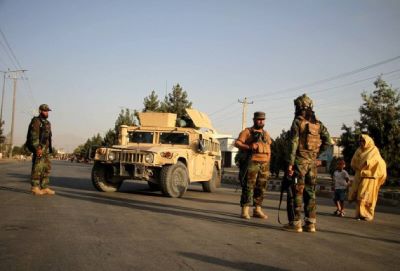
U.S. Central Command said on Sunday that U.S. military forces carried out an airstrike in Kabul against a suspected ISIS-K vehicle, which could pose an imminent threat to the airport.
The airstrike eliminated “an imminent ISIS-K threat to Hamad Karzai International airport,” U.S. Central Command Spokesman Bill Urban said in a statement, referring to a local affiliate of the Islamic State in Afghanistan.
ADVERTISEMENTx
“We are confident we successfully hit the target. Significant secondary explosions from the vehicle indicated the presence of a substantial amount of explosive material,” Urban said.
“We are assessing the possibilities of civilian casualties, though we have no indications at this time. We remain vigilant for potential future threats,” said the spokesman.
The airstrike came after U.S. President Joe Biden warned on Saturday that another terror attack against Kabul airport could be “highly likely in the next 24-36 hours.”
It was the second U.S. military strike in Afghanistan since a suicide bombing outside Kabul airport on Thursday killed 13 U.S. service members and some 170 Afghans. ISIS-K had claimed responsibility for the attack.
In retaliation for the deadly attack, the U.S. military on Friday launched a drone strike against the terror group in Nangarhar province of eastern Afghanistan, which killed two “high-profile” members and wounded another, according to the Pentagon.
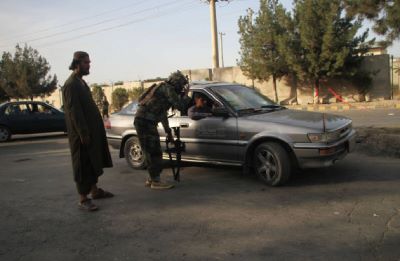
The United States has been scrambling to evacuate Americans and its Afghan partners from the country since the Taliban entered Kabul on Aug. 15. The White House said on Saturday that around 111,900 people had left Afghanistan since Aug. 14.
Update: 6 Afghans killed after rocket falls into residential area in Kabul
A rocket struck a house in a populated residential area, west of the Hamid Karzai International Airport in Kabul, killing two adults and four children.
Six Afghan civilians, including four children, were killed after a rocket was fired at the Kabul airport where the U.S.-led evacuation flights were continuing but failed to hit the target, a local source confirmed.
ADVERTISEMENTx
“The rocket struck a house in Khwaja Bughra, a populated residential area in Police District 15, killing two adults and four children,” Hajji Karim, a representative of the neighborhood in the municipality district, told reporters at the site.
The incident occurred roughly at 4:55 p.m. local time in the area, west of the Hamid Karzai International Airport.
On Thursday, a deadly suicide bomb blast and gun firing claimed by ISIS-K, a local affiliate of the Islamic State group, killed 170 Afghans and 13 U.S. troops at an eastern gate of the Kabul airport and injured nearly 200 others.
No group has claimed responsibility for the attack. Taliban officials and public health authorities have not commented on the blast so far.
The attack came after a U.S. drone was hovering over the city, witnesses said.
Dozens of planes, including military planes, took off from the airport during the day. All U.S. and coalition forces are expected to leave the country on Aug. 31, a planned deadline.
How climate change helped make Hurricane Ida one of Louisiana worst
From its birth, the storm was destined to become a monster. It formed from air that was hot, moist and thick with clouds. It incubated in the sultry Gulf of Mexico, drawing power from water that was unusually warm.
By the time Hurricane Ida made landfall in Port Fourchon, La., on Sunday, it was the poster child for a climate change-driven disaster. The fast-growing, ferocious storm brought 150-mile-per-hour wind, torrential rain and several feet of storm surge to the most vulnerable part of the U.S. coast. It rivals the most powerful storm ever to strike the state.
“People there are going to get blasted,” said Kerry Emanuel, an atmospheric scientist at the Massachusetts Institute of Technology who studies the physics of hurricanes and their connection to the climate. “This is exactly the kind of thing we’re going to have to get used to as the planet warms.”
Hurricane Ida is the latest storm to batter the United States this summer. Tropical Storm Henri weakened as it inundated coastal communities in New England earlier this month, but it still knocked out power to more than 120,000 homes in three states and dumped a record 1.89 inches of rain on New York City in just one hour.
And hurricane season is far from over, as five other tropical systems are now sweeping over the Atlantic Ocean.
Scientists had been bracing for the worst since the moment forecasters identified a tropical depression forming last week. The Gulf of Mexico in August is always a hotbed of hurricane formation. “This time of year, it’s like bathtub water,” said Brian Tang, an atmospheric scientist at the University at Albany in New York.
Lately, conditions in the ocean have been exceptionally bad. According to the National Oceanic and Atmospheric Administration, parts of the Gulf are three to five degrees Fahrenheit higher than the average for the end of the 20th century. Research shows that human greenhouse gas emissions have caused the ocean to warm faster in recent years than at any point since the end of the last ice age.
All this warm water is to hurricanes what gasoline is to a car engine, Tang said. A powerful storm takes energy from the ocean and converts it into roiling clouds and roaring winds.
As Ida developed, it traveled over the hottest parts of the gulf, sucking up energy to fuel its rapid growth. With no shifting upper atmosphere winds to disrupt it, the ring of thunderstorms around the hurricane’s center – called the eyewall – started to churn faster and faster.
Even worse, the sea surface temperature rose as the hurricane got closer to the coast.
“That’s really like stepping on the accelerator,” Tang said. “Flooring it, basically.”
Barely 24 hours after it was identified as an unnamed tropical depression in the Caribbean on Thursday, its wind speeds reached 75 miles per hour – enough for the storm to be upgraded to a hurricane. By Saturday night, winds were hitting 105 miles per hour, making Ida a Category 2 storm.
Kimberly Wood, an atmospheric scientist at Mississippi State University, went to bed with a sinking feeling in her gut.
She woke Sunday to reports from the National Hurricane Center that peak winds were at 150 miles per hour. She thought of all the people who would not have time to evacuate in response to the sudden escalation.
She looked again at satellite images showing what scientists call a “well-organized” storm.
Wood wishes that the scientific terminology didn’t sound so much like a compliment. “It sounds like we’re cheering it on, but we’re not,” she said. “I feel sick to my stomach.”
Emanuel of MIT calls such rapid intensification a “canary in the mine” for climate change. Warmer conditions raise the “potential intensity” for storms – in other words, how bad they can get if nothing disrupts them. Climate change has also widened the disparity between the amount of heat in the ocean and the amount of moisture the atmosphere can hold, which accelerates the process of evaporation and energy transfer.
“Things happen faster,” he said. “It’s getting to a larger velocity and it’s taking less time to get there.”
In a 2017 paper published in the Bulletin of the American Meteorological Society, Emanuel found that once-in-a-century intensification events – in which wind speeds accelerate about 70 miles per hour in just 24 hours – could happen every five to 10 years by 2100. Human-caused warming could lead to never-before-seen escalation of hurricanes, causing unheard-of surge in wind speeds of 100 miles per hour or more.
Climate change not only sets the stage for bigger, fiercer, faster storms, it also makes the deadliest aspect of hurricanes – a deluge of water – even more intense.
For each degree Celsius that air heats up, it is able to hold 7 percent more moisture. This leads to exponentially heavier precipitation during storms.
Rainfall from Hurricane Harvey, which hit Houston in 2017, was made at least 15 percent worse by human-caused warming. Emanuel has found that events like it could become six times more frequent by the end of the century.
“It’s hard to say for any one thing, ‘Yes, for sure this is climate change,’ ” Wood said. “But the warmer waters and the amount of moisture in the air, this in general is going to increase as the climate warms.”
Torrential rain can worsen the effects of hurricanes even when the wind isn’t very strong. Wood noted that Hurricane Henri had deteriorated to a tropical storm by the time it made landfall in Rhode Island, but its torrential rain triggered widespread flooding.
In a small stroke of luck for residents of coastal Louisiana and Mississippi, Hurricane Ida is not expected to slow down significantly as it moves across the land – a behavior that made rainfall from Harvey and Henri especially extreme. But meteorologists still have forecast as much as 20 inches of rain for areas in Ida’s path.
Rising sea levels linked to global warming will also exacerbate the storm’s effect. Few places in the United States have suffered more from rising waters as Louisiana, where seas in some areas are 24 inches above their 1950 levels. This is partly because of development that has eroded the coastline and caused land to sink. But it is made worse by faraway melting glaciers, and the fact that ocean water expands as it warms.
The higher the baseline sea level, the more water will be pushed on shore by wind during hurricanes.
Wood urged residents not to underestimate the potential power of all this water. Just six inches of moving water can knock a healthy adult to the ground. Two feet is enough to float a car, sweeping away the vehicle and anyone inside it.
A 2014 study in the Bulletin of the American Meteorological Society found that 76 percent of fatalities from hurricanes between 1963 and 2012 were caused by storm surge or flooding.
“Those who are hunkering down on the coast are going to be pretty battered from this,” Wood said.
In an era when climate change has raised the bar for how bad hurricanes can become, Emanuel said, Hurricane Ida is a hint of what can happen when a storm reaches its “full potential.”
Energized by hot water, unobstructed by landforms or disruptive wind, Ida surged ashore Sunday with overwhelming force. Towering waves have ripped boats from their moorings and threatened to sweep people out to sea. Trees toppled and roofs went flying amid brutal blasts of wind.
With conditions too dangerous to attempt rescue operations, officials pleaded with people in flooded areas to stay in their homes and wait for the storm to pass.
This monster could not be battled or outrun. As night fell on Louisiana and Ida plowed inland, all people could do was endure.
Ida makes landfall as Category 4 near Port Fourchon, Louisiana
On the 16th anniversary of Hurricane Katrinas assault on New Orleans, Category 4 Ida slammed into the southeast Louisiana coastline after rapidly gaining strength Saturday night. The powerhouse storm, packing winds of 150 mph, is forecast to wallop New Orleans with hurricane-force winds and over a foot of rain Sunday afternoon and evening.
Near where Ida comes ashore, the National Hurricane Center is predicting “potentially catastrophic” wind damage and an “extremely life-threatening” ocean surge. Devastating effects from destructive winds and flooding rain could extend more than a hundred miles inland.
Hours before landfall, NOAA and Air Force Reserve Hurricane Hunter aircraft flew into Hurricane Ida, data helped the National Hurricane Center determine that Ida’s hurricane-force winds extended up to 50 miles from the center, with tropical-storm-force winds up to 150 miles away.
Ida made landfall at 12:55 p.m. and is moving northwest at about 13 mph. The hurricane is projected to turn north by Monday morning as it loses strength over land but produces extremely heavy rainfall.
ADVERTISEMENTx
Tracking by PowerOutage.us showed that nearly 315,000 customers in Louisiana had lost power, with about 100,000 losing service in just the past hour. The outages were concentrated in the southeastern part of the state, near where Ida made landfall.
Sustained winds of 40 mph, gusting to 59, have been reported at the Louis Armstrong New Orleans International Airport.
In the areas hit hardest by outages, a majority of customers were without power. Plaquemines Parish was worst, with the power out for nearly 85% of tracked customers, followed by Terrebonne Parish, where 76% were without power.
Grand Isle, La., located immediately to the east of where Ida’s eye came ashore, has been hammered by the storm’s most intense winds and an unforgiving ocean surge.
A Davis weather station clocked a wind gust of 146 mph; this is not an official reading but is plausible considering the intensity of the storm and Grand Isle’s location. The Grand Isle police chief told the Weather Channel he clocked a 148-mph gust.
A weather station at Southwest Pass, La., located in the most southeastern part of the state, recorded a gust of 128 mph earlier Sunday.
Anthony S. Fauci, the nation’s leading infectious-disease expert, said Sunday that he worried Hurricane Ida could worsen the already dire coronavirus situation in Southern states.
“You’re having two potential or real catastrophes conflating on each other,” Fauci said during an appearance on CNN’s “State of the Union.”
Fauci described the coronavirus situation in Louisiana as “bad enough,” though he said Gov. John Bel Edwards (D) was “doing a very good job in trying to keep things under control.”
Coronavirus infections, hospitalizations and deaths in Louisiana hit their highest levels of the pandemic this month, with the state becoming an epicenter amid the surge fueled by the delta variant. Average new daily cases are declining after exceeding 5,000 the week of Aug. 12, but they remain above 4,000, according to Washington Post tracking.
Hospitals remain strained, with a seven-day average of nearly 2,500 inpatients. Edwards told the Associated Press that officials would consider evacuating hospitals in affected areas under normal circumstances. But doing so “isn’t possible” with beds full of covid patients, he said, noting: “We don’t have any place to bring those patients.”
Fauci said the hurricane threatened to make a bad situation worse.
“We’re having a situation where, even when you’re stressed to the limit, to superimpose upon it what will likely be a historic weather, environmental catastrophe is going to do nothing but make things much, much worse,” he said.
In Gulfport, Mississippians woke up to tornado warnings in Hancock County and rain bands moving across the Gulf Coast on Sunday morning. Highway 90 was quickly inundated by a storm surge, and some neighborhoods are dealing with water in low-lying areas, but most are faring well as Hurricane Ida comes ashore in Louisiana.
Harrison County, which includes the cities of Biloxi and Gulfport, initiated a curfew at 8 a.m. Sunday until further notice. Hancock County’s curfew begins at 6 p.m. Sunday and ends at 6 a.m. Monday. Six shelters are open in Harrison County, including two that accept pets, and emergency personnel are in place should high-water rescues become necessary. About 150-200 people are in Harrison County shelters.
So far, things are going smoothly, Harrison County Fire Chief Pat Sullivan said Sunday afternoon. He credited the curfews, along with the closure of local casinos, with keeping people off the roads, but he cautioned that while all seems calm right now, flooding will remain a concern, even as the storm moves northward.
“The storm is not over yet,” Sullivan said. “We don’t know what the back side of this storm is going to bring, so we have to be prepared for the next phase. You can’t let your guard down. There may be river flooding and street flooding, so we don’t want people going out.”
Area residents are accustomed to storms and are generally prepared to take care of themselves and one another, he said.
“I tell people all the time that we have a PhD in storm prep because of Katrina,” Sullivan said. “Most of the people that live on the [Mississippi] coast know what to do and when to evacuate. A lot of times we don’t have to say anything to them, because they’re way ahead of us. They’re smart, they’ve been through this before. They know how to take care of themselves, and we take care of one another.”
New Orleans officials said Sunday that they are confident their levee system will not fail as it did in Hurricane Katrina, allowing water to surge into the city. Their main worry: torrential rains.
The area is projected to get 15 to 20 inches of rain from Saturday into Sunday, authorities said at a midday news conference held just before Hurricane Ida made landfall. The downpour could exceed three inches per hour, overwhelming the city’s drainage systems and causing flooding.
Leaders warned that the hurricane would cut people off from some city services. The police department is working at “100 percent,” Police Superintendent Shaun Ferguson said, but at some point, it would “have to hunker down.”
“Our health-care system, our hospitals are hunkering down,” echoed Jennifer Avegno, head of the New Orleans Health Department. “They are caring for the patients that are within their walls. Our first responders will be unable to get to you. Please do not try to access a health-care or a hospital facility right now. We will be there for you when the storm passes, but the safest thing you can do is to stay put.”
Authorities urged people to conserve water and said they should stay inside until told otherwise.
“You have everything that you need,” said New Orleans Mayor LaToya Cantrell (D). “We will get through this, together.”
Jefferson County Parish spokeswoman Gretchen Hirt Gendron said Sunday that the Grand Isle mayor believes about 40 people remained on the island town just off the coast of Louisiana and about 50 miles south of New Orleans. Some are residents; others are first responders staying in a fortified building so that they can respond as soon as it is safe, she said.
Surveillance footage from a parish council member captured tables and benches surrounded by water; other clips showed rushing rapids and trees flailing in the wind, also swamped.
Council member Scott Walker tweeted Sunday morning that the situation was “escalating quickly,” with gusts well over 100 mph. By midday, he shared news that a Grand Isle wind-measurement device “broke” at 148 miles per hour and said wind data had been “down for a while.”
Military carries out strike in Kabul as slain service members are returned to U.S.
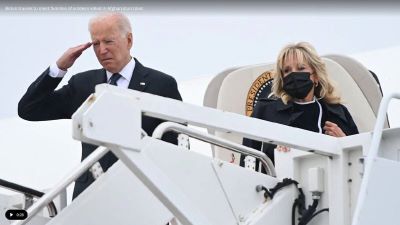
President Joe Biden paid his respects to the U.S. service members slain in Kabul as their remains were transported off a military aircraft at Dover Air Force Base Sunday, hours after the nation carried out a second strike against an Islamic State target in Afghanistan.
The president spoke to the relatives of the troops, who were killed in last week’s airport bombing, and participated in a “dignified transfer” – in which the remains of fallen service members are returned to the U.S. in flag-draped cases.
Thirteen U.S. troops were killed in the attack, many too young to remember a time before the war.
Earlier, the U.S. carried out a strike on a vehicle in Kabul in response to an “imminent” threat to the airport in the Afghan capital, an official said.
A U.S. military official said there were “significant secondary explosions” following the Sunday strike, indicating the presence of a “substantial amount of explosive material.”
“We are confident we hit the target we were aiming for; initial reports indicate there were no civilian casualties caused by our airstrike,” said the official, speaking on the condition of anonymity because of the sensitive nature of the strike.
The strike takes place as U.S. evacuation efforts are winding down with America’s longest war coming to a violent end.
The Islamic State-Khorasan, or ISIS-K, the Afghanistan and Pakistan arm of the militant group, asserted responsibility for the airport attack on Thursday.
In a joint statement with nearly 100 other countries, the United States said Sunday that it had received reassurances the Taliban would permit Afghans to leave the country after the U.S. withdrawal and that Washington, along with others, would continue to take in Afghans.
“We are all committed to ensuring that our citizens, nationals and residents, employees, Afghans who have worked with us and those who are at risk can continue to travel freely to destinations outside Afghanistan,” said the statement, whose signatories included the North Atlantic Treaty Organization, though notably not China and Russia.
“We have received assurances from the Taliban that all foreign nationals and any Afghan citizen with travel authorization from our countries will be allowed to proceed in a safe and orderly manner to points of departure and travel outside the country,” the statement continued. “We will continue issuing travel documentation to designated Afghans, and we have the clear expectation of and commitment from the Taliban that they can travel to our respective countries. We note the public statements of the Taliban confirming this understanding.”
The statement provided no further details regarding the agreement or what, if any, action would be taken if the Taliban reneges.
Secretary of State Antony Blinken told NBC’s “Meet the Press” on Sunday that it was “not likely” that Washington would backtrack on its agreement to withdraw U.S. forces by Aug. 31, comments in sync with previous statements by the Biden administration.
Blinken also continued to reject criticism that the administration was caught unprepared for the Taliban’s swift return to power and the subsequent need to protect Afghans who worked with the United States during its two decades in the country, and to aid Afghans who oppose the extremist group.
“Our commitment to continue to help people leave Afghanistan who want to leave and who are not out by September 1st, that endures,” Blinken said. “There’s no deadline on that effort. And we have ways, we have mechanisms, to help facilitate the ongoing departure of people from Afghanistan if they choose to leave.”
Blinken told ABC News on Sunday that the risk of further attacks around the Kabul airport remained very high, a situation that has effectively halted most evacuation efforts.
The United States’ top diplomat said there were about 300 U.S. citizens who remain in Afghanistan and want to leave.
Blinken denied the United States has given a “kill list” of American citizens and Afghan allies to the Taliban, pushing back on such allegations as “simply wrong.”
“The idea that we’ve done anything to put at further risk those that we’re trying to help leave the country is simply wrong. And the idea that we shared lists of Americans or others with the Taliban is simply wrong,” Blinken said on “Meet the Press.”
Elaborating, Blinken said they had in limited situations shared some names with the Taliban, which is controlling security in a loose perimeter outside Kabul airport, to assure those people could be brought into the airport. That had happened particularly in cases where people did not have the necessary credentials or documents on them, he added.
“In specific instances when you’re trying to get a bus or a group of people through, and you need to show a manifest to do that … you’ll share names on a list of people on the bus so they can be assured that those are people that we’re looking to bring in,” Blinken said. “And by definition, that’s exactly what’s happened.”
Blinken’s comments came following outrage from Republicans lawmakers, conservative commentators and others after Politico reported that the United States had provided the Taliban with the names of American citizens, green-card holders and Afghan allies to ensure their exit from Afghanistan. The report led to accusations that the United States had put these Afghans in danger if they were left behind after the United States left the country.
National Security Council spokeswoman Emily Horne later told Politico that only “in limited cases” the United States has “shared information with the Taliban that has successfully facilitated evacuations from Kabul.”
Blinken emphasized Sunday that the United States has promised nothing to the Taliban and that “there are very significant expectations of the Taliban going forward if they’re going to have any kind of relationship with the rest of the world.” However, Republican leaders, including Senate Minority Leader Mitch McConnell, R-Ky., have scoffed at the idea that the U.S. has any leverage over the Taliban.
“They’re not particularly concerned about international pressure,” McConnell said on “Fox News Sunday.” “These are barbarians who certainly are not motivated by what others may think of them, and they’ve got the neighboring countries that have actually been sympathetic to them.”
Fauci open to covid-19 booster shots sooner than eight months
Anthony Fauci said the door is open to administering booster shots in the U.S. sooner than eight months after a completed covid-19 vaccination, a possibility President Joe Biden has raised.
“We’re still planning on eight months. That was the calculation we made,” Fauci, Biden’s chief medical adviser, said on NBC’s “Meet the Press” on Sunday. However, “we’re totally open to any variation in that based on the data,” he added.
Fauci also said he favors requiring shots for schoolchildren as “a good idea” for the U.S., where only people 12 years and older are eligible for vaccination.
“This is not something new,” he said on CNN. “We have mandates in many places in schools, particularly public schools” for diseases such polio, measles, mumps, rubella and hepatitis, he said.
ADVERTISEMENTx
U.S. health officials have outlined a schedule of administering additional doses after eight months, starting Sept. 20, as vaccine efficacy weakens over time. Last week, Biden wondered publicly if the gap between doses could be shorter.
“Should it be as little as five months?” the president asked during an appearance with Prime Minister Naftali Bennett of Israel, which is aggressively rolling out booster shots. “That’s being discussed,” he said, adding that he had talked to Fauci about it.
The administration needs clearance from the Centers for Disease Control and Prevention to proceed on boosters, as vaccination experts continue to debate the value and impact of extra doses. The White House quickly clarified its stance, saying that the plan hasn’t changed even though Biden’s interest in a rapid rollout is clear.
In the U.S., 820,000 additional shots have been administered since Aug. 13, when those with compromised immune systems became eligible, according to CDC data.
Fauci said he was concerned that another 100,000 people could die from covid-19 by December because so many Americans are refusing to take the shots. About 637,000 U.S. deaths have been blamed on covid since the pandemic began early last year.
“What is going on now is both entirely predictable, but entirely preventable,” Fauci said on CNN’s “State of the Union.” “We have about 80 million people in this country who are eligible to be vaccinated, who are not yet vaccinated.”
“That’s why it’s so important now, in this crisis that we are in, that people put aside any ideological, political or other differences, and just get vaccinated,” he added.
Tourism extension scheme brings the buzz back to Krabi, Phang Nga, Surat Thani
The tourism sector in Krabi, Phang Nga and Surat Thani provinces has started picking up since the launch of the 7+7 Extension scheme last week.
Under the scheme, tourists arriving under the Phuket Sandbox scheme can travel to specific destinations in Surat Thani, Krabi and Phang Nga after spending their first seven days in Phuket.
The destinations they can travel to are:
• Koh Samui, Koh Pha-ngan and Koh Tao in Surat Thani
• Koh Phi Phi, Koh Ngai and Railay Beach in Krabi
• Khao Lak, Koh Yao Noi and Koh Yao Yai in Phang Nga
Tourism Authority of Thailand (TAT) said foreigners have been travelling to the abovementioned islands since last Wednesday and more than 1,874 room nights have been booked. Most of the room nights or 1,026 have been booked in Surat Thani’s three islands.
TAT said travellers are free to return to Phuket to complete their 14-day requirement under the sandbox scheme.
Separately, Krabi Tourism Association said the province has started buzzing again thanks to the extension scheme after nearly two years of silence. It added that everybody living on the three islands has been fully vaccinated against Covid-19.
The Public Health Ministry has come up with a guide for travellers planning to visit Thailand under the pilot reopening schemes like Phuket Sandbox, Samui Plus and Phuket Sandbox 7+7 Extension.
To be eligible to travel under the programme, Thai returnees or foreigners must be:
• 18 years old and above
• Should have received two doses of Covid-19 vaccines that have been approved by Thailand or the World Health Organisation at least 14 days before arrival
Covid-19 vaccines approved in Thailand:
• CoronaVac by Sinovac Biotech: 2 doses / 2-to-4-week interval
• AstraZeneca or Covishield by AstraZeneca and the University of Oxford, SK Bioscience (South Korea), Siam Bioscience, and Serum Institute of India (Covishield): 2 doses / 4-to-12-week interval
• Comirnaty by Pfizer and BioNTech: 2 doses / 3-week interval
• Janssen or Janssen/Ad26.COV2.S by Johnson & Johnson: 1 dose
• Moderna by Moderna: 2 doses / 4-week interval
• Covilo by Sinopharm: 2 doses / 3-4-week interval
• Sputnik V by the Gamaleya Research Institute of Epidemiology and Microbiology: 2 doses/3-week interval
ADVERTISEMENTx
Have you been fully vaccinated?
According to the Public Health Ministry, travellers are considered fully vaccinated if they have received:
• Second dose of two-dose vaccines like AstraZeneca or Pfizer no less than 14 days before travelling to Thailand.
• Single-dose vaccines like Janssen no less than 14 days before travelling to Thailand
• Second dose of mix-and-match vaccines like CoronaVac from Sinovac and AstraZeneca, no less than 14 days before travelling to Thailand.
Apart from being fully vaccinated, travellers to Thailand should have all their advance arrangements in good order.
These include a Certificate of Entry (COE) issued by a Thai embassy or consulate, a Covid-19 health insurance policy with a minimum coverage of US$100,000; confirmation of a SHA Plus hotel booking, and a medical certificate with a negative RT-PCR test result issued no more than 72 hours before departure.








 SootinClaimon.Com