The Stock Exchange of Thailand (SET) Index rose by 4.65 points or 0.29 per cent to 1,632.69 on Thursday morning, witnessing a high of 1,634.74 and a low of 1,631.23 in opening trade.
Krungsri Securities expected the day’s index to rise to between 1,635 and 1,640 points before falling.
It said the index gained positive sentiment from the rising oil price in response to a decline in US oil storage and the Thai government’s move to reveal its timeline for reopening the country.
“However, we predict that investors would sell their shares to curb risks from the FTSE’s move to reduce weight in Thai stocks by approximately US$44 million [Bt1.4 billion],” Krungsri Securities said.
It recommended purchasing of the following companies’ shares as an investment strategy:
ADVERTISEMENT
▪︎ PTT, PTTEP, TOP, PTTGC and SPRC, which benefit from the rising oil price.
▪︎ Hana, KCE, TU, CPF, GFPT, Asian, EPG, NER, Sun and APure, which benefit from a weakening baht.
▪︎ Banpu, Lanna, CKP, GPSC, Gulf and BDMS, whose third-quarter profit is expected to rise.
The SET Index closed at 1,628.04 on Wednesday, up 4.20 points or 0.26 per cent. Transactions totalled THB73.18 billion with an index high of 1,630.05 and a low of 1,620.84.
The baht opened at 32.86 to the US dollar on Thursday, strengthening from Wednesday’s closing rate of 32.88.
The Thai currency is likely to move between 32.80 and 32.95 during the day, Krungthai Bank market strategist Poon Panichpibool predicted.
Poon said the baht was testing the key resistance level of 33.00 to the dollar due to a host of risk factors faced by the country.
The Covid-19 situation might take a turn for the worse and usher in a new dreadful wave, causing investors to offload Thai assets.
He also pointed out that investors who have purchased short duration bonds are closing their risks. In the past two days, foreign investors have sold short duration bonds worth THB12 billion in total.
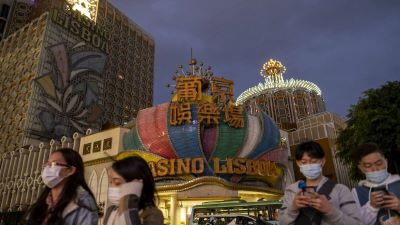
Macau casinos see $18 billion wipeout as China tightens grip
Macaus top gaming stocks lost a record $18.4 billion in combined market value on Wednesday after officials said they would change casino regulations to tighten restrictions on operators, including appointing government representatives to “supervise” companies in the worlds biggest gaming hub.
The Bloomberg Intelligence index of the six big casino operators fell a record 23%. American operators saw the worst selloffs, with Sands China Ltd. sinking as much as 33%, while Wynn Macau Ltd. plunged 34%, both the steepest declines ever. Galaxy Entertainment Group slumped 20%, its sharpest drop in a decade.
The sector also led declines in China’s dollar bond market. A note due 2028 from Wynn Macau sunk 9 cents on the dollar to 91.4 cents, according to Bloomberg-compiled prices, set for its biggest-ever decline. Dollar bonds from SJM Holdings Ltd., MGM China Holdings Ltd. and Melco Resorts and Entertainment dropped at least 3 cents.
Officials in the enclave, the only place in China where gambling is legal, said they would begin a 45-day public consultation period on Sept. 15 to discuss the legal revisions. Among the topics being covered: how many licenses — known locally as “concessions” — will be allowed, how long their terms will be, and the level of supervision by the government.
While license renewals have been expected for some time as the current ones expire next June, the move to tighten regulatory control took the industry by surprise. Besides appointing government representatives, the revisions also propose increasing local shareholdings of casino companies, without elaboration on how these moves will be enacted. Dismay rippled through industry players and analysts after the announcement as China’s ongoing clampdown on sectors from gaming to after-school tutoring appears to have reached Macau at last.
ADVERTISEMENT
“The casino issues are a continuation of what’s been a pretty big crackdown,” said Jason Ader, the chief executive officer of New York-based investment manager SpringOwl Asset Management and a former Las Vegas Sands Corp. board member. “There’s a debate over whether China is even investable right now. You never like to see increased regulation, increased taxes, restrained movement. That all seems to be the status quo.”
JPMorgan Chase & Co. analyst DS Kim downgraded the six operators to sell or neutral weightings in a Wednesday research note. “We think this announcement would have already planted a seed of doubt in investors’ minds, which is probably enough to de-rate these names until clarity emerges on key points,” he wrote.
Read more: Gambling Stocks Tumble as Macau Flags More Government Scrutiny
The tightened scrutiny comes at a time when Macau is still struggling to recover from the Covid-19 pandemic, which prompted the government to restrict travel, cutting off the economy’s lifeblood of Chinese punters. Gaming revenue for the month of August was 82% lower than the same period in 2019.
Among the items officials discussed in a press conference Tuesday were tighter controls on the distribution of dividends, greater participation by locals in the concessions and government representatives directly overseeing the businesses, Kim noted. After the consultation period, a final bill will be tabled to the local legislature.
China has been clamping down on activity by VIP punters in Macau for several years now over concerns that the high-stakes betting there — which takes place in convertible Hong Kong dollars — can sometimes be an illicit channel for currency outflows and money laundering. Beijing has also cracked down on organized gambling trips to Macau and other overseas destinations organized by junkets, companies that service high-rollers and extend them credit, amid a wider effort to discourage casino gaming.
Casino operators catering to high rollers may “face greater pressure to hedge their bets, invest more in non-gaming attractions and work harder to woo the premium mass market,” according to Bloomberg Intelligence gaming analysts Angela Hanlee and Kai Lin Choo.
Despite the market’s panic, some observers said the proposal won’t necessarily have a significant impact on operators. Bernstein analysts led by Vitaly Umansky said that at Tuesday’s press briefing, officials had highlighted the importance of maintaining a scale for the gaming industry, indicating that all six companies are likely to keep their licenses.
“Our view remains that the six operators here today will be here tomorrow,” Umansky said in a note, adding that he didn’t see “any major concerns” over the government’s planned direct supervision as the gaming companies have already been working closely with officials.
While China has been tightening its scrutiny over Macau’s gambling sector for years, Tuesday’s move comes as Beijing undertakes a widespread crackdown on business and society. Initially focused on the growing influence of China’s tech giants, the campaign has taken on a moralistic tone, targeting children’s video-game use to after-school tutoring. The Communist Party has long had a dim view of gambling, citing its impact on families and linking it to social disharmony.
Nonetheless, Chinese are avid gamblers, with the increased oversight of Macau pushing them to less regulated markets like the Philippines and Cambodia, where casinos and online gaming operations were flourishing before the pandemic halted travel.
Ader, too, said it was unlikely a western operator like Sands would lose its license, although the overall climate for foreign companies in the country is deteriorating.
“It’s sort of all going in the wrong direction in China,” he said. “To the extent investors are nervous about China, Macau doesn’t feel like the place it was five years ago for a lot of reasons.”
Stocks rose the most in almost three weeks as the concern that has weighed on investor sentiment about a slowdown in economic growth eased. Crude oil jump and bond yields rose.
Energy shares helped push the S&P 500 up 0.9% and into positive territory for only the second time in eight trading sessions. The tech-heavy Nasdaq 100 rose for the first time in more than a week. Treasuries fell after rallying Tuesday on a lower-than-forecast inflation report, while the dollar weakened against most major peers.
After surging 20% to record highs through the first eight months of the year, the S&P 500 began September on a losing note as concern increased that a pullback in stimulus and the delta variant of the covid 19 virus risked derailing the recovery from the pandemic. The S&P hasn’t closed higher by 1% or more since July 23.
“It is time to reload on equities starting with the North American market,” Sebastien Galy, a senior macro strategist at Nordea Investment, wrote in a note to clients.
Composite volume across all exchanges surpassed 10 billion shares for the third straight day on Tuesday, the longest streak since mid-June, according to data compiled by Frank Cappelleri at Instinet LLC.
ADVERTISEMENT
Oil clung to gains after a U.S. government report showing a bigger-than-expected decline in crude stockpiles signaled a rapidly tightening market. Global benchmark Brent crude rose above $75 a barrel for the first time since early August, while U.S. crude futures surged as much as 3.6% on Wednesday.
While Tuesday’s U.S. inflation print could be seen as reducing pressure on the Federal Reserve to start pulling back on loose monetary policy, investors remain wary of a range of obstacles. These include the impact of the delta virus variant and rising costs on economic reopening, as well as China’s drive to rein in private industries.
Going into the year-end, investors will also have to digest debate around the U.S. debt ceiling, President Joe Biden’s tax package, infrastructure spending and Fed tapering, she added.
Asian stocks dropped after reports showed China’s economy took a knock in August from stringent virus controls and tight curbs on property and as authorities told major lenders to China Evergrande Group not to expect interest payments due next week on bank loans. A debt restructuring could raise the prospect of wider social unrest and contagion in credit markets.
Some of the main moves in markets:
Stocks
– The S&P 500 rose 0.8% as of 4:04 p.m. EDT
– The Nasdaq 100 rose 0.8%
– The Dow Jones industrial average rose 0.7%
– The MSCI World index rose 0.3%
Currencies
– The Bloomberg Dollar Spot Index fell 0.2%
– The euro rose 0.1% to $1.1818
– The British pound rose 0.2% to $1.3844
– The Japanese yen rose 0.3% to 109.36 per dollar
Bonds
– The yield on 10-year Treasurys advanced two basis points to 1.30%
– Germany’s 10-year yield advanced three basis points to -0.31%
– Britain’s 10-year yield advanced four basis points to 0.78%
Commodities
– West Texas Intermediate crude rose 3.1% to $72.65 a barrel
The Stock Exchange of Thailand (SET) Index closed at 1,628.04 on Wednesday, up 4.20 points or 0.26 per cent. Transactions totalled THB73.18 billion with an index high of 1,630.05 and a low of 1,620.84.
In the morning session, Krungsri Securities expected the day’s index to move between 1,615 and 1,620 points, in line with falls in neighbouring stock markets.
It said the SET Index gained positive sentiment from a slight rise in the US Consumer Price Index, which helped allay investors’ concern over the Federal Reserve’s move to taper its quantitative easing programme.
“However, uncertainty over the hike in US corporate tax from 21 per cent to 26.5 per cent will affect investment,” it added.
“Hence, we advise investors to buy shares when prices are cheap, focusing on stocks that have gained positive sentiment.”
The 10 stocks with the highest trade value today were PTT, DELTA, INTUCH, AOT, CPALL, KBANK, SCC, ADVANC, SCGP and PTTGC.
Japan’s Nikkei Index closed at 30,511.71, down 158.39 points or 0.52 per cent.
China’s Shanghai SE Composite Index closed at 3,656.22, down 6.38 points or 0.17 per cent, while the Shenzhen SE Component Index closed at 14,536.31, down 89.77 points or 0.61 per cent.
Hong Kong’s Hang Seng Index closed at 25,033.21, down 469.02 points or 1.84 per cent.
South Korea’s KOSPI closed at 3,153.40, up 4.57 points or 0.15 per cent.
Taiwan’s TAIEX closed at 17,354.00, down 80.90 points or 0.46 per cent.
EIC revises down Thailand’s economic forecast due to prolonged third wave, weak stimulus measures
The Economic Intelligence Center (EIC) has revised downward Thailand’s economic forecast for this year to 0.7 per cent from 0.9 per cent after the prolonged third-wave of Covid-19 infections hit private consumption badly.
The number of foreign arrivals has also been lower than expected due to concerns about the outbreak.
EIC expects the situation to improve in the fourth quarter, by which time more people will have been vaccinated.
Separately, exports have been expanding though they may slow down slightly after the spread of the Delta variant has decelerated the global economy and resulted in supply disruptions in Thailand and Asean.
On the fiscal front, stimulus spending has continued through public consumption and investment, alongside several relief measures. Nonetheless, the measures are still inadequate in terms of areas covered, duration and amount allocated.
EIC expects the government to implement additional relief measures this year using the remainder of the 1-trillion-baht budget and an additional 200 billion baht from another 500-billion-baht loan.
For 2022, EIC believes the Thai economy will grow 3.4 per cent with recovery in both domestic and external demand. Exports should expand, though at a slower pace in line with the global economy.
Higher vaccination rates in Thailand and neighbouring countries to a level that would allow the resumption of travel would benefit the tourism sector. Should this happen, EIC forecasts about 6.3 million tourists next year. It also expects domestic spending to recover from a resumption of economic activities.
However, recovery will be gradual due to a significantly lower number of tourists as well as headwinds from deep economic scars like worsening business dynamism, fragile labour market and high debt levels.
On the fiscal front, though public investment projects will continue expanding, support from the fiscal policy will decline from the previous year as public consumption drops.
Also, the 300 billion baht earmarked is less than the amount spent in 2021.
ADVERTISEMENT
Though the economy will recover next year, it will still be substantially below its potential resulting in a large output loss and could affect Thailand’s potential economic growth in the future.
Hence, the government should consider additional borrowings to support recovery. While the public debt level will rise above the ceiling of 60 per cent of the GDP, it remains manageable under a low-interest rate environment and high domestic liquidity.
The government must also come up with a convincing medium-term fiscal consolidation plan to boost confidence.
EIC expects the Monetary Policy Committee to maintain the policy rate at 0.5 per cent through 2021 and 2022 to support economic recovery.
ADVERTISEMENT
The Bank of Thailand will focus on boosting the efficiency of monetary policy transmission through various policies to boost liquidity of households and SMEs.
At the same time, the central bank will encourage financial institutions to restructure loans according to problems faced by each group of borrowers in addition to considering intervention in financial markets to stabilize interest rates.
However, the Thai economy still faces significant downside risks from:
• A potential resurgence in Covid-19 cases both domestically and overseas if virus mutations cause vaccine efficacy to fall.
• Supply chain disruptions which could occur due to the closure of local factories and production stoppages
ADVERTISEMENT
• A more severe impact from scarring effects than expected leading to widespread consequences on households and businesses debt servicing.
The Stock Exchange of Thailand (SET) Index rose by 3.00 points or 0.18 per cent to 1,626.84 on Wednesday morning, witnessing a high of 1,628.72 and a low of 1,623.84 in opening trade.
Krungsri Securities predicted the day’s index would move between 1,615 and 1,620 points in line with the fall in neighbouring stock markets.
It said the index gained positive sentiment from a slight rise in the US Consumer Price Index, which helped allay investor concern over the Federal Reserve’s move to taper its quantitative easing programme.
“However, uncertainty over the US corporate income tax hike from 21 per cent to 26.5 per cent would affect investment,” Krungsri Securities pointed out.
“Hence, we advise investors to buy shares when prices are cheap, focusing on stocks that have gained positive sentiment.”
It recommended purchasing of the following companies’ shares as an investment strategy:
ADVERTISEMENT
▪︎ PTT, PTTEP, TOP, PTTGC and SPRC, which benefit from the rising oil price.
▪︎ Hana, KCE, TU, CPF, GFPT, Asian, EPG, NER, Sun and APure, which benefit from a weakening baht.
▪︎ PSL, TTA and RCL, which would benefit from a rise in the freight rate.
The SET Index closed at 1,623.84 on Tuesday, down 9.92 points or 0.61 per cent. Transactions totalled THB84.17 billion with an index high of 1,640.40 and a low of 1,621.96.
The price of gold peaked by THB250 in morning trade on Wednesday.
AGold Traders Association report at 9.25am said the buying price of a gold bar was THB28,050 per baht weight and selling price THB28,150, while gold ornaments cost THB27,545.72 and THB28,650, respectively.
At close on Tuesday, the buying price of a gold bar was THB27,800 per baht weight and selling price THB27,900, while gold ornaments cost THB27,303.16 and THB28,400, respectively.
The spot gold price on Wednesday morning was moving around US$1,804 (THB59,442) per ounce after Comex gold at close on Tuesday rose by $12.70 to $1,807.10 per ounce due to expectation that the US Federal Reserve would go slow on any increase in the interest rate and relax its bond purchasing programme under quantitative easing measures after the country revealed lower-than-expected inflation numbers.
Baht performance hinges on Covid situation: market strategist
The baht opened at 32.95 to the US dollar on Wednesday, weakening from Tuesday’s closing rate of 32.93.
The Thai currency is likely to move between 32.90 and 33.05 during the day, Krungthai Bank market strategist Poon Panichpibool predicted.
Poon said the baht might test the key resistance level of 33.00 to the dollar due to risk factors faced by the country.
The Covid-19 situation might take a turn for the worse and usher in a new dreaded wave, causing investors to offload Thai assets, he pointed out, adding that investors who have purchased short duration bonds might close their risks.
Meanwhile, the market is still in a risk-on state and supported by the dollar’s momentum, Poon said.
The baht will not strengthen in the short term until the market sees worries ease and is ready to take risks, during which the dollar may weaken, he added.
World must wait for extra oil as Ida wipes out OPEC+ hike
The world will have to wait until October for additional oil supplies as output losses from Hurricane Ida wipe out increases from OPEC+, the International Energy Agency said.
Consumers should have been enjoying “solid gains” in production as the Organization of Petroleum Exporting Countries and its allies continued their revival of idle capacity, the agency said in its monthly report. Instead, global supply fell by 540,000 barrels a day in August due to unexpected disruptions and will be flat this month.
“Unplanned production outages have temporarily halted an uptrend in world oil supply that began in March, but growth is set to resume in October,” said the Paris-based IEA, which advises developed economies on energy policy.
The supply disappointment hasn’t had a big impact on prices because of bearish trends in fuel consumption. Global oil demand has been falling since July as rising Covid-19 cases prompt mobility restrictions in Asia, the IEA said. Crude has traded near $70 a barrel in New York for most of this month.
World fuel consumption will contract by 310,000 barrels a day on average each month from July to September, the IEA said. Yet there are signs that the coronavirus resurgence is abating and the agency expects a sharp rebound in demand of 1.6 million barrels a day next month, with continued growth to the end of the year.
The matching shifts in supply and demand meant this year’s prevailing oil-market trend — shrinking inventories — continued unabated. Fuel stockpiles in developed economies fell by 30 million barrels last month, putting them 186 million barrels below the five-year average, according to preliminary IEA estimates. There should be “hefty draws” again this month, the agency said.
“It is only by early 2022 that supply will be high enough to allow oil stocks to be replenished,” according to the report. “In the meantime, strategic oil stocks from the U.S. and China may go some way to help plug the gap.”
Hurricane Ida, a Category 4 storm that hit the U.S. Gulf Coast on Aug. 29, initially shut down 1.7 million barrels a day of oil production. Weeks later, the industry is still struggling to restart many of the affected fields and the region’s crude output is expected to be down as much as 650,000 barrels a day on average this month, the IEA said.
ADVERTISEMENT
The total crude supply loss could amount to 30 million barrels, making Ida the most damaging hurricane to hit the Gulf oil industry since Katrina and Rita in 2005. Another storm, named Nicholas, made landfall in Texas on Tuesday and threatened to unleash flooding in Houston and parts of Louisiana.
While most of OPEC boosted output in August, a handful of members plus several allied producers saw production drop. Overall OPEC+ crude supply fell by 150,000 barrels a day to 41.58 million barrels a day in August as increases from Saudi Arabia, Iraq and Russia failed to offset losses in Nigeria, Kazakhstan and Mexico.
The group is scheduled to revive another 400,000 barrels a day of idle capacity this month, but members including Nigeria, Angola and Malaysia continue to struggle to boost output, the IEA said.







 SootinClaimon.Com