[Weekender] Who needs staff, when there are robots and tech-savvy customers? #SootinClaimon.Com

#SootinClaimon.Com : ขอบคุณแหล่งข้อมูล : หนังสือพิมพ์ The Nation.

https://www.nationthailand.com/international/40009071


From ready-meals to ice cream, unstaffed stores are fast spreading in the tech-savvy country
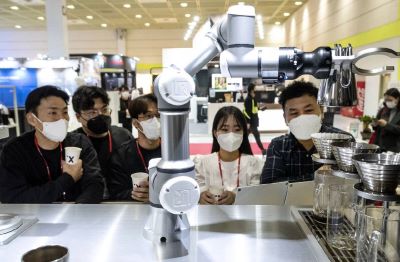
At this year’s annual Seoul International Cafe Show which took place earlier this month, automation and smart devices such as drip coffee-making robots enjoyed the spotlight.

“From smart coffee roasters to drip coffee-making robots, there were various opportunities to get a taste of the ‘smart cafe’ experience,” one official at the event said.

These are the latest sign of automation and a demographic shift in South Korea where cashier-free stores have increasingly been popping up on the streets. Over the last few years, retailers small and large have been adopting self-checkout systems, also known as kiosks, or even going completely staff-free to save labor costs and keep stores open late into the night.

Nearly 1,700 “hybrid” stores, which rotate between having staff in the store and going unmanned, are currently in operation between the four major local convenience store chains — CU, GS25, 7-Eleven and E-Mart 24. With over 47,000 convenience stores in the country, the figure might not be so staggering for now. But the number of hybrid stores has been rapidly rising in recent months, according to E-Mart 24.

“After we announced the decision to expand hybrid stores in July, we have been rolling out the system. Nearly 80 percent of our stores are not open 24 hours a day,” one representative at E-Mart 24 said.

Boasting over 5,700 locations in total, the convenience store chain, operated by Shinsegae Group, saw the number of hybrid stores jump from some 150 earlier this year to around 700 as of late October.

Meal kit or banchan stores — shops dedicated to selling ready-made meals and side dishes — have also been getting the automation treatment.

“Our main target is married women in their 30s and 40s who are also working and part of dual-income couples,” a representative at Omealdang, an unmanned meal kit store chain, said.

With no need to hire shopkeepers, these stores are open 24 hours a day all year round.

“The ready-made meals are produced in factories and supplied (to stores) directly and be put on display and sold without having to be cooked in the store, which has been well-received by meal kit shop owners,” the representative added.

It was early 2018 when Amazon first unveiled its cashier-less Amazon Go to the public. Since then, South Korean businesses have also quickly adopted a similar concept in businesses ranging from ice creams stores to unmanned cafes and coin laundry services.

According to Shinhan Card, a leading card issuer in the country, credit card transaction volume at staff-free cafes saw a 50 percent year-on-year jump between August 2019 and January 2020, leaving behind franchise coffeehouses and budget cafes which saw a 5 percent and 24 percent jump over the same period, respectively.

The number of self-service laundries from six major companies also grew from 3,086 in 2016 to 4,252 in 2020, an increase of 37.8 percent, according to a report from the Korea Consumer Agency. Revenue also grew from 49.8 billion won ($42.1 million) in 2016 to 112.9 billion won in 2020.

The increase in numbers comes as the share of single-person households in the country also grew from 27.2 percent in 2015 to 30.2 percent in 2019, according to Statistics Korea. The figure rose to 31.7 percent in 2020, meaning that nearly 6 in 10 households are either single- or double-person households.

Lee Young-ae, a professor at the Department of Consumer Science at Incheon National University, said “price competitiveness,” “curiosity about something new” as well as “being able to shop quickly” have made unmanned stores appealing to consumers.

But for staff-free stores to last long-term, they will have to tackle issues such as security, the professor said.

“It could look like a lot of people are using these services because they did not exist before. But in the long run, customers could feel tired or confused if they are not given the information or services they need (at unmanned stores).”

How will the automation boom affect the job market?

Professor Lee Jung-hee at Chung-Ang University College of Business & Economy says demand for staff-free stores will continue to grow.

“We have already experienced the contactless age. And as (business owners) face issues such as labor costs and manpower management, staff-free stores present an alternative. I expect the demand for similar business models to continue to rise,” Professor Lee said.

Staff-free stores often appeal to prospective shop owners with their low initial costs amid growing labor costs.

A study from the Korea Economic Research Institute last year argued that many low-paying jobs were erased when the country’s minimum wage was increased by 16.4 percent in 2018 while those who were employed enjoyed higher pay.

In a survey conducted by the Korea Federation of Micro Enterprise earlier this year, some 87 percent of small business owners said they would have difficulties paying the minimum wage if it were increased for next year.

In an effort to help small business owners, the government announced the “smart supermarket” plan earlier this year — equipping hundreds of supermarkets with entry verification systems and self-checkout kiosks as well as security devices.

“This is a trend which cannot be stopped by the government. It could also create jobs in new fields such as solutions companies focusing on unmanned stores including kiosks and other automation systems. Low-skilled jobs are likely to disappear as a result.

“Rather than focusing on this specific trend, the government needs to come up with a comprehensive plan to address the issue of jobs (like cashiers) disappearing,” the professor said.

Published : November 21, 2021

By : The Korea Herald

‘Vax’ is Oxford English Dictionary’s 2021 word of the year #SootinClaimon.Com

#SootinClaimon.Com : ขอบคุณแหล่งข้อมูล : หนังสือพิมพ์ The Nation.

https://www.nationthailand.com/international/40009070


The word chosen by the Oxford English Dictionary (OED) as the word of the year is ‘Vax’.

In 2021, the words related to vaccines spiked in frequency due to the ongoing Covid-19 pandemic with double-vaxxed, unvaxxed, and anti-vaxxer all seeing a surge in use, reported BBC.

An obvious choice was ‘Vax’ as it has made “the most striking impact”, OED senior editor Fiona McPherson was quoted as saying.

“It goes back at least to the 1980s, but according to our corpus it was rarely used until this year,” she said.

“When you add to that its versatility in forming other words – vaxxie, vax-a-thon, vaxinista – it became clear that vax was the standout in the crowd”, Fiona said.

The most common form of the spelling ‘vax’ is with a single ‘x’. Although both vax and vaxx are accepted.

The usage of the word ‘vax’ in September was up more than 72 times from its level last year, said OCED. Other words related to vaccination had also been broadened into wider ranges such as “vax cards” and “fully vaxxed”, reported the Guardian.

The report said that the usage of the word ‘pandemic’ has also been increased by more than 57,000 percent this year.

The word “Vax” has been derived from the Latin word ‘Vacca’, meaning cow, which was first recorded in English in 1799. Both its derivatives vaccinate and vaccination first appeared in 1800.

OED reports, this is because of the English physician and scientist Edward Jenner’s pioneering work on vaccination against smallpox in the late 1790s and early 1800s.

Collins chose the word ‘lockdown’ as the word of the year in 2020.

Nonetheless, Oxford decided to expand its award to encompass a handful of new keywords such as lockdown, bushfires, and Covid-19, as well as Black Lives Matter, WFH (working from home), keyworkers, and furlough since it was an unprecedented year with too many contenders, says the report.

Oxford’s language resource gathers news content and is updated daily containing over 14.5 billion words for the lexicographers to search and analyze.

(With inputs from IANS)

Published : November 21, 2021

By : The Statesman

BN crushes Anwar’s coalition for major win in Melaka polls #SootinClaimon.Com

#SootinClaimon.Com : ขอบคุณแหล่งข้อมูล : หนังสือพิมพ์ The Nation.

https://www.nationthailand.com/international/40009069


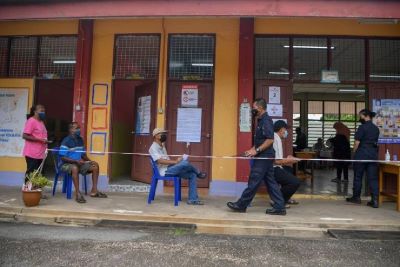
KUALA LUMPUR – Malaysia’s Barisan Nasional (BN) coalition led by Umno captured Melaka on Saturday (Nov 20), winning 21 of the 28 seats in the Melaka state polls.

Rival pact Pakatan Harapan (PH) won in five constituencies and Perikatan Nasional (PN) won two seats, according to results confirmed by the Election Commission late on Saturday.

This  meant that BN has won 75 per cent of the wards in Melaka, the second-smallest Malaysian state by land size after Perlis.

Umno president Ahmad Zahid Hamidi, who wore a neck brace when he appeared at the BN operations centre, praised the efforts of his deputy Mohamad Hasan, who led the coalition’s election machinery in Melaka, and other state leaders.

Referring to former premier Najib Razak, he added to cheers from the crowd: “I did not forget Bossku’s  contributions.”
Zahid did not join the Melaka campaign because he was away in Germany for medical treatment.

Najib was highly visible during the 12-day campaigning period as he made  many public appearances, despite curbs by the federal government on public contact amid the pandemic.

BN lost Melaka to PH in the May 2018 general election, mirroring the unexpected PH victory at the federal level.

But the PH state government collapsed due to defections early last year, just as its federal counterpart was ousted for similar reasons.

Another round of defections last month saw the BN-led state government, which had replaced PH, also losing its majority, leading to the dissolution of the legislative assembly.

The PH coalition, which is an opposition bloc at the federal level, conceded defeat yesterday, ahead of the release of the official results.

PH secretary-general Saifuddin Nasution said that based on the unofficial results it obtained, the Melaka voters have decided to give their mandate to BN.

“We would like to state that the people of Melaka have made their decisions through the ballot box,” Datuk Seri Saifuddin told a news conference, as quoted by The Star daily. “And based on that, it shows that they wanted Barisan to form a government and Pakatan needs to respect the results.”

The state election is closely watched as Melaka has a racial composition and urban-rural split similar to the national averages, making yesterday’s polls a bellwether for the next general election.

The general election is not due until 2023 but is expected to take place next year.

PH chief Anwar Ibrahim suffered a crushing blow as his bloc won only five seats, compared with the 15 it won in the May 2018 general election.

His own Parti Keadilan Rakyat lost the three seats it won in 2018.

Former premier Muhyiddin Yassin’s PN pact won two seats, and he said its candidates secured good chunks of the votes.

This was despite expectations that PN would do poorly as the third coalition standing between BN and PH.

PN is anchored by Tan Sri Muhyiddin’s Parti Pribumi Bersatu Malaysia and Parti Islam SeMalaysia.

Mr Muhyiddin yesterday declared that PN will be BN’s main challenger in the upcoming general election.

“We have arrived here and will remain steadfast to become BN’s main challenger,” he told the media in Melaka.

Seats won and lost

Barisan Nasional: 21 seats

(2018: It won 13 seats)

• Umno: 18

• Malaysian Chinese Association: 2

• Malaysian Indian Congress: 1

Pakatan Harapan: 5 seats

(2018: It won 15 seats with Bersatu)

• Parti Keadilan Rakyat: 0

• Democratic Action Party: 4

• Parti Amanah Negara: 1

Perikatan Nasional: 2 seats

(new pact)

• Parti Pribumi Bersatu Malaysia: 2

• Parti Islam SeMalaysia: 0

• Parti Gerakan: 0

Published : November 21, 2021

By : The Straits Times

Five locals from three villages in Khin U Township killed for being alleged informers and members of Pyusawhtee group #SootinClaimon.Com

#SootinClaimon.Com : ขอบคุณแหล่งข้อมูล : หนังสือพิมพ์ The Nation.

https://www.nationthailand.com/international/40009068


Five locals from three villages in Khin U Township were killed for being military informants and members of Pyusawhtee group (alleged military supporters) on November 18, local sources said.

They were from Saigaung, Shwe Minwin and Kalarluu villages according to locals.

“We heard that they were killed on November 18 while they were in their villages.  Although there were no military column in the area, they were killed as they were military informants and members of Pyusawhtee group (alleged military supporters),” said a local from Khin U.

Those killed were about 50 years’ old couples from Saigaung village, over 30 years old man from Shwe Minwin village, and a young man from Kalarluu village according to locals from these villages. 

Khin U Township Jungle Cobra claimed the responsibility on its Facebook page for killings the five people as they were military informants and involvement in  Pyusawhtee group. It also wrote that the group killed altogether 61 informants so far.

Published : November 21, 2021

By : Eleven Media

Xi to mark 30 years of Chinas ties with ASEAN #SootinClaimon.Com

#SootinClaimon.Com : ขอบคุณแหล่งข้อมูล : หนังสือพิมพ์ The Nation.

https://www.nationthailand.com/international/40009067


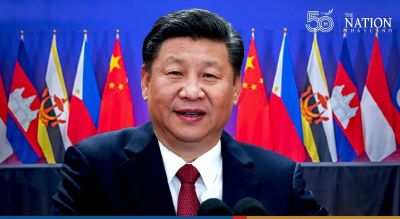
Xi will discuss with leaders from the member countries of the Association of Southeast Asian Nations how to summarize the achievements and experiences over the past 30 years and navigate their relationship in the future, Foreign Ministry spokesman Zhao Lijian said at a daily news conference on Friday.

Viewing ASEAN as a neighbor and important cooperation partner of China, Zhao said that the two sides have forged the largest trading partnership, the most substantial cooperation partnership and the most dynamic strategic partnership since they established the dialogue relationship in 1991.

The upcoming summit demonstrates the great importance China and ASEAN attach to their relationship, Zhao said.

China expects to continue to work together with ASEAN to upgrade their relations, build a closer community with a shared future and promote regional peace, stability and prosperity, he added.

China and ASEAN have built the biggest free-trade zone among developing countries, and their bilateral trade volume has increased 85 fold over the past three decades.

Statistics showed that bilateral trade reached $630.54 billion in the first three quarters of 2021, up 31.1 percent year-on-year.

China has also provided ASEAN member states with over 360 million doses of COVID-19 vaccines and a great volume of emergency medical supplies.

In 2019, over 65 million mutual visits were recorded. So far, over 200 pairs of sister city relationships have been established.

Published : November 21, 2021

By : China Daily

Envoy: China part of solutions, not problems, in world #SootinClaimon.Com

#SootinClaimon.Com : ขอบคุณแหล่งข้อมูล : หนังสือพิมพ์ The Nation.

https://www.nationthailand.com/international/40009066


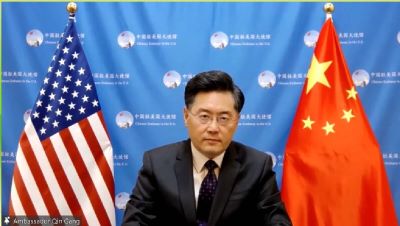
China will continue to be a “reliable member” of the international system, committed to promoting peaceful development, while contributing its wisdom and solutions to global issues, Chinese ambassador to the US said as he called for “vision and actions” to prevent the two countries from confrontations.

“China does not want to disrupt or overturn the existing international system,” Ambassador Qin Gang said at a dialogue with the Brookings Institution Board of Trustees in Washington on Thursday. “China is not part of the problems in the world, but part of the solutions.”

In his speech, titled “Two Different Countries, One International System”, Qin noted that in recent years, the world has been increasingly looking to China to see what impact the country’s rapid growth has on the international order.

“We only want to work for a more peaceful and developed world, and at the same time create a favorable environment for our peaceful development, and contribute our wisdom and solutions to global issues,” the ambassador said.

He noted that throughout the past five decades of its United Nations membership, China was, is and will still be a reliable member of the international system.

“Despite the various difficulties we have, we always try our best to do our part and do it well,” he said.

Qin started his speech with a clarification of China’s view of the “rules-based international order” and “rules of the road”, terms that are frequently used but not made clear by the US side.

For example, the US says that its China policy is for defending the “rules-based international order” and ensuring the implementation of “rules of the road”, but it has not made itself clear on questions such as what the rules are, who made them and who are the “traffic police”.

“In our view, there is only one international system in the world, namely, the international system with the United Nations at its core. There is only one international order, which is the one underpinned by international law,” Qin said.

There is only one set of rules, namely, the basic norms governing international relations based on the purposes and principles of the UN Charter, and consequently, international affairs should be addressed through consultation, and genuine multilateralism must be practiced, he added.

As relations between the world’s top two economies have been going through “unprecedented difficulties” in recent years, some people believe that China and the US are two different “operating systems” incompatible with each other, the envoy said.

“On this, UN Secretary-General Antonio Guterres voiced out a common international concern: China and the US must avoid confrontation and the world cannot afford to be further divided,” Qin said. “We must work together to prevent his worry from coming true.”

To that end, the two sides must show vision and determination, and “take real actions to blaze a bright path” for the two countries and the world, he said.

The foremost thing to do is for both founding members of the UN to keep in mind the words in the UN Charter: “We, the people of the United Nations, are determined to save succeeding generations from the scourge of war, which twice in our lifetime has brought untold sorrow to mankind.”

“We must follow the trend of the times, bear in mind the common aspirations of the people, and work for an open, inclusive, clean and beautiful world with lasting peace, common security and shared prosperity,” Qin said.

Then the two countries must shoulder the “unshirkable responsibilities” for upholding the authority and position of the UN as the world’s two largest economies and permanent members of the UN Security Council.

The ambassador also said that there are principles to adhere to, including not to “reverse the wheels of history” by putting together small groups targeted at third parties, or to act against the trend of globalization by abusing and overstretching the concept of national security, setting up the so-called “Clean Network” and “democratic technology alliance”, and suppressing foreign companies without any justifiable grounds.

“Such actions have also increased global economic risks. The world should not be disrupted by ‘decoupling’ and the threat of ‘cutting off supplies’,” he added.

There are many areas where China and the US should and must cooperate, such as climate change, but different attitudes to the global issues may lead to “completely different results”, according to Qin.

“In 2014, we jointly helped African countries fight the Ebola epidemic. But after the outbreak of COVID-19, the US chose to politicize the disease, which created obstacles for us to get through this together,” he said.

Qin recalled that during their first virtual summit last Monday, Chinese President Xi Jinping told US President Joe Biden that the global initiatives China has proposed are all open to the US.

“We hope the reverse is also true,” Qin said. “The Belt and Road Initiative follows the principles of extensive consultation, joint contribution and shared benefits. We welcome the US to find its complementarity with Build Back Better World.”

Published : November 21, 2021

By : China Daily

Railway inauguration planned for December 3, passenger transport date not yet decided #SootinClaimon.Com

#SootinClaimon.Com : ขอบคุณแหล่งข้อมูล : หนังสือพิมพ์ The Nation.

https://www.nationthailand.com/international/40009065


Inauguration of the 426-km Laos-China railway and the start of freight transport are scheduled for December 3, but a precise date for the start of passenger services has not been yet decided, a senior government official has said.

Head of the committee in charge of preparations for the inauguration ceremony, Mr Phoxay Khaykhamphithoune, told reporters on Thursday the plan is for Prime Minster Phankham Viphavanh to lead the inaugural train trip, travelling on a train that has been named Lane Xang.

The historic train will depart Vientiane Station in Xay village, Xaythany district for Boten Station in Luang Namtha province near the Chinese border.
Cross border freight transport between Laos and China will begin on the same day shortly after the inaugural train journey.  
However, an exact for the start of passenger travel is yet to be defined. 
“A timetable [for passenger services] has not yet been detailed,” said Mr Phoxay, who is also Deputy Minister of Foreign Affairs and a member of the committee in charge of overseeing the construction of the railway.
“The company [the Laos-China Railway Company Limited] may reveal [details] at a later date.”

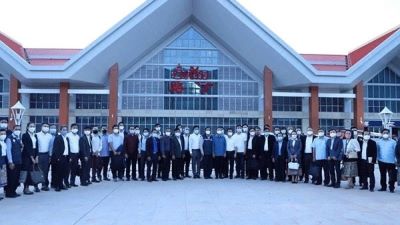
On November 18, the deputy minister led a delegation of officials from relevant ministries on a round trip on the train from Vientiane to Luang Namtha to inspect the progress made in preparation for the start of railway services.
All work is progressing well and everything will be ready in time for the inauguration, Mr Phoxay told reporters shortly after meeting with relevant central and local officials and members of the Laos-China Railway Company Limited in Luang Namtha.
Immigration, customs, plant quarantine and health screening at the station in Luang Namtha are being arranged for operation.
The meeting reported that officials in charge plan to trial documentation procedures for freight transport on November 23. 
When passenger travel begins, it is initially expected that this will be limited to travel within Laos amid Covid-19 pandemic that has resulted in Laos and China imposing travel restrictions.

The Laos-China Railway Company Limited told the meeting that 
the cost of tickets is being reviewed by the Ministry of Public Works and Transport.
Eventually, the company plans to run two freight trips and two passenger services each day.
Use of the railway is expected to cut the cost of transport through Laos by 30-40 percent compared to travel by road.
It takes more than a day or even two days to drive from Vientiane to Luang Namtha by road, as this requires travel through the mountainous terrain in the north and takes much longer than travel by train.
During the journey from Vientiane to Luang Namtha on November 18 the train travelled at an average speed of 160 kilometres per hour with short stops at two stations along the way, taking about three hours in total.
The railway, which connects Vientiane to the Chinese border, slices through northwestern Laos, passing through the provinces of Vientiane, Luang Prabang, Oudomxay and Luang Namtha.
The track passes through 75 tunnels which have a combined length of 197.83km, constituting nearly half of the total route. 
There are 10 passenger stations situated in Vientiane, Phonhong, Vangvieng, Kasy, Luang Prabang, Nga, Xay, Namor, Nateuy and Boten.  There are also 22 stations for the loading and unloading of freight.
Construction of the US$5.986 billion (37.4 billion yuan) railway began in December 2016.

Published : November 21, 2021

By : Vientiane Times

Pan-Asian Railway closer to realisation


After 18 countries signed the Trans-Asian Railway Network Agreement in June 2006, the Kunming-Vientiane rail journey will be possible next month, which makes analysts wonder whether Malaysia is up to speed compared with its neighbours when it comes to rail network development.

Bangkok and Kuala Lumpur – remains very much alive. Touted as landlocked Laos’ most expensive project, the Boten-Vientiane stretch, which is part of China’s Belt and Road Initiative push, will be connected to China’s Yuxi-Mohan stretch (504km), which is also slated to open on Dec 3 to allow for cross border services between the two countries.

ON Dec 3, the 414km Boten-Vientiane railway (more commonly referred to as the China-Laos railway) will open for cargo service, marking an important milestone in the Pan-Asian Rail network, which is part of the grander Trans-Asian Rail network envisioned in the 1950s.

The realisation of this Kunming-Vientiane stretch indicates that the proposal to link Kunming with Singapore using rail – via Vientiane,

A 9.7km cross-border stretch will provide that final joining between Boten and Mohan, forming the China-Laos network designed mostly for medium speed travel, of up to 160kph, for passenger services. By next year, attention will shift to the Bangkok-Nong Khai high-speed railway or what is also known as Thailand’s north-eastern high-speed rail (HSR) line, a 608km stretch that is currently under construction as efforts to modernise Thailand’s rail network, and a critical stretch that makes the Kun-ming-Singapore stretch closer to reality.

It is the first high-speed line in Thailand, and this stretch is expected to be operational by 2030 at the latest as the country battles hard to overcome several challenges along the way. Under Phase 1, the 252km stretch from Bangkok to Nakhon Ratchasima will be completed in a few years from now (no exact timeline given).

Over the long term, Thailand intends to expand its HSR coverage all the way to Padang Besar, Perlis, the northernmost point of Malaysia’s rail network (excluding the inactive stretch from Kelantan’s Pasir Mas to Hatyai (via Thailand’s Sungai Kolok town).

The Pan-Asia stretch is part of the grander Trans-Asian Railway (TAR) promoted by the United Nations’ Escap (Economic and Social Commission for Asia and the Pacific) to facilitate the movement of goods across the entire Asian-Europe region. Currently, the TAR network comprises slightly over 118,000km of rail routes that have been selected for their potential to serve international trade within the Escap region as well as between Asia and Europe.

Thailand’s HSR ambitions

Thailand makes no secret of its ambition to be the HSR hub of the Asean Economic Community, with announcement of having five HSR lines sprouting from Bangkok in all directions, including one southwards to the Malaysian border.

On its website, the Thailand Board of Investment says to ensure it maximises its strategic location at the heart of the Asean Economic Community (AEC), Thailand will invest around 1.9 trillion baht (RM255bil) under its Thai Transport Infrastructure Development Plan 2015-2022 and Urgent Transport Action Plan 2015.

Key infrastructure projects include intercity rail network development, along with public transportation network development to address road traffic problems in Bangkok and its suburbs, even though it will increase its highway capacity to connect the country’s key production bases with those of neighbouring countries.

“Thailand has an excellent rail system spanning 4,952km of railways that constitute a vital link in the transportation chain.

“The office of the Royal State Railways of Siam was first established under the control of the Public Works Ministry in October 1890,” says the Thai Board of Investment as it tries to drum up investor confidence in Thailand’s transport infrastructure.

Over in Cambodia, construction is ongoing to improve the country’s connectivity with Laos, Thailand and Vietnam so that it will not be left out in the larger scheme of things.

Likewise, Vietnam is also modernising its network, but adopting the use of standard gauge (track width), which is 1,435mm, in its newer stretches, even as existing intercity trains trundle at a relatively slow pace along its century-old metre-gauge network (like Malaysia’s) built during the 1880s by French colonialists.

If things go as planned, Indonesia will earn bragging rights pretty soon too, as the country gets ready to welcome its maiden HSR service from Jakarta to Bandung, a stretch measuring 142km.

Indonesia’s maiden HSR

Over in Indonesia, the Jakarta-Bandung HSR is on track to open for service in 2023, bridging the congested road corridor between these two megacities, with the latter being the capital of West Java. Bandung itself is the fourth-largest city in Indonesia, with Greater Bandung being the country’s second-largest metropolitan area.

By most standards, the Jakarta-Bandung HSR is rather unusual as it only covers a distance of 142km, a departure from the typical “sweet spot” of HSR, which is around 300km to 900km. However, careful analysis of the current traffic flow between these two cities found that the project is justified, as it can take up to five hours to drive the distance (and on a really bad day, nearly 10 hours), demonstrating the huge amount of time wasted by people on the road. The HSR, when running non-stop between the two cities, covers the distance in a mere 40 minutes by using rolling stock capable of hitting 250kph.

While a conventional train exists between Jakarta and Bandung, it still takes three hours to cover the distance, thus limiting its attractiveness as it struggles with both congestion on board as well as jostling for space with cargo trains. Potential for further development of the HSR network in Indonesia comes from the possibility of extending the line from Bandung onwards to Surabaya.

Indonesian transport authorities, along with the Japanese Inter-national Cooperation Agency, also conducted studies for a project that extends the HSR line all the way to Surabaya after Bandung, covering around 730km in total. Indonesia started considering HSR seriously in 2008, but groundbreaking on the Jakarta-Bandung HSR only took place in early 2016.

The republic is also cognisant that things have to move faster when it comes to its overwhelmed public transport infrastructure.

In March 2017, Indonesia appointed Japan as the partner to refurbishing its conventional railway connecting Jakarta and Surabaya, which runs on a 1,067mm gauge (considered narrow gauge by modern standards).

The project aims to upgrade the tracks to standard gauge so that intercity trains can move closer to 160kph, and this is done by replacing nearly 1,000 level crossings between Jakarta and Surabaya with viaducts.

What then, for Malaysia?

While Malaysia currently has a metre-gauge double track running all the way from Padang Besar, Perlis, to Gemas, Negri Sembilan, operated by KTM Bhd (KTMB), the country needs to urgently upgrade its rail network to ensure that it will be able to tap into the potential of moving cargo by rail, the only part of KTMB’s operation that is profitable.

Currently, KTMB’s cargo train operations have to give priority to passenger traffic, thus imposing serious constraints on its capacity to grow its cargo business.

The impending opening of Gemas-Johor Baru double tracking by the end of 2022 may offer some relief for the southern sector, but not by much for those who need to reach Johor Baru or Singapore in a hurry. The time savings of the Kuala Lumpur to Singapore HSR has already been well laid out: No commercial airline would be able to match the 90 minute non-stop service between Bandar Malaysia in KL and Jurong East in Singapore when the time needed to get to and from airports is considered in the equation.

Restarting the HSR had been the clarion call of former prime minister Datuk Seri Najib Razak, who has argued throughout this month that the country badly needs the project in order not to be left behind.

The HSR was also turned into an electoral issue for yesterday’s Melaka state election, with then caretaker Chief Minister, Datuk Seri Sulaiman Md Ali pronouncing before voting day that the KL-Singapore HSR should be revived as it will bring huge benefits to Melaka.

In fact, Sulaiman proclaimed on Nov 12 that if Barisan Nasional is given the mandate to govern Melaka, it will prevent the project from being built in the state if it is not eventually connected to Singapore (ie, if it ended only at Johor Baru). He said the original route from KL to Singapore was not only important in reducing road traffic congestion but also critical in bringing business and investments to Melaka.

For Dr Carmelo Ferlito, CEO of the Center for Market Education in Malaysia, a boutique think thank based in KL, Malaysia just needs to embrace a wider perspective when planning its rail infrastructure, such as viewing the issue beyond just the KL-Singapore HSR corridor.

“I believe it is in Malaysia’s interest to keep it alive while rethinking its scope and how to finance it. In fact, this moment of difficulty could present the chance to imagine the future of the transportation system in Malaysia not only for passengers but for cargo too.

“For reasons of both economic and environmental sustainability, Malaysia needs to rethink its entire North-South connection and move people and goods traffic from roads to trains.

“Malaysia could implement a successful North-South HSR for both passengers and cargo [with all the due differences], while creating opportunities for economic development and, at the same time, reducing the environmental impact created by vehicular traffic,” he said.

Published : November 21, 2021

By : The Star

SIA to operate VTL flights to more cities under the quarantine-free travel scheme #SootinClaimon.Com

#SootinClaimon.Com : ขอบคุณแหล่งข้อมูล : หนังสือพิมพ์ The Nation.

https://www.nationthailand.com/international/40009043


SINGAPORE – Travellers will have more options for quarantine-free travel from next year with Singapore Airlines (SIA) opening up additional vaccinated travel lane (VTL) flights from Jan 17.

The national carrier on Friday (Nov 19) said it will be operating such flights from Amsterdam, Barcelona, Copenhagen, Frankfurt, London, Milan, Munich, New York, Paris, Rome, Seattle and Vancouver.

From Jan 19, it will operate such flights from Houston and Manchester as well. SIA had earlier announced that VTL flights from Kuala Lumpur will start from Nov 29.

By Dec 6, Singapore will have arrangements for VTLs with a total of 21 nations.

Transport Minister S. Iswaran had announced on Monday that travellers from Indonesia, and possibly India, will also be able to enter the country under the quarantine-free travel scheme from Nov 29.

In addition, travellers from Qatar, Saudi Arabia and the United Arab Emirates will be able to enter Singapore from Dec 6, in a further expansion of the VTL scheme.

VTL flights from Sweden and Finland will start on Nov 29.

Travellers entering Singapore under the VTL scheme do not have to serve a stay-home notice.

Instead, they have to test negative for Covid-19 two days prior to departure for Singapore, as well as upon arrival.

Since Nov 11, travellers can submit a negative test result from either a polymerase chain reaction (PCR) swab test or a professionally administered antigen rapid test.

Upon arrival, they will be required to take a PCR test, and can go about their activities if they test negative.

By Shermaine Ang

Published : November 20, 2021

By : The Straits Times

Japan decides to restrict activities more lightly in a future virus emergency #SootinClaimon.Com

#SootinClaimon.Com : ขอบคุณแหล่งข้อมูล : หนังสือพิมพ์ The Nation.

https://www.nationthailand.com/international/40009042


Economic and social activities will be restricted more lightly than before, even during a pandemic state of emergency, under a policy change decided by the government on Friday.

At the government’s subcommittee meeting of experts on basic measures to deal with the novel coronavirus, strengthening the medical system was also decided.

On Friday morning, the policy was presented and approved at the meeting, and it was officially decided at the government task force meeting in the afternoon.

This is the first revision of the basic coronavirus response policy since the Cabinet of Prime Minister Fumio Kishida was launched.

Under the new guidelines, the government plans to create a system by the end of November that will be capable of accepting 37,000 people at hospitals, about 30% greater than the number of patients hospitalized during this summer’s infection peak.

The new guidelines also include a policy that the government will be responsible for securing hospital beds on an emergency basis by restricting regular medical services if the spread of infections is expected to put pressure on medical care.

The guidelines also will allow restaurants and other food service establishments, if they are approved by prefectural governments, to serve alcohol and stay open until 9 p.m. even under a declared state of emergency.

Using the government’s so-called vaccine and testing package — under which COVID-19 restrictions are eased if people have proof of vaccinations or negative test results for the virus, there will be no restriction on the number of people at such establishments, with groups of more than four people allowed.

In addition, full capacity will be allowed at events if organizers submit a safety plan for infection prevention.

The government also removed its target of cutting commuters by 70%, for which it had called on businesses to reduce the number of employees at offices.

The indices for judging whether to issue a declaration of emergency or take other measures will be changed to five levels based on the strain placed on the health care system, from the current four stages that are based on the number of newly confirmed cases.

Published : November 20, 2021

By : THE NATION