Japan and the United States will officially announce as early as this week the release of oil reserved for emergencies, according to an official related to the Japanese government.
Private-sector reserves have been released in the past, but this would be the first time for the government’s stores to be released. The aim is to prevent the prices of petroleum products, including gasoline, from rising further by temporarily increasing the supply of oil to the market. However, the actual outcome is hard to predict.
The administration of U.S. President Joe Biden had been quietly urging other countries, including Japan and South Korea, to make concerted efforts with Washington to release emergency stores of petroleum. The Japanese government was initially cautious, as it has never released oil stored for emergencies in response to rising petroleum prices, but it ultimately changed tack.
There are at least two kinds of oil stockpiled for emergencies in Japan: oil owned and stockpiled by the state, and that stored by the private sector as required by law. As of the end of September, the state’s reserves were equivalent to the amount of oil consumed in the nation over 145 days. The private sector reserves were equivalent to 90 days’ consumption.
The Petroleum Reserve Law stipulates that the state should stockpile at least 90 days’ worth of daily imports of crude oil, while the private sector must have at least 70 days’ worth in reserve.
Both the government and the private sector currently have more than the required minimum. It has been suggested that the amount in excess of the target should be sold and supplied to the market.
Private sector stores were released during the Gulf War in 1991 and also when the situation in Libya deteriorated in 2011.
The Petroleum Reserve Law was revised in 2012, in response to the severe shortage of gasoline that occurred in the wake of the Great East Japan Earthquake. The revision allowed the release of stockpiled oil at times of disaster, in addition to when there is a shortage of supply from overseas.
The average retail price of regular gasoline in Japan stood at ¥168.9 per liter as of Nov. 15, the highest level in seven years. Even if reserves are released, however, the amount is expected to be limited, making it uncertain how much this measure would hold down prices at the pump.
The K-pop group takes home three trophies from the 2021 AMA, including the coveted Artist of the Year
BTS achieved another landmark feat at the American Music Awards on Sunday, bagging three trophies in total, including Artist of the Year.
During the 2021 AMA ceremony on Sunday (US time) at the Microsoft Theater in Los Angeles, the K-pop superstars picked up prizes in three categories — Artist of the Year, Favorite Pop Duo or Group and Favorite Pop Song, for their hit “Butter.”
BTS is the first Asian act in history to be nominated and win Artist of the Year at the AMAs. The other nominees for the top honor were Ariana Grande, Drake, Olivia Rodrigo, Taylor Swift and The Weeknd.
“Four years ago, we gave our first TV live performance at this stage, AMAs. It was ‘DNA.’ And we were too excited and nervous at that time. It’s been a long and amazing ride since then, but nobody could have ever bet on the odds of us standing here receiving this award,” RM said in English while accepting the award.
Jungkook added, in English, “We just wanted to make people happy with our music. We believe that this award opens the beginning of our new chapter.”
Speaking in Korean, Suga expressed gratitude to their global fandom, Army, saying, “We’d never imagined we’d win the artist of the year. It’s all thanks to you guys, Armys. Thank you!”
BTS also clinched the Favorite Pop Duo or Group — the category’s name was changed from Favorite Duo or Group in Pop/Rock this year — award for the third straight year. They were up against AJR, Glass Animals, Maroon 5 and Silk Sonic (R&B duo composed of Bruno Mars, Anderson .Paak).
The K-pop act went onto lift their first win for Favorite Pop Song with their hit summer release “Butter,” beating out some of the year’s biggest hits, including Olivia Rodrigo’s “drivers license” and Dua Lipa’s “Levitating.”
“‘Butter’ is a special song to us. We hope it makes you feel ‘smooth like butter,’” Jungkook said while accepting the award, referring to the song’s signature lyric, while RM said, “‘Butter’ has received so much love this year. All we wanted to do was to put out the positive energy despite of the hard times. This award truly proves that this song reaches many people’s heart.”
The group took the stage twice, once on their own and once with Coldplay to perform their collaborative single “My Universe” together for the first time. The boy band closed the night with their live performance of “Butter.” They were originally set to perform a remix of the song with rapper Megan Thee Stallion, but she pulled out at the last minute on Saturday due to “unexpected personal matters.”
The septet’s presence at the award show electrified the event, as chants of “BTS” from frenzied fans could be heard sporadically in the background throughout the show. Not only fans, but other artists were also hyped up to see the group take the stage, singing and dancing along as BTS performed.
Rappers Doja Cat and Megan Thee Stallion were the other top winners at the 2021 AMAs, each taking home three trophies. The awards’ biggest winner in history, Taylor Swift, broke her own record by taking home her seventh Favorite Female Pop Artist and Best Pop Album with “evermore,” bringing her total to 34 AMA trophies. Olivia Rodrigo, the 18-year-old breakout singer-songwriter who entered the awards as the top nominee with seven nods, was named this year’s New Artist of the Year.
This year marks the fourth consecutive year that BTS is taking home trophies from the AMAs. They earned their first win in 2018, when the group was named the Favorite Social Artist as the first Korean act ever to be nominated and to win at the American awards show. The group went on to secure Favorite Social Artist prize three times in a row until last year, and also grabbed the Tour of the Year prize in 2019 for “BTS World Tour Love Yourself: Speak Yourself.”
“It took four years to be on this stage to get this trophy,” RM said during his acceptance speech for the Favorite Pop Duo or Group award, adding, “it means to us even more because we’re a small boy band from Korea. We just got united by our love for our music and all we wanna do is spread love and good vibes and energy through music and performance. But without you guys, ARMYs, we could not have done nothing. Thank you so much.“
Meanwhile, BTS is set to kick off their “Permission to Dance On Stage” concert series on Nov. 28 at SoFi Stadium in Los Angeles, as their first set of in-person concerts in two years, before taking the stage at the 2021iHeartRadio Jingle Ball tour around the US.
MANILA, Philippines — President Rodrigo Duterte on Monday told a regional summit hosted by Chinese leader Xi Jinping that the Philippines “abhors” a recent altercation with Chinese ships in the West Philippine Sea and said the rule of law was the only way out of problems.
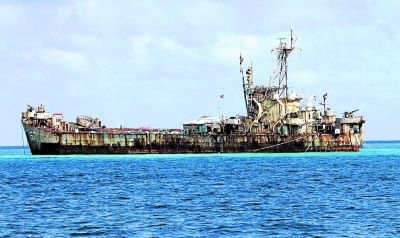
The Chinese coast guard on Nov. 16 blocked and used water cannon on Philippine boats bringing food supplies to Filipino soldiers stationed at Ayungin Shoal, part of the Kalayaan Island Group located 194 kilometers west of Palawan province.
“We abhor the recent event in the Ayungin Shoal… This does not speak well of the relations between our nations and our partnership,” the President said at the Asean (Association of Southeast Asian Nations)-China special summit commemorating the 30th anniversary of their dialogue relations. It was co-hosted by Xi and Brunei Sultan Hassanal Bolkiah, the current Asean chair.
Duterte said the South China Sea issue was “a strategic challenge that cannot be solved by force” and called on stakeholders to “exercise utmost self-restraint, avoid the escalation of tensions and work toward the peaceful resolution of disputes in accordance with international law.”
The president said the United Nations Convention on the Law of the Sea (Unclos), as well as the 2016 arbitral award on the South China Sea, should be used as the legal tools to resolve the conflicting and overlapping maritime claims in the region.
These “provide [the] legal clarity … pointing us to a just and fair solution to our disputes. We must fully utilize these legal tools to ensure that the South China Sea remains a sea of peace, stability and prosperity,” Duterte said.
The arbitral award stated, among other things, that the Philippine-occupied Ayungin Shoal was within the country’s 370-kilometer exclusive economic zone. China has rejected the award.
Rule of law
The President also called on Beijing to remain committed to the conclusion of an effective and substantive Code of Conduct in the South China Sea.
“There is simply no other way out of this colossal problem but the rule of law,” he said.
Chinese President Xi Jinping told Asean leaders at the summit that Beijing would not “bully” its smaller regional neighbors.
Xi said China would never seek hegemony nor take advantage of its size to coerce smaller countries, and would work with Asean to eliminate “interference.”
“China was, is and will always be a good neighbor, good friend and good partner of Asean,” Chinese state media quoted Xi as saying.
The aborted supply mission to Ayungin Shoal resumed on Monday with no security escort on the request of China, according to Defense Secretary Delfin Lorenzana.
The same two wooden-hulled boats blocked and turned back by Chinese vessels left Oyster Bay in Palawan on Monday morning and are expected to arrive at Ayungin Shoal on Tuesday morning, Lorenzana said in a message to reporters on Monday.
Policy statement
Reacting to President Duterte’s statement, House Deputy Minority Leader and Bayan Muna Rep. Carlos Isagani Zarate said on Monday that this should be backed by clear, concrete steps to stop China’s “aggressive, unchecked expansionism.”
“China’s aggressiveness in the West Philippine Sea and inside our own territory is largely a product of the so-called ‘soft landing’ and ‘pivot to China’ foreign policies of the Duterte administration since 2016,” he said.
He proposed three concrete measures to accompany the president’s policy statement: the deployment of more troops to Kalayaan Islands, more Philippine Coast Guard ships to disputed areas, and the rehabilitation of the Pag-asa Island airstrip at the soonest possible time.
More support
The European Union (EU), New Zealand and the United Kingdom have also added their voices to those condemning China over the Ayungin incident.
New Zealand Ambassador Peter Kell, in a post on Twitter, said respect for international law, especially the Unclos, and compliance with the 2016 arbitral ruling were vital for a peaceful and secure Indo-Pacific.
Amanda Milling, the United Kingdom’s minister for Asia, also expressed concern over the incident.
“Pleased to reaffirm the importance the UK attaches to Unclos and a stable, prosperous South China Sea. I am concerned by recent incidents that have raised tensions and urge against actions that hinder the peaceful settlement of disputes,” she said on Twitter.
The EU, on the other hand, said the incident “follows other unilateral actions by vessels of the People’s Republic of China in the South China Sea over the past months.”
“The European Union reiterates its strong opposition to any unilateral actions that endanger peace, security and stability in the region,” EU spokesperson for Foreign Affairs and Security Policy Nabila Massrali said in a statement.
Defense treaty
National security adviser and national task force for the West Philippine Sea Chair Hermogenes Esperon Jr. pushed for an automatic trigger to the Philippines’ mutual defense treaty (MDT) with the United States.
In an interview aired Monday at radio station dzBB, Esperon said the MDT could be triggered only with the approval of the US Congress.
Esperon, however, said that the Philippines could not also act recklessly in terms of asserting its sovereign rights on the West Philippine Sea.
“Let’s remember that our relations with China do not start and end with the South China Sea or West Philippine Sea. We have cultural ties, economic, defense, tourism,” Esperon pointed out.
Duterte also said in his speech that China deserved its status as the Asean’s comprehensive strategic partner, underlining the depth and breadth of its 30-year partnership with the regional bloc.
He pointed to China’s timely provision to the Asean of much-needed COVID-19 vaccines and medical supplies to address the pandemic as nations scramble to contain it.
China, he added, was also the first Asean Dialogue Partner to engage the regional grouping in addressing the pandemic.
Among those who joined the president during the special summit were Foreign Affairs Secretary Teodoro Locsin Jr. and Trade Secretary Ramon Lopez.
By: Jerome Aning, Julie M. Aurelio, Tina G. Santos
—WITH REPORTS FROM JEANNETTE I. ANDRADE AND REUTERS
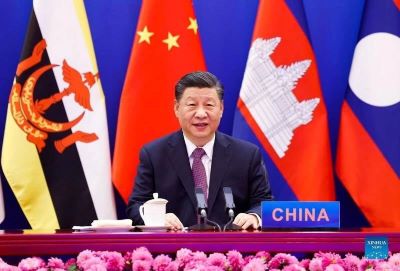
BEIJING – China and the Association of Southeast Asian Nations have established a comprehensive strategic partnership, Chinese President Xi Jinping said on Monday at the ASEAN-China Special Summit to Commemorate the 30th Anniversary of ASEAN-China Dialogue Relations.
“This is a new milestone in the history of our relations and will inject new impetus into peace, stability, prosperity and development of our region and the world,” Xi said.
He was chairing the summit via video link from Beijing.
NEED FOR DIALOGUE
President Xi stressed that China and the ASEAN need to pursue dialogue instead of confrontation, build partnerships instead of alliances, and make concerted efforts to address the various negative factors that might threaten or undermine peace.
“Maintaining peace is our greatest common interest and the most cherished aspiration of people of all countries. We need to serve as the builders and guardians of peace in the region,” he said.
“We need to practice true multilateralism and stick to the principle that international and regional affairs be handled through discussion among us all.”
China firmly opposes hegemony and power politics. China pursues long-term, friendly coexistence with neighboring countries, and is part of the common efforts for durable peace in the region, said the Chinese leader. “China will never seek hegemony, still less bully smaller countries,” he added.
CLOSER CHINA-ASEAN COMMUNITY
President Xi called for fostering a closer community with a shared future for China and the ASEAN.
Quoting an ancient Chinese statesman who observed that “Designs for justice prevail, and acts for people’s benefit succeed,” he stressed keeping in mind the people’s aspirations for a better life and shouldering the mission of the times to safeguard peace and promote development.
He urged working hand in hand to build on what has been achieved, striving toward a closer China-ASEAN community with a shared future, and making the region and the world even more prosperous and beautiful.
GOOD-NEIGHBORLY FRIENDSHIP
President Xi hailed the good-neighborly friendship and win-win cooperation between China and ASEAN over the past 30 years and said China-ASEAN dialogue relations have gone through an extraordinary journey over the past three decades.
“These 30 years have witnessed intensive development of economic globalization and profound changes in the international landscape. These 30 years have also seen China and ASEAN seizing opportunities of the times and achieving leapfrog development in our relations,” he said.
China and ASEAN have cast away the shadow of the Cold War and jointly upheld stability in the region, spearheaded economic integration in East Asia, promoted common development and prosperity, and delivered better lives to the over two billion people, said Xi.
We have explored a bright path of good-neighborliness and win-win cooperation, taken strides toward building a closer community with a shared future and made important contribution to the cause of human progress,” Xi said.
China was, is and will always be ASEAN’s good neighbor, good friend and good partner, he said.
Xi reaffirmed that China will unswervingly take ASEAN as a high priority in its neighborhood diplomacy, unswervingly support ASEAN unity and ASEAN Community building, unswervingly support ASEAN centrality in the regional architecture, and unswervingly support ASEAN in playing a bigger role in regional and international affairs.
BUILDING PROSPEROUS HOME TOGETHER
Saying that China and the ASEAN can build a peaceful, safe and secure, prosperous, beautiful and amicable home together, he assured that China’s development will provide more opportunities for and inject strong impetus into the region and the wider world.
China stands ready to work with the ASEAN to grasp the overriding trend, remove interference, share opportunities and promote shared prosperity, he said.
“We will implement in earnest our Comprehensive Strategic Partnership, and make new strides toward building a closer China-ASEAN community with a shared future,” Xi said.
EXPERIENCE OF COOPERATION
The Chinese leader said the valuable experience of China-ASEAN cooperation over the past 30 years should be cherished and upheld over the long run.
“The gains in China-ASEAN cooperation over the past 30 years are attributable to our unique geographical proximity and cultural affinity and, more importantly, to the fact that we have actively embraced the development trend of our times and made the right historic choice.”
He said China and ASEAN have respected each other, acted by the basic norms of international relations, cooperated for win-win results, and followed a path of peaceful development.
China and ASEAN have looked out for each other, honored the principle of amity, sincerity, mutual benefit and inclusiveness, upheld inclusiveness and mutual learning, and jointly contributed to open regionalism, he said.
“The valuable experience we have gained over the past 30 years is the shared asset of China and ASEAN. It lays the foundation and provides guidelines for developing our Comprehensive Strategic Partnership,” Xi said.
He called for doubly cherishing the experience, upholding it over the long run, and keeping enriching and expanding it.
HÀ NỘI — Việt Nam will continue to implement new technologies and policies in its bid to become a cashless country, said banking experts and policymakers in a conference on Friday discussing the current situation of cashless technology in the country.
Speaking at the event, the governor of the State Bank of Vietnam (SBV), Nguyễn Thị Hồng, said the central bank has established numerous policy frameworks for the implementation of electronic payment technologies, such as personal bank accounts based on electronic Know-Your-Customers tech, mobile money and other payment methods including using QR code and chip cards.
In addition, payment solutions and infrastructure have been developing rapidly and integrated with a wide variety of products and services. They have been well-received by consumers for their security, speed and convenience.
Government support policies during the pandemic, which included e-banking fee reductions and other incentives to encourage consumers to reduce cash-based transactions, have resulted in the rapid development of cashless payment technology in the country.
Since 2020, banks have cut over VNĐ2 trillion in banking fees and processed 80 per cent of all personal banking transactions free of charge.
According to SBV Deputy Governor Phạm Tiến Dũng, 95 per cent of all financial institutions in Việt Nam have been developing their own digitalisation strategy. Currently, over 80 banks have offered customers e-banking services; 44 banks have offered mobile banking services and 45 fintech firms offer payment intermediary services. Across the country, there are currently over 90,000 stores that accept QR code payments and nearly 300,000 PoS terminals.
Việt Nam’s objectives, in the near future, is to continue to support banking and payment technologies, to connect isolated and rural parts of the country with banking systems, to provide small-amount transactions electronically nationwide, to provide 24/7 automatic financial services and to update electronic payment security features.
In addition, SBV is to work closely with the press in an effort to encourage Vietnamese consumers to switch to cashless payments with an emphasis on security, speed and convenience.
“Making the switch to cashless payments will result in reduced risks for consumers, lower operating costs for financial institutions and improved transparency,” said Lê Thị Thúy Sen, head of SBV’s Public Communication Department.
During the first nine months of the year, the number of transactions done using the electronic banking system increased by 1.88 per cent and 42.58 per cent in value compared to the same period last year. The number of internet payments increased by 51.16 per cent.
By the end of September, the number of personal bank accounts reached nearly 111 million, a 15.4 per cent increase compared to the same period last year. — VNS
Pyongyang urges UN to look into US human rights abuses
Pyongyang “strongly” condemned the recent passage of the UN draft resolution on human rights violations in North Korea and reiterated its call for the UN to investigate the US for human rights abuses, state-run media reported Sunday.
North Korea claimed that the US and other “hostile forces” forcibly adopted the draft resolution, in a press statement issued by an unnamed spokesperson of the Ministry of Foreign Affairs.
The press statement was released four days after the EU-led draft resolution was passed at the Third Committee of the UN General Assembly on Wednesday for the 17th consecutive year by consensus, with more than 60 countries joining as co-sponsors.
“The Ministry of Foreign Affairs of the DPRK strongly denounces and categorically rejects the anti-DPRK human rights resolution of the hostile forces,” the spokesperson said, echoing North Korea‘s UN Ambassador Kim Song’s remarks during Wednesday’s meeting.
The Foreign Ministry spokesperson dismissed the resolution as a “product of anti-DPRK hostile policy and double standards as well as a grave infringement upon the sovereignty aimed at tarnishing the prestigious image of our state.”
Pyongyang also pledged to firmly respond to any attempts to violate its sovereignty.
“To us, human rights are, after all, state rights,” the statement, which was carried by Korean Central News Agency primarily targeting external audiences, read.
“We will never tolerate any attempts that violate the sovereignty of our state, and we will continue to resolutely counter to the end the ever-worsening moves of the hostile forces against us.”
In Sunday’s statement, Pyongyang also specifically urged the UN to look into human rights violations associated with the US, which participated in the UN human rights resolution as a co-sponsor.
The Foreign Ministry spokesperson said that the UN should put the “inhumane crimes committed by the US” on the agenda and bring the US to account for killing “a large number of civilians in Iraq, Syria, and Afghanistan under the pretext of democracy and protection of human rights.”
The condemnation is in line with the trend of the country’s Foreign Ministry releasing statements addressing US human rights issues more frequently since this August on its official website.
Sunday’s denunciation is not fresh, but it is notable given that the Biden administration places human rights issues and democratic values at the center of US foreign policy, mainly to counter China.
Washington has reversed the Trump administration’s decision to withdraw from the UN Human Rights Council. The Biden administration is set to return to the HRC next January after regaining a seat on the council this October.
North Korea’s Foreign Ministry also last Friday called for eradicating the US “double-dealing standards” over human rights issues in a statement uploaded on its online website.
In a separate statement, the ministry denounced the UN on the same day for arbitrarily addressing human rights issues in specific countries including Syria and Iran. Pyongyang also complained that the US and other western countries have been excluded from the target of UN investigation into violations and abuses of human rights.
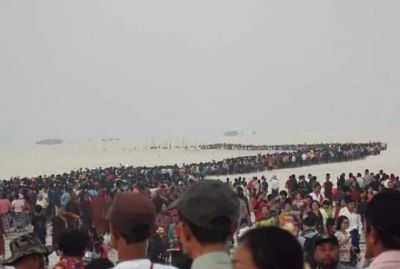
At least 15 pilgrims died and some others went missing in a crush and waves this morning at the festival of Kyaikne Yele Pagoda located in the sea about two miles from the beach between Emkhe and Wekalaung villages, Thanphyuzayet Township, Mon State, according to local people and aid organizations.
“About a 30-foot stretch of the path called Nat Street to the pagoda was still under water. Boats shuttled to carry the pilgrims going to and from the pagoda. When the boats came back from the pagoda, those on the path scrambled to get on them, triggering a crush and some were washes away by waves forming after,” said a local resident.
He said the bodies of one monk, two men and 12 women including a nine-year-old were recovered while five women and three men were rescued.
He added that among the dead were the pilgrims coming from Waw and Mudon in Bago Region, Mawlamyine in Mon State and Yangon Region. There were 15 pilgrims who came from Waw but eight bodies could be retrieved, and the death toll is like to increase. Currently, security forces, firefighters, members of the Red Cross Society and aid organizations and local people are making search and relief efforts.
“Since early morning, pilgrims showed up to go to the pagoda. At that time, the tide was still in on the path to the pagoda. Those in front happened to be pushed by others in the back as they tried to get on the boats. Then, a crush occurred and waves formed. We have learnt that many were washed away,” said an official from Mon Myat Setana Rescue.
The 15 discovered bodies were sent to Thanphyuzayet Township Hospital and search is going on for those who went missing, he added.
The pagoda festival is annually held from 1 to 3 Waning of Tazaungmon in Myanmar calendar (in November). When the tide is out, Nat Street surfaces and pilgrims use the street leading to the pagoda about two miles from the beach. The pagoda attracts large numbers of pilgrims from across Myanmar.
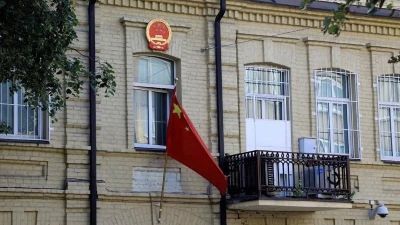
BEIJING – China has decided to downgrade the diplomatic relations with Lithuania to the level of charge daffaires, the Chinese foreign ministry said on Sunday.
According to a statement released on the Foreign Ministry’s website, Lithuania, in disregard of China’s strong protest and repeated representations, allowed on Nov 18 the Taiwan authorities to set up a “Taiwanese Representative Office in Lithuania.” This act openly creates the false impression of “one China, one Taiwan” in the world, renounces the political commitment made by Lithuania in the communique on the establishment of diplomatic relations with the People’s Republic of China (PRC), undermines China’s sovereignty and territorial integrity, and grossly interferes in China’s internal affairs.
“The Chinese side expresses its strong indignation and protest against this move, and decides to downgrade its diplomatic relations with Lithuania to the charge d’affaires level,” it said.
There is only one China in the world and the government of the PRC is the sole legal government representing the whole of China, the statement said, noting the one-China principle is an overwhelming consensus of the international community, a widely recognized norm governing international relations, and the political foundation for China and Lithuania to develop bilateral ties.
It pointed out that the Chinese government has, out of goodwill to preserve China-Lithuania ties, repeatedly warned Lithuania against acting in bad faith. Regrettably, Lithuania has chosen to ignore China’s solemn position and to disregard the broader interests of bilateral ties and the basic norms governing international relations. It has allowed the establishment in Lithuania of the “Representative Office” bearing the name of Taiwan, thus creating an egregious precedent in the world.
Given the fact that the political foundation for an ambassadorial-level diplomatic relationship has been damaged by Lithuania, the Chinese government, out of the need to safeguard national sovereignty and basic norms governing international relations, has no choice but to downgrade its diplomatic relations with Lithuania to the charge d’affaires level. The Lithuanian government must bear all the ensuing consequences, according to the statement.
“We urge the Lithuanian side to immediately put right its mistake and not to underestimate the Chinese people’s strong resolve, will and capability to defend national sovereignty and territorial integrity,” the statement reads.
“We also have this stern warning for the Taiwan authorities: Taiwan is never a country,” it added.
According to the statement, no matter how “Taiwan independence” forces try to misrepresent facts and confound black and white, the historical fact that the mainland and Taiwan belong to one and the same China cannot be changed. Attempts to seek foreign support for political manipulation will prove to be a dead end.
SINGAPORE/MELBOURNE – For the first time in almost two years, Mrs Flora Chng, 68, was able to book an air ticket to Australia to visit her daughter, a permanent resident in the land Down Under.
Plans for a trip there were disrupted by the Covid-19 pandemic as Australia had been under lockdown and had opened its borders only to New Zealand.
The retired bank employee took the first flight out of Singapore into Australia under a pilot reopening scheme on Sunday morning (Nov 21).
Under the travel pilot, Singapore citizens flying into Australia will not have to serve 14-days quarantine in a hotel after arrival in New South Wales and Victoria. Non-Singapore citizens do not qualify under this scheme.
“If Australia had not opened up for quarantine-free travel, we would not have decided to go on this trip,” said Mrs Chng, who flew with her 27-year-old son.
They were among nearly 200 passengers who boarded the first flight out of Singapore into Australia under a pilot reopening scheme early Sunday morning.
The Straits Times understands that about 60 per cent of the 263 seats in the economy class cabin, and about 95 per cent of the 40 seats in the business class cabin of SQ237 were filled.
The plane, operated by Singapore Airlines (SIA), took off from Changi Airport at about 1.15am. The flight landed at Melbourne Airport at 11.08am local time (8.08am Singapore time).
Australia is limiting the number of arrivals in the initial stages of the pilot, which comes after Singapore started a Vaccinated Travel Lane (VTL) scheme on Nov 8 to allow travellers arriving from Australia to skip quarantine.
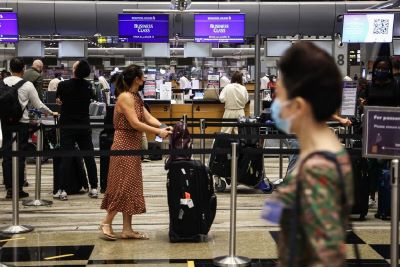
At Changi Airport on Saturday night, long queues formed at SIA’s check-in counters for the various SIA flights taking off, including the one to Australia.
People sending off friends and relatives waited near the counters but Changi Airport staff reminded them to maintain a safe distance from one another.
The Straits Times completed check-in and cleared immigration in about 15 minutes.
All passengers have to present their vaccination certificate and a negative pre-departure Covid-19 test result in addition to the usual immigration documents.
Singapore citizens entering Australia under the pilot also have to fill travel declarations, apply for the relevant visa and download contact-tracing apps, among other measures.
Upon arrival in Australia, travellers will be required to take a Covid-19 polymerase chain reaction (PCR) swab test within 24 hours. The test can be done for free at government testing facilities in New South Wales, Victoria and Australian Capital Territory.
Another passenger on SQ237, Mr Tan Jun Xiang, 34, said he had wanted to get out of Singapore for a holiday for some time.
The tax manager decided on visiting Australia over South Korea, as he has friends in Melbourne. The free PCR swab tests in Australia also meant that he would spend less.
“The airport feels back to normal, the whole process was quite seamless and immigration clearance was very fast,” he said. “But I was worried that I did not do all the necessary declarations or applied for the necessary permits.”
There were also passengers transiting in Singapore on the way to Australia.
Engineer Kent Tran, 43, who is based in Japan, was looking forward to meeting his family again. He said he had not been able to return home since the pandemic started due to strict caps on arrivals in Australia. These caps have been eased in recent weeks.
Mr Tran added: “I used to transit through Singapore five to 10 times a year, so compared with the last time, Changi Airport feels like a ghost town. It is sad to see such a great airport being decimated like this.”
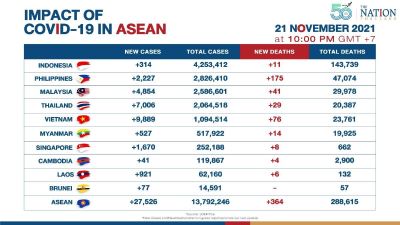
The number of Covid-19 cases crossed 13.79 million across Southeast Asia, with 27,526 new cases reported on Sunday (November 21), lower than Saturday’s tally at 27,662. New deaths are at 364, decreasing from Saturday’s number of 460. Total Covid-19 deaths in Asean are now at 288,615.
Vietnam Association of Seafood Exporters and Producers (VASEP) reported that the country’s seafood export turnover to China reached $1.4 billion in the last two consecutive years, which accounted for 17-18 percent of total seafood exports. However, the exports to the market have declined since the beginning of the year as Chinese customs have been tightening control over imports to curb Covid-19 spreading. As of the end of Q3, the exports to China accounted for only 11 percent of total seafood export turnover.
Meanwhile, the Indonesian government will impose the moderate level 3 public mobility restrictions, locally known as PPKM, nationwide from December 24, 2021 to January 2, 2022 in order to contain a third wave of coronavirus infections expected in year-end holidays. Under level 3, public places such as cinemas, restaurants, shopping centres and houses of worship are only allowed to receive visitors at up to 50 per cent capacity and to operate until 9 pm.