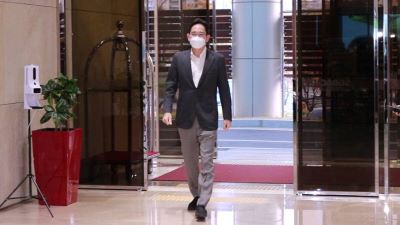
After staying under the radar for more than three months since his parole in August, Samsung Electronics Vice Chairman Lee Jae-yong on Sunday revealed himself at an airport in Seoul leaving for a business trip to Canada and the United States.
The Samsung Electronics executive arrived at Seoul Gimpo Business Aviation Center at around 7:45 a.m. on Sunday and hopped on a Korean Air charter flight to Canada after briefly talking to the press.
Asked whether he would finalize Samsung Electrics’ $17 billion foundry investment in the US, Lee said, “I will meet many (semiconductor) partners.” In response to a question on whether he will meet with a Moderna official, Lee answered, “I will visit Boston.” Moderna’s headquarters is based in Massachusetts, Boston.
Though details remain unclear, Lee is first expected to visit Samsung Electronics’ artificial intelligence lab in Canada and head to the US afterwards to finalize the site selection for the firm’s new chip foundry plant worth $17 billion.
This is Lee’s first overseas business trip after being released from prison in August and his first business travel to the US since 2016.
The Samsung chief’s direct visit to the US signals the 53-year-old leader’s return to management of Samsung, which suffered a leadership void during his absence amid an intensifying global chip war.
Earlier this year Samsung’s greatest rival TSMC pledged to spend $100 billion over the next three years to boost foundry capacity. Though Samsung Electronics’ cash reserves reached a record 209 trillion won ($177.1 billion) in July, the company did not proceed with aggressive chip expansion when Lee was serving time for bribing ousted former President Park Geun-hye.
Now, all eyes are on how the vice chairman would navigate the world’s biggest memory chip and mobile phone maker and manifest “New Samsung,” a slogan Lee proclaimed on Oct. 25, which was the first anniversary of the death of his father, Lee Kun-hee.
In lock step with New Samsung vision, Samsung Electronics announced last week that it would overhaul its job ranking system to upgrade its evaluation and promotion system.
During his US visit, Lee is expected to meet with local government officials and iron out final details for the $17 billion foundry plant. While the city of Taylor in Texas is viewed as the strongest contender, Samsung has left other options open, such as Phoenix in Arizona and upstate New York.
Some view that Lee might well visit Austin in Texas — where Samsung’s foundry plant No. 1 is located — and even meet with Qualcomm CEO Cristiano Amon. Major clients of Samsung are located near the Austin plant including Qualcomm and Nvidia.
Also, it remains to be seen whether Lee will meet with the Moderna CEO Stephane Bancel, who agreed to supply the first batch of COVID-19 vaccines manufactured in Korea for local use at Lee’s request.
Lee has used his personal connections to reach out to Bancel, as Korea struggled with vaccine shortages. The two agreed to prioritize 2.4 million doses of Moderna vaccines manufactured at Samsung Biologics’ factory in Songdo, Incheon, to the Korean government starting this month.
MANILA, Philippines — President Rodrigo Duterte’s daughter, Davao City Mayor Sara Duterte, on Saturday formalized her candidacy for vice president in next year’s national elections and may end up in direct competition for the post against her father.
Communications Secretary Martin Andanar said that Duterte would also run for vice president and would file his candidacy papers on Monday.
The Davao mayor’s representative, lawyer Reynold Munsayac, filed her certificate of candidacy (COC) as the vice presidential bet of the Lakas-Christian Muslim Democrats (Lakas-CMD) party just two days after joining it and four days after withdrawing her candidacy for a third term as mayor. She substituted for Lakas-CMD’s vice presidential candidate Lyle Uy, who personally withdrew his COC.
Lakas-CMD said its presidential bet, Anna Velasco, also withdrew her COC.
“We are honored that Mayor Sara accepted the challenge to help lead the party at a crucial time when the nation desperately needs a steady leader who can inspire us all to bounce back from the ravages of the pandemic,” said Lakas-CMD president and House Majority Leader Martin Romualdez.
In a statement explaining her decision to run for the vice president instead of president, Duterte said it also hurt her that she could not give what her supporters wanted.
“Many of you were hurt and felt hopeless, but we can still work together for our country. We don’t need to be in any position. We don’t need to be a president to be able to help. Let’s keep helping others in our daily lives,” she said in a statement.
This move ended months of speculation about the political plans of the president’s daughter, who joined Lakas-CMD just hours after leaving the regional party, Hugpong ng Pagbabago, which she founded in February 2018.
Partido Federal ng Pilipinas (PFP), whose standard-bearer is former Sen. Ferdinand “Bongbong” Marcos Jr., quickly issued a resolution “adopting” Mayor Duterte as its vice presidential candidate.
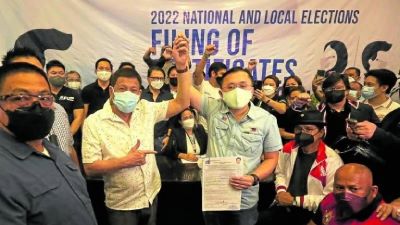
Later, the president accompanied Senators Ronald dela Rosa and Bong Go to the Commission on Elections (Comelec) where they withdrew their candidacies for president and vice president, respectively, of the Partido Demokratiko PIlipino-Lakas ng Bayan (PDP-Laban).
The PDP-Laban announced that Go would run for president under the Pederalismo ng Dugong Dakilang Samahan (PDDS).Go substituted for the group’s standard-bearer Grepor Belgica, according to the latter’s son, Greco, who told reporters that the PDDS was in a coalition with the PDP-Laban.
The PDDS was organized in 2018 to continue the president’s fight against corruption, drugs, and criminality, Greco said.
He also noted that the PDP-Laban was still facing a legal battle, referring to the dispute between the faction led by Energy Secretary Alfonso Cusi and presidential candidate Sen. Manny Pacquiao.
‘Has she filed?’
In a statement, PDP-Laban Secretary General Melvin Matibag said Go was running under the PDDS because Comelec has yet to resolve the PDP-Laban leadership issue.
“I will be his assistant now,” the president told reporters, pointing to Go while withdrawal documents were being completed by his former aide and Dela Rosa.
Asked whether he was going to run for senator, Duterte replied: “For vice president.”When reporters asked about the looming rivalry with his daughter, he responded: “I don’t know. Has she filed? My daughter, has she filed?”
“I will do so on Monday,” the president added.
Andanar, who accompanied the presidential party, said Duterte would return to the Comelec on Monday “to file his candidacy for vice president.”
“Let’s wait for the next chapter,” he told reporters.
PFP resolution
The Nov. 13 PFP resolution read in part: “Vice presidential candidate Mayor Sara Duterte-Carpio of the Lakas-CMD is hereby adopted by the Partido Federal ng Pilipinas as its candidate for vice president, and hereby endorses her candidacy as the running mate of the PFP’s official candidate for president of the Philippines, Sen. Ferdinand R. Marcos Jr. in the 9 May 2022 national elections.”
The resolution also stated that the PFP did not have official candidates for vice president and senators.
Romualdez, a cousin of Marcos, earlier said that the son and namesake of dictator Ferdinand Marcos and the Davao mayor were in talks to possibly “work together” for next year’s elections.
Romualdez said Lakas-CMD members in the government “are all committed to work double-time to ensure Mayor Sara’s victory as the country’s next vice president.”
House Deputy Speaker and Buhay Rep. Lito Atienza, who is Pacquiao’s running mate, said he was “happy and elated by the competition for the vice presidency,” adding that “the giants have gotten together.”
‘Mad tandem’
“Now that Sara has slid down, we are not in any way daunted. She has been a mayor and we have been a mayor, too. So voters will have a lot to base their judgment on,” Atienza said.
Bayan Muna Rep. Carlos Isagani Zarate said he was not surprised by the mayor’s move.
“A potential ‘dictatorannical’ regime is now in the political horizon, thus, it behooves on all democratic nonadministration candidates and forces to unite their efforts and thwart this from happening,” he warned in a message to the Inquirer. “We must prevent the ‘mad’ tandem from winning as this means another dark, even darker, time in our history.”
His party’s chair, senatorial candidate Neri Colmenares, said the “merger of the forces of tyranny, dynasty, and corruption is complete.”
“The need for a united opposition has never been more important. The task of the opposition is to unite and work with all democratic and freedom-loving Filipinos in defeating this unholiest alliance of dynasts and budding tyrants,” Colmenares said.
Supposedly ‘tired’
Once the president formalizes his substitution of Go on Monday, he and his daughter would have turned their backs on many public pronouncements not to run for a national position next year.
As early as February 2018, barely two years in office, Duterte said he was growing tired and wanted to quit by 2020.
Early last month, he said that he was not going to run for vice president as he had earlier declared and would retire from politics after he steps down in June next year.
Following the reports that her father would be running for vice president, Mayor Duterte said she would not run for president.
“I am not running for a national position as we both agreed only one of us would run for a national position in 2022,” she said then.
The mayor filed for reelection on Oct. 2.
On Oct. 6, she apologized to her supporters, saying that she had closed the door to running for president despite calls for her to withdraw her COC for mayor and gun for a national post instead.
She told supporters she still wanted to finish her third term as mayor and promised to work with whoever was elected president.
State Councilor and Foreign Minister Wang Yi said China and the United States should get ready for and ensure a smooth and successful virtual meeting between the two heads of state, and bring bilateral ties back to the track of sound and stable development.
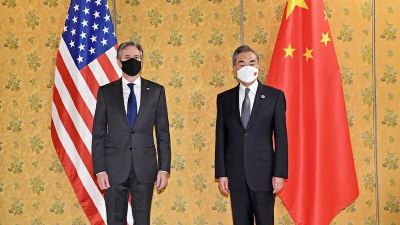
Wang made the remarks in a telephone conversation with US Secretary of State Antony Blinken on Saturday, three days ahead of the much anticipated meeting between President Xi Jinping and his US counterpart Joe Biden.
Noting their meeting will mark a major event not only in China-US relationship but also in international relations, Wang said that the two peoples and the international community hope that the meeting will yield results beneficial to the two countries as well as the world.
The two heads of state play a key role in steering bilateral ties, Wang stressed.
Washington looks forward to sharing its views on bilateral relationship with China in the spirit of mutual respect and jointly sending a strong signal to the world, Blinken said.
Speaking of the wrong remarks and actions of the US regarding the Taiwan question, Wang urged Washington to stop sending wrong signals to “Taiwan independence” forces.
“Taiwan independence” forces are the biggest threat to cross-Straits peace and stability, any connivance and support for them will undermine tranquility in the area and will eventually bear the consequences.
If the US really wants to safeguard peace across the Taiwan Straits, it should clearly and firmly oppose any “Taiwan independence” activity, honor its commitment made in the three China-US joint communiques, and take actions to uphold the one-China principle, he said.
Wang and Blinken also exchanged views on issues including energy security, climate change, Iran nuclear issue, and agreed to maintain dialogue in order to address various global challenges.
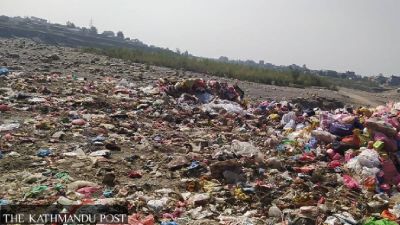
Butwal Sub-metropolitan City, which is responsible for collecting and managing garbage from in and around the city, has been dumping its waste on the banks of Tinau River for years. This has caused massive pollution in the river area, adversely affecting the residents of nearby settlements.
According to Bhuwa Prasad Luintel, senior officer at the sub-metropolis office, the city dumps its waste on the riverbanks, as it does not have a local waste processing centre.
“The city has been dumping its waste in the ditches along the riverbank so as to avoid the garbage from entering the river,” said Luintel, “Once the ditches are filled, we cover them up and move on to another area to dump the city’s waste.”
Butwal, one of the major cities in western Nepal, produces around 60 tonnes of garbage on a daily basis. The city does not have a designated dumping site or a processing centre.
Data from the sub-metropolitan showed that around 70 percent of the collected waste is biodegradable while the remaining waste can be processed and recycled.
However, in the absence of a waste processing centre, the city has opted to dump its garbage along the river banks. The east side of the Tinau River spanning from Kandhaghari to Majhuwa is turning into a landfill site, local residents say.
Despite it being the responsibility of the local governments to keep the water bodies and forests free from pollutants, major cities and municipalities in Rupandehi have been dumping their waste products in local rivers and forests for years.
Starting this year, Butwal has begun dumping its waste materials on the west side of the river, stating that the city would build a roadway after the ditches near Majhuwa are filled.
The settlements on the west side of the river that were already at risk of erosion and flooding are now facing a new ordeal with the metropolis starting to dump garbage near their homes.
“We had gone to the sub-metropolitan office to request the construction of an embankment but the office told us it will begin construction only after the ditches are filled,” said Singh Bahadur Bogati, chairman of the Local Waste Management Committee. “The foul smell of garbage has made our lives miserable, but we are tolerating it in hopes that the embankment will be constructed soon and our homes will be safe.”
The waste materials that are dumped along the river banks not only emit foul smell but during monsoons, the covered dumping ditches are exposed and the garbage flows towards the settlements, farmlands and forests, affecting the local biodiversity.
“The water sources in the city have become polluted due to the garbage. Local aquatic plants are dying due to the presence of excessive chemicals in the river,” said Narayan Bhattarai, environmental expert at the Ministry of Forest, Environment and Soil Conservation of Lumbini Province. “This is affecting the biodiversity of the region.”
With the increase in population, the then Butwal Municipality had planned to construct a waste processing centre 21 years ago and the budget for the same has been allocated multiple times. Studies were conducted for the project but the work never took off from the ground level.
In 2010, the city signed an agreement with the Asian Development Bank to construct a waste processing centre with the capacity of processing 83 tonnes of waste daily at a cost of Rs370 million. However, the project that was slated to complete by 2015 was scrapped in 2018 after the local residents protested and refused to let the city bring its waste near their settlements.
Meanwhile, Butwal, along with Sainamaina Municipality and Kanchan Rural Municipality, has now planned the construction of a waste processing plant at Sainamaina, which will cost around Rs 1 billion.
However, since the project is in its initial stage, it is unclear as to when and how the processing centre will be constructed.
“Since it is a big project, it will take at least two years to finalise the details,” said Butwal’s Mayor Shivaraj Subedi.
Terming the air pollution in New Delhi and neighbouring areas an “emergency situation”, Indian Supreme Court today suggested the authorities take immediate measures including putting the capital under lockdown along with stopping vehicle movements.
Pointing out that people are wearing masks inside their houses, a top court bench, comprising Indian Supreme Court Chief Justice NV Ramana, Justices DY Chandrachud and Surya Kant, asked the Indian and Delhi governments to take emergency measures to curb the air pollution.
The bench, which was hearing a case relating to the air pollution in Delhi, said the air quality in Delhi is in the “severe” category and will dip further in the next two-three days, reports our New Delhi correspondent.
“Tell us, how we can reduce air quality index from 500 at least by 200 points. Take some urgent measures. Can you think of two days of lockdown or something? How can people live? We will look at a long-term solution later,” the Supreme Court said.
“You have to look at this issue beyond politics and government. Something must be done so that in two to three days we feel better,” the bench said.
Solicitor General Tushar Mehta, appearing for the Indian government, told the bench that the government is going to hold a meeting today on the matter.
Delhi Chief Minister Arvind Kejriwal also called an emergency meeting to discuss the severe air pollution.
The air quality in Delhi remained in the “severe” category today with the air quality index being recorded at 473.
The AQI of neighbouring Noida and Gurugram was recorded at 587 and 557, respectively.
An AQI between zero and 50 is considered as “good”, 51 and 100 “satisfactory”, 101 and 200 “moderate” 201 and 300 “poor”, 301 and 400 “very poor”, and 401 and 500 as “severe”.
India’s Central Pollution Control Board yesterday advised the people to limit outdoor activities and told government and private offices to cut vehicle use by at least 30 percent as air quality in Delhi-NCR inched towards the emergency level amid a rise in emissions from farm fires and unfavourable meteorological conditions.
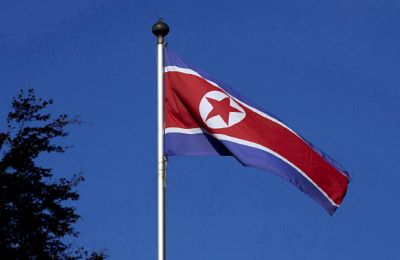
North Koreans should make the best use of the remainder of the year to support the regime’s economic plan, the official newspaper Rodong Sinmun said Friday, as the North faces a growing economic crisis.
“Those who are falling behind what they are expected to do should come to their senses and respond to what our revolution demands: bold action,” the newspaper said, referring to the five-year initiative that national leader Kim Jong-un revealed in January to jump-start the economy.
At the January party congress, Kim laid out goals for each sector and admitted that he had failed “terribly” to deliver on earlier expectations. Nevertheless, Kim did not give up on the North’s Juche strategy, or the pursuit of growth without outside help.
The Rodong Sinmun said the regime had seen some progress in science and technology, without elaborating on details. Pyongyang carried out multiple weapons tests this year, most recently a submarine-launched ballistic missile in October. Preparations for a second test were reported.
Meanwhile, the Unification Ministry, which handles inter-Korean affairs in the South, said it was monitoring closely for signs of unusual activity in North Korea. Kim is seen as trying to cement his grip on power as he tries to put in place a more authoritarian rule.
Kim is now called “suryong,” a title North Korea’s constitution reserves for Kim Il-sung — Kim Jong-un’s grandfather, who founded the regime — and Kim Jong-il, Kim Jong-un’s father. State media have already floated the idea of “Kim Jong-un-ism,” meaning what he does dictates the regime’s course without being second-guessed.
“The new title could mean that party leaders and organs are seeking to reaffirm their loyalty to Kim,” the Unification Ministry said, adding there was nothing unusual about Kim making no public appearances for about a month because he had done the same thing many times in the past.
In December, it will be 10 years since Kim Jong-un came to power.
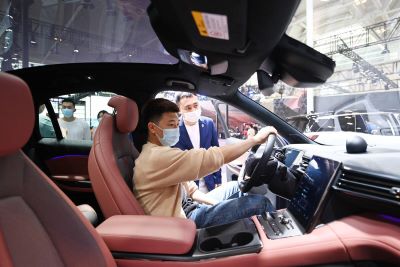
Sales of new energy vehicles are expected to maintain high-speed growth in China, as they become a serious choice for volume car buyers, industry experts said.
Deliveries of those vehicles soared 141.1 percent in October to 320,000 units, the China Passenger Car Association said. That means nearly 19 of every 100 passenger car buyers chose electric cars or plug-in hybrids instead of conventional gasoline vehicles, the association said. The percentage was just 5.8 percent in 2020, and has been on the rise since.
From January to October, new energy vehicle deliveries surged 191.9 percent year-on-year to 2.14 million, accounting for roughly 13 percent of total car sales.
Cui Dongshu, secretary-general of the association, said sales will rise even higher in November and December, a pattern seen in the past few years. He expects total deliveries of new energy vehicles, including passenger cars as well as buses and trucks, to hit 3 million this year.
Currently, volume brands are seizing the lion’s share of China’s new energy vehicle market, a sign of their growing acceptance among ordinary customers.
Six carmakers saw their sales exceed 10,000 units in October. Tesla was the only premium brand, statistics from the China Passenger Car Association showed. China’s BYD topped the list with 80,373 units sold that month. Tesla followed at 54,391. The third most popular brand was Wuling, known for its two-seat mini-vehicles, which sold over 42,000 units.
Startups are doing well too. New York-traded Xpeng sold over 10,000 units in October. Nio, which is listed in New York as well, delivered over 24,000 units from July to September. Its chairman, William Li, expects similar volume in the last quarter of the year.
Besides better driving experiences and lower use costs, the fact that car buyers are getting younger is helping promote the popularity of electric cars and plug-in hybrids, said Chen Shihua, deputy secretary-general of the China Association of Automobile Manufacturers.
“In the past, first-time car buyers were aged around 30. Now they are younger, and young people would like to try new things, such as new models and new brands,” said Chen.
Like Nio and Xpeng, there are around a dozen local startups that have launched or are ready to unveil their models. Traditional carmakers from SAIC to Geely are establishing new dedicated electric car models to appeal to the young.
“So far this year, you can rarely see carmakers launch newly developed gasoline models. Almost all of the new launches are electric or plug-in hybrids,” Chen said.
At this year’s Guangzhou Auto Show, which is expected to kick off on Friday, there will be 241 new energy models, 100 more than at the event last year, its organizers said.
Xu Haidong, deputy chief engineer of the China Association of Automobile Manufacturers, said new energy vehicles are boosting China’s vehicle exports, especially to developed countries.
“There is demand and China-made new energy models are competitive,” said Xu.
Carmakers including BYD, Nio and FAW’s premium Hongqi are exploring overseas markets. China’s largest carmaker SAIC delivered over 12,000 electric vehicles and plug-in hybrids in Europe in the first half, accounting for almost 60 percent of all its sales on the continent.
“Our rivals are local European brands. In France, they are Renault, Peugeot and Citroen,” said Liu Xinyu, president of SAIC’s French subsidiary. He said SAIC’s success in Europe lies in its products and services. “Our two models in France have five-star safety ratings and we offer a seven-year warranty, which is the longest in the market.”
The World Association of Newspapers and Publishers (WAN-IFRA), RSF (Reporters without Borders), and CPJ (Committee to Protect Journalists) call for the immediate release of Denny Fenster, managing editor of Frontier Magazine after he is sentenced to 11 years in prison.
“We call for Danny Fenster’s immediate release and for all charges to be dropped in what is a clear act of intimidation against the embattled independent press in Myanmar,” said Andrew Heslop, WAN-IFRA Executive Director for Press Freedom. “These baseless charges are designed to instil fear and to discourage media from doing their work. Furthermore, we condemn the implication that Danny is being used in political brinkmanship in response to US sanctions against the Myanmar regime. That any journalist should be targeted like this is wholly unacceptable.”
“With five charges, including one that could result in his spending the rest of his days in one of Myanmar’s prisons, the treatment reserved by the junta for Danny Fenster clearly constitutes persecution,” said Daniel Bastard, the head of RSF’s Asia-Pacific desk. “This journalist is paying a high price for his commitment to press freedom in Myanmar. We demand his immediate and unconditional release.”
“We regret today’s harsh ruling against journalist Danny Fenster, call for his immediate and unconditional release, and for all charges pending against him to be dropped,” said Shawn Crispin, CPJ’s senior Southeast Asia representative. “Myanmar must stop jailing journalists for merely doing their jobs of reporting the news.”
Danny Fenster, a U.S. citizen, was arrested by security forces at Yangon international Airport in the last week of May. In the special court hearing in Insein Prison, Denny Fenster was found guilty of three charges and faces up to 11 years in prison.
New, more serious charges of sedition and violations of the terrorism act were added earlier this week, which are punishable each by a maximum 20 years in prison
KUALA LUMPUR: Malaysia will propose the creation of a supervisory mechanism to facilitate smooth and safe travels across the region, said Prime Minister Datuk Seri Ismail Sabri Yaakob.
Addressing the Apec (Asia-Pacific Economic Cooperation) Economic Leaders’ Meeting (AELM) last night, where he is head of the Malaysian delegation, Ismail Sabri urged Apec members to collectively work towards realising this aspiration, considering that the reopening of borders will accelerate the recovery for the travel and tourism sectors that have been battered by the Covid-19 pandemic, thus contributing to general economic recovery.
“On this ground, I am glad to share that fully vaccinated Malaysians are now travelling overseas since last month, while foreign tourists can enter Malaysia by observing strict procedures and protocols.
“I am proud to say that beginning Nov 29, the Vaccinated Travel Lane between Malaysia and Singapore will begin operations,” he told the audience consisting of leaders from 21 Apec economic leaders that gathered virtually in the meeting chaired by New Zealand Prime Minister Jacinda Ardern.
Themed “Join, Work, Grow, Together”, the AELM is expected to deliberate on issues related to revitalising the region, socially and economically.
“Malaysia is also in the process of implementing travel corridor arrangements with Indonesia,” he said as he called for more multilateral effort to make vaccines available, both in terms of distribution and mutual recognition, while discarding vaccine “discrimination”.
Ismail Sabri said it is essential to ensure that no country gets left behind on the road to recovery from the pandemic.
“Recognising the need to swiftly address the impacts of Covid-19, the AELM will also explore efforts and collaborations necessary to accelerate economic recovery and create sustainable growth for the region in the post-pandemic era,” reported Bernama on a statement released by the International Trade and Industry Ministry (Miti).
Miti said Malaysia is expected to share the nation’s views on strategic collective efforts concerning mutual vaccine recognition, safety measures for cross-border travels, intensifying technology and innovation, as well as the advancement of sustainability and green growth that could reap future benefits in fostering regional recovery.
At the end of AELM, Apec leaders are expected to endorse the 2021 Apec Economic Leaders’ Declaration as well as the adoption of the Implementation Plan of Putrajaya Vision 2040 to chart the trajectory of Apec over the next two decades.
Apec launched Putrajaya Vision 2040 in November 2020, under which the world’s most dynamic regional economies will cooperate toward building an open, dynamic, resilient and peaceful Asia-Pacific.
“Indeed, this will progressively advance towards achieving its vision by 2040, for the prosperity of all our people and future generations,” said Miti.
In leading up to the AELM and as part of the active engagement with the private sector, the Apec economic leaders will hold a dialogue with the Apec Business Advisory Council (Abac).
Ismail Sabri, together with permanent members of Abac Malaysia, Datuk Rohana Mahmood, Datuk Ruben Emir Gnanalingam Abdullah and Tengku Muhammad Taufik Tengku Aziz, will participate in the discussion on the way forward for the region to successfully emerge from the health crisis.
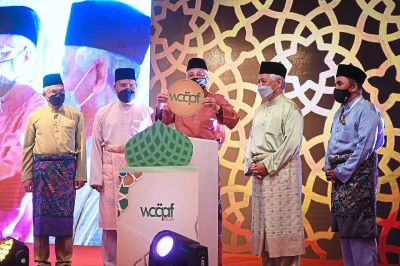
Earlier in the day, Ismail Sabri said the government is drawing up a National Wakaf Master Plan, a holistic plan to strengthen wakaf (endowment) management in Malaysia.
The Prime Minister said that under Budget 2022, the government has allocated a RM10mil start-up fund to launch the initiative on Small and Medium Enterprises (SME) Halal Wakaf, Agriculture Wakaf and Disaster Wakaf.
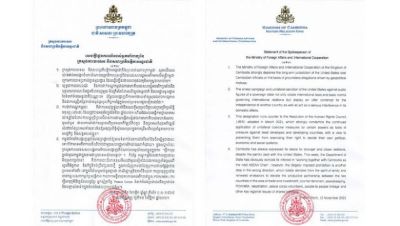
The Ministry of Foreign Affairs and International Cooperation “strongly deplores the long-arm jurisdiction of the United States” over Cambodian officials based on “groundless allegations driven by geopolitical motives”, according to spokesman Koy Kuong.
“The smear campaign and unilateral sanction of the United States against public figures of a sovereign state not only violate international laws and basic norms governing international relations but display an utter contempt for the independence of another country as well as act as a serious interference in its domestic affairs,” he said.
The reaction came after the US Department of the Treasury’s Office of Foreign Assets Control (OFAC) sanctioned two Cambodian military commanders – Ministry of National Defence director-general for Material and Technical Services Chao Phirun and Royal Cambodia Armed Forces (RCAF) commander Tea Vinh – alleging corruption.
The US department said Phirun and Vinh “are designated pursuant to Executive Order 13818, which builds upon and implements the Global Magnitsky Human Rights Accountability Act and targets perpetrators of serious human rights abuse and corruption around the world”.
It alleged that in 2020-2021, Phirun “conspired to profit from activities regarding the construction and updating of Ream Naval Base facilities.
“Additionally, [Phirun, Vinh] and other Cambodian government officials likely conspired to inflate the cost of facilities at Ream Naval Base and personally benefit from the proceeds. [The two officials] planned to share funds skimmed from the Ream Naval Base project.”
Kuong said the US’ “designation runs counter to the Resolution of the Human Rights Council [46/5] adopted in March 2021, which strongly condemns the continued application of unilateral coercive measures by certain powers as tools of pressure against least developed and developing countries, with a view to preventing them from exercising their right to decide their own political, economic and social systems”.
“Cambodia has always expressed its desire for stronger and closer relations, despite the painful past with the United States,” he said.
He noted that the US Department of State had earlier this week signalled its interest in “working together with Cambodia as the next ASEAN Chair”.
“However, the illegally imposed prohibition is another step in the wrong direction, which totally deviates from the spirit of amity and renewed endeavours to elevate the productive partnership between the two countries in the area of trade and investment, counter-terrorism, peacekeeping, POW/MIA [military members who are prisoners of war or are missing in action], repatriation, peace corps volunteers, people-to-people linkage and other key regional issues of shared interests,” Kuong said.