Logistics, regulatory bottlenecks loom as South-east Asia embarks on Covid-19 vaccine roll-out #SootinClaimon.Com

#SootinClaimon.Com : ขอบคุณแหล่งข้อมูล : หนังสือพิมพ์ The Nation.

Logistics, regulatory bottlenecks loom as South-east Asia embarks on Covid-19 vaccine roll-out

Feb 07. 2021
By Straits Times

JAKARTA – Malaysia’s Health Ministry completed a 550km practice run in rural Sarawak to test its Covid-19 vaccine supply chain, while Indonesia’s president rolled up his sleeve on live television to get the jab.

South-east Asian countries are slowly rolling out vaccines, navigating regulatory hurdles, accelerating infections and supply bottlenecks across a vast and diverse population in the first mass immunisation of its kind in history.

Past immunisation programmes for diseases like polio and tuberculosis had captive audiences: school children, for example.

This time everyone needs a shot. The effort will be uneven. Experts say richer countries will be faster at rolling out vaccines, helped by well-staffed medical services and experience with past epidemics.

But political will, logistics and regulation will also weigh on the pace of immunisation.

“The volumes of people to vaccinate is a problem to be overcome,” Mr Wiku Adisasmito, spokesman for Indonesia’s national Covid-19 task force, told The Straits Times.

Indonesia aims to vaccinate two thirds of its roughly 270 million people – enough to effectively halt transmission of the virus – over the next 15 months, the government said last month.

That target, however, is “not set in stone”, Mr Wiku said.

Vaccination rates of nearly a million a day are “manageable” on the crowded and more urbanised western half of the archipelago, Mr Wiku said. But it will be an uphill climb in the far-flung islands with more limited power grids, roads and health workers.

Indonesia may use its military as well as logistics companies to help with the effort, he added.

“On distant islands, the transportation, the logistics, the cold chain will be problematic, of course, but it doesn’t mean it can’t be solved,” Mr Wiku said.

For its part, Malaysia hopes to immunise its 32 million citizens over the next 18 months after it gets its first vaccine shipment this month.

Health officials wrapped up a vaccine-delivery practice run last week that started in Belgium, where Pfizer-BioNTech makes its Covid-19 shot, and ended at a rural health clinic in Belaga, Sarawak, in the heart of Borneo.

The successful rehearsal was to test a delivery chain through which the vaccine must remain at minus 70 deg C.

The region’s richer and geographically smaller economies are expected to wrap up immunisation even faster.

Singapore started vaccinations in late December and expects to have enough doses to cover all citizens and residents by September.

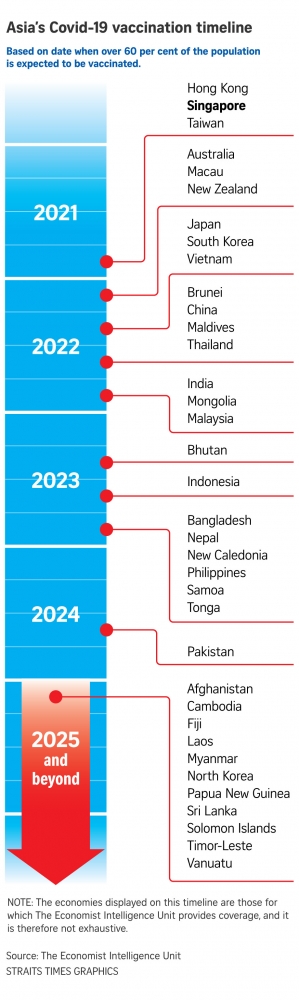
The Economist Intelligence Unit (EIU) said on Jan 27 that Singapore, Hong Kong and Taiwan will reach so-called herd immunity by the end of the year, with Australia and New Zealand soon to follow.

But limited resources and regulatory delays in the rest of the region will collide with the realities of reaching 650 million people scattered over a cross-section of cities, villages and jungle.

Vietnam and Thailand will not be sufficiently immune until the middle of 2022 at the earliest. Indonesia’s ambition to vaccinate 181.5 million people over the next 15 months will take twice as long.

Laos and Myanmar and other poor countries won’t reach herd immunity before 2025 – if at all.

The resulting patchwork of immunity versus vulnerability risks giving the virus a chance to mutate. Neighbours will need to pool resources to extend vaccination to the poorer neighbours to keep the pandemic at bay.

“It’s in the interest of the vaccinated countries to help,” said EIU analyst Imogen Page-Jarrett, who helped compile the report.

Regulatory bottlenecks are also wreaking havoc.

While Thailand will import about two million doses of Sinovac by April for health workers, it’s counting on a locally produced version of the AstraZeneca-Oxford vaccine for its immunisation drive but the first doses won’t be available until June.

The company that will make the AstraZeneca vaccine, Siam Bioscience, is owned by King Maha Vajiralongkorn, drawing fire from opposition figures of self-dealing at the expense of public health.

In the Philippines, disorganisation and past trauma may also be slowing its vaccine roll-out. The government has made few firm plans to buy any foreign vaccine except for a combined half million from Pfizer and AstraZeneca in February and two million doses a month from China’s Sinovac between now and early next year for its 108 million residents.

Critics say the delays underscore the lack of coordination among policymakers. But they also illustrate the uneasiness with foreign vaccines.

A 2016 jab for dengue from France’s Sanofi was thought to have sickened kids, prompting parents to yank children from immunisation drives. Vaccination coverage for tuberculosis among small children under two years old dropped from 90 per cent in 2009 to 69 per cent a decade later.

Asia’s roll-out starts amid signs that the number of new cases is accelerating.

Indonesia’s tally of infections blew past the one-million mark last month, with one swab test in four turning up positive.

While the tally is low by comparison with the United States and Brazil, it strains Indonesia’s health infrastructure. The country has half the hospital beds per thousand people than neighbouring Malaysia.

Dr Dicky Budiman, an epidemiologist with Griffith University in Queensland, said there may be too much emphasis on immunisation.

While vaccines may prevent sickness, it’s not clear whether they stop transmission. Distancing and masks are still key.

“Vaccination is not the super bullet,” Dr Dicky told the Straits Times. “It’s just one of the tools.”
Japanese conglomerate Kirin Holdings cuts ties with Myanmar #SootinClaimon.Com

#SootinClaimon.Com : ขอบคุณแหล่งข้อมูล : หนังสือพิมพ์ The Nation.

Japanese conglomerate Kirin Holdings cuts ties with Myanmar

Feb 07. 2021

By The Daily Star

Japanese conglomerate Kirin Holdings Company Limited has terminated its ties with Myanmar’s military-linked company Myanmar Economic Holdings Public Company Limited — a decision being seen as a strong message to the Myanmar military.

The announcement comes days after Myanmar military took control of the country through a coup and detained the country’s elected leader Aung San Suu Kyi and other political leaders of the National League of Democracy that saw a landslide victor in the November elections.

In a statement Friday, Kirin Holdings Company Limited said it is deeply concerned by the recent actions of the military in Myanmar, which are against the standards and human rights policy that Kirin maintains.

“We decided to invest in Myanmar in 2015, believing that, through our business, we could contribute positively to the people and the economy of the country as it entered an important period of democratization,” it said.

However, it said, given the current circumstances, it has no option but to terminate its current joint-venture partnership with Myanmar Economic Holdings Public Company Limited, which provides the service of welfare fund management for the military.

“We will be taking steps as a matter of urgency to put this termination into effect,” read the statement.

According to Japan Times, Kirin acquired a majority stake in Myanmar Brewery in 2015 in partnership with Myanmar Economic Holdings Ltd (MEHL). It was part of billions of dollars in foreign investment which flooded into the country with the partial lifting of international sanctions.

Kirin took a controlling stake in Mandalay Brewery Ltd in 2017 at a cost of $4.3 million, topping off its more than $500 million investment in top producer Myanmar Brewery in 2015.

Human rights groups have been demanding that Japanese and other foreign companies having businesses linked to Myanmar military cut their ties since 2017 when a brutal military crackdown caused influx of some 750,000 Rohingyas to Bangladesh. Rights groups called it a genocide.

Faced with pressure from human rights monitors, Kirin hired third-party investigators to look into the business and said in November it was halting payments from the beer ventures to MEHL. But it had been undecided on how to resolve the issue.

Justice For Myanmar, a covert group of activists, congratulated Kirin following Friday’s statement, saying it has been a major financial supporter of the Myanmar military and has made the right decision by ending that relationship after the military’s illegitimate February 1 coup.

Myanmar wrote to Bangladesh explaining military takeover: foreign minister #SootinClaimon.Com

#SootinClaimon.Com : ขอบคุณแหล่งข้อมูล : หนังสือพิมพ์ The Nation.

Myanmar wrote to Bangladesh explaining military takeover: foreign minister

Feb 07. 2021Bangladesh Foreign Minister Dr AK Abdul MomenBangladesh Foreign Minister Dr AK Abdul Momen
By The Daily Star

Myanmar has written to Bangladesh through the Ambassador in Yangon, explaining why the military took over on February 1.

The current interim government conveyed that some 10.4 million fake votes were cast in the national election held in November last year.

“We got a letter. They gave the letter to our Ambassador,” said Foreign Minister Dr AK Abdul Momen, sharing the updates with reporters after attending a function today.

After the takeover, the new military administration in Myanmar has reached out to Rohingyas in Rakhine State which is seen as the military junta’s “desire to gradually bring back normalcy” in the Rakhine state, giving confidence to Rohingyas for voluntary repatriation. “These are good news. It’s a good beginning,” Momen said.

“Whatever may be the military’s new approach and policy on Rohingya and Rakhine issues, it’ll take time to get a shape,” a diplomatic source told UNB. 

Merkel, Macron for independent EU policy towards China #SootinClaimon.Com

#SootinClaimon.Com : ขอบคุณแหล่งข้อมูล : หนังสือพิมพ์ The Nation.

Merkel, Macron for independent EU policy towards China

Feb 07. 2021

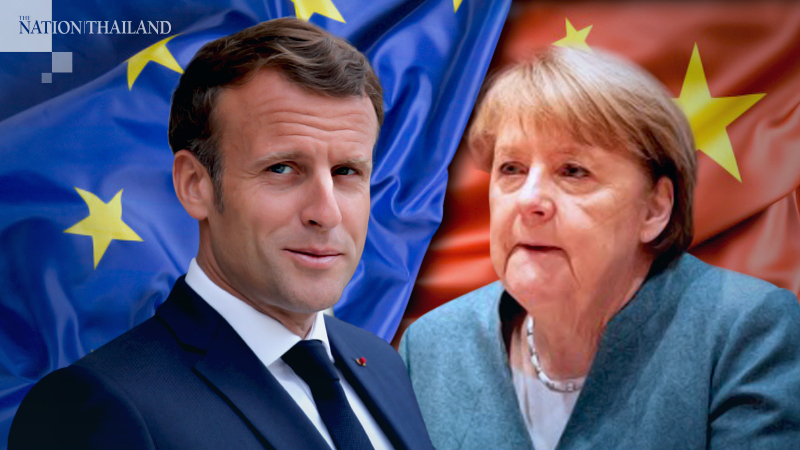
French President Emmanuel Macron and German Chancellor Angela Merkel

French President Emmanuel Macron and German Chancellor Angela Merkel

By China Daily

PARIS – The European Union (EU) should maintain its strategic autonomy and has its own policy towards China, said French President Emmanuel Macron and German Chancellor Angela Merkel on Friday, as Washington is pushing for a common US-EU policy.

READ MORE: China, EU agree investment deal

“We have already made a step in this direction with the investment agreement with China. I think the EU should have its own policy vis-a-vis China,” said Merkel at a joint press conference with Macron following an online meeting of the French-German Defence and Security Council.

We have already made a step in this direction with the investment agreement with China. I think the EU should have its own policy vis-a-vis China.

Angela Merkel, German Chancellor

The two leaders made the remarks when asked to comment on US President Joe Biden‘s first foreign policy speech, in which he called China his country’s “most serious competitor.”

The EU policy towards China should “take into consideration points of accord with the US,” but “despite this, there are numerous reasons, such as the fight against climate change and other themes, that push us to work with China, notably for the reinforcement of multilateralism,” said the German chancellor.

“And I think the decoupling, especially at the digital era, is not a good idea,” she added.

For his part, the French president said European sovereignty means “the power to decide our choice by ourselves and not to be in a strategy of alignment with anyone.”

ALSO READ: China-EU meeting to enhance ties

Second, “we both believe in peace and stability… therefore in doing everything to avoid escalation of tension,” said Macron.

“The third thing is that we have indeed plurality in the relations with China – partnership on certain issues, such as the climate, on which China since the Paris agreement has been a trustful partner…” he continued. 

Yang holds phone conversation with US state secretary #SootinClaimon.Com

#SootinClaimon.Com : ขอบคุณแหล่งข้อมูล : หนังสือพิมพ์ The Nation.

Yang holds phone conversation with US state secretary

Feb 07. 2021

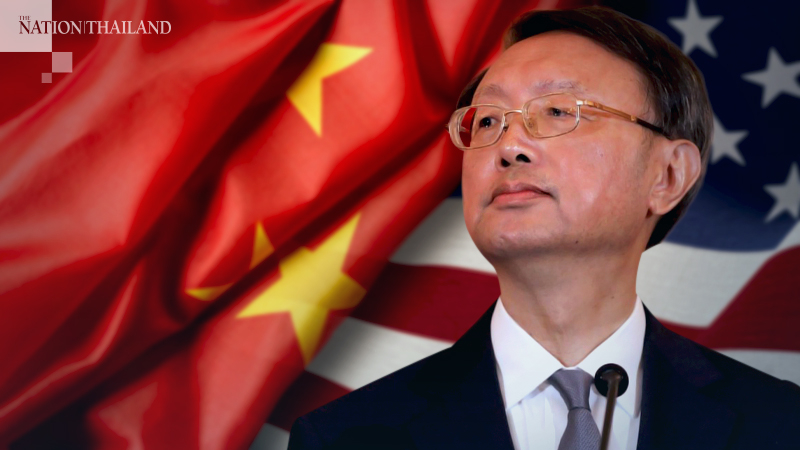
Senior Chinese diplomat Yang Jiechi

Senior Chinese diplomat Yang Jiechi

By China Daily

BEIJING – Senior Chinese diplomat Yang Jiechi on Saturday held a phone conversation with US Secretary of State Antony Blinken.

The development of China-US relations has brought great benefits to the people of the two countries and also promoted world peace and prosperity, said Yang, a member of the Political Bureau of the Communist Party of China (CPC) Central Committee and director of the Office of the Foreign Affairs Commission of the CPC Central Committee.

READ MORE: US govt urged to focus on cooperation

Senior Chinese diplomat Yang Jiechi said Hong Kong, Xinjiang and Tibet-related affairs are all China’s internal affairs and allow no interference by any external forces

China-US relations now stand at a critical moment, he said, adding that the Chinese government takes a stable and consistent policy toward the United States.

China urges the United States to rectify its mistakes made over a period of time and work with China to uphold the spirit of no conflict, no confrontation, mutual respect and win-win cooperation, focus on cooperation and manage differences, so as to push forward the healthy and stable development of bilateral relations, Yang added.

Yang stressed that the two sides should respect each other’s core interests and choices of political system and development path, and manage their domestic affairs well.

China will unswervingly follow its path of socialism with Chinese characteristics and no force could stop the realization of the great rejuvenation of the Chinese nation, Yang said.

ALSO READ: Biden signals shift in US stance on bilateral ties with China

The Taiwan question, the most important and sensitive core issue in China-US relations, bears on China’s sovereignty and territorial integrity, Yang said.

Yang Jiechi reiterated China’s position on the current situation in Myanmar, stressing that the international community should create an enabling external environment for the proper settlement of the Myanmar issue

The United States should strictly abide by the one-China principle and the three Sino-US joint communiques, he said, adding that Hong Kong, Xinjiang and Tibet-related affairs are all China’s internal affairs and allow no interference by any external forces.

Any attempt to slander and smear China will not succeed, and China will continue to firmly safeguard its sovereignty, security and development interests, Yang added.

Yang pointed out that all countries in the world should safeguard the international system with the United Nations at its core, the international order based on international law, and the basic norms of international relations in line with the purposes and principles of the UN Charter.

ALSO READ: China calls for upholding Myanmar stability

Such is the consensus of the international community, not the so-called rules-based international order championed by a few countries, Yang added.

US Secretary of State Antony Blinken reiterated that the US side will continue to pursue the one-China principle and abide by the three Sino-US joint communiques, and this policy stance has not changed

Yang urged the US side to play a constructive role in promoting peace and stability in the Asia-Pacific region. He reiterated China’s position on the current situation in Myanmar, stressing that the international community should create an enabling external environment for the proper settlement of the Myanmar issue. 

For his part, Blinken said the US-China relations are very important to both countries and the world, and the US side is willing to develop stable and constructive bilateral relations with China.

Blinken reiterated that the US side will continue to pursue the one-China principle and abide by the three Sino-US joint communiques, and this policy stance has not changed.

The two sides have agreed to maintain contact and communication on bilateral relations as well as international and regional issues of common concern.

Tesla to start talks on plans to invest in electric vehicle, lithium batteries and power generation in Indonesia #SootinClaimon.Com

#SootinClaimon.Com : ขอบคุณแหล่งข้อมูล : หนังสือพิมพ์ The Nation.

Tesla to start talks on plans to invest in electric vehicle, lithium batteries and power generation in Indonesia

Feb 06. 2021

By Wahyudi Soeriaatmadja
The Straits Times/ANN

JAKARTA – US green energy giant Tesla will start discussions with the Indonesian authorities next week on its investment plans to set up plants in the country to make electric vehicle (EV), lithium batteries and power generators after the local government on Thursday (Feb 4) confirmed receiving a proposal letter from the carmaker.

This follows moves by two global EV battery giants – China’s CATL and South Korea’s LG Chem – which have earlier made advanced talks to invest billions of dollars in South-east Asia’s largest economy, which holds a quarter of nickel reserve, a key raw material to make EV batteries.

“Tesla’s proposal is a bit different from CATL and LG Chem. The base technology that Tesla will use is different,” Mr Septian Hario Seto, Indonesian deputy minister in charge of mining and investment, told a virtual media briefing on Friday.

Transfer of technology is a key consideration as Indonesia requires investors coming to the country to commit to this key area.

“We are excited to work with Tesla. Tesla’s lithium battery technology is among the world’s best. If we have investment from CATL, LG Chem – which also have a very good technology – plus Tesla, Indonesia will pick up a lot to learn,” Mr Seto added.

Tesla will build an EV plant in India’s Karnataka state, local media reported.

CATL, the world’s largest producer of lithium-ion batteries, shipped 40.7 gigawatt hours (GWh) last year, followed by the second-largest maker Panasonic with 30.7GWh and LG Chem with 13.3GWh, according to Bloomberg.

CATL has recently secured a deal to supply battery packs to Tesla, which overtook Toyota in mid-2020 to become the world’s most valuable carmaker. Panasonic was previously the long-time supplier of Tesla.

State-controlled gold and nickel miner Aneka Tambang will be the local partner of these giant companies, and will ensure continued supply of the raw material.

With Tesla, the talks will also cover a plant to make an energy storage system (ESS), which involves a device that stores energy to supply to homes or industries during peak times when energy demand far surpasses supply, said Mr Seto.

“It works the way mobile phone’s power banks work, but an ESS may supply power to homes and industries. Its size could be tens of megawatts or even a hundred megawatt,” Mr Seto said.

The government has been trying to encourage the setting up of an end-to-end EV industry in the country. In 2015, it started the construction of a nickel industrial park on 2,000ha in Central Sulawesi province that has today become the world’s largest, producing millions of tonnes of stainless steel slabs. Nickel is also used to make steel.

Also at Friday’s briefing, Mr Seto said Indonesia is on track to have China’s Tsingshan and US copper and gold miner Freeport work together to build a US$2.5 billion (S$ ) copper smelter by 2023 in North Maluku province’s Weda Bay.

“Negotiations are under way. The target is that we have this concluded by end-March,” Mr Seto said, adding that about 92.5 per cent of the project cost would be covered by Tsingshan, and 7.5 per cent by Freeport, and that the project would be mutually beneficial to all parties.

Tsingshan will benefit as it could develop the downstream industries that produce copper derivatives that could in turn be used in electric vehicles, while Freeport will also benefit as it is required by the existing law to build a smelter to continue its mining operations beyond 2023, Mr Seto explained.

“Three commodities that we have in abundance that would play a strategic role in renewable energy development are nickel, copper and bauxite. An EV uses four times more copper than a conventional car. Solar panels and wind power plants use bauxite and copper derivatives significantly,” he added.

Kyoto heritage site to launch ‘space temple’ in 2023 #SootinClaimon.Com

#SootinClaimon.Com : ขอบคุณแหล่งข้อมูล : หนังสือพิมพ์ The Nation.

Kyoto heritage site to launch ‘space temple’ in 2023

Feb 06. 2021A sample cross-section rendering of a satellite that Daigoji temple plans to send into outer space. (Courtesy of Terra Space Inc.)A sample cross-section rendering of a satellite that Daigoji temple plans to send into outer space. (Courtesy of Terra Space Inc.)
By The Japan News/ANN

A Buddhist temple in Kyoto has revealed ambitious plans to launch a satellite-sized temple into outer space sometime in 2023.

The UNESCO World Heritage Site Daigoji temple in Fushimi Ward, Kyoto, announced Monday that Terra Space Inc., a Kyoto-based firm it established in February last year, is developing a “space temple” that will be installed a box-shaped satellite measuring 20 centimeters long, 30 centimeters wide and 10 centimeters deep, according to the company.

Miniature mandala paintings and a statue of the Buddha will be enshrined inside one of the satellite’s compartments, and regular memorial services will be conducted.

The project also aims to build a communications network that could be used to help other temples in remote mountainous areas with disaster prevention preparedness. If everything goes according to plan, the satellite will orbit the Earth once every 1½ hours, transmitting image data captured from an altitude of about 500 kilometers.

Describing the motivations behind the project, Junei Nakada, 56, executive manager of Daigoji, said, “We thought it was necessary to have a temple that could transcend region, race, and religion to pray for world peace and security from the bigger perspective available in space.”

China to provide 500,000 doses of Covid-19 vaccine to Nepal #SootinClaimon.Com

#SootinClaimon.Com : ขอบคุณแหล่งข้อมูล : หนังสือพิมพ์ The Nation.

China to provide 500,000 doses of Covid-19 vaccine to Nepal

Feb 06. 2021

By The Kathmandu Post/ANN

The message was conveyed to Foreign Minister Gyawali by Chinese Foreign Minister Wang during a telephone conversation Friday evening.

China is providing 500,000 doses of Covid-19 vaccine to Nepal.

During a telephone conversation between Foreign Minister Pradeep Gyawali and Foreign Minister Wang Yi on Friday evening, China made a commitment that it would provide 500,000 doses of Covid-19 vaccine as a grant.

China also said that it would accord priority to Nepal in vaccine cooperation, according to the statement of the Ministry of Foreign Affairs.

Foreign Minister Gyawali thanked the Chinese government for the support of Covid-19 vaccines, the statement added.

Earlier this week on Sunday the Chinese embassy in Kathmandu had announced that it would provide 300,000 vaccines to Nepal. But Nepali authorities have not given approval to any vaccine other than Covishield vaccine developed by University of Oxford and AstraZeneca, the Swedish-British pharmaceutical giant.

Last month India provided as grant one million vaccines with which frontline health workers and other personnel like cleaners and ambulance drivers are being vaccinated across the country.

Following the Chinese embassy announcement on Sunday, the Department of Drug Administration had said that it has asked for the necessary documents from the producer of the Chinese vaccine before it gives approval. 

Facilities in Wuhan get visit from WHO team #SootinClaimon.Com

#SootinClaimon.Com : ขอบคุณแหล่งข้อมูล : หนังสือพิมพ์ The Nation.

Facilities in Wuhan get visit from WHO team

Feb 06. 2021An international expert team from the World Health Organization visit an exhibition on how China fought the coronavirus in Wuhan, Central China's Hubei province on Jan 30, 2021. [Photo/Xinhua]An international expert team from the World Health Organization visit an exhibition on how China fought the coronavirus in Wuhan, Central China’s Hubei province on Jan 30, 2021. [Photo/Xinhua]

By WANG XIAOYU
China Daily/ANN

An international expert team from the World Health Organization has visited a number of key facilities in Wuhan, Hubei province, in recent days, including food markets, disease control centers and a research institution, as their scientific research into the origin of the novel coronavirus makes progress, the National Health Commission said on Thursday.

Commission spokesman Mi Feng said the team had visited Wuhan Baishazhou Agricultural Market, Huanan Seafood Market, Wuhan Center for Disease Control and Prevention, Hubei Provincial Center for Disease Control and Prevention, Hubei Provincial Center for Animal Disease Control and Prevention, and the Chinese Academy of Sciences’ Wuhan Institute of Virology.

“The WHO team has talked with relevant administrative personnel, experts, business owners, residents and media representatives there,” he said during a news conference.

Mi added that team members have also had talks with experts from the Wuhan Blood Center and Huazhong Agricultural University.

The visiting team arrived in Wuhan on Jan 14 and began field visits on Jan 28 after completing the mandatory 14-day quarantine required for inbound travelers.

Previously, the team had visited two local hospitals-Hubei Provincial Hospital of Integrated Chinese and Western Medicine and Wuhan Jinyintan Hospital-where some of the earliest COVID-19 patients were treated.

Peter Daszak, a British zoologist and a team member, said on social media on Wednesday that the team had an “extremely important meeting” with researchers at the Wuhan Institute of Virology, including the leading scientist Shi Zhengli, who had firmly dismissed conspiracy theories that the virus was leaked from the institute in Wuhan.

“Frank, open discussion. Key questions asked and answered,” Daszak said in a social media post that described the meeting.

In a video interview with British television news channel Sky News, Daszak said that China’s openness and willingness to cooperate with the international expert team is being felt every day.

“They are sharing data with us that we’ve never seen before, that no one has seen before. They are talking with us openly about every possible pathway,” he said, adding that any scientific inquires concerning people’s lives are sensitive worldwide and appropriate constraints are necessary.

He stressed that on-site visits in Wuhan had enabled team members to directly pose significant questions.

“We do not just wander around and take a few pictures. We look into things and ask questions. We talked to people who collected the samples from the market that tested positive,” he said.

In China, the virus has been largely brought under control despite a number of outbreaks in recent weeks.

As of Wednesday, the country had administered over 31.23 million doses of COVID-19 vaccines to people deemed at higher risk of catching the virus, including public service employees, and coldchain and port workers, according to commission spokesman Mi.

Korean trade minister withdraws bid for WTO chief #SootinClaimon.Com

#SootinClaimon.Com : ขอบคุณแหล่งข้อมูล : หนังสือพิมพ์ The Nation.

Korean trade minister withdraws bid for WTO chief

Feb 06. 2021South Korean Trade Minister Yoo Myung-hee speaks during a press conference held in Seoul on Friday. (Yonhap)South Korean Trade Minister Yoo Myung-hee speaks during a press conference held in Seoul on Friday. (Yonhap)

By Song Su-hyun
The Korea Herald/ANN

South Korean Trade Minister Yoo Myung-hee announced Friday that she was dropping out of the race for the chief position at the World Trade Organization.

“I decided to resign as a candidate through close coordination with the US government, our solid ally, in order to facilitate reaching a consensus among the WTO member countries,” Yoo said during a press briefing in Seoul on Friday.

“I hope the WTO eases the leadership vacancy problem as soon as possible and restores multilateral trade orders and other major issues.”

The Ministry of Trade, Industry and Energy added in a statement that Korea will continue to contribute to the rebuilding and enhancement of multilateralism. It also vowed to play a leading role in global issues, including reform of the WTO, as well as the digital economy and climate change.

The Korean trade minister had announced her bid in June to become the next director-general of the WTO. She emerged in October as one of two finalists, the other being Nigerian economist Ngozi Okonjo-Iweala.

In November, Yoo fell behind Okonjo-Iweala in the final round of consultations among the global trade body’s 164 member states. The WTO proposed making Okonjo-Iweala the next WTO chief, but the selection process fell into limbo as the United States under the former Trump administration publicly endorsed Yoo.

The WTO General Council was set to formally endorse the Nigerian candidate at a special council meeting Nov. 9, but the US blocked it from doing so.

At the time, Korea’s Foreign Ministry denied rumors that Yoo might withdraw her candidacy.

The process of picking a new director-general of the WTO is based on consensus among all member states, meaning a single nation could block either Yoo or Okonjo-Iweala.

Last month, some news reports said Washington was actively considering whom to choose as the next WTO leader.

A decision by the US to support a certain candidate may be seen as an early sign of how US President Joe Biden plans to approach the global trade body.

Born in Seoul in 1967, Yoo graduated from Seoul National University with a bachelor’s degree in English literature and a master’s in public policy. She also holds a J.D. from Vanderbilt University Law School in the US.

In 2018 Yoo was appointed deputy minister of trade, becoming the first woman to achieve the rank since the ministry was established in 1948. The next year she was promoted to trade minister, breaking the glass ceiling again.