South Korean president faces diplomatic tightrope walk at Nato summit

#SootinClaimon.Com : ขอบคุณแหล่งข้อมูล : หนังสือพิมพ์ The Nation.

https://www.nationthailand.com/international/40016513


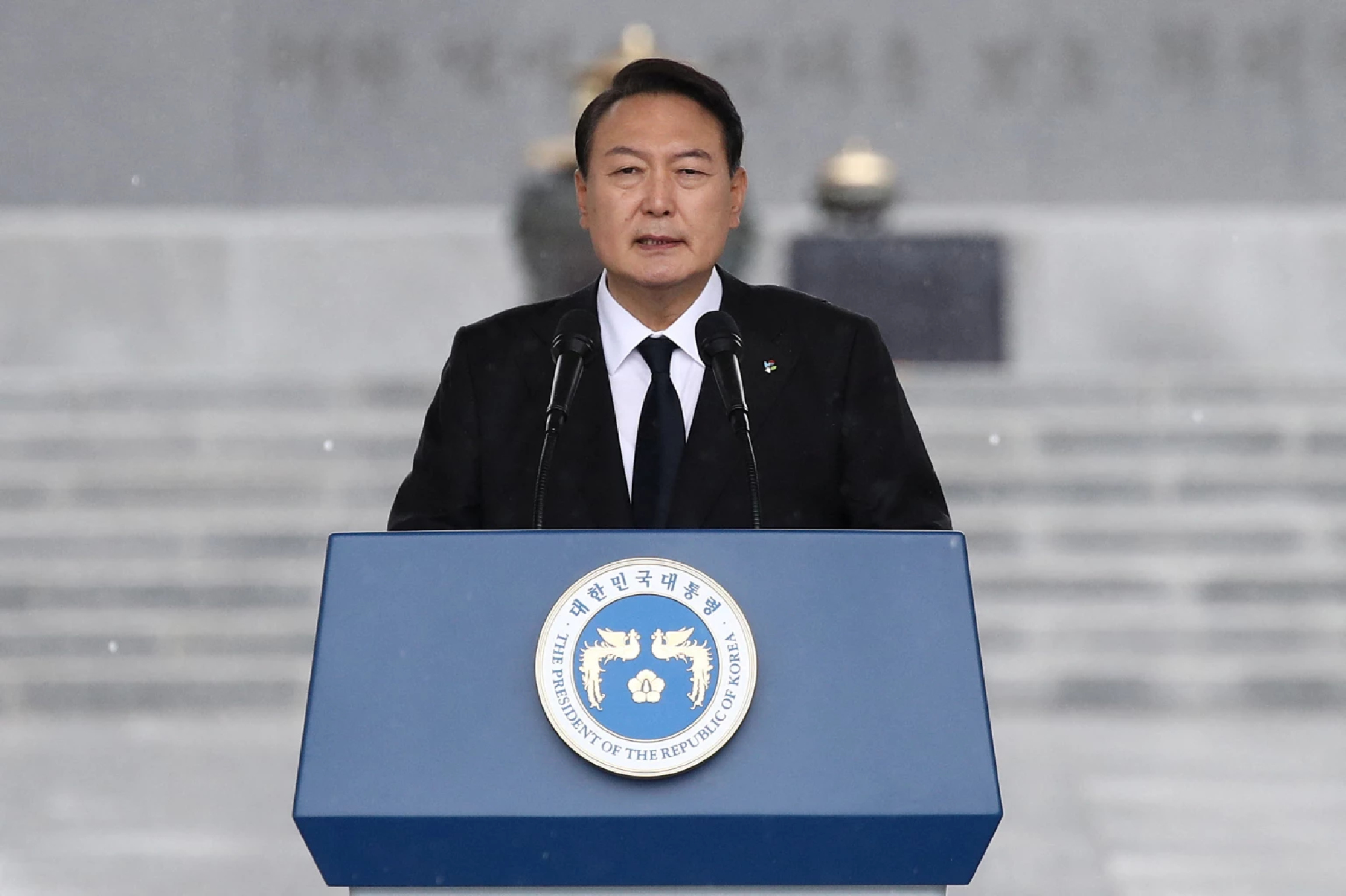
South Korea’s President Yoon Suk-yeol will face his first test in multilateral diplomacy if his visit to an upcoming Nato summit is confirmed.
South Korean president faces diplomatic tightrope walk at Nato summit

It would also provide an opportunity for him to deepen South Korea’s relationship with the US and its allies amid diplomatic pressures with China and Russia.

If Yoon participates in the Nato summit to be held in Madrid in late June, he would be the first Korean president to attend the meeting.

Nato has invited leaders from four Asia-Pacific countries — non-members South Korea, Japan, Australia and New Zealand — for the first time. It is seen as a sign of Nato aiming to strengthen relations with Asian countries to target China, which is expanding its military influence in the Indo-Pacific region.

President Yoon said on Thursday he is “preparing” to decide on whether he would attend the Nato summit in Madrid, although “it is difficult to say that [he has] confirmed it.”

Chance to mend ties with Japan?

For Yoon, one of the key points of the trip is whether to meet with Japanese Prime Minister Fumio Kishida, who is highly likely to attend the summit.

The two countries’ leaders have not talked directly for two and a half years since the Korea-China-Japan summit in Beijing in December 2019. Bilateral relations have been strained as conflicts deepened due to historical issues and Japan’s economic and trade retaliation measures in July 2019.

According to Japanese reports, Kishida is considering attending the Nato summit. South Korean Foreign Minister Park Jin is expected to visit Japan in mid-June to hold talks with Japanese Foreign Minister Yoshimasa Hayashi to discuss the possible summit.

Yoon has consistently expressed his intention to improve Korea-Japan relations since he was a presidential candidate, raising hopes of restoring the relationship.

Korea-Japan relations are currently considered to be at their worst state since diplomatic normalisation in 1965.

When asked about how he would handle wartime sexual enslavement issues at the possible Korea-Japan summit, Yoon told reporters, “We expect the issue to be resolved smoothly between Korea and Japan in terms of cooperation in the future.”

But despite his remarks, experts doubt the challenges will be solved promptly through the summit. In addition to the historical issues such as comfort women and forced labour, challenges continued to emerge in recent years. They include the Fukushima water release, Japan pushing for the Sado mine to be designated a Unesco World Heritage Site, and most recently, a marine survey around the Dokdo islets.

Professor Yuji Hosaka of Sejong University said their meeting at the Nato summit could only end up accelerating cooperation in security to deter North Korea‘s provocations.

In response to Pyongyang’s continued missile launches, the two nations held talks to strengthen their military cooperation. Defence chiefs from South Korea, the US and Japan met in Singapore on Wednesday to discuss ways to address North Korea’s provocations. The same day, the three vice foreign ministers agreed to strengthen security cooperation in response to North Korea’s sophisticated nuclear and missile threats.

“However, it seems difficult to find a solution to other issues,” professor Hosaka said. “Both show no intention of giving up on most sensitive issues.”

Earlier, Tokyo lodged a complaint against Seoul for conducting a marine survey in waters off the Dokdo islets, but the Korean government rejected a protest from Japan in late May.

According to a recent survey by Hankook Ilbo and Yomiuri Shimbun, eight out of 10 Koreans and six out of 10 Japanese people said that their country should not make concessions to the other country in the historic conflict between Korea and Japan.

Moving away from China?

Concerns have been raised that Yoon’s potential attendance could be a diplomatic burden on South Korea’s relations with China and Russia.

On June 1, US Secretary of State Antony Blinken said Nato members face challenges, including “the People’s Republic of China’s rapid militarisation, its no-limits friendship with Russia and efforts to weaken the rules-based international order that is the foundation for peace and security around the world.”

Nato secretary-general Jens Stoltenberg then said Nato should “prepare for an age of increased strategic competition with authoritarian powers like Russia and China.”

The US position is likely to become more apparent at the Nato summit. It is expected that the US intends to build a united front by gathering allies to respond to the dual threats of China and Russia at the same time.

Under the situation, “the US and Nato, China, Russia and North Korea are highly likely to interpret South Korea’s participation in the summit as bloc logic, regardless of South Korea’s intentions,” Lee Soo-hyung, a researcher at the Institute for National Security Strategy, said in a report.

“This interpretation may limit [South] Korea’s strategic position and act as a diplomatic burden on its relations with China, North Korea and Russia in the future,” he said.

China recently stepped up its rhetoric to warn about Nato and the expanding US presence in Asia.

“Nato, a military organisation in the North Atlantic, has in recent years come to the Asia-Pacific region to throw its weight around and stir up conflicts,” Wang Wenbin, a Chinese Foreign Ministry spokesman, said in late April.

South Korea has had a long-standing policy of strategic ambiguity in its dealings with the US and China. But Seoul is increasingly in a position to choose a side in the changed international situation. With the US keeping China in check for its hegemony, President Yoon has already chosen “strategic clarity”, not “strategic ambiguity”, said Chung Jae-hung, a research fellow of the Sejong Institute in South Korea.

He said that by joining the US-led economic alliance, the Indo-Pacific Economic Framework, and contemplating attending the Nato summit — both of which are aimed at checking China — South Korea has clearly shown its position between the two big powers.

“In this situation, it is not easy to maintain friendly relations with China as before. But there is also no need to make it worse considering economic relations with China,” Chung said. “While maintaining friendly relations with China, we should adapt to new changes in the international situation.”

Researcher Lee suggested that it would be better to “promote cooperation in the field of nonproliferation and cybersecurity” with the principle of promoting security cooperation with Nato in preparation for the North Korean nuclear threat “rather than the US-China competition”.

The Korea Herald

Asia News Network

Asia News Network: The Nation (Thailand), The Korea Herald, The Straits Times (Singapore), China Daily, Jakarta Post, The Star and Sin Chew Daily (Malaysia), The Statesman (India), Philippine Daily Inquirer, Yomiuri Shimbun and The Japan News, Gogo Mongolia, Dawn (Pakistan), The Island (Sri Lanka), Kuensel (Bhutan), Kathmandu Post (Nepal), Daily Star (Bangladesh), Eleven Media (Myanmar), the Phnom Penh Post and Rasmei Kampuchea (Cambodia), The Borneo Bulletin (Brunei), Vietnam News, and Vientiane Times (Laos).

Published : June 10, 2022

By : The Korea Herald

Laos-China railway transports 400,000 plus passengers over 6 months

#SootinClaimon.Com : ขอบคุณแหล่งข้อมูล : หนังสือพิมพ์ The Nation.

https://www.nationthailand.com/international/40016510


Operators of the Laos-China railway have recorded over 400,000 passengers in the past six months, while more than 600,000 tonnes of freight have been shipped across the Laos-China border.

Laos-China railway transports 400,000 plus passengers over 6 months

The railway has been a huge turning point for Laos’ international transport network and its role in freight transport is becoming increasingly important.

The Laos-China Railway Company Ltd said 410,000 people travelled on the railway and 640,000 tonnes of goods have been transported across the border between Laos and China.

Four passenger stations were operational when the railway first came into service, at Nateuy, Kasy, Meuang Nga and Namor. There are now 10 passenger stations in operation.

Another high-speed EMU train, named “Lane Xang”, and a standard train were put into service so that more passengers can be carried and they have more ticket options.

Trains run an average of six times a day, with a maximum of eight journeys a day, when a maximum of 5,000 passengers can be carried.

Tickets can now be purchased in advance of travel and ticket outlets have been installed in key cities. With more train stations and easier travel options available, more people are travelling to Vangvieng, Luang Prabang and other popular destinations.

The railway has created a convenient international transport link between China and Asean, greatly reducing the time and cost of transport.

According to the Regional Comprehensive Economic Partnership Agreement, which entered into force in January, the demand for freight transport between China and Laos is growing. As a result, freight stations have opened at South Vientiane, Nateuy, Vangvieng, Luang Prabang and Phonhong to facilitate the shipment of more goods.

Thailand is also looking into linking up via Nong Khai, though it is currently making use of the Laos-China railway to ship products to Kunming.

Vientiane Times

Asia News Network

Asia News Network: The Nation (Thailand), The Korea Herald, The Straits Times (Singapore), China Daily, Jakarta Post, The Star and Sin Chew Daily (Malaysia), The Statesman (India), Philippine Daily Inquirer, Yomiuri Shimbun and The Japan News, Gogo Mongolia, Dawn (Pakistan), The Island (Sri Lanka), Kuensel (Bhutan), Kathmandu Post (Nepal), Daily Star (Bangladesh), Eleven Media (Myanmar), the Phnom Penh Post and Rasmei Kampuchea (Cambodia), The Borneo Bulletin (Brunei), Vietnam News, and Vientiane Times (Laos).

Published : June 10, 2022

By : Vientiane Times

Marcos Jr can travel to US as head of state, says top official

#SootinClaimon.Com : ขอบคุณแหล่งข้อมูล : หนังสือพิมพ์ The Nation.

https://www.nationthailand.com/international/40016509


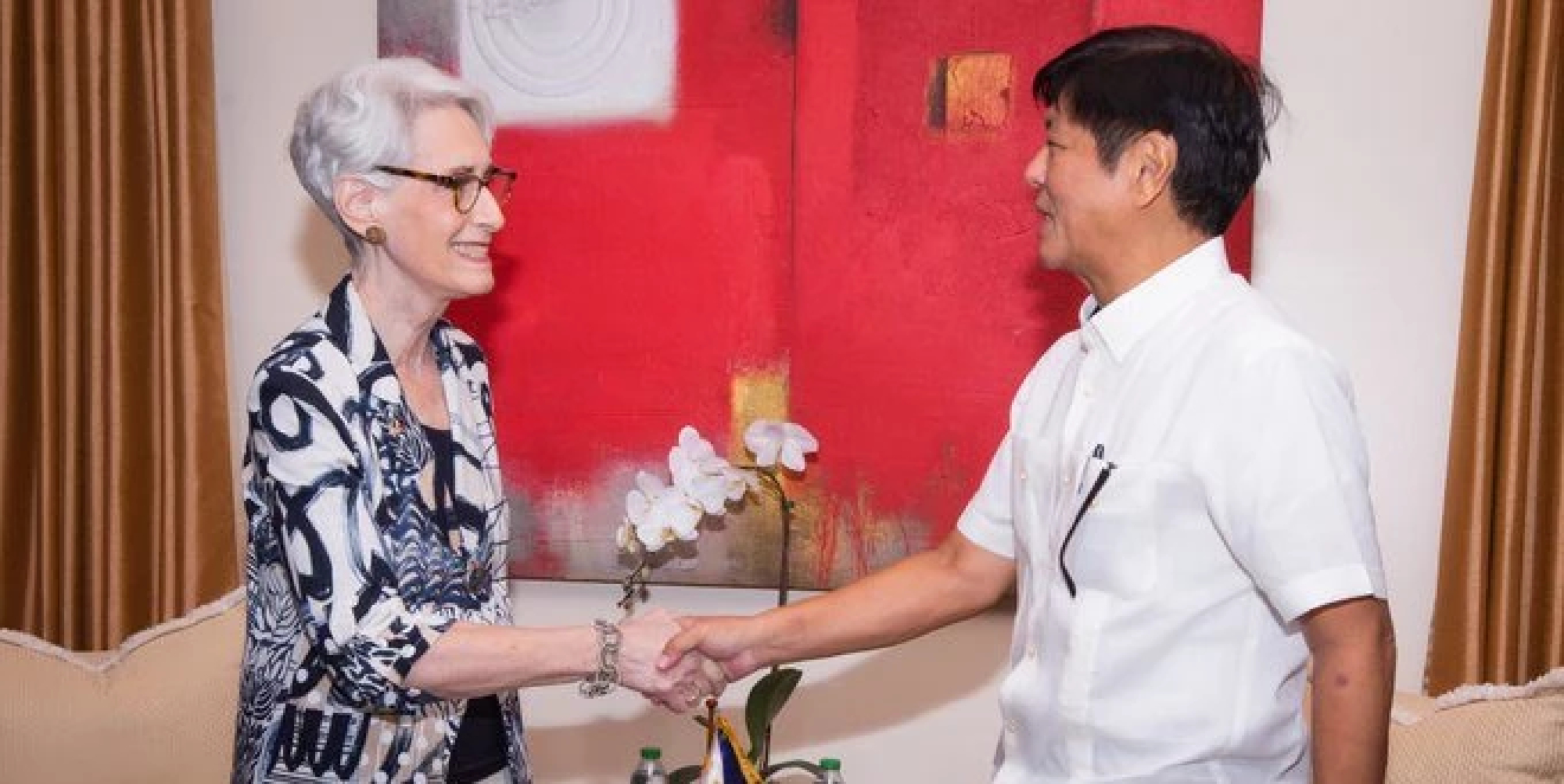
President-elect Ferdinand Marcos Jr would be “welcome” to the United States given his diplomatic immunity as a head of state, a top Washington diplomat pointed out on Thursday.

Marcos Jr can travel to US as head of state, says top official

“The fact is, when you’re a head of state, you have immunity in all circumstances and are welcome to the United States in your official role,” US Deputy Secretary of State Wendy Sherman told reporters in a roundtable discussion in Pasay City when asked on the matter.

Before this, she capped off a day of meetings with Philippine officials, including Marcos Jr and outgoing Foreign Secretary Teodoro Locsin Jr.

In 2012, a US Court of Appeals for the 9th Circuit handed down a contempt judgment against Marcos Jr, his mother Imelda, and the estate of Ferdinand Marcos Sr for violating an injunction that barred them from dissipating assets of the estate.

The contempt order came after the Marcoses entered into a settlement with the Ramos administration in 1992 and agreed to share their wealth with the Philippines government. It was considered a violation of the 1991 decision of the US District Court of Hawaii prohibiting the Marcos family from touching their US assets because these were the source of potential payment of damages to the human rights victims of martial law.

Thousands of martial law victims won a class-action lawsuit for human rights violations against the estate of Marcos Sr in Hawaii in 1986, where they were awarded close to US$2 billion.

The contempt award also meant that the Marcoses would not be allowed to set foot on any US territory.

This issue was earlier raised during the first press conference of Marcos Jr’s then-campaign spokesperson Victor Rodriguez. A reporter had asked how the then-presumptive president, as the country’s top diplomat, could travel to the United States given the contempt order, but Rodriguez ignored this and subsequent questions about the issue.

Sherman also stressed the “robust” relations between Manila and Washington, which spans 75 years.

She met with Marcos Jr earlier on Thursday and had a “positive” and “productive” meeting where they discussed a wide range of topics, including ensuring freedom of navigation in the South China Sea and human rights.

So far, Sherman is the highest US official that Marcos Jr has met since his proclamation as the country’s president.

“The friendship between the United States and the Philippines runs deep. And so, too, does our shared commitment to upholding and strengthening the rules-based international order,” Sherman told reporters.

“The Philippines has been a leader and a champion for upholding freedom of navigation in the South China Sea in the face of increasing encroachments,” she said.

“The United States remains committed to standing with the government of the Philippines to uphold the rules and laws underpinning the international maritime order, and we have spoken up against infringements of the Philippines’ sovereign rights.”

Sherman said she was pleased to meet Marcos as part of her 10-day Asian swing that includes South Korea, Vietnam and Laos.

Philippine Daily Inquirer

Asia News Network

Asia News Network: The Nation (Thailand), The Korea Herald, The Straits Times (Singapore), China Daily, Jakarta Post, The Star and Sin Chew Daily (Malaysia), The Statesman (India), Philippine Daily Inquirer, Yomiuri Shimbun and The Japan News, Gogo Mongolia, Dawn (Pakistan), The Island (Sri Lanka), Kuensel (Bhutan), Kathmandu Post (Nepal), Daily Star (Bangladesh), Eleven Media (Myanmar), the Phnom Penh Post and Rasmei Kampuchea (Cambodia), The Borneo Bulletin (Brunei), Vietnam News, and Vientiane Times (Laos).

Published : June 10, 2022

By : Philippine Daily Inquirer

China’s coastal areas face increasing risks from rising sea levels

#SootinClaimon.Com : ขอบคุณแหล่งข้อมูล : หนังสือพิมพ์ The Nation.

https://www.nationthailand.com/international/40016501


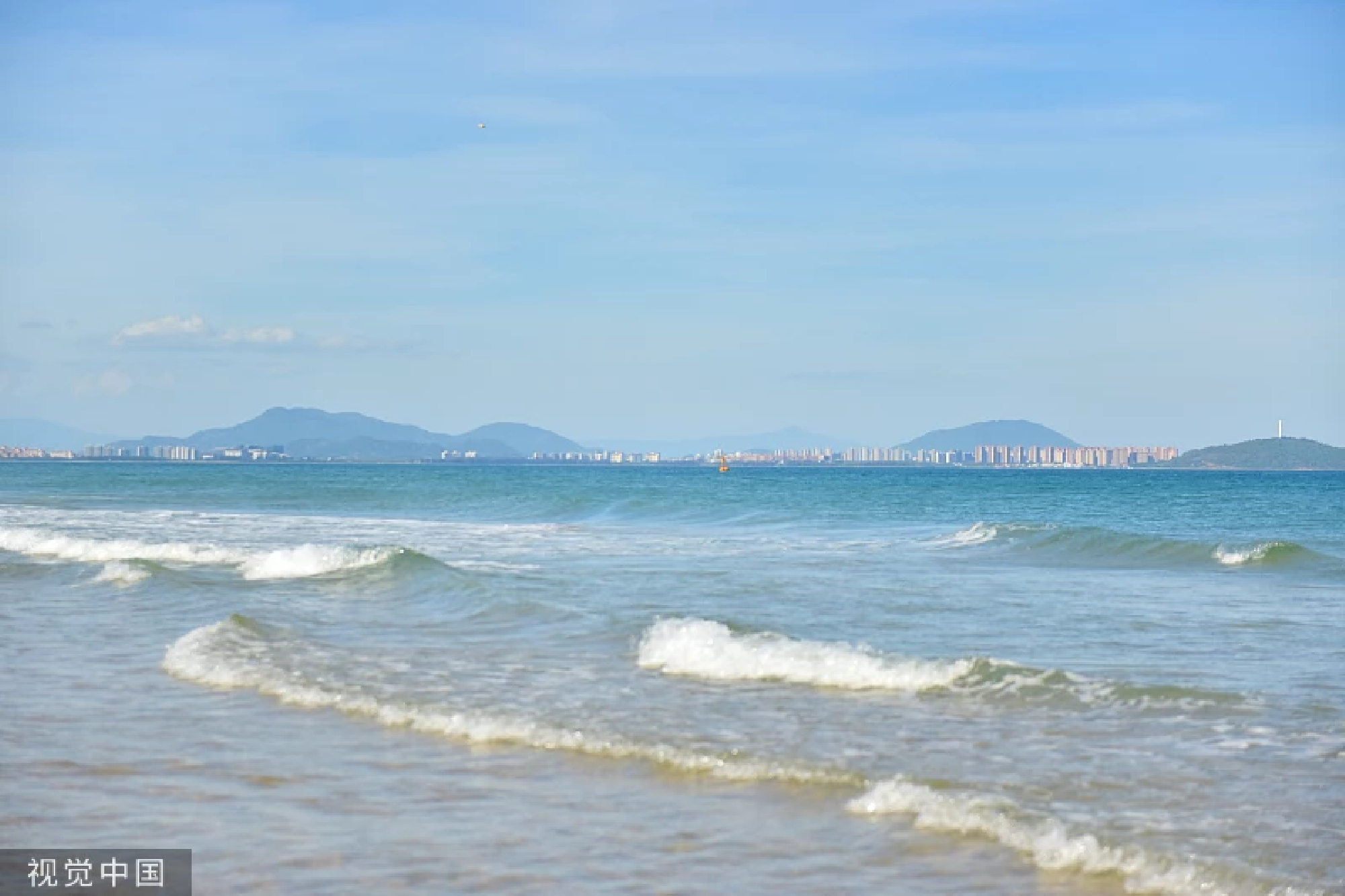
China’s coastal sea level will rise by 68 to 170 millimetres over the next 30 years, and coastal regions face growing threats from rising sea levels, according to a bulletin by the Ministry of Natural Resources.

China's coastal areas face increasing risks from rising sea levels

Last year, the country saw its highest coastal sea level since 1980, which has been 84 mm higher than that of normal years. The coastal sea level rose at an average rate of 3.4 mm per year from 1980 to 2021, more than the global average over the same period, according to the bulletin.

With accelerated urbanization, China’s coastal areas face increasing risks from the rising sea level, said the bulletin.

The accelerated rise of coastal sea level is largely due to global warming, which has led to the expansion of seawater, and the melting of glaciers and polar ice caps.

Rising sea levels magnify the impact of marine disasters. Last year, China’s storm surges and flooding in coastal regions mainly occurred between July and October as this period saw higher sea levels.

The report called for more efforts to prevent marine disasters and mitigate the impacts of rising sea levels.

According to an assessment by the Intergovernmental Panel on Climate Change, the global mean sea level could rise by 2 meters by 2100 and by 5 meters by 2150 under a worst-case scenario.

China Daily

Asia News Network

Asia News Network: The Nation (Thailand), The Korea Herald, The Straits Times (Singapore), China Daily, Jakarta Post, The Star and Sin Chew Daily (Malaysia), The Statesman (India), Philippine Daily Inquirer, Yomiuri Shimbun and The Japan News, Gogo Mongolia, Dawn (Pakistan), The Island (Sri Lanka), Kuensel (Bhutan), Kathmandu Post (Nepal), Daily Star (Bangladesh), Eleven Media (Myanmar), the Phnom Penh Post and Rasmei Kampuchea (Cambodia), The Borneo Bulletin (Brunei), Vietnam News, and Vientiane Times (Laos).

Published : June 10, 2022

By : China Daily

Combined riches of Malaysian tycoons down 10%

#SootinClaimon.Com : ขอบคุณแหล่งข้อมูล : หนังสือพิมพ์ The Nation.

https://www.nationthailand.com/international/40016500


The combined wealth of tycoons on the 2022 Forbes list of Malaysia’s 50 richest fell 10% from a year ago to US$80.5bil (RM353.7bil)

Combined riches of Malaysian tycoons down 10%

Overall, the 30 tycoons on the list saw their wealth decline, according to a statement from Forbes Asia.

The collective wealth of the country’s five rubber glove tycoons took a nosedive, falling more than US$5.7bil (RM25.04bil) as the share prices of glove stocks return to pre-pandemic levels.

The Kuok Group founder Robert Kuok held on to his long-standing top spot in the richest list even though his fortune dropped to US$11bil (RM48.3bil) from US$12.2bil (RM53.6bil) last year.

Tan Sri Quek Leng Chan, chairman of Hong Leong Group, was the biggest gainer in dollar terms and consolidated his position as Malaysia’s second-richest person with a wealth of US$10.1bil (RM44.4bil).

He added US$500mil (RM2.2bil) to his net worth of US$9.6bil (RM42.2bil) last year.

Tan Sri Koon Poh Keong and his siblings, who control aluminium giant Press Metal Aluminium Holdings Bhd, remained in the third position with US$6.2bil (RM27.2bil), nearly flat from a year ago.

Public Bank Bhd founder and chairman Tan Sri Teh Hong Piow is at No. 4 with a net worth of US$5.7bil (RM25.04bil) and Ananda Krishnan at fifth with a net worth of US$5bil (RM21.9bil).

Forbes Asia said Malaysia’s rubber glove makers, who were among last year’s biggest winners, faced a stark reality check.

The demand for personal protective gear sank as the pandemic abated, knocking down shares of their companies.

The wealth of Kuan Kam Hon of Hartalega Holdings Bhd (No. 11, US$1.9bil or RM8.3bil) and Top Glove Corp Bhd executive chairman Tan Sri Lim Wee Chai (No.14, US$1.4bil or RM6.2bil) fell the most in US dollar terms.

Supermax Corp Bhd Datuk Seri Stanley Thai and his wife Datin Seri Cheryl Tan (No. 45) saw the biggest percentage drop in their wealth, which shrank by more than two-thirds to US$340mil (RM1.5bil).

The collective wealth of this group of five, which includes Kossan Rubber Industries Bhd founder Tan Sri Lim Kuang Sia (No. 24, US$740mil or RM3.3bil) and Wong Teek Son of Riverstone Holdings Ltd (No. 30, US$565mil or RM2.5bil), dropped more than US$5.7bil (RM25.04bil).

Forbes Asia also noted that Indonesia’s temporary ban on edible oil exports amid a drop in Malaysia’s palm oil production had resulted in windfall gains for tycoons in that sector.

The fortune shared by US-educated brothers Tan Sri Lee Oi Hian and Datuk Lee Hau Hian (No. 12, US$1.6bil or RM7.03bil) got a boost of more than a third as shares of their company Batu Kawan Bhd and its plantation subsidiary Kuala Lumpur Kepong Bhd soared on rising profits.

Tan Sri Ling Chiong Ho (No. 36, US$425mil or RM1.9bil), one of two returnees this year, makes his comeback after a four-year gap as shares of Sarawak Oil Palm Bhd, the flagship of his Shin Yang group, rallied.

The March listing of dairy producer Farm Fresh propelled Loi Tuan Ee (No. 43), who shares a US$380mil (RM1.7bil) fortune with two siblings, into the list for the first time.

The company, which Loi and his brother Tuan Kin started in 2007 and which went on to get the backing of Khazanah Nasional Bhd, has five dairy farms in Malaysia and one in Australia.

The minimum net worth to make the list was US$255mil (RM1.12bil), down from US$315mil (RM1.4bil) in 2021, Forbes said.

The complete list can be found at http://www.forbes.com/malaysia as well as in the June issue of Forbes Asia.

The top 10 richest in Malaysia are:

1. Robert Kuok; US$11bil (RM48.3bil)

2. Tan Sri Quek Leng Chan; US$10.1bil (RM44.4bil)

3. Tan Sri Koon Poh Keong and siblings; US$6.2bil (RM27.3bil)

4. Tan Sri Teh Hong Piow; US$5.7bil (RM25.06bil)

5. T. Ananda Krishnan; US$5bil (RM21.9bil)

6. Datuk Lee Yeow Chor and Lee Yeow Seng; US$4.8bil (RM21.1bil)

7. Tan Sri Chen Lip Keong; US$2.7bil (RM11.9bil)

8. Tan Yu Yeh and Tan Yu Wei; US$2.4bil (RM10.6bil)

9. Tan Sri Lim Kok Thay; US$2.35bil (RM10.3bil)

10. Tan Sri Lau Cho Kun; US$2bil (RM8.8bil).

The Star

Asia News Network: The Nation (Thailand), The Korea Herald, The Straits Times (Singapore), China Daily, Jakarta Post, The Star and Sin Chew Daily (Malaysia), The Statesman (India), Philippine Daily Inquirer, Yomiuri Shimbun and The Japan News, Gogo Mongolia, Dawn (Pakistan), The Island (Sri Lanka), Kuensel (Bhutan), Kathmandu Post (Nepal), Daily Star (Bangladesh), Eleven Media (Myanmar), the Phnom Penh Post and Rasmei Kampuchea (Cambodia), The Borneo Bulletin (Brunei), Vietnam News, and Vientiane Times (Laos).

Published : June 10, 2022

By : The Star

The latest news on what’s happening in the region

#SootinClaimon.Com : ขอบคุณแหล่งข้อมูล : หนังสือพิมพ์ The Nation.

https://www.nationthailand.com/international/40016482


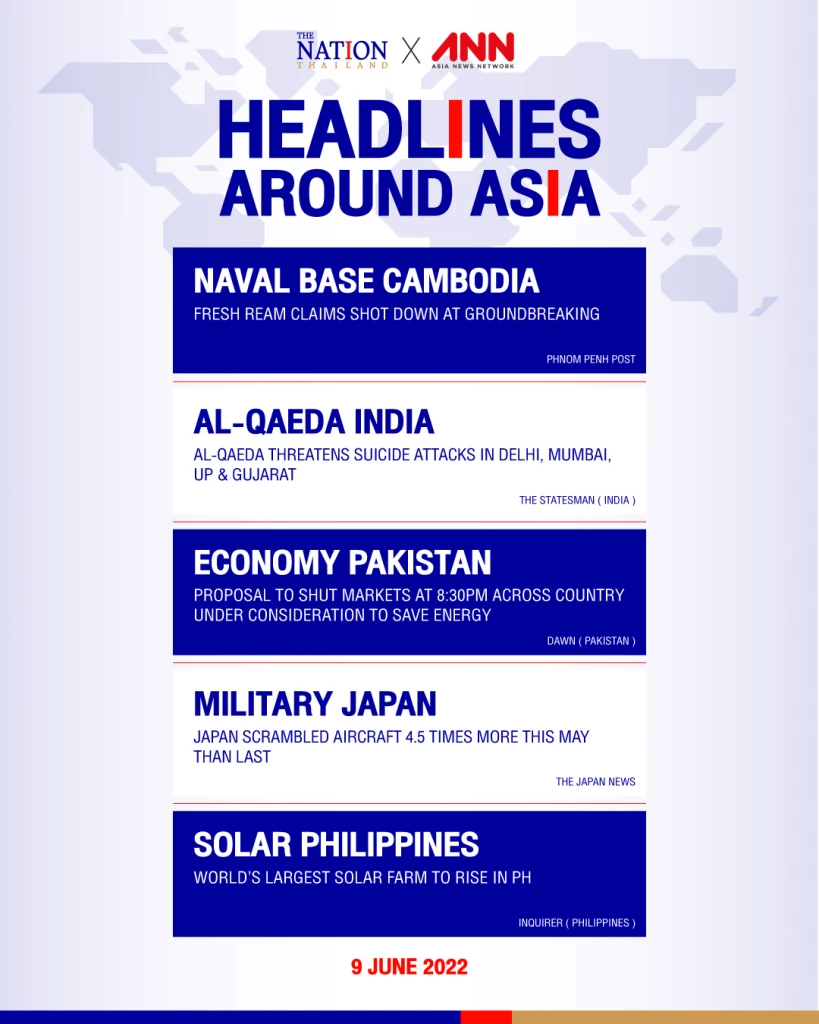
Check out what’s hot in the region on June 8 as The Nation puts together headlines from members of Asia News Network (ANN). Click to read more:

The latest news on what's happening in the region

Naval Base Cambodia

Fresh Ream claims shot down at groundbreaking

Phnom Penh Post
https://www.nationthailand.com/international/40016460

Al-Qaeda India

Al-Qaeda threatens suicide attacks in Delhi, Mumbai, UP & Gujarat 

The Statesman ( India )
https://www.nationthailand.com/international/40016474

Economy Pakistan

Proposal to shut markets at 8:30pm across country under consideration to save energy

Dawn ( Pakistan )
https://www.nationthailand.com/international/40016477

Military Japan
Japan scrambled aircraft 4.5 times more this May than last 

The Japan News
https://www.nationthailand.com/international/40016471


Solar Philippines
World’s largest solar farm to rise in PH 

Inquirer ( Philippines )
https://www.nationthailand.com/international/40016462

Asia News Network: The Nation (Thailand), The Korea Herald, The Straits Times (Singapore), China Daily, Jakarta Post, The Star and Sin Chew Daily (Malaysia), The Statesman (India), Philippine Daily Inquirer, Yomiuri Shimbun and The Japan News, Gogo Mongolia, Dawn (Pakistan), The Island (Sri Lanka), Kuensel (Bhutan), Kathmandu Post (Nepal), Daily Star (Bangladesh), Eleven Media (Myanmar), the Phnom Penh Post and Rasmei Kampuchea (Cambodia), The Borneo Bulletin (Brunei), Vietnam News, and Vientiane Times (Laos).

Published : June 09, 2022

By : THE NATION

Proposal to shut markets at 8.30pm across Pakistan under consideration

#SootinClaimon.Com : ขอบคุณแหล่งข้อมูล : หนังสือพิมพ์ The Nation.

https://www.nationthailand.com/international/40016477


A recommendation to close markets at 8.30pm across Pakistan in an effort to conserve energy came under discussion on Wednesday during a meeting of the freshly reconstituted National Economic Council (NEC).

Proposal to shut markets at 8.30pm across Pakistan under consideration

Prime Minister Shehbaz Sharif chaired the meeting, which was attended by the chief ministers of Sindh, Punjab and Balochistan. Khyber Pakhtunkhwa Chief Minister Mahmood Khan did not attend the meeting while chief secretary Shehzad Bangash represented the province.

According to a handout issued after the meeting, all four provinces agreed in principle on the proposal to close down markets by 8.30pm. However, the chief ministers of Sindh, Balochistan and Punjab sought two days to consult trade bodies and business communities in their respective provinces.

During the meeting, the chief ministers were consulted on the national strategy for tackling the energy crisis. The participants were also informed about the federal cabinet’s decisions and proposals for conserving energy, the statement said.

However, KP Finance Minister Taimur Khan Jhagra said on Twitter that the province had not agreed to close its markets.

Meanwhile, Minister for Power Khurram Dastgir said the government had planned a number of measures to conserve energy, including two weekly offs and work-from-home on one day of the week. He also said the government was taking practical steps to address the energy crisis.

The minister said inefficient and expensive power plants would be gradually phased out.

He said the country’s total power generation was 22,010MW while the demand was 26,227MW, adding that the shortfall stood at more than 4,000MW on June 7.

The minister said the government had decided that power plants which used imported fuel would no longer be set up. Massive investment will be carried out in the solar energy sector in order to increase its output to 10,000MW, he added.

The decision comes as Pakistan is currently facing an energy shortfall, with parts of the country witnessing hours-long load-shedding.

A day earlier, the federal cabinet decided that priority would be given to holding government meetings virtually till an energy conservation plan was approved. The cabinet also decided to cut the consumption of utilities at the government level and in offices by 10 per cent.

Earlier this month, Defence Minister Khawaja Asif suggested taking advantage of “365 days of sunshine” and operating markets during the day as opposed to the convention of “opening markets at 1pm and closing them at 1am”.

Dawn

Asia News Network

Asia News Network: The Nation (Thailand), The Korea Herald, The Straits Times (Singapore), China Daily, Jakarta Post, The Star and Sin Chew Daily (Malaysia), The Statesman (India), Philippine Daily Inquirer, Yomiuri Shimbun and The Japan News, Gogo Mongolia, Dawn (Pakistan), The Island (Sri Lanka), Kuensel (Bhutan), Kathmandu Post (Nepal), Daily Star (Bangladesh), Eleven Media (Myanmar), the Phnom Penh Post and Rasmei Kampuchea (Cambodia), The Borneo Bulletin (Brunei), Vietnam News, and Vientiane Times (Laos).

Published : June 09, 2022

By : DAWN

India on security alert after al-Qaeda threat of suicide attacks

#SootinClaimon.Com : ขอบคุณแหล่งข้อมูล : หนังสือพิมพ์ The Nation.

https://www.nationthailand.com/international/40016474


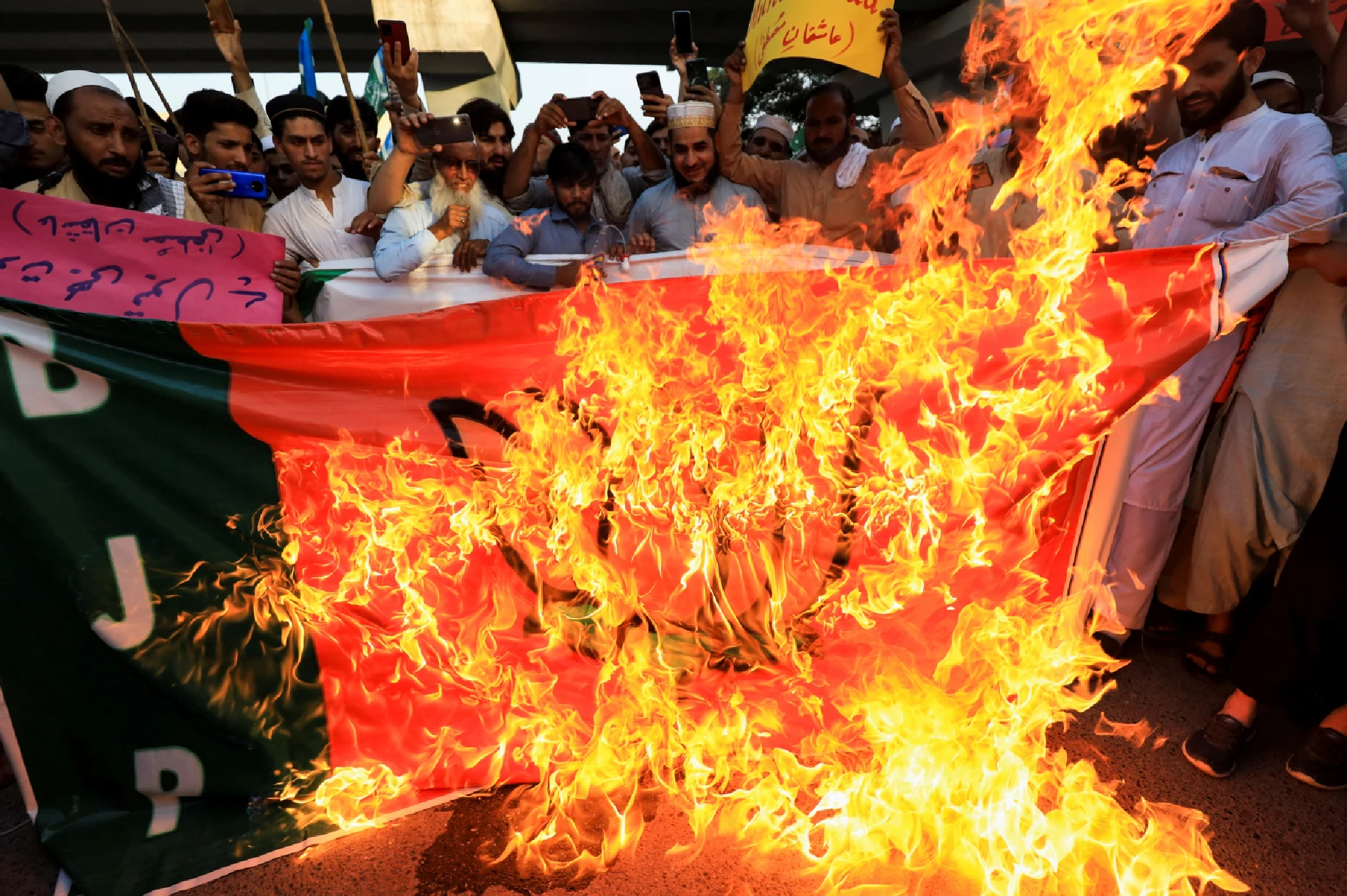
Al-Qaeda in Indian Subcontinent (AQIS) has threatened to carry out “suicide bombings” in Delhi, Mumbai, Uttar Pradesh, and Gujarat to take revenge for the ”insult” of Prophet Muhammad by two now-suspended functionaries of the ruling Bharatiya Janata Party (BJP).

India on security alert after al-Qaeda threat of suicide attacks

In a threat letter dated June 6, al-Qaeda said it would launch suicide attacks to “fight for the honour of the Prophet”.

Central agencies are “seriously” looking into the threat letter sent by the terror outfit, agency sources said.

Alerts have been issued across these places through law enforcement agencies to tighten the vigil at specific locations like airports, metro, railway stations, and market areas, said a source privy to the development.

“Security personnel have been instructed to report to the concerned department soon after noticing any suspicious activity,” the agency said.

“The saffron terrorists should now await their end in Delhi, Bombay, UP, and Gujarat. They should find refuge neither in their homes nor in their fortified army cantonments,” a threat letter by the AQIS read.

It said that the “hearts of Muslims all over the world are bleeding” and they were filled with the feeling of revenge and retribution.

The letter also mentioned Ghazwa-e-Hind — the battle for India — which spoke about the victory of Muslims in the country. “At the same time, we bring tidings of death and destruction to the rulers of India, of executions and hangings, of imprisonment and being bound with chains,” read the letter.

The letter follows the controversy that has erupted after two BJP leaders allegedly made remarks against Prophet Muhammad.

On June 5, the BJP suspended its spokesperson Nupur Sharma and expelled media in-charge Naveen Jindal over the remarks. The party issued a statement emphasising its intolerance for disrespect of any religious personality.

The controversial statement made by Sharma set off an international furore.

Several Muslim nations, including Afghanistan, Pakistan, Saudi Arabia, the UAE, Qatar, Kuwait, Bahrain, Indonesia, and Iran, as well as the Organisation of Islamic Cooperation (OIC) have officially protested their statements and demanded an apology.

India, meanwhile, has maintained that the views belong to a few fringe elements only and do not represent those of the government of India.

India also “categorically rejected” as “unwarranted and narrow-minded” the OIC statement slamming India

Meanwhile, suspended BJP spokesperson Sharma was provided security by the Delhi police in the wake of death threats she has received over her controversial remarks.

The Statesman

Asia News Network

Asia News Network: The Nation (Thailand), The Korea Herald, The Straits Times (Singapore), China Daily, Jakarta Post, The Star and Sin Chew Daily (Malaysia), The Statesman (India), Philippine Daily Inquirer, Yomiuri Shimbun and The Japan News, Gogo Mongolia, Dawn (Pakistan), The Island (Sri Lanka), Kuensel (Bhutan), Kathmandu Post (Nepal), Daily Star (Bangladesh), Eleven Media (Myanmar), the Phnom Penh Post and Rasmei Kampuchea (Cambodia), The Borneo Bulletin (Brunei), Vietnam News, and Vientiane Times (Laos).

Published : June 09, 2022

By : The Statesman

Japan scrambled aircraft 4.5 times more this May than last

#SootinClaimon.Com : ขอบคุณแหล่งข้อมูล : หนังสือพิมพ์ The Nation.

https://www.nationthailand.com/international/40016471


As more foreign military aircraft seemingly threaten to intrude into Japan’s airspace, the country’s Air Self-Defence Force scrambled fighter jets on 119 occasions in May, about four-and-a-half times more than the 26 cases in the same month last year.

Japan scrambled aircraft 4.5 times more this May than last

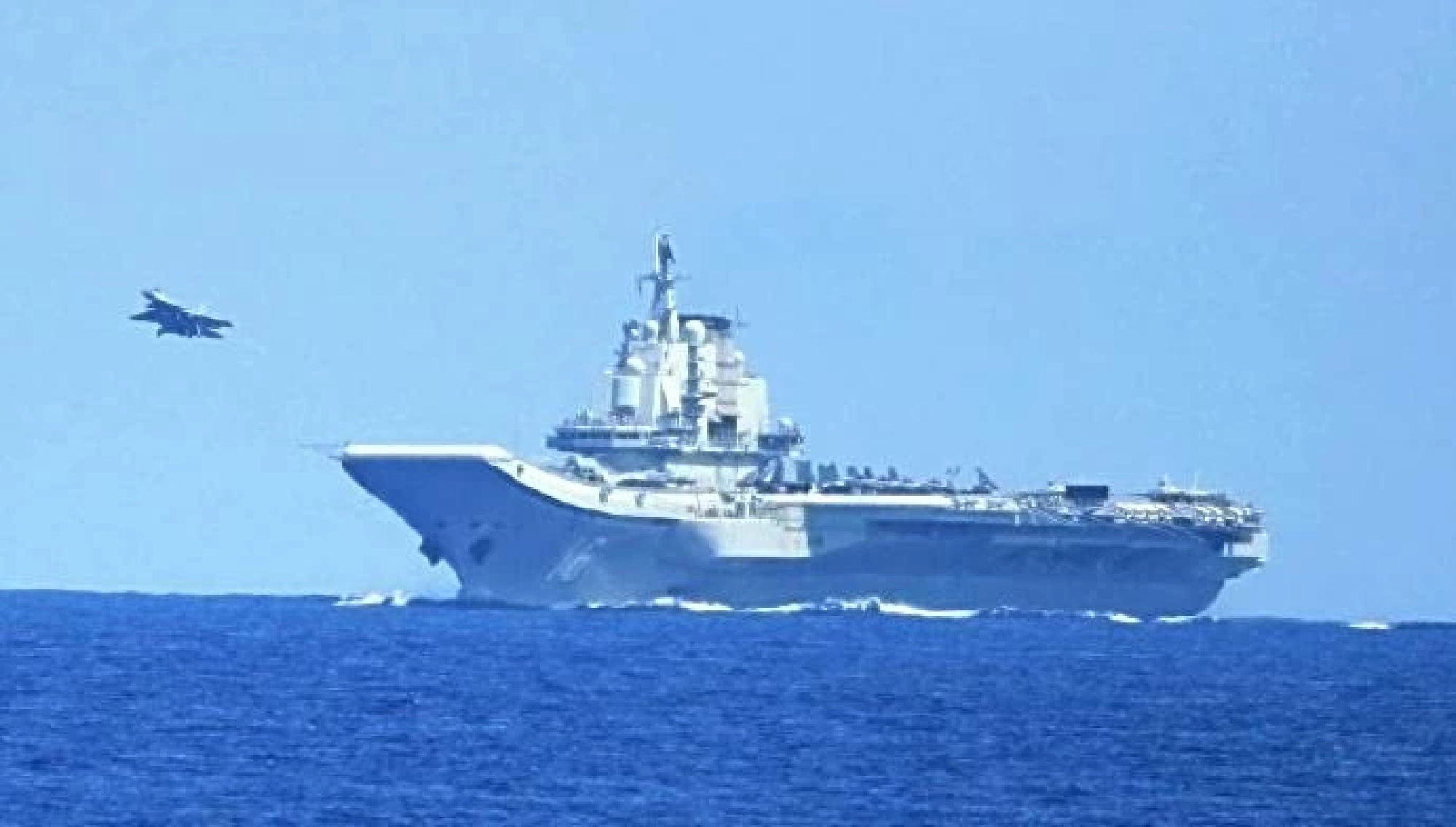
Japan’s Defence Ministry said on Tuesday that this number was inflated by responses to China’s exercises of fighter jets and helicopters with the Liaoning aircraft carrier in the Pacific. China conducted over 300 takeoffs and landings with the Liaoning off Okinawa in May.

On May 24, Chinese and Russian bombers jointly flew over the Sea of Japan and the Pacific for the first time since Russia’s invasion of Ukraine.

According to the Joint Staff of the Defence Ministry, ASDF fighter jets scrambled 93 times to intercept Chinese warplanes, an increase from 20 cases in the same month last year. The remaining 26 scrambles were to intercept Russian military aircraft, up from six cases in May 2021.

Nearly 70 per cent of the scrambles, or 81 cases, involved the Southwestern Air Defence Force that oversees Okinawa and the Nansei Islands, the island chain between Kyushu and Taiwan.

The Japan News

Asia News Network

Asia News Network: The Nation (Thailand), The Korea Herald, The Straits Times (Singapore), China Daily, Jakarta Post, The Star and Sin Chew Daily (Malaysia), The Statesman (India), Philippine Daily Inquirer, Yomiuri Shimbun and The Japan News, Gogo Mongolia, Dawn (Pakistan), The Island (Sri Lanka), Kuensel (Bhutan), Kathmandu Post (Nepal), Daily Star (Bangladesh), Eleven Media (Myanmar), the Phnom Penh Post and Rasmei Kampuchea (Cambodia), The Borneo Bulletin (Brunei), Vietnam News, and Vientiane Times (Laos).

Published : June 09, 2022

By : The Japan News

World’s largest solar farm to rise in Philippines

#SootinClaimon.Com : ขอบคุณแหล่งข้อมูล : หนังสือพิมพ์ The Nation.

https://www.nationthailand.com/international/40016462


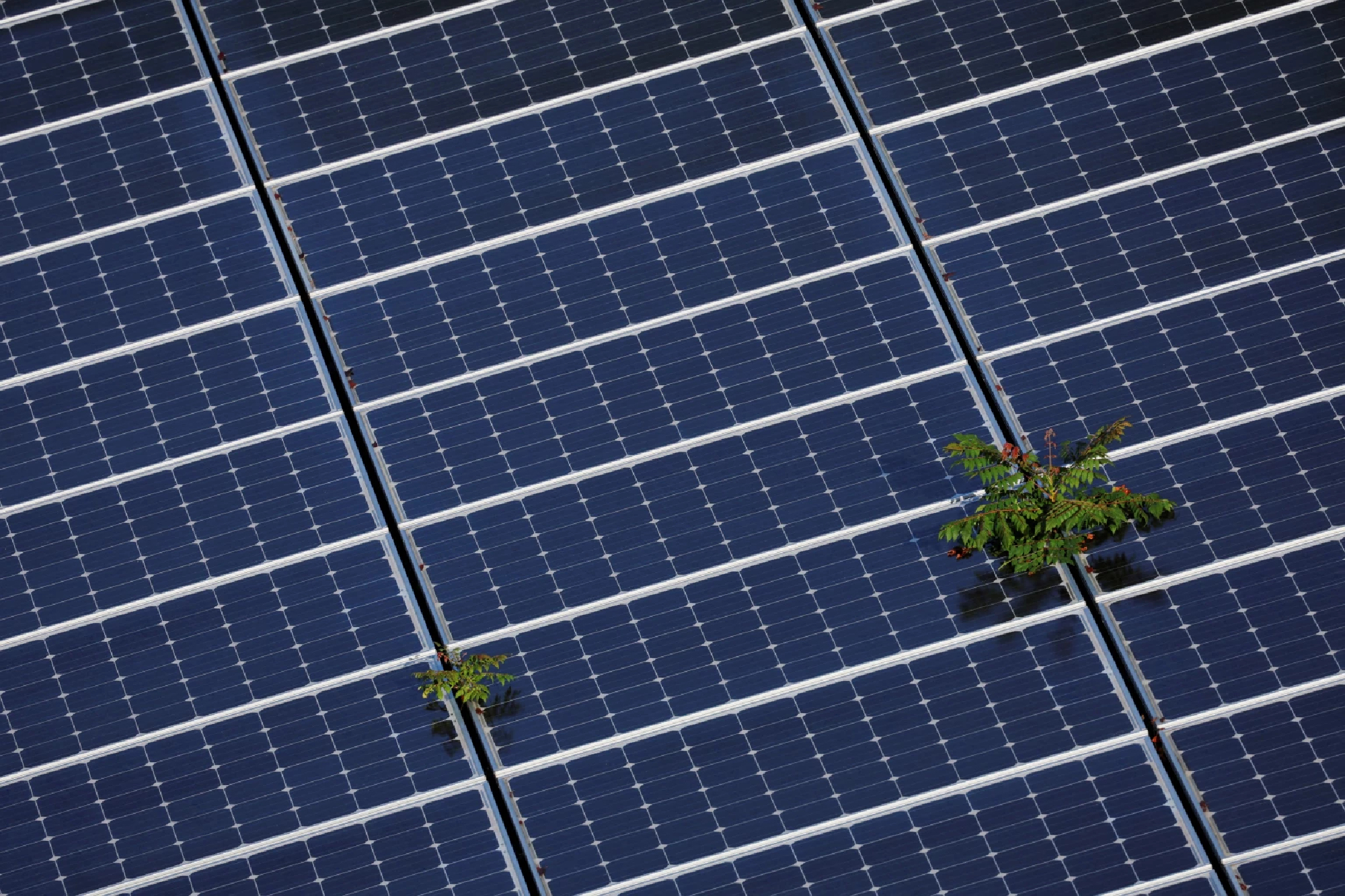
Businessman Enrique Razon Jr. wants to put up the world’s largest solar power facility in the Philippines with a capacity of 2,500 to 3,500 megawatts, along with a massive battery energy storage system.

World’s largest solar farm to rise in Philippines

Razon’s infrastructure arm Prime Infrastructure Holdings Inc. said in a statement on Wednesday that it would boost the country’s supply of renewable energy, which would also be used to provide power to Manila Electric Company (Meralco). The battery storage system is envisioned to have a capacity of 4,000 to 4,500 MW per hour.

The project will be undertaken by Terra Solar Philippines, a unit of Terra Renewables Holdings Inc., which is a renewable power subsidiary under Prime Infra’s control and in partnership with Solar Philippines Power Project Holdings Inc., which is led by businessman Leandro Leviste.

From this power facility, Terra Solar will supply 850 MW to offtaker Meralco. Prime Infra said 600 MW would be available by 2026, while the additional 250 MW will be delivered in 2027.

According to Terra Solar’s projection, the 850-MW supply can displace an annual consumption of around 1.4 million tons of coal or 930,000 litres of oil. This means a reduction in both greenhouse gas emissions and import dependency for the country from 2026 to 2046.

‘Critical’ infrastructure

“Prime Infra finds a sweet spot to pursue solar as we take advantage of the steep decline in installation costs over the past decade and the improved battery energy storage system technology that allows us to build an economically critical and socially relevant infrastructure at a scale the world has never seen before,” said Guillaume Lucci, president and chief executive officer of Prime Infra.

Prime Infra said this development would be a boon to Meralco, which will increase its renewable energy sourcing as mandated by the Department of Energy’s Renewable Portfolio Standards.

The Terra Solar project is a model of “dependable” renewable energy, which represents stable pricing not subject to fuel imports volatility for the rest of its 20-year contract, according to Prime Infra.

Philippine Daily Inquirer

Asia News Network

Asia News Network: The Nation (Thailand), The Korea Herald, The Straits Times (Singapore), China Daily, Jakarta Post, The Star and Sin Chew Daily (Malaysia), The Statesman (India), Philippine Daily Inquirer, Yomiuri Shimbun and The Japan News, Gogo Mongolia, Dawn (Pakistan), The Island (Sri Lanka), Kuensel (Bhutan), Kathmandu Post (Nepal), Daily Star (Bangladesh), Eleven Media (Myanmar), the Phnom Penh Post and Rasmei Kampuchea (Cambodia), The Borneo Bulletin (Brunei), Vietnam News, and Vientiane Times (Laos).

Published : June 09, 2022

By : Philippine Daily Inquirer