UN rights chief urges China to review Xinjiang counter-terrorism practices

#SootinClaimon.Com : ขอบคุณแหล่งข้อมูล : หนังสือพิมพ์ The Nation.

https://www.nationthailand.com/international/40016073


The United Nations human rights chief is calling on China to review all its counter-terrorism measures in Xinjiang, and ensure they are in line with international standards and not applied “in an arbitrary and discriminatory way”.
UN rights chief urges China to review Xinjiang counter-terrorism practices

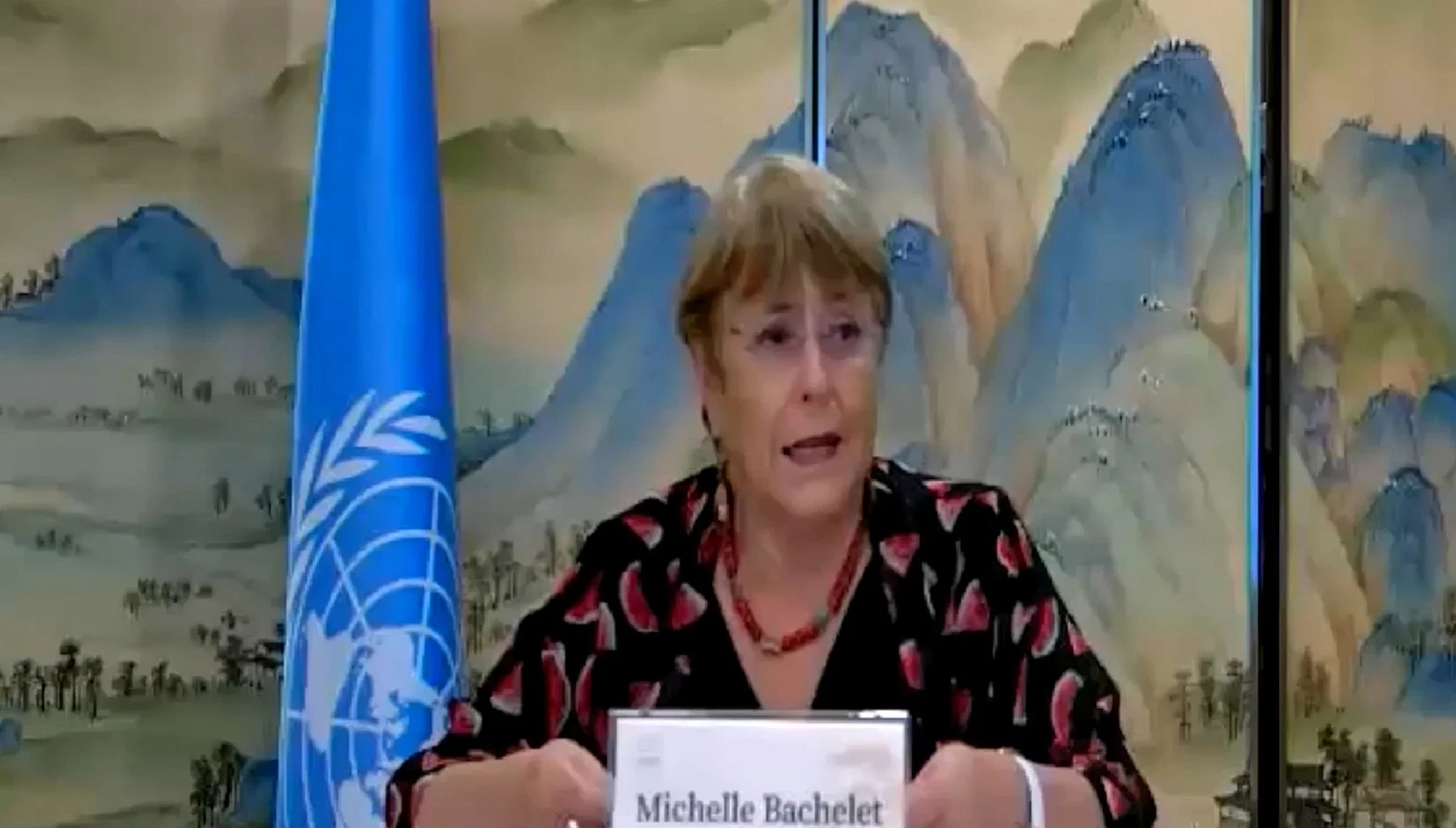
Wrapping up her six-day official visit to the country – the first by a UN human rights high commissioner in 17 years, Michelle Bachelet said on Saturday that while violent acts of extremism have a significant impact on the lives and safety of the community, it is critical that responses do not violate human rights.

“The application of relevant laws and policies, and any mandatory measures imposed on individuals, need to be subject to independent judicial oversight, with greater transparency of judicial proceedings,” she told reporters via a video link from Guangzhou.

“All victims must be able to seek redress.”

‘Deradicalisation’ camps

Bachelet had gone to Kashgar and Urumqi in China’s western Xinjiang province, where more than a million Uyghurs and other Muslim minorities had supposedly been held in detention camps to be deradicalised.

Beijing says these are vocational education and training centres (VETCs), and all participants had graduated by 2019.

The UN rights chief said she had been assured by the authorities that these camps had been dismantled.

“While I am unable to assess the full scale of the VETCs, I raised with the government the lack of independent judicial oversight of the operation of the programme, the reliance by law enforcement officials on 15 indicators to determine tendencies towards violent extremism, allegations of the use of force and ill-treatment in institutions, and reports of unduly severe restrictions on legitimate religious practices,” she said.

She did not elaborate on what those indicators are.

Bachelet’s visit had been shadowed by nagging doubts about the level of access she would receive, especially since she would be travelling within a closed-loop bubble to prevent the spread of Covid-19. No media accompanied her.

Choreographed tour

Last Monday, during her video call with diplomats, United States Ambassador to China Nicholas Burns and some others expressed concern that she would be led on a highly controlled and choreographed tour by Beijing.

The US had called her visit under such conditions “a mistake”.

Bachelet stressed that her trip was not an investigation, as official visits by a high commissioner are high profile and not conducive to the kind of detailed and discreet work required of a probe.

She defended her visit by saying it was an opportunity to meet the country’s top leaders on human rights “to listen to each other, raise concerns, explore and pave the way for more regular, meaningful interactions in the future”.

It also provided a chance for her to ask China to use its leverage to bring about political solutions to crises in the region and the world, although she did not say what these issues were.

Besides a virtual call with President Xi Jinping, the UN rights envoy also met Foreign Minister Wang Yi.

When asked about cases of families seeking information about their missing loved ones in Xinjiang, Bachelet said she had spoken to the authorities about them, but added: “I don’t want to harm, so I can’t go into more details”.

Besides Xinjiang, she also urged Beijing not to stifle human rights activists and academics in Hong Kong, saying their arrests under the national security law are “deeply worrying”.

Hundreds of activists, journalists, lawyers and academics have been arrested since the law was introduced in June 2020.

Bachelet’s visit has been a highly politicised affair with a tug of war over competing narratives unfolding during the week.

After her call with Xi, Chinese state media reported that the rights chief had “expressed admiration for China’s efforts on … protecting human rights”, which her office later debunked by providing a transcript of her opening remarks.

Damning reports by a consortium of media outlets, including the BBC, were also timed for release as she began her visit.

Based on leaked police documents and pictures mostly from 2017 and 2018, the reports showed there was, among other things, an order for guards to shoot if any detainees in the Xinjiang camps tried to escape and refused to stop.

A Foreign Ministry spokesman has accused “anti-China forces” of using the reports to “smear” China.

State propaganda

On Saturday night, Bachelet said her office and Beijing will hold an annual senior strategic meeting, while a working group will facilitate discussions on a range of issues related to human rights, from poverty alleviation, and counter-terrorism to judicial issues.

A readout by the Foreign Ministry said Vice-Foreign Minister Ma Zhaoxu told reporters that China is ready to work with the UN, but that some Western countries had “abused multilateral human rights platforms to spread rumours and lies”.

“These behaviours have gravely poisoned the atmosphere of international human rights cooperation, and must be taken seriously, and must be changed,” he reportedly said.

The Straits Times

Asia News Network

Asia News Network: The Nation (Thailand), The Korea Herald, The Straits Times (Singapore), China Daily, Jakarta Post, The Star and Sin Chew Daily (Malaysia), The Statesman (India), Philippine Daily Inquirer, Yomiuri Shimbun and The Japan News, Gogo Mongolia, Dawn (Pakistan), The Island (Sri Lanka), Kuensel (Bhutan), Kathmandu Post (Nepal), Daily Star (Bangladesh), Eleven Media (Myanmar), the Phnom Penh Post and Rasmei Kampuchea (Cambodia), The Borneo Bulletin (Brunei), Vietnam News, and Vientiane Times (Laos).

Published : May 29, 2022

By : The Straits Times

High costs, legal impasses hinder Vietnam’s LNG energy production

#SootinClaimon.Com : ขอบคุณแหล่งข้อมูล : หนังสือพิมพ์ The Nation.

https://www.nationthailand.com/international/40016072


Too many variables and over-reliance on imports have been hindering Vietnam’s plan to build power plants running on liquefied natural gas (LNG), industry experts have said.

High costs, legal impasses hinder Vietnam’s LNG energy production

Akey issue for investors was the lack of guarantee for future output once the plants become operational, or at least a penalty clause in the event Electricity Vietnam (EVN) – the country’s largest power distributor – failed to purchase the said output.

EVN, however, said such a policy was not possible under the country’s current regulations, which has resulted in several projects being unable to proceed.

A source from the Industry and Trade Ministry said it would likely take a long time to overcome such legal hurdles and conclude negotiations with investors, especially foreign ones.

Another issue was the difficulty in calculating energy prices based on LNG.

As global demand rises and supply contracts, LNG-based electricity likely will become more expensive in the future.

According to the country’s latest energy planning paper, costs per MMBtu (metric million British thermal unit) were estimated at US$10.60 during the 2021-2045 period or $0.092 per kWh, $0.011 higher than the average cost incurred by the current production. Higher LNG costs in the future will widen this gap even further.

To realise the goal of producing 23,900MW from LNG as laid out in the paper, Vietnam must import 15-17 million tonnes of LNG every year, which requires the country to start negotiating orders years in advance to secure supply.

Given the entire supply of LNG must be imported and how volatile the LNG global market has been in recent years, experts have called for alternative sources to be put in place to ensure the country’s energy security.

Viet Nam News

Asia News Network

Asia News Network: The Nation (Thailand), The Korea Herald, The Straits Times (Singapore), China Daily, Jakarta Post, The Star and Sin Chew Daily (Malaysia), The Statesman (India), Philippine Daily Inquirer, Yomiuri Shimbun and The Japan News, Gogo Mongolia, Dawn (Pakistan), The Island (Sri Lanka), Kuensel (Bhutan), Kathmandu Post (Nepal), Daily Star (Bangladesh), Eleven Media (Myanmar), the Phnom Penh Post and Rasmei Kampuchea (Cambodia), The Borneo Bulletin (Brunei), Vietnam News, and Vientiane Times (Laos).

Published : May 29, 2022

By : Vietnam News

New South Korean PM launches bid to improve bilateral ties with Japan

#SootinClaimon.Com : ขอบคุณแหล่งข้อมูล : หนังสือพิมพ์ The Nation.

https://www.nationthailand.com/international/40016071


A new era of diplomacy between South Korea and Japan advocated by newly elected President Yoon Suk-yeol will get into full swing with a meeting between the two countries’ foreign ministers next month.

New South Korean PM launches bid to improve bilateral ties with Japan

South Korean Foreign Minister Park Jin will make his first visit to Japan to meet with his Japanese counterpart Yoshimasa Hayashi, South Korean government sources said.

The two top diplomats will aim to set up a meeting between Yoon and Prime Minister Fumio Kishida and to resolve pending issues such as lingering historical disputes.

Yoon has expressed a desire to improve relations with Japan that deteriorated under his predecessor Moon Jae-in.

According to one South Korean government source, Park is expected to tell Hayashi of his aspiration to have pending issues between the two countries resolved as soon as possible.

In addition, with both Kishida and Yoon expected to attend the North Atlantic Treaty Organisation (NATO) summit scheduled for late June in Madrid, an agenda will be worked out with the Japanese side for a face-to-face meeting between the two Asian leaders.

However, even if such a meeting takes place, Japan and South Korea are expected to only agree on the normalisation of relations in broad terms. This is because there are many matters still to be resolved, such as wartime issues of lawsuits involving requisitioned workers from the Korean Peninsula and the problem of so-called comfort women, as well as Seoul’s strong opposition to Japan’s toughening of export controls on semiconductor materials to South Korea.

The South Korean side has drawn up a two-stage scenario in which Yoon will visit Japan after the summer for another round of talks to collectively resolve the issues by the end of the year.

Under US pressure

Behind the move to quickly improve relations between Japan and South Korea is US President Joe Biden’s desire to swiftly strengthen the bonds between the three countries, given North Korea’s progress in nuclear and missile development.

“Several senior officials in the Biden administration have repeatedly called for improvement in the South Korea-Japan relationship,” another South Korean government source disclosed.

The Biden administration is pursuing the establishment of a new economic order to counter China with measures such as last Monday’s launch of the Indo-Pacific Economic Framework that includes Japan and South Korea.

Washington is also working to strengthen the supply chain for semiconductors and wants the dispute revolving around Japan’s export controls on semiconductor materials to South Korea to be resolved as quickly as possible.

Political toll on both

At this point, the key will be whether the Yoon administration can present a solution acceptable to Japan on the biggest pending issue — the requisitioned workers’ lawsuit — that can also win over the support groups of the plaintiffs and domestic public opinion.

In this case, South Korean courts have ordered that the assets of Nippon Steel Corp and Mitsubishi Heavy Industries Ltd be liquidated.

Park’s visit to Japan in June will also focus on how to stop the enforcement of the orders against the two defendants.

Some observers believe that the Yoon administration will consider proposing subrogation, in which the South Korean government would shoulder the compensation to the plaintiffs.

However, such a plan can expect a fierce backlash from the plaintiff’s support groups and leftist opposition parties that will insist the compensation come from the Japanese companies. The Yoon administration may insist on an apology from the Japanese side to appease the South Korean public.

Resolving the pending issues will take a heavy political toll on both administrations.

Any concrete measures to improve relations will likely not be finalised until after local elections in South Korea and the House of Councillors election in Japan.

The Yoon administration will look to create a favourable atmosphere by resuming human exchanges with Japan, which had been interrupted by the coronavirus pandemic.

The Japan News

Asia News Network

Asia News Network: The Nation (Thailand), The Korea Herald, The Straits Times (Singapore), China Daily, Jakarta Post, The Star and Sin Chew Daily (Malaysia), The Statesman (India), Philippine Daily Inquirer, Yomiuri Shimbun and The Japan News, Gogo Mongolia, Dawn (Pakistan), The Island (Sri Lanka), Kuensel (Bhutan), Kathmandu Post (Nepal), Daily Star (Bangladesh), Eleven Media (Myanmar), the Phnom Penh Post and Rasmei Kampuchea (Cambodia), The Borneo Bulletin (Brunei), Vietnam News, and Vientiane Times (Laos).

Published : May 29, 2022

By : The Japan News

Tradition of worshipping the heavens continues in 21st century Korea

#SootinClaimon.Com : ขอบคุณแหล่งข้อมูล : หนังสือพิมพ์ The Nation.

https://www.nationthailand.com/international/40016065


In Korean spirituality, the soul and spirit of a person is defined as “honbaek”: “Hon” is the soul that rises to heaven, while “baek” is the spirit body that is interred underground.

Tradition of worshipping the heavens continues in 21st century Korea

From the earliest times in Korean civilization, Koreans looked to the heavens for spiritual strength.

Chamseongdan, one of the oldest altars for worshiping heaven, dates back to the Gojoseon (Ancient Joseon) period, and is still used atop Manisan in Ganghwa island.

The indigenous belief of worshiping heaven, the land and people was based on the Cheonjiin philosophy. Cheon, the heaven which is round, ji, the land which has four corners, and in, the people, all are inextricably connected. 
 

Additional schools of thought came out of the Cheonjiin philosophy that led to social changes, such as the Donghak Peasant Movement of 1894 in which the people demanded that even as we are in awe with the heavenly god, each person should also be treated with reverence and humility since we all connected.

Korean kings through Goryeo had altars dedicated to regular rituals to pray to heaven. That changed when neo-Confucianism, the official religion of the Joseon Kingdom (1392-1910), became the standard for governing ancestor worship among ordinary citizens.

During the Joseon period, ancestor worship became institutionalized with the construction of a royal shrine for the ancestor called Jongmyo, and a set of royal altars called Sajikdan — a place where sacrifices were made to the gods of land and grain — near a royal palace in Seoul.

Until the early 20th century, Korean kings often made ceremonial sacrifices at the Sajikdan altar several times a year, praying to the gods of land and grain to avert famine or drought.
 

Typically, when an ancestor passes away, the hon stays with the family for four generations. This is roughly about 120 years, covering 30 years per generation. On holidays and on memorial anniversaries, families offer food and drinks to the honbaek of the ancestors, up to the previous four generations.

Visiting graves to please the ancestor’s baek spirit buried underground on special occasions is also a common practice.

The royal family of Joseon was not too different, except all of the royal family’s hon souls were honored at the Jongmyo Shrine.

Jongmyo Shrine was dedicated to holding ancestor worship rituals led by the incumbent king to please honbaek of the deceased kings and queens of the Joseon Dynasty.

On May 1, some 140 officiants wearing headgear called yangguan, wearing hairpins called gae, conducted a ritual led by Yi Won, the last heir to the Korea Empire, offering drinks and food to the honbaek of all of the Joseon kings and queens.

Incense was burned to summon hon, the souls from heaven, and drinks were poured into a hole in the ground to welcome baek, the spirit bodies of the deceased from the underworld.

During an elaborate annual royal ancestral ritual at the Jongmyo Shrine, court music that was more than 550 years old and was composed by King Sejong the Great (1397 – 1450) was performed.

Some 45 dishes of cooked and raw food are served on elevated dishes along with drinks. “The offering of uncooked meat and food are a reflection of an ancient tradition of rituals that go back to prehistoric times, when food was consumed uncooked,” according to the Korea Cultural Heritage Administration.
The following prayer was offered to the spirits of the ancestors:

“On this beautiful occasion, please experience a number of ceremonial dishes which have been prepared with a longing heart while adhering to proper guidance.”

Reflecting the practice of ancestor worship, a number of visual clues were observed during the annual Jongmyo rite which are evident in Hanja writing.

For example, a Hanja character which means a man or husband, “bu,” has an extra slash over a character which means a big man. A hair stick called “gae,” which is worn to secure a male officiant‘s headgear called “yangguan,” looks like the Hanja character ”bu.“

A Hanja character in the shape of a wooden tray with three compartments for meals placed on the table for the deceased, is part of the word ”jo“ that means a cutting board for food for ancestors.

A Hanja character, ”mu,“ meaning dance has a logogram showing a tilted dancer with equipment.

The annual royal ancestral rite at the Jongmyo Shrine and its music are listed as part of UNESCO’s Intangible Cultural Heritage of Humanity.

Koreans have been called the “People of the East with impeccable manners” since the time of Confucius. “Koreans worship gods and chase ideals. The reason Korea still maintains the 3,000-year-old Gojoseon rituals is because it suits Korean people’s psyche which is Confucianism, the Gojoseon philosophy that Confucius taught,” said Yi Ki-hoon, the author of “Dongyi Korean History.”


The Korea Herald

Asia News Network
Asia News Network: The Nation (Thailand), The Korea Herald, The Straits Times (Singapore), China Daily, Jakarta Post, The Star and Sin Chew Daily (Malaysia), The Statesman (India), Philippine Daily Inquirer, Yomiuri Shimbun and The Japan News, Gogo Mongolia, Dawn (Pakistan), The Island (Sri Lanka), Kuensel (Bhutan), Kathmandu Post (Nepal), Daily Star (Bangladesh), Eleven Media (Myanmar), the Phnom Penh Post and Rasmei Kampuchea (Cambodia), The Borneo Bulletin (Brunei), Vietnam News, and Vientiane Times (Laos).

Published : May 29, 2022

By : The Korea Herald

Malaysian-born, US-based aviation engineer’s paper plane breaks World Record

#SootinClaimon.Com : ขอบคุณแหล่งข้อมูล : หนังสือพิมพ์ The Nation.

https://www.nationthailand.com/international/40016064


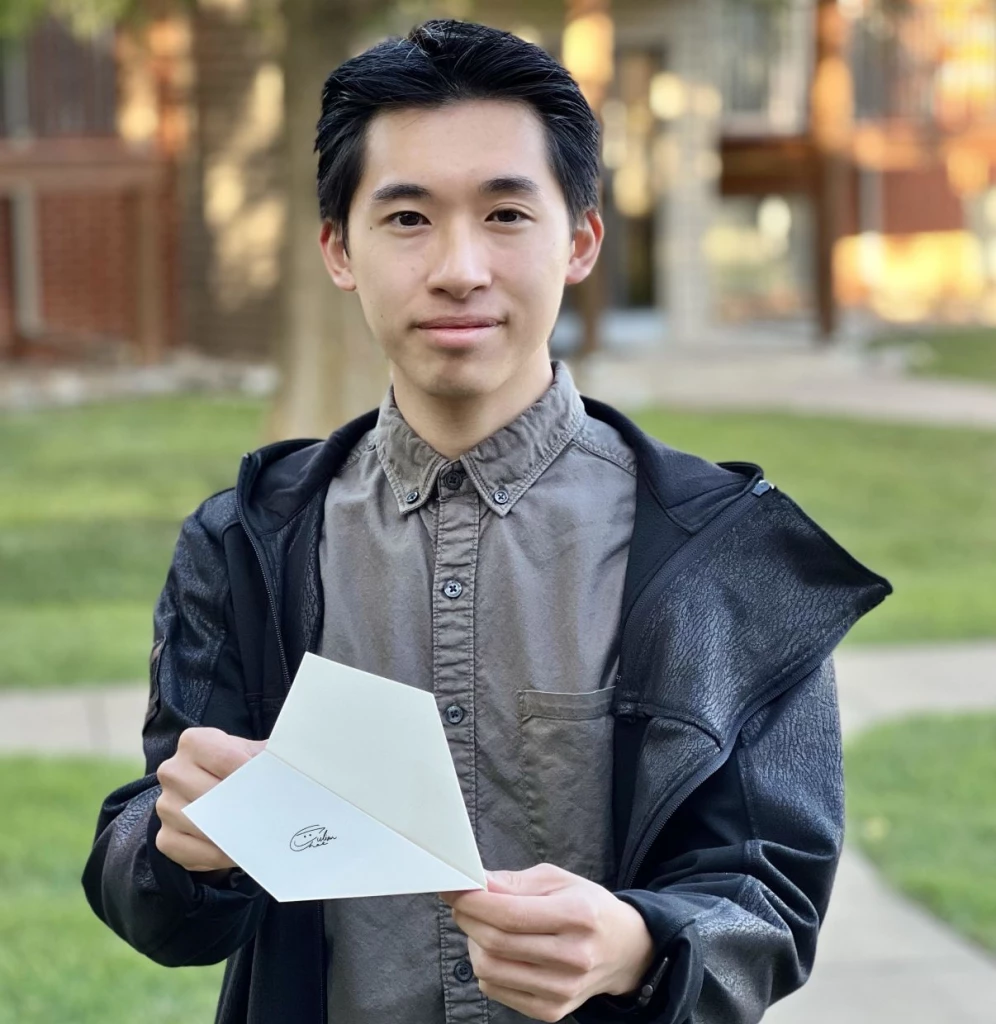
Most of us folded paper aeroplanes for fun when we were kids, but it has always been Julian Chee Yie Jian’s childhood dream to design such planes and break records. And recently, he did just that.

Malaysian-born, US-based aviation engineer's paper plane breaks World Record

Currently based in Kansas, the United States, Chee, 24, has put Malaysia on the world map by earning a Guinness World Record (GWR) in the “Farthest flight by a paper aircraft” category.

His paper plane design flew 77.134m, beating the previous record of 69.14m held by Americans John Collins and Joe Ayoob in 2012.

“It feels long overdue to put Malaysia in the GWR. It’s no moonshot but I represent Malaysia to the best of my ability. It’s definitely not going to be my last,” said Chee in an email interview recently.

Asked if he had ever expected to break the GWR, he said: “Yes, I did. Back in 2019, I tested my design in an aeroplane hangar and I hit approximately 90% of the 2012 record distance on the first day alone. So I knew it was within reach with a bit more refinement.”

Chee, a design engineer with Airbus, teamed up with his South Korean buddies Kim Kyu Tae and Shin Moo Joon to tackle the challenge. The trio achieved their incredible distance in Daegu, Gyeongsangbuk-do in South Korea on April 16.

Malaysian-born, US-based aviation engineer's paper plane breaks World Record

The guys each had a specific area to focus on – Shin (a paper aircraft veteran) folded the plane, Kim was the thrower, while Chee was the designer.

“I have known Shin for nearly a decade now, and we’ve constantly been discussing, via email and social media, new ways to fly higher, further and longer. So in 2019, I did some tests at my university’s indoor baseball park and an old Boeing hangar in Wichita, Kansas.

“Unfortunately, I didn’t continue the project as school and work kept me busy. Shin was the only person who knew my design and he introduced me to Kim with the plan to break the record. The community in (South) Korea also started noticing my design, so we wanted to quickly get it in the record books, and we did,” said Chee, who graduated from Kansas’ Wichita State University in aerospace engineering last year.

The former SMK Taman SEA (Petaling Jaya) student took months of research to conceptualise the design. He explained there are a few factors influencing the performance of any aircraft but in the end, it boils down to the balancing act between the mass and how big the wing area is.

“The heavier the paper, the more inertia it possesses to keep it going, and the better the structure. The smaller the wings, the faster it flies too. For this application, the wings must be sized so they can still glide at a particular speed, or they’ll just hit the ground like a dart,” explained Chee.

Sheela Chandran

The Star

Asia News Network

He said throwing a paper airplane seems easy, but thrusting it at high speeds with minimal distortions, consistency and endurance is much more complex.

“Unexpectedly, the challenge is getting it to fly straight at various speeds because the paper is a soft material. Often, throwing itself would distort and damage the wings, causing the plane to roll or turn rapidly.

“Compared to the 2012 record glider, my design is smaller, with more layers compacted into the wing, making it stiffer and less prone to distortion. As a result, our winning plane started gliding from a much higher altitude rather than a very aggressive swoop down to pick up more speed.”

Chee said paper planes are a kid’s version of engineering and art.

“Since it’s a lot faster and cheaper to make something from old mail (or an exam paper that I never want to see again!), there’s a lot of trial and error,” said Chee, who, aside from creating origami aircrafts, enjoys music and playing the yoyo.

“Every throw is an experiment to learn from, and that’s incredibly important for any kid trying to figure out how the world works. It’s also a great outlet to let the mind wonder.

“Whether it’s a flapping plane, one that resembles a bird, replicas of existing airplanes, or just a high-performance glider, it’s endless. That’s the best part. It’s simple in concept but complex in possibilities,” said Chee, the middle of three siblings.

Next, the engineer wants to design, build and launch a small but efficient rocket into space.

“It will take a few years as I’m in the midst of studying and writing the analysis code and learning how to manufacture rocket propellant,” shared Chee.

We have no doubt he will continue to fly high in his future pursuits.

The Star

Asia News Network

Asia News Network: The Nation (Thailand), The Korea Herald, The Straits Times (Singapore), China Daily, Jakarta Post, The Star and Sin Chew Daily (Malaysia), The Statesman (India), Philippine Daily Inquirer, Yomiuri Shimbun and The Japan News, Gogo Mongolia, Dawn (Pakistan), The Island (Sri Lanka), Kuensel (Bhutan), Kathmandu Post (Nepal), Daily Star (Bangladesh), Eleven Media (Myanmar), the Phnom Penh Post and Rasmei Kampuchea (Cambodia), The Borneo Bulletin (Brunei), Vietnam News, and Vientiane Times (Laos).

Published : May 29, 2022

By : The Star

[Cambodia] PM orders maps redrawn to redress Tonle Sap issues

#SootinClaimon.Com : ขอบคุณแหล่งข้อมูล : หนังสือพิมพ์ The Nation.

https://www.nationthailand.com/international/40016036


Prime Minister Hun Sen has instructed authorities in six provinces to re-evaluate protected area zoning in the flooded forests surrounding the Tonle Sap Lake, to ensure that long-time residents of local communities would not be required to relocate.

[Cambodia] PM orders maps redrawn to redress Tonle Sap issues

From the north in clockwise direction, Southeast Asia’s largest freshwater lake by surface area is bordered by five provinces – Siem Reap, Kampong Thom, Kampong Chhnang, Pursat and Battambang – with Banteay Meanchey in the northwest also encompassed in the system.

The Tonle Sap Area has been classified into three zones. Private residence and land ownership is allowed only in Zone 1, whereas land use in Zone 2 is restricted to certain subsistence activities. Zone 3 is strictly protected area.

The instruction comes in a special message after a series of breaches in Zone 3 prompted the government to take serious actions starting in November, with a number of locals and officials landing in court as a result.

The message was posted on the premier’s official Facebook page on May 27, addressed to Minister of Land Management, Urban Planning and Construction Chea Sophara and ministry officials, as well as provincial and district governors and commune chiefs in the six provinces.

Hun Sen told the officials to consider downgrading segments of zones 2 and 3 where communities had been set up for a long time, especially those with pagodas, assuring that none of their long-standing residents would be displaced.

“I stress now that the authorities of the six provinces have to be responsible for their own people, both at the provincial, district and commune levels,” he said.

He also instructed the officials to revise the borders between zones 2 and 3, with attention to potential trade-offs between forest conservation and crop cultivation.

“It’s not hard. If we were able to sign things, we can also rescind them and revise boundaries. And I appeal to the people not to infringe on the new areas. For those who have been relying on them, there must be adjustments to the legal standards, and border posts demarcating Zone 3 have to be relocated to redraw Zone 2, or Zone 2 downgraded to Zone 1,” Hun Sen said.

But he warned that the instruction would not apply to locations “taken by rich people”.

He also told the public works minister to work with other authorities such as the water resources and agriculture ministries, the Tonle Sap Authority and officials from the six aforementioned provinces.

By: Mom Kunthear

Asia News Network: The Nation (Thailand), The Korea Herald, The Straits Times (Singapore), China Daily,  Jakarta Post, The Star and Sin Chew Daily (Malaysia), The Statesman (India), Philippine Daily Inquirer, Yomiuri Shimbun and The Japan News, Gogo Mongolia,  Dawn (Pakistan),  The Island (Sri Lanka), Kuensel (Bhutan), Kathmandu Post (Nepal), Daily Star (Bangladesh), Eleven Media (Myanmar), the Phnom Penh Post and Rasmei Kampuchea (Cambodia), The Borneo Bulletin (Brunei), Vietnam News, and Vientiane Times (Laos).

Published : May 28, 2022

By : The Phnom Penh Post

HCM City strengthens monkeypox watch

#SootinClaimon.Com : ขอบคุณแหล่งข้อมูล : หนังสือพิมพ์ The Nation.

https://www.nationthailand.com/international/40016035


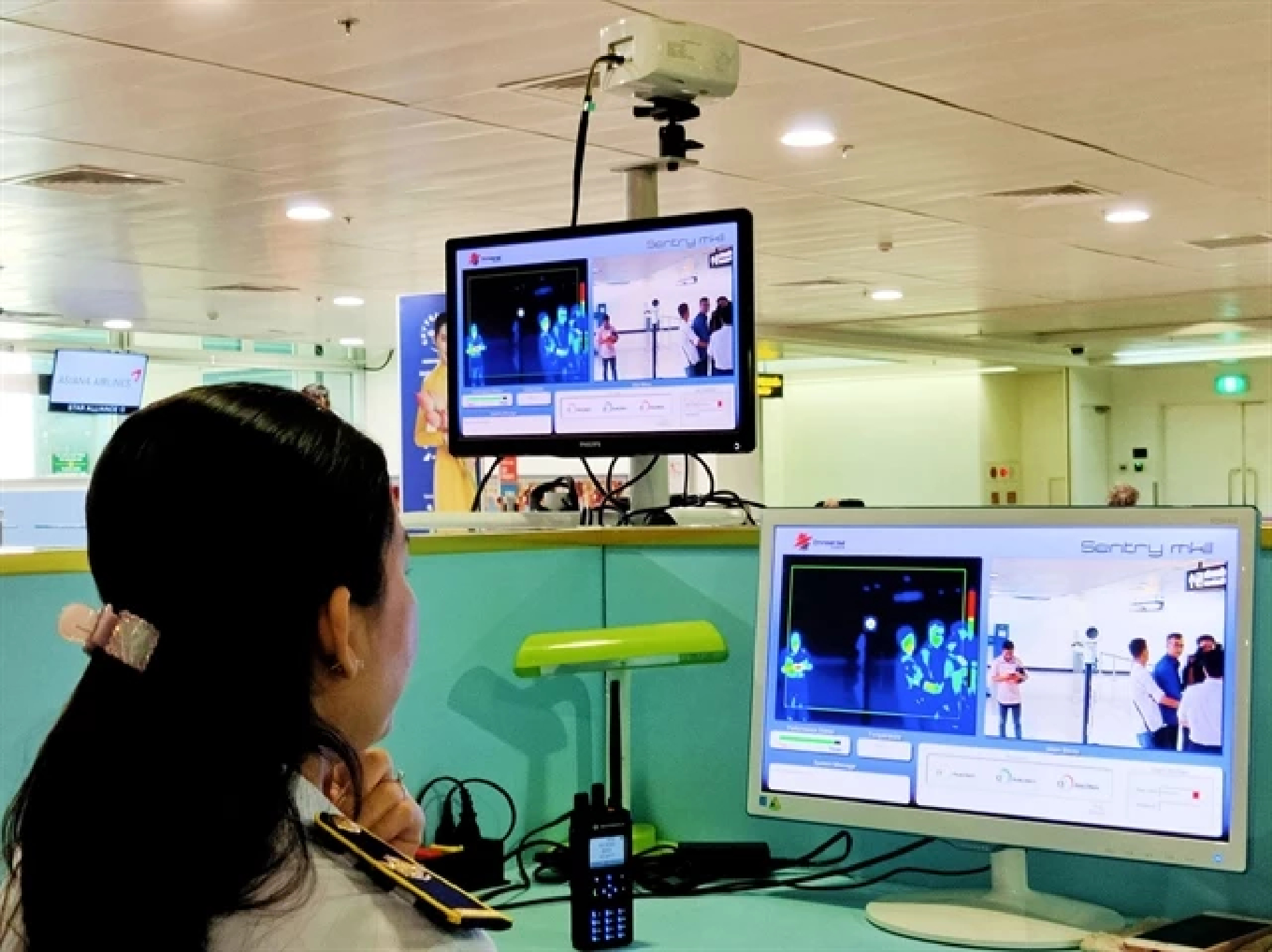
HCM CITY — HCM City is upped its guard against monkeypox by strengthening surveillance at border gates to monitor suspect cases, especially among those returning from countries where the disease is circulating.

HCM City strengthens monkeypox watch

The municipal Department of Health asked public and private medical facilities in districts and Thủ Đức City to inform the Centre for Disease Control (HCDC) if suspect cases are discovered.

The cases will be tested for confirmed patients will be sent to medical facilities for treatment.

The department also instructed local authorities to communicate and raise people’s awareness about monkeypox as well as measures to prevent and control the disease. 

The World Health Organization on Thursday said the cases of monkeypox virus infection have so far been reported in more than 20 countries, including North American and Europe, urging nations to increase surveillance of the infectious disease as outbreaks grow.

No deaths from this virus were recorded to date, and patients usually recover in a few weeks. — VNS

Published : May 28, 2022

By : Vietnam News

China, Russia veto sanctions on North Korea; US-China rivalry growing into bloc competition

#SootinClaimon.Com : ขอบคุณแหล่งข้อมูล : หนังสือพิมพ์ The Nation.

https://www.nationthailand.com/international/40016034


US says China poses ‘serious, long-term threat’ to global order in policy speech

China, Russia veto sanctions on North Korea; US-China rivalry growing into bloc competition

China and Russia vetoed a resolution to toughen sanctions against a rule-breaking North Korea at the United Nations Security Council vote on Thursday, teaming up to block the US-drafted resolution which all remaining Council members supported.

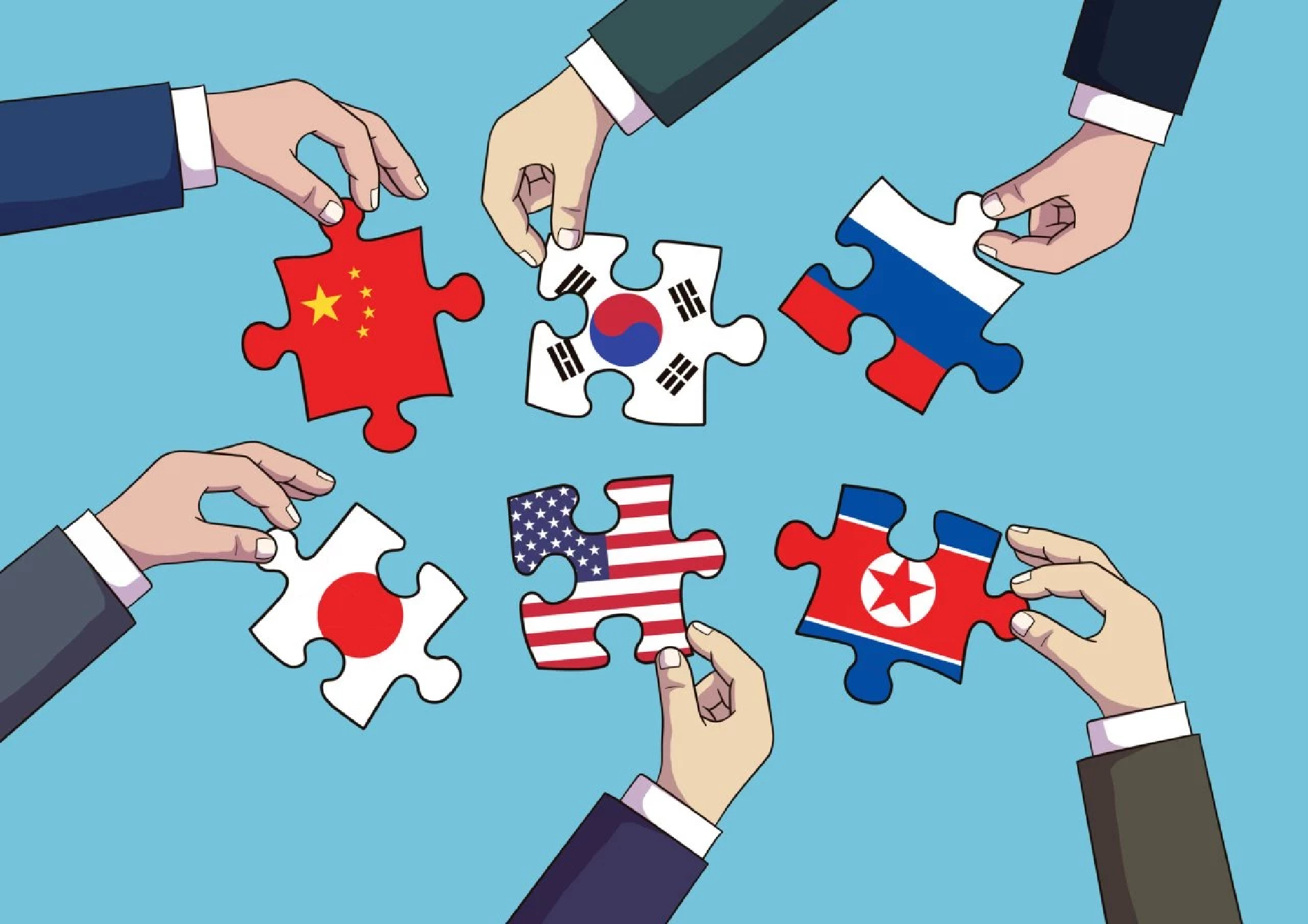
Signs are becoming more clear that the US-China rivalry is growing into a team competition, and possible conflicts may be centered in the East Asia region with the US, backed by South Korea and Japan, and China with North Korea and Russia, according to experts here.

In the vote that came after Pyongyang’s test-firing of three missiles, which includes what is assumed to be its largest intercontinental ballistic missile, 13 members of the UN’s top decision-making body voted in favor of the US-drafted resolution which aims to ban oil and tobacco exports to the reclusive regime.

After it failed to pass, South Korea’s Foreign Ministry conveyed “strong regret” and urged for responsible action from member states.

“It is the first case in which a UNSC resolution on imposing sanctions on North Korea is voted down,” Foreign Ministry spokesperson Choi Young-sam said in a statement. “I express a strong regret that the resolution was rejected, despite the support from most of the UNSC member states. North Korea is continuing with its provocations launching ICBMs and the possibility of (Pyongyang’s) nuclear tests are also being raised.”

The last time a resolution to tighten sanctions on Pyongyang was passed in 2017 — the recalcitrant regime had violated multiple UNSC regulations in conducting a nuclear test and testing an ICBM — China and Russia had voted in favor, sharing the idea that North Korea’s nuclear ambitions should be kept in check.

But this time, Beijing and Moscow have been working to ease sanctions for Pyongyang, citing humanitarian grounds.

“We do not think additional sanctions will be helpful in responding to the current situation. It can only make the situation even worse,” China’s UN Ambassador Zhang Jun had told reporters earlier on Thursday, before the vote took place.

While it was clear from early on that China and Russia would veto the resolution, the US’ push to hold the vote is interpreted by some as an attempt to keep piling on pressure.

Amid prospects that North Korea would likely conduct a seventh nuclear test, it may come as a burden for China and Russia to veto again, should the UNSC vote on a new resolution to counter Pyongyang’s nuclear ambitions.

Park Won-gon, a professor of North Korean Studies at Ewha Womans University, said China and Russia teaming up to wield their vetoes show they are bolstering their ties, and with North Korea as well. And this has obviously pushed the US to strengthen the bonds with South Korea and Japan.

“Potential conflicts may grow sharply in the East Asia region between the two alliances,” Park told The Korea Herald.

He also raised concerns that China and Russia’s veto would likely to weaken the status and influence of the UNSC.

“China and Russia did vote in favor of the last resolution for sanctions. The fact that China and Russia vetoed the resolution this time, shows they do not respect the international entity anymore,” Park added. 

US’ China policy

On the same day, the US revealed that it aims to contain China’s clout in its administration’s policy approach.

While saying that China poses the “most serious, long-term threat” to the global order, the US underscored that it does not intend to create conflict nor want a “new Cold War.”

“Even as (Russian) President Putin’s war continues (with Ukraine), we will remain focused on the most serious long-term challenge to the international order — and that is the one posed by the People’s Republic of China,” US Secretary of State Antony Blinken said, delivering his speech at George Washington University in Washington DC.

“China is the only country with both the intent to reshape the international order and, increasingly, the economic, diplomatic, military, and technological power to do it.”

Beijing’s vision “would move us away from the universal values that have sustained so much of the world’s progress over the past 75 years,” so the US will work to defend and strengthen the universal values and institutions for peace and to coexist, Blinken said.

The US, however, does not seek to block China from its role as a major power, nor stop the country from growing the economy or advancing the interests of their people, Blinken said.

“We are not looking for conflict or a new Cold War. To the contrary, we’re determined to avoid both,” Blinken said.

Instead of directly forcing Beijing to abide by its rules, Washington will “shape the strategic environment around Beijing” to keep China in check, which means it would form coalitions to curb China’s aggressions.

“We can’t rely on Beijing to change its trajectory,” he said. “So we will shape the strategic environment around Beijing to advance our vision for an open and inclusive international system.”

While the US administration denies that the strategic competition with China is a zero-sum game, it has already evolved into one, and Blinken’s speech is intended to appeal to other countries to take its side, Park of Ewha University said.

“To put it nicely, the US is just suggesting that it will give the shares (benefits) to countries taking its side. It basically appears to be lining up its allies in the order of the level of loyalty,” Park said.

Blinken said in his speech that the US’ diplomacy is based on “partnership and respect for each other’s interests.

“We don’t expect every country to have the exact same assessment of China as we do,” he said. “This is not about forcing countries to choose. It’s about giving them a choice.”

By Jo He-rim

Asia News Network: The Nation (Thailand), The Korea Herald, The Straits Times (Singapore), China Daily,  Jakarta Post, The Star and Sin Chew Daily (Malaysia), The Statesman (India), Philippine Daily Inquirer, Yomiuri Shimbun and The Japan News, Gogo Mongolia,  Dawn (Pakistan),  The Island (Sri Lanka), Kuensel (Bhutan), Kathmandu Post (Nepal), Daily Star (Bangladesh), Eleven Media (Myanmar), the Phnom Penh Post and Rasmei Kampuchea (Cambodia), The Borneo Bulletin (Brunei), Vietnam News, and Vientiane Times (Laos).

Published : May 28, 2022

By : The Korea Herald

Japan, U.S. amid global disarray / Defense budget boost becomes Kishida’s ‘international pledge’

#SootinClaimon.Com : ขอบคุณแหล่งข้อมูล : หนังสือพิมพ์ The Nation.

https://www.nationthailand.com/international/40016033


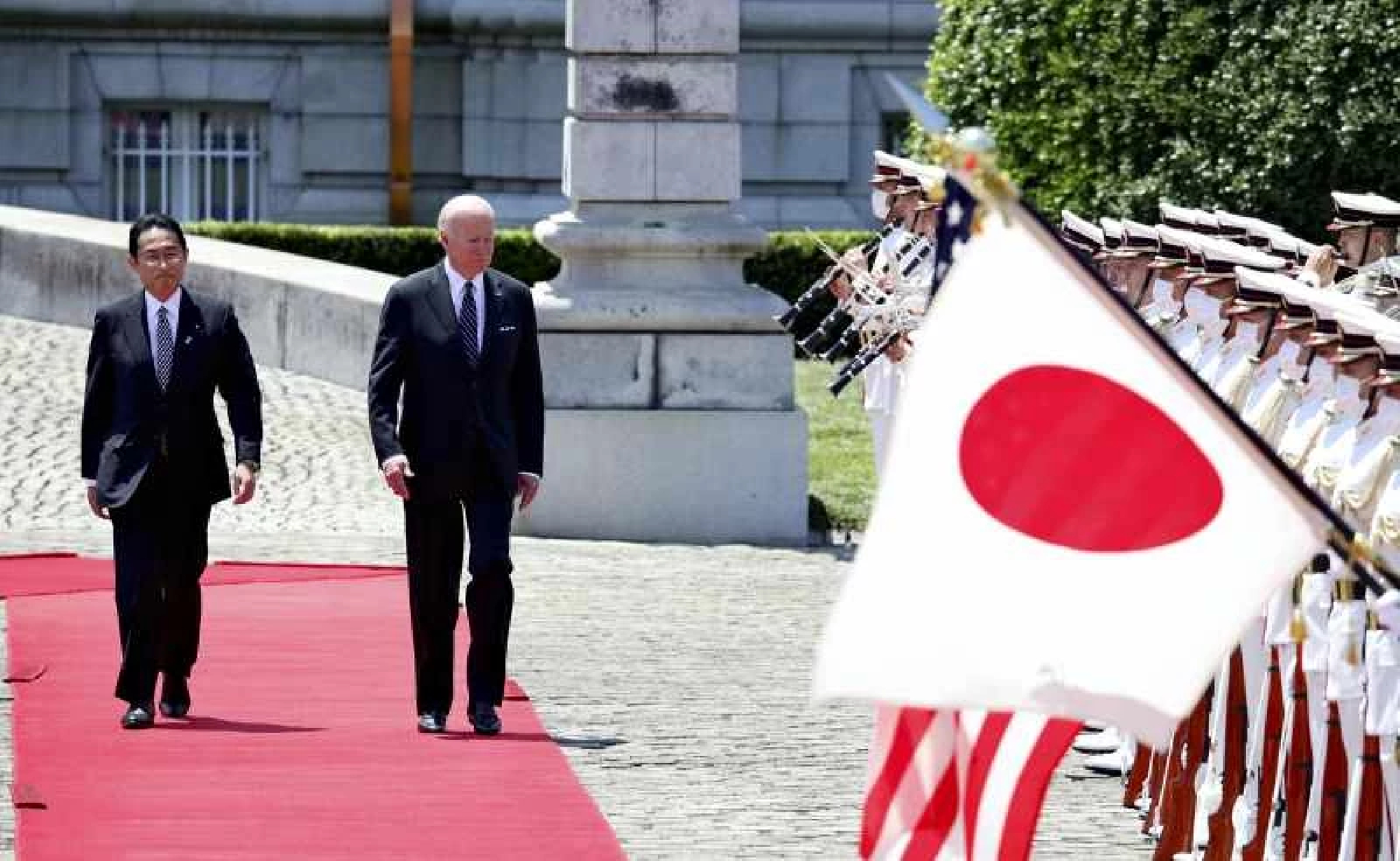
As Joe Biden and Fumio Kishida were having dinner in a room at the luxurious Happo-en garden estate in Minato Ward, Tokyo, on Monday, a hanging scroll caught the U.S. president’s eye. As Kishida’s wife, Yuko, served Biden a cup of tea, she explained the meaning of the word — senri dofu — written on the scroll.

Japan, U.S. amid global disarray / Defense budget boost becomes Kishida’s ‘international pledge’

“It means that no matter how far apart people are, if they understand each other’s feelings, the same wind will carry them and they will reach the same place,” Yuko said. “Japan and the United States might be geographically distant, but we share universal values and have the same spirit.”

Biden seemed deeply impressed by the explanation. “That’s a nice story,” he reportedly said.

The first full-fledged talks between Kishida and Biden deepened their relationship of trust. In addition, both leaders agreed to bolster the Japan-U.S. alliance and strengthen its deterrence and response capabilities. This comes at a time when Russia is pushing ahead with its invasion of Ukraine, and China is taking increasingly hegemonic actions. Kishida declared his determination to secure a “substantial” increase in Japan’s defense budget, a move that even some members of the ruling parties oppose. Kishida also told Biden he is considering possessing — for self-defense purposes — counterstrike capabilities against facilities including enemy bases that launch missiles at Japan.

Biden replied that the United States will absolutely fulfill its commitment to defend Japan. The president even stated the United States would get involved militarily to defend Taiwan. This remark infuriated China, and the U.S. government scrambled to defuse the situation by saying there was no change to conventional U.S. policy on Taiwan. However, Biden did not retract his comment. Some observers have suggested Biden was emboldened by Kishida’s strong resolve on defense issues.

Kishida has started making moves to implement his own statement, which has become an “international pledge.”

Following this summer’s House of Councillors election, key items on Kishida’s to-do list before the end of this year include work to compile next fiscal year’s draft budget and the revision of three key documents, including the National Security Strategy. Kishida intends to push on with efforts to give concrete shape to the “substantial” increase in the defense budget and possession of counterstrike capabilities. However, there will inevitably be discussions over where the funding for this defense budget increase will come from, and compiling a priority-based budget will be essential.

Japan’s neighbors continue to take provocative actions. Russian and Chinese bombers made a joint flight in airspace near Japan on Tuesday, and North Korea fired several ballistic missiles Wednesday. Although the Japanese public is becoming increasingly understanding of the need for strengthened defense capabilities, Kishida’s strong leadership and ability to provide clear explanations will be tested so that talks of such steps becomes more specific.]

Asia News Network: The Nation (Thailand), The Korea Herald, The Straits Times (Singapore), China Daily,  Jakarta Post, The Star and Sin Chew Daily (Malaysia), The Statesman (India), Philippine Daily Inquirer, Yomiuri Shimbun and The Japan News, Gogo Mongolia,  Dawn (Pakistan),  The Island (Sri Lanka), Kuensel (Bhutan), Kathmandu Post (Nepal), Daily Star (Bangladesh), Eleven Media (Myanmar), the Phnom Penh Post and Rasmei Kampuchea (Cambodia), The Borneo Bulletin (Brunei), Vietnam News, and Vientiane Times (Laos).

Published : May 28, 2022

By : The Japan News

Beijing makes major headway against latest contagion outbreak

#SootinClaimon.Com : ขอบคุณแหล่งข้อมูล : หนังสือพิมพ์ The Nation.

https://www.nationthailand.com/international/40016032


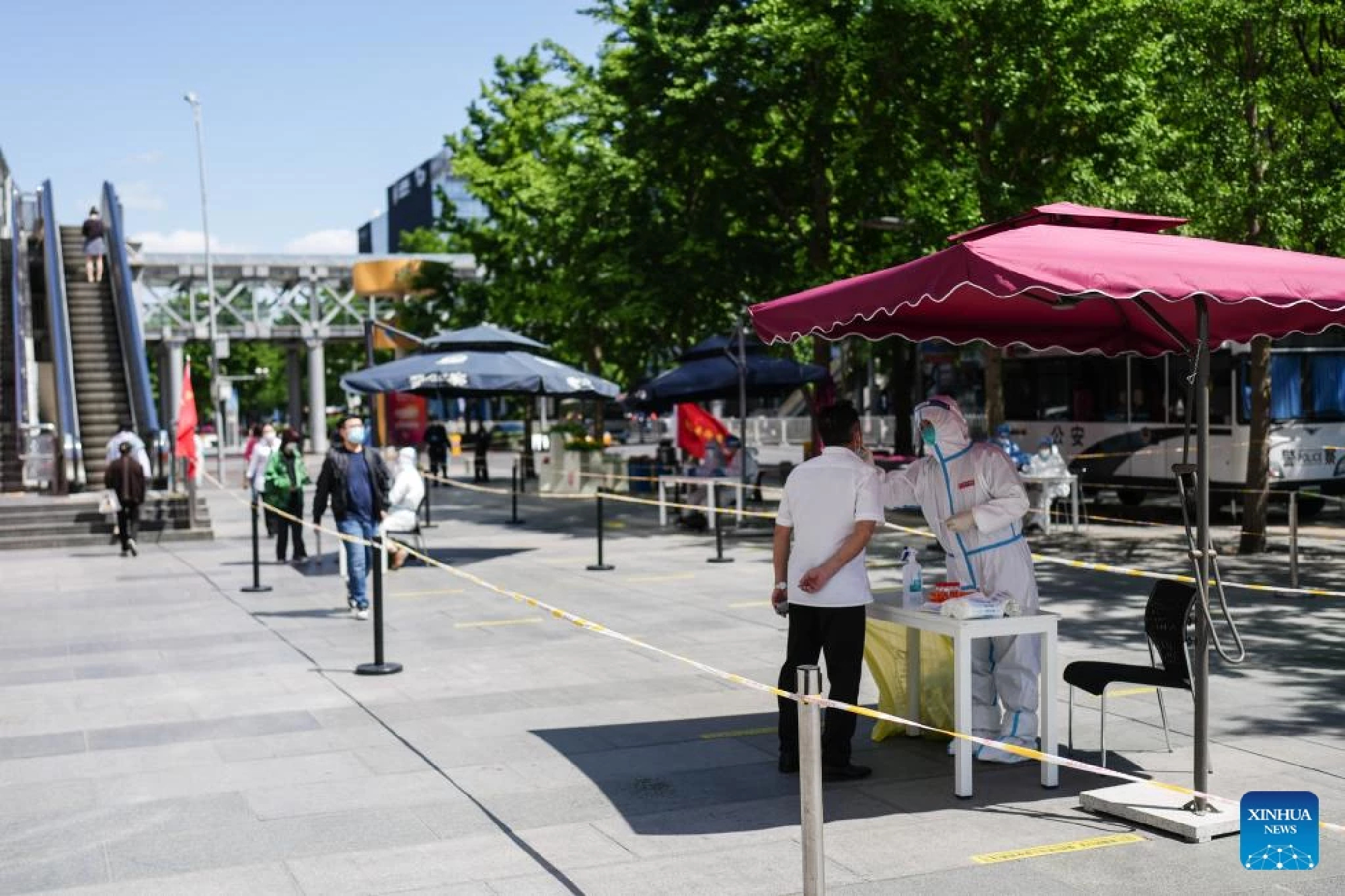
Beijing has basically cut off new transmission chains amid the ongoing COVID-19 outbreak and the epidemic situation in the capital city is coming under increasing control, a senior official said on Friday.

Beijing makes major headway against latest contagion outbreak

Beijing reported 20 new locally transmitted cases as of 3 pm on Friday, bringing the total number of infections to 1,701 since April 22, according to Liu Xiaofeng, deputy director of the Beijing Center for Disease Prevention and Control, at a news conference on Friday afternoon.

“All of the new infections were reported in quarantined locations, and no cases were found from mass nucleic acid tests at community levels,” Liu said.

Of all the 1,701 cases so far, Chaoyang district registered 422, the most amid the current outbreak, followed by Fangshan, which announced 413. Fengtai reported 368 and Haidian 235 during the period.

Chaoyang has not reported any cases at the community level for more than three days, and Fangshan has reported no such cases for more than seven days, Liu said.

As of Friday, Beijing had seven high-risk areas for COVID-19 and 17 medium-risk areas.

Beijing is offering residents aged 60 and above government-backed insurance for medical accidents linked to COVID-19 vaccinations, according to the city’s banking and insurance regulatory bureau.

The insurance policy payout could be as high as 500,000 yuan ($74,200) per person for a single benefit.

According to the city government, more than 3.43 million residents aged 60 and above have received at least one dose of vaccine as of April 13, accounting for 80 percent of the total population of the demographic.

The new insurance plan, with premiums covered by the government, aims to alleviate concerns over vaccinations among the elderly and their family members.

According to an announcement by the Shunyi district government on Friday, the Beijing Health Commission and the district government have launched an investigation into a local hospital and Beijing Emergency Medical Center’s Shunyi branch following an accusation that they allegedly delayed medical treatment, which resulted in the death of a patient.

The person in charge of the emergency center’s branch and other relevant persons have been suspended pending the investigation.

The whole process, including the center’s responses before the treatment, will be investigated.

By DU JUAN

Asia News Network: The Nation (Thailand), The Korea Herald, The Straits Times (Singapore), China Daily,  Jakarta Post, The Star and Sin Chew Daily (Malaysia), The Statesman (India), Philippine Daily Inquirer, Yomiuri Shimbun and The Japan News, Gogo Mongolia,  Dawn (Pakistan),  The Island (Sri Lanka), Kuensel (Bhutan), Kathmandu Post (Nepal), Daily Star (Bangladesh), Eleven Media (Myanmar), the Phnom Penh Post and Rasmei Kampuchea (Cambodia), The Borneo Bulletin (Brunei), Vietnam News, and Vientiane Times (Laos).

Published : May 28, 2022

By : China Daily