World Bank rules out new loan to Sri Lanka until it gets its policy framework in order

#SootinClaimon.Com : ขอบคุณแหล่งข้อมูล : หนังสือพิมพ์ The Nation.

https://www.nationthailand.com/international/40015959


The World Bank has ruled out bridging finance or new loan commitments to crisis-hit Sri Lanka until the nation’s economy sets up an adequate macroeconomic policy framework.
World Bank rules out new loan to Sri Lanka until it gets its policy framework in order

The World Bank issued a report on Tuesday following claims that the Washington-based institution was planning to support Sri Lanka to overcome the financial crisis in the form of a bridge loan or new loan commitments.

However, the WB has said that it is reshuffling the already allocated resources to provide essential medicines and other cash assistance to the vulnerable.

“Recent media reports have inaccurately stated that the World Bank is planning support for Sri Lanka in the form of a bridge loan or new loan commitments among other incorrect assertions,” the WB has said in a statement.

“We are concerned for the people of Sri Lanka and are working in coordination with the IMF and other development partners in advising on appropriate policies to restore economic stability and broad-based growth. Until an adequate macroeconomic policy framework is in place, the World Bank does not plan to offer new financing to Sri Lanka,” it said.

It expressed hope that Sri Lanka is making continuous efforts toward economic stability.

“We are currently repurposing resources from previously approved projects to help the government with some essential medicines, temporary cash transfers for poor and vulnerable households, school meals for children of vulnerable families, and support for farmers and small businesses,” the statement said.

Sri Lanka is near bankruptcy and has severe shortages of essentials from food, fuel, medicines and cooking gas to toilet paper and matchsticks. For months, people have been forced to stay in long lines to buy the limited stocks.

Sri Lanka has suspended repayment of about $7 billion in foreign loans due this year out of $25 billion to be repaid by 2026. The country’s total foreign debt is $51 billion.

Sri Lanka, in the midst of its worst economic crisis, has started a negotiating programME with the IMF.

The country however is in need of $4-5 billion in bridging finance to arrest the crisis where shortages of essentials had led to street rioting.

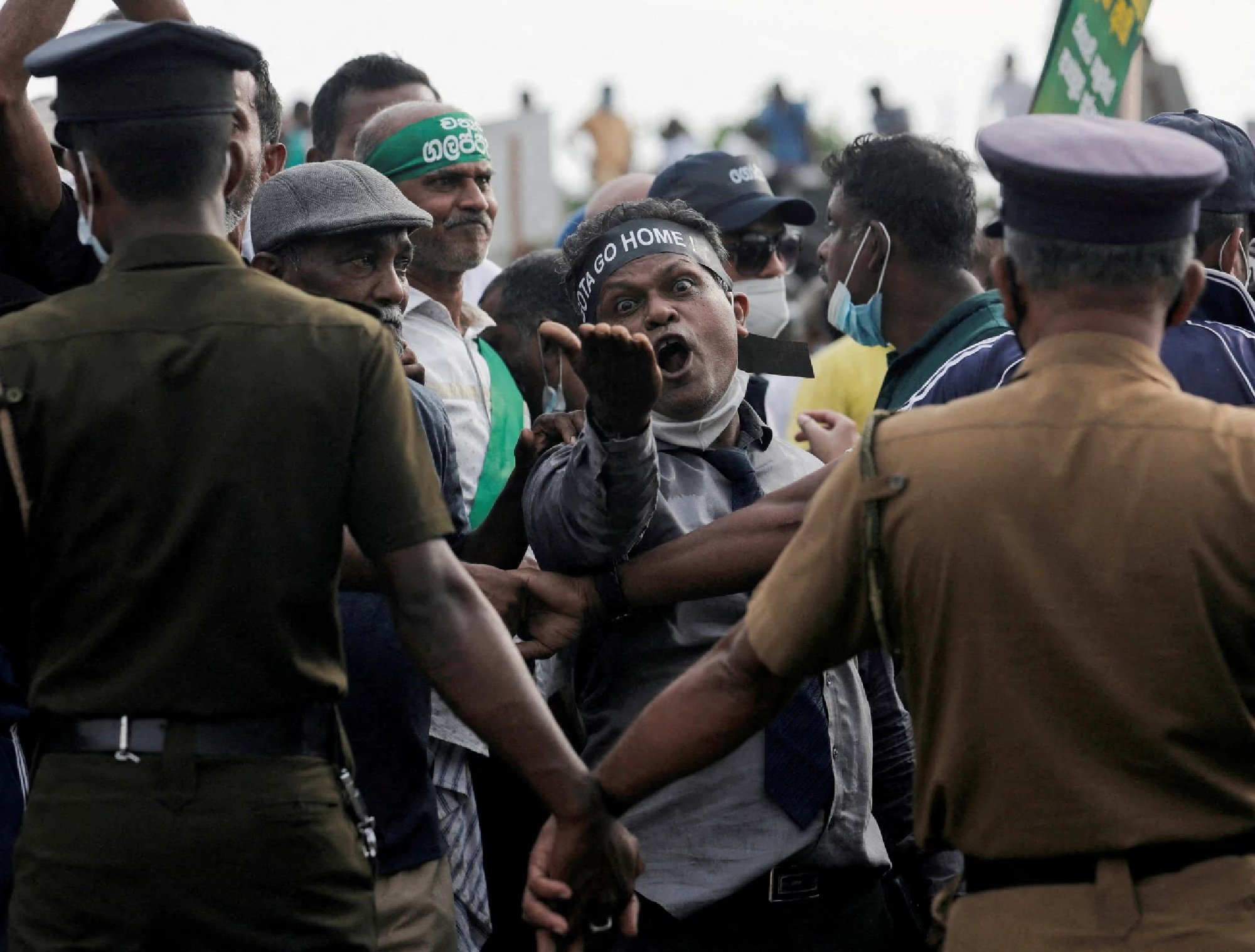
Sri Lanka’s economic crisis has created political unrest with a protest occupying the entrance to the president’s office, demanding his resignation continuing for the past 40 days. The crisis has already forced Prime Minister Mahinda Rajapaksa, the elder brother of the President, to resign on May 9.

An inflation rate spiralling towards 40 per cent, shortages of food, fuel and medicines and rolling power blackouts have led to nationwide protests and a plunging currency, with the government short of the foreign currency reserves it needed to pay for imports.

The Island

Asia News Network

Asia News Network: The Nation (Thailand), The Korea Herald, The Straits Times (Singapore), China Daily, Jakarta Post, The Star and Sin Chew Daily (Malaysia), The Statesman (India), Philippine Daily Inquirer, Yomiuri Shimbun and The Japan News, Gogo Mongolia, Dawn (Pakistan), The Island (Sri Lanka), Kuensel (Bhutan), Kathmandu Post (Nepal), Daily Star (Bangladesh), Eleven Media (Myanmar), the Phnom Penh Post and Rasmei Kampuchea (Cambodia), The Borneo Bulletin (Brunei), Vietnam News, and Vientiane Times (Laos).

Published : May 26, 2022

By : The Island

The latest news on what’s happening in the region

#SootinClaimon.Com : ขอบคุณแหล่งข้อมูล : หนังสือพิมพ์ The Nation.

https://www.nationthailand.com/international/40015939


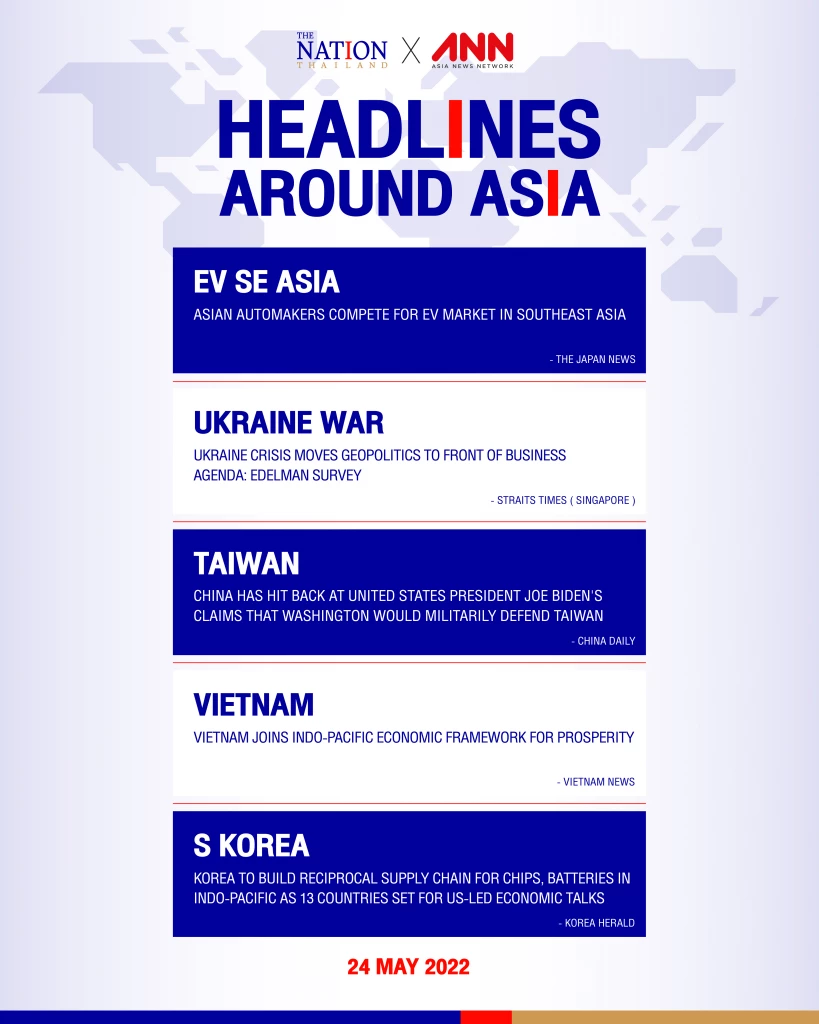
Check out what’s hot in the region on May 23 as The Nation puts together headlines from members of Asia News Network (ANN). Click to read more:

The latest news on what's happening in the region

Travel Myanmar
Three Thai airliners to resume flights from Yangon International Airport

Eleven Media ( Myanmar )
https://www.nationthailand.com/international/40015913

Ukraine War Cambodia
Hun Sen: Stop Russia sanctions

Phnom Penh Post
https://www.nationthailand.com/international/40015915

Philippines-US
Marcos looking at extending security pact with US 

Inquirer( Philippines )
https://www.nationthailand.com/international/40015938

WEF Asean
Asean’s future complex amid multiple pressures: ST-WEF panel 

Straits Times ( Singapore )
https://www.nationthailand.com/international/40015917

Japan-US
Japan, U.S. clearly state opposition to China, Russia 

The Japan News
https://www.nationthailand.com/international/40015934

Asia News Network: The Nation (Thailand), The Korea Herald, The Straits Times (Singapore), China Daily, Jakarta Post, The Star and Sin Chew Daily (Malaysia), The Statesman (India), Philippine Daily Inquirer, Yomiuri Shimbun and The Japan News, Gogo Mongolia, Dawn (Pakistan), The Island (Sri Lanka), Kuensel (Bhutan), Kathmandu Post (Nepal), Daily Star (Bangladesh), Eleven Media (Myanmar), the Phnom Penh Post and Rasmei Kampuchea (Cambodia), The Borneo Bulletin (Brunei), Vietnam News, and Vientiane Times (Laos).

Published : May 25, 2022

By : THE NATION

Marcos in talks with US on extending VFA military agreement

#SootinClaimon.Com : ขอบคุณแหล่งข้อมูล : หนังสือพิมพ์ The Nation.

https://www.nationthailand.com/international/40015938


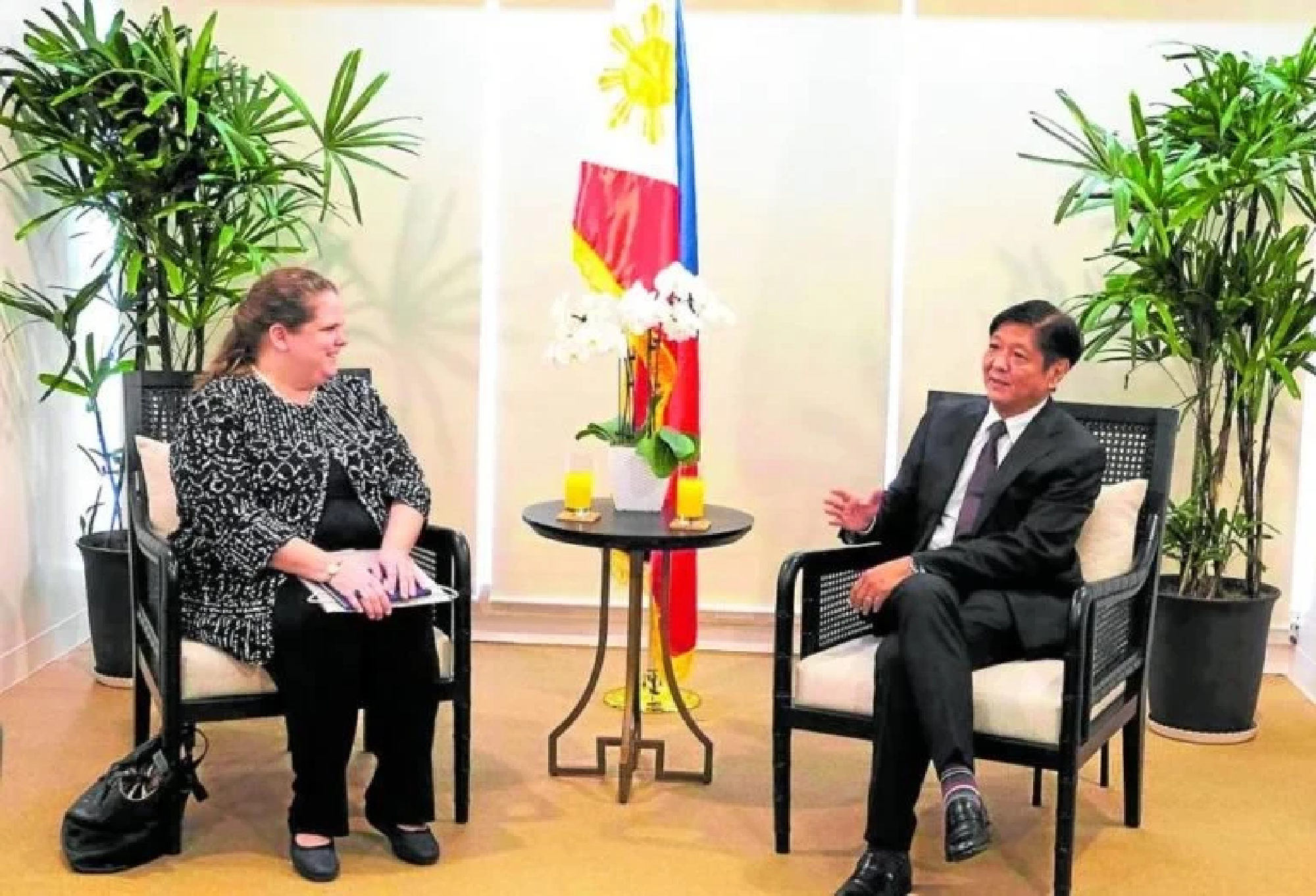
Presumptive Philippine President Ferdinand Marcos Jr said he has met with Washington’s top diplomat in the country and discussed the “re-signing or the extension” of the Visiting Forces Agreement (VFA) between the Philippines and the United States.

Marcos in talks with US on extending VFA military agreement

Marcos on Monday said security issues were raised during his meeting with US Chargé d’Affaires Heather Variava at his election campaign headquarters in Mandaluyong City.

Variava was one of the four senior diplomats who met with Marcos two weeks after the Philippine presidential elections, which he won with more than twice the votes received by his main rival, Vice President Leni Robredo.

The ambassadors of Japan, South Korea, and India also paid a courtesy call on the son and namesake of the late ousted dictator.

“Security concerns, of course, have always been a big part of our relationship with the United States,” Marcos told reporters in his first news conference after the May 9 elections.

Washington had fully backed his father after he declared martial law in September 1972, shut down Congress and ruled by decree, clamped down on the press, and tried to eliminate all opposition until the dictator was toppled by a popular revolt in February 1986.

“Of course, we discussed about security issues, the return or the re-signing or the extension of the VFA and how it has to be redefined for the near future with the situation around the world, especially in our region,” Marcos said.

The VFA, which provides a legal framework for the presence of US troops during joint military exercises in the country, was a bone of contention for outgoing President Rodrigo Duterte, who repeatedly threatened to scrap it.

There is no fixed date for the termination of the VFA. As currently worded, the military agreement shall remain in force until the expiration of 180 days from the date on which either the Philippines or the United States gives the other party notice in writing that it desires to terminate the agreement.

In February last year, Duterte demanded payment from Washington if it wanted to maintain the VFA.

A year earlier, Duterte ordered the VFA’s termination after Washington cancelled the visa of Senator Ronald de la Rosa, his first national police chief.

But in July last year, he scrapped the plan following a visit to Manila by US Defence Secretary Lloyd Austin.

The White House earlier said it would seek closer security ties with the Philippines under Marcos.

The meeting between Marcos and Variava came days after the former senator had a “lengthy” phone conversation with Chinese President Xi Jinping.

Marcos said he assured Xi of “more fruitful and meaningful” relations despite the maritime dispute in the South China Sea between Manila and Beijing.

Marcos told reporters that he would also welcome possible joint ventures between the United States and the Philippines, but did not elaborate.

“One of the first subjects we came upon was the assistance that the United States is offering to mitigate climate change in the different countries and they are very active. They want to take a leadership role in the mitigation of the effects of climate change, of global warming,” he said.

Marcos said he discussed aid projects with Japan’s ambassador and microfinance with India’s envoy.

He said his meeting with South Korea’s ambassador covered information technology, regional security, and the possible reactivation of the unused Bataan Nuclear Power Plant, which was built during his father’s time.

The plant was intended by his late father to be part of his economic modernisation legacy but was mothballed following his overthrow two years after completion.

Asia News Network

Asia News Network: The Nation (Thailand), The Korea Herald, The Straits Times (Singapore), China Daily, Jakarta Post, The Star and Sin Chew Daily (Malaysia), The Statesman (India), Philippine Daily Inquirer, Yomiuri Shimbun and The Japan News, Gogo Mongolia, Dawn (Pakistan), The Island (Sri Lanka), Kuensel (Bhutan), Kathmandu Post (Nepal), Daily Star (Bangladesh), Eleven Media (Myanmar), the Phnom Penh Post and Rasmei Kampuchea (Cambodia), The Borneo Bulletin (Brunei), Vietnam News, and Vientiane Times (Laos).

Published : May 25, 2022

By : Philippine Daily Inquirer

Japan, US to deepen military ties amid China, Russia ‘threat’

#SootinClaimon.Com : ขอบคุณแหล่งข้อมูล : หนังสือพิมพ์ The Nation.

https://www.nationthailand.com/international/40015934


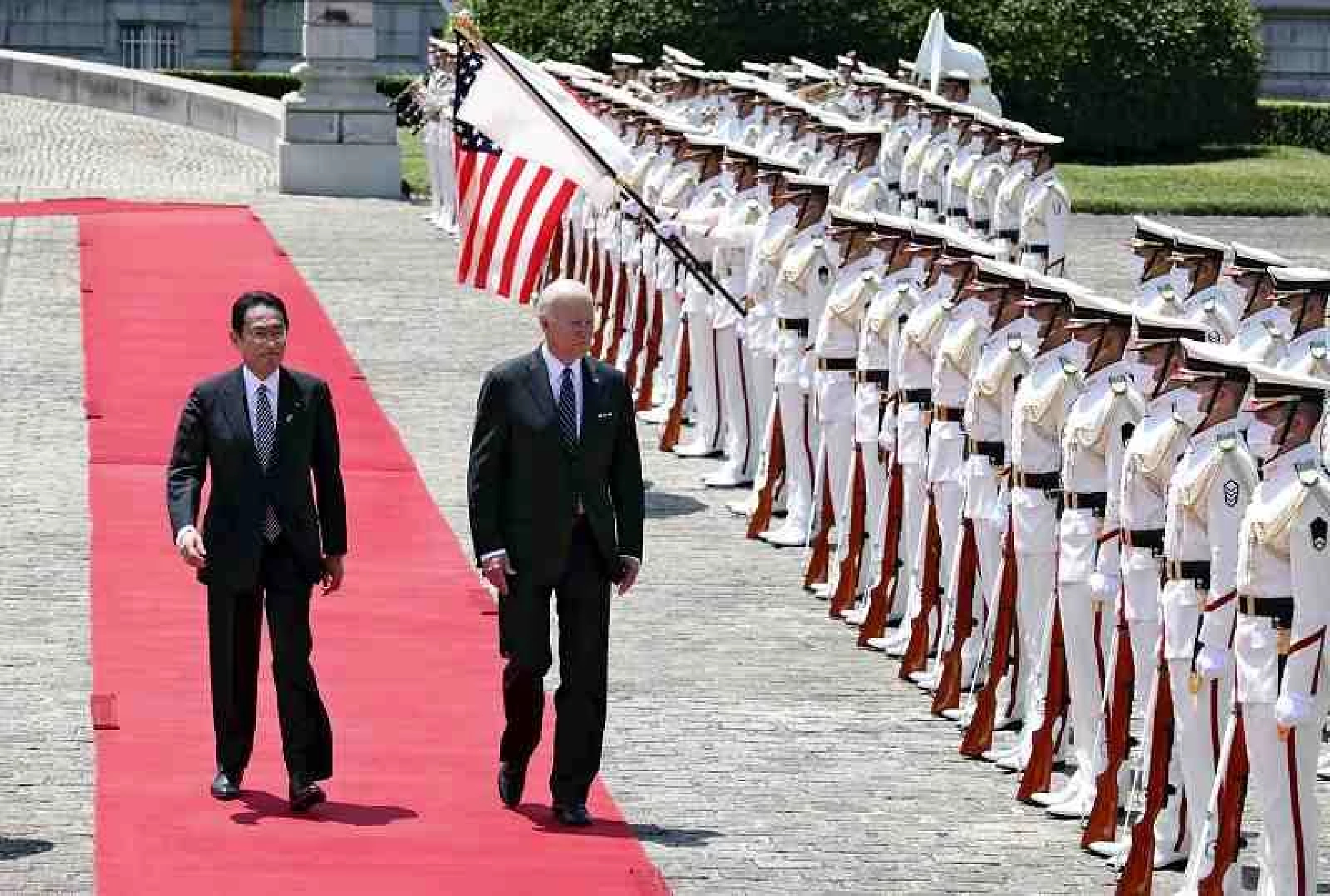
Japanese Prime Minister Fumio Kishida and US President Joe Biden confirmed at a meeting on Monday that their two nations will jointly stand in opposition to China and Russia, and play a leading role in the fields of diplomacy, security and the economy.

Japan, US to deepen military ties amid China, Russia 'threat'

Japan’s commitment to further deepening the Japan-US alliance will be put to the test.

According to the Japan-US Joint Leaders’ Statement released after Kishida and Biden’s summit talks, “Prime Minister Kishida stated his determination to fundamentally reinforce Japan’s defence capabilities and secure substantial increase of its defence budget needed to effect it.”

A source close to the Japanese government said the expression “substantial increase” was the “major point of the talks”.

Kishida did not name a specific amount, but it is quite unusual to inform the United States of a planned increase in the defence budget before the Japanese government actually prepares its budget.

Some Japanese officials were wary of the prime minister mentioning a higher defence budget because a drastic increase could bring up the issue of how to fund it, which might have an impact on the House of Councillors election scheduled for July.

Kishida nevertheless mentioned the increase due to the fact that the US-China military balance in East Asia is changing in favour of China, as Beijing has increasingly engaged in hegemonic actions and the expansion of its military power.

At around 350, China now has the most naval ships in the world.

Also, the number of Chinese bombers is said to surpass that of the United States by about 60, and Beijing is working to develop anti-ship ballistic missiles that could target US aircraft carriers and hard-to-intercept hypersonic glide vehicles.

Earlier this month, the Chinese Navy aircraft carrier “Liaoning” and other ships, including missile destroyers, conducted more than 300 takeoff and landing drills for fighter jets and other aircraft in waters near Japan’s Okinawa prefecture. Two bombers passed between the main island of Okinawa and Miyakojima island, both in the prefecture, which appears to have been a drill assuming an invasion of Taiwan, according to sources.

Biden welcomed Japan’s moves, saying at a press conference, “I applaud Prime Minister Kishida’s determination to strengthen Japanese defence capabilities as well.” This was prompted by the United States’ belief that it would be difficult for it to surpass China on its own in terms of military power in the Indo-Pacific region.

Australia, the United Kingdom and the United States formed a trilateral security cooperation framework in September called AUKUS, while the US 2022 National Defence Strategy compiled in March advocates the concept of “integrated deterrence”, which involves consolidating various resources of its partner nations, including military capabilities and advanced technology. As illustrated by these moves, Washington is seeking to compete with Beijing by cooperating with friendly nations.

The Russian military is also increasing its presence around Japan. The joint statement said, “The two leaders expressed concern about the increasing activities of Russian military forces around Japan, and committed to remain attentive to cooperation between China and Russia in military affairs.”

As for North Korea, which has repeatedly launched ballistic missiles, the two leaders confirmed that they would deal with the country through bilateral cooperation between Japan and the United States and trilateral cooperation including South Korea.

The Japanese government has hurdles to overcome in increasing the defence budget. In three documents to be revised by the end of this year, including the National Security Strategy, Kishida plans to include the possession of counterattack capabilities to attack enemy facilities, such as missile launch bases, for self-defence, aiming to drastically strengthen Japan’s defence capabilities.

Specific measures will include the procurement of counterattack equipment like long-range cruise missiles, and steps to deal with new fields such as space, cyber and electromagnetic waves. The issues faced by the government include selecting necessary equipment based on coordination with the US and securing financial resources amid the expected rise in social security expenses.

Published : May 25, 2022

By : The Japan News

Asean’s future complex amid multiple pressures

#SootinClaimon.Com : ขอบคุณแหล่งข้อมูล : หนังสือพิมพ์ The Nation.

https://www.nationthailand.com/international/40015917


Asean’s future looks promising but increasingly complex as the United States and China vie for the attention of countries in the region and the war in Ukraine puts pressure on economic recovery and disrupts supply chains.

Asean's future complex amid multiple pressures

Still, there is optimism about the region’s prospects for growth although differences remain between neighbours on the way forward for the alliance.

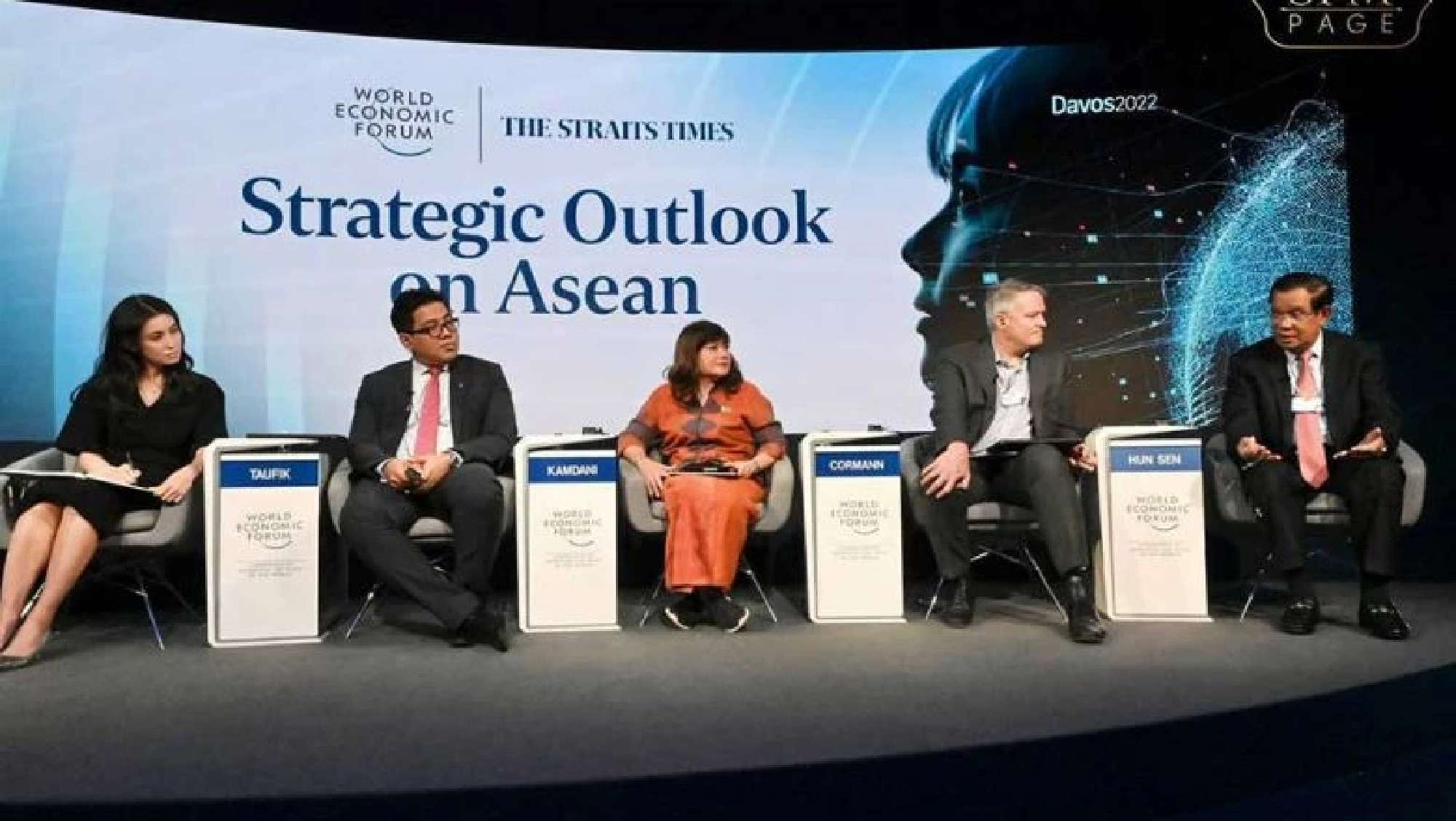
This was the view of panellists joining a discussion on the Strategic Outlook for Asean, during the World Economic Forum meeting in Davos, Switzerland, on Tuesday (May 24).

The session was jointly organised by The Straits Times and World Economic Forum.

Setting the stage for discussions, Mr Warren Fernandez, editor-in-chief of SPH Media Trust’s English, Malay and Tamil Media Group and editor of The Straits Times and moderator for the session, drew attention to mentions of the region as one full of promise but not without perils.

The key would be to get on the right side of “the balance between being a thriving region and the theatre of tensions”, he said, referring to a characterisation of the Indo-Pacific by European Commission president Ursula von der Leyen earlier this month.

Panellist Lynn Kuok, senior fellow for Asia-Pacific at the International Institute for Strategic Studies, Singapore, said the “flurry of outreach by the US and China to engage Asean more actively set the context of what’s going on and the challenges that the region finds itself in”.

“It’s nice to be wooed but not so nice to feel like you need to choose,” Dr Kuok remarked, noting that Southeast Asian countries sometimes feel they are caught between a rock and a hard place.

“They feel their strategic options are being narrowed,” she told the audience of government officials, international observers as well as business leaders.

While the US is a security provider, China provides current economic opportunities as well as future ones, she said.

Datuk Tengku Muhammad Taufik, president and group chief executive of Petronas in Malaysia, shared the concerns, pointing to growing polarisation in the region even though there shouldn’t be a “reason to choose sides”.

There is a hive of activity in the resource-rich region, which has a talented human capital pool but the smooth flow of commerce and trade continues to be a worry amid security concerns, he said.

The region’s potential and economic recovery have found mentioned in discussion at the Forum, along with security threats driven by unresolved differences between the United States and China.

A WEF outline for this session noted the region’s role in multilateral cooperation in terms of mega-regional trade agreements coming into force and the hosting of the G-20 and Apec summits by Asian countries.

The Regional Comprehensive Economic Partnership trade agreement came into force in January.

Indonesia holds the G-20 presidency for the current year, while Thailand will host the Apec Summit in November.

There were “green lights, yellow and red lights” when it comes to evaluating future prospects of the region, said Ms Shinta Widjaja Kamdani, coordinating vice-chair of the Indonesian Chamber of Commerce and Industry.

Asean’s progress and achievements count for green lights, but the geopolitical events and shocks amount to yellow light, and the red ones will need to be tackled, she said.

The issue of finance for development needs to be addressed, she said. And while the region was on the right path in terms of intra-regional trade, she said it was important to note that countries have divergent interests and priorities. With competition comes challenges, she remarked.

“We often ask ourselves why Vietnam has been able to get more investment than Indonesia,” she said.

Delivering his closing remarks, Cambodian Prime Minister Hun Sen highlighted the need to stay neutral amid geopolitical rivalry between the US and China.

Drawing attention to initiatives by several other countries such as Japan and Australia to draw Asean closer, and to the rule of law amid security concerns, he expressed hope that the region could work together.

Mr Hun Sen said he had offered a five-star hotel in Phnom Penh to bring the stakeholders together to discuss the Code of Conduct on the South China Sea between Asean and China, but “nobody showed any willingness to come to Phnom Penh for negotiation”.

China and Asean agreed on a Declaration on the Conduct of Parties in the South China Sea in 2002, and are to agree on a Code of Conduct but progress has been slow, despite increasing tensions.

The Cambodian PM also brought up other flashpoints he has been dealing with during his tenure as Asean chair.

“I received a hot stone, not a hot potato. If it was a hot potato I could eat it,” he said, leaving his panellists amused.

The “hot stones” he has had to deal with include dealing with Myanmar, border closures because of the pandemic, and Russia’s invasion of Ukraine, with its repercussions on food and energy security.

He said he hoped that the gains made by Asean during his tenure would be continued by Indonesia, which takes up the rotating Asean chair next.

Shefali Rekhi

Asia News Network Editor

The Straits Times

Asia News Network

Asia News Network: The Nation (Thailand), The Korea Herald, The Straits Times (Singapore), China Daily, Jakarta Post, The Star and Sin Chew Daily (Malaysia), The Statesman (India), Philippine Daily Inquirer, Yomiuri Shimbun and The Japan News, Gogo Mongolia, Dawn (Pakistan), The Island (Sri Lanka), Kuensel (Bhutan), Kathmandu Post (Nepal), Daily Star (Bangladesh), Eleven Media (Myanmar), the Phnom Penh Post and Rasmei Kampuchea (Cambodia), The Borneo Bulletin (Brunei), Vietnam News, and Vientiane Times (Laos).

Asean's future complex amid multiple pressures

Published : May 25, 2022

By : The Straits Times

Stop Russia sanctions : Prime Minister Hun Sen

#SootinClaimon.Com : ขอบคุณแหล่งข้อมูล : หนังสือพิมพ์ The Nation.

https://www.nationthailand.com/international/40015915


Prime Minister Hun Sen said sanctions against Russia as a result of its military offensive in Ukraine should be stopped as they have produced no tangible results and predicted that a global food crisis would ensue in 2023 as a consequence.

Stop Russia sanctions : Prime Minister Hun Sen

Speaking to an audience at the Strategic Outlook on Asean session of the World Economic Forum in Davos, Switzerland, Hun Sen said: “Sanctions should be stopped because they don’t produce any benefits. Not only do poor countries suffer, but even the countries that issued the sanctions are also affected … The sanction directly impacts those of us who are not involved in the conflict.”

He said the effects of the war in Ukraine were “very serious”, warning that it could turn out not to be a global military war, but an economic war caused by an energy crisis stemming from worldwide increases in the price of fuel.

Hun Sen said that 2023 “could be the year of the food crisis” owing to issues in global wheat production. “I hope that Asean will not be severely affected because almost half of all Asean members produce rice… this food crisis has also created other challenges for us,” he said.

If a ceasefire in Ukraine is achieved quickly, this will mitigate the severe crisis, he added.

With regards to the outlook on Asean, Hun Sen said the bloc is currently at a critical juncture due to the twin harms of the Covid-19 pandemic and the Russia-Ukraine war. He noted that the rule-based international order supported by multilateral mechanisms has also been “shaken”.

He said that, while at the May 12-13 Asean-US Special Summit in Washington, DC, he informed Asean and US leaders in attendance that Cambodia has received a “hot stone, not a hot potato” on the issues of Myanmar and the war in Ukraine. “If it is a hot potato, I can eat it. But it is a hot stone on Myanmar and… the Russian invasion of Ukraine,” he said, suggesting the issues are without any upside.

However, he then struck a positive note, saying that Covid-19 was no longer a “severe” issue for Cambodia, noting that May 24 was the 17th day the Kingdom recorded zero new cases, after an extensive national campaign that led to 94 per cent of the population being vaccinated.

Lynn Kuok – Shangri-La Dialogue senior fellow for Asia-Pacific Security at the International Institute for Strategic Studies (Asia) – said at the WEF session that Asean is at a “crossroads between China and the US and that the bloc is in the middle of a competition between the two world powers, which has already forced some countries to take aside.

But Hun Sen stressed that Asean member states must not side with any hegemony, and revealed that even a superpower had told [him] that Asean did not need to take sides.

“We don’t take side with anyone, but it doesn’t mean that we are not working with anyone,” he clarified. “The geopolitical rivalry makes Asean’s position difficult … Now we see that there is the Indo-Pacific initiative, how many more of these initiatives are we going to have?”

“I announced in principle that any initiative related to the Indo-Pacific region must serve three purposes, whether you support it or not,” he said, referring to the maintaining of peace, security and development; the enforcing of the principle of non-belligerence; and the upholding of Asean centrality.

“Don’t just think that Asean follows others. We need to be cautious about any outside mechanisms because, even if they say they respect Asean centrality … if they do not support Asean initiatives, then what is the point?” he added.

Hun Sen also touched on the South China Sea issue, saying that as Asean chair, he wished for the South China Sea Code of Conduct to be signed in Phnom Penh, noting that he was even willing to offer a five-star hotel as a venue to achieve this end.

Phnom Penh Post0

Asia News Network

Asia News Network: The Nation (Thailand), The Korea Herald, The Straits Times (Singapore), China Daily, Jakarta Post, The Star and Sin Chew Daily (Malaysia), The Statesman (India), Philippine Daily Inquirer, Yomiuri Shimbun and The Japan News, Gogo Mongolia, Dawn (Pakistan), The Island (Sri Lanka), Kuensel (Bhutan), Kathmandu Post (Nepal), Daily Star (Bangladesh), Eleven Media (Myanmar), the Phnom Penh Post and Rasmei Kampuchea (Cambodia), The Borneo Bulletin (Brunei), Vietnam News, and Vientiane Times (Laos).

Stop Russia sanctions : Prime Minister Hun Sen

Published : May 25, 2022

By : The Phnom Penh Post

Three Thai airliners to resume flights from Yangon International Airport

#SootinClaimon.Com : ขอบคุณแหล่งข้อมูล : หนังสือพิมพ์ The Nation.

https://www.nationthailand.com/international/40015913


Nok Air, Thai Smile and Air Asia will resume flights at Yangon International Airport, according to information released by Yangon International Airport.

Three Thai airliners to resume flights from Yangon International Airport

The International passenger flights, which were suspended from March 29, 2020, are resumed by Singapore Airlines on the Singapore-Yangon route on April 1.

Currently, Malaysia Airlines and Singapore Airlines and two domestic airlines: MAI and MNA, are operating international flights at Yangon International Airport.

Thai Smile and Air Asia airlines will resume flights on June 1 and 3 and Nok Air on July 1.

Commercial flights have resumed at Yangon International Airport and flights to Singapore, Bangkok and Kuala Lumpur by Myanmar National Airlines (MNA) are now operating regularly.

In addition, Myanmar Airways International (MAI) operates regular flights to Kuala Lumpur, Bangkok, Tokyo, Singapore, Seoul, Guangzhou, Dubai, Phnom Penh, Kolkata and Delhi flights on scheduled dates.

From April 1, passengers who have received a full dose of Covid-19 vaccine will no longer be required to show entry approval and enter quarantine upon arrival in Singapore.

Currently, as the Covid-19 confirmed cases, infection rate and mortality rate have dropped significantly, Myanmar needs to develop its international tourism industry and attract more foreigners and tourists to Myanmar and make it easier for Myanmar citizens to enter the country, a temporary restriction on international flights was set until April 16, and regular flights are allowed to resume on April 17 in accordance with the Covid immigration requirements.

Foreigners (including diplomats and staff from UN agencies) should visit the nearest Myanmar embassy or consulate abroad to be exempted from visa restrictions if they are to arrive in Myanmar by relief or special flight due to emergency government duty or unavoidable circumstances.

Eleven Media

Asia News Network

Asia News Network: The Nation (Thailand), The Korea Herald, The Straits Times (Singapore), China Daily, Jakarta Post, The Star and Sin Chew Daily (Malaysia), The Statesman (India), Philippine Daily Inquirer, Yomiuri Shimbun and The Japan News, Gogo Mongolia, Dawn (Pakistan), The Island (Sri Lanka), Kuensel (Bhutan), Kathmandu Post (Nepal), Daily Star (Bangladesh), Eleven Media (Myanmar), the Phnom Penh Post and Rasmei Kampuchea (Cambodia), The Borneo Bulletin (Brunei), Vietnam News, and Vientiane Times (Laos).

Three Thai airliners to resume flights from Yangon International Airport

Published : May 25, 2022

By : Eleven Media

The latest news on what’s happening in the region

#SootinClaimon.Com : ขอบคุณแหล่งข้อมูล : หนังสือพิมพ์ The Nation.

https://www.nationthailand.com/international/40015908


Check out what’s hot in the region on May 23 as The Nation puts together headlines from members of Asia News Network (ANN). Click to read more:

The latest news on what's happening in the region

EV SE Asia
Asian automakers compete for EV market in Southeast Asia 


The Japan News
https://www.nationthailand.com/international/40015907


Ukraine War
Ukraine crisis moves geopolitics to front of business agenda: Edelman survey 

Straits Times ( Singapore ) 
https://www.nationthailand.com/international/40015902


Taiwan
China has hit back at United States President Joe Biden’s claims that Washington would militarily defend Taiwan 

China Daily
https://www.nationthailand.com/international/40015896

Vietnam
VietNam joins Indo-Pacific Economic Framework for Prosperity 

Vietnam News
https://www.nationthailand.com/international/40015904

S Korea 
Korea to build reciprocal supply chain for chips, batteries in Indo-Pacific as 13 countries set for US-led economic talks 

Korea Herald
https://www.nationthailand.com/international/40015903

Asia News Network: The Nation (Thailand), The Korea Herald, The Straits Times (Singapore), China Daily, Jakarta Post, The Star and Sin Chew Daily (Malaysia), The Statesman (India), Philippine Daily Inquirer, Yomiuri Shimbun and The Japan News, Gogo Mongolia, Dawn (Pakistan), The Island (Sri Lanka), Kuensel (Bhutan), Kathmandu Post (Nepal), Daily Star (Bangladesh), Eleven Media (Myanmar), the Phnom Penh Post and Rasmei Kampuchea (Cambodia), The Borneo Bulletin (Brunei), Vietnam News, and Vientiane Times (Laos).

Published : May 24, 2022

By : THE NATION

Asian automakers compete for EV market in Southeast Asia

#SootinClaimon.Com : ขอบคุณแหล่งข้อมูล : หนังสือพิมพ์ The Nation.

https://www.nationthailand.com/international/40015907


In Southeast Asia, Chinese automakers and manufacturers are launching into the electric vehicle market. This expansion comes as demand for EVs is expected to rise and countries seek to attract factories, and it could destabilize the position of Japanese car manufacturers.

Asian automakers compete for EV market in Southeast Asia

In late March, the Bangkok International Motor Show was held in Thailand, known as the “Detroit of Asia” due to its high concentration of automobile industries. Companies competed to introduce EVs, demonstrating that the age of the electric vehicle has arrived. At the booth of China’s Great Wall Motor Co., Narong Sritalayon, the managing director of the company’s local subsidiary, emphasized that the company is listening to its customers and aims to be the leader in the EV market.

Last fall, Great Wall Motor began selling a compact EV, the ORA Good Cat, in Thailand. The price of the cheapest model is 800,000 baht, about ¥3 million, and it is being positioned as a middle-class car. As of mid-April, orders for the ORA Good Cat exceeded 3,500 units, and reservations for the model were temporarily suspended due in part to a shortage of semiconductors.

There is also a plan to produce EVs mainly through local capital, and competition among Southeast Asian companies is intensifying.

The PTT Public Co. has unveiled an EV prototype and formed a partnership with Taiwan’s Hon Hai Precision Industry Co. Hon Hai, known for being contracted to produce iPhones, is aiming to mass-produce EVs in response to orders from various companies. In Vietnam, VinFast Trading and Service LLC, an automaker under the umbrella of a major local conglomerate, began selling EVs at the end of last year.

Tax reduction incentives

Governments in each country are also competing to attract factories. Indonesia is the world’s largest producer of nickel, an element used in batteries. The government is trying to lure factories to the country through a possible embargo on unprocessed nickel and through lower taxes on companies that manufacture their products in the country.

In April, China’s Contemporary Amperex Technology Co., known as CATL, a major automotive battery manufacturer, announced that along with Indonesian companies it would invest $6 billion, about ¥770 billion, to build a new factory and other projects. The company explained that the investment was “an important milestone for CATL’s global footprint expansion.” South Korea’s Hyundai Motor Co. has also begun producing EVs in Indonesia.

In February, the Thai government announced an incentive program of lower tax rates for companies that produce EVs within the country. Sales subsidies are also available. The government aims to foster related industries and to stimulate demand through both the tax system and subsidies.

With the global trend toward decarbonization and an expectation that demand for EVs will increase further, countries are accelerating their strategies to become hubs for EV production.

Japan lags behind

Japanese manufacturers are also trying to catch up. Toyota Motor Corp. exhibited its mass-produced model electric vehicle, the bZ4X, and EV models of its luxury car brand Lexus at the motor show in Bangkok. In late April, Toyota signed a memorandum of understanding with the Thai government to apply for incentives.

Japanese automakers have been dominant in Southeast Asia, with market share exceeding 80% in some countries. However, they have focused on hybrid vehicles and plug-in hybrid vehicles as their main electrified vehicles, with their production of fully electric vehicles lagging behind.

Mitsubishi Motors Corp., together with Thailand Post Co., will conduct demonstration tests for converting commercial vehicles to EVs. Competing Chinese automakers provide more than just an offer of low prices. An official at a major Japanese automaker stated, “Unlike in the past, Chinese manufacturers have grown not only in technology but also in design.”

Hajime Yamamoto of Nomura Research Institute Thailand pointed out that if prices fall further and recharging stations increase in rural areas, the spread of EVs will accelerate. “Depending on the situation, Japanese manufacturers may be forced to rethink their strategies.”

The Japan News

Asia News Network

Asia News Network: The Nation (Thailand), The Korea Herald, The Straits Times (Singapore), China Daily, Jakarta Post, The Star and Sin Chew Daily (Malaysia), The Statesman (India), Philippine Daily Inquirer, Yomiuri Shimbun and The Japan News, Gogo Mongolia, Dawn (Pakistan), The Island (Sri Lanka), Kuensel (Bhutan), Kathmandu Post (Nepal), Daily Star (Bangladesh), Eleven Media (Myanmar), the Phnom Penh Post and Rasmei Kampuchea (Cambodia), The Borneo Bulletin (Brunei), Vietnam News, and Vientiane Times (Laos).

Published : May 24, 2022

By : The Japan News

Vietnam joins Indo-Pacific Economic Framework for Prosperity

#SootinClaimon.Com : ขอบคุณแหล่งข้อมูล : หนังสือพิมพ์ The Nation.

https://www.nationthailand.com/international/40015904


Vietnam will join 12 countries in the region in the Indo-Pacific Economic Framework for Prosperity (IPEF) as US President Joe Biden launches the initiative on Monday during his visit to long-term ally Japan.

Vietnam joins Indo-Pacific Economic Framework for Prosperity

The formal rollout of the IPEF was held in a hybrid format in Tokyo – with US President, Japanese Prime Minister Fumio Kishida, and Indian Prime Minister Narendra Modi taking part in person, and leaders from Australia, Brunei, Indonesia, Malaysia, New Zealand, Philippines, Singapore, South Korea, Thailand, and Vietnam joining remotely.

The White House said this economic framework with an initial 13 countries represents 40 per cent of global GDP.

The framework will focus on four key pillars – Connected Economy (including rules on the digital economy, standards on cross-border data flows and data localisation, online privacy, and use of artificial intelligence); Resilient Economy (first-of-their-kind supply chain commitments that better anticipate and prevent disruptions); Clean Economy (commitments on clean energy and decarbonisation, infrastructure that promote good-paying jobs); and Fair Economy (effective tax, anti-money laundering, anti-bribery regimes, etc.)

Prime Minister Pham Minh Chinh attends the announcement event for the Indo-Pacific Economic Framework for Prosperity virtually from Hanoi on Monday. — VNA/VNS Photo Dương Giang

“Vietnam is committed to pursuing and is making all efforts towards an independent, self-reliant economy hand-in-hand with extensive and substantive international integration,” PM Chinh underlined.

“Vietnam is also participating in various initiatives at international connectivity, and is an active contributor to the joint efforts to accelerate economic recovery and sustainable development in the region and the world.”

With regards to the IPEF, PM Chinh expects that the discussions and brainstorming will bring about a cooperation framework “that is truly beneficial to all people,” as after all, “people are the centre, the object, the purpose, and the driver for development in all types of international integration processes today.”

It should be an inclusive, open, and flexible process, balanced and under international laws, and serves the lawful and legitimate interests of all parties concerned, PM Chinh said.

“IPEF will be best harnessed when it complements the existing economic connectivity initiatives,” he added.

Việt Nam pledged to work with Asean members and US partners in the discussions to clarify what the IPEF cooperation pillars entail and bring about an economic agenda that is conducive for the region and each country, for peace, stability, cooperation, and development in the region and the world and prosperity for all.

For Vietnam, Australia, and New Zealand, the IPEF will be their third major trade pact aside from the Comprehensive and Progressive Agreement for Trans-Pacific Partnership (CPTPP) and the Regional Comprehensive Economic Partnership (RCEP). 

Vietnam News

Asia News Net

Asia News Network: The Nation (Thailand), The Korea Herald, The Straits Times (Singapore), China Daily, Jakarta Post, The Star and Sin Chew Daily (Malaysia), The Statesman (India), Philippine Daily Inquirer, Yomiuri Shimbun and The Japan News, Gogo Mongolia, Dawn (Pakistan), The Island (Sri Lanka), Kuensel (Bhutan), Kathmandu Post (Nepal), Daily Star (Bangladesh), Eleven Media (Myanmar), the Phnom Penh Post and Rasmei Kampuchea (Cambodia), The Borneo Bulletin (Brunei), Vietnam News, and Vientiane Times (Laos).

Published : May 24, 2022

By : Vietnam News