Seoul sparks Beijing’s anger over US-led alliance, supply chain pledge

#SootinClaimon.Com : ขอบคุณแหล่งข้อมูล : หนังสือพิมพ์ The Nation.

https://www.nationthailand.com/international/40015903


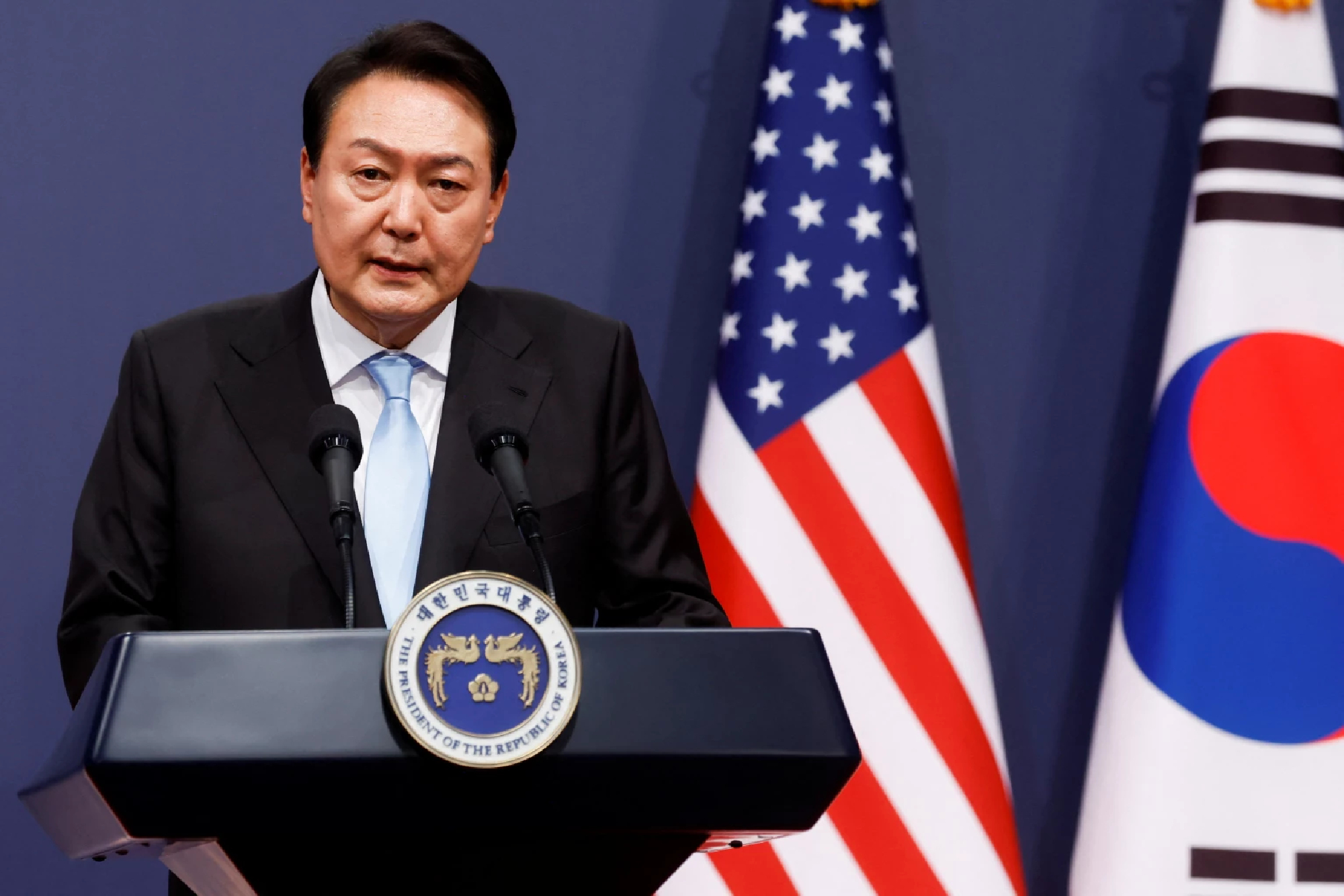
South Korean leader Yoon Suk-yeol vowed to build a supply chain for semiconductors and batteries spanning the Indo-Pacific during talks at the first Indo-Pacific Economic Framework (IPEF) summit on Monday.
Seoul sparks Beijing's anger over US-led alliance, supply chain pledge

However the IPEF, which also features Thailand, was condemned by China as “a strategy for destroying peace”.

The US-led economic alliance was launched on Monday and followed Saturday’s South Korea-US summit, where the presidents of both countries pledged close cooperation and economic ties.

“The launch of the IPEF is a meaningful first step in demonstrating the will of solidarity and cooperation among countries in the region in a rapidly changing economic environment,” President Yoon said at the IPEF summit, with US President Joe Biden among leaders of 13 countries participating by video link. Other nations taking part were Australia, Brunei, India, Indonesia, Japan, Malaysia, New Zealand, Philippines, Singapore, Thailand and Vietnam.

“As a nation with core competencies in high-tech industries such as chips, batteries and future vehicles, we will build a mutually beneficial supply chain” with countries in the Indo-Pacific region, Yoon said.

He also pledged to “lead new technological innovations such as AI, data and 6G”, and “contribute to building digital infrastructure and bridging the digital divide”. South Korea claims to be the first country to launch and commercialise a high-speed 5G network nationwide.

Lastly, Yoon promised that Seoul would “actively cooperate in the clean energy and decarbonisation fields and build a carbon reduction infrastructure through bold investments”.

Participating members jointly declared they would strengthen cooperation in four areas: trade, supply chains, clean energy, decarbonisation and infrastructure, and tax and anti-corruption.

The member nations will seek to “ensure access” to key raw and processed materials, semiconductors, critical minerals and clean energy technology through the alliance. They plan to “accelerate the development and deployment of clean energy technologies” to decarbonise their economies and build resilience to climate impacts. They are committed to “promoting fair competition” by enacting and enforcing effective and robust taxes, as well as anti-money laundering and anti-bribery regimes.

Yoon has repeatedly expressed enthusiasm and commitment to the US-led economic alliance.

He told local reporters, “IPEF is not a trade negotiation with a certain content like a free trade agreement, but a process of making a wide range of economic and trade-related rules in the Indo-Pacific region.

“We must participate in the Indo-Pacific Economic Framework. If we are left out in making the rules, it will greatly damage national interests.”

‘Strategy for destroying peace’

China, however, was quick to condemn the new alliance, branding it “a strategy for destroying peace”.

In remarks on Sunday after the Korea-US summit had ended, Chinese Foreign Minister Wang Yi said the US’ Indo-Pacific strategy is “doomed to fail”.

“Facts will prove that the so-called Indo-Pacific strategy is essentially a strategy for creating divisions, a strategy for inciting confrontation, and a strategy for destroying peace,” he said.

South Korea’s Foreign Minister Park Jin responded by saying China seemed to be looking at only “one side” of the issue.

Containing China was not important, he added, rather it was about how to find and secure a future growth engine amid the newly unfolding Indo-Pacific order.

Asked if he had any concerns after participating in the IPEF summit on Monday, Yoon said: “Even if we strengthen our alliance with the United States in security and technology, it does not mean that we think our economic cooperation with China is unimportant.

“So I do not believe it is reasonable for China to be overly sensitive about this matter,” he told CNN in an interview.

The Korea Herald

Asia News Network

Asia News Network: The Nation (Thailand), The Korea Herald, The Straits Times (Singapore), China Daily, Jakarta Post, The Star and Sin Chew Daily (Malaysia), The Statesman (India), Philippine Daily Inquirer, Yomiuri Shimbun and The Japan News, Gogo Mongolia, Dawn (Pakistan), The Island (Sri Lanka), Kuensel (Bhutan), Kathmandu Post (Nepal), Daily Star (Bangladesh), Eleven Media (Myanmar), the Phnom Penh Post and Rasmei Kampuchea (Cambodia), The Borneo Bulletin (Brunei), Vietnam News, and Vientiane Times (Laos).

Published : May 24, 2022

By : The Korea Herald
Consumers shift focus to business ethics amid Russia-Ukraine war: survey

#SootinClaimon.Com : ขอบคุณแหล่งข้อมูล : หนังสือพิมพ์ The Nation.

https://www.nationthailand.com/international/40015902


Doing business was about providing a service and meeting the needs of consumers, and by doing so effectively over time, companies have gained more trust from people than governments, non-governmental organisations and the media have.

Consumers shift focus to business ethics amid Russia-Ukraine war: survey

Today, while people still see the key responsibility of business as contributing to the economy and societies, businesses are adding geopolitics to their list of responsibilities as well.

This was one of the key findings of the latest Edelman Trust Barometer poll released at a breakfast briefing in Davos, on the opening day of this year’s World Economic Forum annual meeting on Monday.

Russia’s invasion of Ukraine has moved geopolitics to the front and centre of the business agenda, the survey shows.

People are now evaluating where a company operates and what actions it takes in situations of conflict, and there is support for business activism in geopolitics, the audience was told.

Nearly 60 per cent of respondents in the poll said geopolitics is now a top priority for business.

Nearly every respondent (95 per cent) said they expect businesses to act in response to an unprovoked invasion, and this could take the form of exerting political or economic pressure or publicly speaking out against the aggressor.

Almost half (47 per cent) of the respondents said they had bought or boycotted brands based on the parent company’s response to the invasion of Ukraine.

Edelman’s report, “The Trust Barometer Special Report: The Geopolitical Business”, follows its survey of 14,000 respondents from 14 countries in the past month.

Introducing it to a select group of people, the global communications firm’s chief executive Richard Edelman said the ability of businesses “to get things done has led to an increasing reliance on business, not government, as the primary actor on societal issues, from sustainability to diversity and inclusion to human rights, to wage levels and reskilling.

“The Russian invasion of Ukraine has now added geopolitics to the list of business priorities,” he added.

“The exit of 1,000 companies from the Russian market in the three months since the invasion is also evidence of the new values standard for business, expected to be an ethical participant in society.”

Edelman’s opening remarks to the audience sparked a lively debate among panellists over the implications of the findings and what they would mean for companies’ dealings, and for the West with China.

Discussions also touched on inequity in society and the need to do more to uplift the living conditions of the poor, boardroom discussions on evolving corporate values, and related issues.

Singapore’s former diplomat Kishore Mahbubani, who joined a group of panellists for the discussion, took up differences between how the West perceives China and Asia’s view of its neighbour.

China’s rise is a natural return, and most of Asia is realising that China is their most important neighbour and integration efforts are underway, he said.

So, if the West tries to decouple from China, it would be decoupling from a wider region, he noted.

Former Denmark prime minister Helle Thorning-Schmidt cautioned about a clash of values coming up between different civilisations, and reminded the audience of the imperative of universal values that support human rights and democracy.

Edelman’s survey also showed that employees are more willing to recommend their employer if the company has suspended its business in Russia.

The poll showed that companies can garner a huge net increase of 30 points in trust by ceasing operations in Russia. The reverse was also true. Those continuing to operate in Russia are at risk of a net loss of 38 points in trust, the poll showed.

Shefali Rekhi

Asia News Network Editor

The Straits Times

Asia News Network

Asia News Network: The Nation (Thailand), The Korea Herald, The Straits Times (Singapore), China Daily, Jakarta Post, The Star and Sin Chew Daily (Malaysia), The Statesman (India), Philippine Daily Inquirer, Yomiuri Shimbun and The Japan News, Gogo Mongolia, Dawn (Pakistan), The Island (Sri Lanka), Kuensel (Bhutan), Kathmandu Post (Nepal), Daily Star (Bangladesh), Eleven Media (Myanmar), the Phnom Penh Post and Rasmei Kampuchea (Cambodia), The Borneo Bulletin (Brunei), Vietnam News, and Vientiane Times (Laos).

Published : May 24, 2022

China slams Biden over pledge to defend Taiwan militarily

#SootinClaimon.Com : ขอบคุณแหล่งข้อมูล : หนังสือพิมพ์ The Nation.

https://www.nationthailand.com/international/40015896


China has hit back at United States President Joe Biden’s claims that Washington would militarily defend Taiwan, warning that no one should underestimate the nation’s “firm resolve, staunch will and strong ability” to safeguard its sovereignty and territorial integrity.

China slams Biden over pledge to defend Taiwan militarily

Speaking at a regular news conference on Monday, Foreign Ministry spokesman Wang Wenbin said that China expresses strong dissatisfaction with and firm opposition to Biden’s remarks, stressing that Taiwan is an inalienable part of Chinese territory.

Wang’s comment came after Biden, who was visiting Japan, said earlier on Monday in Tokyo that the US would intervene militarily to defend Taiwan, a statement that was seen as a violation by Washington of its commitment to the one-China principle and a fresh challenge to China’s core interests.

The spokesman reiterated that the Taiwan question is purely China’s internal affair and so allows no foreign interference.

“On issues that bear on China’s sovereignty, territorial integrity and other core interests, no one shall expect China to make any compromise or trade-offs,” said Wang, warning the US not to stand on the opposite side of the 1.4 billion Chinese people.

He also urged the US to earnestly abide by the one-China principle and stipulations in the three China-US joint communique, honour its commitment to not supporting “Taiwan independence” and be prudent with its words and actions on the Taiwan question.

The US should avoid sending wrong signals to “Taiwan independence” separatist forces, lest it should seriously damage China-US relations and peace and stability across the Taiwan Straits, Wang said.

“The Chinese side will take firm actions to safeguard its sovereignty and security interests. We live up to our words,” he added.

Shortly after Biden’s remarks, a White House official clarified that the US policy toward Taiwan remains unchanged, Reuters reported. The official said that Biden reiterated that the US pursues the one-China policy and stays committed to peace and stability across the Taiwan Straits.

Meanwhile, the 75th World Health Assembly unequivocally refused on Monday to put on the conference’s agenda the proposal of a handful of countries inviting Taiwan to participate as an observer. The World Health Assembly is the decision-making body of the World Health Organization.

It has been proved that the one-China principle is a broad consensus of the international community and also an overriding trend that brooks no challenge, said Zhu Fenglian, a spokeswoman for the Taiwan Affairs Office of the State Council, on Monday.

The Taiwan question has been the most sensitive in China-US relations. However, Washington has constantly played the “Taiwan card” in recent years to contain China’s development by developing official exchanges with Taiwan and selling more advanced arms to the island.

In 2018, then US President Donald Trump signed the Taiwan Travel Act, encouraging visits between the US and Taiwan at all levels. One of Washington’s provocative moves against China was the visit by a delegation of US Congress members to Taiwan in April. There had been reports that Nancy Pelosi, speaker of the US House of Representatives, might visit Taiwan during her Asian trip, but the trip was postponed after she became infected with COVID-19.

Recently, wording about not supporting “Taiwan independence” and acknowledging Beijing’s position that Taiwan is part of China was removed from the section of the US State Department website regarding Taiwan.

The Foreign Ministry has warned Washington to stop hollowing out the one-China principle and stop condoning or abetting “Taiwan independence” moves and urged it to honour its political commitments to China.

Observers said that Washington’s irresponsible words and deeds run counter to a series of consensuses reached between the heads of state of the two countries and that if the US persists in playing the “Taiwan card” and goes further down the wrong path, it will lead to a very perilous situation.

Xu Liping, a researcher at the National Institute of International Strategy of the Chinese Academy of Social Sciences, said that at a time when the conflict between Russia and Ukraine has yet to be resolved, the US is constantly fanning the flames and attempting to damage cross-Straits relations, which is detrimental to regional and global peace, stability and development.

As the world’s largest economy, the US should take the responsibility for promoting world peace, but what it is doing is only hampering regional and global development, Xu said, adding that this shows the hypocrisy of the US government.

China Daily

Asia News Network

Asia News Network: The Nation (Thailand), The Korea Herald, The Straits Times (Singapore), China Daily, Jakarta Post, The Star and Sin Chew Daily (Malaysia), The Statesman (India), Philippine Daily Inquirer, Yomiuri Shimbun and The Japan News, Gogo Mongolia, Dawn (Pakistan), The Island (Sri Lanka), Kuensel (Bhutan), Kathmandu Post (Nepal), Daily Star (Bangladesh), Eleven Media (Myanmar), the Phnom Penh Post and Rasmei Kampuchea (Cambodia), The Borneo Bulletin (Brunei), Vietnam News, and Vientiane Times (Laos).

Published : May 24, 2022

By : China Daily

The latest news on what’s happening in the region

#SootinClaimon.Com : ขอบคุณแหล่งข้อมูล : หนังสือพิมพ์ The Nation.

https://www.nationthailand.com/international/40015868


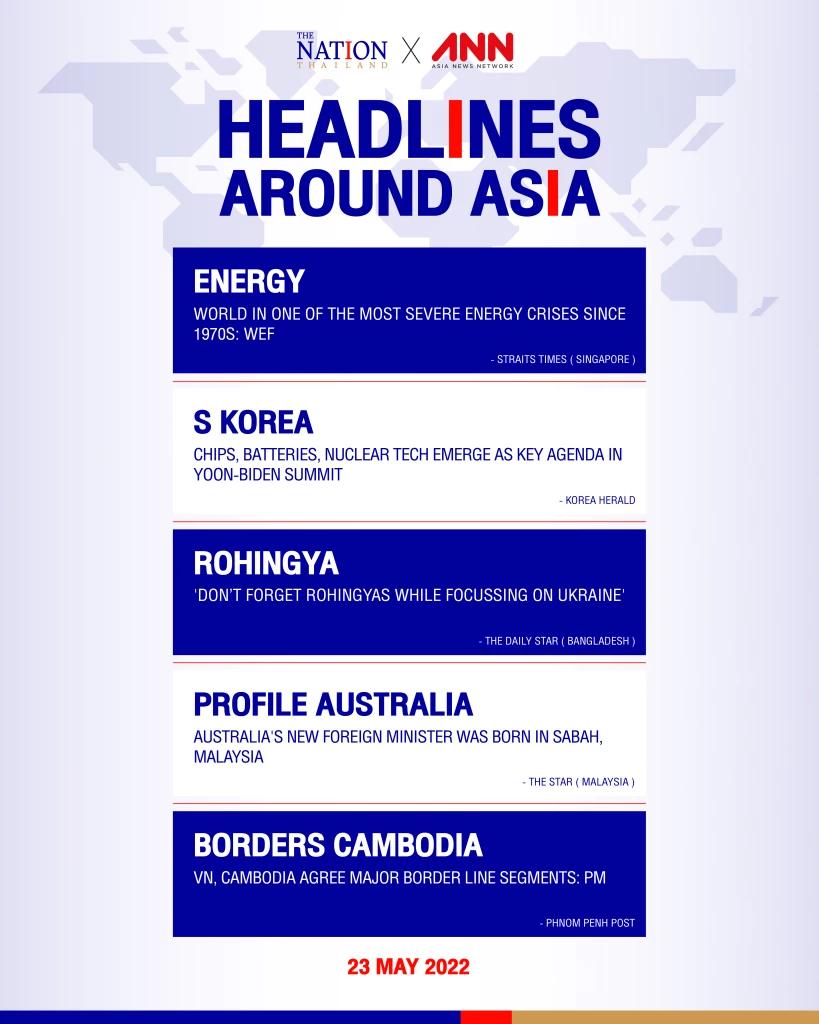
Check out what’s hot in the region on May 23 as The Nation puts together headlines from members of Asia News Network (ANN). Click to read more:

The latest news on what's happening in the region

Energy 
World in one of the most severe energy crises since 1970s: WEF 


Straits Times ( Singapore )
https://www.nationthailand.com/international/40015857

S Korea
Chips, batteries, nuclear tech emerge as key agenda in Yoon-Biden summit 


Korea Herald
https://www.nationthailand.com/international/40015851

Rohingya 
‘Don’t forget Rohingyas while focussing on Ukraine’ 


The Daily Star ( Bangladesh )
https://www.nationthailand.com/international/40015860


Profile Australia 
Australia’s new Foreign Minister was born in Sabah, Malaysia 


The Star ( Malaysia )
https://www.nationthailand.com/international/40015852


Borders Cambodia 
VN, Cambodia agree major border line segments: PM  


Phnom Penh Post
https://www.nationthailand.com/international/40015849

Asia News Network: The Nation (Thailand), The Korea Herald, The Straits Times (Singapore), China Daily, Jakarta Post, The Star and Sin Chew Daily (Malaysia), The Statesman (India), Philippine Daily Inquirer, Yomiuri Shimbun and The Japan News, Gogo Mongolia, Dawn (Pakistan), The Island (Sri Lanka), Kuensel (Bhutan), Kathmandu Post (Nepal), Daily Star (Bangladesh), Eleven Media (Myanmar), the Phnom Penh Post and Rasmei Kampuchea (Cambodia), The Borneo Bulletin (Brunei), Vietnam News, and Vientiane Times (Laos).

Published : May 23, 2022

‘Don’t forget Rohingyas while focussing on Ukraine’

#SootinClaimon.Com : ขอบคุณแหล่งข้อมูล : หนังสือพิมพ์ The Nation.

https://www.nationthailand.com/international/40015860


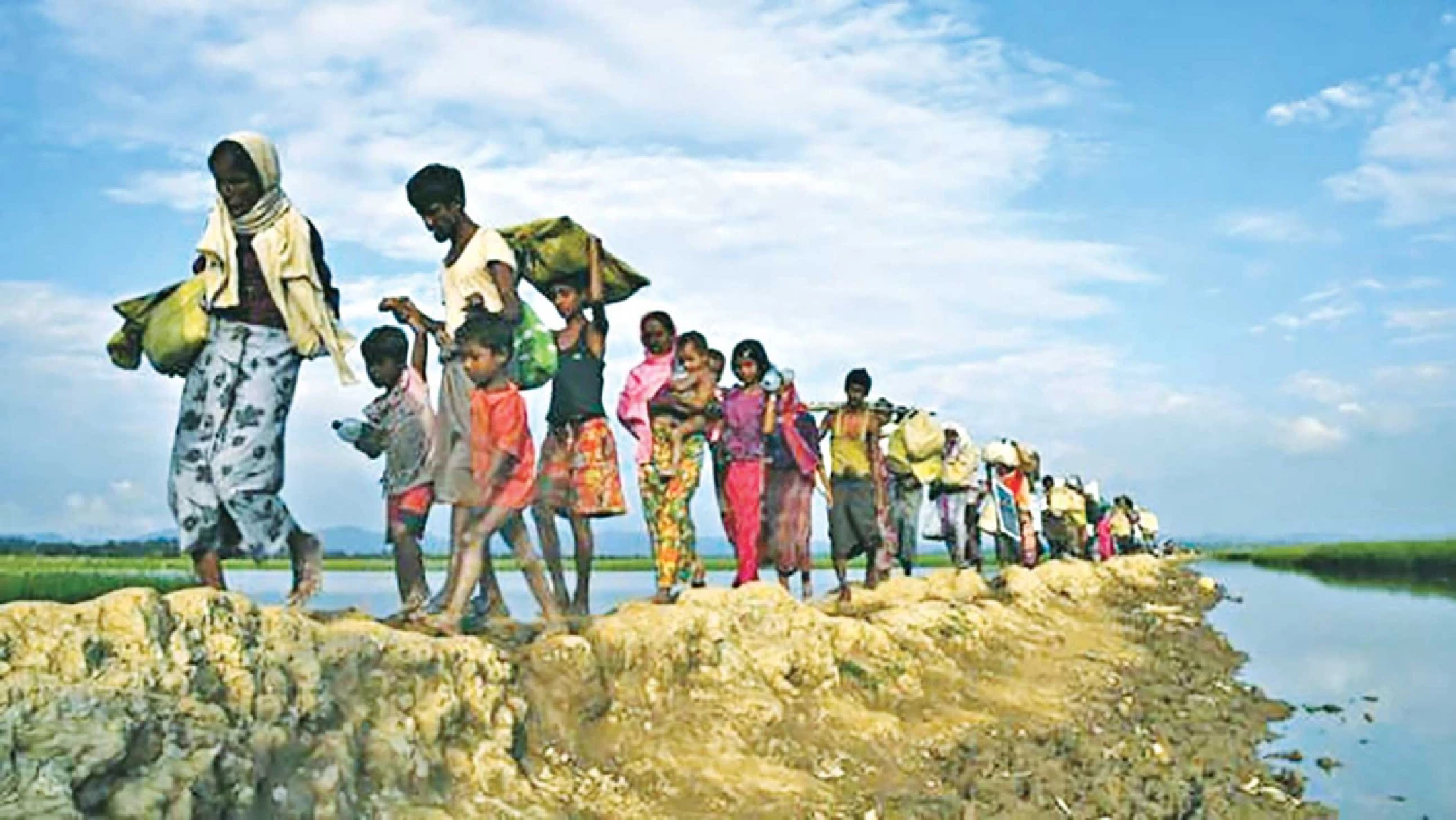
Filippo Grandi, the UN High Commissioner for Refugees, has said they must not forget other difficult situations in the world including the Rohingya crisis that need its attention and resources while focussing on the “catastrophic emergency” in Ukraine.

'Don’t forget Rohingyas while focussing on Ukraine'

In a video message released on Sunday, Grandi said he came to Bangladesh to emphasise it once again like what he did in Afghanistan and Cameroon recently.

“I came to Bangladesh because this is such a priority partner country for the UNHCR and the Rohingya crisis is such a priority crisis,” he said. His five-day visit to Bangladesh began yesterday.

Grandi, who last visited Bangladesh in March 2019, said it is very useful to visit projects and talk to the Rohingya, religious leaders from the community, environmental activists and people who have been in Rohingya camps for many decades.

Everybody has different perspectives but there is a strong sense of uncertainty about the future, he said.

Grandi said most of the Rohingyas want to go back to their country – Myanmar which is just across the river.

“They want to do this only if their security is guaranteed and if their citizenship is recognised. These are virtually stateless people at this moment,” he said, highlighting the importance of their freedom of movement and access to services after their return to Myanmar.

The high commissioner will meet with representatives of the government of Bangladesh to discuss the ongoing response to Rohingya refugees in Cox’s Bazar and Bhashan Char.

He will also highlight the need for sustained international support when meeting with key donors and partners who support the humanitarian response in Cox’s Bazar and Bhashan Char.

During his visit to the camps and Bhashan Char, Grandi will meet with Rohingya refugees to discuss their needs, challenges and hopes for the future.

Grandi is accompanied on his visit by Indrika Ratwatte, UNHCR’s regional director for Asia and the Pacific, and Herve de Villeroche, senior advisor to the High Commissioner.

Daily Star

Asia News Network: The Nation (Thailand), The Korea Herald, The Straits Times (Singapore), China Daily, Jakarta Post, The Star and Sin Chew Daily (Malaysia), The Statesman (India), Philippine Daily Inquirer, Yomiuri Shimbun and The Japan News, Gogo Mongolia, Dawn (Pakistan), The Island (Sri Lanka), Kuensel (Bhutan), Kathmandu Post (Nepal), Daily Star (Bangladesh), Eleven Media (Myanmar), the Phnom Penh Post and Rasmei Kampuchea (Cambodia), The Borneo Bulletin (Brunei), Vietnam News, and Vientiane Times (Laos).

Published : May 23, 2022

World facing one of its most severe energy crises: WEF

#SootinClaimon.Com : ขอบคุณแหล่งข้อมูล : หนังสือพิมพ์ The Nation.

https://www.nationthailand.com/international/40015857


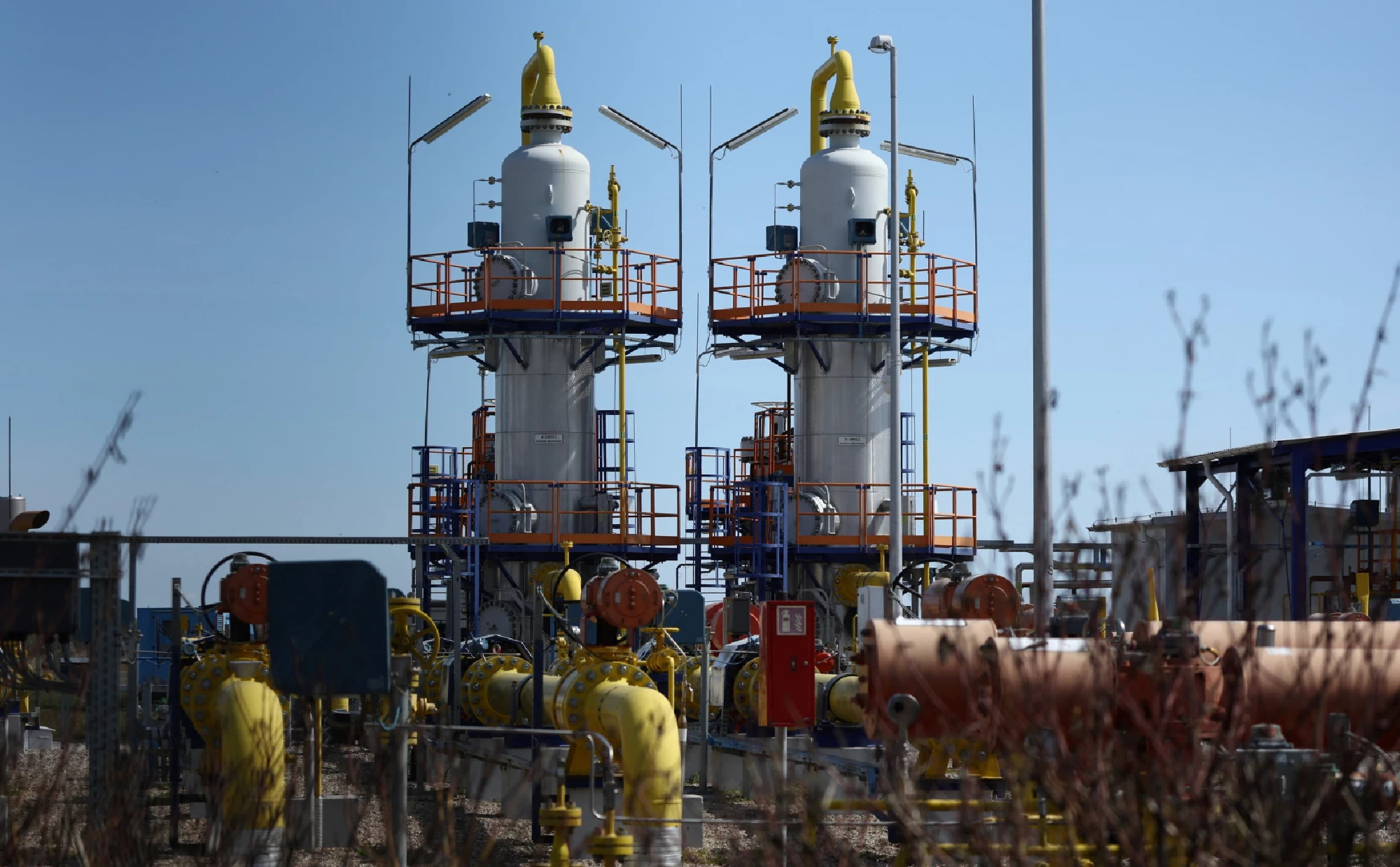
The war in Ukraine, as well as the pandemic and the quick economic rebound in its aftermath, significantly disrupted energy transition efforts.

World facing one of its most severe energy crises: WEF

This has left the world in one of the most severe energy crises since the 1970s, the World Economic Forum (WEF) said in a new report titled “Fostering Effective Energy Transition 2022”.

The pace of energy transition needs to be supercharged for the world to keep to its sustainability goals, it noted.

United Nations Secretary-General Antonio Guterres drew attention to the energy crisis in an address on May 19, noting that Russia’s war on Ukraine will likely have major implications for global heating targets.

Many countries are stepping up the use of coal or imports of liquefied natural gas as alternative sources to Russian energy, he noted, calling the short-sighted rush to fossil fuels “madness”.

The WEF, in its latest energy transition report, called for urgent action by both private and public actors to ensure a resilient transition.

This “urgency for countries to accelerate a holistic energy transition is reinforced by high fuel prices, commodities’ shortages, insufficient headway on achieving climate goals and slow progress on energy justice and access”, it said.

Roberto Bocca, head of energy, materials and infrastructure at the WEF, said: “Countries are at risk of future events compounding the disruption of their energy supply chain at a time when the window to prevent the worst consequences of climate change is closing fast.”

He added: “Now is the time to double down on the action.”

The WEF report detailed key recommendations for governments, companies, consumers and other stakeholders on measures to advance the energy transition.

Countries will need to prioritise efforts to ensure a resilient energy transition and diversification of the energy mix, it stated.

Diversification needs to be pursued on two fronts: Countries need to review their domestic energy mix and consider their fuel and energy suppliers in the shorter term.

Most countries rely on just a handful of trade partners to meet their energy requirements and have a deficient diversification of energy sources, providing limited flexibility to deal with disruptions, the WEF said.

The report noted that of 34 countries with advanced economies, 11 rely on only three trade partners for more than 70 per cent of their fuel imports.

More countries need to make binding climate commitments, create a long-term vision for domestic and regional energy systems, attract private-sector investors for decarbonisation projects and help consumers and the workforce adjust, the report added.

Shefali Rekhi

Asia News Network Editor

The Straits Times

Asia News Network: The Nation (Thailand), The Korea Herald, The Straits Times (Singapore), China Daily, Jakarta Post, The Star and Sin Chew Daily (Malaysia), The Statesman (India), Philippine Daily Inquirer, Yomiuri Shimbun and The Japan News, Gogo Mongolia, Dawn (Pakistan), The Island (Sri Lanka), Kuensel (Bhutan), Kathmandu Post (Nepal), Daily Star (Bangladesh), Eleven Media (Myanmar), the Phnom Penh Post and Rasmei Kampuchea (Cambodia), The Borneo Bulletin (Brunei), Vietnam News, and Vientiane Times (Laos).

Published : May 23, 2022

By : The Straits Times

Australia’s new Foreign Minister was born in Sabah

#SootinClaimon.Com : ขอบคุณแหล่งข้อมูล : หนังสือพิมพ์ The Nation.

https://www.nationthailand.com/international/40015852


Veteran senior politician Penny Wong is slated to take office on Monday as Foreign Affairs Minister under the Labour government of Anthony Albanese.

Australia's new Foreign Minister was born in Sabah

The law and arts graduate from the University of Adelaide was born in Kota Kinabalu, Sabah and then moved to Australia in 1976 as an eight-year-old.

She is the daughter of respected architect Francis Wong.

She was elected senator in 2001 and in 2008, became the first Asian-born member of an Australian Cabinet when she served as Climate Change Minister in the Kevin Rudd administration.

In 2013, she became the Leader of the Government in the Senate and later, after the change of government, she was appointed the Leader of the Opposition in the Senate. She is the first woman to hold these roles.

Asia News Network: The Nation (Thailand), The Korea Herald, The Straits Times (Singapore), China Daily, Jakarta Post, The Star and Sin Chew Daily (Malaysia), The Statesman (India), Philippine Daily Inquirer, Yomiuri Shimbun and The Japan News, Gogo Mongolia, Dawn (Pakistan), The Island (Sri Lanka), Kuensel (Bhutan), Kathmandu Post (Nepal), Daily Star (Bangladesh), Eleven Media (Myanmar), the Phnom Penh Post and Rasmei Kampuchea (Cambodia), The Borneo Bulletin (Brunei), Vietnam News, and Vientiane Times (Laos).

Published : May 23, 2022

By : The Star

Chips, batteries, nuclear tech emerge as key agenda in Yoon-Biden summit

#SootinClaimon.Com : ขอบคุณแหล่งข้อมูล : หนังสือพิมพ์ The Nation.

https://www.nationthailand.com/international/40015851


US President Joe Biden’s trip to Asia and his choice of South Korea as his first stop underscore Washington’s willingness to address global supply chain uncertainties largely posed by Russia’s invasion of Ukraine, along with efforts to counter dependence on China.

Chips, batteries, nuclear tech emerge as key agenda in Yoon-Biden summit

This can be achieved by strengthening collaboration with technology powerhouses in Asia’s fourth-largest economy, the summit between President Yoon Suk-yeol and Biden showed.

To this end, Yoon and Biden called on the need for more investment, research and people-to-people exchanges of experts to nurture innovative products and technologies from Korea and the US, including thinner semiconductor chips, the batteries that power electric vehicles, civil nuclear power reactors to cut carbon emissions, and more.

On Saturday, Yoon told reporters that the summit during Biden’s three-day visit to Korea marked an agreement “to step up (Korea’s) practical cooperation” in the fields of semiconductors, batteries, civil nuclear power, space development and cyberspace, adding these are a matter of “economic security.”
 

“As a first step, our offices will launch an economic security dialogue so that in supply chains, advanced science and technology, and other areas of economic security, our two countries can have timely communication and cooperation,” Yoon said.

“The tragedy brought on by Russia’s invasion of Ukraine must be resolved swiftly so that the people can return to their peaceful, normal lives.”

The decision comes against the backdrop of growing supply chain disruptions that are affecting the livelihoods of ordinary people and the overall national economy.

Korea has suffered supply shortages of critical materials and products, including consumer goods like cars as well as diesel exhaust fluid.

“Due to the COVID-19 pandemic and the formation of the blocks in the market, we see permanent risks when it comes to the supply chain,” Yoon said, adding the lapses in economic security could lead to threats to national security as well as to military security.


This highlights the growing role of Korea in the Asia-Pacific region when it comes to addressing supply chain challenges.

“Our two nations are working together to take on both the opportunities and the challenges of the moment, continuing to fight COVID-19, securing the supply chains, tackling the climate crisis, deepening our security cooperation to meet regional challenges and writing the rules of the road to ensure the Indo-Pacific is a free and open area,” Biden told reporters.

The summit suggested a regular ministerial-level Supply Chain and Commercial Dialogue between Korean Industry Minister Lee Chang-yang and US Secretary of Commerce Gina Raimondo, aimed at discussing the promotion of resilient supply chains of products including semiconductors and batteries, as well as critical minerals. Previously, the two nations had held working-level discussions on the matter.

Private companies in Korea have been moving in tandem.

Tech giant Samsung Electronics announced in November a $17 billion plan to build a foundry plant in Taylor, Texas, aiming to begin operations in 2024. Samsung has also reportedly filed for greater investment with authorities in the area — the Taylor and Manor school districts in Texas — and more tax breaks in return.

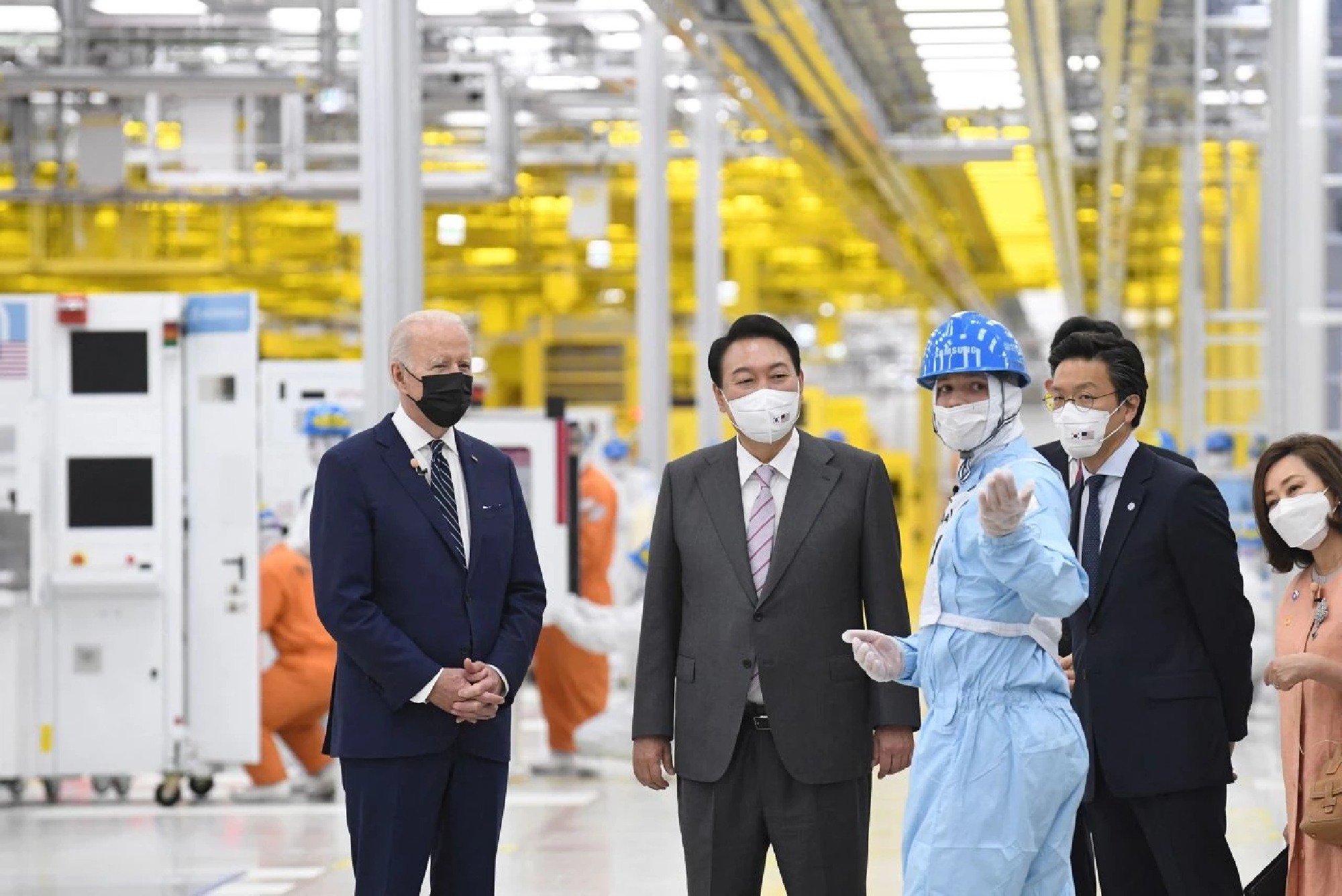
Samsung’s track record in the US was in the spotlight during Biden’s visit on Friday to a chip plant in Pyeongtaek, Gyeonggi Province, including the Texas chip plant and its battery affiliate Samsung SDI’s effort to build a battery factory with Stellantis through a joint venture announced in October.

Moreover, SK Group’s wafer production arm SK Siltron also unveiled in November a $600 million investment plan in the US to expand production capacity over the next five years.

The US is facing imminent pressure to stay in the global chip arms race amid China’s bid to expand chip manufacturing. In 2021 alone, Chinese firms announced $26 billion in investment plans through 28 projects across China, showed an estimate by the Semiconductor Industry Association, an advocacy group in the US.

Korea is projected to become home to the third-largest semiconductor chip production base. By 2030, Korean firms will be responsible for nearly 20 per cent of total chip production, trailing China with 24 per cent and Taiwan with 21 per cent, according to a report jointly conducted by the SIA and Boston Consulting Group. US firms are projected to produce a combined 10 per cent of chips globally in 2030.

On the electric vehicle front, automaker Hyundai Motor unveiled a combined $10 billion plan to invest in the US during Biden’s visit to Korea.

On Sunday, Hyundai Motor pledged a $5 billion investment in robotics, autonomous driving, air taxis and artificial intelligence, a day after it unveiled a $5.5 billion plan to build full electric vehicle and battery manufacturing facilities in Bryan County, Georgia, aiming to kick off in 2025.

As for plans to launch more civil nuclear power plants, Yoon said the country will seek the development of advanced reactors and small modular reactors.

Asia News Network: The Nation (Thailand), The Korea Herald, The Straits Times (Singapore), China Daily, Jakarta Post, The Star and Sin Chew Daily (Malaysia), The Statesman (India), Philippine Daily Inquirer, Yomiuri Shimbun and The Japan News, Gogo Mongolia, Dawn (Pakistan), The Island (Sri Lanka), Kuensel (Bhutan), Kathmandu Post (Nepal), Daily Star (Bangladesh), Eleven Media (Myanmar), the Phnom Penh Post and Rasmei Kampuchea (Cambodia), The Borneo Bulletin (Brunei), Vietnam News, and Vientiane Times (Laos).

Published : May 23, 2022

By : The Korea Herald

Vietnam, Cambodia agree major border line segments

#SootinClaimon.Com : ขอบคุณแหล่งข้อมูล : หนังสือพิมพ์ The Nation.

https://www.nationthailand.com/international/40015849


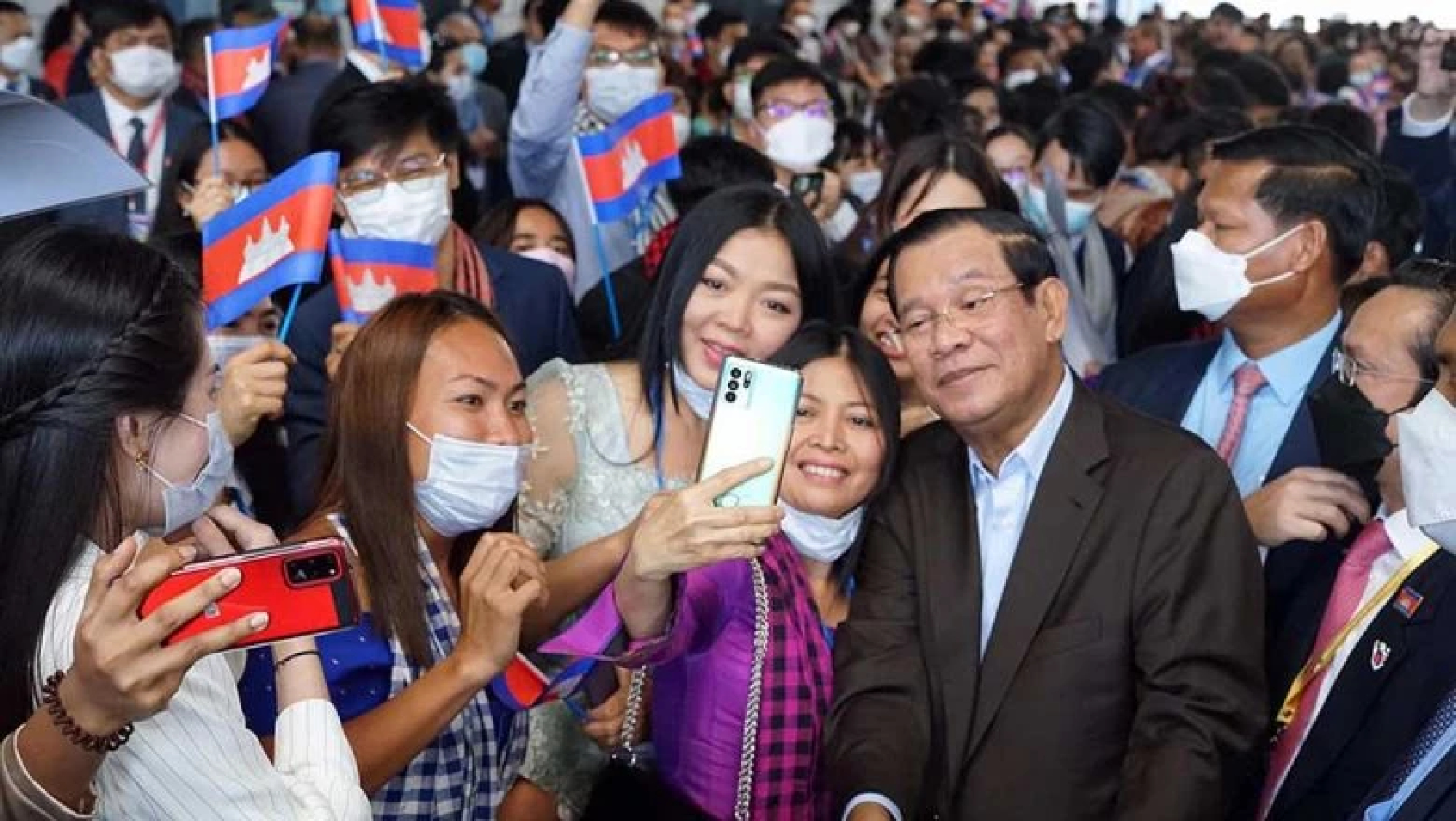
Prime Minister Hun Sen has revealed that Cambodia and Vietnam have agreed on six per cent of the remaining undemarcated borders between the two countries, in a varied speech to members of the Cambodian diaspora in Europe, in which he also discussed the upcoming commune council elections.

Vietnam, Cambodia agree major border line segments

While greeting them on May 21 before attending the World Economic Forum in Davos, Switzerland, Hun Sen said the border committees of Cambodia and Vietnam had recently negotiated the boundary for six of the remaining 16 per cent of undemarcated borders between the two countries.

“I have invited the Prime Minister of Vietnam to visit Cambodia and put a signature on this six per cent,” he said, referring to his recent meeting with his Vietnamese counterpart Pham Minh Chinh during the May 12-13 ASEAN-US Special Summit in Washington, DC.

Hun Sen also criticised those who accused him of “ceding” land to Vietnam. He said if that were the case, he would not have needed to negotiate, as he had with Vietnam on the six per cent of borders.

“I have no right to take Cambodian territory and give it to other people – even a millimetre of it. If it was… my land, sure, I could give some of it to others. But it is impossible to cede land from one country to offer another country,” he said.

Cambodia needs to be friendly with other countries, especially those with whom it shares a border, he added, in a rebuttal against unnamed critics of his negotiation tactics, who he said had historically sought to “fight against Vietnam to take the land back”.

In the same speech, Hun Sen also brought up the upcoming commune elections, scheduled to take place on June 5. As political parties in Cambodia kicked off their campaigns on May 21, he noted that the first day of campaigning went smoothly, and urged the public to continue to maintain civility and refrain from violence.

“Our country has gone through too much hardship there has been enough violence. We must now use policy to compete, rather than [resort to] cursing each other, [though] I can curse too,” he said.

The premier also criticised those he claimed: “like to talk about human rights but dare not talk about how to keep the peace”. He noted that since Cambodia achieved comprehensive peace in 1998, it has been able to maintain civility, with no one being killed or suffering from war-related violence or destruction.

“The absence of war has enabled us to begin the process of establishing democracy and respecting human rights,” he said.

Hun Sen also announced to the members of the Cambodian diaspora that the government will permit them to register for, and obtain, Khmer national identification cards to ease their ability to do business in Cambodia, enabling them to buy real estate “or even to form a political party”.

At the meeting, Hun Sen also revealed that he will be making a request to change his official birthday from 1951 to 1952 after the commune elections, noting that there was an over one-year difference between his stated and actual age.

The premier claimed that he chose his current birthdate of April 4, 1951, in 1970 – when he joined the armed forces of the then-prince Norodom Sihanouk to fight against foreign invaders and the Lon Nol-led coup – due to an inability to remember his actual birth date. After joining the armed forces, his commander told 300 members to write down their birth dates. As he was not able to remember the date he was born, he put the date he joined the armed group.

“I will request the court to change my date of birth from April 4, 1951, to my real birth date of August 5, 1952,” he said.

Asia News Network: The Nation (Thailand), The Korea Herald, The Straits Times (Singapore), China Daily, Jakarta Post, The Star and Sin Chew Daily (Malaysia), The Statesman (India), Philippine Daily Inquirer, Yomiuri Shimbun and The Japan News, Gogo Mongolia, Dawn (Pakistan), The Island (Sri Lanka), Kuensel (Bhutan), Kathmandu Post (Nepal), Daily Star (Bangladesh), Eleven Media (Myanmar), the Phnom Penh Post and Rasmei Kampuchea (Cambodia), The Borneo Bulletin (Brunei), Vietnam News, and Vientiane Times (Laos).

Published : May 23, 2022

By : The Phnom Penh Post

Rohingyas sneaking into Bangladesh from India now

#SootinClaimon.Com : ขอบคุณแหล่งข้อมูล : หนังสือพิมพ์ The Nation.

https://www.nationthailand.com/international/40015811


The illegal entry of Rohingyas into Bangladesh from India over the past three weeks has triggered a fresh concern as the new inflow will create an additional burden for the country already hosting one million of the forcibly displaced Myanmar nationals.

Rohingyas sneaking into Bangladesh from India now

Police and intelligence officials said many of the Rohingyas, who lived in different places in India, sneaked into Bangladesh with the help of brokers and some were detained by law enforcers. They were later sent to the transitional camps in Cox’s Bazar.

There is no official record of the numbers of Rohingyas entering so far, but officials said some 500 of them may have entered Bangladesh from India over the last one month.

“We are heavily burdened with the Rohingyas and any sort of illegal entry is a matter of serious concern. It should be stopped immediately,” said a top government official engaged in the Rohingya repatriation process in Cox’s Bazar, where over one million Rohingyas live in several refugee camps.

On Tuesday, Foreign Minister AK Abdul Moment voiced similar concerns.

“Unfortunately, many Rohingyas are coming to Bangladesh from India,” he told reporters, adding that he would take up the matter with his Indian counterpart.

Bangladesh has been facing episodic influxes of Rohingyas fleeing violence in Myanmar for decades, with the largest exodus from Rakhine State taking place in August 2017. They joined the 300,000 of their compatriots already there from previous waves of displacement, causing significant economic and strategic challenges for Bangladesh.

Rohingyas who entered Bangladesh illegally from India told Bangladesh law enforcers that they had to spend around 15,000 Indian rupees to cross the border, sources said.

Take the example of Selim.

In 2012, Selim went to Jammu from Maungdaw and had since been sheltered in a refugee camp with a UNHCR card along with 200-300 other Rohingya families, law enforcers said, citing Selim.

Selim claimed that recently the situation in the Jammu area became volatile. He then communicated with his sister-in-law Tomida Khatun, who lives in Kutupalong camp in Cox’s Bazar.

“My sister-in-law told me that the Rohingya camp situation in Bangladesh is good and that the Bangladesh government is very kind and helpful. Then I decided to move,” he said.

Selim later communicated with an Indian broker and made a deal to cross the border.

As per the deal, Selim along with his wife and two children went to Delhi from Jammu by bus on May 8. From Delhi, they came to Agartala by train, which took them 72 hours.

Around 2:00pm on May 13, they entered Feni district of Bangladesh through an opening of the wire fence of Agartala border.

An unknown broker received them and then they went to Ramu in Cox’s Bazar and reached near the camp.

“After arriving here, I phoned my sister-in-law and then she came and took us inside the camp through an opening of the barbed-wire fence,” he told law enforcers.

But based on a tip-off, the Armed Police Battalion took them from the camp and sent them to the office of the Camp in Charge (CiC) in the Rohingya camp.

Naimul Haque, commanding officer of Armed Police Battalion (APBn)-14 said it is difficult to say exactly how many Rohingyas entered Bangladesh from India.

“But in my camp, we have arrested some 25 Rohingyas and they were sent to the CiC office,” he said.

He also said that some of the Rohingyas who came from India said they crossed the border as they have relatives here. Others cited the poor law and order situation in India and better living conditions in Bangladesh camps.

They said Rohingyas with the help of brokers first come to Kolkata by train. Then another group of brokers take the Rohingyas and then they were taken to Bangladesh’s borders in Sylhet, Cumilla and Moulvibazar by train.

There, another group of brokers near the border divide them into groups of 5-6 and help them enter Bangladesh through the barbed wire at the border.

Rohingyas who have already entered Bangladesh told the law enforcement agencies that some 2,000-3,000 Rohingyas are waiting in bordering areas to trespass into Bangladesh.

Intelligence sources said many of the Rohingyas have already spread to many parts of the country.

Md Mamunur Rashid, Deputy Commissioner of Cox’s Bazar, said, “It is a concern as Rohingyas are coming from India. They are now in the transit camps and the decisions about them will be taken soon after reviewing the overall situation.”

According to Human Rights Watch, an estimated 40,000 Rohingyas are in India, at least 20,000 of whom are registered with the UNHCR.

Since 2016, ultranationalist Hindu groups have targeted Rohingya refugees in Jammu as part of growing attacks on Muslims in India and called for their expulsion from the country.

After October 2018, the Indian government deported 12 Rohingyas to Myanmar, claiming that they left voluntarily. However, the government denied repeated requests by the UNHCR to gain access to them to independently assess whether the decision was voluntary.

Published : May 22, 2022

By : The Daily Star