Stocks under pressure as megacap tech sells off

#SootinClaimon.Com : ขอบคุณแหล่งข้อมูล : หนังสือพิมพ์ The Nation.

https://www.nationthailand.com/business/40010089


A rout in some of the worlds biggest technology companies dragged down the broader equity market, outweighing gains in companies that stand to benefit the most from an economic rebound.

Stocks under pressure as megacap tech sells off

The S&P 500 fell after earlier climbing on bets that central banks can move toward tighter policies to fight inflation without derailing the economy. The Nasdaq 100 tumbled, led by losses in giants like Apple and Tesla. Commodity, financial and industrial shares rose. European equities jumped as the region’s policy makers unveiled a gradual pullback of pandemic stimulus, while the pound gained as the Bank of England unexpectedly raised rates. Bitcoin slumped.

Central banks are weighing measures to fight price pressures while balancing risks to growth amid coronavirus challenges. European Central Bank President Christine Lagarde unveiled forecasts showing a strong economic rebound along with an outlook for faster inflation. The Federal Reserve said Wednesday it will accelerate the pace at which it tapers bond purchases, and projected rate hikes through 2024.

Comments:

– “Bitcoin and big tech are getting punished today as investors reallocate some of their more profitable risky bets. The growth outlook still remains upbeat for next year” with some traders rotating back into cyclicals, said Edward Moya, senior market analyst at Oanda.

– “While we expect increased stock market volatility as the Federal Reserve embarks on normalizing policy, equity markets should end the year higher as the economy still remains strong, which should lead to continued earnings growth,” said Richard Saperstein, chief investment officer at Treasury Partners.

– “I do think that central banks are being reactive, which is good. If inflation does start to moderate as these major central banks are still expecting, we may actually expect some turn in the policy direction in the later part of next year,” said Janet Mui, investment director at Brewin Dolphin.

Corporate highlights:

– Adobe Inc. forecast revenue for the first fiscal quarter and full year 2022 that fell short of analysts estimates.

– Delta Air Lines Inc. projected it will report a profit this quarter, citing strong demand for travel and a decline in jet-fuel prices.

– Reddit Inc., the social-media platform that helped fuel this year’s meme stock frenzy, said it has confidentially filed for an initial public offering.

– Air France-KLM agreed to buy 100 single-aisle planes from Airbus in another major order setback for Boeing — which had supplied aircraft the new jets will replace.

Stocks:

– The S&P 500 fell 0.5% as of 1:04 p.m. New York time.

– The Nasdaq 100 fell 2.2%.

– The Dow Jones Industrial Average rose 0.1%.

– The MSCI World index was little changed.

Currencies:

– The Bloomberg Dollar Spot Index fell 0.4%.

– The euro rose 0.3% to $1.1319.

– The British pound rose 0.4% to $1.3316.

– The Japanese yen rose 0.4% to 113.62 per dollar.

Bonds:

– The yield on 10-year Treasuries declined three basis points to 1.42%.

– Germany’s 10-year yield advanced one basis point to -0.35%.

– Britain’s 10-year yield advanced two basis points to 0.76%.

Commodities:

– West Texas Intermediate crude rose 2.2% to $72.42 a barrel.

– Gold futures rose 1.9% to $1,798.20 an ounce.

Published : December 17, 2021

By : Bloomberg
BOE surprises with first hike in crisis to curb inflation

#SootinClaimon.Com : ขอบคุณแหล่งข้อมูล : หนังสือพิมพ์ The Nation.

https://www.nationthailand.com/business/40010085


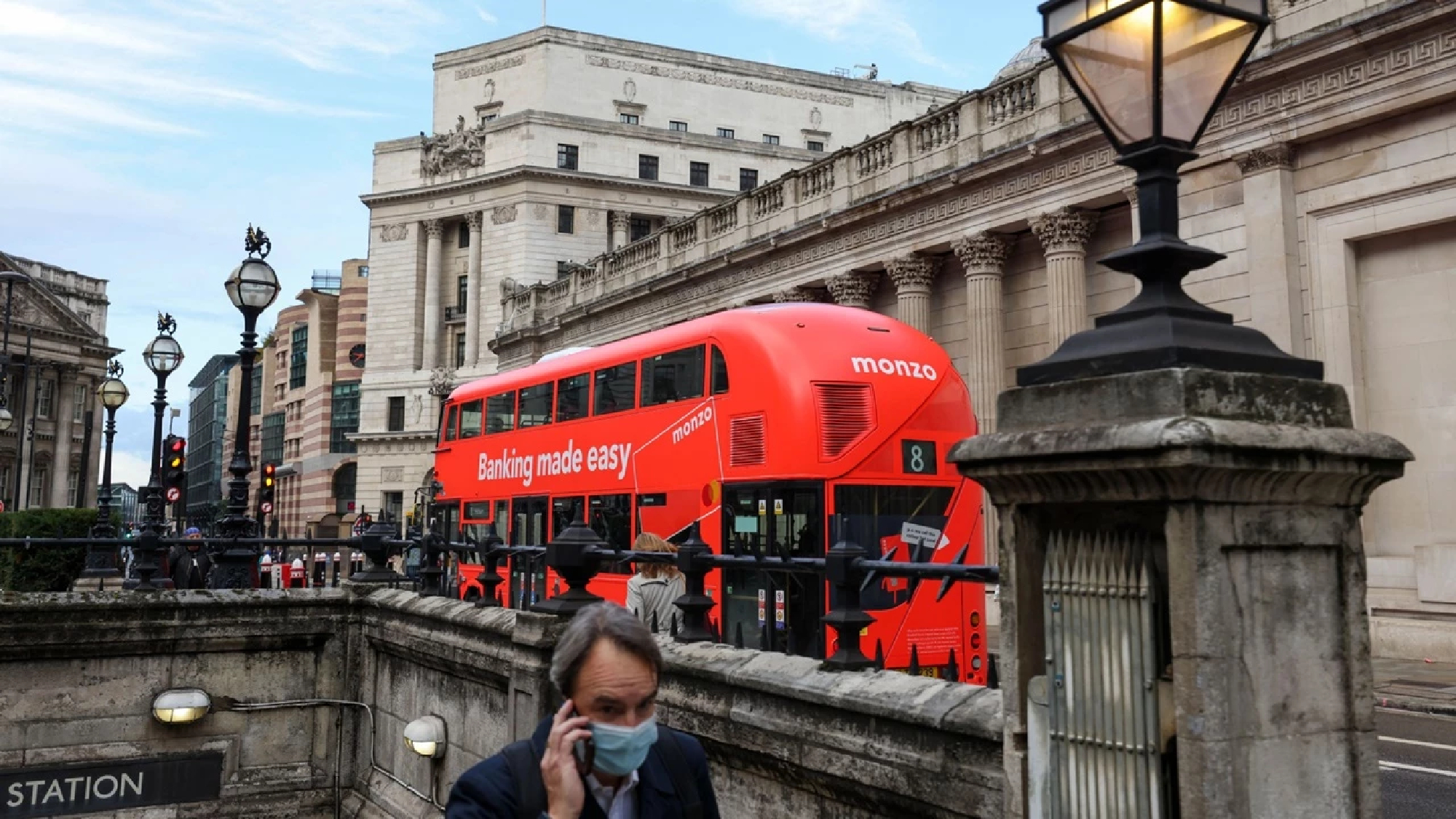
The Bank of England unexpectedly raised interest rates for the first time in three years, setting aside concerns over a surge in coronavirus infections to tackle the highest inflation in more than a decade.

BOE surprises with first hike in crisis to curb inflation

The first major central bank to hike its benchmark since the pandemic began opted to lift borrowing costs by 15 basis points to 0.25%, delivering an increase that no other Group of Seven central bank has made since the start of the crisis.

The pound rallied as much as 0.8% while U.K. 10-year yields jumped 5 basis points after the decision. Traders now see the BOE’s key rate rising to 1% by September. The FTSE 100 stock index pared gains.

“Another hike in February of 25 basis points is well in the cards,” said Fabrice Montagne, chief U.K. economist at Barclays. “If delivered, the MPC would also be in a position to start running down its balance sheet with bonds starting to mature out of its portfolio in early March.”

Markets are current pricing in another 20 basis points of increases in February — implying an around 80% chance of a move to 0.5% at that meeting. That would allow the BOE to immediately bring an end to its policy of reinvesting its expired QE bond holdings, allowing as much as 37 billion pounds of government debt to roll off its balance sheet by the end of 2022.

Officials led by Governor Andrew Bailey voted 8-1 for the increase, with Silvana Tenreyro dissenting in favor of no change. Policy makers said more “modest” tightening is likely to be needed as inflation heads toward a peak likely to be around 6% in April.

“Worries about inflation trumped concerns about omicron at the Bank of England’s December meeting. The move is a gamble — it’s possible the economy will shrug off the new variant of Covid-19, but no one knows for sure. Assuming the virus doesn’t slow the economy materially, we expect the next move in May, although there’s a small risk the BOE hikes again in February,” Dan Hanson of Bloomberg Economics wrote.

While the decision surprised investors, it was consistent Bailey’s guidance. In October, he signaled that rates would need to rise to address inflation. Later, he set out his concerns that markets seemed to think that policy makers were prioritizing growth over their inflation-fighting remit.

In a speech earlier this month, Ben Broadbent, the deputy governor, added that the BOE’s job was to focus on the medium-term risks. The decision to raise rates in the context of surging inflation and flagging growth is a clear statement of the BOE’s priorities. The focus on medium term price risks over the impact of omicron, which is likely to be short term, is consistent with Broadbent’s stance.

The U.S. Federal Reserve already set a hawkish tone on the eve of the BOE announcement by signaling three rate hikes next year and accelerating the wind down of its stimulus program, while Norway kept up its own tightening effort on Thursday with its second increase this year.

The BOE’s precipitous shift into tightening mode will surprise the large majority of economists who anticipated no change, and investors who were pricing in around a 40% chance of a move. The outcome was the second in a row featuring a surprise after November’s decision to stay on hold wrong-footed financial markets.

“The Bank of England’s decision to raise interest rates was surprising given mounting uncertainty over the economic impact of the Omicron variant,” said Suren Thiru, head of economics at the British Chambers of Commerce. “While today’s rate increase may have little effect on most firms, many will view this as the first step in a longer policy movement.”

The BOE hike is a response to the danger posed by surging prices gains, with a report this week showing inflation jumped to 5.1% in November — more than double the central bank’s target — and a separate report Tuesday showing U.K. companies added to payrolls at a record pace.

Considering that backdrop, Goldman Sachs Chief European Economist Jari Stehn told Bloomberg Television just hours earlier that an outcome of no change was “not a done deal,” even though it was his main expectation.

The decision to move now is all the more remarkable since the country is in the grips of a new coronavirus wave driven by the more infectious omicron variant, which has pushed daily case loads in the U.K. to the highest recorded total since the pandemic began.

The danger that poses in potentially overwhelming the country’s health services is such that Prime Minister Boris Johnson’s government has reintroduced some curbs on activity, with more possible in coming days and weeks if the outbreak can’t be quelled.

By moving now, the BOE heeded a warning this week from the International Monetary Fund, which cautioned against policy inaction on inflation.

The increase is the first from the BOE since 2018 and comes a day after officials wrapped up their pandemic-era quantitative easing plan. The buying has left the central bank’s holdings of government bonds at 875 billion pounds ($1.2 trillion), from 435 billion pounds before the crisis hit.

The central has only hiked rates once in December in the past 45 years, and never since it was granted independence in 1997.

Outside of emergency actions during the pandemic, it’s also the first time officials have moved at a meeting that isn’t a so-called “Super Thursday”– the nickname for the quarterly events when the BOE simultaneously publishes its decision, minutes and forecasts — since they were introduced in 2015.

The European Central Bank on Thursday set out its plan to move on from emergency stimulus, saying it will expand its regular bond purchase for half a yera to smooth a transition toward phasing out its debt-buying program. Officials in Frankfurt confirmed their 1.85 trillion-euro ($2.1 trillion) pandemic measure, known as PEPP, will wind down as planned in March.

To cushion that halt in emergency purchases, they temporarily boosted their conventional bond-buying tool. President Christine Lagarde has been at pains however to persuade investors that a rate increase in the euro zone isn’t going to happen any time soon.

Published : December 17, 2021

By : Bloomberg

SET surges over 1 per cent after falling in previous day

#SootinClaimon.Com : ขอบคุณแหล่งข้อมูล : หนังสือพิมพ์ The Nation.

https://www.nationthailand.com/business/40010072


The Stock Exchange of Thailand (SET) Index closed at 1,645.32 on Thursday, up 21.66 points or 1.33 per cent. Transactions totalled 89.09 billion baht with an index high of 1,645.44 and a low of 1,624.31.

SET surges over 1 per cent after falling in previous day

The index rose after falling by 6.98 points or 0.43 per cent on Wednesday.

The 10 stocks with the highest trade value today were EA, KBANK, SCB, GULF, GPSC, AOT, GUNKUL, CPALL, JAS and KTB.

Other Asian indices were on the rise:

  • Japan’s Nikkei Index closed at 29,066.32, up 606.60 points or 2.13 per cent.
  • China’s Shanghai SE Composite closed at 3,675.02, up 27.39 points or 0.75 per cent, while the Shenzhen SE Component closed at 15,112.81, up 86.60 points or 0.58 per cent.
  • Hong Kong’s Hang Seng Index closed at 23,475.50, up 54.74 points or 0.23 per cent.
  • South Korea’s KOSPI Index closed at 3,006.41, up 17.02 points or 0.57 per cent.
  • Taiwan’s TAIEX Index closed at 17,785.74, up 125.64 points or 0.71 per cent.

Published : December 16, 2021

By : THE NATION

Gold price sees better signs

#SootinClaimon.Com : ขอบคุณแหล่งข้อมูล : หนังสือพิมพ์ The Nation.

https://www.nationthailand.com/business/40010055


The price of gold rose by THB150 in morning trade on Thursday.

Gold price sees better signs

AGold Traders Association report at 9.25am said the buying price of a gold bar was THB28,100 per baht weight and selling price THB28,200, while the buying and selling price of gold ornaments is THB27,591.20 and THB28,700, respectively.

At close on Wednesday, the buying price of a gold bar was THB27,950per baht weight and selling price THB28,050, while gold ornaments were THB27,439.60 and THB28,550, respectively. 


Comex gold at close on Wednesday dropped by US$7.8 or 0.44 per cent to $1,764.5 per ounce which is the lowest closing level since December 2.

Related news:

Published : December 16, 2021

By : THE NATION

SET expected to fluctuate amid Omicron and QE tapering concerns

#SootinClaimon.Com : ขอบคุณแหล่งข้อมูล : หนังสือพิมพ์ The Nation.

https://www.nationthailand.com/business/40010044


Krungsri Securities forecast the Stock Exchange of Thailand (SET) Index on Thursday (December 16) would fluctuate between 1,620-1,640 points. 

SET expected to fluctuate amid Omicron and QE tapering concerns

It said the index would be under pressure due to uncertainty over the US Federal Reserve’s quantitative easing tapering and news of Omicron death.

“Hence, we advise investors to buy stocks which gained specific positive sentiment,” Krungsri Securities said.

It also recommended buying of the following companies’ shares as an investment strategy:

▪︎ HMPRO, GLOBAL, DOHOME, CPN, CRC, SYNEX and COM7, which benefit from the Cabinet’s plan to launch additional economic stimulus measures.

▪︎ AWC, BANPU and HANA, which would be listed in SET50 Index.

▪︎ BLA, BPP, EPG, KEX, RCL, SIRI, STARK and TTA, which would be listed in SET100 Index.

▪︎ RCL, LEO, III, WICE, SONIC and JWD, which benefit from rising freight rate.

Published : December 16, 2021

By : THE NATION

Baht advances after US Fed meeting sees dollar weaken

#SootinClaimon.Com : ขอบคุณแหล่งข้อมูล : หนังสือพิมพ์ The Nation.

https://www.nationthailand.com/business/40010043


The baht opened at 33.40 to the US dollar on Thursday, strengthening from Wednesday’s closing rate of 33.415.

Baht advances after US Fed meeting sees dollar weaken

The Thai currency is likely to move between 33.35 and 33.45 to the greenback during the day, Krungthai Bank market strategist Poon Panichpibool predicted.

Poon said that the baht is likely to strengthen after investors knew the result of the US Federal Reserve meeting. The baht might strengthen because the dollar slightly weakened which will cause the gold price to go up.

Moreover, Poon said that he saw a sign that foreign investors are coming back to invest in the baht as they bought the short term bonds for 2.5 billion baht. They will not invest much more until they saw how mergers and acquisitions transactions at the end of this year go.

He added that the baht resistance level would be at 33.30 to the dollar while the support level would be at 33.50 which was the weakest level before the Fed meeting.

Related News

Baht weakens as investors cautiously await Fed meeting outcome

Baht likely to strengthen in response to US Fed meeting on Thursday

Baht advances as foreigners plough THB6.3 bn into short-term bonds

Published : December 16, 2021

By : THE NATION

Fed pivots toward tackling inflation, forecasting three rate hikes in 2022

#SootinClaimon.Com : ขอบคุณแหล่งข้อมูล : หนังสือพิมพ์ The Nation.

https://www.nationthailand.com/business/40010035


The Federal Reserve made its strongest move yet signaling a pivot toward tackling inflation on Wednesday, moving up the timeline for what policymakers project could be three interest rate hikes next year.

Fed pivots toward tackling inflation, forecasting three rate hikes in 2022

The change in policy, including a faster timeline for when the Fed will end its vast asset purchase program, marks a significant shift in how the Fed is responding to rising costs during the covid pandemic, and could affect everything from car loans to business investments in an effort to bring expenses for everyday goods and services under control.

Still, the Fed said that it will keep rates near zero, where they have been since the pandemic began, until the labor market makes enough progress to fall in line with what policymakers consider to be “maximum employment.”

“Progress on vaccinations and an easing of supply constraints are expected to support continued gains in economic activity and employment as well as a reduction in inflation,” according to a statement released at the conclusion of the Fed’s two-day policy meeting. “Risks to the economic outlook remain, including from new variants of the virus.”

Throughout the pandemic, the Fed’s economic policy has been aimed at helping the labor market grow after the pandemic shut down the economy and wiped away millions of jobs. Now the Fed faces a major test as it falls under economic and political pressure to keep inflation in check without triggering consequences for the rest of the economy.

The Fed also announced on Wednesday that it will speed up the process of pulling back economic support for the financial system.

The faster timeline puts the Fed on track to fully wind down its vast asset purchase program by March, as opposed to the initial goal of mid-2022. The end of the so-called “taper” would then tee the Fed up to raise rates from near zero for the first time since the pandemic began.

Fed Chair Jerome H. Powell is expected to talk more about the policy shift and the economic outlook at a news conference at 2:30 E.T.

Fed officials on Wednesday released updated economic projections that offer a snapshot of the next few years. Policymakers expect inflation will drop off notably in 2022 but remain elevated at 2.6 percent. According to the projections, policymakers don’t see inflation falling all the way to the Fed’s 2 percent target by the end of 2023 or 2024.

At the same time, officials are forecasting continued growth in the labor market, where the jobless rate is currently 4.2 percent. Policymakers expect the unemployment rate will fall to a pre-pandemic level of 3.5 percent in 2022. That’s an improvement from the last round of projections, released in September, that put next year’s jobless rate at 3.8 percent.

The Fed’s final meeting of the year comes as inflation rises to nearly 40-year highs and is increasingly spreading throughout the economy. For much of the year, Fed leaders said inflation would be temporary, or “transitory,” and more limited to sectors hit hard by supply chain issues and other repercussions from the pandemic.

Over time, that message conflicted with the severity of inflation spreading further in the economy. Meanwhile, rising prices have become one of the most charged economic and political issues in a generation.

Prices have risen in just about every sector, from pork, poultry and produce to housing and sporting goods, stretching the pocketbooks of households and businesses and eroding peoples’ optimism of how the economy overall is doing. Backtracking on earlier forecasts, Fed officials recently ditched their messages around temporary inflation and have worked to acknowledge that high prices are proving larger and more persistent than they expected.

The Fed’s main lever for fighting inflation is through interest rates. Central bankers can raise of lower rates, depending on what they are seeing in the economy. Lower rates boost growth and help make the cost of business investment or loans cheaper. Higher rates limit that growth, in turn, have a cooling effect over the job market. Rates that are raised too sharply have the ability to spur a recession.

But that tool has its limits and operates with a lag. Rates affect the economy overall and cannot specifically bring down the sticker price for used cars or solve a broken supply chain.

Rising prices have also thrust the Fed into a heated political battle. Republicans blame Democrats’ sprawling stimulus measures for overheating the economy and turbocharging consumer demand. GOP lawmakers and right-leaning economists also argue that Fed has been too slow to respond to widespread inflation and will ultimately be behind the curve once it decides to intervene.

Democrats say their stimulus measures were key to stabilizing the recovery, and they argue that their additional proposals to invest in jobs and infrastructure would bring down costs for working-class families over the long term. Much of President Biden’s economic legacy could also rest on whether the Fed gets its policies right, and Biden’s confidence in the Fed appears strong. In late November, Biden reappointed Powell to a second term as chair.

The Fed has two mandates – keeping prices stable and getting the economy to full employment. But combating inflation by raising interest rates can slow job market growth.

Throughout the pandemic, Powell has said the Fed won’t pull back on its support for the economy until the labor market has healed. But it is unclear what the Fed considers to be “maximum employment,” and what it has to see in the labor market to decide that threshold has been met.

By many measures, the job market has shown tremendous improvement. The unemployment rate fell to 4.2 percent in November, down from 4.6 percent in October. Since the Fed’s last policy meeting in November alone, two jobs reports showed the economy adding roughly 740,000 jobs.

However, some 4 million jobs are still missing from the labor market compared to pre-covid days. Economists say they are hopeful that the coming months will continue to bring strong job gains, so long as the Omicron variant or other unforeseen challenge don’t slow momentum.

Published : December 16, 2021

By : The Washington Post

Stocks jump on bets economy can handle fed hikes

#SootinClaimon.Com : ขอบคุณแหล่งข้อมูล : หนังสือพิมพ์ The Nation.

https://www.nationthailand.com/business/40010033


Stocks rallied on speculation that the Federal Reserve will effectively combat surging prices without choking off economic growth.

Stocks jump on bets economy can handle fed hikes

The S&P 500 extended gains after initially dropping when the Fed statement came out. The Nasdaq 100 jumped about 2.5%. Treasury yields rose, with money markets shifting to price in three quarter-point hikes by the end of 2022 as signaled by officials. The new forecasts also showed policy makers see another three rate increases in 2023 and two more in 2024.

“The big question for markets now is: can the U.S. economy digest this pace of hikes without ending up with a stomach ache?,” said Seema Shah, chief strategist at Principal Global Investors. “After the 20 months we’ve had, perhaps six hikes over a two-year period looks overwhelming. But compared to previous hiking cycles — most pertinently 2004 to 2006 when the Fed made 17 consecutive hikes — we are tentatively confident that the U.S. economy can handle it. Not only that, but U.S. inflation needs it.”

The Fed will also double the pace at which it’s scaling back purchases of Treasuries and mortgage-backed securities to $30 billion a month, putting it on track to conclude the program in early 2022, rather than mid-year as initially planned.

“Economic activity is on track to expand at a robust pace this year,” Fed Chair Jerome Powell said, adding that “the economy has been making rapid progress toward maximum employment.”

More comments:

–“The Fed is signaling that it is taking inflation seriously and, so far, the market believes that the Fed will successfully fight inflation,” said Chris Zaccarelli, chief investment officer at Independent Advisor Alliance.

–“While the three rate hikes for ’22 projected by the dot plot likely raised more than a few eyebrows, keep in mind that would still keep us within the realm of historically low rates. The market often moves positively when it has a clearer picture of the future, which the Fed no doubt provided,” said Mike Loewengart, managing director of investment strategy at E*Trade Financial.

–“This isn’t the Fed’s first rodeo when it comes to tapering. All else equal, investors should not expect Fed tapering to be a disruptive process for markets,” said Jason Pride, chief investment officer of private wealth at Glenmede.

A key gauge in the bond market that measures the gap between yields on inflation-adjusted Treasuries and those on regular securities suggests the Fed will be challenged to get inflation down toward its 2% target. The five-year breakeven rate — which hit a record high last month — is currently around 2.7%.

Some corporate highlights:

–Chinese firms listed in the U.S. like Alibaba Group Holding Ltd. and Baidu Inc. slid on concerns the U.S. will hit more companies with investment and export sanctions.

–Lowe’s Cos. delivered a revenue outlook that missed analyst estimates and said it expects home-improvement demand to slow next year.

–Eli Lilly & Co. raised its 2021 earnings and revenue forecast and said it expects 2022 sales in a range of $27.8 billion and $28.3 billion, sending shares up the most since June.

Investors also monitored the latest developments on the omicron coronavirus variant. Anthony Fauci, who serves as a medical adviser to President Joe Biden, said on a briefing Wednesday that studies so far show strong antibody responses from existing boosters, though protections against omicron are weaker with just two doses. The strain could make up about 13% of Covid-19 cases in New York and New Jersey, projections from the Centers for Disease Control and Prevention show.

Here are some key events this week:

–BOE rate decision, Thursday.

–ECB rate decision, Thursday.

–U.S. housing starts, initial jobless claims, industrial production, Thursday.

–BOJ monetary policy decision, Friday.

–S&P Dow Jones Indices quarterly rebalance effective after markets close, Friday.

–“Quadruple witching” day in the U.S. market, when options and futures on indexes and equities expire, Friday.

Some of the main moves in markets:

Stocks

–The S&P 500 rose 1.6% as of 4 p.m. New York time

–The Nasdaq 100 rose 2.4%

–The Dow Jones Industrial Average rose 1.1%

–The MSCI World index rose 1.1%

Currencies

–The Bloomberg Dollar Spot Index fell 0.2%

–The euro rose 0.3% to $1.1288

–The British pound rose 0.2% to $1.3261

–The Japanese yen fell 0.3% to 114.04 per dollar

Bonds

–The yield on 10-year Treasuries advanced two basis points to 1.46%

–Germany’s 10-year yield was little changed at -0.36%

–Britain’s 10-year yield advanced one basis point to 0.74%

Commodities

–West Texas Intermediate crude rose 1.2% to $71.56 a barrel

–Gold futures rose 0.4% to $1,778.70 an ounce

Published : December 16, 2021

By : Bloomberg

SET loses 0.43 per cent amid Omicron and QE tapering concerns

#SootinClaimon.Com : ขอบคุณแหล่งข้อมูล : หนังสือพิมพ์ The Nation.

https://www.nationthailand.com/business/40010017


The Stock Exchange of Thailand (SET) Index closed at 1,623.66 on Wednesday, down 6.98 points or 0.43 per cent. Transactions totalled 63.10 billion baht with an index high of 1,630.89 and a low of 1,622.49.

The index fell after rising by 0.30 per cent on Tuesday and 0.47 per cent on Monday.

The 10 stocks with the highest trade value today were JAS, EA, CPALL, PTT, KBANK, AOT, ADVANC, GUNKUL, BBL and IVL.

Other Asian indices were mixed:

  • Japan’s Nikkei Index closed at 28,459.72, up 27.08 points or 0.095 per cent.
  • China’s Shanghai SE Composite closed at 3,647.63, down 13.90 points or 0.38 per cent, while the Shenzhen SE Component closed at 15,026.21, down 110.57 points or 0.73 per cent.
  • Hong Kong’s Hang Seng Index closed at 23,420.76, down 215.19 points or 0.91 per cent.
  • South Korea’s KOSPI Index closed at 2,989.39, up 1.44 points or 0.048 per cent.
  • Taiwan’s TAIEX Index closed at 17,660.10, up 60.73 points or 0.35 per cent.

Published : December 15, 2021

By : THE NATION

Gold price slides down

#SootinClaimon.Com : ขอบคุณแหล่งข้อมูล : หนังสือพิมพ์ The Nation.

https://www.nationthailand.com/business/40009998


The price of gold dropped by THB150 in morning trade on Wednesday.

A9.27am report from the Gold Traders Association showed the buying price of gold bar at THB28,000 per baht weight and selling price at THB28,100, while the buying and selling price of gold ornaments is THB27,500.24 and THB28,600, respectively.

At close on Tuesday, the buying price of gold bar was THB28,150 per baht weight and selling price THB28,250, while gold ornaments were THB27,636.68 and THB28,750, respectively.

The spot gold price on Wednesday morning was hovering around US$1,773 (THB59,235) per ounce after Comex gold at close on Tuesday dropped by $16 to $1,772.3 per ounce, hitting the lowest level in nearly two weeks. This was due to pressure from concerns that the US Federal Reserve (Fed) would accelerate interest rate hikes after the producer price index (PPI) in November hit the highest record level.

Related news: 

The price of gold in Hong Kong, meanwhile, slumped by HK$100 to $16,500 (THB70,631) per tael, the Chinese Gold and Silver Exchange Society reported.

Published : December 15, 2021

By : THE NATION