Baht hits 6-month high against dollar after US Fed meeting
THURSDAY, DECEMBER 15, 2022
The baht opened at 34.53 to the US dollar on Thursday, strengthening from Wednesday’s close of 34.57 to a six-month high.
The currency will likely move between 34.50 and 34.70 against the greenback during the day, Krungthai market strategist Poon Panichpibool said.
Poon said that the baht strengthened on dollar weakening and gold sales but cautioned the Thai currency could weaken if foreign investors begin selling Thai stocks due to a risk-off state in the US and Asian currency markets.
Moreover, foreign investors may begin selling Thai short- and long-term bonds amid dropping yields, especially after the US Federal Reserve approved a half-point interest rate hike on Wednesday. The baht had fallen to 34.745 about an hour after the start of trading on Thursday.
Poon estimated the baht’s key support level at 34.50 to the dollar.
He doubts the baht will weaken past its resistance level at 35 as most investors are waiting to sell the dollar or short the dollar-baht market.
Poon also advised investors to use hedging tools such as options to manage risks in a highly volatile currency market.
World Bank urges government to increase tax revenue and reduce inequality
WEDNESDAY, DECEMBER 14, 2022
Nongluck Ajanapanya
The World Bank is urging the government to speed up efforts to increase tax revenue and better target spending so that it focuses on helping the most vulnerable groups to reduce inequality.
It also lowered Thailand’s growth forecast for 2023 from its June estimate of 4.3% to 3.6% now, citing declining exports as one factor.
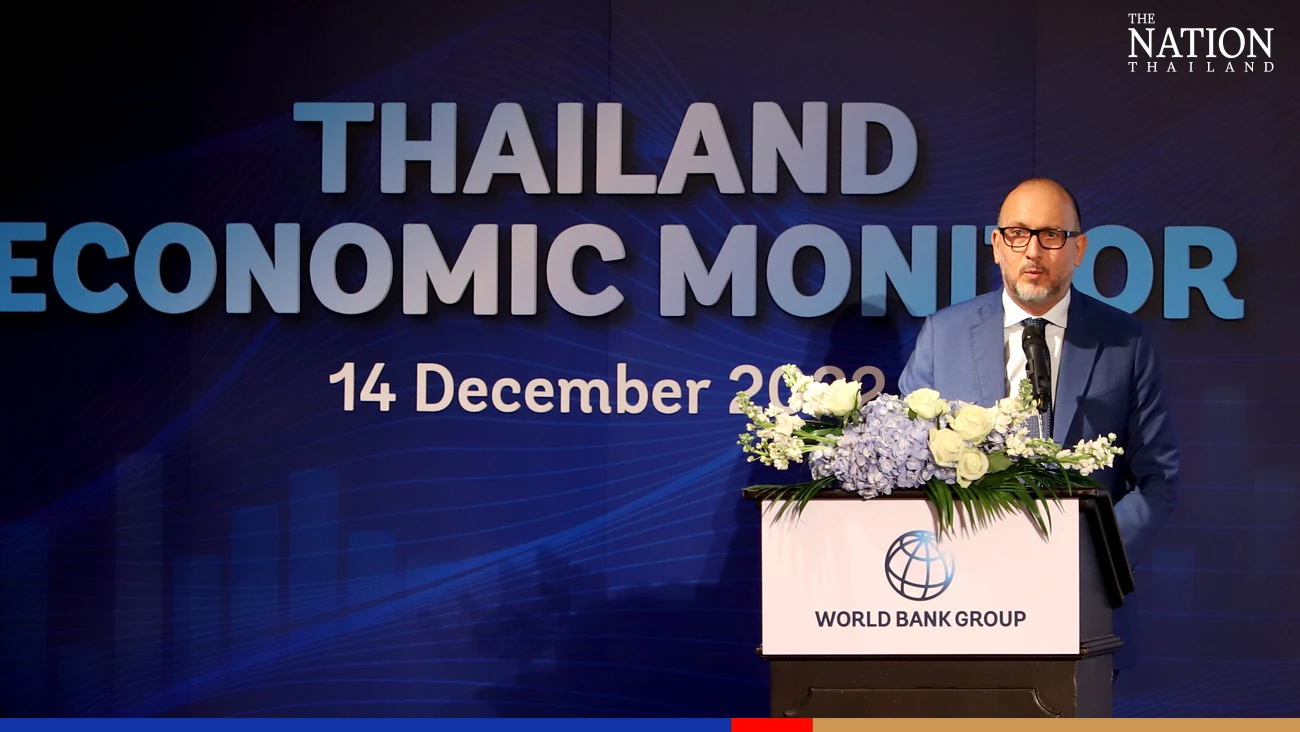
The World Bank provided its analysis and recommendations at the launch of its “Thailand Economic Monitor (TEM) : Fiscal Policy for a Resilient and Equitable Future”.
The report describes Thailand’s economic performance over the previous six months, and provides a summary of economic and policy developments in Thailand within national, regional, and global contexts.
Fabrizio Zarcone, World Bank country manager for Thailand, said the Thai economy was showing resilience despite global headwinds, pointing to its 4.5% annualised growth in the third quarter. A resurgence of private consumption and strong inflows of tourists are driving growth, Zarcone said.
Although growth is expected to be 3.4% this year and 3.6% in 2023, Thailand faces a number of challenges, the report says.
These include geopolitical uncertainty, the possibility of prolonged high energy prices, a deeper slowdown in global economic activity, and further deterioration of Thailand’s fiscal space.
Thailand must transform its economy to sustain its growth momentum, Zarcone said.
Fabrizio Zarcone
The World Bank has identified three key areas where Thailand can build a more resilient and equitable society in the medium and long term.
First, Thailand’s policies should prioritise increasing the potential rate of growth and economic resilience by increasing public investment in areas such as innovation, skills, and digital infrastructure to improve human capital. Furthermore, Thailand must liberalise the services sector and accelerate the process of household debt reduction.
Second, the government needs to ensure adequate fiscal space to meet the additional spending needs associated with an aging society and to provide a buffer for future shocks.
Lastly, focusing on more targeted social assistance spending is a cost-effective way to mitigate the pain associated with the rising risk of a prolonged period of high energy prices and other future shocks. Thailand’s low tax revenue collection contributes to a lack of investment in pro-poor spending.
According to World Bank senior economist Nadia Belhaj Hassine Belghith, inequality is one of Thailand’s most significant long-term challenges.
Despite Thailand’s low poverty rate, income distribution is very uneven, with a large revenue gap between the rich and the poor.
Belhaj proposed raising tax revenue without burdening the poor and eliminating some generous deductions and allowances to improve tax collection while making the system more equitable.
“Stop using the current universal energy subsidy scheme because it creates an unnecessary burden for the government to bear and instead focus on groups in need,” the senior economist said.
Kiatipong Ariyapruchya, senior economist for Thailand at the World Bank, added that the current crisis serves as a catalyst for much-needed structural reforms to improve the quality and allocation of spending while also raising structurally low revenue.
“Meeting the spending need while also improving the distributional impacts of fiscal policies and undergoing fiscal consolidation necessitates more efficient and targeted spending as well as additional revenue mobilisation efforts,” he said.
Japanese restaurants see record-breaking growth in Thailand
WEDNESDAY, DECEMBER 14, 2022
The number of Japanese restaurants in Thailand rose 21.9% in 2022 over the year before, the highest jump since the Japan External Trade Organisation (Jetro) began keeping track in 2007, Jetro said on Wednesday.
Jetro recorded a total of 5,325 Japanese restaurants in Thailand this year, up 955 from 4,370 in 2021. It said the expansion of Japanese restaurants has been prominent in Bangkok and its surrounding provinces. However, since 2019, it has been possible to find Japanese restaurants in every province, according to Jetro.
“I’m glad that more Japanese restaurants are opening in Thailand … [they] offer a great opportunity for Japanese food lovers to taste Japan’s delicious dishes and expand the market for Japan’s food industry,” said Jun Kuroda, president of Jetro Bangkok.
“Jetro Bangkok will continue to promote Japanese cuisine among Thais and facilitate the import of high quality agricultural and food products from Japan to Thailand,” Jun added.
Jetro’s latest survey found that 1,404 new Japanese restaurants opened in Thailand this year: 448 were sushi restaurants, 263 offer Japanese cuisine, and 185 focus on ramen.
However, 105 Japanese restaurants shut down in Thailand this year, a number that is significantly lower than the tally in 2021, when the Covid-19 crisis forced 231 restaurants to close their doors, Jetro said.
In the survey’s interview section, restaurant operators said sales in 2022 have increased to about 70%-90% of pre-pandemic levels. Restaurants face other challenges, including rising costs of ingredients and labour, as well as the commission taken by food delivery services and the ongoing appeal of using these services.
Jetro said its Bangkok office launched several campaigns this year to boost sales of Japanese products and services, including the “Made in Japan: Genuine Japanese raw materials” campaign that runs from November 1 until February next year. The campaign will bring Japanese beef, pork and seafood to 236 restaurants in Thailand.
Baht opens 34.58/dollar on Wed but all eyes on Fed meeting
WEDNESDAY, DECEMBER 14, 2022
The baht opened at 34.58 to the US dollar on Wednesday, strengthening from Tuesday’s close of 34.80.
The currency will likely move between 34.50 and 34.70 against the greenback during the day, Krungthai market strategist Poon Panichpibool said.
Poon said that the baht strengthened quickly last night amid dollar weakening and gold sales after its price breached the resistance level.
However, baht strengthening will slow as investors wait for results of the US Federal Reserve meeting on interest policy on Thursday morning (Thai time), he added.
He said the baht might strengthen today before the meeting results as the market is in a risk-on state with investors buying Thai short and long-term bonds as US bond yield falls.
Poon estimated the baht’s key support level at 34.50 to the dollar.
He expected a stronger dollar and higher US 10-year bond yield if the Fed takes a “hawkish” view and raises its policy rate in line with a peak level beyond 5.00%.
However, he doubted baht would weaken past its resistance level at 35 as most investors are waiting to sell the dollar or short the dollar-baht market.
Poon also advised investors to use hedging tools such as options to manage risks in a highly volatile currency market.
Tourism revival boosts Thailand’s industries sentiment index
TUESDAY, DECEMBER 13, 2022
The Thai Industries Sentiment Index (TISI) showed a month on month improvement, reaching 93.5 points in November, bolstered by the tourism sector despite concerns over energy price.
Federation of Thai Industries (FTI) president Kriengkrai Thiennukul and FTI executive committee member Pipope Chokvathana said that the TISI in November had increased slightly over the previous month to 93.5 points, thanks to the growing number of foreign tourists.
Since the country’s economic activity is already back on track, consumption and expenditure in the country have flourished.
“Meanwhile, the construction sector was likely to bounce back as the demand for construction products and building materials used for household repairs has recently been on the rise after the improvement in the flood situation,” the FTI said.
Also, exporters have benefited from the plunging freight rates, it added.
The FTI expects the TISI index to reach 97.0 points in the next three months, lower than the previous forecast of 98.8 points due to concerns among entrepreneurs about rising production costs, especially the energy price that still remains high, and inflation that has lowered the country’s purchasing power.
It also pointed out that 70% of entrepreneurs were worried about the global economy, citing its survey conducted on 1,315 entrepreneurs from 45 types of industrial sectors in November this year.
Meanwhile, 43.5% of entrepreneurs were concerned about the domestic political situation, while 43.3% had issues with loan interest rates,” the FTI said.
It said that some businesspeople had suggested the government should control production costs, for example, maintaining the electricity cost per unit to be no more than 4.72 baht or encouraging business owners to invest in renewable energy in manufacturing so as to reduce electricity costs.
“Businesspeople have also advised the government to implement policies supporting the country’s soft power in a bid to attract foreign tourists to Thailand,” the FTI added.
New energy plan will save Thailand over THB500 billion in energy costs over 15 years
TUESDAY, DECEMBER 13, 2022
Thailand’s revised Energy Efficiency Plan (EEP) will help save the country 532.46 billion baht in energy costs by 2037, the Alternative Energy Development and Efficiency Department (AEDED) said.
Prasert Sinsukprasert, AEDED director-general, said on Tuesday that the 2022 EEP, which will replace the 2018 plan and be in force until 2037, will boost energy conservation from 30% in 2018 to 36% over the next 15 years. He said the plan is to reduce the use of energy in the next 15 years by 49,064 kilotonnes of oil equivalent (ktoe), which will save the country 532.455 billion baht.
The 2022 EEP is among the five national energy plans that aim to push Thailand toward carbon neutrality within 2050 and net-zero emissions by 2065.
Prasert said the 2022 plan is still being drafted and should be ready by next year before it is submitted to the Energy Policy and Planning Office (EPPO) for endorsement and the Cabinet for approval. The plan should be implemented by mid-next year, he added.
He went on to say that the new plan will reduce energy intensity (EI) by 40% within 2050, conserving energy by 64,340ktoe.
The plan will be enforced in the form of 14 measures under three strategies covering five target groups, namely industries, buildings, households, agriculture and transport, he said.
Measures aimed at industry, for instance, would control energy consumption at factories, he said. For example, he said, a 2,000-square-metre factory will be required to meet standards in heat insulation, lighting, air-conditioning, hot-water system and alternative energy.
This measure would also include the enforcement of an energy code for factories, commercial buildings, households, and farming as well as measures for conserving energy in the transport sector.
The EEP plan will also promote the use of power-saving labels on four types of machinery including agricultural and construction equipment and household appliances. He said the EEP will also promote energy-saving innovations like smart home systems and smart farming.
FTI urges government to provide relief in fuel costs
TUESDAY, DECEMBER 13, 2022
The Federation of Thai Industries (FTI) asked the government to slow down the increase in fuel tariff (FT) from January to April 2023 to reduce the burden of high energy costs.
FTI vice chairman Isares Rattanadilok na Phuket said on Tuesday that energy price is currently fluctuating and is likely to increase continuously due to the Ukraine-Russia war and the Covid-19 situation.
These situations have caused inflation and recession, and industries, including the manufacturing, servicing, and household sectors, were greatly affected.
The federation had contacted them to seek a solution on energy costs and natural gas price structure, and sought a slowdown in the rate of FT cost but had not got an answer.
The FTI proposed to the government sector to reconsider and postpone the increase of FT cost from January to April 2023 and solve the problem at its root because every sector will have to shoulder the burden.
Isares said, “If [the FT cost] increases again in January to April 2023, electricity bills would go up substantially for two consecutive times and would affect every sector severely in adapting, causing recession worse than expected”.
Meanwhile, it will decrease Thailand’s competitiveness as the manufacturing and service sectors are major industrial sectors driving the country’s economy.
The government should review the guidelines to solve high energy costs and the decision to increase the electricity bill to be fair to every sectors so that businesses can operate with strengthen and compete on the global stage while also creating opportunities for investments in new industries.
Isares also asked the government to ease some operating obstacles such as getting a licence for factories or installing solar cells.
He also wanted cooperation with the Board of Investment to be quick and cover every business group. He suggested adjusting the oil formula of ethanol and gasoline.
Meanwhile, 11 Thai companies were listed on DJSI World, which features the globe’s top 10% of firms in terms of economic, environmental, and social criteria.
The listings reflected the Thai firms’ focus on balancing business and social concerns while creating trust among Thai and foreign investors, the SET commented.
It added that the push for sustainability was also reflected in Thailand gaining most listings in Asean on the FTSE4Good Index and MSCI ESG Universal Index, with 40 and 42 respectively.
SET president Pakorn Peetathawatchai said businesses that operate with ESG (environmental, social, and governance) principles not only shield themselves from crises but also increase competitiveness and trust.
The Revenue Department is drafting classification criteria for digital tokens to ensure that tax collection does not hinder digital-asset development, director-general Lavaron Sangsnit said on Sunday.
Certain kinds of digital tokens could be exempted from value-added tax (VAT), while others will not be subject to taxes like other forms of investment, Lavaron said.
He added that the new classification criteria will put each kind of token in a category based on its asset type.
“For example, tokens that can be traded like shares will be treated and taxed like shares. The same goes for tokens that can be used as debentures,” he said.
Lavaron said the classification criteria will also help investors to identify types of utility tokens according to their different uses.
In March, the government exempted VAT and personal income tax deduction on trade of cryptocurrencies and digital tokens until December 31 next year.
The measure aims to support development of infrastructure, payment systems and the digital economy.
Currently the Royal Decree on Digital Assets Business classifies digital assets as either cryptocurrencies or digital tokens.
It defines cryptocurrencies as electronic data units created as a medium of exchange for the acquisition of goods, services or other rights.
Digital tokens are defined as electronic data units specifying the right of a person to participate in an investment, or to acquire specific goods, services or other rights under an agreement between the issuer and the holder.
Separately, the Securities and Exchange Commission is preparing tighter controls on digital assets trading to protect investors after a series of high-profile bankruptcies in the global industry.
Baht weakens slightly as crucial US Fed meeting looms
TUESDAY, DECEMBER 13, 2022
The baht opened at 34.84 to the US dollar on Tuesday, weakening slightly from Friday’s close of 34.79 after the Constitution Day holiday on Monday.
The currency will likely move between 34.75 and 34.95 against the greenback during the day and between 34.50 and 35.20 during the week, Krungthai market strategist Poon Panichpibool said.
Poon cautioned that the baht could fluctuate and weaken amid a possible sell-off of risky assets. Last week saw foreign investors make net sales of 5 billion baht in the Thai stock market.
Poon said the baht would also face downward pressure if the gold price falls and triggers purchases.
For the dollar, he advised investors to look out for US inflation concerns and the US Federal Reserve’s decision on the interest rate at its two-day meeting starting today (Tuesday, US time). Dollar strengthening is forecast if the Fed signals an interest rate ceiling higher than market expectations of 5.25%.


 Fabrizio Zarcone





 SootinClaimon.Com