The price of gold dropped by THB100 in morning trade on Thursday.
A9.27am report from the Gold Traders Association showed the buying price of gold bar at THB27,950 per baht weight and selling price at THB28,050, while the buying and selling price of gold ornaments is THB27,439.60 and THB28,550, respectively.
At close on Wednesday, the buying price of gold bar was THB28,050 per baht weight and selling price THB28,150, while gold ornaments were THB27,545.72 and THB28,650, respectively.
The spot gold price on Thursday morning was hovering around US$1,777 (THB59,245) per ounce after Comex gold at close on Wednesday dropped by $25.5 to $1,763.9 per ounce due to pressure from the selling of gold as safe-haven assets after the US revealed strong economic data from private sector employment numbers that rose more than expected in October.
The baht opened at 33.28 to the US dollar on Thursday, strengthening from Wednesday’s closing rate of 33.31.
The Thai currency is likely to move between 33.20 and 33.35 during the day, Krungthai Bank market strategist Poon Panichpibool predicted.
Poon said that the baht might strengthen slightly even the dollar weaken because the baht strengthened much before the US Federal Reserve which baht reached 33.45 to the dollar.
Moreover, investors are buying gold as the price went down again which will pressure the baht to weaken.
He said foreign investors will have to invest in Thailand for the baht to reach 33.00 to the dollar. In the short term, Poon expected foreign investors will not invest in Thai stocks until they see a sign of economic recovery after the country opening.
The key resistance level for the baht would be from 33.40 to 33.50 to the dollar, which is the level at which exporters might sell the US currency.
Krungsri Securities forecast the Stock Exchange of Thailand (SET) Index on Thursday (November 4) would fall to between 1,600 and 1,605 points despite positive sentiment from US Federal Reserves move to taper quantitative easing by US$15 billion per month until the middle of next year.
set
It said the index, however, would be under pressure due to falling oil price in line with rising US oil storage, investors’ mass sell-offs of shares to follow Opec+ meeting and market volatility in line with the third-quarter performance forecast.
It also recommended buying of the following companies’ shares as an investment strategy:
▪︎ GULF, BGRIM, CHG, BCH, BDMS, KCE and JMT, whose third-quarter profit is expected to grow.
▪︎ AOT, AAV, BA, MINT, KBANK, SCB, CPN, CRC, HMPRO, CPALL, AMATA, WHA, BTS, BEM and VGI, which benefit from the country reopening.
As of 10.51am on Thursday, the SET Index rose by 5.41 points or 0.34 per cent to 1,617.33, witnessing a high of 1,618.71 and a low of 1,607.73 in opening trade.
Total government debt as of the end of fiscal year 2022 will reach 2.3 trillion baht or 62 per cent of GDP, said Patricia Mongkhonvanit, director-general at the Public Debt Management Office (PDMO) on Wednesday.
“Of this amount, 1.19 trillion baht is debt that we already borrowed and was included in the public debt figure as of September 2021, whereas total public debt is at 57.98 per cent of gross domestic product (GDP),” she said. “Meanwhile, the 1.12 trillion baht will be new debt that the government will borrow in fiscal year 2022, which will drive total public debt at the end of September 2022 to 62 per cent of the country’s GDP.”
Patricia added that in fiscal year 2022 the government will use government bonds as a major tool in borrowing money. “The government will use bonds ranging from 3 to 50 years period to borrow 1.1 to 1.3 trillion baht, or 48 to 56 per cent of projected total debt,” she said. “Other tools that will be used as well include treasury bill at 540 billion baht or 23 per cent, and promissory note and term loan at 390-590 billion or 16 to 25 per cent.”
“The government dose not block loans from foreign sources but will prioritize the use of domestic sources first. In case the domestic bond market becomes more strained we may consider borrowing money from foreign sources, which will be in the form of issuing government bonds for investment projects, such as the construction of U-Tapao International Airport,” said Patricia.
Patricia further added that Ministry of Finance is preparing to issue a new saving bond called Om Pai Duay Kan (Let’s Save Together) at 80 billion baht on November 15 to compensate budget deficit. The second batch of 70 billion baht will be issued around May to August 2022, and will compliment the target of issuing total 150 billion baht worth of saving bonds in fiscal year 2022.
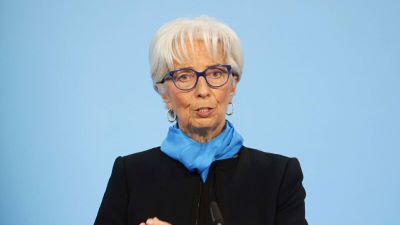
European Central Bank President Christine Lagarde renewed her pushback against market bets for an interest-rate increase in 2022 after an attempt last week left investors unimpressed.
“In our forward guidance on interest rates, we have clearly articulated the three conditions that need to be satisfied before rates will start to rise,” Lagarde said Wednesday in a speech in Lisbon.
“Despite the current inflation surge, the outlook for inflation over the medium term remains subdued, and thus these three conditions are very unlikely to be satisfied next year,” she said.
Lagarde used the news conference following the last Governing Council meeting to call market expectations for a rate hike inconsistent with the ECB’s own analysis and forward guidance. But she stopped short of saying markets are wrong, reflecting an agreement within the Council that such a move could backfire.
Money-market bets on an ECB rate increase by December 2022 have moderated a little after dovish remarks this week by the Reserve Bank of Australia. But they remained at 10 basis points of tightening following Lagarde’s comments, down from 23 basis points on Monday.
The euro was 0.1% higher against the dollar at $1.1592.
“Lagarde is clearly correcting the collective vague pushback last week,” said Piet Christiansen, chief strategist at Danske Bank. “However, the damage isn’t undone as the market will carry an ECB-risk premium. The front end is still with global developments and I don’t think Lagarde or the ECB is able to push the pricing lower by themselves at this stage.”
Market moves have been fueled recently by accelerating inflation across the globe and uncertainty over the outlook for prices. Euro-area inflation breached 4% in October, topping economist estimates, data showed Friday.
The ECB said last week that while the current phase of faster inflation will last longer than previously projected, price pressures should still ease once global supply chains heal and other special factors start to fade.
The bank is gearing up for crucial policy decisions at its December meeting, when new economic forecasts become available. With Covid-19 disruption on the rise again, many analysts see the ECB boosting regular asset purchases once its 1.85 trillion-euro ($2.1 trillion) emergency bond-buying program ends in March.
“As for the calibration of bond purchases in a post-pandemic world, we will announce our intentions in December,” Lagarde said. “Even after the expected end of the pandemic emergency, it will be still important that monetary policy — including the appropriate calibration of asset purchases — supports the recovery and the sustainable return of inflation to our target of 2%.”
For now, the ECB will use emergency bond-buying to keep euro-area borrowing costs low, Lagarde said. An undue tightening of financing conditions “is not desirable at a time when purchasing power is already being squeezed by higher energy and fuel bills,” she said.
Stocks climbed to a record after the Federal Reserve signaled monetary policy will remain accommodative even as the central bank starts reducing its massive bond-buying program this month.
In a feat not seen since January 2018, the S&P 500, the Dow Jones Industrial Average, the Nasdaq 100 and the Russell 2000 closed at their all-time highs for a second straight day. The Treasury curve steepened after Fed Chair Jerome Powell sought to stress that tapering doesn’t mean rate hikes are coming soon. He said officials can be patient on tightening, but won’t flinch from action if warranted by inflation. The dollar fell.
“Powell was very careful not to make any missteps today, sticking carefully to his script that their focus is on tapering, not raising rates,” wrote Seema Shah, chief strategist at Principal Global Investors. “That’s a shame, because interest-rate hikes are all that markets want to talk about!”
Traders largely maintained bets on the timing of rate increases from the level they were at before the Fed decision. Money-market derivatives show about 55 basis points of rate hikes by the end of 2022. The first one is seen coming around July, with about a 70% chance it happens the month before, overnight index swaps show.
Some corporate highlights:
– In late trading, Qualcomm Inc., the world’s largest smartphone chipmaker, gave a stronger-than-expected outlook for the current quarter. Video-game publisher Electronic Arts Inc.’s revenue forecast was broadly in line with analysts’ estimates. Fox Corp. reported quarterly sales and earnings that beat Wall Street’s expectations.
– CVS Health Corp. jumped Wednesday after raising its annual forecast.
– Video-game company Activision Blizzard Inc. tumbled on an outlook that was seen as disappointing.
The Treasury announced the first reduction in its quarterly sale of longer-term debt in more than five years, reflecting diminishing borrowing needs as the wave of pandemic-relief spending ebbs.
U.S. companies added the most jobs in four months, suggesting employers are making progress in filling a near-record number of open positions. The data precede Friday’s monthly employment report from the Labor Department, which is forecast to show that private payrolls increased by 408,000 in October. Service providers expanded at a record pace in October, powered by resilient demand and stronger business activity.
Here are some events to watch this week:
– OPEC+ meeting on output, Thursday
– Bank of England rate decision, Thursday
– U.S. trade, initial jobless claims, Thursday
– U.S. unemployment, nonfarm payrolls, Friday
Some of the main moves in markets:
– – –
– The S&P 500 rose 0.6% as of 4 p.m. New York time
– The Nasdaq 100 rose 1.1%
– The Dow Jones industrial average rose 0.3%
– The MSCI World index rose 0.5%
– – –
– The Bloomberg Dollar Spot index fell 0.3%
– The euro rose 0.2% to $1.1605
– The British pound rose 0.5% to $1.3680
– The Japanese yen was little changed at 114.01 per dollar
– – –
– The yield on 10-year Treasuries advanced four basis points to 1.59%
– Germany’s 10-year yield was little changed at -0.17%
– Britain’s 10-year yield advanced four basis points to 1.07%
– – –
– West Texas Intermediate crude fell 4.9% to $79.82 a barrel
The Federal Reserve will start easing its vast support for financial markets this month, marking a highly anticipated policy change as central bank leaders grapple with major price increases in some parts of the economy but plenty of room to grow in the labor market.
The Fed’s announcement, made after its two-day policy meeting on Wednesday, comes as the economy continues to shift more than 18 months after the coronavirus pandemic first hammered U.S. labor and financial markets. The S & P 500 and other stock indexes closed at record highs on Wednesday amid fresh optimism about the economy’s direction, but other concerns persist, including inflation, supply chain issues, and a disconnect between many unfilled jobs and unemployed workers.
The virus’s delta variant appears to be finally easing, leading to a pickup in hiring. But inflation concerns that the Fed have long labeled as “transitory,” or temporary, haven’t yet receded. Fed leaders on Wednesday pointed to the persistence of “sizable price increases in some sectors,” and Chair Jerome Powell said at a news conference that inflation and the related supply chain issues “will persist well into next year.”
The Fed had provided extraordinary support to the economy since the height of the pandemic to help money flow through the economy, limit bankruptcies, and try and stopgap the wave of layoffs that washed across the United States last year.
For months, the Fed had set the stage to start winding down this sprawling bond-buying program – which includes $120 billion a month in asset purchases – in November. Those purchases have helped stimulate the economy and made borrowing easier by holding down long-term rates, and the expectation was that the purchases will be fully drawn down before the Fed raises interest rates. On Wednesday, the Fed announced it would be cutting purchases by $15 billion each month.
That decision reflected optimism within the Fed that the economy is on the right track. But tremendous uncertainty still hangs over the economy, especially when it comes to how long prices will keep rising faster than wages, a phenomenon many Washington policy makers did not expect to last so long. Following the Fed’s policy meeting, officials released a statement saying that the mismatch of supply and demand, plus the reopening of the economy, have contributed to high prices.
Powell he said he didn’t expect that inflation will have a permanent imprint on the economy, and added that the central bank will use its tools “to make sure that doesn’t become a permanent feature of life,” especially for households most sensitive to higher prices for groceries, rent, gas and more.
Now that the Fed has started its long-awaited “taper,” the markets are hungry for signals about when the Fed will raise interest rates for the first time since the pandemic. But Powell emphasized patience, arguing that the Fed would wait to cool the economy down until as many people as possible have gotten back into jobs first.
“There’s still ground to cover to get to maximum employment, and we don’t want to stop that when there’s good reason to think – although it’s been delayed – that the economy will reopen if we do get past significant outbreaks of covid,” Powell said.
Wednesday’s policy announcement was no surprise: Powell and other Fed leaders have sent strong signals for months that the taper would probably begin in November, if the economy progressed as expected. Still, the shift comes at a precarious time for the economy – and for the central bank, which is charged with keeping prices stable and fostering full employment.
Inflation has climbed higher, and lasted longer, than policymakers within the Fed and Biden administration initially expected. Officials point to persistent supply chain issues that were exacerbated by the delta variant. They say prices won’t settle back down closer to the Fed’s 2 percent annual target until those backlogs are able to clear. (In September, the Fed’s preferred gauge for inflation clocked in at 4.4 percent.)
Meanwhile, the labor market has lagged, with weak job growth in August and September showing how vulnerable the economy still is to covid-19. This week, Treasury Secretary Janet L. Yellen argued that child-care issues and the ongoing pandemic are the main factors holding back the labor market. Still, there are encouraging signs that the economy is poised for an uptick in hiring.
The Fed’s main tool to combat inflation is interest rates, which it can raise or lower depending on what is unfolding in the economy. But Fed leaders are hesitant to hike rates – and cool the economy – if that means undercutting job growth.
Only time will tell if Fed leaders get the timing right. The Fed’s most recent crop of economic projections showed officials moving up expectations for a rate hike in 2022.
But already, inflation has become a flash point in Washington and the rest of the country. Republicans argue that the Biden administration’s vast spending is fueling rising costs and that the Fed will be behind the curve once it decides to raise rates.
Meanwhile, other issues loom over the central bank. Powell’s term as chair expires in February, and the White House has not made a decision on whether he will be reappointed or whom it will nominate for a slate of other openings on the Fed board. Powell on Wednesday declined to answer any questions about the renomination process.
“I’ve been meeting with economic advisers on what the best choices are. We’ve got a lot of good choices, but I’m not going to speculate now,” President Joe Biden said during a Tuesday news conference in Glasgow, Scotland.
Since the Fed’s last policy meeting in September, two Fed regional bank presidents also have exited their posts over their stock-trading behavior. That spurred an independent inspector general probe into whether those activities violated ethics rules and the law. The Fed also announced a major tightening of its internal rules overseeing the personal financial activities of top officials. On Wednesday, Powell said he had briefed officials in the Biden administration and on Capitol Hill about the Fed’s ethics issues.
The Stock Exchange of Thailand (SET) Index closed at 1,611.92 on Wednesday, down 5.97 points or 0.37 per cent. Transactions totalled 84.72 billion baht with an index high of 1,623.08 and a low of 1,607.72.
The index fell after rising by 4.11 points or 0.25 per cent on Tuesday.
In the morning session, Krungsri Securities forecast the SET Index on Wednesday would fluctuate between 1,610 and 1,630 points.
It said negative sentiment of falling oil price and investors’ move to follow the outcome of Federal Open Market Committee (FOMC) and Opec+ meetings would pressure the index.
“However, mass buy-ups of SCB which gained its unique positive sentiment and shares whose third-quarter profit is expected to grow would help boost the index,” Krungsri Securities said.
The 10 stocks with the highest trade value today were SCB, TRUE, KBANK, BANPU, BBL, DELTA, DTAC, HENG, IRPC and KCE.
Other Asian indices were down with one exception:
China’s Shanghai SE Composite closed at 3,498.54, down 7.09 points or 0.20 per cent, while the Shenzhen SE Component closed at 14,367.78, down 9.49 points or 0.066 per cent.
Hong Kong’s Hang Seng Index closed at 25,024.75, down 74.92 points or 0.30 per cent.
South Korea’s KOSPI Index closed at 2,975.71, down 37.78 points or 1.25 per cent.
Taiwan’s TAIEX Index closed at 17,122.16, up 56.19 points or 0.33 per cent.
The price of gold dropped by THB50 in morning trade on Wednesday.
AGold Traders Association report at 9.27am said the buying price of a gold bar was THB28,100 per baht weight and selling price THB28,200, while the buying and selling price of gold ornaments is THB27,591.20 and THB28,700, respectively.
At close on Tuesday, the buying price of a gold bar was THB28,150 per baht weight and selling price THB28,250, while gold ornaments were THB27,636.68 and THB28,750, respectively.
The spot gold price on Wednesday morning hovered around US$1,782 (THB59,429) per ounce after Comex gold at close on Tuesday dropped by $6.4 to $1,789.4 per ounce due to pressure from the appreciation of the US dollar, while investors are keeping an eye on the monetary policy meetings of the US Federal Reserve’s (Fed) on Wednesday night and of the Bank of England (BOE) on Thursday.
The baht opened at 33.28 to the US dollar on Wednesday, weakening from Tuesday’s closing rate of 33.24.
The Thai currency is likely to move between 33.20 and 33.40 during the day, Krungthai Bank market strategist Poon Panichpibool predicted.
Poon said that the baht might fluctuate and weaken because the dollar strengthened and investors bought the gold after the price decreased.
He expected the baht will fluctuate before and after the US Federal Reserve’s meeting because investors expected that the Fed might worry about inflation and increase the interest. (The market expected the Fed to increase the interest two times next year.)
The key resistance level for the baht would be from 33.40 to 33.50 to the dollar, which is the level at which exporters might sell the US currency.
The baht’s key support level would be from 33.00 to 33.10, the level some importers are waiting for so they can buy dollars, he added.