The European Central Bank insists the current price spike will ease, though officials most up-to-date view will be revealed at a decision on the eve of those reports along with their assessment of an economy whose snapback from the pandemic is going awry.
ECB President Christine Lagarde highlighted the threat this month when she said that “the global economy could increasingly be a source of shocks for Europe rather than a stabilizer.” In Germany, the growth motor of the region, the government lowered its outlook on Wednesday after carmakers cut production due to semiconductor shortages.
“We were always going to see a slowdown to the spectacular growth rates that we saw after reopening, but of course these are additional drags,” said Nick Kounis, an economist at ABN Amro. “It does slow progress down in terms of let’s say, a full recovery.”
Friday’s third-quarter data may still be impressive to behold, with a stream of robust numbers around the region. They start with French growth at 7 a.m. in Paris, which forecasters anticipate doubling to 2.2% from 1.1% in the prior three months.
Of the largest four economies, only Italy is expected to show slowing, though with output still up 2%. The euro-zone report at 11 a.m. may reveal similar expansion to the previous quarter, with economists forecasting 2.1%.
Inflation data for October probably accelerated further however. While the median prediction is for 3.7%, the fastest since 2008, Natixis reckons the surge could be half a percentage point higher.
The Bundesbank expects price increases to keep spiking in Germany before they eventually ease, signifying an intensifying squeeze on living costs that is playing out elsewhere too. France has already announced a one-off payment of 100 euros ($116) to lower-paid workers to cushion the blow.
Accompanying the inflation shock are supply bottlenecks already being felt in indexes of purchasing managers. A gauge of business activity in the region slipped to its slowest in six months in October, with optimism clouded by logistics concerns.
Economists surveyed by Bloomberg expect such effects to markedly moderate expansion in the final quarter of the year, with the pace of output seen halving to 1%.
In a hint of what the ECB will say, Bank of Italy Governor Ignazio Visco acknowledged the headwinds on Bloomberg Television last week, even though he cautioned that the euro-area economy is still in a much better shape than anticipated.
“It has sightly softened in the last few weeks,” he said. “The impact of the bottlenecks and shortages is there.”
For Germany, the economy as a whole will now grow only 2.6% this year, compared with a prediction of 3.5% at the end of April. Economy Minister Peter Altmaier told ARD television that a future pickup will depend on disruption fading in global logistics.
“The precondition is that we stabilize international supply chains, and, for example, make sure that more of the chips that are built into almost every device, especially cars, are produced,” he said.
What could still help absorb the price squeeze and slowing growth is a hoard of almost 400 billion euros accumulated by consumers during lockdowns.
“I would not be overly concerned,” said UniCredit economist Marco Valli. “Households have this big buffer thanks to excess savings that will provide them with a bit more of a cushion compared to previous energy shocks.”
U.S. stocks dropped from all-time highs, with shares of small companies leading declines, and Treasurys gained on an uptick in growth concerns.
The S&P 500 and Dow Jones industrial average fell after setting closing records Tuesday. The tech-heavy Nasdaq 100 set an intraday record before closing barely in the green with Google parent Alphabet Inc., Amazon.com Inc. and Tesla Inc. rallying. Robinhood Markets Inc. slumped after missing revenue estimates. The Russell 2000 slumped 1.9%, the biggest decline since late September.
“Earnings are one of the bigger factors with better than expected results out of a lot of sectors,” said Ross Mayfield, investment strategy analyst at Baird. “Some of the fears of inflation or margin pressure are not yet being realized despite the problem being so well-known and probably discounted by the market a bit.”
Long bonds continued to outperform shorter-maturity U.S. debt ahead of the government’s auctions of five-year notes Wednesday and a seven-year sale Thursday. The yield difference between 5- and 30-year bonds narrowed to as little as 78 basis points, the lowest since March 2020.
Mining and energy stocks led a retreat in the Stoxx Europe 600 index as prices of raw materials including aluminum and iron ore fell along with crude oil. Germany’s DAX underperformed after Europe’s biggest economy cut its 2021 growth forecast, citing the lingering effects of the pandemic and a supply squeeze. Bund yields dropped along with those on other European bonds.
Investors are counting on earnings to support equity prices, and so far the reporting season has been solid overall. But worries remain that over time rising raw material and wage costs and supply-chain snarls could crimp margins and weigh on the global economy recovery.
“Equities moved higher last week, fully recovering from the September dip. That said, in our view, last week’s positive performance does not create head winds for performance ahead,” said Lauren Goodwin, economist and portfolio strategist at New York Life Investments. “Market positioning is still approximately neutral, which could point to further upside potential in equity markets. We believe recent positive market moves could be the beginning of a now-earlier ‘Santa Clause rally.’ “
The debt crisis in China’s property sector continues to hang over the market: authorities told billionaire Hui Ka Yan to use his personal wealth to alleviate China Evergrande Group’s woes. Meanwhile, a top Chinese regulator called on companies to make “active preparations” to meet payments on offshore bonds.
Bitcoin fell below $60,000. On the virus front, a Food and Drug Administration panel gave its backing to the Pfizer Inc. and BioNTech SE vaccine for young children.
Some of the main moves in markets:
Stocks
– The S&P 500 fell 0.5% as of 4:07 p.m. EDT
– The Nasdaq 100 rose 0.3%
– The Dow Jones industrial average fell 0.7%
– The MSCI World index fell 0.5%
Currencies
– The Bloomberg Dollar Spot Index was little changed
– The euro was little changed at $1.1600
– The British pound fell 0.2% to $1.3739
– The Japanese yen rose 0.3% to 113.85 per dollar
Bonds
– The yield on 10-year Treasurys declined seven basis points to 1.53%
– Germany’s 10-year yield declined six basis points to -0.18%
– Britain’s 10-year yield declined 12 basis points to 0.99%
Commodities
– West Texas Intermediate crude fell 3% to $82.10 a barrel
Despite the Covid-19 fallout, the food and beverage industry has proved to be a stable income generator for most Thai exporters.
Ronnarong Poonphiphat, director of the Trade Policy and Strategy Office (TPSO), said food and beverage exports accounted for 73 per cent of total exports in the first eight months of this year. Also, she said, 81 per cent of raw materials produced in the country were used in the manufacturing of food and beverages.
Last year, the food and beverage industry earned more than US$20.5 billion and has brought in $14.05 billion in the first eight months of this year.
Ronnarong said that in order to maintain such earnings, operators will need to follow global food trends, especially in the “new normal” when consumers are focusing more on healthy alternatives.
With Thailand reopening on November 1 and the export sector moving in a positive direction, Finance Minister Arkhom Termpittayapaisith reckons the economy will grow by at least 1 per cent this year.
He said the economy is bound to pick up in the last quarter, though some parts of the country still face the risk of flooding.
The recovery of the tourism sector is expected to be gradual as the government will slowly open different parts of the country based on the rate of Covid-19 infections. Though many operators are positive that the tourism industry will start booming again next year, some do not believe the number of arrivals will reach pre-Covid levels any time soon.
The Stock Exchange of Thailand (SET) Index closed at 1,627.61 on Wednesday, down 8.36 points or 0.51 per cent. Transactions totalled 69 billion baht with an index high of 1,635.68 and a low of 1,626.56.
The index fell after rising by 1.77 points or 0.11 per cent on Tuesday.
In the morning session, Krungsri Securities forecast the SET Index on Wednesday would fluctuate between 1,625 and 1,645 points.
It said the index gained positive sentiment from rising oil price in line with economic recovery and mass buy-ups of stocks whose third-quarter profit is expected to grow.
“However, investors’ mass sell-offs of stocks to escape risk before the meeting of the European Central Bank on October 28 and Federal Reserve on November 2-3 would pressure the index,” Krungsri Securities said.
The 10 stocks with the highest trade value today were BANPU, KCE, SCGP, KBANK, AOT, IVL, SCB, PTT, PTTEP and DELTA.
Other Asian indices were down with one exception:
Japan’s Nikkei Index closed at 29,098.24, down 7.77 points or 0.027 per cent.
China’s Shanghai SE Composite closed at 3,562.31, down 35.33 points or 0.98 per cent, while the Shenzhen SE Component closed at 14,393.51, down 159.31 points or 1.09 per cent.
Hong Kong’s Hang Seng Index closed at 25,628.74, down 409.53 points or 1.57 per cent.
South Korea’s KOSPI Index closed at 3,025.49, down 23.59 points or 0.77 per cent.
Taiwan’s TAIEX Index closed at 17,074.55, up 40.21 points or 0.24 per cent.
The baht opened at 33.20 to the US dollar on Wednesday, weakening from Tuesday’s closing rate of 33.12.
The Thai currency is likely to move between 33.10 and 33.25 during the day, Krungthai Bank market strategist Poon Panichpibool predicted.
Poon said that the default crisis of Chinese real estate companies might pressure the Asian currency market and cause the baht to weaken. Moreover, investors selling Asian assets will cause currencies in Asia to weaken.
Meanwhile, foreign investors slow down in investing in Thai stocks because they are waiting for the basic economy factor in Thai to be better. Investors are waiting to see the economy after the country opening in November.
Poon also predicted that the gold trading also cause the baht to be volatile. Investors will sell the gold which will cause the baht to strengthen if the price goes up nearly 1,800 dollars per ounce.
The key resistance level for the baht would be at 33.40 to the dollar, which is the level at which exporters might sell the US currency.
The price of gold dropped by THB100 in morning trade on Wednesday.
A9.27am report from the Gold Traders Association showed the buying price of gold bar at THB28,050 per baht weight and selling price at THB28,150, while the buying and selling price of gold ornaments is THB27,545.72 and THB28,650, respectively.
At close on Tuesday, the buying price of gold bar was THB28,150 per baht weight and selling price THB28,250, while gold ornaments were THB27,636.68 and THB28,750, respectively.
The spot gold price on Wednesday morning was hovering around US$1,789 (THB59,520) per ounce after Comex gold at close on Tuesday dropped by $13.4, fell from the $1,800 level to $1,793.4 per ounce due to pressure from selling the precious metal for profit after the gold price has risen for several days in a row, including the appreciation of the US dollar.
Krungsri Securities forecast the Stock Exchange of Thailand (SET) Index on Wednesday (October 27) would fluctuate between 1,625 and 1,645 points.
It said the index gained positive sentiment from rising oil price in line with economic recovery and mass buy-ups of stocks whose third-quarter profit is expected to grow.
“However, investors’ mass sell-offs of stocks to escape risk before the meeting of the European Central Bank on October 28 and Federal Reserve on November 2-3 would pressure the index,” Krungsri Securities said.
It also recommended buying of the following companies’ shares as an investment strategy:
▪︎ PTT, PTTEP, TOP, PTTGC, SPRC and BCP, which benefit from rising oil price and gross refining margin.
▪︎ GULF, CHG, BCH, BDMS, KCE, JMT, PSL, TTA, BANPU and LANNA, whose third-quarter profit is expected to grow.
▪︎ HMPRO, CPALL, TNP and KK, which benefit from the government’s economic stimulus measures.
The SET Index fell by 4.05 points or 0.25 per cent to 1,631.92 on Wednesday morning, witnessing a high of 1,633.57 and a low of 1,630.38 in opening trade.
European Central Bank officials have some convincing to do about their commitment to rock-bottom interest rates, at a time when investors are growing skeptical.
Financial markets have stubbornly ignored recent warnings from policymakers including Chief Economist Philip Lane that they’re wrong to anticipate a rate hike at the end of next year. The task of persuading people otherwise will fall to President Christine Lagarde as she presents the Governing Council’s latest decision on Thursday.
With inflation spiking, stoked by supply bottlenecks and rising energy, investors are betting that global momentum for withdrawal of monetary stimulus as espoused by the Federal Reserve will soon enough pull the ECB in its wake.
That notion has been fed further by a public debate among officials wondering how to transition from emergency bond purchases, despite the institution’s new low-rate pledge established after Lagarde’s strategy review refocused minds on lackluster price increases.
Back in September, she suggested that financial-market speculation of some eventual tightening in the future was broadly on track. Since then, amid more evidence of inflation, investors started bringing forward expectations for a liftoff in rates. They now see the deposit rate, currently at -0.5%, reaching zero by the end of 2024.
“The market is well ahead of the likely ECB response,” said Giles Gale, head of European rates strategy at NatWest Markets. “We would expect Lagarde to remind the market that they are serious enough about their forward guidance that this path represents a pretty unlikely high-inflation scenario.”
Guiding investors will be a key challenge for Lagarde as she presents the outcome of a decision that has been flagged only as a stepping stone toward a showdown in December between policy makers determining the future of stimulus.
Data on Friday is expected to show consumer-price growth in the 19-nation euro area further approaching 4%, twice what the ECB aims to reach in the medium term. So far, policy makers have insisted that’s largely transitory.
The ECB’s latest forecasts show inflation slowing to 1.5% in 2023 — not enough to justify higher rates based on policy makers’ latest manual that says forecasts must show price pressures at 2% for some time before such a step can be considered.
Investors initially pared back rate-hike expectations when presented with that guidance in July. Bets on increases in borrowing costs picked up as the economy staged a strong summer recovery, and as price growth broke through 3%.
Even so, Lagarde showed little sign of alarm at the end of September, when markets priced in a 0% deposit rate in four years’ time. “Our forward guidance has already led to a better alignment of rate expectations with our new inflation target […] We expect to see further progress toward an even tighter alignment between the expected time of lift-off for our policy rates and the most likely inflation outlook,” Lagarde said at ECB Forum on Central Banking.
Now that rate-hiking bets have kept surging, it’s unlikely that the president can still be as sanguine. If such a trend continues along with a broader tightening of financial conditions guiding policy decisions, it risks curtailing the ECB’s room to gradually phase out crisis support and move to more standard ways of supporting the economy.
“It makes sense for the ECB to be focusing its discussion on the balance sheet, rather than rates at this stage,” said Mohammed Kazmi, a portfolio manager at Union Bancaire Privee.
That focus might have distracted the ECB, said Michael Leister, head of rates strategy at Commerzbank.
“The rate hike repricing was very, very swift,” he said. “You can excuse them for dealing with other issues first.”
While Lagarde hasn’t remarked on the move, some of her colleagues are on edge. Greek Governing Council member Yannis Stournaras said Oct. 7 that rate bets “are not in accordance with our forward guidance.” Italy’s Ignazio Visco warned on Oct. 18 that “perhaps the market has been a bit too hectic.”
Lane, a member of the ECB Executive Board, expressed concern just last week.
“It’s challenging to reconcile some of the market views with our pretty clear rate forward guidance. Various Governing Council members have been indicating [that] markets may not have fully absorbed rate forward guidance,” Lane said at conference on monetary policy approaches.
Even if Lagarde and her colleagues manage to change perceptions this week, their policy will remain vulnerable to investor preoccupations guided by surging global prices.
“Short-end pricing may correct somewhat lower on Thursday,” said Jan von Gerich, chief strategist at Nordea Bank Abp. “But in the bigger picture, global inflation worries still have room to escalate.”
WASHINGTON – Senate Democrats this week are preparing to propose a new tax increase that would raise billions of dollars from a handful of the richest Americans, attempting to create perhaps the most narrowly focused tax policy in postwar history.
But criticisms of the proposal have emerged – including from at least one top Democrat – and party leadership is still considering more traditional approaches to taxing the rich.
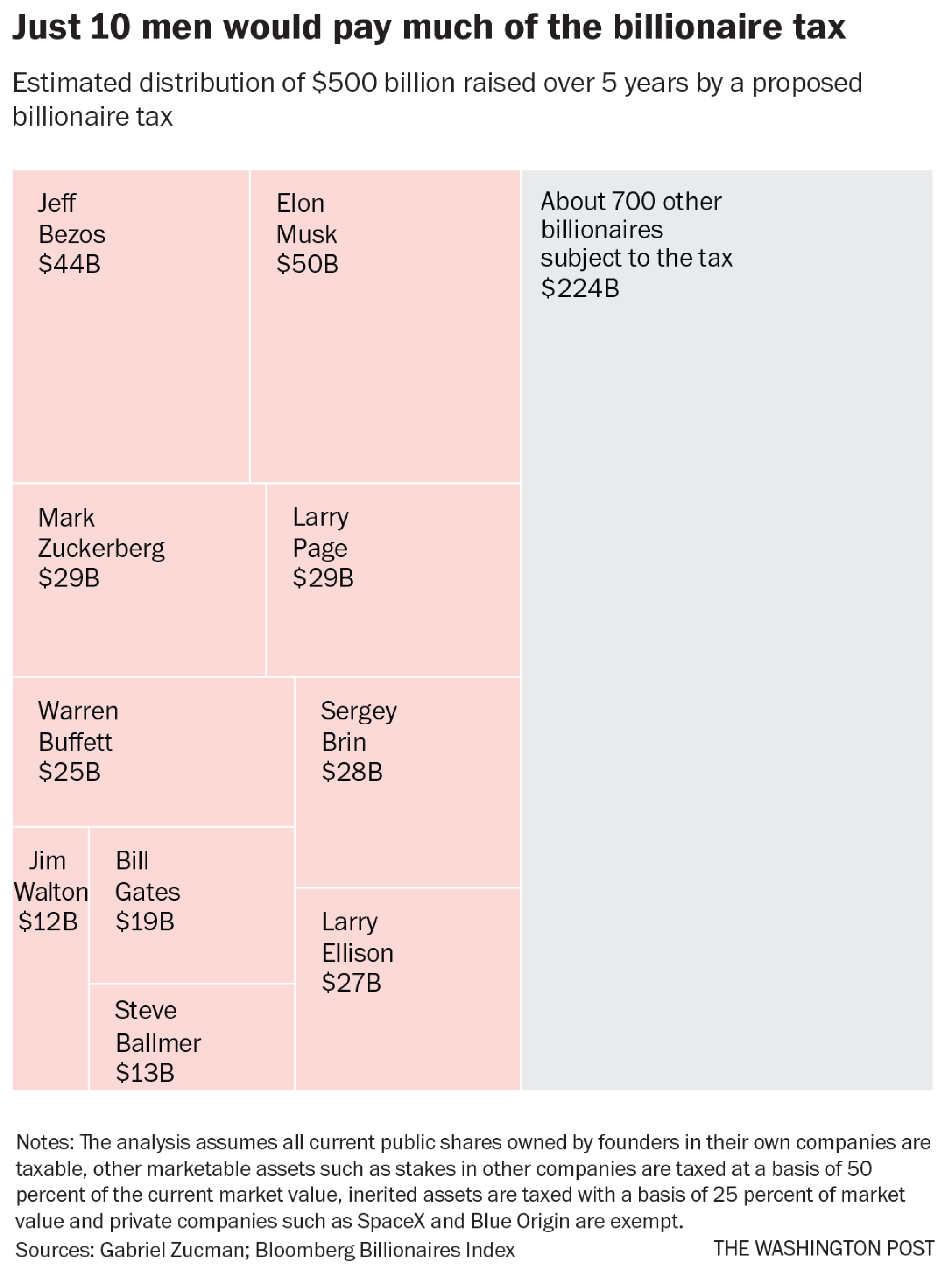
Senate Finance Committee Chairman Ron Wyden, D-Ore., said Monday he will “in a matter of days” release a tax on billionaires that economists and tax experts project could raise more than half of its revenue from just 10 people, including Tesla co-founder and CEO Elon Musk and Amazon founder Jeff Bezos. (Bezos is the owner of The Washington Post.) Estimates vary widely on exactly how much money the plan would bring into federal coffers, in part because no such idea has ever been put into effect.
While Democrats have increasingly eyed the plan as a way to win the support of Sen. Kyrsten Sinema, D-Ariz., who has expressed opposition to increasing the corporate tax rate, some legal scholars have warned it could get struck down by the Supreme Court. And while negotiations are rapidly evolving, Democrats are considering swapping the billionaire tax for a separate 3% “surtax” on millionaires earning more than $5 million per year, according to two people familiar with the negotiations who spoke on the condition of anonymity to reflect internal negotiations. Details remain very much in flux.
The competing tax plans show the difficult trade-offs Democrats must weigh as they try to come to agreement on new sources of revenue to pay for President Joe Biden’s climate and social spending plan – which could cost as much as $1.75 trillion over 10 years – by the end of this week.
The surtax on multimillionaires – originally pitched in House Democrats’ tax plan from September to pay for Biden’s economic package – may prove easier to administer and less vulnerable to legal challenge. But the billionaire tax would fall on far fewer people and, if successfully implemented, could do substantially more to reverse the massive concentration of wealth that Democrats have for years called reflective of a dangerous increase in U.S. inequality.
“If there’s a sliver of good news, it’s that there may be at least enough political cohesion to target a class that clearly has a great deal of resources way in excess of what it needs,” said Darrick Hamilton, an economist at the New School. “When you see billionaires being able to go to space and back for hobby and fun – in a society worried about floods on a periodic basis – that’s a problem.”
Democrats billionaire tax would heavily target 10 wealthiest Americans, but alternative plan is emerging
Billionaires have been able to pay low effective tax rates in part because the value of their company stock holdings is not subject to capital gains taxes until they are sold. Wyden’s plan would amount to a major shift in the U.S. tax code by leveling a 23.8% tax on the increase in stock value – or “unrealized capital gain” – even before those assets are sold.
As a result, the plan would fall primarily on billionaires who have held onto their publicly traded stock holdings – an easily measured and publicly identifiable criteria. Their private business holdings, such as Musk’s SpaceX or Bezos’s Blue Origin, would likely not fall under the tax.
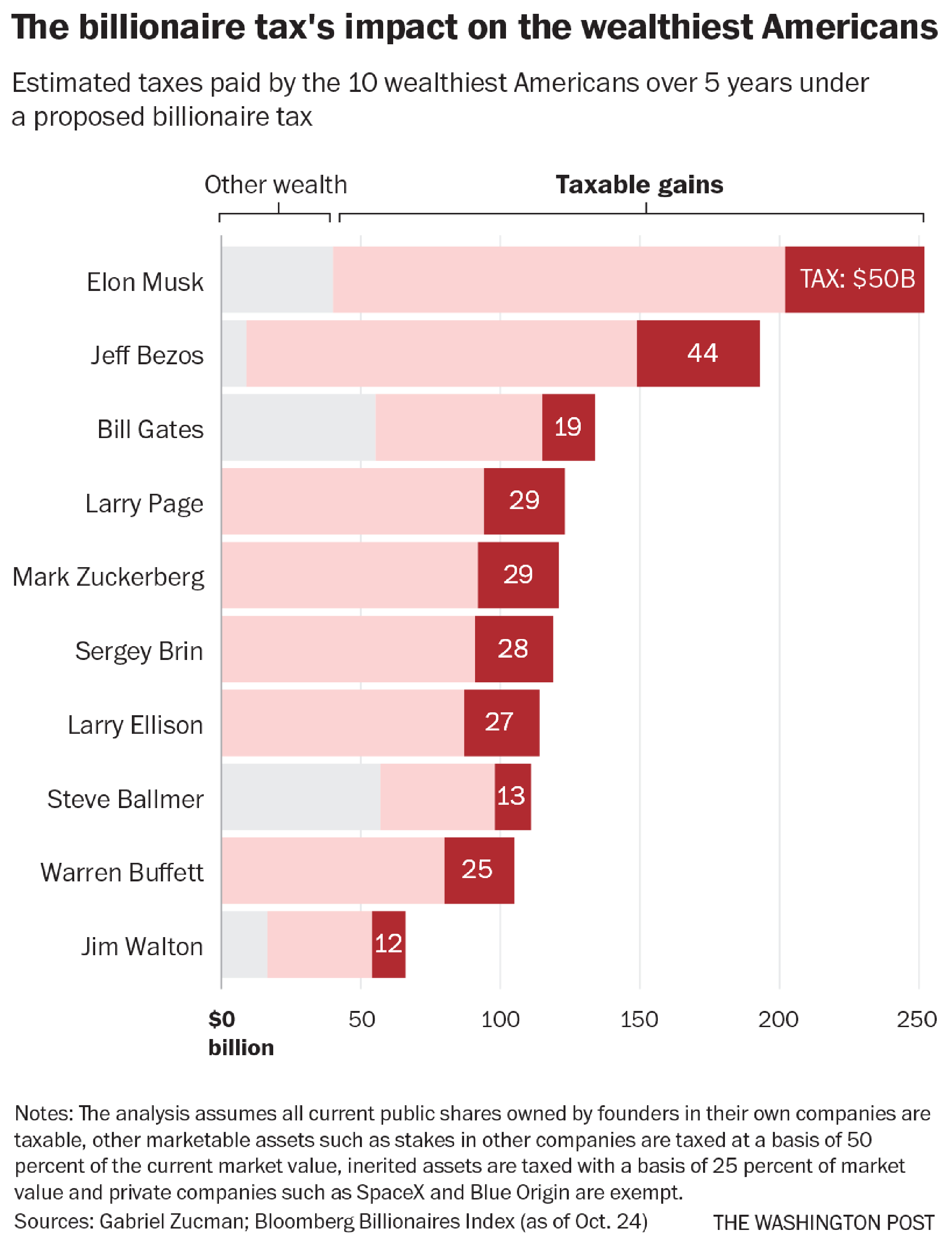
Figures for how much the tax would raise over 10 years range from between $250 billion and upward of $500 billion. But roughly half of its potential new revenue would likely be paid by just the 10 wealthiest Americans, including Musk, Bezos, Bill Gates, Mark Zuckerberg and Warren Buffett, according to an estimate by Gabriel Zucman, an economist at the University of California at Berkeley. Several other tax experts supported his broad conclusions.
According to Zucman’s analysis, Musk would pay as much as $50 billion under the tax over its first five years, while Bezos could pay as much as $44 billion, according to economists’ estimates.
Musk weighed in on the proposal Monday evening, suggesting on Twitter that it could mark the beginning of a much more aggressive taxation campaign by Democrats. “Eventually they run out of other people’s money and then they come for you,” he wrote.
He also wrote: “Who is best at capital allocation – government or entrepreneurs – is indeed what it comes down to. The tricksters will conflate capital allocation with consumption.”
Collectively, the wealthiest 10 Americans own roughly $1.3 trillion, and the Wyden plan would require them to pay a combined $276 billion in taxes. These taxes would essentially fall on billionaires’ lifetime earnings. But, once paid, the billionaires would only pay further taxes on additional increases in unrealized stock gains. That distinguishes the Wyden plan from Sen. Elizabeth Warren’s, D-Mass., wealth tax, which would indefinitely reduce billionaire wealth every year.
Democrats have increasingly viewed the billionaire tax as a way to pay for the economic package in part because of the tremendous increase in wealth at the top of the income distribution since the beginning of the pandemic. The top five billionaires saw their wealth increase 82% since the pandemic began, adding $370 billion since the S&P 500’s pre-pandemic peak in February 2020, according to calculations based on the Bloomberg Billionaires Index.
These calculations are based on wealth as of Sunday, Oct. 24, but revenue estimates will evolve along with billionaire’s wealth. On Monday alone, the total wealth held by Musk skyrocketed by as much as $36 billion due to a new order of Teslas from the rental company Hertz.
The new law would see Musk and his peers paying orders of magnitude more than they had before. A June report from the nonprofit news organization ProPublica found Buffett paid $23.7 million in taxes from 2014 to 2018. He would pay about a thousand times that number under the new proposal. Musk paid $455 million over that time, the report found, or about a hundred times less than he’d pay under the new proposal. Bezos’s new tax bill would be about 10 times what he paid in the earlier five-year period.
“It is being written so that when nurses and firefighters pay taxes with every paycheck, billionaires, who have figured out how to not pay taxes because they don’t take a wage, they’re going to have to pay their fair share,” Wyden told reporters on Monday night.
But questions abound about implementing the billionaire tax. Steve Rosenthal, senior fellow at the nonpartisan Tax Policy Center think tank, said it would be far simpler to enact Biden’s initial plan to tax capital gains when they are inherited – a proposal abandoned due to opposition from centrist Democrats – than create a new part of the tax code for billionaires.
Rosenthal also raised the question of how to ensure billionaires do not simply evade the tax by moving their publicly held stock into more opaque forms of assets, such as private companies. Wyden’s plan proposes an interest penalty on privately held assets, but such an idea is untested.
“While only a few taxpayers would pay the new tax, many more would need to value all their assets annually, including their privately-held businesses,” Rosenthal wrote in a blog critiquing the idea. “Taxpayers close to the line might move in and out of the new tax regime frequently. How would the IRS determine whether all billionaires filed properly?”
House Ways and Means Committee Chairman Richard Neal,D-Mass., has also expressed reservations about the billionaire tax idea. Neal said House Democrats previously had looked at the idea and concluded then – as now – that “it will be a challenge.” Neal raised a number of areas to address, including what the government would do when billionaires had bad years and had taxes owed to them.
“I like the politics of it, yeah, I think it’s sensible,” he said. “I think the implementation of the plan may be a bit more challenging.”
Democrats billionaire tax would heavily target 10 wealthiest Americans, but alternative plan is emerging
Other tax experts say a conservative-dominated Supreme Court would be unlikely to uphold the new tax. The constitutionality of a tax on wealth remains unclear, and it is unclear if the administration could successfully convince the court that the measure is instead an income tax – which would be permissible under the 16th Amendment.
“If I were a justice, I would uphold it . . . But I’m not. Six Republican-appointed judges on the Supreme Court are,” said Daniel Hemel, a tax law professor at the University of Chicago. “There are lots of constitutional ways to do this, and we’ve picked the one constitutionally problematic option.”
Zucman rejected the argument that the tax could prove complicated to implement. He said it “would be the most progressive tax in history,” noting the next closest – the estate tax – raises roughly $20 billion a year, possibly as little as 5% of the Wyden plan.
“For these guys, the truth is it’s so easy to enforce the tax because it’s so obvious what they own,” Zucman said.







 Democrats billionaire tax would heavily target 10 wealthiest Americans, but alternative plan is emerging
 Democrats billionaire tax would heavily target 10 wealthiest Americans, but alternative plan is emerging
