The Transport Ministry is pushing ahead with the procurement and development of battery electric railcars with the aim of having them running by 2023.
The Department of Rail Transport (DRT) and State Railway of Thailand (SRT) have been tasked with setting up a procurement plan as well as working out an operation budget, Transport Minister Saksayam Chidchob said on Friday.
He added that SRT was also cooperating with educational institutes to come up with a design for battery-electric railcars, which will debut at the Bang Sue Grand Station.
“The ministry has also instructed electric railway service agencies to study electricity management to ensure the new railcars are efficiently operated,” he said, adding that the ministry may build a special power plant to power up the battery-electric railcars.
ADVERTISEMENTx
He said the ministry will study and design the new railcars this year, modify fossil-fuel locomotives into battery-electric ones in 2022 and conduct trial runs in 2023.
DRT, SRT, Railway Technology Development Institute and educational institutions are set to turn the four existing GEK or Alsthom locomotives into battery-electric ones by 2023.
“The procurement plan for battery-electric railcars will run until 2024, and the ministry is also planning to procure 20 battery shunting locomotives during that period,” he said.
The Labour Ministry is speeding up efforts to create almost 400,000 jobs in the Eastern Economic Corridor (EEC) to help those affected by the Covid-19 outbreak.
This move came after the National Economic and Social Development Council indicated that unemployment in the country has risen due to the Covid-19 crisis.
Labour Minister Suchart Chomklin said he had instructed the Department of Employment to conduct a survey on employers’ demand for workers.
“According to the survey, there are 31,556 jobs available in the three EEC provinces – Rayong, Chonburi and Chachoengsao,” he said.
“Workers are being sought in the manufacturing, retail and wholesale, automotive engineering, medical supplies, health and logistics industries as well as in government agencies.”
ADVERTISEMENTx
The minister added that he expects the number of available positions in the EEC to rise to 400,000 in the next five years.
“Companies with a high demand for workers include Big C Supercentre, Panus Poultry Group, Italian-Thai Development, Seafco, CH Karnchang and Minor International,” Suchart added.
Gold gains in Thai, HK markets as demand up amid US stock market decline
The price of gold in Thailand rose by THB150 on Friday morning.
AGold Traders Association report at 9.27am said the buying price of a gold bar was THB27,750 per baht weight and selling price THB27,850, while gold ornaments were priced at THB27,257.68 and THB28,350, respectively.
At close on Thursday, the buying price of a gold bar was THB27,600 per baht weight and selling price THB27,700, while gold ornaments were THB27,106.08 and THB28,200, respectively.
Spot gold on Friday morning was moving at around US$1,797 (THB58,720) per ounce after Comex gold rose by $4.20 to $1,795.20 per ounce at close on Thursday, due to support for buying gold as a safe-haven asset after the fall in the US stock market. Meanwhile, the market is keeping an eye on US Federal Reserve chairman Jerome Powell’s announcement on Friday at the Fed annual meeting.
ADVERTISEMENTx
Hong Kong gold price rose sharply by HK$100 to $16,670 (THB69,890) per tael, the Chinese Gold and Silver Exchange Society reported.
US Fed meeting outcome expected to arrest five days of gains for SET
The Stock Exchange of Thailand (SET) Index fell by 0.07 points to 1,601.84 on Friday morning.
The SET Index closed at 1,601.91 on Thursday, up 1.42 points or 0.09 per cent. Transactions totalled THB81.23 billion with an index high of 1,603.99 and a low of 1,595.69.
The SET rose for a fifth straight day after surging past the 1,600 mark on Wednesday.
Krungsri Securities forecast the index on Friday would fall to between 1,590 and 1,595 points despite the Centre for Covid-19 Situation Administration subcommittee proposing the easing of Covid-19 restrictions as domestic infections are declining.
It predicted the index would be under pressure due to investors’ mass sell-offs of stocks in response to the US Federal Reserve’s signal it would taper its quantitative easing programme by this year.
“Meanwhile, ongoing political issues would pressure the index,” Krungsri Securities added.
ADVERTISEMENTx
It recommended selective buying as an investment strategy:
▪︎ AOT, CPN, CRC, HMPRO, AAV, BA, MINT, CENTEL, AMATA and WHA, which would benefit from the country’s reopening.
▪︎ PSL, TTA and RCL, which would benefit from a rise in the freight rate.
Baht expected to move sideways as markets await US Fed meeting outcome
The baht opened at 32.76 to the US dollar on Friday, weakening from Thursday’s closing rate of 32.74.
The Thai currency is likely to move between 32.70 and 32.85 during the day, Krungthai Bank market strategist Poon Panichpibool said.
Poon predicted the baht would move sideways as investors were waiting for important factors, such as the US Federal Reserve’s move to reduce quantitative easing (QE).
Poon expected the baht to strengthen in the short term amid hopes of an economic recovery.
The government might ease lockdown measures and foreign investors might invest in Thai stocks because the situation was stable and might be resolved soon.
ADVERTISEMENTx
He was concerned about the Covid-19 situation in Thailand, as he was not sure if the spread of the virus had been contained because enough proactive testing was not being done. The positive rate in Thailand was higher than 20 per cent, while WHO recommends it should be lower than 5 per cent.
He added that the baht was likely to fluctuate and weaken as the situation was not clearly better.
Three Fed policy hawks push early taper despite risk from delta
Three of the Federal Reserves leading hawks, on the eve of the central banks annual Jackson Hole symposium, urged that policymakers move quickly to slow asset purchases despite the risk from the spreading delta variant.
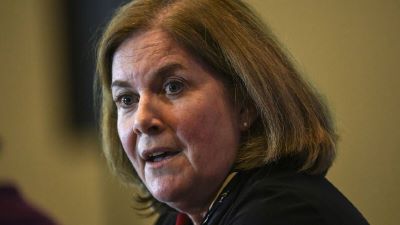
Federal Reserve Bank of Dallas President Robert Kaplan said he favors an announcement at the central bank’s September meeting to begin tapering bond buying and implementing it in October or shortly after. St. Louis’s James Bullard called for a start in the fall — finishing by the end of the first quarter in 2022, while Kansas City Fed’s Esther George urged an early move begin this year.
The three, speaking in television interviews, highlighted one side of the debate among U.S. central bankers. None of them vote on policy in 2021. Fed Chair Jerome Powell has struck a more patient tone and will give his take on the outlook Friday in a virtual speech to get the day-long forum under way.
“I think it’s important to get started and the conditions of pace, timing of when we end, I’m open minded to listening to the debates around that,” George said in a Bloomberg TV interview with Michael McKee conducted Wednesday evening. “But I am less interested in deferring that decision.”
ADVERTISEMENTx
Bullard echoed that view in a CNBC interview Thursday, adding that the delta variant’s impact could be reaching a peak.
“Some on Wall Street seem to think that the numbers are rolling over on delta,” Bullard said. “I don’t really know if we can say that yet but it will peak at some point. The main message here is the economy has learned to adapt to the pandemic.”
U.S. stocks declined as investors absorbed their comments. Treasury yields rose along with the dollar.
While George has been a longtime policy hawk and Bullard has changed his views to more hawkish this year in light of a stronger job market, both will gain votes in 2022 on the policy-setting Federal Open Market Committee. Kaplan, also a hawk, will vote next in 2023.
“It would continue to be my view that when we get to the September meeting, we’d be well served to announce a plan for adjusting purchases and begin to execute that plan in October or shortly thereafter,” Kaplan told CNBC.
ADVERTISEMENT
That seemed to be a small shift in tone from his most recent comments, when he said he would be open to adjusting calls for a quick tapering of bond buying if delta hurts the economy’s progress.
George suggested she might have more flexibility on when the taper should actually be implemented, saying “I think we should get started this year so that we can begin to pare the amount of accommodation.”
“The economy continues to grow at a strong rate,” George said, adding that in terms of the potential risk of the delta variant, “you can imagine that it might slow down some of the returns to the labor market. But I don’t expect at this point that it will derail the economy.”
Most Federal Reserve officials agreed last month they could start slowing the pace of bond purchases later this year, judging that enough progress had been made toward their inflation goal, while gains had been made toward their employment objective, according to the minutes of the FOMC’s July 27-28 meeting.
Bullard said he favored getting started with tapering in the fall and wrapping up the process by the end of the first quarter, which would give the FOMC the option of raising rates earlier in 2022 if needed.
ADVERTISEMENT
“There is some worry that we are doing more damage than helping with the asset purchases because there is an incipient housing bubble in the U.S.,” Bullard said.
With the median house price approaching $400,000, Bullard added, “You are pricing low-income people out of this market. I’m not sure that is what we want to do. We got into a lot of trouble in the mid-2000s by being too complacent about housing prices.”
The Fed has pledged to buy $80 billion in Treasuries and $40 billion in mortgage securities a month until the economy shows “substantial further progress” on inflation and employment as it recovers from Covid-19.
The Kansas City Fed shifted its annual gathering last Friday in light of elevated health risks outside Jackson, Wyoming. Covid-19 cases have spiked across the country as the delta variant spreads, spurring companies to re-evaluate return-to-work plans and schools to return to virtual education, quarantines and mask requirements.
U.S. stocks fall on Kabul blasts, hawkish Fed view
U.S. equities fell Thursday as markets turned cautious after explosions in Afghanistan and ahead of a Federal Reserve gathering that may provide more clues about its approach to paring stimulus.
The S&P 500 and Nasdaq 100 slid as U.S. and civilian casualties were reported from blasts outside the Kabul airport, escalating tensions as the U.S. evacuates the area. The decline came after nonvoting members of the Federal Open Market Committee also made hawkish monetary comments, urging the Fed to start tapering its asset purchase program. Energy shares led the decline as crude oil fell. Treasuries were little changed and the dollar rose.
Michael O’Rourke, chief market strategist at JonesTrading, said the quick drop in shares was likely a culmination of the morning news, including the uncertainty created by the explosions and the Fed commentary ahead of Chairman Jerome Powell’s speech at the Jackson Hole symposium.
Views are split on whether the address Friday will provide a clearer guide on tapering emergency Fed support. While the ongoing economic rebound and elevated inflation add to the case for starting policy normalization, the fast-spreading delta virus strain threatens a slower pace of recovery than some had expected.
“While news of bombings at the Kabul airport has resulted in some volatility this morning, it has become consensus that Jackson Hole will be more or less a nonevent as investors are moving expectations for any major Fed taper announcement to later this year,” said Christopher Murphy, Susquehanna International Group co-head of derivatives strategy.
If Powell fails to hint at when a taper announcement will happen, all eyes will next be on the August jobs report, said Chris Zaccarelli, chief investment officer at Independent Advisor Alliance. The latest jobless claims and annualized gross domestic product data Thursday slightly missed estimates.
“A strong jobs report on Sept. 3 will lead to increased speculation that the Fed will announce their taper plans at the September FOMC meeting,” he said. “However, any weakness or disappointment in that report will push consensus back to the next Fed meeting.”
The Stoxx Europe 600 Index fell, dragged lower by basic resources and travel, while MSCI Inc.’s Asia-Pacific gauge snapped a three-day rally. WTI crude oil fell, paring back its weekly gain to about 9%. Bitcoin slid to about $47,000. Gold was slightly higher.
ADVERTISEMENTx
Some of the main moves in markets:
Stocks
– The S&P 500 fell 0.6% as of 4 p.m. EDT
– The Nasdaq 100 fell 0.6%
– The Dow Jones industrial average fell 0.5%
ADVERTISEMENT
– The MSCI World index fell 0.5%
Currencies
– The Bloomberg Dollar Spot Index rose 0.3%
– The euro fell 0.2% to $1.1754
– The British pound fell 0.5% to $1.3698
ADVERTISEMENT
– The Japanese yen was little changed at 110.03 per dollar
Bonds
– The yield on 10-year Treasurys was little changed at 1.34%
– Germany’s 10-year yield advanced one basis point to -0.41%
– Britain’s 10-year yield was little changed at 0.60%
Commodities
– West Texas Intermediate crude fell 0.8% to $67.84 a barrel
The Stock Exchange of Thailand (SET) Index closed at 1,601.91 on Thursday, up 1.42 points or 0.09 per cent. Transactions totalled THB81.23 billion with an index high of 1,603.99 and a low of 1,595.69. The SET rose for a fifth straight day after surging past the 1,600 mark on Wednesday.
In Thursday’s morning session, Krungsri Securities expected the index to rise to between 1,608 and 1,615 points, buoyed by recently announced plans to ease lockdown measures and administer 100 million doses of Covid-19 vaccine.
It added that the index also gained positive sentiment from foreign inflows for the third straight day in response to the SET’s “Thailand Focus 2021” virtual conference, which is being held until Friday.
“However, sell-offs of stocks to prevent risk before the US Federal Reserve’s annual meeting will pressure the index,” Krungsri Securities said.
The 10 stocks with the highest trade value today were 7UP, KBANK, GUNKUL, PTTGC, GPSC, ADVANC, INTUCH, PTT, KCE and JMART.
ADVERTISEMENTx
Other Asian indices were mixed:
Japan’s Nikkei Index closed at 27,742.29, up 17.49 points or 0.063 per cent.
China’s Shanghai SE Composite Index closed at 3,501.66, down 38.72 points or 1.09 per cent, while the Shenzhen SE Component Index closed at 14,415.46, down 282.04 points or 1.92 per cent.
Hong Kong’s Hang Seng Index closed at 25,415.69, down 278.26 points or 1.08 per cent.
South Korea’s KOSPI closed at 3,128.53, down 18.28 points or 0.58 per cent.
Taiwan’s TAIEX closed at 17,066.96, up 21.10 points or 0.12 per cent.
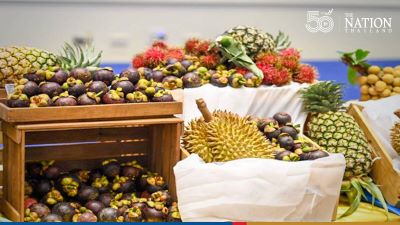
Exports of fresh and processed fruits in the first seven months (January to July) generated 131.16 billion baht, up 48.31 per cent year on year, the Commerce Ministry said on Thursday.
The ministry is targeting at least 180 billion baht in revenue from fresh and processed fruit exports this year, up 30 per cent year on year, said Commerce Minister Jurin Laksanawisit.
The minister credited the rise in fruit exports to four promotional activities – online business matching, a department store promotion campaign, Thai Fruit Golden Month, and sales via foreign platforms such as India’s BigBasket and China’s Tmall.
“In China alone, Thai Fruit Golden Month in eight cities generated up to 15 billion baht,” said Jurin, who expects the same promotion in five more cities to yield another 5 billion baht.
ADVERTISEMENTx
Fruit exports up almost 50% in first 7 months
He added that provincial commerce offices have been instructed to oversee negotiations between buyers and sellers in each province to clear remaining fruit in stock, especially longan and langsat.
“Meanwhile, we have asked commerce ambassadors to seek fruit markets overseas and prepare export plans for next year,” he added.
Gold drops in Thai, HK markets amid slide in Comex price
The price of gold in Thailand dropped by THB50 on Thursday morning.
AGold Traders Association report at 9.28am said the buying price of a gold bar was THB27,700 per baht weight and selling price THB27,800, while gold ornaments were priced at THB27,197.04 and THB28,300, respectively.
At close on Wednesday, the buying price of a gold bar was THB27,750 per baht weight and selling price THB27,850, while gold ornaments were THB27,257.68 and THB28,350, respectively.
Spot gold on Thursday morning was moving at around US$1,790 (THB58,640) per ounce after Comex gold dropped by $17.50 to $1,791 per ounce at close on Wednesday, under pressure to sell gold as a safe-haven asset after the US stock market rose for several days in a row. Investors, meanwhile, are monitoring the US Federal Reserve annual meeting in Jackson Hole, Wyoming from August 26-28 for indicators of its monetary policy direction.
ADVERTISEMENT
Hong Kong gold price dropped by HK$60 to $16,620 (THB69,945) per tael, the Chinese Gold and Silver Exchange Society reported.







 Fruit exports up almost 50% in first 7 months
