The price of gold rose by THB50 per baht weight in morning trade on Wednesday amid a falling US bond yield.
AGold Traders Association report at 9.23am showed the buying price of a gold bar at THB27,450 per baht weight and selling price at THB27,550, while gold ornaments cost THB26,954.48 and THB28,050, respectively.
At close on Tuesday, the buying price of a gold bar was THB27,400 per baht weight and selling price THB27,500, while gold ornaments cost THB26,909 and THB28,000, respectively.
The spot gold price on Wednesday was US$1,802 (THB58,187) per ounce after Comex gold on Tuesday rose by $10.90 to $1,794.20 per ounce.
The Hong Kong gold price, however, dropped by HK$110 to $16,630 (THB69,130) per tael, the Chinese Gold and Silver Exchange Society reported.
OPEC+ crisis propels oil to six-year high as market tightens
Oil fell the most since late May as a stronger dollar spurred a broad sell-off across the commodities complex while uncertainty over OPECs next move loomed large in the markets.
Futures in New York slid 2.4% on Tuesday. The U.S. dollar rose, making commodities priced in the currency less attractive to investors. The pullback in crude is a stark reversal from earlier in the session when futures soared to a six-year high amid an escalating fight between Saudi Arabia and the United Arab Emirates that has pushed OPEC+ into crisis and blocked a potential increase in oil supplies next month.
“Lots of uncertainty is lying ahead about the group’s output policy in coming months and this will lead to increased volatility,” said Tamas Varga, an analyst at PVM Oil Associates Ltd. in London.
Oil prices have staged a massive rally this year as vaccination campaigns and economic reopenings have prompted a comeback in global fuel consumption. Tuesday’s volatility underscores how uncertain the supply picture has become while the world’s largest crude producers remain at a standstill over how to respond.
Discussions among the alliance dissolved acrimoniously as the United Arab Emirates blocked a proposal led by Saudi Arabia and Russia. While the situation is fluid and negotiations could be reactivated, the breakdown has damaged the group’s image as a responsible steward of the market.
“Demand has been the primary signal for the oil markets for the last year or so,” said Louise Dickson, oil markets analyst at Rystad Energy. “Now, we’ve started to reach this pivot where the supply uncertainty is driving the prices and this time, it’s actually been stoked by OPEC+ itself.”
Meanwhile, Biden administration officials have spoken with officials in Saudi Arabia and the United Arab Emirates in hopes of reaching an agreement to stem the rise in crude prices, White House press secretary Jen Psaki said Tuesday.
The U.S. hopes talks will lead to an agreement that “will promote access to affordable and reliable energy,” Psaki said during a briefing at the White House. The impact of talks on gas prices in the U.S. is of interest to the administration, she said.
WTI hit the highest since November 2014, as the breakdown in talks left the market without extra supplies for next month. Tuesday’s subsequent pullback in prices stems from concern or “skepticism that this is not the real oil price, and the last two or three days have reminded us that OPEC+ is holding this thing together,” said Christyan Malek, head of oil and gas research at JPMorgan Chase & Co., in a Bloomberg television interview.
The 23-nation OPEC+ coalition had been on the brink of an agreement to restore production halted during the pandemic, in monthly increments of 400,000 barrels a day. That plan could still be ratified, or members may choose to informally leak barrels to eager consumers.
The lack of OPEC+ unity could invite new barrels to the market and spell bearish news for current prices, said Tom Finlon of Brownsville GTR LLC, a trading and logistics firm based in Houston.
“I think if you have 23 oil-producing countries that are party to an agreement, and that agreement isn’t extended, and the price of crude is in the mid-70s, that’s an engraved invitation to overproduce,” said Finlon.
Oil and Dollars: Why the UAE Is Risking a Falling-Out With OPEC+
Traders will also look to crude and gasoline inventory data in the U.S. released by the industry-funded American Petroleum Institute on Wednesday for signals on how strong demand is in the midst of the summer driving season.
Published : July 07, 2021
By : Syndication Washington Post, Bloomberg · Jill R. Shah
Didi plunges below IPO price as China crackdown brings U.S. pain
Didi Global plunged in premarket trading after a Chinese regulator ordered the removal of the companys platform from app stores, days after a $4.4 billion initial public offering in the U.S.
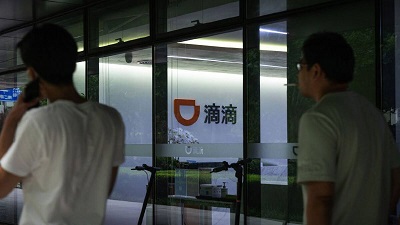
A logo inside the Didi Global headquarters in Beijing on July 5, 2021. MUST CREDIT: Bloomberg photo by Yan Cong
Shares of the China-based tech firm fell as much as 30% to $10.90, wiping out about $22 billion of market value and taking the stock below its $14 IPO price. They traded at $12.50 as of 8:06 a.m. in New York.
The Cyberspace Administration of China barred new users from Didi’s app, citing security risks and tightening its grip on sensitive online data. Didi, whose American Depository Receipts began trading in New York on June 30, said the move may have an “adverse impact” on its revenue in China.
In a statement released Tuesday, China’s State Council said it will improve regulations and laws regarding data security, cross-border data flow and management of confidential information. In addition, the council said it is increasing supervision and revising rules for overseas listings of Chinese companies.
“This is consistent with China’s broad strategy to encourage Chinese companies to list domestically on Hong Kong, Shanghai and Shenzhen exchanges,” said Benjamin Zhan, Vice President and Portfolio Manager at Dynamic Funds.
A crackdown on the nation’s big tech names has knocked about $42 billion off the market value of firms listed on the Nasdaq’s Golden Dragon China Index, which tracks Chinese ADRs, since the government derailed the planned IPO of giant Ant Group in November. Further moves included a record $2.8 billion fine on Alibaba Group Holding after an antitrust probe found it had abused its market dominance, sparking concern about the future of the sector.
“The Chinese government’s tactics appear to have the twin purposes of keeping its corporate leaders in check while also making sure the investor pain lands primarily in the U.S. more so than China,” said Michael O’Rourke, chief market strategist at JonesTrading.
While Didi’s half-billion existing users will still be able to order rides for now, China’s cybersecurity crackdown adds to the uncertainty surrounding all the nation’s internet companies. Tencent Holdings, which has a stake in Didi, is down 2.7% so far this week, after sliding 3.6% Monday and partially trimming losses on Tuesday. The onslaught of government announcements began on Friday after markets in Asia had closed.
Chinese regulators asked Didi as early as three months ago to delay its landmark U.S. IPO because of national security concerns involving its huge trove of data, according to people familiar with the matter.
Uber Technologies, the second-biggest Didi holder, fell 1.6% in premarket. The U.S. stock market was closed on Monday for a holiday.
Full Truck Alliance and Kanzhun, both of which recently went public in the U.S., plummeted 19% and 10%, respectively, after China expanded its probe on the technology industry to include the firms. Beijing ordered both to halt new user registrations, in addition to Didi.
The number of companies based in China filing for New York IPOs has climbed for a third straight quarter despite weakness in other U.S.-listed stocks that conduct most of their business in China and amid the broad antitrust probe into the nation’s internet firms. The Golden Dragon China Index is down about 8% for the year, lagging behind the 14% gain in the Nasdaq Composite Index.
“With Beijing now clearly seeking to make a political statement in the capital markets, it is unclear who, if anyone, will be there to invest in China’s next mega public offering in the U.S.,” said Charles-Henry Monchau, the chief financial and chief investment officer at FlowBank in Geneva. “The decision to crack down on Didi three days after the IPO looks very unfair to investors. It would have been better to prevent the company going public, as they did with Ant Group.”
Published : July 07, 2021
By : Syndication Washington Post, Bloomberg · Divya Balji, Filipe Pacheco
U.S. stocks fell, snapping a streak of seven consecutive closing record highs, as a plunge in Treasury yields to the lowest since February weighed on banks and small caps. A gauge of the dollar strengthened and crude oil dropped from a six-year high.
The benchmark S&P 500 was led lower by the energy and financial sectors. Amazon.com pushed the Nasdaq 100 to another all-time high. Ride-hailing firm Didi Global Inc. plunged after a Chinese regulator ordered the removal of its platform from app stores, days after its U.S. listing. Yields dropped earlier as a gauge of service-sector activity faltered.
The benchmark 10-year yield fell as much as 7.4 basis points to just under 1.35%, the lowest level since Feb. 24. The 30-year bond’s yield slid 5 basis points to 1.99%, testing its 200-day moving average and its first time below 2% since June 21. The session lows were reached shortly after the ISM Services Index for June fell more than expected from May’s record high.
“People start to get nervous when the 10-year gets below 1.45%,” said Sarah Hunt, a money manager at Alpine Woods. “People are worried that it signals that you’re going to have an economic slowdown.”
West Texas Intermediate futures for August fell as much as 3% in New York. The Bloomberg Dollar Spot Index rose, making commodities priced in the dollar less attractive to investors. Oil prices earlier surged to a six-year high after a bitter fight between Saudi Arabia and the United Arab Emirates plunged OPEC+ into crisis and blocked a supply increase. Investors are assessing the risk of the conflict escalating into a price war that could hamper the global economic recovery and add to inflationary pressures. That, in turn, may strengthen the Federal Reserve’s case for tightening policy.
“There’s still concerns about what happens with the Fed tapering and there’s lack of traction on the fiscal stimulus side,” said Keith Lerner, chief market strategist at Truist Advisory Services. “Those uncertainties are just injecting some volatility and then you throw in concerns about peak economic growth. That just feeds into the concerns about — is the best growth behind us?”
Minutes due Wednesday from the Fed’s latest meeting may provide further context on the central bank’s hawkish pivot last month.
The Chinese crackdown has knocked about $42 billion off the market value of firms listed on the Nasdaq’s Golden Dragon China Index, which tracks Chinese ADRs, since the government derailed the planned IPO of giant Ant Group Co. in November. Further moves included a record $2.8 billion fine on Alibaba Group Holding Ltd. after an antitrust probe found it had abused its market dominance, sparking concern about the future of the sector.
These are some of the main moves in markets:
Stocks
– The S&P 500 fell 0.2% at 4 p.m. EDT, the most since June 18
– The Nasdaq 100 rose 0.4% to a record high
– The Dow Jones industrial average fell 0.6%, more than any closing loss since June 18
ADVERTISEMENT
– The MSCI World index fell 0.3%, more than any closing loss since June 18
Currencies
– The Bloomberg Dollar Spot Index rose 0.4%, more than any closing gain since June 17
– The euro slipped 0.3%, more than any closing loss since June 18
– The British pound fell 0.3% to $1.3802
ADVERTISEMENT
– The Japanese yen rose 0.3% to 110.64 per dollar
Bonds
– The yield on 10-year Treasurys declined seven basis points, more than any closing loss since June 17
– Germany’s 10-year yield declined six basis points, more than any closing loss since March 1
– Britain’s 10-year yield declined eight basis points, more than any closing loss in more than 15 months
Commodities
– West Texas Intermediate crude fell 1.8%, the most since June 28
– Gold futures rose 0.8%, climbing for the fourth straight day, the longest winning streak since May 20
Published : July 07, 2021
By : Syndication Washington Post, Bloomberg · Claire Ballentine, Lu Wang
Govt sets aside THB2-bn to help Bangkok restaurants pull through crisis
The Cabinet has earmarked 2 billion baht to help restaurants affected by regulations restricting patrons from dining on the premises.
The new remedy, called “Im Jai Loan”, will be limited to a maximum of 100,000 baht per applicant and will apply to established food and beverage businesses, such as restaurants and eateries or stalls in department stores’ food courts.
The loan will be granted at an annual interest rate of 3.99 per cent for no more than five years, with borrowers being given a payment respite for the first six months.
The loans will be granted by the Government Savings Bank until December 31 and the measure applies to businesses in Greater Bangkok and border provinces in the South.
It is expected that up to 40,000 businesses will seek to borrow about 50,000 baht each on average.
The government already has a similar measure for roadside food vendors, who can borrow up to 10,000 baht from the Government Savings Bank at a monthly interest of 0.35 per cent. This loan is for a term of three years and borrowers do not have to make any payments for the first six months. Applications for this loan will also be accepted until December 31.
The Stock Exchange of Thailand (SET) Index closed at 1,591.43 on Tuesday, up 12.15 points or 0.77 per cent. Transactions totalled THB69.48 billion with an index high of 1,594.15 and a low of 1,585.34.
In the morning session, Krungsri Securities forecast the index on Tuesday would fluctuate between 1,570 and 1,590 points after the oil price rose above US$76 per barrel following Opec+’s failure to reach agreement over output cuts.
Uncertainty over higher Covid-19 cases in Thailand and the outflow of foreign funds would pressure the index, Krungsri Securities said.
The 10 stocks with the highest trade value today were CBG, COTTO, KBANK, PTTEP, BANPU, RCL, SSP, GUNKUL, PTTGC and GPSC.
Other Asian indices were mixed:
Japan’s Nikkei Index closed at 28,643.21, up 45.02 points or 0.16 per cent.
China’s Shanghai SE Composite Index closed at 3,530.26, down 4.06 points or 0.11 per cent, while the Shenzhen SE Component Index closed at 14,667.65, down 51.02 points or 0.35 per cent.
Hong Kong’s Hang Seng Index closed at 28,072.86, down 70.64 points or 0.25 per cent.
South Korea’s KOSPI closed at 3,305.21, up 12.00 points or 0.36 per cent.
Taiwan’s TAIEX closed at 17,913.07, down 6.26 points or 0.035 per cent.
Limited upside for SET amid funds outflow due to concerns on Covid situation
The Stock Exchange of Thailand (SET) Index rose by 8.83 points, or 0.56 per cent, to 1,588.11 on Tuesday morning.
The SET Index closed at 1,579.28 on Monday, up 0.79 points or 0.05 per cent. Transactions totalled THB58.23 billion with an index high of 1,582.46 and a low of 1,573.67.
Krungsri Securities predicted the index on Tuesday would fluctuate between 1,570 and 1,590 points despite oil price rising to over US$76 per barrel after Opec+ postponed the meeting due to conflict within the group on extending output cuts.
Uncertainty over higher Covid-19 cases in Thailand and the outflow of foreign funds would pressure the index, Krungsri Securities said.
It recommended that investors buy:
▪︎ PTT, PTTEP and TOP, which benefit from the rising oil price.
▪︎ HANA, KCE, TU, CPF, ASIAN and EPG, which benefit from the weakening baht.
▪︎ BCH, CHG, BDMS, HMPRO, GLOBAL, BEM, CKP, CBG and ICHI, whose second-quarter business turnover is expected to improve.
The price of gold in Thailand rose by THB100 per baht weight on Tuesday morning.
The Gold Traders Association report at 9.26am showed buying price of a gold bar at THB27,250 per baht weight and selling price at THB27,350, while gold ornaments were priced at THB26,757.40 and THB27,850, respectively.
On Monday morning, gold had gained THB50, while at close buying price of a gold bar was THB27,150 per baht weight and selling price THB27,250, while gold ornaments were priced at THB26,666.44 and THB27,750, respectively.
Spot gold on Tuesday was US$1,799 (THB57,780) per ounce.
The US gold market was closed on Monday for Independence Day.
Hong Kong gold price, meanwhile, rose by HK$10 to $16,620 (THB68,719) per tael, the Chinese Gold and Silver Exchange Society reported.
Step back like a billionaire: Previous tech titan exits offer examples for Bezos
SEATTLE – There are few chief executives today as closely tied to their companys image as Jeff Bezos is with Amazon.
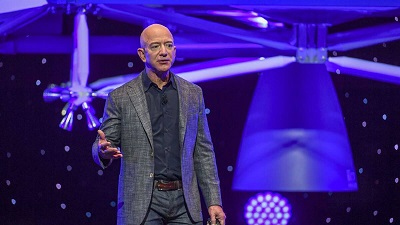
Jeff Bezos at the 2019 introduction of Blue Origin’s lunar lander at the Walter E. Washington Convention Center in Washington, D.C. MUST CREDIT: Washington Post photo by Jonathan Newton
And Bezos’ departure as CEO Monday, handing over the top job to his longtime lieutenant Andy Jassy, likely won’t change that connection anytime soon. Bezos, 57, said he plans to continue working for the company he created as executive chair, a title created for him, where he will focus on innovation and on improving Amazon’s workplace safety record.
The transition isn’t just the most radical shake-up in Amazon’s corporate ranks; it’s the biggest professional shift for Bezos in the three decades that he’s run the company. As Bezos became the world’s wealthiest person with an estimated net worth of $199 billion, according to the Bloomberg Billionaires Index, he’s developed a variety of interests. Those include some wildly expensive ones – such as his space-travel company Blue Origin – that will get more of his focus in the coming years. Bezos plans to ride to the edge of space aboard a Blue Origin rocket just two weeks after stepping down.
He also owns The Washington Post.
There’s not much of a template for business titans who step back from their top jobs. Some have spent time burnishing their image with philanthropy, such as Andrew Carnegie and Bill Gates, who, like Bezos, became lightning rods for criticism of the companies they ran. Others have focused on the playthings of the superwealthy, such as running sports teams or traveling to exotic locales on their yachts. A few, such as former eBay CEO Meg Whitman, even dabbled in politics.
Here’s a look at the post-executive lives of a handful of other billionaire tech bosses:
– Bill Gates
Q: When he did step down as CEO?
A: The Microsoft co-founder began moving away from the software giant in 2000, when he gave the chief executive post to his longtime lieutenant Steve Ballmer. Gates, 44 at the time, took on the role of chief software architect and chairman. Like Bezos, Gates was closely identified with Microsoft, and his departure was carefully orchestrated to ease the transition as the company away from its founder.
In 2008, Gates stepped down as chief software architect and gave up his day-to-day duties at the company to spend the bulk of his work time at the Bill and Melinda Gates Foundation. He stepped down as Microsoft’s chairman in 2014, and left the board altogether last year.
In May, Gates acknowledged through a spokeswoman that he had an extramarital affair with a Microsoft employee nearly 20 years ago, and Microsoft said its board investigated the “intimate relationship” shortly before Gates resigned as a director last year.
Q: What did he do after leaving the CEO job?
A: As Microsoft CEO, Gates had a reputation as a brass-knuckled competitor, so much so that Microsoft became the target of lawmakers and regulators around the globe for using its dominant Windows operating system to crush rivals. In the past two decades, though, Gates has become better known for his philanthropy, creating the Bill and Melinda Gates Foundation with his wife, spending billions addressing global inequity in health care and education. As the coronavirus raged, he emerged as a leading voice for science-based approaches to end the pandemic.
And like Bezos, Gates was the world’s wealthiest person when he left the CEO job.
– Steve Jobs
Q: When did he step down as CEO?
A: The Apple co-founder first left his job as the company’s CEO in 1985 when he was forced out by the board after the commercial failure of the Lisa desktop computer. The 30-year-old Jobs lost a power struggle with his successor, John Sculley.
Jobs returned to Apple a little more than a decade later, and led its revival as it passed ExxonMobil to become the world’s most valuable publicly traded company in August 2011. At the time, Jobs was struggling with complications from pancreatic cancer, and he turned the CEO job over to Tim Cook later that month. Jobs died less than two months later.
Q: What did he do after leaving the Apple CEO job the first time?
ADVERTISEMENT
A: Unlike Bezos, Jobs’ first departure as CEO came early in his career. And he had much to prove.
Jobs quickly launched a new computer company NeXT after his Apple exit. Jobs also moved beyond technology, spending $10 million to acquire Pixar, a graphics supercomputing company owned by the filmmaker George Lucas. Pixar went on to enormous commercial success, sparking the computer-animated movie market with its 1995 hit “Toy Story.” The Walt Disney Company agreed to purchase Pixar for $7.4 billion in 2006.
While NeXT never emerged as a tech power, Apple, without Jobs at the helm, floundered. The company bought NeXT in 1996, and Jobs returned to the company he founded as an adviser. He resumed his CEO responsibilities in 2000, and oversaw Apple’s resurgence as it introduced wildly popular mobile devices such as the iPod, the iPhone and the iPad.
– Larry Page and Sergey Brin
Q: When did they step down as CEOs?
ADVERTISEMENT
A: The Google co-founders stepped down from their jobs running the day-to-day operations of the web search giant in 2019. Page served as CEO of Google’s parent company, Alphabet with Brin as president. Both were 46 at the time.
Page had actually turned over the CEO job once before, in 2001, to Eric Schmidt. He took the post over again 10 years later, when Schmidt stepped down.
At the time, Alphabet was facing investigations from regulators and lawmakers in the United States and abroad for alleged anti-competitive conduct that thwarted the rise of rivals. That scrutiny has only intensified since they stepped back.
Q: What did they do next?
A: Both Page and Brin have remained largely quiet since leaving their executive roles at Google. Like Bezos, Page has been drawn to the skies, putting money behind Kitty Hawk, a flying-car start-up. His investment predates his exit as CEO, though news reports indicate his continued involvement.
Brin, too, has invested in aviation, pouring money into his secretive airship company, LTA Research and Exploration, according to TechCrunch. Brin also began investing in the company before stepping away from his Alphabet duties.
– Mark Cuban
Q: When did he step down as president?
A: Cuban and Broadcast.com CEO Todd Wagner sold their four-year-old audio streaming company to Yahoo for $5.6 billion in 1999. Cuban was 40 at the time.
Q: What did he do next?
A: An avid basketball fan, Cuban used some of his newfound riches to buy the NBA’s Dallas Mavericks in 2000. He has emerged as one of the league’s most outspoken and most recognizable owners.
Bezos, too, has an interest in owning a pro sports team and his name has surfaced as a possible NFL owner.
Cuban also went onto becoming a media figure, starring in “Shark Tank,” the reality television show where he and other successful business leaders support or reject a new entrepreneur’s ideas.
Cuban also occasionally engages in politics. In 2017, Cuban said he was “considering” a presidential campaign. That never came to pass. He’s described his politics as leaning toward libertarianism but with a desire for effective social safety nets, calling himself “independent all the way through.”
– Meg Whitman
Q: When did she step down as CEO?
A: Whitman led eBay for a decade, emerging as one of the tech industry’s most powerful women, before stepping down in 2008. When she left the company, she was 51 and called the move retirement.
But Whitman returned to a CEO post at Hewlett-Packard in 2011, leading the struggling computer printer and server company through brutal cost-cutting phases, and ultimately its breakup into two business. Whitman led the business-technology unit, Hewlett-Packard Enterprise before retiring again in 2018 at 61.
She returned to the CEO post one more time, running the short-lived, short-form video service Quibi last year. Quibi shut down six months after its launch. Whitman was 64 at the time.
Q: What did she do after leaving those jobs?
A: Retirement never seemed to stick for Whitman. After leaving eBay, Whitman declared her candidacy for governor of California, and spent more than $100 million of her own money as a Republican candidate in a losing bid against Jerry Brown.
Whitman joined HP shortly after those political aspirations fizzled. Even so, Whitman remained engaged in politics. She served as finance co-chair of Chris Christie’s presidential campaign during the 2016 Republican primaries, but broke from the party when it nominated Donald Trump. She endorsed Hillary Clinton for president in 2016, and spoke at the 2020 Democratic National Convention in support of Joe Biden.
China targets ride-hailing giant Didi in data crackdown after U.S. listing
China is widening a crackdown on tech companies, as Beijing grows wary of the sprawling reach and power of the countrys Internet giants and signals it is prepared to rein them in despite the financial disruption.
The country’s regulators on Sunday ordered the removal of Didi Chuxing, China’s equivalent of Uber, from domestic app stores, dealing a blow to the company just days after its landmark U.S. listing. On Monday, authorities expanded their sights to at least three other platforms, including truck-hailing apps and a recruitment service.
Didi will remain banned by app stores until further notice as it was found to have “illegally collected and used users’ personal information” in a “grave violation of law and regulation,” China’s cyberspace regulator said in a statement on Sunday after a two-day cybersecurity review. Didi said Monday that it expects the app takedown to “have an adverse impact on its revenue in China,” adding that the app would continue to operate but had suspended new user registrations.
“It’s a bumpy ride for Didi,” said Duncan Clark, a Beijing-based analyst and chairman of consultancy BDA China. “Now, Didi has been asked to put on the seat belt because authorities believe that it was going too fast and too far.”
Didi, a Beijing-based company launched in 2012, raised $4.4 billion last week through an initial public offering in New York – the largest U.S. listing by a Chinese company since Alibaba’s in 2014. The company, which was valued at almost $70 billion after its first day of trading in New York, boasts over 450 million users in China and more than a dozen other markets and is especially popular in China’s larger cities.
The latest regulatory crackdown, which sent Didi shares tumbling, came after Beijing intensified its antitrust campaign against tech giants in recent months, including a record $2.75 billion fine against Alibaba in April. Under a new data security law that comes into effect in September, China plans to set up a “centralized, unified, efficient and authoritative” mechanism for information sharing and risk assessment.
The state-owned Global Times tabloid applauded the regulators’ action, saying that it ensures that the government sets the rules in data collection, not industry leaders such as Alibaba or Didi.
“We still do not know how Didi Chuxing illegally collected users’ personal information,” the nationalist newspaper said in an editorial. “The state will never allow tech giants to collect more detailed personal information in their mega-databases than the state has of the Chinese people.”
Renmin University of China senior researcher Dong Shaopeng told state media that Didi managed “large amounts of data that concerns national security” – such as transportation infrastructure and the flows of people and vehicles – and “might pose threats to China’s national security.” In 2015, Didi raised eyebrows after releasing a big data report of different government ministries based on civil servants’ taxi use.
Didi is not the only company targeted in the latest campaign. The Cyberspace Administration of China said Monday that it was investigating three other platforms – online recruitment company Boss Zhipin and two Chinese truck-hailing apps owned by the New York-listed Full Truck Alliance – which were also ordered to suspend new user registrations, at least throughout the probe.
Shares of Chinese tech companies fell on Monday following the regulator’s intervention. Tencent, which has a stake in Didi, slid nearly 4 percent in Hong Kong, while Meituan slumped 5.6 percent. Japan’s SoftBank, which has a fund that owns stakes in Didi and Full Truck Alliance, also dropped more than 5 percent in Tokyo.
“China is obviously starting a new regulatory front on cybersecurity, which will make it more difficult for Chinese companies to list, or at least drive more investments to Hong Kong rather than New York,” said Clark, the analyst. “Didi has connected people, but there’s no guarantee against intervention, that’s what the regulatory move wants to tell us.”