Online export channel logs orders worth THB10.15bn in first 6 months
Thai exports via a new online channel totalled 10.152 billion baht in the first half of 2021, the Department of International Trade Promotion reported on Monday.
The online export platform www.thaifex-vts.com was used at the THAIFEX Virtual Trade Show on May 25 and will operate until October 3 this year. The platform took orders worth US$2.845 million or 85 million baht at the May 25-29 THAIFEX and expects total orders of $22.515 million (675 million baht) this year.
The offline trade export show will be held at IMPACT Exhibition and Convention Centre, Muang Thong Thani from September 29 to October 3.
Meanwhile, the department has organised 37 online business matching (OBM) forums between Thai exporters and foreign buyers this year. The OBMs covered products such as food, fruit, halal products, medical equipment and auto parts. They generated total sales of 5.94 billion baht, driven by deals for food and fruit worth 4.21 billion baht.
Thailand has lined up a raft of virtual and hybrid online exhibitions in the second half of the year. Highlights include the THAILOG LOGISTIX Virtual Exhibition, TOP Thai Brands, Thailand Week, and Mini Thailand Weeks in Cambodia, Philippines, Indonesia, Myanmar, India and Bangladesh. Meanwhile, Thai exporters will also participate in international trade shows abroad, including digital content fairs in Singapore and South Korea, auto-parts expos in Las Vegas and Dubai, and food product fairs in Australia, Nanning and Shanghai.
SET level as foreign outflows pressure Thai stocks
The Stock Exchange of Thailand (SET) Index closed at 1,579.28 on Monday, up 0.79 points or 0.05 per cent. Transactions totalled THB58.23 billion with an index high of 1,582.46 and a low of 1,573.67.
In the morning session, Krungsri Securities forecast that the SET Index on Monday would fall to between 1,565 and 1,570 points despite a rise in the US non-farm payroll as well as the oil price.
It predicted that uncertainty over the rise in Covid-19 cases in Thailand and outflow of foreign funds would pressure the index.
The 10 stocks with the highest trade value today were KBANK, GUNKUL, GPSC, PTT, SCB, COTTO, BANPU, EA, TTA and SCGP.
Other Asian indices were mixed:
Japan’s Nikkei Index closed at 28,598.19, down 185.09 points or 0.64 per cent.
China’s Shanghai SE Composite Index closed at 3,534.32, up 15.56 points or 0.44 per cent, while the Shenzhen SE Component Index closed at 14,718.66, up 47.95 points or 0.33 per cent.
Hong Kong’s Hang Seng Index closed at 28,143.50, down 166.92 points or 0.59 per cent.
South Korea’s KOSPI closed at 3,293.21, up 11.43 points or 0.35 per cent.
Taiwan’s TAIEX closed at 17,919.33, up 209.18 points or 1.18 per cent.
Uncertain Covid situation puts downward pressure on SET
The Stock Exchange of Thailand (SET) Index rose by 3.00 points, or 0.19 per cent, to 1,581.49 on Monday morning.
The SET Index closed at 1,578.49 on Friday, down 15.26 points or 0.96 per cent. Transactions totalled THB80.92 billion with an index high of 1,596.05 and a low of 1,574.92.
Krungsri Securities forecast that the SET Index on Monday would fall to between 1,565 and 1,570 points despite the rise in US non-farm payroll and oil price.
It predicted that uncertainty over the rise in Covid-19 cases in Thailand and outflow of foreign funds would pressure the index.
It recommended that investors buy:
▪︎ PTT, PTTEP and TOP, which benefit from the rising oil price.
▪︎ HANA, KCE, TU, CPF, ASIAN and EPG, which benefit from the weakening baht.
▪︎ BCH, CHG, BDMS, HMPRO, BEM, CKP, CBG and ICHI, whose second-quarter business turnover is expected to improve.
The baht opened at 32.16 to the US dollar on Monday, strengthening from Friday’s closing rate of 32.19.
The Thai currency is likely to move between 32.10 and 32.25 during the day and between 32 and 32.50 this week, Krungthai Bank market strategist Poon Panichpibool said.
He said the main factors behind the baht’s weakening were the dollar’s strengthening and funds flow from foreign investors in Thailand.
Poon predicted that the dollar will possibly strengthen, since the US economy is recovering well, while other regions in the world – Europe and Asia – are still facing the Covid-19 crisis.
The market strategist added that Thailand should provide at least 500,000 jabs of Covid-19 vaccine a day for foreign investors to buy Thai assets, as they were concerned about the present situation.
Poon added that the baht would slide to 32.50 per US dollar if it weakened to 32.30.
The price of gold in Thailand rose by THB50 per baht weight in the morning trade on Monday.
The Gold Traders Association report at 9.22am showed buying price of a gold bar at THB27,100 per baht weight and selling price THB27,200, while gold ornaments were priced at THB26,605.80 and THB27,700, respectively.
At close on Saturday, buying price of a gold bar was THB27,050 per baht weight and selling price THB27,150, while gold ornaments were priced at THB26,560.32 and THB27,650, respectively.
Uphill task to achieve Thai rice export target as sales plunge in first half
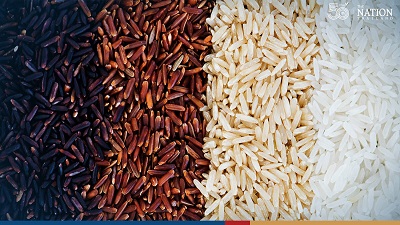
Thailand managed to export only 2.2 million tonnes of rice in the first half of the year, down 21.03 per cent from the same period last year.
Rice exports in the first half of 2021 (from January 1 to June 23) were valued at $1.382 billion, down 28.14 per cent year on year.
The situation is not good for Thai rice exports, said Lt-Colonel Charoen Laothammathat, president of the Thai Rice Exporters Association.
Against the full-year target of 6 million tonnes, worth $5 billion or THB150 billion, Thailand could export 5.7 million tonnes.
Charoen said that in order to export 6 million tonnes of rice during the year, Thais must export an average of 500,000 tonnes per month. Thailand’s rice exports are currently below the target.
He said Thai rice was more expensive than the competition and that affected sales This was a result of the baht’s appreciation and the drought.
He revealed that Thai rice exports had declined continuously in many markets as can be seen from export figures even to neighbouring countries such as Malaysia.
In the first two months of the year, India was the top exporter with 72,203 tonnes, followed by Pakistan 19,575 tonnes, Vietnam 13,978 tonnes, Myanmar 10,899 tonnes, while Thailand was fifth with 6,059 tonnes.
The Ministry of Commerce has joined hands with the Thai Rice Exporters Association to push three main Thai rice exports:
▪︎ 4.8 per growth in jasmine rice to premium markets, and 5.2 per cent growth in fragrant rice sales;
▪︎ 4.7 per cent growth in white rice exports to general market, and 4.9 per cent expansion of parboiled rice;
▪︎ Expand glutinous rice exports by 3.6 per cent, brown rice and milled rice by 12.5 per cent to specialised markets.
At the same time, the ministry will accelerate the government-to-government (G2G) rice trading market.
Recently, Deputy Prime Minister and Minister of Commerce Jurin Laksanawisit revealed that the Department of Foreign Trade had negotiated an additional 20,000 tonnes of G2G white rice exports to China under the contract to buy 1 million tonnes of G2G rice. They also plan to negotiate the sale of G2G rice under the memorandum of understanding that Thailand has signed with Bangladesh and Indonesia.
Charoen said Thai rice export had been plagued by the same problems for the past 10 years. The price of Thai rice is higher than most of its competitors like Vietnam, India, Pakistan, and China. Thai rice varieties do not meet the needs of the market. Recently, there was still the problem of rising freight rates affecting the export cost of Thai rice, he said.
Marilyn Monroe, dead 59 years, is a counterfeiters best friend
Nearly six decades after her death, Marilyn Monroe is still a popular choice for mugs, T-shirts, jewelry and other products using her name — even illegally.
Authentic Brands Group, which owns the rights to the late movie star’s name and the phrase “Diamonds are a Girl’s Best Friend” popularized by her most famous song, has won a court order freezing the assets of dozens of virtual storefronts selling counterfeit goods.
The company said in court documents that it works with marketplaces such as Amazon.com, Alibaba, EBay, Joom and Wish to shut down the sites, but it’s not enough. Court filings lay out an elaborate and often covert operation to identify the counterfeiters, file lawsuits under seal and seek judicial orders before the storefronts knew they were being targeted.
“If it’s suspected that the defendant is operating offshore and you’re operating in the whac-a-mole territory, you have to get creative,” said Anthony Dreyer, a trademark lawyer with the Skadden firm in Washington.
Dreyer, who wasn’t involved in this case, specializes in sports and entertainment intellectual property and represents the National Hockey League in suits to shut down counterfeits. Seizing the illicit goods isn’t always possible and doesn’t solve the problem, he said.
“You want to go further up the chain and you want to make it harder for them to do business,” Dreyer said. “The sophistication of varied payment methods makes it harder to freeze the assets and ultimately seize the assets.”
Lawsuits like the Marilyn Monroe case are becoming increasingly common as consumers shop online with little understanding — or even concern — of what’s real and fake.
“Within the last year, especially with Covid-19 and more consumers shopping online, counterfeiters have gotten really smart and taken advantage of that,” said Tiffany Pho, manager of anti-counterfeiting at the International Trademark Association.
The association has projected that, by next year, the total estimated value of counterfeit goods including digital piracy will reach at least $1.9 trillion annually. Internet sales are particularly popular because the counterfeiters can have a more global reach and more ways to hide, Pho said.
Monroe was 36 when she died Aug. 4, 1962, at the height of her career, which included popular hit movies such as “Gentlemen Prefer Blondes,” “Bus Stop” and “The Seven Year Itch.” The actress, known for her blonde hair and curvy figure, has inspired generations of entertainers and she remains one of the most valuable brands, ranking 13th on the Forbes list of “highest paid dead celebrities.”
Her estate, including certain intellectual property rights, was split, with 25% going to her therapist and 75% to famed acting coach, Lee Strasberg. After Strasberg died in 1982, the rights transferred to his third wife, Anna, and Authentic Brands eventually became owner of that share. The scope of those intellectual property rights have been litigated heavily over the decades but the ownership of Monroe’s name and the title of her most famous song are clearly owned by Authentic Brands.
“She’s got a timeless beauty that even today still resonates,” said Jay P. Kennedy, associate professor and assistant director of research at the Center for Anti-Counterfeiting and Product Protection at Michigan State University. “She represents a part of this history and the culture of this country that people identify with.”
That makes her name and image profitable with both legitimate companies that license the rights from Authentic Brands and those that haven’t. And Marilyn Monroe isn’t alone. Just about every product on the market has a counterfeit version sold on the cheap, Kennedy said.
“As a consumer, if you go online and look for a product, we don’t know what’s trademarked, what’s copyrighted — we just know the product we’re looking for,” he said. “One of our partners at the center joked that if you’re a company and you manufacture a product and you don’t have counterfeits, you’re making a really crappy product.”
Companies including cigarette maker Philip Morris International and trade groups last month set up a new group, United to Safeguard America from Illegal Trade, or USA-IT, to come up with new ideas for both enforcement and public education. Congress also is considering legislation that would force sellers to provide more information so consumers know what they’re buying.
Monroe’s estate was able to extract settlements with some of the websites. On June 25, District Court Judge Michael Brown in Atlanta granted the estate’s request for an order freezing assets of the other companies, who didn’t respond to the suit. Efforts to reach the companies that had reached agreements were unsuccessful, or they would only say that the issue had been resolved.
Authentic Brands, which also represents the estates of Elvis Presley and Muhammad Ali and owns the Izod, Brooks Brothers and Forever 21 brands, declined to comment on the dispute. The company is exploring going public, people with knowledge of the matter said in May.
Published : July 04, 2021
By : Syndication Washington Post, Bloomberg · Susan Decker
The European Union is working on a plan to phase out the practice of raising farm animals in cages, a dramatic shift that is not likely to happen anytime soon but would amount to a major victory for animal rights activists.
“Animals are sentient beings and we have a moral, societal responsibility to ensure that on-farm conditions for animals reflect this,” Stella Kyriakides, the EU commissioner for health and food safety, said in a Wednesday statement.
The European Union has some of the strictest animal welfare standards in the world, including a ban on crowded battery cages, which are often used to house egg-laying hens in the United States. In recent years, however, calls to ban cages altogether have been gaining traction. That has alarmed some farm owners, who would have to radically overhaul their operations and are concerned about the potential costs of making the change.
Over the past year, a European Citizens’ Initiative petition calling for a ban on caged farming received 1.4 million signatures from 18 countries across the bloc, enough that leaders were legally obligated to take up the issue. The European Parliament approved a nonbinding resolution in support of a ban last month, and the European Commission followed with its own endorsement Wednesday.
The “End the Cage Age” petition had proposed a total ban on cages for animals such as hens, rabbits, quails, ducks and geese. Activists also called for rules that would outlaw the use of confined stalls, pens and crates for larger animals such as pigs and cows in areas where such structures are not already prohibited.
The amount of popular support that the proposal garnered demonstrated the “societal demand for more ethical and sustainable farming,” Janusz Wojciechowski, the EU agriculture commissioner, said in a statement.
But industry groups have said the change could cost millions and that the petition fails to account for the fact that farming practices are not the same across Europe.
“In my native Finland, we have down to 30, minus-30 degrees temperatures. So it’s obvious for all of us that animals have to be in an enclosure to protect them from the elements,” Pekka Pesonen, secretary general of the industry group Copa Cogeca, told Euronews.
Practically speaking, any ban will be a long way off. The European Commission plans to introduce legislation by 2023, after consulting with members of the public. The ban would then have to be approved by EU lawmakers and individual EU countries, a process that could take years. The European Commission estimated Wednesday that any ban would most likely not go into effect until 2027.
In a document outlining its plans to write new legislation, the commission noted that a large share of the food consumed within the European Union is imported and that the bloc “bears a societal responsibility also with regard to the products it imports.”
The commission will “step up its bilateral and multilateral efforts to raise animal welfare levels in third countries” and will consider asking importers from outside the bloc to have similarly strict welfare standards, the document states.
Despite the long bureaucratic process ahead, members of environmentally minded political parties and activists who had pushed for a ban expressed optimism this week and hailed the plan as a historic step.
“The Commission’s pledge to end the cruelty of caged farming represents a historic achievement and a key milestone in the fight for a greater recognition of animal rights as well as a step towards the abolition of the most aberrant intensive farming practices, which cause the suffering of hundreds of millions of animals,” Eleanora Evi, a member of the European Parliament who had backed the initiative, said Wednesday.
Compassion in World Farming, an advocacy group, said that moving to end the use of cages was “a massive step towards ending factory farming.”
Broader changes to European farming regulations also could be on the way. Lawmakers set up a special parliamentary committee to investigate animal welfare conditions last year. The committee presented a draft report in late May recommending new animal welfare guidelines and potential sanctions if farmers and companies do not comply with such rules. The draft report will be put to a vote before the end of the year.
Published : July 04, 2021
By : The Washington Post · Antonia Noori Farzan, Quentin Aries
SET down nearly 1% as Thailand logs record deaths from virus
The Stock Exchange of Thailand (SET) Index closed at 1,578.49 on Friday, down 15.26 points or 0.96 per cent. Transactions totalled THB80.92 billion with an index high of 1,596.05 and a low of 1,574.92.
In the morning session, Krungsri Securities expected Friday’s index to rise to 1,600 points after the oil price climbed above US$75 per barrel following Opec+’s hint it would gradually increase oil output.
Krungsri said the index also gained positive sentiment from falling US jobless claims.
However, investors should beware of volatility in foreign fund flows and uncertainty over higher Covid-19 cases in Thailand, it added. Thailand logged a record 61 fatalities and 6,087 new cases on Friday.
It also advised investors to follow results from this week’s Opec+ meeting, with oil output expected to rise by 400,000 barrels per day from August to December.
The 10 stocks with the highest trade value today were BANPU, KBANK, PTT, GUNKUL, PTTGC, COTTO, BBL, SCB, CPALL and GPSC.
Other Asian indices were on the fall except for Japan:
Japan’s Nikkei Index closed at 28,783.28, up 76.24 points or 0.27 per cent.
China’s Shanghai SE Composite Index closed at 3,518.76, down 70.02 points or 1.95 per cent, while the Shenzhen SE Component Index closed at 14,670.71, down 368.17 points or 2.45 per cent.
Hong Kong’s Hang Seng Index closed at 28,310.42, down 517.53 points or 1.80 per cent.
South Korea’s KOSPI closed at 3,281.78, down 0.28 points or 0.0085 per cent.
Taiwan’s TAIEX closed at 17,710.15, down 3.79 points or 0.021 per cent.
Baht on a weakening trend as foreign investors react to Thai Covid situation
The baht opened at 32.09 to the US dollar on Friday, weakening from Thursday’s closing rate of 32.05.
The Thai currency is likely to move between 32 and 32.15 during the day, Krungthai Bank market strategist Poon Panichpibool said.
He predicted that the baht would tend to weaken, and would fluctuate in line with the dollar.
He explained that the market was waiting for the US nonfarm payrolls report this week, as it could strengthen the dollar if the results exceeded observers’ expectations.
However, in Thailand, the biggest factor determining the baht’s movement was the Covid-19 situation. This had led to foreign investors offloading more of their Thai assets, especially stocks, inevitably pressuring the baht to weaken.