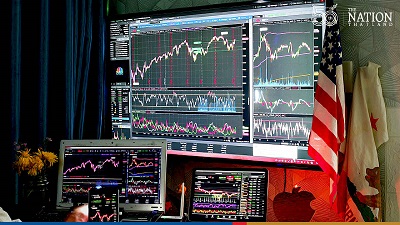
The Stock Exchange of Thailand (SET) Index fell by 1.63 points, or 0.10 per cent, to 1,592.12 on Friday morning.
The SET Index closed at 1,593.75 on Thursday, up 5.96 points or 0.38 per cent. Transactions totalled THB81.32 billion with an index high of 1,596.36 and a low of 1,584.69.
Krungsri Securities expected the day’s index to rise to 1,600 points after oil price rose to over US$75 per barrel following Opec+ signalling it may gradually increase oil output this year.
Krungsri added that the index also gained positive sentiment from falling US jobless claims.
However, investors should beware of volatility in foreign funds flow and uncertainty over higher Covid-19 cases in Thailand, as it would pressure the index, Krungsri Securities said.
It also advised investors to follow the Opec+ meeting, as oil output is expected to increase by 400,000 barrels per day from August to December.
It recommended that investors buy:
▪︎ PTT, PTTEP and TOP, which benefit from the rising oil price.
▪︎ HANA, KCE, TU, CPF, ASIAN and EPG, which benefit from the weakening baht.
▪︎ BCH, CHG, BDMS, HMPRO, BEM, CKP, CBG, ICHI, PSL and TTA, whose second-quarter turnover is expected to improve.
Gold gains as worries rise over Covid Delta variant
The price of gold in Thailand surged by THB150 per baht weight for the second day in morning trade on Friday on mass buy-ups of safe-haven assets amid uncertainty over the outbreak of the Covid-19 Delta variant.
The Gold Traders Association report at 9.28am showed the buying price of a gold bar at THB26,950 per baht weight and selling price at THB27,050, while gold ornaments were priced at THB26,469.36 and THB27,550, respectively.
At close on Thursday, the buying price of a gold bar was THB26,800 per baht weight and selling price THB26,900, while gold ornaments were priced at THB26,317.76 and THB27,400, respectively.
Spot gold price on Friday was US$1,778 (THB57,180) per ounce after Comex gold on Thursday rose by $5.2 to $1,776.8 per ounce.
Hong Kong gold price, meanwhile, rose by HK$210 to $16,460 (THB68,152) per tael, the Chinese Gold and Silver Exchange Society reported.
Saudis, Russia in tentative deal for gradual oil-output hike
An OPEC+ ministerial panel recommended a gradual increase in oil output to the end of the year, paving the way for the wider group to reach a deal that would keep a firm grip on supply even as prices trade at two-year highs.
An employee walks across the top of an oil storage tank at the Salym Petroleum Development oil fields near the Bazhenov shale formation in Salym, Russia., on Feb. 5, 2014. MUST CREDIT: Bloomberg photo by Andrey Rudakov.
The OPEC+ Joint Ministerial Monitoring Committee, which includes Russia and Saudi Arabia, recommended that the group should add 400,000 barrels a day each month from August to December, a delegate said, asking not to be named because the information isn’t yet public.
The panel also suggested that the duration of the cartel’s production-cuts agreement should be extended to December 2022. The current deal, forged last year at the height of the first wave of the coronavirus pandemic, is due to expire in April, potentially returning millions of barrels a day of supply to the market when it still may not be needed.
Oil prices rose, trading near $75 a barrel in New York, on expectations that the supply will remain tight even as the cartel gradually opens the taps. The market reaction suggests concerns around inflation will continue to grow, influencing the decisions of policy makers around the world as they try to nurture a sustainable recovery from the Covid-19 pandemic.
“The price reaction says everything,” Giovanni Staunovo, a commodity analyst at UBS Group, said after preliminary details of the OPEC+ deal had emerged. “The supply increase would be less than market participants expected and demand is still expected to rise into August.”
Crude has risen around 50% this year, with the recovery in demand from the pandemic outpacing the revival of OPEC+ supplies after last year’s deep cuts. Oil’s surge, combined with a rally in other commodities, has central banks fretting about inflation again. It also shows how Saudi Arabia and Russia are back in the driving seat of the global energy market — a remarkable comeback from negative prices just over a year ago.
The Organization of Petroleum Exporting Countries and its allies are already in the process of reviving crude supplies halted last year in the initial stages of the pandemic. The 23-nation coalition decided to add about 2 million barrels a day to the market from May to July, and the question before ministers on Thursday was whether to keep going in the coming months.
The market has experienced a supply deficit for much of this year as the group’s output increases didn’t keep pace with the demand recovery. In the cartel’s view, that’s been an entirely necessary remedy — the only way to deplete the vast surplus in fuel stockpiles that accumulated as economies went into lockdown.
Now, the group’s data show oil inventories are back down to average levels as a strong revival in fuel consumption continues. Demand in the second half will be 5 million barrels a day higher than in the first six months of the year, OPEC Secretary-General Mohammad Barkindo said on Tuesday.
Yet there are several factors that could undo the rally, prompting influential OPEC+ members like Saudi Arabia to repeatedly urge caution.
There’s the risk of a supply influx if the U.S. reaches a nuclear deal with Iran. The highly infectious delta variant of Covid-19, which is already sending some countries back into partial lockdown and triggering a worrying rise in cases in other nations, threatens the demand recovery.
Published : July 02, 2021
By : Syndication Washington Post, Bloomberg · Salma El Wardany, Grant Smith, Dina Khrennikova, Javier Blas
U.S. state jobless claims post larger-than-expected decline
Applications for U.S. state unemployment insurance fell last week by more than projected, reaching a fresh pandemic low and suggesting that dismissals are abating as the economy reopens and labor demand rises.
Initial claims in regular state programs decreased by 51,000 to 364,000 in the week ended June 26, Labor Department data showed Thursday. The median estimate in a Bloomberg survey of economists called for 388,000 initial applications.
Continuing claims for ongoing state benefits increased to 3.47 million the week ended June 19.
The drop in applications is consistent with improving business conditions and companies’ efforts to increase headcounts to meet demand as the economy reopens. Still, initial claims remain above pre-pandemic levels and many employers say they are having trouble finding qualified workers, which is likely holding back the pace of the recovery.
As of June 26, 19 states had ended enhanced unemployment benefits out of the 26 that have announced plans to phase them out before their September expiration. While some businesses and staffing agencies have seen a pickup in applications from job seekers in some of those states, the magnitude of the impact remains to be seen.
Economists say it will take time to see any impact in the data, which, in the case of weekly jobless claims, can be volatile.
States including Indiana, Mississippi and West Virginia — which have ended Pandemic Unemployment Assistance for self-employed workers — saw initial claims in that program drop to zero last week.
The data come ahead of Friday’s closely-watched monthly jobs report, which is currently forecast to show the U.S. added more than 700,000 jobs in June.
Initial claims in Pennsylvania, Kentucky and California posted the largest declines in the latest week, while Massachusetts and Indiana reported increases.
Published : July 02, 2021
By : Syndication Washington Post, Bloomberg · Olivia Rockeman
130 countries sign on to global minimum tax plan, creating momentum for Biden push
President Joe Biden on Thursday celebrated a victory in his drive to make corporations pay a larger share of the cost of government, as 130 countries endorsed a blueprint for a global minimum tax on giant businesses and pledged to work for final approval by the end of October.
The agreement announced by the Organization for Economic Cooperation and Development (OECD) in Paris showcased the president’s preference for patient diplomacy rather than the unilateral moves favored by his predecessor.
Potentially the most significant change in global tax rules in 100 years, the accord is designed to stop countries from competing to lure corporations by offering lower tax rates and to help governments fund their operations at a time of soaring pandemic-related expenses. Biden administration officials also describe the tax plan as a partial remedy for the offshoring of manufacturing jobs that have hollowed out American factory towns and fueled populist resentments.
The president called the deal an example of the “foreign policy for the middle class” that he had promised to deliver, though Republicans were quick to object, and numerous details remain for negotiators to resolve.
“Multinational corporations will no longer be able to pit countries against one another in a bid to push tax rates down and protect their profits at the expense of public revenue,” Biden said. “They will no longer be able to avoid paying their fair share by hiding profits generated in the United States, or any other country, in lower-tax jurisdictions. This will level the playing field and make America more competitive.”
The agreement announced Thursday also includes for the first time provisions for taxing the U.S. giants of the Internet economy, such as Google, Facebook and Amazon. In return, European countries that had instituted their own digital taxes are to remove them, though the OECD statement lacked a timetable for action.
Treasury Secretary Janet Yellen called the agreement “a historic day for economic diplomacy” and said it represented one of the administration’s core foreign policy goals.
“For decades, the United States has participated in a self-defeating international tax competition, lowering our corporate tax rates only to watch other nations lower theirs in response. The result was a global race to the bottom,” she wrote on Twitter.
“Today’s agreement by 130 countries representing more than 90% of global GDP is a clear sign: the race to the bottom is one step closer to coming to an end,” she said in the tweet.
The deal was notable for the inclusion of countries that had been skeptical, including China, Russia and India, tax experts said.
Still, a great deal of work remains before a global minimum tax will become a reality. Participating countries must hammer out agreement on numerous details, bringing into alignment national tax systems that differ in important respects.
“It is a very, very broad-brush document. Now we have to work to get the details,” said Catherine Schultz, vice president for tax and fiscal policy at the Business Roundtable.
Every country will not be required to adopt the same 15% corporate tax rate. But if a country maintains a lower rate, the United States would be able to impose a compensatory levy on companies headquartered there, achieving the same objective.
The agreement on taxing the profits of Internet companies even where they lack a traditional brick-and-mortar presence seems especially complex. The levy applies to multinational corporations with annual sales of more than 20 billion euros, or roughly $24 billion, and before-tax profit margins above 10%.
ADVERTISEMENT
“It requires an unprecedented degree of cooperation and coordination among countries, not just in the design of rules but in their application, permanently,” said Barbara Angus, global tax policy leader for Ernst & Young. “There’s a lot of work to be done.”
A handful of countries did not sign on to the blueprint, including Ireland, a nation that has used its 12.5% corporate tax rate to attract U.S. technology and pharmaceutical companies over the past half-century. Likewise, Hungary and Estonia abstained, further complicating prospects for full European Union endorsement.
Each of the 130 nations, including the United States, also must convert its endorsement of Thursday’s five-page plan into the nitty-gritty detail of legislation that will rewrite individual tax codes.
The OECD statement said the two-pronged accord would reallocate the right to tax $100 billion in digital companies’ profits from their home nations to countries where they earn money even if they lack a physical presence there. The deal also sets a minimum corporate profits tax of “at least 15 percent,” which is expected to raise $150 billion annually, according to the OECD.
The tax overhaul comes after several decades that saw policymakers lighten the tax burden on big business.
ADVERTISEMENT
Since 1980, the global average corporate tax rate, weighted by the size of each economy, has dropped from more than 46% to 26%, according to the nonprofit Tax Foundation. While good news for corporations and investors, the decline has made it harder for governments to fund popular benefits and other programs.
President Donald Trump complained that other countries were using low tax rates to steal U.S. jobs, and Republicans in 2017 passed legislation reducing the corporate tax rate from 35% to 21%.
Biden has proposed raising the rate to 28% to free individual taxpayers from more of the cost of expanding government programs. He also has proposed a 15% minimum corporate tax rate to prevent companies from using exemptions and deductions to effectively eliminate their tax liabilities.
In the United States, annual revenue from corporate taxes relative to the size of the economy is now less than a quarter as large as in 1967, according to the Congressional Budget Office.
The burden-sharing issue has grown only more acute as the coronavirus swept the globe. Governments worldwide spent a collective $16 trillion over the past year to fight the pandemic’s health and economic ills, according to the International Monetary Fund.
“This historic package will ensure that large multinational companies pay their fair share of tax everywhere,” OECD Secretary General Mathias Cormann said. “This package does not eliminate tax competition, as it should not, but it does set multilaterally agreed limitations on it. It also accommodates the various interests across the negotiating table, including those of small economies and developing jurisdictions. It is in everyone’s interest that we reach a final agreement among all Inclusive Framework Members as scheduled later this year.”
The global minimum tax is an essential element of the president’s plan to raise the corporate tax rate at home, by minimizing the incentive to move offshore to escape tax collectors. But early reaction from some prominent Republicans to the OECD statement was sharply negative.
“This is a dangerous economic surrender that sends U.S. jobs overseas, undermines our economy and strips away our U.S. tax base,” said Rep. Kevin Brady of Texas, the senior Republican on the tax-writing House Ways and Means Committee.
Implementing the sweeping proposal would present its own challenges. Administering the new tax on digital companies would require “coordination between the IRS and other tax authorities on a day-to-day basis that we’ve never seen before,” said Angus, a former chief tax counsel for the Ways and Means panel.
Negotiators aim to reach a final deal by the end of October, when the Group of 20 leaders are scheduled to meet in Rome, with implementation to start in 2023.
Another batch of strong economic reports added fuel to the rotation into stocks that stand to benefit the most from a U.S. reopening.
Almost every major group in the S&P 500 advanced, while technology companies underperformed. The benchmark gauge of American equities rose for a sixth straight day, heading toward its longest winning streak since February. Treasuries were little changed. Oil climbed as OPEC+ ministers recommended a gradual increase in output until the end of the year, though the group’s meeting was delayed until Friday to resolve an internal dispute.
U.S. manufacturing expanded at a solid, yet slightly slower pace in June, with a measure of prices paid for materials hitting an almost 42-year high. Applications for state unemployment insurance fell last week by more than projected, reaching a fresh pandemic low. The figures come ahead of Friday’s monthly payrolls report, which will help shape expectations of when the Federal Reserve might start tapering stimulus.
“With economic and earnings growth prospects robust, policy accommodative, and valuations still appealing relative to bonds, we believe the current environment is supportive of further equity gains,” Mark Haefele, chief investment officer at UBS Global Wealth Management, wrote in a note to clients.
However, Haefele is among the strategists advising investors to brace for bouts of volatility ahead. He cites inflation concerns, the spread of coronavirus variants and geopolitical tensions as potential catalysts.
Among the corporate highlights, Robinhood Markets Inc. filed for an initial public offering, saying it has applied to list on the Nasdaq under the symbol “HOOD.” Walgreens Boots Alliance Inc. slid after the drugstore chain signaled a slowdown in earnings growth and an increase in investments over the coming months.
These are some of the main moves in markets:
Stocks
– The S&P 500 rose 0.5% as of 2:51 p.m. EDT
– The Nasdaq 100 was little changed
– The Dow Jones industrial average rose 0.3%
ADVERTISEMENT
– The MSCI World index rose 0.2%
– The Russell 2000 Index rose 0.9%
Currencies
– The Bloomberg Dollar Spot Index rose 0.3%
– The euro fell 0.1% to $1.1844
ADVERTISEMENT
– The British pound fell 0.5% to $1.3756
– The Japanese yen fell 0.5% to 111.62 per dollar
Bonds
– The yield on 10-year Treasurys advanced one basis point to 1.48%
– Germany’s 10-year yield was little changed at -0.20%
– Britain’s 10-year yield advanced one basis point to 0.73%
Commodities
– West Texas Intermediate crude rose 2.1% to $75.01 a barrel
– Gold futures rose 0.2% to $1,775.10 an ounce
Published : July 02, 2021
By : Syndication Washington Post, Bloomberg · Rita Nazareth, Vildana Hajric
Online spending soars 45% as Covid transforms Thai shopping trends
Online shopping in Thailand surged again in the first quarter this year with spending up by an estimated 45.05 per cent.
Thais spent an estimated 75 billion baht per month online from January to March, up from 52 billion baht in November, according to the Department of International Trade Promotion (DITP)’s latest e-commerce survey.
The nationwide survey of 7,499 people also showed online purchases are up by 68.97 per cent from November, as consumers continue to switch to online outlets during the Covid-19 “new normal” era.
Of the 13 product groups covered by the survey, clothes and accessories were the most popular online buys. This was followed by food and beverages, health products, cosmetics, personal items, office supplies, electrical and electronic appliances, mobile phones and mobile devices, sporting goods, stationery, music, movies and other entertainment products, software, games, computers, toys, books, and magazines.
Mobile phones and devices accounted for the highest percentage of online spending.
Online shopping was most popular among people aged 20-29 (87%), followed by those under 20 (85.71%) and those 30-39 (80.13%). By comparison, in November the under-20s were the keenest online shoppers (50.62%), followed by 30-39-year-olds (50.20%) and 20-29-year-olds (49.04%). DITP said the figures reflected characteristics of Generation Y and Z members who grew up in the internet era and are able to learn and adapt quickly to changes.
The biggest spenders were the 20-29 age group, which averaged 2,379.30 baht per month, followed by the 50-59 age group with 2,349 baht.
In terms of occupation, students were the highest online spenders, with mobile phones, devices, and computers accounting for most money spent. Next came government officials, state enterprise employees, and state and company employees.
Classified by region, metropolitan Bangkok had the most online big-spenders, followed by the South, the Central region, the Northeast and the North.
The Stock Exchange of Thailand (SET) Index closed at 1,593.75 on Thursday, up 5.96 points or 0.38 per cent. Transactions totalled THB81.32 billion with an index high of 1,596.36 and a low of 1,584.69.
In the morning session, Krungsri Securities forecast Thursday’s index would fluctuate between 1,580 and 1,600 points amid growth in US private sector employment and the rising oil price.
It expected pressure on the index from foreign fund outflows and uncertainty over the rising Covid-19 caseload in Thailand. Foreign investors sold a net THB10 billion worth of shares in June.
The 10 stocks with the highest trade value today were BANPU, KBANK, GUNKUL, PTT, SCB, GPSC, BBL, KCE, TISCO and AOT.
Other Asian indices were on the fall:
Japan’s Nikkei Index closed at 28,707.04, down 84.49 points or 0.29 per cent.
China’s Shanghai SE Composite Index closed at 3,588.78, down 2.42 points or 0.067 per cent, while the Shenzhen SE Component Index closed at 15,038.88, down 122.83 points or 0.81 per cent.
South Korea’s KOSPI closed at 3,282.06, down 14.62 points or 0.44 per cent.
Taiwan’s TAIEX closed at 17,713.94, down 41.52 points or 0.23 per cent.
Hong Kong’s Hang Seng Index was closed for Special Administrative Region Establishment Day.
Domestic outbreak, QE tapering will sap Thai stock market in Q3: ASP
Covid-19 restrictions at home and QE tapering abroad will pressure the Stock Exchange of Thailand (SET) in the third quarter this year, Asia Plus Securities (ASP) said on Thursday.
ASP executive vice president Therdsak Thaveeteeratham said the US Federal Reserve’s plan to taper its quantitative easing programme at the end of August would trigger outflow of foreign funds from the SET.
Meanwhile, the latest outbreak of Covid-19 in Thailand, which has led to the temporary closure of restaurants, entertainment venues and construction sites, would shrink GDP in the second and third quarters, both quarter-on-quarter and year-on-year, he said.
“However, we believe that the country’s GDP will stand at 1.7 per cent this year as the export sector has recovered significantly, while the government is making efforts to distribute Covid-19 vaccines to provinces nationwide,” he said.
He pinpointed the SET’s support level at 1,510 points, advising investors to buy stocks with good fundamentals that gain positive sentiment and are attractive to domestic investors, including BLA, BDMS, TFG, MCS, GPSC, BJC and CENTEL.
Meanwhile, ASP’s head of investment advisory Padorn Suksawad advised investors to keep an eye on the global Covid-19 situation and countries’ key economic indicators, such as GDP, unemployment rate and Purchasing Managers Index.
He also advised diversifying investment to countries witnessing economic recovery, such as the US and China, to escape risks in carrying Thai stocks pressured by the Covid-19 outbreak.
SET expected to feel the heat from foreign fund outflows, rising Covid-19 cases
The Stock Exchange of Thailand (SET) Index rose by 2.50 points or 0.16 per cent to 1,590.29 on Thursday morning.
Krungsri Securities predicted the index would fluctuate between 1,580 and 1,600 points despite the expansion in US private sector employment and the rising oil price.
It believed foreign fund outflows and uncertainty amid higher Covid-19 cases in Thailand would pressure the index. In June, foreign investors made net share sales worth THB10 billion.
It recommended investors buy:
▪︎ PTT, PTTEP and Banpu, which benefit from the rising oil price.
▪︎ Hana, KCE, TU, CPF, Asian and EPG, which benefit from a weakening baht.
▪︎ BCH, CHG, BDMS, HMPro, BEM, CKP, CBG, PSL and TTA, whose second-quarter turnover is expected to improve.
The SET Index closed at 1,587.79 on Wednesday, down 3.64 points or 0.23 per cent. Transactions totalled THB83.59 billion with an index high of 1,600.57 and a low of 1,584.47.