Skittish foreign fund inflow, increasing Covid-19 cases set to pressure SET
The Stock Exchange of Thailand (SET) Index rose by 6.92 points or 0.43 per cent to 1,598.35 on Wednesday morning.
Krungsri Securities expects the day’s index to rise to 1,600 points on strong US consumer confidence and house price indices.
It said the index also gained positive sentiment from speculation in shares to be listed on the SET50 and SET100 indices on Wednesday.
“However, the index would be under pressure due to volatile foreign fund inflows and higher Covid-19 cases in Thailand,” Krungsri Securities pointed out.
It recommended investors buy:
▪︎ Hana, KCE, TU, CPF, Asian and EPG, which benefit from a weakening baht.
▪︎ BCH, CHG, BDMS, HMPro, BEM, CKP, CBG, PSL and TTA, whose second-quarter turnover is expected to improve.
▪︎ KCE, IRPC, STA and STGT, which will be listed on the SET50 Index on Wednesday.
▪︎ AAV, Ichi, NRF, PSL, PTL, Singer, STGT, Synex and TKN, which will be listed on the SET100 Index on Wednesday.
The SET Index closed at 1,591.43 on Tuesday, up 12.26 points or 0.78 per cent. Transactions totalled THB79 billion with an index high of 1,596.08 and a low of 1,579.44.
The price of gold dropped by THB50 per baht weight in morning trade on Wednesday due to a strengthening dollar and strong US economic data.
AGold Traders Association report at 9.29am showed the buying price of a gold bar at THB26,700 per baht weight and selling price at THB26,800, while gold ornaments cost THB26,226.80 and THB27,300, respectively.
At close on Tuesday, the buying price of a gold bar was THB26,750 per baht weight and selling price THB26,850, while gold ornaments cost THB26,272.28 and THB27,350, respectively.
The spot gold price on Wednesday was US$1,765 (THB56,581) per ounce after Comex gold on Tuesday fell by $17.10 to $1,763.60 per ounce.
The Hong Kong gold price meanwhile dropped by HK$40 to $16,320 (THB67,373) per tael, the Chinese Gold and Silver Exchange Society reported.
Stimulus Pandexit is next challenge as recovery quickens
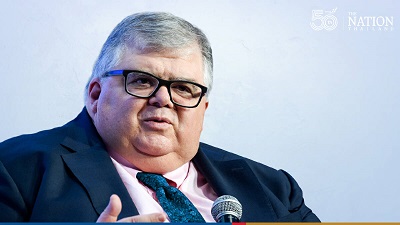
Central banks and governments were quick to buttress the world economy as the Covid-19 pandemic erupted. The bigger challenge will be weaning it off the unprecedented support theyve deployed, according to the Bank for International Settlements.
As economies rebound, officials will need to enact more targeted fiscal measures to preserve policy space, the Basel-based institution said in its annual report released Tuesday, alongside a speech entitled “Central Banks Facing Pandexit Challenges.”
In light of the pick-up in consumer price pressures — which are probably temporary — policy makers will also need to strike a balance between reassuring markets they’re willing to support growth and showing they’re prepared to fight inflation.
“Monetary policy will have to be flexible and prudent,” Agustin Carstens, general manager of the BIS and former governor of the Mexican central bank, said in the speech. “Accommodative policies are still needed, although the recovery could be fast. Careful communication will be at a premium to smooth the ride.”
Central banks around the world are starting to rein in the largess of the past 16 months as the recovery takes hold, albeit unevenly.
The Federal Reserve is gradually approaching the moment when it reduces support, with counterparts in the U.K., Canada, Norway, Sweden, South Korea and New Zealand among those charting a course toward a pullback. Mexico, Hungary and the Czech Republic raised interest rates last week, following hikes in 2021 from Brazil, Turkey and Russia.
“What is key is that central banks have to be very watchful, in particular advanced economy central banks, in looking at the performance of inflation expectations,” Carstens told Bloomberg Television’s Guy Johnson and Alix Steel in an interview.
“They should be very watchful” to ensure such expectations don’t become de-anchored, he said. “So far we haven’t seen that, and that is a good omen.”
With a record of urging policymakers to control ballooning asset prices, the BIS noted that house prices had risen more steeply during the pandemic than fundamentals would suggest, increasing the sector’s vulnerability if borrowing costs rise.
The BIS, a forum for central banks, highlighted other challenges, both short- and longer-term, including the risk of rising corporate insolvencies and the need for regulators to ensure banks keep lending to businesses without taking on too much risk.
Changing demand patterns, as more people choose to work from home permanently, as well as fine-tuning policy guidance so that investors don’t just focus on diary events, will present further challenges, the BIS said.
To prepare for future crises, officials will eventually need to restore their room to maneuver on both fiscal and monetary policy. Rising pressure on central banks to keep interest rates low to help governments manage their strained finances may complicate that task, according to the BIS.
If interest rates return to the levels of the 1990s, debt-service costs could exceed wartime highs, it said.
“Tasks for the longer term center on rebuilding safety margins and the interactions between monetary and fiscal policy,” Carstens said. “It is essential to put public finances on a sustainable path and preserve central bank independence.”
Published : June 30, 2021
By : Syndication Washington Post, Bloomberg · Catherine Bosley
For all the talk about inflated equity prices, a peak in earnings growth and the spread of a highly infectious coronavirus strain, stocks managed to close at another record.
In what some traders called a boring trading session, the S&P 500 eked out a gain of less than 0.1%. The benchmark gauge of American shares also remained on track for its fifth straight monthly advance — the longest run since August. Technology and retail companies rose, while financials underperformed even after some of the largest Wall Street banks boosted payouts to shareholders.
Investors have been weighing possible risks to the rally that drove equities up more than 90% from last year’s lows amid expectations that this quarter will mark the peak of a profit recovery from the depths of the pandemic. BlackRock Investment Institute strategists are dialing down their excitement for U.S. stocks, saying that potentially higher taxes and more regulations could pose “challenges” to the market.
“Investors are probably taking a minute to reassess their near-term outlook,” said Adam Phillips, managing director of portfolio strategy at EP Wealth Advisors. “With momentum fading, stocks likely need a meaningful catalyst from here.”
These are some of the main moves in markets:
Stocks
The S&P 500 was little changed as of 4 p.m. EDT
The Nasdaq 100 rose 0.3%
The Dow Jones industrial average was little changed
ADVERTISEMENT
The MSCI World index was little changed
Currencies
The Bloomberg Dollar Spot Index rose 0.2%
The euro fell 0.2% to $1.1900
The British pound fell 0.2% to $1.3850
ADVERTISEMENT
The Japanese yen was little changed at 110.55 per dollar
Bonds
The yield on 10-year Treasurys was little changed at 1.47%
Germany’s 10-year yield advanced two basis points to -0.17%
Britain’s 10-year yield advanced two basis points to 0.74%
Commodities
West Texas Intermediate crude rose 0.7% to $73.40 a barrel
Gold futures fell 1.1% to $1,761.40 an ounce
Published : June 30, 2021
By : Syndication Washington Post, Bloomberg News · Rita Nazareth, Vildana Hajric
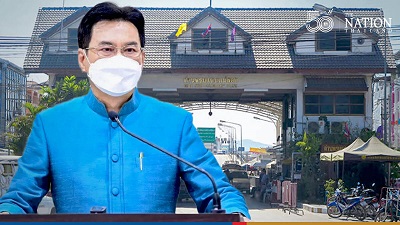
Cross-border trade rose more than 29 per cent in May, increasing for the fifth consecutive month, the Commerce Ministry reported on Tuesday.
Total trade of 677.078 billion baht represented a rise of 29.15 per cent, with exports up 33.6 per cent to 408.3 billion baht and imports up 22.93 per cent to 268.777 million baht. Thailand registered a trade balance of 139.524 billion baht spurred by recovery in neighbouring economies.
Efforts to boost trade and exports would be boosted by the opening of 11 more checkpoints as early as possible, said the ministry. Currently, more than half (51) of Thailand’s 97 border checkpoints remain closed under Covid-19 restrictions.
Thailand’s direct border trade with its four neighbours – Malaysia, Myanmar, Laos and Cambodia – rose 19.85 per cent to 371.04 billion baht in May.
Meanwhile cross-border trade via neighbouring countries to important markets such as China, Singapore and Vietnam grew 42.57 per cent to 306.038 billion baht. China remained the biggest trading partner, followed by Singapore, Vietnam, the United States, Taiwan, Japan and South Korea.
The Commerce Ministry said border and cross-border trade is on course to exceed the target of 1.4 trillion baht.
The Stock Exchange of Thailand (SET) Index closed at 1,591.43 on Tuesday, up 12.26 points or 0.78 per cent. Transactions totalled THB79 billion with an index high of 1,596.08 and a low of 1,579.44.
In the morning session, Krungsri Securities forecast Tuesday’s index would fall to between 1,565 and 1,570 points due to uncertainty over the Covid-19 outbreak, especially in Asia and Britain.
It added that negative sentiment over the virus crisis had led to a drop in the oil price.
“In addition, volatile fund flows and the Thailand Futures Exchange’s move to roll over its futures contracts would pressure the index,” Krungsri Securities said.
The 10 stocks with the highest trade value today were KBANK, RCL, BANPU, SCGP, GUNKUL, SCB, HANA, PTT, PTTEP and SCC.
Other Asian indices were on the fall except in Taiwan:
Japan’s Nikkei Index closed at 28,812.61, down 235.41 points or 0.81 per cent.
China’s Shanghai SE Composite Index closed at 3,573.18, down 33.19 points or 0.92 per cent, while the Shenzhen SE Component Index closed at 14,999.80, down 150.37 points or 0.99 per cent.
Hong Kong’s Hang Seng Index closed at 28,994.10, down 274.20 points or 0.94 per cent.
South Korea’s KOSPI closed at 3,286.68, down 15.21 points or 0.46 per cent.
Taiwan’s TAIEX closed at 17,598.19, up 7.22 points or 0.041 per cent.
SET expected to shed points amid Covid uncertainty, volatile funds flow
The Stock Exchange of Thailand (SET) Index rose by 6.30 points, or 0.40 per cent, to 1,585.47 on Tuesday morning.
The SET Index closed at 1,579.17 on Monday, down 3.50 points or 0.22 per cent. Transactions totalled THB68.83 billion with an index high of 1,581.34 and a low of 1,565.31.
Krungsri Securities predicted the SET Index would fall to 1,565 and 1,570 points due to uncertainty over the Covid-19 outbreak, especially in Asia and Britain.
It added that this negative sentiment had led to a fall in oil price.
“In addition, volatility in funds flow and Thailand Futures Exchange’s move to roll over its future contracts would pressure the index,” Krungsri Securities said.
It recommended that investors buy:
▪︎ HANA, KCE, TU, CPF, ASIAN and EPG, which benefit from the weakening baht.
▪︎ BCH, CHG, BDMS, HMPRO, BEM and CKP, whose second-quarter business turnover is expected to improve.
▪︎ KCE, IRPC, STA and STGT, which will be listed on the SET50 Index on Wednesday.
▪︎ AAV, ICHI, NRF, PSL, PTL, SINGER, STGT, SYNEX and TKN, which will be listed on the SET100 Index on Wednesday.
Importers buy dollars as baht slides towards 32 to the greenback
The baht opened at 31.93 to the US dollar on Tuesday, unchanged from Monday’s closing rate.
The Thai currency is likely to move between 31.85 and 32.00 during the day, Krungthai Bank market strategist Poon Panichpibool said.
He said the most important factor influencing the baht was the Covid-19 crisis in Thailand, and the vaccine distribution in the country.
Poon predicted that importers would buy dollars at this time as the baht has weakening.
He suggested that investors monitor if the baht weakens to 32 per US dollar. If the baht reaches that point, technically the currency will move further to 32.25 to 32.50, he added.
The price of gold in Thailand rose by THB50 per baht weight in morning trade on Tuesday.
The Gold Traders Association report at 9.26am showed buying price of a gold bar at THB26,850 per baht weight and selling price of THB26,950, while gold ornaments were priced at THB26,363.24 and THB27,450, respectively.
At close on Monday, the buying price of a gold bar was THB26,800 per baht weight and selling price THB26,900, while gold ornaments were priced at THB26,317.76 and THB27,400, respectively.
Spot gold price on Tuesday was US$1,775 (THB56,870) per ounce after Comex gold on Monday rose by $2.9 to $1,780.8 per ounce.
The gold market is keeping an eye on the US non-farm payroll in June in a bid to predict the Federal Reserve’s monetary policy.
Hong Kong gold price, meanwhile, dropped by HK$60 to $16,450 (THB67,899) per tael, the Chinese Gold and Silver Exchange Society reported.