The International Monetary Fund has predicted that Thailand’s economy will grow by 3.7% in terms of real GDP in contrast with the global economic slowdown.
In its latest world economic growth projections released last month, the IMF said Thailand was one of two nations in Asia that can be expected to grow in real GDP terms both this year and next. The other country is China.
According to IMF, Thailand’s projected real GDP growth for 2022 is 2.8% and 3.7% for 2023.
The IMF report said the cost-of-living crisis, tightening financial conditions in most regions, Russia’s invasion of Ukraine and the lingering Covid-19 pandemic all weigh heavily on the outlook. As a result, it has forecast a global slowdown from 6% in 2021 to 3.2% in 2022 and 2.7% in 2023.
The report noted that Thailand’s unemployment rate for this year and next is at merely 1%.
Kristalina Georgieva, IMF’s managing director, said at the Apec Summit in Bangkok on Saturday that the economies of most Apec members would slow down and a third of the world will enter an economic recession.
She said the US, China and European Union economies will slow down at the same time, which will affect the export markets of new-world nations because the three are the main driving forces for global economies.
The Thai government worked hard to promote its so-called BCG (bio-circular-green) Economy Model during Apec 2022 despite strong opposition from some environmental groups.
Thailand also managed to secure consensus from leaders of the 21 member countries to adopt the “Bangkok Goals on BCG Economy” as they wrapped up their meeting on Saturday. The BCG concept was introduced by the research community and promoted by the government as a new economic model for inclusive and sustainable growth. The model apparently capitalises on Thailand’s strengths in biological diversity and cultural wealth, and employs technology and innovation to help transform the economy into a value-based, innovation-driven one. The model also conforms to the United Nations’ Sustainable Development Goals (SDGs) and is also intended to align with the sufficiency economy philosophy. The sufficiency economy philosophy is also the key principle of Thailand’s social and economic development.
The government adopted the BCG economic model as the 2021-2026 “national agenda” with the goal of boosting the country’s gross domestic product by 1 trillion baht within that period. According to the National Science and Technology Development Agency, the BCG model focuses on promoting four key industries – agriculture and food; medical and wellness; bioenergy, biomaterial and biochemical; and tourism and creative economy. Science, technology and innovation will be employed to enhance the capacity and competitiveness of players in the value chain, both upstream and downstream, in the four industries, coupled with innovative policy and supportive legal and financial measures. The four industries currently have a combined economic value of 3.4 trillion baht, accounting for 21% of Thailand’s GDP. The BCG model is expected to raise this economic value to 4.4 trillion baht, or 24% of GDP, by 2026. However, some environmental groups have voiced concerns. Penchom Saetang, director of Ecological Alert and Recovery – Thailand (EARTH), warned that the amount of toxic waste imported to Thailand for recycling would hit dangerous levels if members of the Asia-Pacific Economic Cooperation (Apec) adopted the BCG economic model. Greenpeace Thailand director Tara Buakamsri also warned that adopting the BCG economic model would only make large capitalist groups in Thailand even stronger, further widening the wealth gap.
Thailand’s BCG model couples economic recovery with sustainability
SATURDAY, NOVEMBER 19, 2022
At the policy dialogue “Understanding the BCG Economy Model for Strong, Balanced, Secure, Sustainable and Inclusive Growth in the Asia-Pacific” organized in February, APEC 2022 host Thailand welcomed economies of APEC to exchange ideas on how applying the Bio-Circular-Green (BCG) Economy model could foster sustainable development for the region.
“BCG” was introduced by Thailand to APEC this year as a post-pandemic growth strategy combining science, innovation and technology for efficient resource usage, waste reduction and ecosystem maintenance.
According to the National Science and Technology Development Agency, the Bio-Circular-Green Economy model was conceptualized by Thailand’s government as a strategy directed toward economic and social recovery after the COVID-19 pandemic.
Aligned with the Thailand 4.0 aspiration, BCG was also created to enhance Thailand’s commitment to the United Nations Sustainable Development Goals (SDGs).
The model emphasizes applying science, technology and innovation to make the most of an economy’s biological and cultural advantages. For Thailand, these competitive advantages span agriculture and food, wellness and medicine, energy, materials and biochemicals, and tourism and creativity.
The Bio component of the model concerns the production of renewable biological resources and their conversion into products of value. Within the Circular Economy, businesses and consumers reuse and recycle resources. In a Green Economy, the economy, society and the environment are in balance and are conducive to sustainable development.
Differing from traditional economic models, BCG targets economic progress that is also balanced by promoting sustainability of biological resources, strengthening communities and the grassroots economy, enhancing sustainable competitiveness for relevant industries, and resilience to global changes.
Put into practice in 2021, BCG has already empowered Thailand to turn several challenges into opportunities. Amid falling global food prices, BCG allowed Thailand to increase the value of its agricultural produce and returned it to the path of becoming the “Kitchen to the World”.
Similarly, BCG adoption in the medical and wellness sector created a prime opportunity for Thai businesses during the pandemic, when world trends turned to natural and sustainable health products.
With the 2021-2027 BCG Action Plan, Thailand has provided a blueprint for implementing BCG that is ready to adopted by APEC economies, so that they may also achieve sustainable economic prosperity.
Baht opens higher on Friday but downward pressure mounting
FRIDAY, NOVEMBER 18, 2022
The baht opened at 35.85 to the US dollar on Friday, strengthening from Thursday’s close of 35.91.
The Thai currency will likely move between 35.75 and 36.00 against the greenback during the day, Krungthai market strategist Poon Panichpibool said.
Poon cautioned that downward pressure on the baht was rising as the market goes risk-off, which is prompting the dollar to strengthen.
Foreign investors are also selling more Thai stocks, bonds and currency, which could trigger pressure on the baht to weaken in the short term, he added.
Moreover, the falling gold price might add drag to the Thai currency as investors if it nears the support level and attracts more buyers.
Poon estimated the baht’s resistance level at 36 to the dollar.
He also advised investors to use hedging tools such as options to manage risks in a highly volatile currency market.
Sustainable development a challenging balancing act, speakers at Apec CEO Summit say
THURSDAY, NOVEMBER 17, 2022
Maintaining a balance between the economy, society and environment is a challenge towards sustainable development, Peru’s First Vice President Dina Ercilia Boluarte Zegarra said on Thursday.
She was speaking during the session on “Building Sustainable Economies, Businesses and Societies” at the Asia-Pacific Economic Cooperation (Apec) CEO Summit being held at Athenee Hotel in Bangkok.
She said Peru is working on maintaining the balance between the three dimensions to prevent damage to the next generation, secure needs for the future and protect the environment.
On tackling inequality, she said Peru is working alongside the private sector and fostering partnership with foreign investors.
Given its high index of poverty, the country has developed social programmes to promote social inclusion, she added.
“Growth has to be with humans at its core,” she said.
Chile’s President Gabriel Boric said balancing immediate needs with long-term ones are necessary for sustainable development.
He said democracy is a solution for balancing immediate needs as it can help build confidence among people and drive the country forward.
“Protecting and improving democracy, in my opinion, is the key to sustaining the people’s well-being,” he said.
Despite a stable economy, technologies, resources and renewable energy, he said it would be meaningless if there is no equal society.
“We need social reform, otherwise we will have social problems,” he said.
Suzanne Gaboury, director-general of Asian Development Bank (ADB)’s Private Sector Operations Department, said the private sector should take a role in driving the economy towards sustainability.
She added that ADB is offering financial assistance to enable the Asia-Pacific region to become prosperous, inclusive, resilient and sustainable.
“There is a need for the private sector to come in for ideas,” she said.
Mitsubishi UFJ Financial Group (MUFG) president and CEO Hironori Kamezawa said digital transformation, sustainability and culture are three big topics for CEOs in these changing times.
He urged private banks to provide support for sustainable finance to enable CEOs to achieve their ambitious goals.
“We need innovation in sustainability-linked finance to help incentivise customers to reach goals,” he said.
‘Winning trust and mutual cooperation key to cope with current challenges’
THURSDAY, NOVEMBER 17, 2022
Nongluck Ajanapanya
Rebuilding mutual trust is one of the most essential tasks for surviving current challenges and thriving for long-term sustainability, a group of leaders and experts said at the Asia Pacific Economic Cooperation (Apec) CEO Summit.
The unanimous opinion was expressed during an open forum discussion led by Ferdinand Romualdez Marcos Jr, president of the Philippines, Robert E Moritz, global chairman, PricewaterhouseCoopers (PwC), and Klaus Schwab, founder, and chairman of the World Economic Forum (WEF).
They discussed “The Global Economy and the Future of Apec”, which primarily provided the audience with an overview of the current economic situation in the global and Asia-Pacific region, as well as the challenges that exist and how to move forward.
Climate change, supply chain disruption, and food security are the most pressing issues to address, according to the Philippine president, the chairman of PwC, and the WEF chairman.
Although each country prioritises those issues differently depending on its context, finding long-term solutions requires mutual cooperation.
“To get the best trust is to perform what you have said,” the leader of the Philippines stated, adding that in the political sphere if a leader wants to build trust, they must demonstrate by doing it.
Moritz advised everyone to pay close attention to what the other person is saying so they can all understand and reduce the chance of misinterpretation.
All of the pressing issues that they raised on stage are already on the agenda of many summits around the world including Apec CEO Summit 2022.
They are also the driving force behind this year’s summit concept of finding the right solution to address issues in the short term while also assisting each country in seamlessly transitioning to a more sustainable way with the help of digital technology.
In addition to rebuilding trust, Moritz advises countries to support people’s development and improve the country’s database.
“The database will not only allow us to make better and faster decisions, but it also will describe and enable the journey on how they will adapt for the future in order to gain public trust,” Moritz explained.
The Philippines’ president then concluded that the world needed peace and harmony right now. He noted that prosperity cannot exist in the world without peace.
The two-day Apec CEO summit brings together Asia’s top business leaders for discussions with Apec economic leaders, policymakers, academics, and CEOs. The summit is being held on November 17-18, at Athenee Hotel in Bangkok.
Thai, Japanese ministers discuss trade, commercial tie-ups
THURSDAY, NOVEMBER 17, 2022
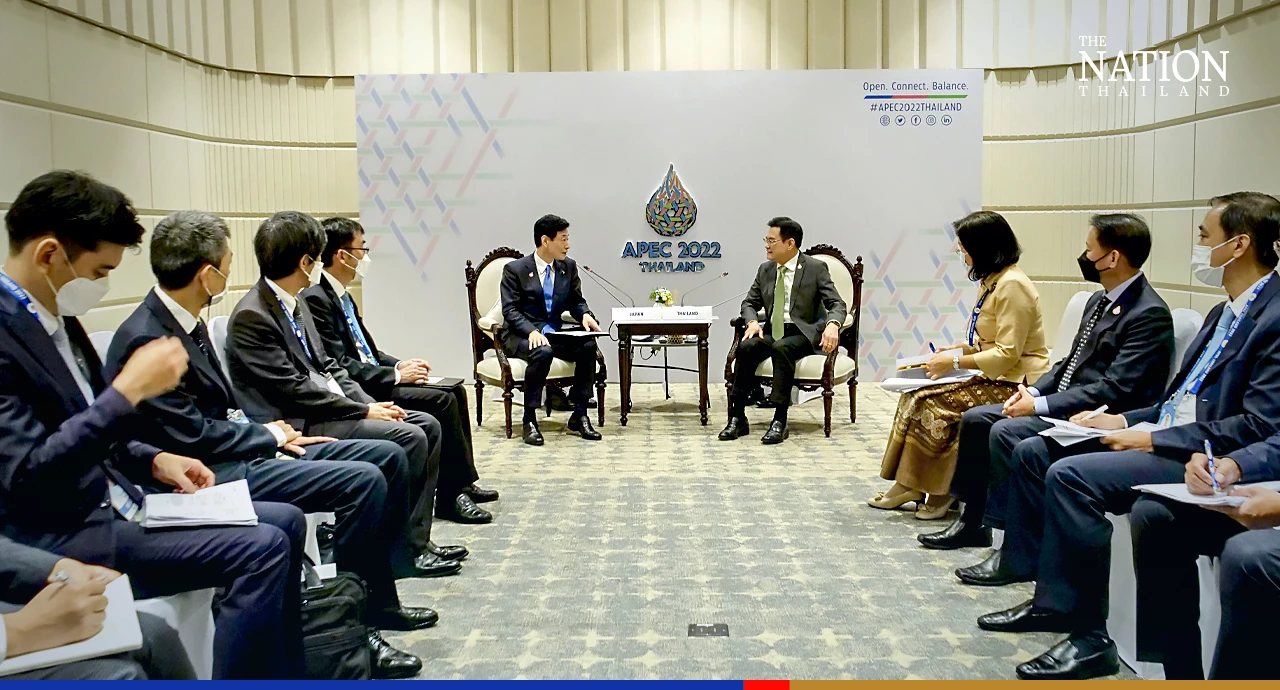
Commerce ministers from Thailand and Japan discussed a boost in trade and commercial cooperation during a meeting on the sidelines of the 2022 Asia-Pacific Economic Cooperation Summit.
Commerce Minister Jurin Laksanawisit met with Japan’s Economy, Trade and Industry Minister Yasutoshi Nishimura on Wednesday at Queen Sirikit National Convention Centre in Bangkok.
Jurin said Nishimura presented a project to celebrate 50 years of ties between Japan and Asean under the concept “Co-create Vision”, with a highlight on building at least 100 networks of private Japanese and Asean firms by boosting business matching and joint investments across various industries.
Japan has earmarked a budget of 8 billion yen (2.1 billion baht) for the project.
Nishimura also affirmed that Japan would fully support the Regional Comprehensive Economic Partnership (RCEP), which groups Thailand, Japan and 13 other countries. The RCEP is currently considered the world’s largest free trade bloc, said Jurin.
Japan also urged the Indo-Pacific Economic Framework (IPEF) to continue its mission to establish economic relationships in the region among 14 member countries, including Thailand, Japan, the United States and Australia.
The IPEF was officially announced in May this year in Tokyo and, together, its members represent 40 per cent of the world’s GDP.
Jurin said he discussed the issue in which Thailand is currently exporting only 3 billion tonnes of banana to Japan under the Japan-Thailand Economic Partnership Agreement, which actually stipulates a quota of 8 billion tonnes per year.
“We could not use the whole quota because the agreement has complex regulations that have made some of our products fall short of Japan’s import standards,” said Jurin, adding that he had asked Nishimura to coordinate with the Japan External Trade Organisation to help provide knowledge and necessary training to Thai farmers so they can improve their product quality to meet Japanese standards.
Jurin also asked Nishimura to consider supporting Phuket as host of the Specialised Expo 2028. The expo, which targets medical technology and promotes medical tourism, is supervised by the Bureau International des Expositions, which Thailand and Japan are members of. The bureau is scheduled to select the host in June next year.
In the first nine months of 2022, trade between Thailand and Japan was worth 1.55 billion baht, increasing 9.13% year on year. About 642 billion baht came from exports, which increased 10.7% year on year and included automotive components, processed chicken, machinery, computers, plastic pallets, copper and steel.
The baht opened at 35.80 to the US dollar on Thursday, weakening from Wednesday’s close of 35.63.
The currency will likely move between 35.70 and 35.95 against the greenback during the day, Krungthai market strategist Poon Panichpibool predicted.
He said the baht is coming under more pressure to weaken as the market has descended into a risk-off state and is therefore supporting the dollar.
Furthermore, foreign investors might offload additional Thai assets for profit so the baht might weaken in the short term, he believed.
Poon suggested keeping an eye on statements from hawkish US Federal Reserve officials as they could cause the market to fluctuate.
Investors are wondering that if the Fed does slow down its interest rate increases, by how much will the rate rise? And is the Fed still deeply concerned about the state of the economy and the rate at which it is slowing?
Poon said mass gold sales could also be a factor in the weakening of the baht.
He expects the currency’s resistance level to be 35.85-36 to the dollar and feels the support level would be 35.50, something most importers are waiting for to purchase the greenback and other foreign currencies.
Poon advised investors to use hedging tools such as options to manage risks in a highly volatile currency market.
Business council adds three urgent items to Apec leaders’ agenda
WEDNESDAY, NOVEMBER 16, 2022
Nongluck Ajanapanya
The Asia Pacific Economic Cooperation (Apec) Business Advisory Council (ABAC) has urged Apec leaders to develop a plan to address three urgent economic issues: inflation, food and energy security, and climate change.
The request has been abruptly added to their five key recommendations to accelerate economic recovery in the aftermath of Covid-19.
ABAC chairman Kriengkrai Thiennukul said at a press conference on Wednesday that the three sudden requests arose from worries of business leaders in the Asia Pacific region.
“We are concerned about the impact of inflation, which we believe will slow the recovery. Meanwhile, geopolitical tensions have a significant impact on energy and food security, and weather variability caused by climate change poses a significant risk to our economic sustainability,” Kriengkrai noted.
He expected Apec leaders to give these urgent items on the agenda serious thought and develop some policies to help mitigate the negative effects.
After four major meetings held throughout the year in Singapore, Canada, Vietnam and Thailand, the meeting finalised five key recommendations with 69 sub-clauses under two objectives, “Promoting speedy and sustained recovery” and “Regaining momentum for sustainable, inclusive, and resilient growth”, according to Kriengkrai.
“The latter includes advancing towards sustainability, deepening regional economic integration, and fostering an enabling environment through digitalisation. The working group will then deliver the complete report to Apec leaders,” he noted.
ABAC is also the host and chair of “Apec CEO Summit 2022”, which will be held from November 16-18 under the theme “Embrace, Engage, Enable”.
This summit brings together economic leaders, thought leaders, and leading CEOs to discuss trade perspectives, investments, and the social drive that will allow the Asia-Pacific region to embrace opportunity, engage in collaboration and enable new possibilities in partnership with the private sector.
Dominique Ng, the next ABAC and Apec CEO Summit chairman of the United States, was also honoured at the press conference.
He praised Thailand and the working group for working tirelessly to find a solution to the current challenges, notably how to support micro, small, and medium enterprises, which account for more than 90% of the Apec region’s economic activities.
He also revealed that the next ABAC’s theme would be: “Equity, Sustainability, and Opportunity”, which will be implemented in 2023.
He pledged to continue promoting the role of the private sector for the benefit of the people, ensuring economic growth while remaining environmentally conscious, and implementing concrete policies that provide inclusive opportunity.
‘Revival of talks on FTA a key development from Thailand hosting Apec Summit’
WEDNESDAY, NOVEMBER 16, 2022
Neena ML.
Auramon Supthaweethum, director-general of the Department of Trade Negotiations (DTN), expects to see positive conclusions from the Apec meetings this week in terms of trade and investment in Thailand’s bio-circular-green economy and free-trade agreements.
In an exclusive interview with The Nation, Auramon speaks about the role of her department in helping Thailand’s preparations to host the Apec Summit, trade and investments issues, bilateral free trade agreements between Thailand and other economies and the predicted outcome of the summit.
Q: As the curtains go up for Apec 2022, how excited is the Department of Trade Negotiations about the possibilities?
A: Very excited, because we have been helping, assisting with the organisation of the Apec Summit since the beginning of this year as an economic pillar.
Q: What are the areas towards which the DTN has contributed?
A: The department has been involved with four key activities that will take place in the next few days.
First, we are helping the MFA [Ministry of Foreign Affairs] host the Apec Ministerial Meeting [AMM], which will be chaired by Jurin Laksanawisit, Deputy Prime Minister and Minister of Commerce, and Don Pramudwinai, Deputy Prime Minister and Minister of Foreign Affairs of the Kingdom of Thailand. It will provide opportunities for ministerial levels to discuss this year’s Apec theme: Open. Connect. Balance. Another activity that my department has been involved in is the bilateral meetings of minister Jurin, because there is going to be a good opportunity to meet other Apec ministers who accompany their leaders to Thailand. It’s a good opportunity to discuss bilateral trade issues with them. The other important development is: we are planning for the ministers to sign a MoU [memorandum of understanding] between Thailand and Australia on economic cooperation, and we are also helping the Department of International Trade Promotion and the Ministry of Commerce in showcasing Thai products on the BCG theme at the event.
Q: What other FTAs are likely between Thailand and other economies?
A: We are going to have the AMM meetings, but they also provide opportunities for Thailand to have bilateral discussions with our trading partners. We have already set the agenda with some countries for ministers to meet. For instance Japan. So it will be a good opportunity.
Q: Apart from Japan, are any other meetings planned, such as with China or Russia for example?
A: Maybe not China and Russia this time. In the case of Russia, the ministers had already met last year. There’s going to be a leaders’ meeting — between President Xi Jinping and Prime Minister Prayut Chan-o-cha — so there’s no need for a ministerial level meeting.
Q; Amid geo-political tensions, are you concerned about any disagreements in international trade between the economies and also would it cause concern or inconvenience to Thailand in negotiating trade with the other economies as well?
A: I think Apec is a forum where members can discuss cooperation, so when Thailand was chosen to host Apec, we set the theme as: Open. Connect. Balance. When we chair and host the AMM on November 17, we have provided some topics for Apec economies to discuss. It will be relevant to the three key areas in the theme, and the meeting will be divided into three main agendas. The agenda that Minister Jurin will chair will be related to Open. I think this will guide Apec economies to discuss their ideas on how Apec can move forward to have open trade in order to make the Apec region very efficient and have sustainable economic integration.
Q: How do you see Apec moving forward and contributing to the world situation right now, especially when the world is recovering from the pandemic, and economies are hit by recession or downturn? How do you see this cooperation between Thailand and the other economies panning out?
A: During the pandemic, we realised the problem that arose from countries’ lockdowns, which caused constraints in the flow of goods and services across borders. So Thailand has tried to kick off the idea of moving forward the FTA agreement of Asia Pacific members. This is the revival of an idea that was brought up in Apec more than 10 years ago. It was suggested by the Apec Advisory Group — ABAC, the private sector. However, over the last decade, not much progress has been made on the FTA Asia Pacific. In order to help members recover from the economic situation from the pandemic, they all realised that having lockdowns and closed borders is not going to help. They recognised the importance of open trade, and the FTA Asia Pacific is one outcome that can support Open trade. So in May this year, when we organised the ministers responsible for trade meetings, the issue was discussed by Apec members and they all supported the idea. They believe that it’s positive to move forward the FTA Asia Pacific. However, because Apec comprises 21 economies — both developed and developing countries — they have different levels of economic development, so their ideas may be different. That is why, Thailand’s Ministry of Commerce held discussions with members at the senior official meetings. We are trying to formulate a four-year work plan to realise the FTA Asia-Pacific and this work plan will be endorsed at the AMM meetings.
Q: What about Asean? Are there any matters of concern related to Apec?
A: Apec is a cooperation forum where members can exchange views and ideas, in order to come up with best practices for members. Of the 21 Apec economies, only some members are from Asean. So we are individual countries, we are not talking in terms of Asean. Because, for example, Cambodia, Laos, Myanmar are not Apec members, however, there are various issues related to trade that members can bring up for discussion.
Q: In the end what is the DTN’s plan for expanding Thailand’s trade and investment and also cooperation between Thailand and the 20 other Apec economies?
A: My department takes care of Thailand’s FTA negotiations — launching new FTAs, as well as trying to implement the existing FTAs. We already have FTA agreements with most of the Apec members. At present, Thailand has 14 FTAs with 18 trading partners. We have FTAs with Asean, China, Japan, South Korea for example, Australia, New Zealand. There are still countries in Apec with whom Thailand does not have an FTA yet, countries such as the US, Canada and Mexico. So, when we are talking about creating an FTA Asia Pacific, we believe that it will also provide additional benefits to Thailand, because it will be an opportunity for Thailand to discuss FTA with the countries that we haven’t had a deal with yet. At the same time my department is also involved in bilateral trade between Thailand and our trading partners so we could also take the opportunities to discuss bilateral trade, to enhance our trade and investment, cooperation, and expansion and there are some countries that we have already set up schedules for ministers to meet during the Apec Summit.
Q: How do you see the conclusion of this Apec Summit on November 19?
A: This is a good question. I think there will be a statement issued at the level of AMM meetings as well as at the leaders’ meetings. The statement certainly will cover all the main issues that members have discussed since the beginning of the year when Thailand became Apec host. It will cover three main areas: Open. Connect. Balance. Regarding Open, members have already discussed how to move forward towards an Asia Pacific FTA. I’m sure it will be covered in the statements. Members also have discussed Connect. How to reconnect after facing the Covid-19 crisis? Also there will be a statement on Balance and the BCG model and how members support the Bio-Circular-Green economy.
Q: Do you think there will be more trade and investment in BCG after the summit?
A: I think so. We can see that this idea has been discussed amongst Apec economies. Various countries have also demonstrated that they also have these policies and they implement green policies and they are trying to move forward in order to tackle climate change. They are also trying to add value to their products by doing recycling, so I think this is a trend between international forums. And like I mentioned to you, the Ministry of Commerce is also involved as we are showcasing the products of Thailand which are aligned with the BCG model. We are also showcasing products that we can use and reuse waste and create new value-added products. This has been organised by the Department of International Trade Promotions.
Q: Do you think that there will be any obstacles to reach an agreement between members, considering serious differences between some members?
A: I think at the working level we are trying to finalise it, trying to get endorsement and support of Apec economies. So we have to wait and see.
Q: If you could choose, what would be an ideal outcome of the meeting?
A: I hope that Thailand will benefit from the meeting. I hope that Thai people and the private sector can perhaps utilise what we have discussed in the Apec Summit and put it to good use and be able to network with Apec economies. If they can engage in more trade with our trading partners and enhance their revenue, it will generate income for the country and also move Thailand’s economy and society forward in a more sustained way




 SootinClaimon.Com