Accelerate business outcomes with Industrial AI #SootinClaimon.Com

#SootinClaimon.Com : ขอบคุณแหล่งข้อมูล : หนังสือพิมพ์ The Nation.

Accelerate business outcomes with Industrial AI

EconFeb 08. 2021Adi PendyalaAdi Pendyala

By By Adi Pendyala, Senior Director, Aspen Technology

In 2021 and beyond, Industrial AI, as a new industry category will go mainstream – catalyzed by key business drivers, dimensions of readiness and adoption of real-world use cases. To set context, Industrial AI can be defined as a systematic, collaborative, and integrative discipline focusing on developing, embedding, and deploying various machine learning algorithms as fit-for-purpose, domain-specific industrial applications with sustainable business value.

Four business drivers for the adoption of Industrial AI

First, industrial organizations will start focusing on how AI can be applied to address domain-specific industrial challenges. This locks in AI-enabled use cases to tangible business outcomes, which clearly makes the case for widespread Industrial AI adoption.

Second, the barrier to AI adoption will be lowered, as a lack of AI expertise and in-house data science skills among industrial organizations has been a key bottleneck to wider Industrial AI enablement. More organizations will deploy targeted, embedded Industrial AI applications combining data science and AI with purpose-built software and domain expertise. Fit-for-purpose, embedded AI applications will empower users to tackle domain-specific functions efficiently and successfully with greater accuracy, reliability, quality, and sustainability across the industrial asset lifecycle – circumventing the need for niche data science expertise.

Third, organizations are increasingly valuing data as a critical driving force and have become laser-focused on amassing as much of it as possible. Data needs to be capitalized on and leveraged into actionable insights to be worthwhile. Organizations, especially those in capital-intensive industries, will need to shift gears from mass data collection to more strategic industrial data management, with specific focuses on data integration, mobility, and accessibility across the business. That opens the door for Industrial AI, and the underlying opportunity for AI-enabled technologies that will allow these organizations to reap the hidden value in their industrial data sets.

Finally, the biggest driver for Industrial AI is the undeniable productivity increases for capital-intensive process industries. Industrial AI enables next-generation asset optimization solutions to be implemented without needing to rely on large-scale data science expertise. This empowers industrial organizations to open the door to new levels of safety and productivity in their workplace, creating semi-autonomous and autonomous processes for collecting, aggregating, and conditioning live data, then feeding it into intelligence-rich applications. The end results are new insights, continuous operational improvements and faster and more accurate decision making.

Is your organization ready for Industrial AI?

Is your organization ready for Industrial AI?

Five dimensions to be Industry AI ready

First, companies need to have a clear action plan that maps AI to business goals, data objectives and KPIs to weave Industrial AI into your digital transformation strategy. Business leaders need to think more broadly than one-off use cases – and an action plan that aligns AI capabilities with overarching business goals does just that.

An overarching industrial data strategy is required – companies need to have accessible, valuable data that can be leveraged constructively by Industrial AI. Garbage in/garbage out is a data problem that afflicts the industrial sector as it does any other industry, so building a strategy around quality and efficient data flows is paramount. That means building a pipeline of industrial data that enables AI solutions to process different types and amounts of data required by each use case and application, and scaling this across the entire organization so that every user and function of the AI gets consistent performance and results.

A future-proof Industrial AI infrastructure necessitates the need to lay the groundwork for Industrial AI readiness, requiring a broad collaboration across industrial environments. In fact, the software, hardware, architecture, and personnel elements will form the building blocks of your Industrial AI infrastructure. And that infrastructure is what empowers organizations to take their Industrial AI proof-of-concepts and mature them into real, tangible solutions that drive ROI. An Industrial AI infrastructure needs to accelerate time to market, build operational flexibility and scalability into AI investments and seek to harmonize the AI model lifecycle across all applications.

Roles, skills, and training are critical. Executing Industrial AI properly relies on having the right people in charge of that execution. That means making a deliberate effort to cultivate the skills, mindsets and approaches needed to create and deploy AI-powered initiatives across the organization. Business leaders need to invest in significant levels of workforce retraining in the coming years to make sure their people are best equipped to deploy Industrial AI.

Finally, ethical and responsible AI use is predicated on transparency, and transparency involving keeping everyone in the loop: creating clear channels of communication, reliable process documentation and alignment across all stakeholders, so that everyone’s on the same page about the Industrial AI’s benefits, limits and uses. The whole premise of Industrial AI is bringing together the best of both worlds in people and AI, and making the two greater than the sum of their parts.

The above is just a guideline but it is worth approaching things with a holistic view that considers the technical, people and processes requirements, and ultimately lays out your organization’s own definition of success.

Top three use cases to bring your Industrial AI strategy to life

The starting point of any organizational strategy begins with identifying the business problems, corporate objectives, and strategic goals that Industrial AI can solve. Organizations looking to drive true business value can take inspiration from these three specific business use cases to unlock the power of Industrial AI, combining data science and AI with software and domain expertise to deliver comprehensive business outcomes for the specific business needs of capital-intensive industries.

Predictive maintenance is the single largest use case for Industrial AI, estimated to have made up more than 24 percent of the total market in 2019, according to the IoT Analytics research report referenced above. Predictive maintenance detects deviations from normal behavior and prescribe detailed actions to mitigate or solve future problems – all with the goal of optimizing output and reducing downtime.

The second use case focuses on quality and reliability. Quality shows how well an object performs its primary function, while reliability shows how well the object maintains its original level of quality over time, through various conditions. Both are significant measurements in an industrial setting and Industrial AI enables an organization to achieve a specific and accurate understanding of the two, saving time and money.

Third, process optimization leverages advanced ML methods, including reinforcement learning and sophisticated deep learning neural networks, to infer information and intelligence from different data sources, assets, and processes. With this, organizations can easily identify and mitigate inefficiencies, which have a direct impact on productivity – the primary economic driver of any industrial enterprise organization.

The use cases outlined above are a concise and clear starting point for any organization building out or redesigning their Industrial AI strategy, and hoping to accelerate time to value in turn.


Thai stocks hold up as Asian markets slide #SootinClaimon.Com

#SootinClaimon.Com : ขอบคุณแหล่งข้อมูล : หนังสือพิมพ์ The Nation.

Thai stocks hold up as Asian markets slide

EconFeb 04. 2021

By The Nation

The Stock Exchange of Thailand (SET) Index closed at 1,482.98 on Thursday, up 1.23 points or 0.08 per cent. Total transactions amounted to Bt77.84 billion with an index high of 1,492.39 and a low of 1,477.88.

In the morning session, Krungsri Securities expected the SET Index to fluctuate between 1,470 and 1,490 points despite hopes of fresh US stimulus measures, plus the rising oil price after US oil storage dropped to its lowest level in almost a year.

“The outflow of foreign funds will pressure the index,” Krungsri Securities added.

The 10 stocks with the highest trade value today were BBL, PTT, KBANK, IVL, SCB, CPALL, EA, GPSC, SCC and ADVANC.

As of 4.30pm, the price of oil rose by US$0.24 or 0.43 per cent to $55.93 per barrel, while gold dropped by $22.20 or 1.21 per cent to $1,812.90 per ounce.

Other Asian indices were on the fall:

Japan’s Nikkei Index closed at 28,341.95, down 304.55 points or 1.06 per cent.

China’s Shang Hai SE Composite Index closed at 3,501.86, down 15.45 points or 0.44 per cent, while Shenzhen SE Component Index closed at 15,105.94, down 127.21 points or 0.84 per cent.

Hong Kong’s Hang Seng Index closed at 29,113.50, down 193.96 points or 0.66 per cent.

South Korea’s KOSPI Index closed at 3,087.55, down 42.13 points or 1.35 per cent.

Taiwan’s TAIEX Index closed at 15,706.22, down 65.10 points or 0.41 per cent.

SET rallies on US stimulus hopes, but foreign fund outflows cast shadow #SootinClaimon.Com

#SootinClaimon.Com : ขอบคุณแหล่งข้อมูล : หนังสือพิมพ์ The Nation.

SET rallies on US stimulus hopes, but foreign fund outflows cast shadow

EconFeb 04. 2021

By The Nation

The Stock Exchange of Thailand (SET) Index rose by 7.41 points, or 0.50 per cent, to 1,489.16 in the morning session on Thursday.

The SET Index is expected to fluctuate between 1,470 and 1,490 points despite hopes over the rollout of fresh US economic stimulus measures, as well as the rising oil price after US oil storage dropped to its lowest level in almost a year, a Krungsri Securities analyst said.

“The outflow of foreign funds will pressure the index,” he added.

He recommended investors buy:

▪︎ PTTGC, TOP, IVL, EPG, VNT, CBG, Rojna, TVO, STGT, HTC, CPF, RCL, PSL, SYNEX, Com7, XO, Wice, JMT, JMART, Singer, MTC, Sawad and KCE, whose fourth-quarter turnover is expected to improve.

▪︎ ADVANC, INTUCH, AP, Siri and WHAUP, which pay high dividends.

The SET Index closed at 1,481.75 on Wednesday, down 4.50 points, or 0.30 per cent. Total transactions amounted to Bt79.48 billion, with an index high of 1,500.17 points and a low of 1,481.69.

Gold price drops in opening trade #SootinClaimon.Com

#SootinClaimon.Com : ขอบคุณแหล่งข้อมูล : หนังสือพิมพ์ The Nation.

Gold price drops in opening trade

EconFeb 04. 2021

By The Nation

The price of gold dropped by Bt150 per baht weight in morning trade on Thursday, the Gold Traders Association reported.

As of 9.26am, the buying price of a gold bar was Bt25,900 per baht weight and selling price Bt26,000, while gold ornaments cost Bt25,438.48 and Bt26,500, respectively.

At close on Wednesday, the buying price of a gold bar was Bt26,050 per baht weight and selling price Bt26,150, while gold ornaments cost Bt25,574.92 and Bt26,650, respectively.

The spot gold price moved to US$1,826 (Bt54,810) per ounce in the morning, while the Comex (Commodity Exchange) gold price rose by $1.70 to $1,835.10 per ounce on Wednesday, thanks to mass buy-ups of the precious metal after its price dropped sharply yesterday.

The Hong Kong gold price fell by HK$30 to $16,940 (Bt65,598) per tael, the Chinese Gold and Silver Exchange Society reported.

Thai investor confidence rises for second month in a row #SootinClaimon.Com

#SootinClaimon.Com : ขอบคุณแหล่งข้อมูล : หนังสือพิมพ์ The Nation.

Thai investor confidence rises for second month in a row

EconFeb 04. 2021

By The Nation

Thailand’s Investor Confidence Index was up 1.5 per cent in January for its second successive monthly rise, the Federation of Thai Capital Market Organisations (Fetco) reported on Wednesday.

The index rose to 132.55, buoyed by an influx of foreign funds, the rollout of Covid-19 vaccines and the performance of companies listed in the Stock Exchange of Thailand (SET), Fetco chairman Paiboon Nalinthrangkurn said.

Meanwhile, downside factors causing uncertainty among investors were the fresh Covid-19 outbreak, worries over the euro zone’s economy, and Thailand’s economic recession.

He added that investors were drawn to shares in the energy, petrochemical and commercial sectors. They showed little interest in tourism and steel shares, as well as property funds and real estate investment trusts.

Paiboon forecast the Thai stock market would hit 1,600 points this year from the influx of foreign funds spurred by Thailand’s second-half economic recovery, SET-listed companies’ rising profits and the Covid-19 vaccination rollout.

Meanwhile Myanmar’s coup would have only a limited impact on the Thai stock market as Thailand’s revenue from retail business with Myanmar was low, he added.

“However, we would like to warn investors to use discretion before purchasing high-speculation stocks such as GameStop in the US market, because their price may drop sharply when the speculation is over,” he said.

Thai stock market down 0.3% as investors eye foreign fund outflows #SootinClaimon.Com

#SootinClaimon.Com : ขอบคุณแหล่งข้อมูล : หนังสือพิมพ์ The Nation.

Thai stock market down 0.3% as investors eye foreign fund outflows

EconFeb 03. 2021

By The Nation

The Stock Exchange of Thailand (SET) Index closed at 1,481.75 on Wednesday, down 4.50 points or 0.30 per cent. Total transactions amounted to Bt79.48 billion with an index high of 1,500.17 and a low of 1,481.69

In the morning session, Krungsri Securities expected the day’s index to rise to between 1,495 and 1,500 points on hopes of US stimulus rollout together with a decline in US Covid-19 cases.

He said the index gained positive sentiment from the rising oil price after the Opec+ bloc decided to maintain oil production at current levels.

“However, investors should beware of volatility due to the outflow of foreign funds and the index’s resistance level of 1,500 points,” he said.

The 10 stocks with the highest trade value today were KBANK, PTT, SCB, BBL, SCC, ADVANC, MINT, PTTEP, CBG and CPALL.

As of 4.30pm, the price of oil rose by US$0.15 or 0.27 per cent to $54.91 per barrel, while gold rose by $3.00 or 0.16 per cent to $1,836.40 per ounce.

Other Asian indices were mixed:

Japan’s Nikkei Index closed at 28,646.50, up 284.33 points or 1.00 per cent.

China’s Shang Hai SE Composite Index closed at 3,517.31, down 16.38 points or 0.46 per cent, while the Shenzhen SE Component Index closed at 15,233.15, down 102.51 points or 0.67 per cent.

Hong Kong’s Hang Seng Index closed at 29,307.46, up 58.76 points or 0.20 per cent.

South Korea’s KOSPI closed at 3,129.68, up 32.87 points or 1.06 per cent.

Taiwan’s TAIEX closed at 15,771.32, up 11.27 points or 0.072 per cent.

BOT keeps interest rate at 0.5% amid weak economic recovery #SootinClaimon.Com

#SootinClaimon.Com : ขอบคุณแหล่งข้อมูล : หนังสือพิมพ์ The Nation.

BOT keeps interest rate at 0.5% amid weak economic recovery

EconFeb 03. 2021

By The Nation

The Bank of Thailand (BOT) kept its benchmark interest rate unchanged on Wednesday.

The unanimous vote to maintain the policy rate at 0.5 per cent was exercised to support a fragile economic recovery. The BOT policy committee assessed that the new outbreak of Covid-19 would take a short-term toll on the Thai economy.

However, exports and stimulus from government measures were expected to improve, said Titanun Mallikamas, secretary of the Monetary Policy Committee (MPC) after Wednesday’s meeting.

The MPC calculated the economic impact of the fresh outbreak was not as severe as the first wave, thanks to less stringent disease-control measures.

Meanwhile the economy had responded quickly to government stimulus measures while recovery of exports had gathered pace. As a result, the Thai economy had expanded – though slightly less than previously estimated.

In the short term, economic recovery will depend on the effectiveness of control measures for the new virus wave. The next phase of recovery would depend on the return of foreign tourists and the effectiveness of Covid-19 vaccination programmes.

The labour market would also be affected by the new outbreak, resulting in a short-term rise in unemployment and virtual unemployment.

The committee said it would use additional monetary tools to support economic recovery if appropriate, while monitoring both the sufficiency of government measures and various risk factors – especially the pandemic situation both here and abroad.

Bangkokians expected to spend less this year during Chinese New Year #SootinClaimon.Com

#SootinClaimon.Com : ขอบคุณแหล่งข้อมูล : หนังสือพิมพ์ The Nation.

Bangkokians expected to spend less this year during Chinese New Year

EconFeb 03. 2021

By The Nation

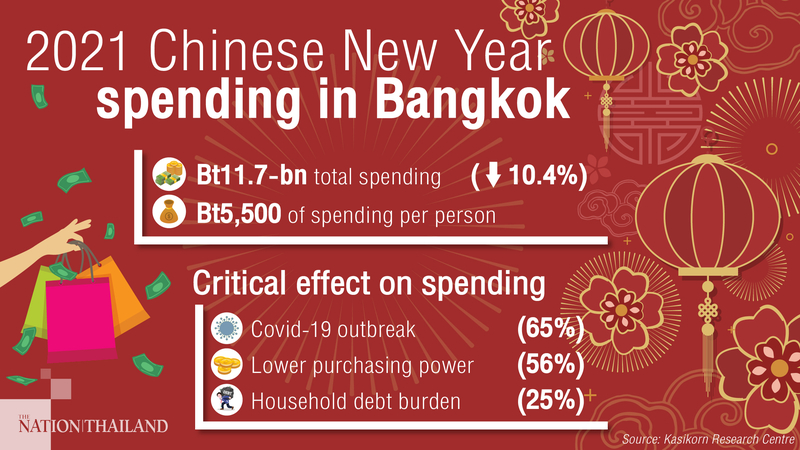
Covid-19 is a major factor that is pressuring Chinese New Year spending in Bangkok, leading to an expected 10.4 per cent decline in spending this year, Kasikorn Research Centre said.

Chinese-Thai Bangkok residents have reduced their spending on all activities, especially tourism, making merit and giving cash gifts, the research centre said.

Money spent in Bangkok during the Chinese New Year festival this year should total approximately Bt11.7 billion – a 10.4 per cent decrease compared to the previous year, the centre said.

Of the total, Bt5.6 billion is expected to be spent on offerings (a 5.1 per cent decrease), Bt2.9 billion on tourism/merit making/dining out (a drop of 20.8 per cent) and Bt3.2 billion on cash gifts (a decrease of 8.1 per cent).

The effects of Covid-19 have forced Bangkokians to go in for ready-made offerings via online channels or call-to-order stores for deliveries – more than in previous years.

The survey found that 43 per cent of Bangkok’s residents were interested in purchasing pre-made offerings, up by 22 per cent compared to the previous year. Most said online platforms responded to the immediate needs of especially the new generation.

The survey also found that most people in Bangkok are still not interested in buying offerings via online or call channels. More than 84 per cent are concerned about the quality of the offerings, especially meat and fruit, followed by 75 per cent who feel prices were higher when compared to purchases at shops, while more than 60 per cent think the variety of offerings are limited on online channels.

Therefore, the centre said, entrepreneurs need to respond to consumer behaviour, along with ensuring quality and value for money compared to products at physical stores.

The centre concluded that Bangkok’s Chinese New Year celebration this year will “not be as busy as it should”. Purchasing power has not yet recovered from last year as consumers have been hit by a new wave of Covid-19.

SET Index up, expected to rise further #SootinClaimon.Com

#SootinClaimon.Com : ขอบคุณแหล่งข้อมูล : หนังสือพิมพ์ The Nation.

SET Index up, expected to rise further

EconFeb 03. 2021

By The Nation

The Stock Exchange of Thailand (SET) Index rose by 9.49 points, or 0.64 per cent, to 1,495.74 in the morning session on Wednesday.

The SET Index is expected to rise to between 1,495 and 1,500 points on hopes that US economic relief measures will be rolled out, together with the decline in US Covid-19 cases, said a Krungsri Securities analyst.

He said the index gained positive sentiment from the rising oil price after the Opec+ bloc decided to maintain its oil production agreement.

“However, investors should beware of volatility due to the outflow of foreign funds and the index’s resistance level of 1,500 points,” he said.

He recommended investors buy:

▪︎ PTTGC, TOP, IVL, EPG, VNT, CBG, Rojna, TVO, STGT, CPF, RCL, PSL, SYNEX, Com7, XO, Wice, JMT, JMART, Singer, MTC, Sawad and KCE, whose fourth-quarter turnover is expected to improve.

▪︎ Advanc, INTUCH, AP, Siri and WHAUP, which pay high dividends.

The SET Index closed at 1,486.25 on Tuesday, up 8.20 points, or 0.55 per cent. Total transactions amounted to Bt77.03 billion, with an index high of 1,496.46 points and a low of 1,480.50.

Thai stocks buoyed by rising oil but foreign outflows a worry #SootinClaimon.Com

#SootinClaimon.Com : ขอบคุณแหล่งข้อมูล : หนังสือพิมพ์ The Nation.

Thai stocks buoyed by rising oil but foreign outflows a worry

EconFeb 02. 2021

By The Nation

The Stock Exchange of Thailand (SET) Index closed at 1,486.25 on Tuesday, up 8.20 points or 0.55 per cent. Total transactions amounted to Bt77.03 billion with an index high of 1,496.46 and a low of 1,480.50.

In the morning session, Krungsri Securities forecast the day’s index would fluctuate between 1,485 and 1,490 points in line with other stock markets in the region after investors relaxed their focus on the GameStop share battle on Wall Street.

The securities firm said the SET was supported by the rising oil price, after Saudi Arabia cut production.

The firm also warned investors of continued outflow of foreign funds from the SET.

The 10 stocks with the highest trade value today were PTT, KBANK, AOT, BANPU, EA, SCB, JMART, BBL, PTTEP and CBG.

As of 4.40pm, the price of oil rose by US$0.65 or 1.21 per cent to $54.20 per barrel, while gold dropped by $13.50 or 0.72 per cent to $1,850.40 per ounce.

Other Asian indices were on the rise:

Japan’s Nikkei Index closed at 28,362.17, up 271.12 points or 0.97 per cent.

China’s Shang Hai SE Composite Index closed at 3,533.68, up 28.40 points or 0.81 per cent, while Shenzhen SE Component Index closed at 15,335.66, up 311.42 points or 2.07 per cent.

Hong Kong’s Hang Seng Index closed at 29,248.70, up 355.84 points or 1.23 per cent.

South Korea’s KOSPI Index closed at 3,096.81, up 40.28 points or 1.32 per cent.

Taiwan’s TAIEX Index closed at 15,760.05, up 349.96 points or 2.27 per cent.