Baht strengthens against dollar on signs of foreign appetite for Thai stocks
TUESDAY, OCTOBER 25, 2022
The baht opened at 38.14 to the US dollar on Tuesday, strengthening from Friday’s close of 38.34.
The currency will likely move between 38.00 and 38.25 against the greenback during the day and between 37.80 and 38.50 during the week, Krungthai market strategist Poon Panichpibool predicted.
Poon said the baht will swing sideways with a key resistance level of 38.50 to the dollar.
Gold prices and foreign transactions in the Thai stock market would govern the baht’s volatility this week, he added.
The analyst said foreign investment started flowing back into Thai stocks following the Stock Exchange of Thailand (SET) index’s rebound last week.
He expects a shift in foreign investment towards Thailand if the index exceeds its resistance level of 1,600 points while the market is in a risk-on state.
However, he warned to watch out for foreign investors selling long-term Thai bonds amid a continuous increase in global bond yields.
For the dollar, he advised monitoring investors’ reactions to big-tech companies’ performance reports, as disappointment would push the currency market back towards a risk-off state and pressure the dollar to strengthen.
This week’s meetings of the European Central Bank and Bank of Japan may also cause fluctuation in the currency market. Poon said the euro and yen may weaken if the banks fail to signal tighter monetary policy.
He advised investors to use hedging tools such as options to manage risks in a highly volatile currency market.
Thai central bank reports strong signs of recovery in 3 regions
MONDAY, OCTOBER 24, 2022
The Bank of Thailand (BOT) has reported strong signs of economic recovery in September, crediting a tourism revival and subsidies to stimulate spending.
Reports from BOT offices in three regions showed the economy is rebounding fast from Covid-19, government spokeswoman Tipanan Sirichana said on Monday.
The northern office reported that a rebound in the tourism sector had boosted purchasing power and employment, mainly thanks to events such as King’s Cup football in Chiang Mai and the advent of the high season.
The report added that subsidies offered by the government had also shored up consumers’ confidence, prompting them to spend more.
The BOT’s northeastern office reported a rise in consumer spending driven by the subsidies, which had aided economic recovery. Employment rates also improved as MICE (Meetings, Incentives, Conferences, Exhibitions) tourism got back on track.
The Thailand Moto Grand Prix in Buri Ram on October 2 also boosted the local economy thanks to spending from domestic and foreign spectators, the report said. However, it added that the Northeast was now facing a labour shortage after workers returned to jobs in Bangkok.
The BOT’s office in the South reported that tourism continued to grow in September, adding momentum to economic recovery via government spending subsidies.
Foreign tourist continued to return in high numbers while more events were held. The high season had also boosted tourism employment in the region.
The report said government travel and accommodation subsidies had prompted an influx of visitors to tourism provinces in the South, also helping to boost economies of nearby provinces.
The government’s “We Travel Together” tourism subsidy pays 40 per cent of accommodation costs and 600 baht per night for food while its Khon La Kruen co-payment scheme offers 150 baht off daily shopping bills. Both have proved popular among Thais seeking relief from financial burdens triggered by the Covid-19 pandemic.
Thai private sector targets Apec summit with 5-pronged strategy
MONDAY, OCTOBER 24, 2022
Thailand’s business leaders said on Monday they will table five issues to boost the Thai economy at the Asia-Pacific Economic Cooperation (Apec) summit in Bangkok next month.
Federation of Thai Industries chairman Kriengkrai Thiennukul said his Apec Business Advisory Council (Abac) will tap opportunities at the summit, especially for Thailand’s small and medium-sized enterprises (SMEs).
The five issues Abac will put to world leaders are regional economic integration; digital infrastructure; sustainable practices of micro-entrepreneurs, small and medium-sized enterprises (MSMEs); sustainability; and finance and economics.
Abac submitted feedback from the Thai private sector to Prime Minister Prayut Chan-o-cha earlier this month, with a focus on handling inflation, food and energy insecurity, climate change and regional economic integration.
Kriengsak said the private sector urged support for MSMEs and digital infrastructure to boost economic recovery and growth.
Meanwhile, Thai Chamber of Commerce chairman Sanan Angubolkul said the summit was Thailand’s big opportunity to connect with the global economy.
The summit would also attract foreign investment, boost tourism and stimulate trade and exports.
“Foreign businesspeople attending the meeting will help generate revenue for Thailand’s economy, aiding recovery,” he said.
The meeting will discuss other issues related to people’s lives, such as public health, the Bio-Circular-Green (BCG) economy model, and global warming, resulting in benefits to the government, private and public sectors, he added.
Sanan pinpointed an urgent need to boost Thailand’s competitiveness by applying digital infrastructure to enhance SMEs’ potential and access to funds.
He added that the creative and knowledgeable new generation would accelerate Thailand’s competitiveness.
He also expected an influx of long-term foreign residents following an easing of visa rules.
“Hence, Thailand should improve investment privileges, tax incentives and rules related to the property sector to facilitate foreign investors,” he said.
“Apart from generating revenue for Thailand, this will also help promote technology exchange and employment.”
He added that Thailand should tap 5G technology and the Eastern Economic Corridor (EEC) to attract more foreign investment.
Thailand’s EEC extends tax breaks to lure high-tech Korean firms
SUNDAY, OCTOBER 23, 2022
The Eastern Economic Corridor Office (EECO) has agreed to extend tax and other investment privileges for South Korean companies.
The move is aimed to attract more Korean investment in the EEC for high-tech businesses, including electric vehicle making and smart city development.
An EECO source said the agency will extend a memorandum of understanding on investment privileges with the Korea Trade-Investment Promotion Agency (Kotra). The MoU had been due to expire soon.
The extended MOU will cover EV manufacturing, and the health product, biological technologies, logistics, and smart cities sectors.
The two agencies will hold an online meeting to discuss details of the extension, the source added.
South Korean companies have applied for Board of Investment (BoI) privileges on 63 projects worth 14.367 million baht since 2018.
The South Korean projects receiving privileges are in the automaking, digital, electronics and biological sectors.
Over the past 10 years, South Korean businesses have sought and obtained BoI tax privileges for 365 projects, worth 65.123 million baht.
BCG and FTAs: Empowering Thai trade in the Asia-Pacific
SUNDAY, OCTOBER 23, 2022
THE NATION
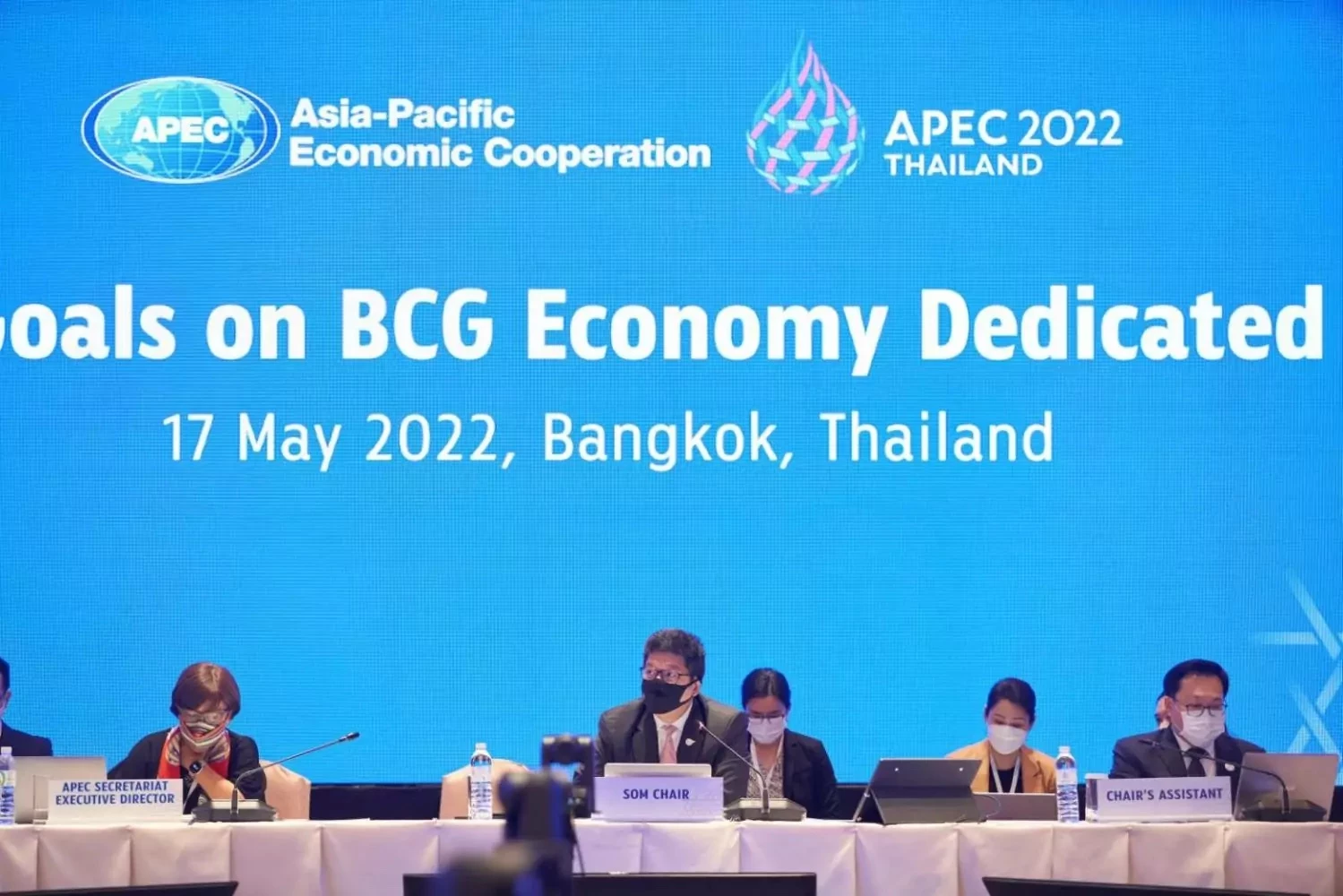
Part of the economic tapestry that drives APEC, Thailand – hosting the cooperation in 2022 – implemented a range of programs and projects to revitalize its trade and commerce, mobilizing both the Bio-Circular-Green Economy (BCG) concept and Free Trade Agreements (FTAs) to stimulate economic activity.
Coupling the potential of BCG and FTAs was the Department of Trade Negotiations under the Ministry of Commerce’s “Thai Entrepreneur Program for FTA Market”.
The endeavor first sought out businesses with the potential to greatly benefit from implementing the BCG approach, which combines the bio, circular and green economic models into one that adds value by making producers more environmentally-friendly and socially responsible, bolstering their sustainability.
These enterprises, mostly in the realms of agricultural produce and lifestyle goods, were given support to realize their potential under BCG and then access to a business matching session in July 2022 at the “Thai Entrepreneur Program for FTA Market”, an event organized by the Department of International Trade Promotion.
The businesses were matched with possible partners within the Regional Comprehensive Economic Partnership (RCEP), spanning ASEAN and Japan, as well as major entities such as TV Direct and e-commerce platform Thailand Mall.
Feedback from the effort was immensely positive, with participating businesses hailing it for broadening their trade bases and boosting their standing.
The program was more notably, a prime example of how Thailand is promoting BCG as a way to unlock value for businesses as well as how producers and service providers based in Thailand can significantly benefit from its FTAs.
According to the Department of Trade Negotiations, Thailand is engaged in 14 FTAs with 18 countries both within and beyond the Asia-Pacific. These agreements range from bilateral with Australia, New Zealand and India to multilateral via ASEAN.
Hosting APEC for 2022, Thailand’s mobilization of FTAs is consistent with the priority of “opening” the region to all opportunities. Employing the power of the BCG economy model, Thailand has provided clear examples for APEC on how the forum can reignite trade and prepare it for a future where environmental harmony and sustainability are leading economic factors.
Thai manufacturing industry suffering badly from rising costs, export slump: TTB Analytics
SATURDAY, OCTOBER 22, 2022
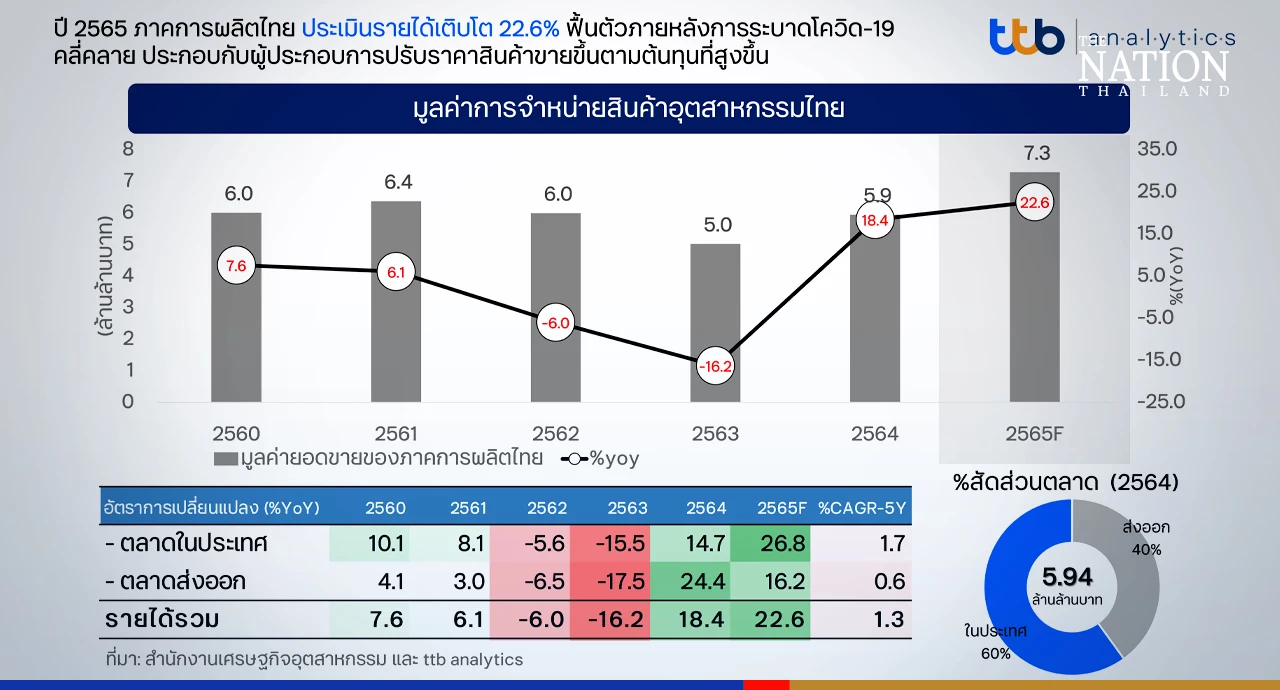
Thailand’s manufacturing sector has shown an underwhelming yearly growth of 1.3 per cent over the past five years, the most recent TTB Analytics report shows.
To improve conditions, the analysts have advised the government to promote investments in the EEC areas to boost employment and revenue in the sector.
The economic analytical centre under TMB Thanachart Bank said the manufacturing sector is responsible for about 27 per cent of Thailand’s gross domestic product (GDP) and employs about 9 million people.
The centre said since the emergence of Covid-19 in late 2019, the demand for Thai products has dropped drastically, affecting growth in the sector. The sale of the country’s manufactured products has dropped 16.2 per cent from 6 trillion baht in 2019 to 5 trillion baht in 2020.
TTB Analytics cited the data from the Office of Industrial Economics which said that from 2017 to 2021, the manufacturing sector’s revenue has expanded 1.3 per cent year on year on average. Domestic sales expanded 1.7 per cent, while exports expanded 0.6 per cent year on year on average.
The centre said in 2020, the sale of manufactured products had dropped in almost the entire industrial sector due to Covid-19 lockdowns. Food and consumer products only saw slightly increasing consumption in the domestic market, while only a handful of products enjoyed significantly increasing demands during the outbreak, such as medical gloves. The manufacturing output in the computer and electronics industry also saw steady growth during the pandemic as they were not affected by employees being forced to work from home.
TTB Analytics said the manufacturing sector bounced back in 2021 as more Covid-19 restrictions were eased, allowing people to resume economic activities. Sales of manufactured products in 2021 expanded 18.4 per cent year on year, though most industries have boosted their output, two have yet to fully recover from the impact of the pandemic, namely beverage and construction materials. The beverage industry relies on exports and has not recovered because many countries are keeping their borders closed, while the construction industry is losing out due to a drop in people’s purchasing power.
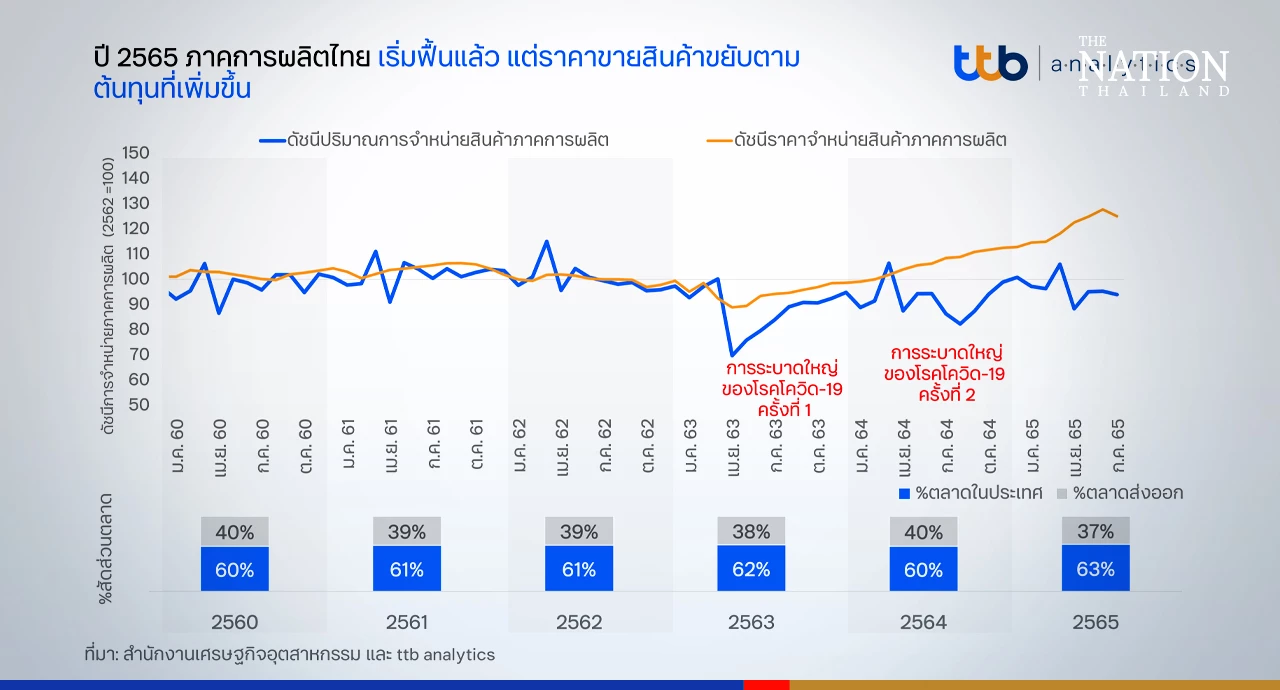
TTB Analytics said in 2022, the sales of manufactured products rose 22.6 per cent year on year, though this is mainly due to inflated prices as the sales volume is nearly at the same level as before Covid-19. The centre warned that though sales show an improving trend, manufacturers are suffering from rising costs and a significant drop in profits.
“Manufacturers have been raising their prices since the start of this year to cope with increasing costs. This strategy will stop working when the prices soar beyond people’s purchasing power and will send the economy into recession next year. This trend should be monitored closely,” it said.
TTB Analytics added that in the past five years, growth in the manufacturing sector has been limited to large industries such as automotive components, energy, chemicals, food and electronics, all of which had been severely affected by decreasing demand during the pandemic.
“To ensure continued growth and comprehensive revenue distribution across the entire manufacturing sector, the government must promote investment in new S-curve industries, especially in the Eastern Economic Corridor [EEC] areas, which will also boost employment in local communities,” said the centre.
TTB Analytics said industries that need immediate investment promotion include food processing, biotechnology, digital, automation system and robotics, aircraft, and national security technology.
“As the Covid-19 outbreak is nearly at an end, the government must focus on investment promotion aspects to ensure a steady growth of the country’s economy, including attracting foreign direct investment and building of infrastructure and ecosystem for target industries, which will surely help boost GDP expansion to 5 per cent annually in the near future,” said the centre.
TTB Analytics, however, forecast economic growth in 2022 at 3.2 per cent and 3.7 per cent in 2023, with a major contribution from the tourism industry.
Explainer: True-Dtac merger deal born after 9 months
SATURDAY, OCTOBER 22, 2022
The National Broadcasting and Telecommunications Commission (NBTC) voted 3:2 to “conditionally acknowledge” a planned merger between True Corporation and Total Access Communications (Dtac) after nine months of deliberation.
The decision was made on Thursday night at a meeting that lasted more than 11 hours.
Two NBTC board members voted to acknowledge the merger plan and two voted against, leaving board chairman Sorana Boonbaichaipreug to cast the deciding vote.
Consumer rights organisations oppose the merger, saying it will leave Thailand with just two telecom companies, undermining competition and hurting consumers.
Summary of the merger
The board will now send a summary of the vote to the Office of The National Broadcasting and Telecommunications Commission.
The merger process
A new company must be founded.
But before that happens, the shareholders of both companies must approve the merger plan. Once approved, an application can be submitted to the Commerce Ministry. The newly merged company must then inform the Stock Exchange of Thailand, a process expected to be completed by December.
According to telecom industry rumours, the merged company’s name will be “TRUE-D”.
Two into one
The new company to be formed by the True-Dtac merger in December will operate the NBTC frequency licences granted to True Move H Universal Communication (TUC) and Dtac TriNet (DTN).
No sharing for 3 years
Among conditions placed on the merger by the NBTC board is that True and Dtac must retain their brands – with no frequency sharing – for three years.
The merged company will have total assets of around 800 billion baht.
True will bring assets of 615.637 billion baht while Dtac has 159.759 billion baht.
The merger will leave Thailand with just two mobile telecom operators, the other being Advanced Info Service (AIS). AIS has assets of 349.517 billion baht.
The merged firm would also overtake AIS as Thailand’s largest operator since True and Dtac currently have 34 and 21 per cent of subscribers nationwide, respectively, compared with 44 per cent for AIS. The newly merged company will control 54 per cent of the market.
How Thailand fosters digital connectivity at home and for APEC 2022
SATURDAY, OCTOBER 22, 2022
Robustly preparing for this task, Thailand’s government has been actively fostering digital connectivity for years, making significant strides.
Creating a foundation for Thailand’s digital connectivity is the Village Broadband Internet, or Net Pracharat, project. Introduced to bolster the National Broadband Network by extending high-speed internet to every village in the country, Net Pracharat has effectively provided locals of even remote areas free access to the same internet speeds found in urban centers.
The purpose of the project is to allow all people in Thailand to reap the benefits of online services and information, so that they may apply the offerings of the internet to improving their daily lives.
Installation of fiber cabling for the project completed in December 2017, bringing access to 24,700 target rural villages and free public Wi-Fi hotspots to millions more.
With strong fundamentals in place, the Thai government has been able to achieve considerable success in supporting electronic payment, or e-Payment, in the country.
Official campaigns have led to widespread adoption and usage of the Prompt Pay e-Payment application, which allows for further programs such as Chim-Shop-Chai, Rao Chana, and the Co-Payment scheme implemented to significant effect.
More recent government wallet applications have also been well-received by Thai citizens and has opened an array of new opportunities for financial activity and commerce.
These domestic developments have empowered Thailand as host of APEC to promote digital connectivity across the region.
Acknowledging that the COVID-19 pandemic has accelerated the digital transformation, Thailand seeks this year to facilitate the cooperation’s adaptation by strengthening customs cooperation, market access. and digitalized border processes.
At relevant discussions, such as the 64th APEC Telecommunications and Information Working Group Meeting, Thailand joined in endorsing developments for information and communication technology infrastructure and complementary policies and regulations, speaking with experience from its own achievements.
Freebies not the solution to challenges faced by Thai farmers, says World Bank
FRIDAY, OCTOBER 21, 2022
Nongluck Ajanapanya
World Bank experts are urging the Thai government to stop free subsidies to help farmers and instead implement more conditional assistance measures that would directly improve production efficiency.
The statement was made at a seminar co-hosted by the World Bank and Kasetsart University on Friday to launch their joint study, “Ending Poverty in Thailand: Rural Income Diagnostic – Challenges and Opportunities for Rural Farmers”.
Nadia Belhaj Hassine Belghith, poverty economist at the World Bank, noted that rural Thailand continues to face the most severe poverty challenges, with high-income inequality.
Though it is commendable that the Thai government provides many freebies, this type of assistance will have a negative impact in the long run.
Witsanu Attavanich, a professor at Kasetsart University’s Faculty of Economics who participated in this study, elaborated that gratuitous measures only help Thai farmers in the short term, while what they really need is to learn how to increase their productivity in order to sustain their income.
Wisanu called it a “waste of time and money”. He said that the government should use the budget to improve irrigation systems and agricultural technology, as well as to educate more farmers on current farming practices instead.
Belghith added that the right assistance would help Thailand overcome its persistent poverty.
“Cross-cutting policy measures related to skill development will also be important in order to support rural households,” Belghith said. “With low levels of education and digital literacy, combined with an ageing farmer population, it is critical to develop the skills of farmers, young and old, to enable them to adapt to the changing context of climate change and benefit from new technologies.”
The World Bank Rural Income Diagnostic for Thailand aims to examine the challenges and opportunities to improve income and productivity in the rural sector.
The diagnostic also examines how to facilitate income growth in the short to medium term and places particular focus on farming households given their higher poverty and vulnerability.
The report found that Thailand’s poverty rate in rural areas was more than three percentage points higher than in urban areas in 2020. Furthermore, the rural poor outnumbered the urban poor by nearly 2.3 million. The majority of them make a living by farming.
Fabrizio Zarcone, World Bank country manager for Thailand, pointed out that Thailand has the potential to support faster and more sustained rural household income growth.
“As Thailand’s economy adjusts to a new normal post-Covid, policy measures that boost agricultural productivity, encourage crop diversification to higher-value crops, and improve access to markets through improved rural connectivity and digital technology adoption can help overcome the constraints faced by the rural poor,” Zarcone suggested.
According to the study, the Covid-19 pandemic has had a significant impact on the urban sector, resulting in strict mobility measures, business closures, and job layoffs.
However, the urban sector is expected to recover faster, while the rural economy will be hit harder by the crisis. The World Bank Thailand Covid-19 monitoring phone survey results also found that 70 per cent of rural households reported a decrease in income since March 2020.
The analysis also shows that Thailand has the highest income inequality rate in East Asia and the Pacific region, with a Gini coefficient of 43.3 per cent in 2019.
The average monthly income for rural households was only about 68 per cent of that of urban households. Rural households continue to face challenges, such as low education, a high number of dependents, and difficult living conditions.
In her closing remarks, Dina Umali-Deininger, regional manager of Agriculture and Food Global Practice at World Bank, urged the Thai government to reduce the disparity between urban and rural households.
She advocated increased agricultural productivity, added value in agricultural products, and more investments to improve the agricultural sector and prepare for the effects of climate change.
NBTC finally gives True-Dtac merger ‘conditional’ approval after 9 months
FRIDAY, OCTOBER 21, 2022
At a meeting that lasted for more than 11 hours, the Thai telecoms watchdog voted 3:2 to “conditionally acknowledge” a proposed merger between True Corporation and Total Access Communications (Dtac).
The decision was made on Thursday night, many months after True and Dtac – the country’s second and third-largest mobile network operators, respectively – filed their business merger report with the National Broadcasting and Telecommunications Commission (NBTC) in January.
However, this decision was a huge disappointment for consumer protection and civic society groups that have been against the merger, saying it would lead to market control and unfair competition.
Meanwhile, the opposition Move Forward Party has threatened to take legal action against NBTC for alleged dereliction of duty.
Deputy party leader Sirikanya Tansakul said on Friday that the agency failed to perform its constitutional duty to protect the interest of consumers.
In its resolution, the NBTC appeared to avoid using the term “approve”, though the minority commissioners maintained the regulator is empowered to decide whether to give the green light to such a business merger.
In a statement released on Thursday night, the NBTC admitted that the True-Dtac merger “is a sensitive matter that has impacts on the public”.
Prof Pirongrong Ramasoota, one of the two commissioners who voted against, dubbed the lengthy discussion between the five NBTC members as “the longest meeting in my life”.
In her Facebook post, Pirongrong apologised to reporters waiting outside the meeting room for declining an interview. “I was totally exhausted. My battery was depleted,” she wrote.
Pirongrong and her fellow minority commissioner, Assoc Prof Suphat Suphachalasai, reserved their rights not to permit a business merger between True and Dtac.
In her written statement, Pirongrong said she viewed such a merger as ownership of the same business type, which could severely affect the mobile network market and the national economic development.
She said the telecoms law and NBTC rules empower the regulator to prevent monopoly or unfair competition.
In her seven-point arguments, Pirongrong cited constitutional clauses that prohibit business domination and competition restriction. She also mentioned the findings of a study by the NBTC’s independent foreign advisers SCF Associates Ltd that pointed to the negative impacts of the merger on consumers.
In his written statement, Suphat said the True-Dtac merger would have severe consequences on the country’s economy and society, with reduced service quality and obstruction to new players in the market. There is a high likelihood of market collusion that would discourage new competitors, he said.
Before reaching their final decision, the five NBTC commissioners were evenly split. Suphat and Pirongrong viewed that the NBTC should not allow the merger as it would lead to a duopoly of the telecom business and unfair competition. But NBTC president Dr Sarana Boonbaichaiyapruck and Torpong Selanont disagreed, saying the regulator should acknowledge the merger with conditions.
The fifth commissioner, Air Marshal Thanapant Raicharoen, abstained explaining that there were some legal issues that need to be further considered.
The NBTC president cast the deciding vote, making it 3:2 in favour of the proposed merger, which was in line with the NBTC rules.
The conditions set for the merged entity include service fee controls and ceilings, independent verification of cost structures and service pricing by experts to be hired by the operators at their expense, for at least five years after the merger, space to be provided for the operation of mobile virtual network operators (MVNO) and separate rates to be charged for voice, data and messaging services.
Under the NBTC’s conditions, True and Dtac will use their existing brand names, True Move H Universal Communications (TUC) and Dtac TriNet (DTN), for three years after the merger, before they can adopt a new brand name.
They are also required to install a 5G network to cover 75 per cent of the Thai population within three years of the merger and 90 per cent coverage within five years.













 The report found that Thailand’s poverty rate in rural areas was more than three percentage points higher than in urban areas in 2020. Furthermore, the rural poor outnumbered the urban poor by nearly 2.3 million. The majority of them make a living by farming.
 The analysis also shows that Thailand has the highest income inequality rate in East Asia and the Pacific region, with a Gini coefficient of 43.3 per cent in 2019.
 SootinClaimon.Com