Ministry says inflation peaked in August, prices lower for rest of year

#SootinClaimon.Com : ขอบคุณแหล่งข้อมูล : หนังสือพิมพ์ The Nation.

https://www.nationthailand.com/thailand/economy/40020566

Ministry says inflation peaked in August, prices lower for rest of year

Ministry says inflation peaked in August, prices lower for rest of year

FRIDAY, SEPTEMBER 30, 2022

THE NATION

Thailand’s inflation rate has peaked and will remain below 6.5 per cent for the whole year, according to the Commerce Ministry.

The ministry’s Trade Policy and Strategy Office (TPSO) said on Thursday that inflation had soared in recent months, driven by international conflict and economic measures in foreign countries. This had driven up energy and food costs, resulting in higher retail prices in Thailand, it said.

Inflation peaked at 7.86 per cent in August and has been slowing since then, TPSO director Ronnarong Poonphiphat said. Inflation was being controlled by government measures, including asking product manufacturers to cap prices, he added.

Ronnarong predicted that raising the daily minimum wage on October 1 would have a minimal effect on inflation, as only a small proportion of manufacturing workers are on minimum wage. He said employers were expected to implement wage-management strategies to keep their costs from rising further.

Raising the fuel tariff should have hiked inflation by 0.78 per cent but government fuel subsidies and other measures had limited the rise to 0.25 per cent, he added.

Energy prices were the main driver of inflation up to August, rising 30.5 per cent over the previous six months.

Ronnarong said the improving economic situation and declining inflation were reflected in the Bank of Thailand’s move to raise the policy interest rate from 0.75 per cent to 1 per cent on Wednesday. The TPSO reckoned the 0.25 percentage point rise will dampen inflation by 0.04 to 0.12 per cent.

“TPSO estimates that Thailand’s headline inflation this year will not exceed 6.5 per cent and be within our estimated range of 5.5 to 6.6 per cent,” said Ronnarong.

However, factors that required monitoring included fluctuating energy prices, flooding that could affect agricultural output, and the weakening of baht, he added.

THE NATION

BOT admits printing error in one lot of 20-baht notes, tells public no need to panic

#SootinClaimon.Com : ขอบคุณแหล่งข้อมูล : หนังสือพิมพ์ The Nation.

https://www.nationthailand.com/thailand/economy/40020555

BOT admits printing error in one lot of 20-baht notes, tells public no need to panic

BOT admits printing error in one lot of 20-baht notes, tells public no need to panic

THURSDAY, SEPTEMBER 29, 2022

THE NATION

The Bank of Thailand (BOT) on Thursday admitted that there was a discrepancy in the Thai and English numerals in the serial number of a lot of 20-baht bank notes.

The central bank’s deputy governor, Wachira Aromdee, said the lot, which has been printed by De La Rue International Limited (DLR), has different Thai and English numerals in the serial number.

She said after the central bank found the discrepancy in the printing, it ordered a halt to the release of the remaining notes from the lot to commercial banks.

The central bank is now retrieving the 20-baht notes from the lot already in circulation, she added

Wachira said the public needed not panic as the notes with the printing error could be used as normal cash. If anyone finds notes with a discrepancy in the serial numbers, they could exchange them at commercial banks or financial institutions.

She said the unusual error had led to the printed notes escaping detection under the normal process.

Wachirra said DLR had pledged to cooperate with the central bank to investigate the cause of the error to prevent similar occurrences in the future and DLR would work with the central bank to address the issue.

THE NATION

Focus on renewable energy, waste management critical, says Deloitte, as report lauds Thailand’s BCG model

#SootinClaimon.Com : ขอบคุณแหล่งข้อมูล : หนังสือพิมพ์ The Nation.

https://www.nationthailand.com/thailand/economy/40020547

Focus on renewable energy, waste management critical, says Deloitte, as report lauds Thailand’s BCG model

Focus on renewable energy, waste management critical, says Deloitte, as report lauds Thailand’s BCG model

THURSDAY, SEPTEMBER 29, 2022

Nongluck Ajanapanya

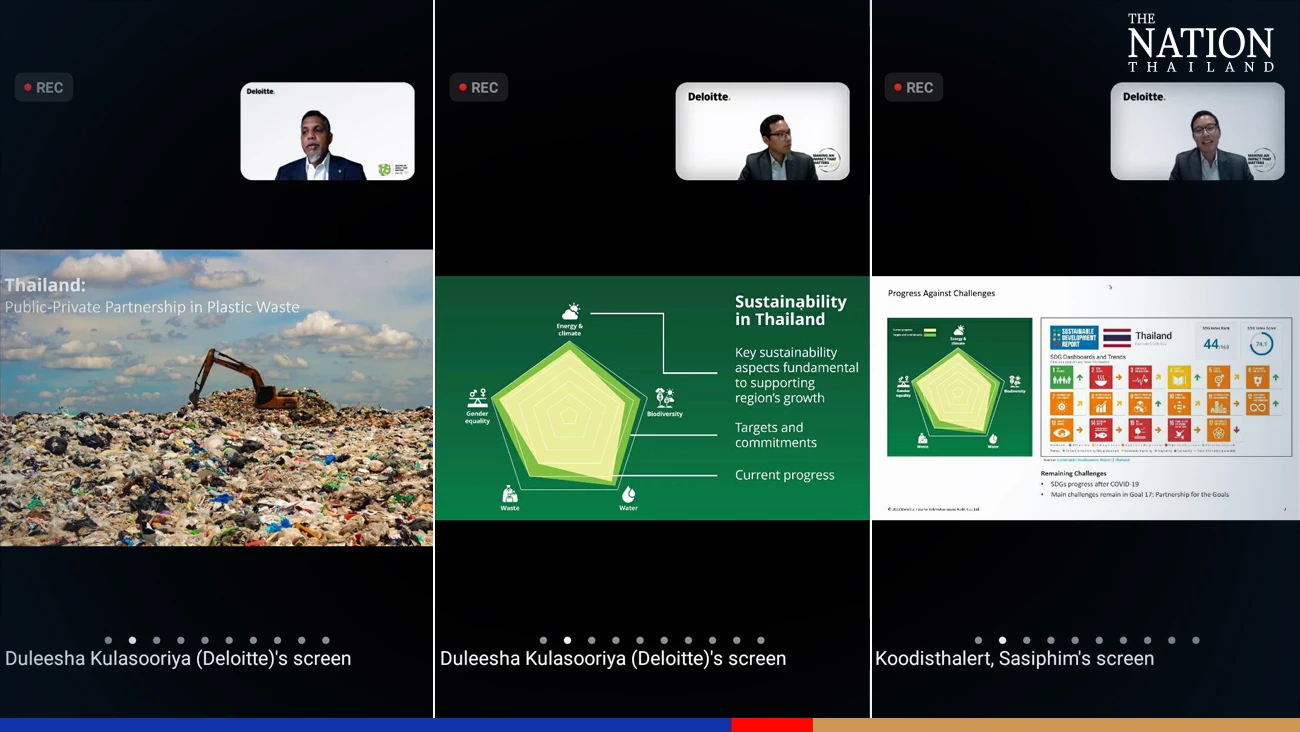
Deloitte has praised Thailand for initiating the Bio-Circular-Green economy (BCG) model, but urged the country to quickly implement renewable energy policies and effective waste management in order to be one of the region’s leading green countries.

Deloitte’s positive comments came during the company’s launch on Thursday of its new report, “Southeast Asia Sustainability Ambitions 2022”. The report outlines the sustainability challenges that Southeast Asian countries face, as well as the government’s ambitions to address these challenges.

The US-Asean Business Council and Deloitte Center for the Edge collaborated on a study that focuses on detailed insights on Southeast Asian countries into five key sustainability factors: energy and climate, biodiversity, water, waste, and gender equality. These factors were chosen by US-Asean Business Council members.

Focus on renewable energy, waste management critical, says Deloitte, as report lauds Thailand’s BCG model

Duleesha Kulasooriya, managing director, Centre for the Edge, Deloitte Southeast Asia, stated during the online video conference that Thailand is outperforming its neighbours in all five areas. However, waste management is Thailand’s main concern now because the country ranks sixth in the world among plastic waste polluters of oceans.

Furthermore, urbanisation and climate change are current challenges to the country’s development. In 2020, slightly more than half of the population will live in cities, and the country’s urbanisation rate has been decreasing over the last decade.

Kulasooriya pointed out that with a sizeable proportion of the population living in rural areas, persistent challenges such as water service provision and municipal waste management remain. He also stated that climate change is causing extreme weather patterns, exacerbating and compounding these issues.

He suggested that Thailand empower the labour force while the country transitions from a developing to a developed one under the “Thailand 4.0” goal.

Drew Hasson, director (sustainability) of the US-Asean Business Council, said it is a critical and multifaceted challenge that touches on issues such as biodiversity, water, waste, and gender equality. Public-private partnerships will be critical in assisting Thailand and Asean in meeting these challenges, he said.

Focus on renewable energy, waste management critical, says Deloitte, as report lauds Thailand’s BCG model

Kasiti Ketsuriyonk, sustainability and climate leader, Deloitte Thailand, added that Thailand’s BCG model highlights opportunities for the private and public sectors to collaborate to achieve Thailand’s net-zero economy commitment. Thailand, on the other hand, will require more investment and a strengthened ecosystem for both economic and technological solution development to keep the country on track in its decarbonisation journey.

Furthermore, he stated that there are numerous opportunities for collaboration between the public and private sectors in the areas of biomass-powered electricity generation, food waste valorisation alternatives, and wastewater network expansion through infrastructure projects and technical capacity building in order to build a sustainable and economically successful future for Thailand.

The report provides an overview of Southeast Asia and features a detailed analysis of nine countries — including Brunei, Cambodia, Indonesia, Laos, Malaysia, the Philippines, Singapore, Thailand and Vietnam.

Focus on renewable energy, waste management critical, says Deloitte, as report lauds Thailand’s BCG model

Kulasooriya stated that countries in Southeast Asia, due to geographical location and developing natural ecosystem, are more vulnerable to climate change than the rest of Asia Pacific.

“If Asean governments take decisive action on climate commitments, collaborate with the private sector, and mobilise grassroots action to address climate and sustainability issues, they will have the potential to fuel new growth engines in Southeast Asia. However, if Asean countries do nothing, they will cause damage of more than $28 trillion,” he said.

Nongluck Ajanapanya

Central bank chief voices concern over increasing insecurity for young Thais

#SootinClaimon.Com : ขอบคุณแหล่งข้อมูล : หนังสือพิมพ์ The Nation.

https://www.nationthailand.com/thailand/economy/40020538

Central bank chief voices concern over increasing insecurity for young Thais

Central bank chief voices concern over increasing insecurity for young Thais

THURSDAY, SEPTEMBER 29, 2022

The Thai central bank chief has voiced concern over worsening security in the economy, society and the environment that is troubling young people.

Bank of Thailand Governor Sethaput Suthiwartnarueput said on Thursday that the young generation serves as a key force behind the country’s development but they are experiencing insecurity in many ways.

He pointed out that when compared to previous generations, young Thais today were in a time of slower economic growth and rapid global changes, making it difficult for them to stay updated. Also, compared to previous generations, many people have debt at a young age.

“Half of the people in their 30s have credit card debts stemming from their consumption. One-fifth of people with bad debts are those aged 29 and below. They are in the working age and just starting a new family,” Sethaput said.

He was speaking at the central bank’s annual seminar on “Strengthening Economic and Financial Foundations for the Next Generation”.

Regarding social insecurity, Sethaput said that young Thais are living at a time when the country is seeing a rise in violent social conflicts.

“What’s worrying is that social insecurity in Thailand does not appear to be decreasing in the future,” the central bank governor said.

Instead, conflicts appear to be worsening due to extreme views and biased feelings spread repeatedly among people with the same opinions through the “echo chamber”, he added.

Sethaput pointed out that environmental insecurity was caused by worsening climate change, which is damaging economies and people’s livelihoods across the world.

He said Thailand is among the first countries to be affected by severe natural disasters while the country’s capacity in dealing with natural disasters is low, being ranked 39th among 48 countries assessed.

Environmental insecurity also includes food and human settlements, he said.

The lack of security in many ways is undermining young people’s future, aspirations, readiness and opportunity, according to the central bank chief.

APEC council draws up plans to rejuvenate region’s economic engine – MSMEs

#SootinClaimon.Com : ขอบคุณแหล่งข้อมูล : หนังสือพิมพ์ The Nation.

https://www.nationthailand.com/thailand/economy/40020513

APEC council draws up plans to rejuvenate region's economic engine – MSMEs

APEC council draws up plans to rejuvenate region’s economic engine – MSMEs

THURSDAY, SEPTEMBER 29, 2022

Nongluck Ajanapanya

The APEC Business Advisory Council (ABAC) has released its first draft proposal to revitalise and support all-important micro, small, and medium enterprises (MSMEs).

The proposal will be presented to Asia-Pacific Economic Cooperation (APEC) leaders at their November summit in the hopes of providing some guidelines on business operations to promote MSMEs, said ABAC chairman Kriengkrai Thiennukul during a media interview.

Although the overall economy is gradually recovering, MSMEs are still extremely vulnerable and have been negatively impacted by Covid-19, he pointed out.

“MSMEs are the Apec region’s economic engine. They employ more than 50 per cent of all workers and make up over 97 per cent of entrepreneurs. Given that MSMEs are responsible for between 40 and 60 per cent of GDP, future GDP growth is possible if these small business owners are inspired to realise their full potential,” Kriengkrai noted.

The proposal was compiled from three previous ABAC meetings.

APEC business leaders and leading analysts all agreed that promoting and supporting MSMEs is critical to driving the region’s economic recovery and sustainability.

It will meet the needs of APEC policymakers looking for ways to expand new possibilities, he said.

The recommendations made to the APEC meeting to promote MSMEs will centre on four major areas.
 

The first proposal is to create an enabling environment for these enterprises to use digital technologies by leveraging public-private partnerships to accelerate the development of digital skills.

Policymakers should subsequently encourage and improve sustainable practices.
The next step is to create a concrete digital market infrastructure ecosystem for supply chain finance.

Lastly, it must assist underrepresented MSME groups such as women, indigenous peoples and youth in overcoming production barriers and constraints, as well as in balancing economic risk diversification.

Kriengkrai emphasised the importance of promoting MSMEs.

He believes the APEC economy will be able to sustain its growth if MSMEs receive adequate funding or access to global markets, as well as increased business knowledge and skills, support for competitiveness growth, digital entry into international markets, coordination with large corporations, and inclusive promotion.

Nongluck Ajanapanya

Food security high on Apec’s priorities, especially in aftermath of pandemic

#SootinClaimon.Com : ขอบคุณแหล่งข้อมูล : หนังสือพิมพ์ The Nation.

https://www.nationthailand.com/thailand/economy/40020505

Food security high on Apec’s priorities, especially in aftermath of pandemic

Food security high on Apec’s priorities, especially in aftermath of pandemic

WEDNESDAY, SEPTEMBER 28, 2022

THE NATION

Food security is an important issue for members of the Asia-Pacific Economic Cooperation (Apec) to enable people to access quality foods, a senior Thai Foreign Ministry official said on Tuesday.

Deputy director-general of the ministry’s Department of International Economic Affairs, Prinat Apirat, was speaking during the 8th Apec Media Focus Group “Apec and Food Security: Sustainability beyond global uncertainties” at King Mongkut’s Institute of Technology Ladkrabang in Bangkok.

She said Apec economies are paying attention to three aspects related to food security — production, distribution and sustainable food system.

She also pointed out that sustainable food system is a pain point for Apec economies as food production has been disrupted by the Covid-19 crisis and geopolitical conflict.

Food security high on Apec’s priorities, especially in aftermath of pandemic

“So, sustainability is a key part of this discussion, including of natural resources, environment biodiversity and waste management,” she said.

She added that the discussion will also focus on implementing a regulatory framework, policies, partnerships and practices for production.

Food security high on Apec’s priorities, especially in aftermath of pandemic

Meanwhile, Pasinee Napombejra, senior policy and plan analyst at the Agriculture Ministry’s Office of Agricultural Economics, said food security has become a major concern for Apec economies more than it was 10 years ago.

She added that Thailand has implemented a road map for food security, covering food safety and trade facilitation, improving the livelihood of people, sustainability of natural resources and environment, digital innovation in the agricultural sector and balancing the economy, social and environment with the Bio-Circular-Green economy model.

THE NATION

MPC raises key policy rate in bid to tame impact of inflation on economic growth

#SootinClaimon.Com : ขอบคุณแหล่งข้อมูล : หนังสือพิมพ์ The Nation.

https://www.nationthailand.com/thailand/economy/40020503

MPC raises key policy rate in bid to tame impact of inflation on economic growth

MPC raises key policy rate in bid to tame impact of inflation on economic growth

WEDNESDAY, SEPTEMBER 28, 2022

THE NATION

The Monetary Policy Committee (MPC) on Wednesday further raised the policy interest rate by 25 basis points to 1.00 per cent per annum with immediate effect.

The latest hike by 0.25 percentage point followed a similar increase last month.

The MPC has sent out a strong signal since June that it would increase the policy rate to cool down inflation. In June, the MPC voted to maintain the policy rate at 0.50 per cent while three members voted to increase the rate by 25 basis points.

MPC secretary Piti Disyatat said the committee voted to raise the policy rate because the Thai economy was still recovering, driven by the tourism sector and spending by the private sector, while inflation was still high.

Piti said the MPC expected Thailand’s economic growth would be 3.3 per cent this year and 3.8 per cent next year because of the push from from the tourism sector and spending by the private sector. He said the MPC saw the tourism sector’s recovery had exceeded expectations and more sectors of the economy were improving.

The MPC expected headline inflation would be 6.3 per cent this year and 2.6 per cent next year, Piti said. He explained that the MPC expected lower inflation next year because it believes global oil prices would go down while supply issues related to raw materials for manufacturing would also ease.

Piti added that the MPC expected core inflation this year and next year would be 2.6 and 2.4 per cent respectively.

He said the MPC expected inflation to rise because of increasing cost of manufacturing and surging demand for raw materials, but the MPC would closely monitor inflation and try to control it.

The MPC also saw that Thai banks still enjoyed stability with strong reserves, while businesses and households have better capabilities to repay their debt.

Piti said the MPC regarded the overall financial situation was still easing with government bonds offering higher yields and private firms having the capacity to mobilise funds via bonds.

The MPC would also monitor the volatile exchange rate and the baht’s depreciation, which has weakened along with other currencies in the region, Piti said.

Since the MPC see potential for growth of the economy, but is facing a risk from rising inflation, the MPC had decided to gradually increase the policy rate to ensure sustainable economic growth in the long run, Pitti said.

THE NATION

New business registrations rise 33 per cent year on year in August

#SootinClaimon.Com : ขอบคุณแหล่งข้อมูล : หนังสือพิมพ์ The Nation.

https://www.nationthailand.com/thailand/economy/40020501

New business registrations rise 33 per cent year on year in August

New business registrations rise 33 per cent year on year in August

WEDNESDAY, SEPTEMBER 28, 2022

THE NATION

More than 7,400 new firms were registered in August, a sharp 33 per cent increase year on year, the Business Development Department said on Wednesday.

Thosapol Thangsubut, director-general of the department, said 7,418 new limited partnerships and limited companies were registered in August, up 27 per cent over the previous month and 33 per cent more than in August last year.

He said the new firms have a combined registered capital of 24.393 billion baht and the top three registered businesses are construction firms, property developments and restaurants.

Thosapol noted that restaurants are the third highest number of new businesses registered for seven consecutive months.

He noted that the high number of new restaurants being registered could be attributed to the recovering economy and tourism after Thailand fully reopened to foreign tourists.

Thosapol said the high number of new businesses being registered in recent months was proof of investors regaining confidence after the country allowed businesses to resume operations fully following the Covid-19 pandemic. The fact that schools and universities have resumed normal classes and foreign arrivals are on the increase also have boosted the confidence of business operators, he added.

Meanwhile, a total of 1,941 businesses reported an end to their operations in August, an increase of 26 per cent compared to July and 65 per cent compared to August last year. The top three sectors that registered the most number of closures in August were also in the same sectors as new business registrations – construction, property and restaurants, Thosapol said. The 1,941 firms had registered capital of 12.5 million baht.

During the first eight months of this year, 53,577 new businesses registered with registered capital of 334.109 million baht, while 9,493 firms with registered capital of 78.163 million baht reported end of operations.

Thosapol said his department expects about 68,000 to 72,000 businesses would be registered this year.

As of August 31, there are 849,410 registered businesses operating in the country with total registered capital of 20.39 trillion baht. The businesses comprise 203,074 partnerships, 644,971 limited companies, and 1,365 public companies, Thosapol said.

THE NATION

Thailand signs mini-FTA with Gyeonggi province, South Korea’s ‘Silicon Valley’

#SootinClaimon.Com : ขอบคุณแหล่งข้อมูล : หนังสือพิมพ์ The Nation.

https://www.nationthailand.com/thailand/economy/40020498

Thailand signs mini-FTA with Gyeonggi province, South Korea’s 'Silicon Valley'

Thailand signs mini-FTA with Gyeonggi province, South Korea’s ‘Silicon Valley’

WEDNESDAY, SEPTEMBER 28, 2022

THE NATION

The Commerce Ministry on Wednesday signed a memorandum of understanding (MoU) with South Korea’s trade promotion agency, to promote international trading and cooperation between Thailand and Gyeonggi, South Korea’s most populous province.

The MoU was signed by Lee Gae-youl, head of Global Trade Department and executive director, Gyeonggi Business and Science Accelerator (GBSA), and Phusit Rattanakul Sereeruengrit, director-general at Thailand’s Department of International Trade Promotion.

The ceremony was witnessed by Deputy Prime Minister and Commerce Minister Jurin Laksanawisit, Commerce deputy permanent secretary Keerati Rushchano, and Korean Ambassador to Thailand Moon Seoung-hyun.

“Under the MoU with GBSA, both parties will seek to minimise trade obstacles and locate new opportunities for economic cooperation,” Jurin said. He added that the MoU will serve as a mini-free trade agreement between Thailand and the South Korean province, and will be the sixth mini-FTA that the ministry has signed with three countries to promote international trade and investment.

Five previous mini-FTAs were with China’s Hainan and Gansu provinces, India’s Telangana state, Japan’s Kofu city, and South Korea’s Pusan city.

Currently Thailand has 14 full FTAs with 18 countries worldwide. Jurin said his ministry is targeting more FTAs in the coming years.

Thailand signs mini-FTA with Gyeonggi province, South Korea’s 'Silicon Valley'

Jurin added that Gyeonggi has the highest GDP among South Korean provinces and is considered the country’s Silicon Valley due to the advanced IT industry, which will be greatly beneficial to Thailand’s small and medium-sized enterprises.

Trade volume between Thailand and Gyeonggi in 2021 amounted to US$3.2 billion, while this year the trade volume in seven months has already surpassed $2 billion.

Ambassador Moon Seoung-hyun added that to further promote bilateral trade between the two countries, South Korea will organise “G-Fair Korea 2022” in Bangkok on Wednesday and Thursday in a bid to find Thai business partners and suppliers for South Korean entrepreneurs and vice versa. He also hoped that the mini-FTA would bring about more business cooperation, especially in electronics and soft power industries, and that it could be incorporated into the Regional Comprehensive Economic Partnership of which both Thailand and South Korea are members.

THE NATION

Top 7 Thai beauty market priorities as the market projects to grow by 5.4%

#SootinClaimon.Com : ขอบคุณแหล่งข้อมูล : หนังสือพิมพ์ The Nation.

https://www.nationthailand.com/thailand/economy/40020488

Top 7 Thai beauty market priorities as the market projects to grow by 5.4%

Top 7 Thai beauty market priorities as the market projects to grow by 5.4%

WEDNESDAY, SEPTEMBER 28, 2022

WGSN reveals the top strategies include Traceability and Transparency, Science-First Skincare and Holistic Beauty

According to Statista, the SEA beauty, health, household and personal care segment is valued at US$18.5bn and is projected to grow at an annual rate of 16% during 2022-2026. Thailand’s beauty market is valued at US$5.42bn as of 2022 and is projected to have a CAGR of 5.4% (2022–2026). 

WGSN’s proprietary methodology predicts consumer trends on the 18 – 24 month horizon with 90 per cent accuracy, and the firm has unveiled its South & Southeast Asian beauty priorities analysis report that health is a concern that connects all countries in Asia.

In Southeast Asia and India, product safety and authenticity are particularly important, with counterfeit products and poor manufacturing processes posing a dangerous issue. 

Thailand is prioritizing skin health as consumers gravitate to cosmeceuticals formulated with clean, natural and herbal ingredients. In addition, Thai consumers are also concerned about product safety and value innovative brands that are trustworthy and ethical. 

“Health is one of Thai consumersʼ top beauty priorities, making clean and safe formulations is a must among beauty brands. Brands should prioritize traceability and transparency processes as top strategies, as Thai consumers expect to see full transparency on product sourcing and performance,” said Christine Chua, Beauty Analyst, WGSN.

Top 7 Thai beauty market priorities as the market projects to grow by 5.4%

WGSN has revealed the top 7 beauty priorities for Thailand, which include:

1)    Traceability and transparency: Health is Thai consumer’s biggest beauty priority, making clean and safe formulations a must. Education is also important as they try to learn more and increase ʻingredient-fluencyʼ as 70 per cent of Thai consumers only recognise 3 out of 10 active ingredients and are looking to retailers to fill the gap. 

2)    Science-first skincare: Derma-backed beauty brands will grow in popularity, valued for perceived expertise and prestige branding. Alongside perennially popular all-natural formulations, ʻscience-madeʼ ingredients will gain traction. 

3)    Holistic beauty: A growing cohort of Thai consumers will continue to seek head-to-toe beauty and self-care products. Scalp care products will uptick, with hair loss one of Thai consumersʼ biggest beauty concerns. 

4)    Wellness products and services: Rising stress levels and burnout are driving demand for wellness products and services. Intentional products such as massage oils, foot baths, candles and aromatherapy-infused skin and body care will appeal to Thai consumers, while spending on professional treatments, spas and wellness retreats will continue to increase.

5)    Gender-neutral to gender-specific: Thai men are developing more sophisticated beauty needs. While gender neutrality is expected, informed consumers are seeking facial skincare custom formulated for their concerns. Thailand is also home to a prominent trans community. Products that address the skin dehydration and hair loss common with hormone replacement therapies will be in demand and offer a white space opportunity for brands and retailers.

6)    Experimental purchases: The growing affluence and usage of digital channels have created a thirst for innovation. 81 per cent of Thai consumers plan to spend more or the same as now on beauty, especially on new brands with good reviews. In addition, local brands are also leveraging local pride, using Thai art, food and heritage as their muse. 

7) Community-minded: Conscious Thai consumers are seeking brands that fulfil their Protopian beliefs, benefiting others and the planet as well as themselves. For example, a Bangkok-based farm-to-face brand uses every part of the moringa, including the leaves, branches and seed, leaving no waste behind. The moringa is harvested organically in small batches to prevent overworking the soil and helps ensure fair trade for local families the brand partners with.

Social media and e-commerce have radically changed the way Thai consumers discover new brands and products. Moreover, with the growing ageing population in Thailand, the anti-ageing category is now a prime territory for brands and retailers. Sunscreens and skin screens are also popular by association, especially with the all-year summer in the tropics region.