The Stock Exchange of Thailand (SET) Index fell by 1.02 points, or 0.08 per cent, to 1,266.61 in the morning session today (September 23).
An analyst at Krungsri Securities expected the index to fall between 1,260 and 1,270 points amid a second lockdown in European countries, several banks’ illicit fund flows and a delay in the rollout of US economic stimulus measures, all of which are pressuring the index.
He recommended that investors buy:
> Stocks whose third-quarter performance will improve, such as TU, Asian, Com7, CHG, PTG and PlanB.
> Stocks that benefit from the weakening baht, such as Delta, Hana, KCE and SMT.
The SET Index closed at 1,267.63 yesterday, down 7.53 points, or 0.59 per cent. Total transactions amounted to Bt42.53 billion, with an index high of 1,275.27 points and a low of 1,262.41.
By The Washington Post · Rachel Siegel · NATIONAL, BUSINESS, CONGRESS WASHINGTON – Federal Reserve Chair Jerome Powell and Treasury Secretary Steven Mnuchin credit the Cares Act with helping to build economic recovery, yet their call on Congress to fill the remaining holes is not triggering action on Capitol Hill.
Of increasing concern is whether hundreds of billions of dollars in unused Cares Act money should be reallocated, or whether existing programs can be expanded to reach more businesses and municipalities on the brink. At a House Financial Services Committee hearing Tuesday, Powell and Mnuchin said the lending programs run by the Fed and Treasury could only go so far and cannot replace targeted aid from Congress.
Negotiations between Congress and the White House on another round of stimulus have been stalled for weeks.
Asked by committee Chair Rep. Maxine Waters, D-Calif., whether Treasury could further enhance the existing programs, Mnuchin said, “I unfortunately think there’s not more we can do.”
“Almost every single one of the facilities has extra capacity,” Mnuchin said, adding that the money could be reallocated “to better use.”
The House and Senate are at odds over government funding before it runs out at the end of September and triggers a shutdown. And since the death of Supreme Court Justice Ruth Bader Ginsburg last week, much of Capitol Hill has been focused on the coming nomination battle.
Still, Mnuchin said he believes that “a targeted package is still needed,” and that the White House was ready to reach a bipartisan deal.
Unlike a sweeping rescue bill passed by Congress in March, Mnuchin said another relief package would focus specifically on helping children – perhaps through money to schools – and protecting jobs in hard-hit industries such as travel and restaurants. Mnuchin added that there’s “broad bipartisan support for extending the PPP,” or Paycheck Protection Program, especially to help small businesses.
Lawmakers also talked about the $600 billion Main Street lending program, which has roughly $2 billion in loans that are either funded or in the pipeline. Businesses, banks and lawmakers say the program’s onerous terms hinder the number of loans that can be made. It’s also unclear how willing Congress is to allow for riskier loans.
Yet Powell and Mnuchin both said that for many small businesses, grants similar to those from the Paycheck Protection Program may be a better fit. For example, Powell said that the Main Street program is seeing little demand for loans under $1 million, and that even smaller loans often require borrowers to put up some sort of personal guarantee to make the loan.
Powell said a program geared toward smaller loans “would have to be a different kind of facility.”
“Trying to underwrite the credit of hundreds of thousands of small businesses would be very difficult,” Powell said. “I think PPP is a better way to address that space in the market.”
Lawmakers also raised concerns about the fate of small indebted hotels and the larger commercial real estate market. Mnuchin said that in many cases, more PPP funding would be needed to help cover commercial rent and mortgage payments, since taking on more debt may not be the answer.
Another program, the Fed’s $500 billion fund to support cash-strapped local governments, was also in the spotlight. There’s disagreement over how to judge the program’s effectiveness, as it’s only issued two loans – one to the state of Illinois and one to New York’s Metropolitan Transportation Authority – for a total of $1.6 billion.
Powell said the mere announcement of the program back in the Spring caused the municipal bond market to perk up, making it easier for local governments to borrow. Yet some lawmakers say that the program should not just be judged on how the markets respond, and that such a massive allocation of money was not being utilized even as local governments expect massive budget shortfalls.
As Powell and Mnuchin made their latest appearance on Capitol Hill, Wall Street is becoming increasingly convinced that no more stimulus is coming. Markets have been down the past three weeks, in part on pessimism about a deal on more stimulus. Meanwhile, a little more than half the 22 million payroll jobs lost in March and April have not returned. Health officials and economists fear the coming flu season could slow the pace of the recovery.
“The recovery will go faster if we have both tools [from the Fed and Congress] continuing to work together,” Powell said.
Yet in other slices of the economy, the rebound is happening faster than expected. Household spending looks to have recovered about 75% of its earlier decline, Powell noted, aided by federal stimulus payments and expanded unemployment benefits. The housing market has rebounded, and Fed leaders are growing more optimistic about where the unemployment rate will fall in the years to come.
Mnuchin said he expects “tremendous third-quarter growth, fueled by strong retail sales, housing starts and existing-home sales, manufacturing growth, and increased business activity.”
The economy has been “resilient” since many Cares Act benefits expired over the summer, Powell said, but there are unknowns about where the economy is headed. For example, Powell said savings are very high, raising the long-term risk that people will go through money stored away before they’re able to go back to work.
“So their spending will decline, their ability to stay in their homes will decline, and so the economy will begin to feel those effects at some time,” Powell said.
Powell and Mnuchin will also testify on the Cares Act on Thursday morning before the Senate Banking Committee.
By Syndication Washington Post, Bloomberg · Rita Nazareth, Vildana Hajric · BUSINESS Stocks climbed as dip buyers emerged after the market sell-off, tempering concern over remarks from Federal Reserve officials that pointed to a slow economic recovery. The dollar rose.
Most groups in the S&P 500 advanced, with retailers and tech companies among the biggest gainers. The Nasdaq 100 notched a back-to-back rally, while the Dow Jones industrial average underperformed amid a drop in banks. Equities fell earlier Tuesday as Fed Chairman Jerome Powell said the economy has a long way to go before fully recovering and will need further support. Meanwhile, Chicago Fed President Charles Evans noted that rates could rise before the inflation target is reached.
American stocks are still heading toward their first monthly slide since March on concern Congress hasn’t agreed on another fiscal stimulus package, while an increase in global virus cases has raised the specter of more lockdowns. British Prime Minister Boris Johnson announced new restrictions that are likely to last six months and told people to work from home if possible, saying the country is at a “perilous turning point” for the virus.
“We think equities will move higher over the medium term, thanks to the likely development of a successful vaccine, an end to election uncertainty, the passage of new U.S. fiscal stimulus, and continued extraordinary global monetary support,” wrote Mark Haefele, chief investment officer of global wealth management at UBS Group AG. “However, the path to ‘more normal’ is likely to be bumpy,” he said, adding that “we therefore expect volatility to persist over the balance of the year.”
These are some of the main moves in markets:
Stocks
–The S&P 500 advanced 1.1% as of 4 p.m. EDT.
–The Stoxx Europe 600 Index gained 0.2%.
–The MSCI Asia Pacific Index fell 0.8%.
Currencies
–The Bloomberg Dollar Spot Index climbed 0.5%.
–The euro decreased 0.5% to $1.1708.
–The Japanese yen depreciated 0.3% to 104.98 per dollar.
Bonds
–The yield on 10-year Treasurys advanced one basis point to 0.67%.
–Germany’s 10-year yield advanced three basis points to -0.51%.
–Britain’s 10-year yield gained five basis points to 0.203%.
Commodities
–West Texas Intermediate crude advanced 0.7% to $39.60 a barrel.
Thai private sector wants progress on EU free trade deal
EconSep 23. 2020Trade Negotiations Department director general Auramon Supthaweethum
By The Nation
The private sector has urged the government to resume talks on a free trade agreement (FTA) with the European Union (EU).
Thai Chamber of Commerce vice chairman Chusak Chuenprayoth said that members supported resumption of the talks and did not want to see any further delays to the FTA, which would benefit the country.
He admitted the FTA would impact some Thai businesses, but said they should hurry to adjust their operations to comply with export requirements and standards under the planned agreement.
Waiving trade tariffs under the EU FTA would boost Thailand’s economy by 1.28 per cent or Bt200 billion, said Trade Negotiations Department director general Auramon Supthaweethum, citing a study by the Institute of Future Studies for Development.
Findings from a public hearing on the FTA, including concerns at its impact and proposed remedial measures, will be put to Commerce Minister Jurin Laksanawisit in mid-October, Auramon said.
It should be clear by the end of this year whether Thailand is ready to resume talks with EU, she added.
The EU has already signed free trade deals with Singapore and Vietnam and is in talks for a deal with Indonesia. It has suspended talks with Thailand, Malaysia and the Philippines. Talks with Thailand that began in 2013 were suspended in 2014 following the military coup.
Thailand has so far signed 13 free trade accords with 18 countries – Asean partner countries, China, Japan, South Korea, India, Australia, New Zealand, Chile and Peru.
Trade with these 18 partners last year accounted for 62.8 per cent of Thailand’s total global trade.
The EU is currently Thailand’s fifth largest trading partner, after Asean, China, Japan and the US. It is the fifth largest investor in Thailand after Japan, China, Asean, and Taiwan.
Experts have advised local investors on how to manage their risk to deal with renewed volatility in global assets.
Signs of a second Covid-19 wave in Europe coupled with delayed rollout of US economic stimulus measures triggered selloffs of stocks, gold and oil on Tuesday, while the dollar suddenly strengthened.
However, experts reckon the low interest rate means volatile assets remain attractive to investors who are seeking good returns in the “new normal” long term, especially if prices fall.
Theeranat Rujimethapass, president of Tisco Asset Management, advised buying stocks during the market correction for long-term investment because the market is still being driven by hopes that a Covid-19 vaccine will be available next year.
He suggested risk-averse investors hold 20 per cent in stocks and gradually increase that investment, while those who could tolerate risk should invest 50 per cent in Thai and foreign stocks.
“Investors should pick not more than 15 Thai stocks in line with Tisco Strategic Fund [TSF]’s strategy, while selecting foreign stocks that benefit from the Covid-19 outbreak, such as biotech, healthcare tech and global tech shares, in line with Tisco Global Technology Equity Fund [TISTECH]’s strategy,” he said.
“The rest of their portfolios should be made up of debt instruments to maintain investment stability and real estate investment trusts [REITs] to generate returns of 4 per cent per year.”
He added that investing 20 per cent in stocks will generate higher returns than bank deposits and debt instruments at approximately 2-3 per cent per year, while investing 50 per cent in stocks will generate a return of about 5 per cent per year.
Navin Intharasombat, first senior vice president for foreign investment management at Kasikorn Asset Management, advised investors to allocate assets in line with K FIT Allocation M Fund (K-FITM) at low to moderate risk to generate returns of 5.5 per cent per year.
“This portfolio invests 29 per cent in short-term debt instruments, 25 per cent in Thai stocks, 25 per cent in foreign stocks (5 per cent in China, 4.5 per cent in Asia, 4.5 per cent in Japan, 4 per cent in the US, 4 per cent in Europe and 3 per cent in India) 10 per cent in other assets (5 per cent in gold, 3 per cent in infrastructure funds and 2 per cent in property funds) and 11 per cent in debt instruments (9 per cent in middle and long-term debt instruments and 2 per cent in foreign debt instruments),” he said.
Somchai Amornthum, CEO’s assistant at Krungthai Asset Management’s Strategic Asset Allocation & Fund Marketing Department, advised investing 54 per cent in stocks (30 per cent in foreign stocks especially China and 24 per cent in Thai stocks), 38 per cent in debt instruments, 3 per cent in gold, and 5 per cent in property funds and REITs.
“This investment portfolio will generate return at 5-7 per cent per year in line with Krung Thai Mee Sup Fund Class A (KTMEE-A), while investors could gain more returns if they take more risks,” he said.
The Stock Exchange of Thailand (SET) Index closed at 1,267.63 today (September 22), down 7.53 points or 0.59 per cent. Total transactions tallied at Bt42.53 billion with an index high of 1,275.27 and a low of 1,262.41.
In the morning session, an analyst at Krungsri Securities said he expected the index to fall between 1,265 and 1,270 due to international factors.
“On Monday night, European and US stock indices fell sharply due to news of a second lockdown in European countries, several banks’ illicit funds flows and a delay in the rollout of US economic stimulus measures, resulting in an impact on the SET,” he said.
The top 10 stocks with the highest trade value today were MINT, PTT, AOT, KBANK, TASCO, BAM, DELTA, SCB, BBL and SCC.
As of 4.30pm, the price of oil rose by US$0.32 or 0.81 per cent to $39.63 per barrel, while gold dropped by $1.80 or 0.09 per cent, to $1,908.80 per ounce.
Other Asian indices also fell:
China’s Shanghai SE Composite Index closed at 3,274.30, down 42.63 points or 1.29 per cent, while Shenzhen SE Component Index closed at 13,023.43, down 126.07 points or 0.96 per cent.
Hong Kong’s Hang Seng Index closed at 23,716.85, down 233.84 points or 0.98 per cent.
South Korea’s KOSPI Index closed at 2,332.59, down 56.80 points or 2.38 per cent.
Taiwan’s TAIEX Index closed at 12,645.51, down 149.61 points or 1.17 per cent.
Japan’s Nikkei Index was closed for Autumnal Equinox Day.
Labour Minister Suchart Chomklin on Tuesday (September 22) instructed the Department of Employment to set up an online option for job seekers nationwide to access employment opportunities offered at Job Expo Thailand 2020.
The fair, offering more than a million jobs, will be held at the
Bangkok International Trade and Exhibition Centre (Bitec) from Saturday to next Monday.
“Since some people may not be able to attend this fair, we have ordered the Department of Employment to provide online job-search service during the expo period,” he said.
Suchart Pornchaiwisetkul, director general of the Department of Employment, said provincial employment offices have been appointed to help job seekers via the “Thailand has jobs” website.
“People can apply for jobs or training courses via the website or they can call the department’s 1506 hotline and press 2 or visit provincial employment offices for details,” he said.
The Cabinet on Tuesday gave the green light to a new Bt51-billion stimulus package to assist low-income workers hit by the Covid-19 crisis. PM Prayut Chan-o-cha said ministers had agreed to two schemes – “Kon La Khreung” (Let’s Go Halves) and a boost to shopping subsidies for state welfare cardholders.
Under the Kon La Khreung scheme, 10 million people will get daily discounts on their shopping of up to Bt100, capped at Bt3,000. The scheme will open for merchants to register through the website from October 1.
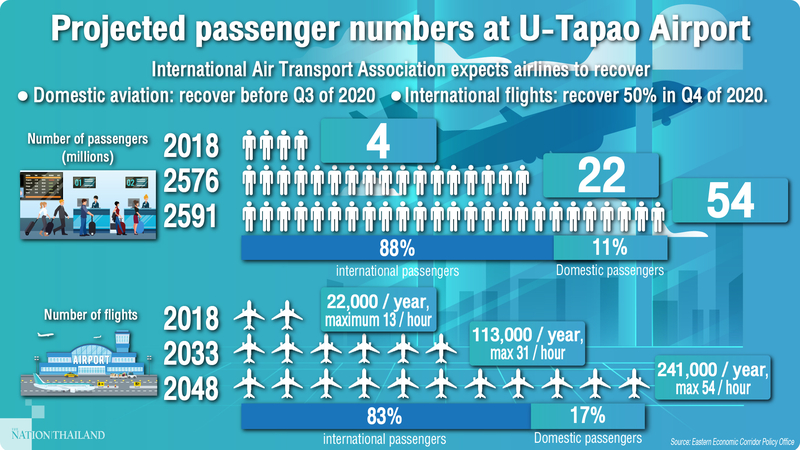
The Eastern Economic Corridor (EEC) Policy Committee has revealed progress on the Bt290-billion U-Tapao Airport and Eastern Aviation City scheme after signing a joint-investment deal to construct the megaproject in June.
The Aviation City will radiate 30 kilometres from U-Tapao Airport and house aviation businesses, logistics, tourism facilities and more, said EEC Committee secretary-general, Kanit Sangsuphan.
U-Tapao Airport would serve at least 15 million passengers per year, bringing three million tourists and an additional Bt75 billion to Bt100 billion annually to Rayong province, he added, speaking at a recent seminar titled “U-Tapao Airport: Aiming to be the third international airport of Bangkok”.
The airport would also create about 230,000 new jobs, more than half of the 475,000-strong EEC workforce.
U-Tapao International Aviation Co Ltd won bidding for the project’s construction and 50-year concession with a bid of just over Bt272 billion, or 90 per cent of the total Bt290 billion budget. The Bt272 billion will be used to construct the terminal, ground transportation centre, warehouse, free trade area, apron for 102 aircraft, and commercial areas.
The government is investing the remaining 10 per cent, or Bt17.768 billion, to construct the second runway.
Since the airport is deemed security infrastructure, the state will own the project.
U-Tapao Airport is expected to generate economic benefits of Bt189 billion.
The project’s master plan, including environmental and health impact assessments, will take 18 months to complete.
Construction is scheduled to begin at the end of 2021 and the first phase to open in 2024, with completion of the high-speed rail project connecting U-Tapao with Bangkok’s Don Mueang and Suvarnabhumi airports and the aircraft repair centre.
U-Tapao’s Aircraft Maintenance, Repair and Operating centres (MRO) project has procured 500 rai for construction – 200 rai for Thai Airways International and 300 rai for other airlines with total investment of at least Bt30 billion.
The MRO centres are included in Thai Airways’ business rehabilitation plan. One of three investment options will be chosen and finalised in January-February 2021: Continue to invest with Airbus, invest without Airbus but use Airbus technology, and co-invest with other aviation companies.
Anawat Leelawatwattana, director of U-Tapao International Aviation Co, also revealed more about the management of U-Tapao airport.
“We are in talks with Narita Airport executives to manage U-Tapao airport as the two airports share similar characteristics, such as being international airports serving capitals from outside the capital. Public transportation is required to transport passengers between the capital and the airport. Narita Airport also has modern passenger technology such as passport-free face-scanning systems to maintain distancing and prevent the spread of Covid-19,” he said.
Meanwhile, overall investment in the EEC is on target to meet its five-year (2017-2022) goal of Bt1.7 trillion, with Bt900 billion recently registered or applied for at the Board of Investment (BOI).
The investment is split into Bt240 billion for the high-speed rail link between three airports, Bt55 billion for phase 3 development of Map Ta Phut Port, Bt290 billion for the U-Tapao Airport Project, and the rest private investment in various industries.
The remaining two years of the EEC target will see large-scale investments in infrastructure, namely phase 3 development of Laem Chabang port and the Aircraft MRO Project, with total value of Bt150 billion. Private investment in 2020 will total about Bt120 billion, about Bt250 billion in 2021 and about Bt350 billion in 2022.
The Stock Exchange of Thailand (SET) Index fell by 4.11 points, or 0.32 per cent, to 1,271.05 in the morning session on Tuesday.
An analyst at Krungsri Securities expected the index to fall between 1,265 and 1,270 due to international factors.
“On Monday night, European and US stock indices fell sharply due to news of European countries’ second lockdown, several banks’ illicit funds flows and delay in the rollout of US economic stimulus measures, resulting in an impact on the SET,” he said.
He recommended that investors buy:
▪︎ Stocks whose third-quarter performance will improve, such as TU, ASIAN, COM7, CHG, PTG and PLANB.
▪︎ Stocks that benefit from the weakening baht, such as DELTA, HANA, KCE and SMT.
The SET Index closed at 1,275.16 on Monday, down 13.23 points or 1.03 per cent. The volume of total transactions was Bt40.18 billion with an index high of 1,295.35 and a low of 1,273.44.

 Federal Reserve Chair Jerome Powell / File photo
 Trade Negotiations Department director general Auramon Supthaweethum
 Suchart Chomklin