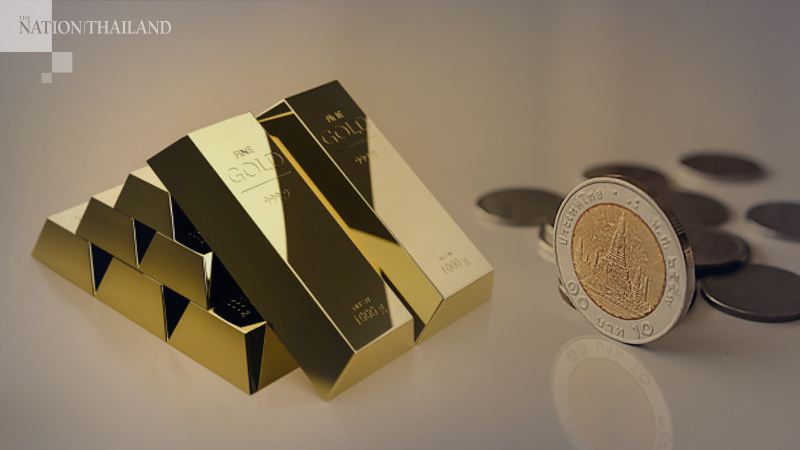
The price of gold dropped by Bt200 per baht weight in morning trade on Tuesday (September 22), the Gold Traders Association reported.
As of 9.30am, the buying price of a gold bar was Bt28,300 per baht weight and selling price Bt28,400, while gold ornaments were priced at Bt27,788.28 and Bt28,900, respectively.
At close on Monday, the buying price of a gold bar was Bt28,500 per baht weight and selling price Bt28,600, while gold ornaments were priced at Bt27,985.36 and Bt29,100, respectively.
The Comex (Commodity Exchange) gold price to be delivered in December dropped by US$51.5, or 2.62 per cent, closing at $1,910.6 (Bt59,948.49) per ounce on Monday.
The price of gold dropped sharply on Monday due to the strengthening dollar and uncertainty over the delay in the rollout of US economic stimulus measures.
Hong Kong gold price dropped by HK$230 after opening at $17,730 (Bt71,784.57) per tael Tuesday morning, the Chinese Gold and Silver Exchange Society reported.
It’s mostly about rates for growth-deprived emerging markets
EconSep 22. 2020The Bank of Thailand’s last meeting under the incumbent governor is being held on Wednesday, with the central bank widely expected to keep rates on hold.
By Syndication Washington Post, Bloomberg · Netty Ismail, Simon Flint, Sydney Maki, Robert Brand · BUSINESS, US-GLOBAL-MARKETS
Record low interest rates, rising commodity prices and improved mobility data have been buoying expectations of a recovery across emerging markets even as investors cast a wary eye toward November’s U.S. presidential election.
Yet for all those plus points – and any small boost provided by a gentler geopolitical backdrop – it’s rate differentials that are sustaining much of the investor demand. Bond funds last week extended their longest streak of inflows since a 12-week run in the fourth quarter of 2017, according to EPFR Global, with China bond funds attracting “above-average” interest.
“Even though policy rates in emerging markets have come down a lot, many of them show meaningful relative interest-rate advantages versus the dollar now, despite benign inflation,” said Morgan Harting, a New York-based money manager at AllianceBernstein who oversees about $2.8 billion. “This could support ongoing capital flows to emerging markets, which would generally be good for stocks and bonds.”
The MSCI currency index climbed for a fourth week in the five days through Friday, the best run since January. Domestic bonds clocked up their biggest gains since June, while a gauge of stocks rose the most since early June relative to the S&P 500 Index, untroubled by a retreat in U.S. technology shares.
For all the optimism, the evidence of recovery has been uneven, suggesting a protracted return to levels of economic activity recorded before the covid-19 pandemic and the resulting lockdowns. While China has rebounded, other nations such as South Africa, India and Turkey have lagged behind.
“The area where the pace of recovery has remained weak is the emerging economies outside China, which account for roughly 25% of global nominal dollar GDP,” Chetan Ahya, chief economist at Morgan Stanley in New York, wrote in a report Sunday. “While the emerging-markets-ex-China recovery has been relatively weak and some of these economies also face structural challenges, we think that the cyclical outlook for the group will improve from the first half of 2021.”
Emerging markets looked poised to enjoy a fresh tailwind Monday after President Donald Trump’s weekend approval of Oracle’s bid for the American operations of TikTok – a move that might have taken some of the heat out of Washington’s standoff with Beijing. That was before a report on bank allegations and signs that London is heading for a second virus-induced lockdown triggered a fresh bout of risk-aversion.
Declines in the South African rand and Mexican peso put the MSCI currency index on course for its biggest retreat in more than four weeks, while almost every major stock market in Asia and the Europe, Middle East and Africa region fell. The premium investors demand to hold emerging-market dollar bonds instead of Treasuries widened 3 basis points, according to a JPMorgan Chase & Co. index.
The slowing of the rate-cutting trend among developing-market central banks looks set to continue in the coming week, following the hold decisions from Brazil, South Africa, Russia, Taiwan and Indonesia last week. Policy makers in China, Hungary, Thailand, Egypt, Colombia, Nigeria, Turkey and the Czech Republic are among those due to meet over the next five days.
Of these, Turkey’s decision may be the closest watched as the central bank struggles to shore up the lira while avoiding an outright rate increase that would defy President Recep Tayyip Erdogan’s calls to cut borrowing costs.
– – –
Mexico, Colombia:
– Mexican policy makers are expected to lower interest rates by 25 basis points to 4.25% on Thursday, breaking from the pattern of half-point cuts in previous meetings, according to economists surveyed by Bloomberg.
Traders will also watch retail sales figures for July, to be posted on Wednesday, for signs of how the pandemic is affecting household demand.
On Friday, a reading of the nation’s economic activity index for July will probably show a decline from a year earlier.
Since the end of June, the Mexican peso has strengthened almost 10% against the dollar, the best performance among about 140 currencies tracked by Bloomberg. The peso has also delivered the No. 1 carry trade return.
– Colombia’s central bank will probably trim its key interest rate by 25 basis points on Friday to 1.75%, which would be the lowest on record.
Bloomberg Economics expects policy makers to reiterate that the end of the easing cycle is close while keeping the door open for more cuts.
The Colombian peso has underperformed most of its Latin American peers this month.
– – –
Turkey:
– Most economists surveyed by Bloomberg expect Turkey’s central bank to hold the benchmark repo rate at 8.25% for a fourth month on Thursday2.
– The lira has lost more than a quarter of its value against the dollar since December, and is on track for an eighth annual depreciation. The currency is trading at all-time lows against both the dollar and the euro. For now though, the central bank has resisted calls for an outright rate hike and is resorting to stealth tightening instead by pushing up the weighted-average cost of funding.
-Yet the monetary authority is coming under pressure from investors to reverse an easing cycle this year that’s pushed annual borrowing costs below inflation.
-The central bank will raise the upper bound of its interest-rate corridor while keeping benchmark borrowing costs on hold, according to Goldman Sachs Group.
– – –
China:
– China’s Loan Prime Rates – the reference rate for bank loans to companies – remained unchanged Monday.
“The go-slow approach to easing suggests the authorities may be satisfied with the pace of economic recovery so far and the strong credit expansion since the second quarter,” Bloomberg Economics said in a report.
Industrial profits due on Sept. 27 are expected to continue their rebound.
The yuan is one of the best-performing currencies in emerging Asia this month, helped by better-than-forecast economic data and fading trade-war concerns.
– – –
Hungary:
Hungary’s central bank will probably leave its policy rate unchanged at 0.6% on Tuesday, according to the median of economist estimates in a Bloomberg survey.
The forint’s depreciation against the euro since the beginning of August has added to concerns about price pressures.
– – –
Nigeria:
– On Tuesday, Nigeria’s central bank is seen leaving its benchmark rate unchanged at 12.5% for a second consecutive meeting.
– – –
Egypt:
– Egypt’s central bank will likely hold rates on Thursday even with inflation at its lowest in nearly a year, after cutting by 450 basis points in 2019 and another 300 in a mid-March emergency session.
While the pandemic cut into some of Egypt’s main sources of hard currency, such as tourism and remittances, and spurred capital outflows from March to May, investors began returning in June after the country secured financing from the International Monetary Fund.
– – –
Czechoslovakia:
The Czech central bank will stand pat on Wednesday, after cutting interest rates the most in the European Union this year. It should keep the benchmark at 0.25% for at least a year before considering raising it, Deputy Governor Tomas Nidetzky said in an interview last week.
– – –
Thailand:
– The Bank of Thailand’s last meeting under the incumbent governor is being held on Wednesday, with the central bank widely expected to keep rates on hold.
– – –
Brazil:
Investors will eye the minutes of Brazil’s September central bank meeting, to be released on Tuesday, for more details on a plan to hold interest rates at record lows for the foreseeable future.
Bi-weekly CPI figures on Wednesday will also help give traders a fresh assessment on inflation. On Thursday, policy makers will release their quarterly inflation report. The real is the worst-performing currency in the developing markets this year.
– – –
China’s Bond Index Inclusion
– FTSE Russell is due to announce the results of a fixed-income review on Thursday, with investors expecting some Chinese debt to be included in the World Government Bonds Index (WGBI). While the short-term boost to the yuan might be limited, the longer-term implications are positive.
Inclusion could prompt USD140b worth of index-related inflows over a 20-month period, following a one-year grace period, according to Goldman Sachs.
Chinese bonds appear good value at current high real yieldsChina’s 10-year bond yields edged lower last week.
– – –
Other Data and Events
– South Korea’s consumer confidence data for September are due on Friday. The Korean won was Asia’s best-performing currency last week.
– Taiwan’s August export orders, due on Monday, may show a continued recovery from a year earlier. Industrial production numbers will be released on Wednesday.
The Taiwan dollar broke free of the central bank’s grip last week, and may have further to run, based on past performance.
Thailand’s trade figures for August are due on Wednesday. Investors may be alert to a rise in political tension, with Thailand’s anti-government protesters calling for a general strike next month as the movement challenges long-held taboos including questioning the monarchy’s powers
– Malaysia’s August CPI, due on Wednesday, is forecast to show continued deflation.
Malaysian bonds, the best performers in Asia this quarter, now face challenges, including the dimming prospect of another interest-rate cut.
The nation’s 10-year bond yields rose about 5 basis points last week.
– Poland reports last month’s construction output and retail sales data on Monday, followed on Tuesday by the August money supply M3 print, the previous month’s unemployment and consumer confidence.
The central bank publishes minutes from its last meeting on Thursday, followed on Friday by Fitch’s update on Poland’s credit rating
– Argentina’s second-quarter GDP data, expected on Tuesday, will probably show a contraction amid social distancing measures, unsustainable policies and debt negotiations, according to Bloomberg Economics.
By The Washington Post · Rachel Siegel · NATIONAL, BUSINESS, POLITICS, US-GLOBAL-MARKETS Federal Reserve Chair Jerome Powell casts the economy as showing “marked improvement” but still highly uncertain, and possibly requiring more aid from Congress, in remarks to lawmakers, he’s scheduled to make on Tuesday.
Economic activity – from household spending to the housing market – has picked up since the economy bottomed out in the second quarter, according to Powell’s prepared remarks before the House Financial Services Committee. The testimony notes that household spending looks to have recovered about 75% of its earlier decline, thanks in part to federal stimulus payments and expanded unemployment benefits.
Still, with about half of the 22 million payroll jobs lost in March and April still off the books, Powell’s statement suggests that the rise in joblessness has been especially severe for low-wage workers, women and people of color.
“A full recovery is likely to come only when people are confident that it is safe to reengage in a broad range of activities,” according to Powell’s written statement. “The path forward will depend on keeping the virus under control, and on policy actions taken at all levels of government.”
Powell is scheduled to testify at 10:30 a.m. E.T., Tuesday alongside with Treasury Secretary Steven Mnuchin. Both will also appear on Thursday before the Senate Banking Committee to give updates on the Cares Act.
Powell is likely to get questions from lawmakers on the Fed’s Main Street lending program, which has become the focus of an ongoing debate about the Fed’s ability to directly help the economy beyond setting interest rates, ramping up asset purchases or flooding the stock market. The $600 billion program has roughly $2 billion in loans that are either funded or in the pipeline.
For months, businesses, lenders and lawmakers have argued that the program’s onerous terms make it so that loans can’t get out the door to businesses without much time to wait.
“Many borrowers will benefit from these programs, as will the overall economy, but for others, a loan that could be difficult to repay might not be the answer,” according to Powell’s remarks. “In these cases, direct fiscal support may be needed.”
By The Washington Post · Hamza Shaban, Hannah Denham · BUSINESS Stock markets fell sharply, then rebounded somewhat, Monday as rattled investors weighed how the death of Supreme Court Justice Ruth Bader Ginsburg and the search for her successor could overshadow coronavirus stimulus talks, and the implications of a blockbuster report on global banks
Financial stocks tumbled after an investigation by BuzzFeed News and the International Consortium of Investigative Journalists reported over the weekend that major Western banks knowingly facilitated suspicious transactions tied to terrorism and illicit drugs.
Dow Jones industrial average fell more than 509 points, or 1.8%, to close at 27,147.70. At one point, the blue chip index was down 912 points. The S&P 500 index gave up more than 38 points, or 1.2%, to 3,281.06. The broad-based index had been off more than 2.7% at the session’s low.
Meanwhile the tech-heavy Nasdaq composite shed more than 14 points, or 0.1%, to close at 10,778.80.
Wall Street has recorded three consecutive weeks of losses, in line with the market’s traditional September lull but also as the coronavirus recession dovetails with a presidential election. The market retreat this month was largely fueled by a sell-off in technology stocks and mixed messaging from drugmakers and the Trump administration about the timeline for a coronavirus vaccine and other treatments.
Optimism dimmed on word that a vaccine was not likely to be available to most of Americans until mid-2021, said Kristina Hooper, chief global market strategist at Invesco. But investors also are wary of the contentious political environment domestically, as well as an uptick in coronavirus cases abroad.
“Given that election season has gone into high gear and covid-19 infections are rising in a number of countries around the world, we should all be fastening our seat belts as volatility is likely to increase from here,” she said.
Michael Farr, president of Farr, Miller & Washington, said a covid resurgence in Europe has the United Kingdom considering another shutdown, triggering a sell-off in airline, cruise line, and hotel stocks – which all lose when business and recreational travel is stymied.
And the political battle over the next Supreme Court justice “kills the chances of passing an additional stimulus bill prior to the November election,” he said.
The tech giants that had stoked Wall Street’s astonishing comeback in the spring and early summer continued to slide, with Facebook sheding 1.7%. And Apple, Alphabet, Amazon, Microsoft and Netflix have tumbled since their all-time highs in early September. (Amazon chief executive Jeff Bezos owns The Washington Post.) Farr also noted deep declines in the financial sector: “Any of these presents a strong head wind to share prices but taken together, they are inflicting more broad damage.”
The banking giants were rocked by news coverage, based on more than 2,100 documents known as suspicious activity reports or SARs. Banks are legally required to file them when they see transactions that have the traits of financial misconduct or money laundering, such as large transactions in round numbers, or payments between two companies that have no observable business relationship.
BuzzFeed shared these reports with the ICIJ and more than 100 news organizations across 88 countries. The news outlets mapped more than $2 trillion in transactions from 1999 to 2017. Though the major banks that file SARs could have halted nearly any of the flagged financial activity, BuzzFeed reported, they allowed the transactions to go through and continued to collect their fees.
The documents, according to the news organizations, “expose the hollowness of banking safeguards, and the ease with which criminals have exploited them. Profits from deadly drug wars, fortunes embezzled from developing countries, and hard-earned savings stolen in a Ponzi scheme were all allowed to flow into and out of these financial institutions, despite warnings from the banks’ own employees.”
The Treasury Department, in its response, did not directly address detailed questions posed by the investigation, BuzzFeed reported. Instead, the agency said it was “aware that various media outlets intend to publish a series of articles based on unlawfully disclosed Suspicious Activity Reports (SARs).” The agency went on to say that “the unauthorized disclosure of SARs is a crime,” and that it was referring the matter to the Department of Justice and its own Inspector General’s office.
Investors also are tracking the escalation in tensions between the U.S. and China, said Nicole Tanenbaum of Chequers Financial Management.
In recent weeks, the Chinese government unveiled new global data security standards intended to counter a rival U.S. initiative; the American ambassador to China quit his post in Beijing; and President Trump vowed publicly “to end our reliance on China once and for all.”
Over the weekend, a federal court granted a preliminary injunction halting the Trump administration’s planned ban of the Chinese app WeChat, a popular tool for Chinese speakers in the U.S. to communicate with friends and relatives in China, where most Western messaging apps, including Facebook Messenger and WhatsApp, are banned.
The remarkable decline on Wall Street follows a dramatic rise of almost uninterrupted gains, culminating in multiple shattered records of individual stocks and closely watched indexes. Less than three weeks ago, the S&P 500 recorded its highest level ever, at 3,580. But it has since shed nearly 8.4%. The benchmark index is down about 6.3% for the month.
Every sector in the S&P fell Monday, and nearly every company in the Dow lost ground. Oil prices slipped 5% and even safe haven assets like gold were beaten down. The steep losses echoed the market turbulence so common in the early days of the pandemic.
One of the hardest hit stocks Monday stemmed from a unique set of challenges. Shares of the electric truck start-up Nikola dropped sharply after its executive chairman and founder Trevor Milton resigned from the company, following accusations from a short seller that Nikola “is an intricate fraud built on dozens of lies.” Nikola has denied the accusations. The stock skidded 19.3%.
An analyst at Trinity Securities says investors should switch focus to small- and mid-cap stocks since the price of large-cap stocks would fall after the uptick rule expires on October 1.
The Stock Exchange of Thailand (SET) and Thailand Futures Exchange announced the uptick rule, which stipulates that members can only short-sell stocks at a price higher than the previous trading price, will be scrapped on October 1. The new “zero-plus” tick rule will allow investors to short-sell stocks at a price equal to the trading price.
Also, the ceiling and floor prices of stocks will be restored to 30 per cent on October 1.
Nuttachart Mekmasin, assistant managing director at Trinity Securities, expects the value of short sales to rise over Bt1 billion again due to higher liquidity and high stock valuation.
“Short sales will cause the SET to fall below 1,200 points because the index will move in line with [market] reality after the uptick rule that supports the index expires,” he said.
He predicted the SET would not rise back above 1,300 points, while shares on the large-cap dominated SET100 would be hit by short-selling.
“After the zero-plus tick rule and ceiling and floor adjustment come into effect, positive and negative sentiments will have more impact on the SET, while the index will fall in October or November according to listed companies’ third-quarter performance and the result of the US presidential election,” he said.
He expected SET100 stocks to perform worse than stocks in other indices due to mass selloffs in large-cap stocks and high valuation.
Small- and mid-cap stocks – especially those traded in the Market for Alternative Investment (MAI) and sSET – would generate better returns than large-cap stocks, he predicted.
As of September 18, the annual price return and total return index (TRI) from the SET and sSET had fallen, but the MAI price return and TRI had risen by 0.30 and 3.69 per cent respectively, he noted
During this year’s third quarter, the five stocks registering highest short sales are Kasikorn Bank (KBANK and KBANK-R) at Bt2.36 billion, Airports of Thailand (AOT) at Bt2.04 billion, CP All (CPALL) at Bt1.45 billion, PTT at Bt1.35 billion, and Minor International (MINT) at Bt1.07 billion.
Jet fuel is now so cheap it’s being blended for use by ships
EconSep 21. 2020A ground crew member connects a fuel hose to a Deutsche Lufthansa Airbus A321 aircraft at Tegel airport in Berlin on March 13, 2019. MUST CREDIT: Bloomberg photo by Krisztian Bocsi Photo by: Krisztian Bocsi — Bloomberg Location: Berlin, Germany
By Syndication The Washington Post, Bloomberg · Elizabeth Low, Ann Koh
The fuel that powers passenger planes is normally among the most expensive oil products, but in a sign of the times the coronavirus has turned it into a blending component for typically cheaper shipping fuel.
Straight-run kerosene, usually processed into jet fuel, is now being used to make very low-sulfur fuel oil for the maritime industry amid a plunge in consumption by airlines. Higher than normal amounts of diesel and vacuum gas oil are also finding their way into shipping fuel.
The shift, almost unthinkable just a year ago, reflects the obliteration of demand the aviation industry has suffered in the wake of the Covid-19 pandemic. And with the International Air Transport Association not expecting air travel to get back to pre-virus levels until 2024, it may be a feature of the market for some time to come.
Jet fuel components were used for blending in April and May in Singapore before it became uneconomic as prices moved back to a premium to VLSFO, said Eugene Lindell, a senior analyst at consultant JBC Energy GmbH. The switching is picking up again after aviation fuel flipped back to a discount, he said.
“Only in a situation where the economy is in complete tatters, do we see usually more expensive components heading straight into VLSFO,” Lindell said.
Jet fuel prices in Singapore plunged from above $70 a barrel in January to close to $20 in early May before recovering to trade around $41, according to Bloomberg Fair Value data. VLSFO bunker prices in the Asian oil hub, meanwhile, are around 53% lower than they were at the end of last year, Cocket Marine prices show.
The destruction of demand for aviation and road transport fuels has led to a greater availability of blending components for shipping fuel, Unni Einemo, director of the International Bunker Industry Association, said at the Platts APPEC 2020 conference last week.
While jet fuel’s woes are resulting in cheaper prices for the shipping industry, blending can pose problems. Trading houses and refiners typically buy a variety of fuel oil and distillates to mix into fuel for ships. Using too much straight-run kerosene, however, can lower the temperature at which fuels catch fire, a serious risk for vessels.
“As a very combustible petroleum product, jet fuel can be used in a marine fuel blend, and so we would not be surprised this practice may be occurring,” Tim Wilson, principal specialist for fuels, lubes and emissions at Lloyd’s Register, told Bloomberg earlier this year. However, jet fuel grades can have a far lower flash point, or temperature at which it ignites, than what’s required for shipping fuels, he said.
The Stock Exchange of Thailand (SET) Index closed at 1,275.16 today (September 21), down 13.23 points or 1.03 per cent. The volume of total transactions was Bt40.18 billion with an index high of 1,295.35 and a low of 1,273.44.
During the morning session, an analyst at Krungsri Securities said he expected the index to fluctuate between 1,280 and 1,295 despite there being no clashes during the anti-government protest this weekend.
“However, uncertainty related to the student-led protesters’ plan to hold a political rally again next month, US-China tensions and reduced foreign investors’ cash flow will pressure the index,” he said.
The top 10 stocks with the highest trade value today were AOT, TASCO, CPF, KBANK, MINT, PTT, SCC, JAS, GULF and SCB.
As of 4.30pm, the price of oil dropped by US$0.80 or 1.95 per cent to $40.31 per barrel, while gold dropped by $21.00 or 1.07 per cent, to $1,941.10 per ounce.
Other Asian indices also dropped:
China’s Shanghai SE Composite Index closed at 3,316.94, down 21.15 points or 0.63 per cent, while Shenzhen SE Component Index closed at 13,149.50, down 95.59 points or 0.72 per cent.
Hong Kong’s Hang Seng Index closed at 23,950.69, down 504.72 points or 2.06 per cent.
South Korea’s KOSPI Index closed at 2,389.39, down 23.01 points or 0.95 per cent.
Taiwan’s TAIEX Index closed at 12,795.12, down 80.50 points or 0.63 per cent.
Japan’s Nikkei Index was closed for Respect for the Aged Day.
The share price of Siam Commercial Bank (SCB) on Monday made gains despite the call by student-led protesters to boycott the bank.
Recently, the United Front of Thammasat and Demonstration group had urged protesters to stop transactions with SCB because of the bank’s involvement with alleged dictators.
As of 10.35am on Monday, the stock price of SCB rose from Friday’s closing price of Bt67.25 per share to Bt67.75 per share, up by Bt0.50 or 0.74 per cent, with transactions amounting to Bt182.5 million.
In the second quarter of this year, SCB has assets under management of Bt3.11 trillion and Bt2.70 trillion of liabilities. The bank generated Bt84.08 billion revenue with Bt17.61 billion profit and earnings per share of Bt5.18.
Meanwhile, the Stock Exchange of Thailand at 10.40am on Monday rose by 4.60 points, or 0.36 per cent, to 1,292.99 with transactions amounting to Bt9.17 billion.
An analyst at Krungsri Securities expected the index to fluctuate between 1,280 and 1,295 despite the non-violent anti-government protests at the weekend.
“However, uncertainty following the student-led protesters’ move to hold a political rally again next month, US-China tensions and foreign investors’ cash flow would pressure the index,” he said.
The Stock Exchange of Thailand (SET) Index rose by 2.39 points, or 0.19 per cent, to 1,290.78 in the morning session on Monday (September 21).
An analyst at Krungsri Securities expected the index to fluctuate between 1,280 and 1,295 despite the non-violent anti-government protests at the weekend.
“However, uncertainty following student-led protesters’ move to hold a political rally again next month, US-China tensions and foreign investors’ cash flow would pressure the index,” he said.
He recommended that investors buy:
▪︎Stocks whose third-quarter performance will improve, such as TU, ASIAN, COM7, CHG, PTG and PLANB.
▪︎Stocks that benefit from the rising oil price, such as PTTEP, TOP and PTTGC.
The SET Index on Friday closed at 1,288.39, up 3.99 points or 0.31 per cent. Total transactions amounted to Bt49.97 billion with an index high of 1,293.29 and a low of 1,280.43.
The price of gold was unchanged in morning trade on Monday, the Gold Traders Association reported.
As of 9.19am, the buying price of a gold bar was Bt28,550 per baht weight and selling price Bt28,650, while gold ornaments were priced at Bt28,030.84 and Bt29,150, respectively.
Gold price on Saturday rose by Bt50 per baht weight as the association announced a change in the precious metal’s price for one time.
Spot gold price moved to US$1,951 (Bt60,451.04) per ounce Monday morning after the price rose by $12.2 to $1,962.1 per ounce at Friday’s close.
Gold price closed in positive territory on Friday, as investors were buying gold as a safe-haven asset amid uncertainty over economic recovery and the weakening dollar.
Hong Kong gold price dropped by HK$30, opening at $18,040 (Bt72,121.86) per tael Monday morning, the Chinese Gold and Silver Exchange Society reported.


 The Bank of Thailand’s last meeting under the incumbent governor is being held on Wednesday, with the central bank widely expected to keep rates on hold.
  Federal Reserve Chair Jerome Powell
 A ground crew member connects a fuel hose to a Deutsche Lufthansa Airbus A321 aircraft at Tegel airport in Berlin on March 13, 2019. MUST CREDIT: Bloomberg photo by Krisztian Bocsi Photo by: Krisztian Bocsi — Bloomberg Location: Berlin, Germany