Investors have been warned to avoid speculating on initial public offering (IPO) shares as some listed companies take advantage of the market situation by setting the share price higher than its base price, experts said.
Anurak Boonsawaeng, a large investor who specialises in value investing, said many IPO shares were launched recently, and some of those attracted investors with good returns, tempting companies that were in the preparatory stages to list on the market to cash in on the positive sentiment.
“I believe that this factor led to high IPO share price because many companies took advantage by setting the price higher than its base price and the IPO share price rose by 200 per cent, hoping that investors would buy their shares on the first day of trading,” he said.
“Personally, I would like to warn investors to avoid investment in IPO shares if they are hoping that the share price will rise by 200 per cent on the first day of trading because the price of IPO shares will drop after rising for a while.”
He explained that the reason for the 200 per cent appreciation of an IPO share price on the first day of trading may be due to lower free float.
“I do not recommend investors buy IPO shares if they are hoping that share owners will boost the price, because they will not allow investors to take profit easily,” he said.
“Therefore, investors who have not subscribed should avoid investing in IPO shares, unless it has good fundamentals because the price will eventually reflect the company’s fundamentals.”
He said he has over 50 shares in his investment portfolio.
“I advise investors to gradually buy shares that have good fundamentals because, sometimes, the price of some IPO shares may remain in negative territory for the long term,” he said.
He added that the time when the Stock Exchange of Thailand (SET) Index falls sharply is a good opportunity to buy shares that have good fundamentals.
Meanwhile, Watchara Kaewsawang, another large investor, said investors should be careful while selecting IPO shares.
“Initially, investors should check the company’s fundamentals, such as business direction, profit, free float, especially its price whether the subscription price is higher than its base price or not,” he said.
He added that whether the price of IPO shares would rise sharply or not, would depend on market conditions as well.
“In the past two months, the price of IPO shares was higher than the subscription price because the stock market performed well,” he added.
Amid increasing calls from student activists for reforms to the monarchy, the steep rise in the annual budget for Palace agencies over the years has drawn the attention of netizens.
The House committee for vetting the national budget bill for fiscal year 2020-21 spent only two minutes at Thursday’s meeting discussing the annual budget of the Palace agencies, pegged at Bt8.98 billion, Thanathorn Juangroongruangkit, leader of the Progressive Movement and former leader of the disbanded Future Forward Party, posted on his Facebook page on Friday.
Thanathorn, as an adviser to the committee, attended the budget scrutiny meeting on Thursday. He took notes and posted the details of the committee’s discussions on the Progressive Movement’s Facebook page on Friday.
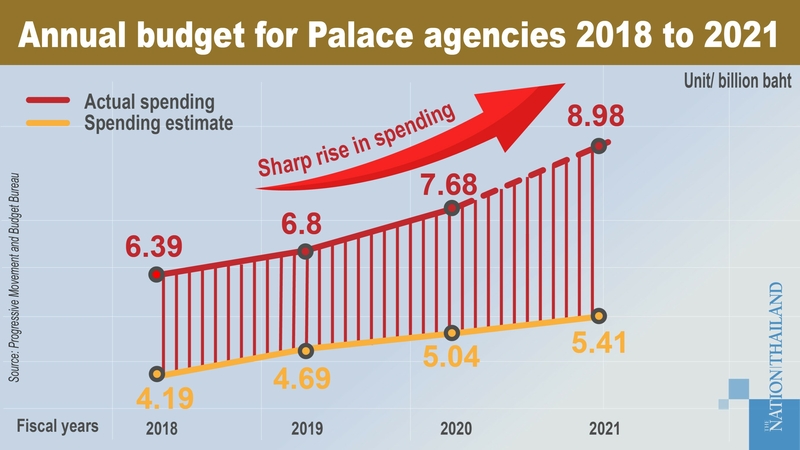
Palace agencies have asked for Bt8.98 billion for 2021 fiscal year (October 2020 to September 2021. The amount was up 16.8 per cent from Bt7.68 billion spent in the current fiscal year, compared to a 3.1 per cent rise in the overall national budget, Thanathorn pointed out.
He questioned at Thursday’s meeting about the wide gap between estimated and actual spending of Palace agencies from 2018 to 2021.
According to Budget Bureau records, the estimated spending for fiscal 2018 was Bt4.19 billion, but actual spending was 52.5 per cent higher at Bt6.39 billion.
The estimated expenditure for fiscal 2019 was Bt 4.69 billion while actual spending was Bt6.8 billion; the estimate for fiscal 2020 was Bt5.04 billion while actual spending was Bt7.68 billion, and the estimate for 2021 is Bt5.41 billion, but Palace agencies are seeking Bt8.98 billion.
Viyada Chotrattanasiri, deputy director at the Budget Bureau, explained to Thanathorn that the government had issued an emergency decree last year to transfer security units from the Defence Ministry to Palace supervision, so that added about Bt2 billion to the Palace agencies’ budget in the current fiscal year. Excluding that amount, the budget was actually down by Bt833 million, she noted.
For fiscal 2021, the Defence Ministry had cut its budget by Bt1.3 billion while the budget for personnel of Palace agencies had risen by Bt1.29 billion, she said.
Thanathorn said that he had questioned the increasing budget allocation by the government to Palace agencies, which is on a sharp upward trend until fiscal 2024, with current estimates rising to Bt10.69 billion and the potential of actual spending overshooting the estimate.
He called for a cut in the budget allocation for Palace agencies in line with the overall national budget, saying he was concerned about the fallout of Covid-19 on common people, public debt and dwindling tax revenue.
As of Sunday evening, Thanathorn’s Facebook post on the Palace budget had got over 38,000 likes, 3,800 comments and 15,000 shares.
Thanathorn’s request comes as anti-government protesters put pressure to reform the monarchy, in addition to demanding the drafting a new Constitution, ending government intimidation of people having divergent opinions, and dissolving Parliament.
By The Washington Post · Jeff Stein, Tony Romm · NATIONAL, BUSINESS, POLITICS, PERSONAL-FINANCE WASHINGTON – Just two weeks after President Donald Trump approved executive actions aimed at bypassing stalled stimulus negotiations with Congress, only one state has said it is paying new jobless benefits, few evictions have been paused, and leading employers have made clear that workers will not benefit from the president’s new payroll tax deferral.
After talks with congressional Democrats faltered, the president on Aug. 8 signed four executive actions aimed at staving off further economic turmoil. They included a $300-per-week benefit for jobless Americans, after the previous enhanced benefits expired in late July. Trump also directed a deferral of payroll taxes, as well as a halt to evictions and a suspension of student loan payments.
But Trump’s directives have so far produced limited economic relief for Americans hurt by the coronavirus pandemic, despite promises by top White House aides that help would come within weeks. By Friday, only Arizona had started sending the extra $300 to its residents.
Thirteen states have been approved to give the enhanced payments, and some, including Montana and Kentucky, will kick in a $100 match, meaning out-of-work residents there could get up to $400 in enhanced benefits. Many other states either have said they’re applying or have not said whether they will move forward and offer the payments. South Dakota has turned down the jobless benefits.
For the majority of the 28 million unemployed workers who had been getting an extra $600 a week, relief remains elusive. Just last week, jobless benefit claims rose slightly compared with the previous week, to more than 1 million. It’s the 21st week that unemployment claims have topped 1 million during the pandemic.
“I don’t know when my next paycheck will come, unemployment has not been helpful, and I’m not sure when the furlough will end. It’s extremely stressful,” said Caleb Dunlop, 28, who lost his job in college athletics in western Washington state on July 1. Dunlop said he had $9 in his bank account after paying rent and utilities last month, and he missed payments for his medication for treating chronic depression.
Trump and his economic team have repeatedly suggested that the executive actions largely render talks with Congress unnecessary, with the president saying that they would “take care of pretty much this entire situation.” National Economic Council Director Larry Kudlow boasted that the orders had led to a dramatic increase in the stock market, while Treasury Secretary Steven Mnuchin said after the orders were signed that the new unemployment payments would arrive “immediately.”
The next day, Mnuchin said the payments would be arriving “within the next week or two.” Kudlow also said at the time that the benefits would take “about two weeks” to be paid out.
The administration’s assessment of the timing of the benefits has almost certainly proved too optimistic. So far, only Arizona has reported sending the extra $300 week on top of traditional state unemployment benefits, according to Michele Evermore, an unemployment expert at the National Employment Law Project, a nonprofit.
Numerous governors have complained that the program is too complicated and could take several more weeks to set up. The White House also stipulated that people receiving less than $100 per week in unemployment benefits from their states are not eligible for the extra $300, effectively preventing as many as 1 million jobless Americans from receiving the benefit. And guidance from the Federal Emergency Management Agency – which manages the disaster relief fund that’s being tapped for the payments – suggested the extra benefit would last only three weeks.
About 20 states have said publicly they will apply for the program. Most are expected to need anywhere from “at least a few additional weeks to a couple additional months” to get the money out, said Evermore, who has been in regular contact with state unemployment officials. Some states may not be able to send the new payments out until the end of September, Evermore said.
Exacerbating the delays are financial and technical challenges, requiring states to update computer systems that in some cases are decades old. Similar upgrades kept some Americans from receiving their jobless aid for weeks or months earlier in the pandemic, as labor officials struggled to implement the new programs authorized under the $2 trillion Cares Act.
State unemployment officials have said that it would be easier if Congress adopted a new coronavirus aid package rather than piecemeal programs that require constant computer fixes. There appears to be little chance of that happening soon. The White House and congressional Democrats have not restarted meaningful negotiations since Trump’s executive actions, and congressional aides do not expect talks to resume until after Labor Day. Many economic experts say the absence of a deal with Congress is sharply limiting the recovery and is hurting unemployed Americans, given the administration’s challenges in implementing the new jobless benefits.
White House officials say they acted rapidly to help the unemployed, without ceding to Democrats’ demand to provide up to $1 trillion in aid to states, cities and tribal governments; Trump officials said that would be a bailout to blue states and localities that mismanaged their budgets. Mnuchin said this week that the White House was not willing to go along with Democrats’ “unreasonable” demands.
“President Trump has provided relief for American workers, where Congressional Democrats have failed,” White House spokesman Judd Deere said in a statement.
But the lack of urgency in reaching a deal on an aid package also reflects the White House’s view that no more federal help is needed to stimulate the economy. Kudlow has repeatedly said that the United States has now entered a “self-sustaining” recovery.
Stock markets – one of Trump’s favorite economic indicators – have soared even without an additional federal stimulus package. Sales of previously owned houses skyrocketed in July by a record 24.7 percent, the National Association of Realtors reported Friday, thanks to cheap mortgage rates.
“The economy right now is in a very strong rebound, which in my view is a self-sustaining recovery,” Kudlow told reporters Thursday. “I’m not making this stuff up. These are the government statistics . . . the stock market is correctly portraying a V-shaped recovery.”
Kudlow has also said the administration’s actions to defer payroll taxes will provide a “gigantic” wage increase to as many as 140 million Americans. Trump’s order opened the door for those employees’ taxes to be deferred starting Sept. 1 through the end of the year, but it doesn’t absolve those debts outright – meaning Americans who defer may owe thousands of dollars in 2021 without an intervention by Congress.
Lawmakers of both parties continue to express an unwillingness to end the payroll tax, given its impact on the budget and federal entitlement programs such as Social Security and Medicare. Roughly 30 industry groups – representing auto part suppliers, restaurateurs, retailers and others – told the White House this week that the plan is “unworkable” from a technical and logistical standpoint.
Deere, the White House spokesman, said in a statement: “President Trump used the authorities available to him to give employers the opportunity to put more money in the pockets of their employees, and he encourages all employers to take advantage of this to support hard-working Americans.”
On evictions, the president’s executive action instructed federal agencies to “consider” whether additional moratoriums were necessary. The Federal Housing Administration temporarily extended its foreclosure and eviction ban, but that covers only FHA-backed properties – a tiny portion of the U.S. rental market, said Diane Yentel, president and CEO of the National Low Income Housing Coalition.
State and local eviction moratoriums across the country are expiring, and census data suggests that as many as 40 million Americans fear losing their homes by the end of the year, a sharp increase from typical numbers.
“If Congress does nothing, we are very likely to see millions of renters face displacement or eviction, starting in September and October,” Yentel said. Trump “literally did nothing to stop or prevent evictions. There’s no requirement to do anything.”
Trump said on Aug. 11 of his eviction order: “We are not letting people be evicted.”
Ernie Tedeschi, a former economist in the Obama administration, said that the recovery was to a large degree fueled by the extraordinary levels of federal support approved by Congress in March. With that support vanishing, Tedeschi said, the White House may be prolonging the depths of the recession and spreading pain unnecessarily.
“The broader picture is there are still people and many sectors who are hurting and not able to recover yet,” Tedeschi said.
Cyn Brunelle, 41, of Cranston, R.I., receives disability benefits, and her husband, Elijah Brunelle, 40, worked as a cook at a nearby nursing home. Because Elijah Brunelle has diabetes and asthma, his employer told him not to return to his high-risk job. When his unemployment benefits expired, he went from receiving $698 a week to $198 a week. The family is now struggling to make ends meet even though they have three roommates and their son, a high school senior, has taken an additional job washing dishes.
“We went from being able to afford groceries and afford transportation to really struggling hard just to afford anything,” Cyn Brunelle said. “It’s really hard, very difficult and very stressful.”
EconAug 22. 2020Ekniti Nitithanprapas, the Revenue Department’s director-general
By The Nation
E-services tax, or value-added tax, is likely to be levied next year on foreign digital platforms that do not have a subsidiary company in Thailand, and it is expected to generate Bt3 billion per year revenue to the state, the top Revenue Department official said.
Ekniti Nitithanprapas, the department’s director-general, said the House of Representatives had approved the draft bill, adding that it was under consideration by the Senate committee.
“Once the e-services tax draft bill is approved by the Senate committee and the Constitutional Court, and is announced in the Royal Gazette, the act will be effective within 180 days, or in 2021,” he said.
He explained that the e-services tax aimed to create a level playing field between foreign and domestic online business entrepreneurs, as foreign entrepreneurs who operate businesses in Thailand are required to register for value added tax. The act will not be a burden on customers, he assured.
“However, the department expected that e-services tax collection will generate Bt3 billion revenue per year to the state,” he said.
“This will enable the Revenue Department to achieve the revenue collection target in fiscal year 2021.”
He added that in fiscal year 2020, the Revenue Department would not be anle to achieve its revenue collection target of Bt2.116 trillion.
“Revenue collection in the first nine months of this year is expected to be Bt1.26 trillion,” he added.
Shares of power giant BCPG on Friday closed at Bt12.80 per share, down Bt1.70 or 11.72 per cent, after the company announced an increase in capital by offering 1.3 billion additional common shares to specific investors, experts said.
Bundit Saphianchai, BCPG president, informed the Stock Exchange of Thailand that the company’s board of directors had approved increasing its capital to Bt16.508 billion from the previous Bt10 billion by launching 1.301 billion additional common shares at the par value of Bt5 per share. The company aimed to inform shareholders at an extraordinary general meeting on October 7.
He explained that not more than 250 million additional shares will be offered to existing shareholders at the ratio of one new share for 8 shares at Bt11.50 per share, while the company will grant BCPG -W1 and BCPG -W2 warrants to existing shareholders without any charges.
“The conpany will grant 89.3 million units each of BCPG -W1 and BCPG -W2 warrants at a ratio of 2.80 additional shares per unit. Existing investors can use one warrant per additional share at Bt8 per share. The terms of the BCPG -W1 and BCPG -W2 warrants are two years and three years, respectively,” he said.
He further explained that not more than 391.5 million additional shares will be offered to Pilgrim Partners Asia and Capital Asia Investments equally at Bt11.50 per share, while the company will grant BCPG -W3 warrants to those companies without any charges.
“BCPG -W3 warrants totalling 178.6 million units will be granted at a ratio of 2.1924 additional shares per unit. Existing investors can use one warrant per additional share at Bt8 per share. The term of the BCPG -W3 warrants are one year,” he said.
He said that not more than 283 million additional shares will be offered to a limited group of investors at market price during the offering period.
“Meanwhile, not more than 357.2 million shares were for BCPG -W1, BCPG -W2 and BCPG -W3 warrant exercises and not more than 20 million shares will be issued to company directors, executives and employees,” he said.
He added that this move aimed to raise capital for business expansion, such as investment, development, and acquisition of power plants under the company’s investment plan, as well as repaying debts to financial institutions.
An analyst at Asia Plus Securities said BCPG’s announcement to increase capital had caused the share price to drop in the short term because the share volume will increase to 3.3 billion shares, up 62 per cent from the current 1.99 billion shares.
“We expect that this negative sentiment will plunge the share price at least 12-15 per cent,” he said.
He added that the securities company has cut its base value forecast at the end of this year to Bt11.90 per share from the previous Bt19.70 per share, advising investors to speculate profit from other shares due to such factors.
The price of mobile phone retail shares has risen sharply after the Bank of Thailand (BOT) moved to ban use of mobile banking services on old or jailbroken phones to prevent cyberattacks.
The new BOT measure will be effective from December 31, forcing many people to buy new phones to access mobile banking.
It will bar access to mobile banking apps for users of rooted or jailbroken phones, as well as devices with outdated operating systems. Users must also set up a PIN or password to use banking apps.
The move lifted share prices of mobile phone retail shares over the past two days.
Shares in Synnex (Thailand) (SYNEX) rose by 17.4 per cent, Hana Microelectronics (HANA) by 10.2 per cent and , Jaymart (JMART) by 9.9 per cent, and Com7 (COM7) by 3.8 per cent.
The companies’ performance was expected to improve through the second half of 2020, said Supachai Wattanavitheskul, an analyst at Yuanta Securities (Thailand).
Many people also expect the launch of 5G in the second half of the year will mean they have to buy new mobile phones to use the technology, he pointed out.
He also expects the share price of COM7, Apple’s official distributor in Thailand, to increase after Apple shares hit a new high recently.
“Also, JMART gained positive sentiment from its subsidiaries’ second-quarter results, while SYNEX’s second-quarter performance is expected to be strong,” he said.
He predicted mobile phone retail shares would rise by around 10 per cent in the second half of 2020.
“However, investors should be careful when speculating on these shares since the price is currently high and they could face mass sell-offs if performance or business direction is not as investors expect,” he added.
Passakorn Linmaneechote, managing director at Kasikorn Securities, affirmed that the BOT measure had lifted mobile phone retail shares but urged caution over a saturation point in mobile use.
“This positive sentiment will not support the shares as much as expected because the number of internet banking and mobile banking accounts is currently around 61 million [in Thailand], while the number of SIM cards is around 100 million,” he said.
Meanwhile, most current users of internet and mobile banking have new phones and operating systems, while those with old phones may not want to use these services, he added.
U.S. existing-home sales surged in July by most on record
EconAug 21. 2020A real estate sign stands outside a home for sale in Peoria, Ill., on May 30, 2019. CREDIT: Bloomberg photo by Daniel Acker.
By Syndication Washington Post, Bloomberg · Maeve Sheehey · BUSINESS, PERSONAL-FINANCE, US-GLOBAL-MARKETS
U.S. sales of previously owned homes surged by the most on record in July as lower mortgage rates continued to power a residential real estate market that’s proving a key source of strength for the economic recovery.
Closing transactions increased 24.7% from the prior month to a 5.86 million annualized rate, the strongest pace since the end of 2006 and reflecting broad gains across the U.S., according to National Association of Realtors data issued Friday. The median estimate in a Bloomberg survey of economists called for a 5.41 million rate. Prices jumped 8.5% from a year earlier, on an unadjusted basis, to the highest on record.
“The housing market is past the recovery phase and is now in a booming stage,” Lawrence Yun, NAR’s chief economist, said on a call with reporters. “Certainly, record-low mortgage rates are bringing more buyers into the market.”
Cheaper borrowing costs, pent-up demand and greater interest in suburban markets following the pandemic-related shutdowns earlier in the year are so far generating plenty of momentum in housing. At the same time, lean inventory, higher asking prices, and the coronavirus itself represent hurdles to further outsize gains.
“With the sizable shift in remote work, current homeowners are looking for larger homes and this will lead to a secondary level of demand even into 2021,” Yun said in a statement.
There were 1.5 million existing homes for sale last month, down 21.1% from July 2019, the 14th straight year-over-year decline. It was the leanest supply for any July on record.
The number of houses for sale would last 3.1 months at the current sales pace. Anything below five months is seen as a tight market.
In July, properties remained on the market for an average of 22 days, the shortest timespan on record. The median home price increased to an all-time high of $304,100 last month and compared with $280,400 a year earlier.
Purchases of previously owned single-family homes rose 23.9% and sales of condominiums increased nearly 32%, according to the NAR data.
Existing-home sales increased in all four U.S. regions in July, including a 30.5% rise in the West and a 19.4% advance in the South, the largest U.S. region. Purchases climbed 27.5% in the Midwest and 30.6% in the Northeast.
Previously owned home sales account for roughly 90% of U.S. tractions and are calculated when a contract closes. July new-home sales data will be released by the Commerce Department on Tuesday.
Europe’s economic recovery stumbles after initial bounceback
EconAug 21. 2020A waiter serves a customer amongst empty tables at a cafe in Marseille, France, on Aug. 12, 2020. CREDIT: Bloomberg photo by Jeremy Suyker.
By Syndication Washington Post, Bloomberg · Fergal O’Brien · BUSINESS, WORLD, US-GLOBAL-MARKETS, EUROPE The euro-area economy unexpectedly lost momentum this month after a resurgence of coronavirus cases forced new restrictions, highlighting the challenge of rekindling growth while the pandemic remains untamed.
The sharp slowdown — driven by services — shows that the escape from recession won’t be plain sailing, and undermines lingering hopes for a V-shaped recovery. While infections are approaching levels recorded during strict lockdowns earlier this year, governments are so far reluctant to re-impose those measures.
In a report published Friday, IHS Markit said its composite measure of private-sector activity dropped to 51.6 in August from 54.9 in July. The manufacturing gauge remained virtually unchanged, but services plunged to 50.1, a level that practically signals stagnation.
The economy had initially bounced back strongly after restrictions were eased, though concerns lingered that the pace could fade. At their last meeting in July, European Central Bank policy makers were reluctant to draw firm conclusions about the health of the economy, a stance that looks justified by Friday’s numbers.
The fallout on jobs in both sectors continued, with employment declining for a sixth straight month. That’s a key worry for governments, who fear a damaging rise in joblessness could persist. While France and Germany, the euro area’s biggest economies, continued to see growth in activity, the Markit report suggested output declined in Italy and Spain.
“The euro zone stands at a crossroads,” said Andrew Harker, economics director at IHS Markit. “The path taken will likely depend in large part on how successfully Covid-19 can be suppressed and whether companies and their customers alike can gain the confidence necessary to support growth.”
To rein in the spread of the virus, countries across the region have tightened some restrictions on public life. Spain and Italy shut discos, and Greece limited hours for bars and restaurants in hopes of avoiding more stringent measures after the holiday season winds down. Irish authorities are also considering new measures to curb the pandemic.
For the battered travel industry, those steps already have consequences. Ryanair Holdings, Europe’s biggest discount carrier, has cut back on schedules, saying the uncertainty has discouraged people from booking foreign trips.
Deutsche Lufthansa’s Eurowings unit said Tuesday it’ll reduce capacity to Spain, in response to a German travel warning. The country has re-emerged as a new hotspot for the virus.
Passenger numbers in Germany may take until 2024 to reach their 2019 level, according to industry association BDL.
German Chancellor Angela Merkel called on European leaders Thursday to work together to prevent renewed lockdowns.
“Politically, we want to avoid closing borders again at any cost, but that assumes that we act in coordination,” she said during a visit to Emmanuel Macron at his presidential residence on the Mediterranean coast.
Before the meeting, Macron had told Paris Match magazine that “we cannot shut down the country, because the collateral damage of confinement is considerable.” France reported 4,771 new infections Thursday, the largest daily increase since mid-April.
The Stock Exchange of Thailand (SET) Index closed at 1,299.26 today (August 21), up 2.47 points or 0.19 per cent. Total transactions amounted to Bt42.295 billion with an index high of 1,307.64 and a low of 1,296.68.
In the morning session, a stock analyst at Krungsri Securities said he expected the index to fluctuate between 1,290 and 1,305 despite positive sentiment from China’s plan to meet with US representatives to review the first phase of their trade agreement.
“The index will be under pressure from uncertainty over the impact of Covid-19 on US economic data and over the political situation in Thailand,” the analyst said.
The 10 stocks with the highest trade value today were CPALL, GPSC, NER, PTT, AOT, JMART, JMT, TOP, KCE and MINT.
As of 4.30pm, the price of oil fell by US$0.33 or 0.77 per cent to $42.49 per barrel, while gold fell by $6.40 or 0.33 per cent, to $1,940.10 per ounce.
Other Asian indices were on the rise:
Japan’s Nikkei Index closed at 22,920.30, up 39.68 points or 0.17 per cent.
China’s Shang Hai SE Composite Index closed at 3,380.68, up 16.78 points or 0.50 per cent, while the Shenzhen SE Component Index closed at 13,478.00, up 157.08 points or 1.18 per cent.
Hong Kong’s Hang Seng Index closed at 25,113.84, up 322.45 points or 1.30 per cent.
South Korea’s KOSPI Index closed at 2,304.59, up 30.37 points or 1.34 per cent.
Taiwan’s TAIEX Index closed at 12,607.84 up 245.20 or 1.98 per cent.
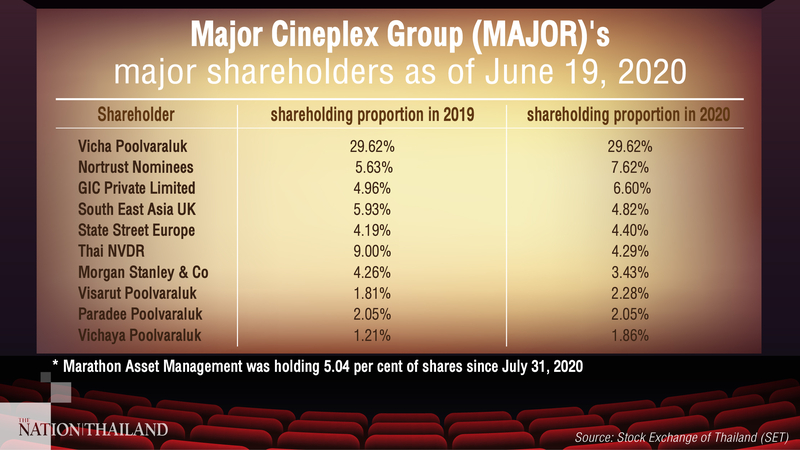
Foreign institutional investors were buying Major Cineplex Group (MAJOR) shares amid the Covid-19 crisis, as its share price recovered faster than its base price, experts said.
MAJOR was one of the businesses affected the most by the Covid-19 pandemic. The company faced a loss for two consecutive quarters, especially in the second quarter when the government imposed lockdown measures, causing the company to lose Bt475 million compared to a profit of over Bt500 million in the past five years.
The company’s net loss in the first half of this year totalled Bt730 million.
Meanwhile, MAJOR’s share price fell from Bt25 per share at the end of 2019 to Bt11.20 per share at the end of March, the lowest in eight and a half years since the great flood of 2011.
There were negative views about MAJOR’s shares as its cinema business would be disrupted by technologies that enable people to watch movies at home and the Covid-19 crisis had led most people to believe the cinema business would change.
However, according to the last book closing on June 19 this year, foreign institutional investors, such as GIC Private Limited, a Singapore government fund, has increased its shareholding in MAJOR from 5.93 per cent in April 2019 to 6.6 per cent, while Nortrust Nominees has increased its shareholding from 5.63 per cent to 7.62 per cent.
On August 5, Marathon Asset Management, a London-based asset management firm, bought 5.04 per cent of MAJOR shares until it was listed in the top five major shareholders, however Thai NVDR has decreased its shareholding proportion from 9 per cent to 4.29 per cent.
Dithanop Vattanawakin, an analyst at Capital Nomura Securities, said foreign institutional investors were buying MAJOR shares because its price had dropped sharply, while investors hoped that the company’s performance will improve which can be seen from the rising share price that has currently risen over its base price at Bt14.80 per share.
“However, there are a lot of uncertainties during the third quarter this year. Apart from expenses that MAJOR has to incur after resuming operations, the company’s revenue would not recover quickly because many movie releases were postponed, causing a decline in the number of customers,” he said.
He expected MAJOR’s business direction to become more clear in September this year after big movie releases, such as Mulan, adding that the company’s share price rose amid uncertainties in the past two weeks.
Meanwhile, Phatipak Navawatana, an analyst at Krungsri Securities, expected MAJOR to recover in the second half of this year, adding that the company’s second-quarter performance was the lowest point as many cinemas were closed, while many movie releases were postponed.
“However, the company would face a loss in the third quarter before taking a profit in the fourth quarter. Its performance will recover after big movies are released,” he said.
“Even though the company’s bad results have bottomed out, it still lacks positive sentiment to boost share price as the current movies may not attract customers, resulting in a decline in revenue and profit.”


 President Trump
 Ekniti Nitithanprapas, the Revenue Department’s director-general

 A real estate sign stands outside a home for sale in Peoria, Ill., on May 30, 2019. CREDIT: Bloomberg photo by Daniel Acker.
 A waiter serves a customer amongst empty tables at a cafe in Marseille, France, on Aug. 12, 2020. CREDIT: Bloomberg photo by Jeremy Suyker.