Executives of large SET-listed companies are now buying back shares after the market suffered a correction from the Covid-19 pandemic, according to one expert.
Several executives have bought back shares after the SET fell to around the 1,300 mark this week.
According to the latest report on executives’ securities and derivatives trade, the number of transactions increased by 32. Most of that increase came from executives buying back shares under their control on August 17-18 when the SET fell to 1,315 from 1,350 last week.
Leading the way was Jay Mart (JMART) executive Ekachai Sukhumvitaya, who bought back 1.8 million shares at an average Bt13.38 and 1 million shares at Bt13.27, totalling Bt37 million.
Meanwhile, six executives at Sri Trang Gloves (Thailand) (STGT) – Oralak Nakin, Jarinya Jirojkul, Kitichai Sincharoenkul, Vitanath Sincharoenkul, Sarana Boonbaichaiyapruck and Anan Pruksanusak – bought back 130,000 shares at an average Bt67 per share, totalling Bt8.7 million.
Chone Sophonpanich, a Bangkok Life Assurance (BLA) executive, bought back 68,900 shares at Bt15.40 per share, accounting for Bt1.06 million, while Yuth Chinsupakul, Eastern Power Group (EP) executive, bought back 1.09 million shares at Bt4.09, totalling Bt4.5 million.
Following the market correction from the end of July to the start of August, Minor International (MINT) executives William Heinecke and Niti Osathanugrah bought back 17.32 million shares at an average Bt17.50, and worth Bt303 million.
However, Heinecke also sold 350,000 shares at Bt20.50 per share, amounting to Bt7.1 million.
Meanwhile, Asia Plus Group Holdings (ASP)’s Kongkiat Opaswongkarn bought back 4 million shares at Bt1.8 per share, totalling Bt7.2 million.
Nuttachart Mekmasin, a research analyst at Trinity Securities, said market conditions weren’t the only reason behind the buybacks by directors.
“The index may rise or drop from the 1,300 support line in the third quarter, and could fall below 1,300 in the fourth quarter given multiple risks,” he said.
He predicted the index would slide in Q3 due to lack of positive sentiments, but would not fall below 1,260 given the uptick rule, debt payment moratoriums and liquidity injections.
“However, we expect the index to fall below 1,300 after the abovementioned measures expire, while it could also come under pressure if the trade war escalates after the US presidential election in November,” he said.
By Syndication Washington Post, Bloomberg · Rita Nazareth, Claire Ballentine · BUSINESS, US-GLOBAL-MARKETS
Stocks extended gains after closing at a record for the first time since the pandemic started amid a rebound in giant technology companies. Treasuries advanced.
The S&P 500 rose as investors assessed earnings from retailers and the latest on stimulus talks ahead of the Federal Reserve’s meeting minutes. Apple reached a $2 trillion market valuation for the first time after an almost 60% surge this year. Target rallied as revenue trounced analysts’ projections, brushing off concerns that demand would ebb after consumers spent their relief checks. Lowe’s gained on a strong summer sales pace that beat estimates. Momenta Pharmaceuticals soared as Johnson & Johnson agreed to acquire the company for about $6.5 billion.
A buying stampede drove American stocks up more than 50% from this year’s lows, with the S&P 500 completing its fastest-ever return to a record after a plunge of at least 20%. A drop in New York City’s positive Covid-19 test rate to the lowest since the pandemic began and signs the outbreak is easing in Sunbelt states also bolstered optimism. Meanwhile, high-frequency economic indicators and corporate earnings have improved amid ultra-easy monetary policy and massive stimulus measures.
“The Fed’s largesse means that there are trillions of dollars of excess liquidity sloshing around seeking greater returns than the near zero or even negative rates offered by fixed income,” wrote Win Thin, global head of currency strategy at Brown Brothers Harriman & Co. in New York. “Much of that is going into equities.”
Democratic and Republican leaders are hinting that they are looking for a path toward reviving stalled negotiations on the next round of pandemic relief for the U.S. economy, even as both sides remain far from any deal. The Trump administration sees a possibility for both partis to agree on a smaller round of pandemic relief totaling $500 billion that would omit the biggest areas of disagreement, a senior U.S. official said on Tuesday night.
“The wall of cash really buoying the risk appetite of investors has successfully lifted the market past where it was prior to the outbreak of Covid,” Todd Jablonski, chief investment officer at Principal Global Asset Allocation. “That’s a testament to what you’ve seen in terms of policy response, but it by no means means that we’re in the clear.”
Boosted by the S&P 500’s surge to a record on Tuesday, the market cap of global equities is at an all-time high of $89.7 trillion. Risk assets have rallied since March as unprecedented stimulus measures and gains in technology stocks have outweighed concerns about U.S.-China trade tensions and rising coronavirus cases.
Stocks:
– The S&P 500 rose 0.2% as of 11:24 a.m. New York time.
– The Stoxx Europe 600 Index advanced 0.4%.
– The MSCI Asia Pacific Index was little changed.
Currencies:
– The Bloomberg Dollar Spot Index decreased 0.1%.
– The euro increased 0.1% to $1.1944.
– The Japanese yen was little changed at 105.42 per dollar.
Bonds:
– The yield on 10-year Treasuries dipped one basis point to 0.65%.
– Germany’s 10-year yield decreased one basis point to -0.47%.
– Britain’s 10-year yield fell less than one basis point to 0.217%.
Commodities:
– The Bloomberg Commodity Index was little changed.
– West Texas Intermediate crude dipped 0.6% to $42.63 a barrel.
The Stock Exchange of Thailand (SET) Index closed at 1,308.67 today (August 19), down 21.44 points or 1.61 per cent, while total transactions tallied at Bt57.283 billion with an index high of 1,332.79 and a low of 1,301.97.
During the morning session, a stock analyst at Krungsri Securities said he expected the index to fluctuate between 1,320 and 1,340 points due to a lack of positive investment sentiment.
“Besides, uncertainty in relation to US-China tensions after Washington announced further restrictions on the Chinese phone brand Huawei, and a delay in the rolling out of the $1-trillion economic stimulus in the US will pressure the index,” he said.
The top 10 stocks with the highest trade value today were STGT, CPALL, PTT, MINT, KBANK, AOT, BDMS, ADVANC, SCB and KCE.
As of 4.30pm, the price of crude oil fell by US$0.28 or 0.65 per cent to $42.61 per barrel, while gold fell by $10.30 or 0.51 per cent, to $2,002.80 per ounce.
Other Asian indices were mixed:
Japan’s Nikkei Index closed at 23,110.61, up 59.53 points or 0.26 per cent.
China’s Shanghai SE Composite Index closed at 3,408.13, down 42.96 points or 1.24 per cent, while Shenzhen SE Component Index closed at 13,480.85, down 287.31 points or 2.09 per cent.
Hong Kong’s Hang Seng Index closed at 25,178.91, down 188.47 points or 0.74 per cent.
South Korea’s KOSPI Index closed at 2,360.54, up 12.30 points or 0.52 per cent.
Taiwan’s TAIEX Index closed at 12,778.64, down 93.50 points or 0.73 per cent.
The bank index rose sharply yesterday (August 18) on hopes that the Bank of Thailand (BOT) will allow banks to pay dividends if October stress test shows their capital is above the minimum requirement of 12 per cent.
The Stock Exchange of Thailand (SET) Index closed at 1,330.11 yesterday, up 9.20 points, or 0.70 per cent, while the bank index rose by 4.09 points, or 1.49 per cent, to 279.43.
Tisco Financial Group’s share price rose by Bt1.75, or 2.62 per cent, to Bt68.50 per share, with transactions totalling Bt766.19 million.
Bangkok Bank’s price increased by Bt2, or 1.90 per cent, to Bt107.00 per share, with transactions amounting to Bt541.19 million.
Kasikorn Bank rose by Bt1.50, or 1.71 per cent, to Bt89.25 per share, with transactions totalling Bt1.71 billion.
Siam Commercial Bank increased by Bt1, or 1.38 per cent, to Bt73.25 per share, with transactions amounting to Bt771.51 million.
Krungthai Bank (KTB) rose by Bt0.10, or 1.02 per cent, to Bt9.90 per share. Transactions totalled Bt208.64 million.
TMB Bank was up by Bt0.01, or 1.03 per cent, to Bt0.98 per share, with transactions amounting to Bt190.75 million.
Kiatnakin Bank (KKP) rose by Bt0.75, or 1.89 per cent, to Bt40.50 per share. Transactions totalled Bt122.16 million.
According to a KTB Securities (KTBST) analysis, banks will pay dividends this year at the lowest payout ratio as their capital was currently 17-22 per cent.
“Comparing banks’ dividend yield based on the lowest dividend payout ratio, small banks have a dividend yield that is more than large banks,” the analysis said. “KKP and Tisco have a dividend yield at 6 per cent and 5 per cent, respectively, while KTB is the only large bank that has the highest dividend yield at 5 per cent.”
KTBST weighted investment in bank shares as same as the market, advising investors to buy BBL at a target price of Bt120 per share as this bank has the lowest risks from setting up allowances for doubtful debts and the highest coverage ratio at 171 per cent to deal with risks in the future.
According to a Capital Nomura Securities’ analysis, the average commercial bank’s capital in June was 19.2 per cent, higher than BOT’s minimum requirement of 12 per cent despite the Covid-19 fallout.
“Considering each bank’s capital at the end of the first quarter this year, KKP and SCB have the lowest at 17.2 per cent, while Tisco has the highest at 20.7 per cent,” the analysis said.
“Banks’ capital is currently strong, especially large banks that are able to handle losses from Bt72 billion to Bt130 billion, so they will be able to pay dividend,” it added.
However, the securities company still weighted investment in bank shares as same as the market, advising investors to buy BBL and Tisco at a target price of Bt120 and Bt80 per share, respectively.
The Stock Exchange of Thailand (SET) Index fell by 1.39 points, or 0.10 per cent, to 1,328.72 in the morning session today (August 19).
A stock analyst at Krungsri Securities expected the index to fluctuate between 1,320 and 1,340 points due to a lack of positive investment sentiment.
“Besides, uncertainty following US-China tensions after the US announced further restrictions on China’s Huawei, and a delay in rolling out a new US economic stimulus package would pressure the index,” he said.
“We advise investors to follow a joint Opec+ meeting today,” he added.
He recommended that investors buy:
> Stocks that benefit from the rising crude oil price, such as PTTEP, PTTGC, Top and IVL.
> Stocks that benefit from lockdown easing and progress in the development of a Covid-19 vaccine, such as CRC, CPN, HMPro, Global, Com7, DoHome, AOT, Mint, Centel and ERW.
The SET Index closed at 1,330.11 yesterday, up 9.20 points, or 0.70 per cent. Total transactions amounted to Bt50.85 billion, with an index high of 1,330.40 and a low of 1,321.07.
The price of gold dropped by Bt100 per baht weight in morning trade today (August 19), the Gold Traders Association reported.
As of 9.32am, the buying price of a gold bar was Bt29,300 per baht weight and selling price Bt29,400, while gold ornaments cost Bt28,773.68 and Bt29,900, respectively.
At close yesterday, the buying price of a gold bar was Bt29,400 per baht weight and selling price Bt29,500, while gold ornaments cost Bt28,864.64 and Bt30,000, respectively.
The Comex (Commodity Exchange) gold price to be delivered in December rose by US$14.4, or 0.72 per cent, to $2,013.1 (Bt62,798.07) per ounce at yesterday’s close.
The gold price rose more than $2,000 per ounce again from a decline in the dollar and US bond yields. Besides, uncertainty following US-China tensions boosted demand for the precious metal as a safe-haven asset.
By Syndication Washington Post, Bloomberg · No Author · BUSINESS
China, the world’s biggest oil importer, has ramped up purchases of American crude in the lead-up to a highly anticipated review of the trade deal between the two economic powerhouses.
As much as 14 million barrels — or seven superclass tankers full — of U.S. oil will be loaded next month for delivery to China, according to estimates by Vortexa Ltd. based on provisional tanker bookings. If all those shipments make the trip that will be more than double the volumes set for August.
The surge in bookings comes before a review of the phase-one trade deal, under which China pledged to boost purchases of U.S. energy products. The talks, which were originally planned for last weekend, have been delayed indefinitely, however, amid deteriorating relations between the two countries.
Chinese imports of U.S. goods in the first six months of the year only reached about 23% of the total target under the trade agreement for 2020, Bloomberg calculations based on data from General Administration of Customs show. The nation’s refineries have been cranking up run rates as the economy emerges from a virus-induced slump, which may be another reason for the boost in buying.
“The rise in U.S. crude purchases is likely politically driven,” said Serena Huang, a senior analyst at Vortexa, a market analytics firm. “China is still sitting on large stockpiles of oil, and current U.S. crude prices are not much more favorable than their Middle East competitors.”
Oil-refining heavyweights PetroChina Co. and Sinopec chartered more than 40% of the China-bound supertankers set for September loading as of Aug. 17, Vortexa’s data show. Grades such as WTI Midland and Mars were among the types of American oil purchased by China, but they weren’t always cheaper than alternative feedstock from other regions, according to traders.
A Beijing-based Sinopec official at the company’s press office and an official at China National Petroleum Corp., parent company of PetroChina, both declined to comment on the matter.
China bought an average about 568,500 tons, or 4.2 million barrels, of U.S. oil a month in May and June, General Administration of China Customs data show. The country imported no American oil for the previous five months as relations between the two countries deteriorated amid the coronavirus.
China’s energy demand has rebounded in-line with an uptick in its economy, said Rajiv Biswas, Asia-Pacific chief economist at IHS Markit. “These new orders for U.S. crude will help to improve China’s overall progress toward the U.S.-China phase one trade deal targets,” he said.
By The Washington Post · Hamza Shaban, David J. Lynch · BUSINESS, US-GLOBAL-MARKETS
Defying the coronavirus pandemic’s mounting human and economic toll, stocks closed Tuesday at a record high, bringing an end to the shortest bear market in U.S. history.
After notching three consecutive weeks of gains, the Standard & Poor’s 500 index closed at 3,389, gaining 0.2% on the day. The finish capped a remarkable comeback from the March plunge that slashed 34% off the previous record, set Feb. 19, as the pandemic tightened its grip on the country.
Investors Tuesday brushed aside worries about the nation’s continuing struggle to contain the pandemic, focusing instead on signs of strength in the housing and retail sectors. Housing starts in July rose 22.6% to a seasonally adjusted annual rate of nearly 1.5 million, the Commerce Department said. Permits also rose sharply for both single- and multifamily dwellings.
“One of the economy’s most important leading indicators is telling us that not only is the pandemic recession over, the economic outlook is actually growing brighter by the day,” Chris Rupkey, chief financial economist for MUFG Union Bank in New York, wrote in a note to clients.
Walmart, one of the nation’s largest retailers, reported same-store sales rose 9.3% in the quarter that ended July 31. The company said its online business rose by 97%.
The pandemic, meanwhile, continues to stalk the $19 trillion U.S. economy. More than 5.4 million Americans have been infected by the coronavirus, and more than 171,000 have lost their lives, according to Johns Hopkins University.
As inprevious stock market rallies, the financial rewards of the latest surge have been highly uneven. Savvy investors have been showered with profits while millions of people without money to invest or even pay rent in the months ahead, have been left out. Only about half of Americans own stocks, mainly through retirement accounts, according to the Federal Reserve.
“At the end of the day, the record is just a number,” said Wayne Wicker, chief investment officer at Vantagepoint Investment Advisers. But the rise in the stock market suggests that investors see a recovery on the horizon. “Although today’s economy remains in a miserable state in an absolute sense,” he said, “markets care about better or worse, not good or bad,” and the leading economic indicators continue to improve.
The S&P 500’s milestone came one day after the tech-heavy Nasdaq posted its own record, drawing kudos on Twitter from President Donald Trump. Before trading began Tuesday, Trump touted signs of economic recovery and took credit for the market upswing.
“Jobs are flowing, NASDAQ is already at a record high, the rest to follow. Sit back & watch!” Trump tweeted.
For Main Street, moves in the market often presage moves in the economy, said Kristina Hooper, Invesco’s Chief global market strategist. “So a strong rebound for stocks could indicate that the economy will also experience a strong rebound,” she said.
The Dow Jones industrial average, which remains about 5% below its February peak, gave up 67 points or 0.2%. And the tech-heavy Nasdaq increased by 81 points, or 0.7%.
Stock prices cratered in March, following the initial coronavirus cases and subsequent stay-at-home mandates designed to slow infections. Since then, Wall Street has mounted a dramatic comeback. Several companies, such as Tesla, Wayfair and Masco, have set their own share-price records. Perhaps most prominently, investors have flocked to the tech giants, which wield massive cash reserves and whose products are seen as increasingly valuable in the shift to working-from-home and remote learning.
In 2018, Apple generated a stream of headlines for becoming the first company with a market value of $1 trillion. Two years later, the maker of the iPhone is on the cusp of doubling that figure. Microsoft and Amazon are not far behind, with valuations near $1.6 trillion.
“Notably, the rally has largely been driven by the continued surge in mega-cap tech stocks, which have carried the S&P 500 to new record highs through the pandemic as investors wager on their ability to deliver strong growth unhindered by the broader economic shutdowns,” said Nicole Tanenbaum of Chequers Financial Management.
But the stock market rally also coincides with dire economic data, double-digit unemployment rates, and the relentless virus.
“Certainly the last time we hit this number the world looked a lot different than it does today,” said Wicker. “Despite the fact that we are faced with new challenges it seems to indicate that investors are pretty positive about where we are going in the future,” he said.
The turnaround concludes the shortest bear market in history. A bear market is generally understood to refer to a period when stocks fall at least 20% from the previous peak. And a bull market is defined as 20% rise from the previous low.
Now that the S&P 500 set a new peak, it means the bear market lasted from Feb. 19 to March 23, when stocks bottomed and inaugurated a fresh bull run.
“Even though financial markets reflect a lot of volatility this year, the long term story is they are resilient and have an upward bias over time,” said Wicker.
The new record arrived as the Democratic Party kicked off its national convention, as the presumptive nominee Joe Biden holds a double-digit lead over President trump, according to a Washington Post-ABC News poll. Congressional Democrats have pushed for a more aggressive economic response to the coronavirus crisis and have characterized Republican plans as inadequate for a public health emergency. Earlier this month, President Trump attempted to bypass Congress by signing executive actions to make dramatic changes to tax and spending policy, in an effort to expand unemployment aid for jobless Americans.
Investors have been buoyed by the dramatic actions of the Federal Reserve and Congress to keep the economy from sliding further. “As it did during the global financial crisis, the Fed provided the rocket fuel for stocks’ gains, despite high unemployment and high covid-19 infections and deaths,” said Hooper, explaining how the stock market has “decoupled” from the broader economy.
Shareholders are also anticipating another round of emergency government relief. But as both parties prepare to deliver their political sales pitches to the American public, Congress and the White have yet to agree on the next stage of coronavirus aid.
The number of unemployed youth in Thailand will double this year, while 220 million young workers in Asia will be vulnerable to labour market disruption caused by Covid-19, the Asian Development Bank said.
The Covid-19 pandemic has triggered a massive disruption of labour markets, having a disproportionate impact on the employment of young people, said ADB report titled “Tackling the Covid-19 youth employment crisis in Asia and the Pacific”.
With lockdowns and travel restrictions in place, demand has slumped and many businesses have been forced to close or cut back on operations, having a serious impact on workers. Nearly 220 million people aged 15 to 24 in the region are particularly vulnerable given that they hold insecure, informal, part-time jobs in sectors that have especially been hit hard.
Given their relative lack of experience, young people face higher rates of unemployment than people above the age of 25 regardless of the business cycle. Young people are also more likely than adults to work in less secure, lower-wage jobs usually with limited legal rights, social protection and representation.
The Covid-19 crisis brings the vulnerabilities of youth labour markets to the fore but with the further complication of disrupted education and training pathways. Young people will be hit harder than adults in the immediate crisis and also bear higher longer-term economic and social costs. Pre-existing vulnerabilities of youth in the labour market will be exacerbated, with negative consequences for intergenerational poverty and inequality.
The crisis negatively impacts the prospects for youth through three channels: job disruptions from reduced working hours and layoffs; disruption in education and training as they try to complete studies; and difficulties transitioning from school to work and moving between jobs.
The crisis will affect young people differently depending on their situation in the labour market. The scale of the impact will depend on the length of the crisis, the choices governments make for socioeconomic recovery and the capacity of institutions to implement effective measures.
Youth in the Asia-Pacific region faced a challenging labour market situation before the crisis. The regional youth unemployment rate was 13.8 per cent in 2019 compared with 3 per cent for adults and the global youth unemployment rate was 13.6 per cent. More than 160 million youth (24 per cent of the population) were not in employment, education or training in 2019, and the region’s rates have been rising primarily as a result of the exclusion of young women who face an excessive burden of unpaid household and care work.
Four in five young workers in the region were engaged in informal employment – a higher share than among adults – and one in four young workers was living in conditions of extreme or moderate poverty.
At the onset of the crisis, nearly half of young workers in the region were employed in the four sectors destined to be hardest hit by the recession. These sectors – wholesale and retail trade and repair, manufacturing, rental and business services, and accommodation and food services – employed nearly half of all young people (more than 100 million) working in Asia-Pacific at the onset of the crisis. Young women are overrepresented in three of the four highly impacted sectors, particularly accommodation and food services.
The vulnerability of youth in labour markets was already visible in the first half of this year as the Covid-19 crisis unfolded. Youth unemployment rates jumped in the first quarter of 2020 from the last quarter of 2019 in all economies for which data is available.
Compared with the first quarter of 2019, youth unemployment rate increased in six of nine economies that have quarterly data available: Australia, Indonesia, Japan, Malaysia, and Vietnam, as well as in Hong Kong which showed the largest increase of 3 percentage points.
All economies that experienced increases showed sharper jumps in youth rates than in adult rates.
The reduction in working hours is unprecedented. Working hours across the region dropped 7.1 per cent in the first quarter of 2020 from the fourth quarter 2019. The loss of working hours rose to 13.5 per cent in the second quarter of 2020. While the regional figure is not disaggregated by age, evidence from two countries – South Korea and Thailand – showed young workers experienced a significantly larger loss of hours than adults.
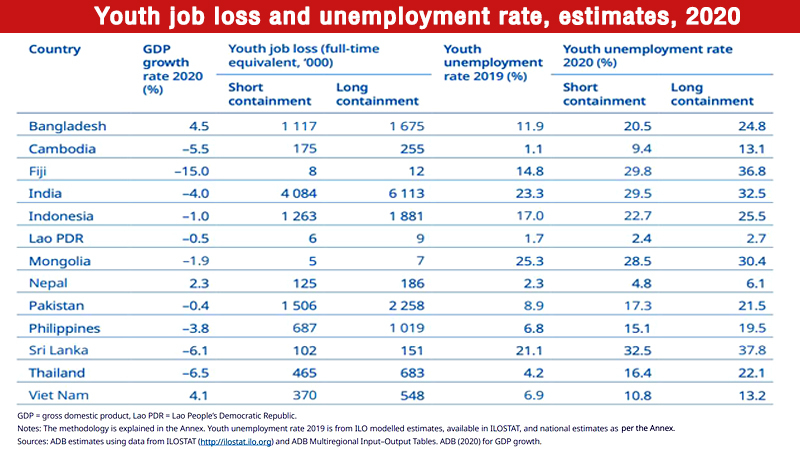
Job loss among youth will continue throughout 2020 and could result in youth unemployment rates doubling. Between 10 and 15 million youth jobs (full-time equivalent) may be lost across 13 Asia-Pacific countries 2020. These estimates are based on the expected fall in output and consequent decrease in labour demand for the year relative to a non-Covid-19 scenario. The estimates include large countries, such as India and Indonesia, as well as small ones such as Fiji and Nepal.
The projected rise in youth unemployment rates varies considerably across the 13 countries, but increases are expected in all countries. In Cambodia, Fiji, Nepal, Pakistan, the Philippines and Thailand, youth unemployment rates are expected to at least double the 2019 estimates even if Covid-19 is contained.
Policy measures are urgently required to tackle the youth employment crisis in Asia-Pacific and recover lost ground on inclusive growth and sustainable development. Experience from past crises suggests that young people who try to enter the working world during a slowdown face long-term impacts on employment pathways, wages and productivity.
To minimise future “scarring” of the current generation, governments are called upon to urgently adopt and implement large-scale and targeted measures to stimulate the economy and youth employment, balancing the inclusion of youth in wider labour market and economic recovery measures with youth-targeted interventions to maximise efficiency in the allocation of resources.
Support measures, many of which should be directed at enterprises in the hardest-hit sectors where youth job losses are concentrated, to be prioritised include:
• Providing youth-targeted wage subsidies and public employment programmes;
• Expanding job information and employment services targeted to young jobseekers;
• Supporting apprenticeship programmes and focusing on demand-driven skills development;
• Increasing funds for upskilling and reskilling, especially in growth sectors;
• Investing in digital inclusion for equitable access to education, training and entrepreneurship; and
• Supporting young entrepreneurs through access to capital combined with non-financial services.
Three cross-cutting considerations should underpin an effective policy response: reaching the most vulnerable youth including the poorest and marginalised young women, meaningfully engaging young people in policy development and social dialogue, and facilitating disaggregation of crisis impact data by age and enhanced youth labour market information.
Cabinet releases billions more in SME loans to support grassroots economy
EconAug 19. 2020Deputy government spokeswoman Rachada Dhnadirek
By The Nation
The Cabinet on Tuesday approved five more financial-relief measures to support small and medium-sized enterprises (SMEs) and individuals suffering fallout from Covid-19 and other crises, said deputy government spokeswoman Rachada Dhnadirek.
First, the Thai Credit Guarantee Corporation (TCG) will guarantee loans taken by SMEs under the central bank’s soft loans scheme. The guarantee scheme will cost Bt57 billion and cover loan terms of up to eight years. The guarantee will kick in the third year of borrowing. The guarantee fee is 1.75 per cent annually, with up to 30 per cent subsidised by the TCG. The TCG has asked for Bt9.12 billion in compensation from the Budget Bureau.
Second, the Government Savings Bank will expand coverage of the existing Covid-19 lending scheme to provide loans of up to Bt50,000 to individuals with regular income. The Bt10 billion scheme will also cover small business, the self-employed and families affected by the virus outbreak, economic fallout or natural disasters. The loans have a six-month grace period for principal and interest rate payment. Another Bt5 billion will be earmarked for loans of up to Bt500,000 for small businesses and individuals in tourism-related industries such as restaurants, spas, traditional massage, car rental, guest houses, and hostels. The GSB will charge 3.99 per cent interest rate for a five-year loan term with one-year grace period on interest rate payment.
Third, the Finance Ministry wants the GSB to expand coverage of the Bt80-billion lending scheme for SMEs approved earlier by the Cabinet. The GSB will offer Bt10 billion in loans to support SMEs in tourism, related services, and other sectors, offered via non-bank financial companies. Another Bt3 billion will be lent directly by the GSB to SMEs. Each borrower will get up to Bt20 million in credit.
Fourth, the Small and Medium Enterprise Development Bank of Thailand will expand its existing loan scheme worth of Bt10 billion for tourism and related services to cover other types of businesses affected by the virus crisis. These loans are open to both individual or corporate entities and capped at Bt30 million. Currently the bank has approved loans worth only Bt417 million, leaving Bt9.6 billion still available.
Fifth, the Cabinet approved extending the loan guarantee scheme under the TCG package to support micro entrepreneurs with total funding of Bt15 billion. Each will get no more than Bt200,000. The deadline for application was also extended from July 23 to December 30. Loans totalling Bt2.5 billion are still available.





 Deputy government spokeswoman Rachada Dhnadirek
