Authorities insist that a Bt24.5-billion project to build a floating storage and regasification unit (FSRU) is going ahead.
Wattanapong Kurovat, director general of the Energy Policy and Planning Office, said work was progressing on its study of the project, which will supply liquefied natural gas (LNG) to the Electricity Generating Authority of Thailand (Egat).
The FSRU, anchored in the upper Gulf of Thailand, will receive shipments of LNG before processing and pumping it to Egat’s South Bangkok power plant in Samut Prakan.
The project is part of infrastructure to support the importation of natural gas, in line with National Energy Policy Committee directives.
Meanwhile, the Energy Regulatory Commission has submitted findings on the impact on electricity prices of Egat’s recent importation of 130,000 tonnes of LNG, to the Energy Policy Administration Committee.
The information will be used to help draw up a plan to promote competitiveness in the natural gas sector. The office is expected to present the plan to the Energy Policy Administration Committee next month.
A source at the Energy Ministry said the office has already proposed options for the new competition structure to the subcommittee tasked with opening up the LNG sector. The options range from a full opening of the market, to allowing PTT to remain the country’s sole importer of LNG.
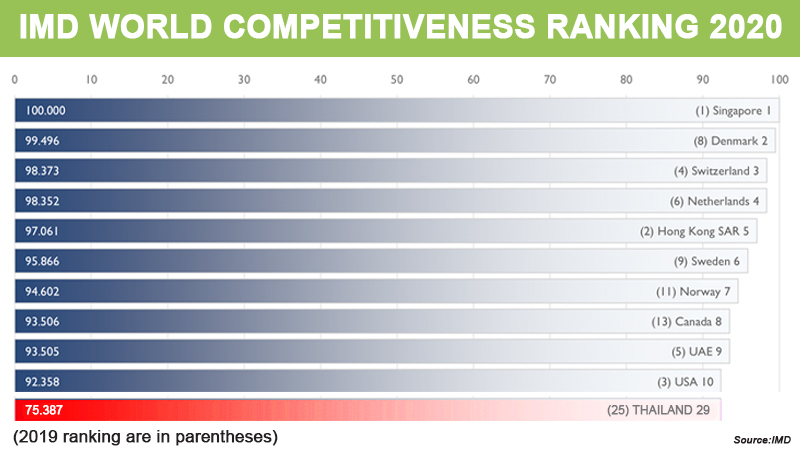
Poor economic performance and an inefficient government has brought Thailand’s global competitiveness ranking down by four places this year. Thailand now stands 29 out of 63 economies, down from last year’s ranking of 25, according to the IMD World Competitiveness Ranking 2020 hosted by Switzerland-based International Institute for Management Development.
The report released on Tuesday (June 16) also showed that Thailand’s scores had dropped to 75.387 from 77.233 last year.
The Kingdom’s ranking in competitiveness had been further weighed down by its economic performance, which fell six places and government efficiency, which dropped three slots.
“Thailand’s place in the list has been affected by a sluggish economy, no longer being attractive to foreign investor and concerns about labour shortage in the long run,” said Teeranun Srihong, chairman Thailand Management Association (TMA).
“Another key factor is poor government efficiency, taking into account a weakening rule of law, poorly run key national institutions and a deterioration of financial stability.”
However, the country did better in business efficiency and showed slight improvement in infrastructure development.
“Thailand’s overall of competitiveness scores, however, remain low as it has many challenges to overcome such as education, public health, environment as well as science and technology infrastructure,” Teeranun said.
The IMD this year also added new indicators to its ranking methodology, namely sustainable development goals, democracy index and total early-stage entrepreneurial activity.
“Thailand’s ranking was up five places last year, but down four places this year, suggesting that the country’s ability to efficiently respond to fast-changing environments remains the biggest challenge in the long run,” he added.
The top three countries in this year’s competitiveness ranking are Singapore, Denmark and Switzerland in that order.
The Stock Exchange of Thailand (SET) Index rose by 25.14 points or 1.87, closing at 1,367.13 today (June 16), while transactions totalled Bt68.455 billion with an index high of 1,376.99 and a low of 1,362.38.
During the morning session, a stock analyst at Krungsri Securities said he expected the index to rebound to between 1,365 and 1,370 points in response to the US Federal Reserve’s move to buy corporate bonds worth US$750 billion (Bt23.24 trillion) to increase liquidity and support employment.
The analyst, however, advised investors to beware of short-term mass sell-offs due to uncertainty after a second wave of Covid-19 infections hit many countries including the US, China and Japan.
“The index also gained positive sentiment from the rising price of crude oil, while there were mass purchases of stocks added to the SET50 and SET100,” he said.
“We also advise investors to follow the Cabinet meeting on tourism stimulus measures,” he added.
The Cabinet recently earmarked a whopping Bt22 billion to fund three packages aimed at stimulating domestic tourism after the lockdown.
The top 10 stocks with the highest trade values today were SUPER, KTC, PTTEP, KBANK, PTT, BAM, PTTGC, MINT, TOP and CPF.
As of 4.30pm, crude oil rose by US$0.57 or 1.54 per cent to $37.69 per barrel, while gold rose by $11.20 or 0.65 per cent to $1,738.40 per ounce.
Global indices were on the rise:
Japan’s Nikkei Index closed at 22,582.21, up 1,051.26 points, or 4.88 per cent.
China’s Shanghai SE Composite Index closed at 2,931.75, up 41.72 points, or 1.44 per cent, while Shenzhen SE Component Index closed at 11,398.97, up 206.69 points, or 1.85 per cent.
Hong Kong’s Hang Seng Index closed at 24,344.09, up 567.14 points, or 2.39 per cent.
South Korea’s KOSPI Index closed at 2,138.05, up 107.23 points, or 5.28 per cent.
Taiwan’s TAIEX Index closed at 11,511.64, up 205.38 points, or 1.82 per cent.
Jun 16. 2020Energy Minister Sontirat Sontijirawong
By THE NATION
Oil and gas conglomerate PTT Plc will sign a contract with the Electricity Generating Authority of Thailand (Egat) on June 19 to sell natural gas to the state agency for 10 years, Energy Minister Sontirat Sontijirawong said.
Under the pact, PTT will procure natural gas for Egat’s power plants. The contract also allows Egat to import a million tonnes of liquefied natural gas for use in its plants.
Separately, the Energy Policy Administration Committee has decided to change the calculation formula of the ex-refinery price of oil effective from Wednesday. The revision will see 50 satang per litre on average drop in the price of all fuel types.
The committee also resolved to extend the subsidy on cooking gas to September 30 from the original expiration date of June 24.
Under the existing subsidy, a 15-kilogram gas canister goes for Bt318, which is Bt45 cheaper than normal.
The Stock Exchange of Thailand Index rose by 30.41 points, or 2.27 per cent, to 1,372.40 this morning (June 16).
A stock analyst at Krungsri Securities expected the index to rebound to between 1,365 and 1,370 points in response to the US Federal Reserve move to buy corporate bonds worth US$750 billion (Bt23.24 trillion) to increase liquidity and support employment.
“In addition, the index gained positive sentiment from the rising crude oil price while a mass buy-offs in stocks added to the SET50 and SET100,” he said.
The analyst, however, advised investors to beware of short-term mass sell-offs in shares due to uncertainty following the second wave of Covid-19 after an increase in the number of new virus cases in many countries including the US, China and Japan.
“Also, we advise investors to follow the Cabinet meeting on tourism stimulus measures,” he added.
He recommended investors buy:
▪ Stocks added to the SET50–BPP and TTW, and SET100–AAV, Ace, DoHome, RBF, SIRI, TVO and WHAUP.
▪ Stocks whose second-quarter performance will improve, such as CKP, Tasco, STA and RS.
▪ Stocks that would benefit from the Cabinet’s move to issue tourism stimulus measures, such as Mint, Centel, ERW and AOT.
The SET Index dropped sharply by 41 points yesterday, or 2.93 per cent, closing at 1,342. Total transactions were worth Bt8.3 billion.
Foreign investors made a net sell of Bt4.014 billion in stocks, but purchased Bt2.194 billion in bonds. There were 4,311 net short TFEX SET50 contracts.
The price of gold rose by Bt100 per baht weight in morning trade today (June 16), the Gold Traders Association reported.
As of 9.27am, the buying price of a gold bar was Bt25,300 per baht weight and selling price Bt25,400, while gold ornaments were priced at Bt24,847.24 and Bt25,900, respectively.
At close yesterday, the buying price of a gold bar was Bt25,200 per baht weight and selling price Bt25,300, while gold ornaments were priced at Bt24,741.12 and Bt25,800, respectively.
The Gold Spot Index price this morning moved to around US$1,730 (Bt53,571) per ounce after the price dropped by $10.1 to $1,727.2 per ounce at yesterday’s close as investors sold gold amid uncertainty following the second wave of Covid-19.
The gold price on the Hong Kong market rose by HK$15 to $15,950 (Bt63,729) per tael this morning.
By The Washington Post · Abha Bhattarai · BUSINESS, RETAIL
The coronavirus crisis has upended just about every part of daily life. Tens of millions of Americans are out of work, and a deepening recession has forced many people to rethink their spending. Retailers – already saddled with a glut of unsold winter and spring merchandise – are scrambling to get a handle on these new habits and what is projected to be a long-term shift in the types of clothing, shoes and accessories people will be willing to buy.
“The longer we stay in this pandemic, the more our relationship with fashion will evolve,” said Dawnn Karen, a fashion psychologist and branding consultant.
Here are five changes in the fashion and beauty industries already taking hold:
– Hello, false lashes. Sales of eye makeup are on the rise as Americans look for ways to express themselves behind face masks while staying six feet apart.
Leading the charge: False eyelashes, which averaged 15% increases in week-over-week sales in May as businesses in many parts of the country began to reopen, according to market research firm NPD Group. Mascara sales, meanwhile, grew 11% in the same period, while demand for eyebrow products jumped 5 percent.
“It makes complete sense,” said Larissa Jensen, a beauty analyst for NPD. “When you have to go out and you’re wearing a protective face mask, those are the products that emphasize your ‘smize’ – your smiling eyes.”
Sales of lip products, meanwhile, fell 5 percent in May. After all, Jensen said, nobody wants lipstick smudges inside their masks.
Makeup sales picked up last month after about two months of declines, when much of the country was hunkered down at home. During that period, Jensen says, many Americans shifted away from cosmetics to skin care products such as face scrubs and body creams, which are still performing well. Sales of high-end soaps, home scents and hair color also have risen in recent months, she said.
“One of the first things we’ve seen in the pandemic is a shift to skin care,” Jensen said. “During a time when most of the country was on lockdown, everyone’s concern was on meeting their basic needs.”
–Goodbye, high heels and stiff dress shoes.
Sales of high heels, loafers and other dress shoes have been tumbling for years, and analysts say the pandemic has turbocharged their demise. Sales of men’s and women’s dress shoes plunged 70 percent in March and April, according to NPD.
“High heels are way down,” said Beth Goldstein, a footwear analyst for NPD. “The question now is whether they’ll ever rebound. Of course, some women out there are dying to put their heels back on. But I think most of them are saying, ‘I’m never going to wear those shoes again.’ “
Lately, she says, it’s all about comfort: Slipper sales doubled in April, as Americans splurged on higher-priced options such as fur-lined Ugg products. Crocs, known for their homely but comfortable signature foam clog, also have been “super hot,” she said.
That trend is likely to continue even as Americans return to work. Shoe manufacturers, she said, are busy creating designs with wider and thicker heels, padded insoles and other athletic touches to add stability and comfort. Sales of stiletto-shaped heels, she said, dropped 11 percent last year.
“Retailers are recognizing that they’re going to have to rethink what they know about work and fashion,” Goldstein said. “There is going to be a long-term shift.”
– A return to basics. Malls are reopening, but don’t expect to see racks filled with seasonal trends. With money tighter, retailers and consumers are loading up on evergreen basics and neutrals.
“The biggest upcoming change is going to be the propensity toward value,” said Marshal Cohen, a retail analyst for NPD. “As we come off the stimulus check, the consumer is not going to feel so rich anymore, which means a lot fewer impulse purchases.”
That has led many retailers to stock up on items such as plain T-shirts, classic-cut jeans, and beige and khaki pieces that won’t fall out of favor if they don’t sell right away.
“What we’re looking for today are core basics,” Morris Goldfarb, chief executive of G-III Apparel Group, which owns a number of brands including DKNY and Bass, said on an earnings call this month. “Fashion is not as important this year.”
Jeans, joggers and leggings have become among the biggest sellers at American Eagle. Meanwhile, online lingerie brand ThirdLove is focusing on neutrals and basics while pushing off trendier items, such as lace bras or seasonal colors, to next year, according to co-founder Heidi Zak.
“It’s virtually impossible to forecast right now,” she said.
– Shorter hemlines. According to common lore – and the century-old Hemline Index – skirts and dresses get longer as the economy worsens.
But this time, analysts say, fashion is heading in the opposite direction, away from maxi dresses and floor-sweeping skirts.
“Hemlines were inching shorter anyway,” said Cohen of NPD. “Do I expect them to get even shorter? I do.”
The shift, he said, is less about fashion trends and more about retailers’ desperation. “When business gets bad, you need to make a bold statement to get people to buy something new,” he said. And if shoppers already have closets filled with ankle-length styles, that means enticing them with above-the-knee fashion.
– Even more casual wear. Corporate America has been retreating from blazers and ties for years, and analysts expect to see more athletic wear and casual attire at the office even after the pandemic is over.
When Americans do head back to the office, they’re likely to trade in business casual for “Silicon Valley chic,” said Karen, the fashion psychologist. Think hoodies paired with blazers, and sweatpants with silky tops.
“There will be much more mixing and matching between dressing up and dressing down,” she said. “And it’ll be okay to wear the same thing over and over again. The pressure is off.”
By The Washington Post · Heather Long · BUSINESS, US-GLOBAL-MARKETS Top Federal Reserve officials on Monday urged Congress to spend more as the nation emerges from the global health crisis.
The calls came the same day that the Fed launched a new lending program for small and midsized firms and announced plans to start buying the bonds of big companies on Tuesday, news that triggered a stock market rally on Wall Street.
The U.S. government can borrow money at a historically cheap rate right now after the Fed cut interest rates to zero in March and signaled low rates are likely to remain in place through 2022. San Francisco Fed President Mary Daly was one of several top officials who called on Congress to invest soon in education, health care and digital infrastructure to create a stronger – and more inclusive – U.S. economy for years to come.
“We can’t wait 10 years for an economic recovery to reach everyone,” Daly said at a National Press Club event. “Inclusive growth is faster growth – and it will pay for itself in the long run.”
Fed leaders are making two big asks from Congress: First, to be prepared to deliver more emergency aid this summer if there’s a second wave of coronavirus cases and deaths. And second, to make long-term investments that can help the nation grow faster after the covid-19 threat passes.
“If we are going to get to the other side of this crisis, we have to be thinking about the longer-term changes that will enable our economy to recover – and give more people a shot at participating when it does,” wrote Richmond Fed President Thomas Barkin in a blog post Monday.
Barkin called for more spending on community colleges, digital workforce training, child care and elderly care to make it easier for the 21 million people currently out of work to find jobs again. The job losses have been the most severe for low-income black and Hispanic Americans, especially women who are the most likely to hold many of the restaurant, retail and hospitality jobs that were impacted by shelter-in-place orders.
The U.S. economy is facing its worst crisis since the Great Depression, and many workers may not return to the jobs they had before the pandemic. Meanwhile, the Fed has been criticized for rushing to aid Wall Street and large companies. Fed Chair Jerome Powell has pushed back, arguing the jobs losses and permanent business closures would likely have been worse without the Fed’s aggressive action.
Powell and other top Fed officials have also said the central bank’s tools are best suited to boosting the overall economy and stabilizing markets. They say Congress has to play a role in making a more equitable economy and ensuring black and Hispanic workers are not permanently scarred by this crisis.
“The fastest-growing demographics in this country are blacks and Hispanics. If they don’t grow equally then we’re going to grow more slowly,” said Dallas Fed President Robert Kaplan in an interview Sunday on CBS News’ “Face the Nation.” Kaplan added, “Fiscal policy is going to be critical from here.”
The central bank has pumped close to $3 trillion into markets since mid-March and slashing interest rates to zero helped provide financial lifelines to businesses, families and state and local governments.
Wall Street investors have noticed just how quick the Fed has been to step in and calm markets. On Monday, the Fed said it will start buying a wide range of corporate bonds, even of big companies that aren’t asking for aid. While the Fed also launched its loan program for companies with fewer than 15,000 employees, those smaller firms have to go to a bank and apply for the relief, a distinct difference to the central bank’s latest lifeline for larger companies.
“This is yet another sign that the Fed is going to do everything under their power to help liquidity. Worries of a second wave? No worries, the Fed is here,” Ryan Detrick, senior markets strategy for LPL Financial, told clients.
Stocks started Monday in the red but ended the day higher with the Dow Jones industrial average up 158 points, largely due to the Fed announcement that corporate bond buying would begin Tuesday and encompass a wider range of companies than initially expected. This is the first time America’s central bank is buying corporate bonds.
“There is no red line this Fed will not cross,” tweeted Sven Henrich, a Fed critic and founder of the blog Northman Trader
House Speaker Nancy Pelosi, D-Calif., told reporters in March that Powell had told her “interest rates are low, think big.” What exactly that big step looks like is under debate in Congress and the White House.
While some have suggested spending on infrastructure projects like roads and bridges, many Fed leaders are pushing for investments in education and social services.
“If you’re a white American, your chances of being college educated are far greater than a black American or Hispanic. Just equalizing that would boost our output growth in a way that is material,” Daly said Monday.
As protests over racial injustice sweep the nation, Fed leaders have made the case that the nation must focus on ensuring equal opportunities for all in order for the economy to reach its full potential.
“Systemic racism is a yoke that drags on the American economy,” wrote Raphael Bostic, president of the Atlanta Fed on Friday. “A commitment to an inclusive society also means a commitment to an inclusive economy.”
Bostic is the first and only African American to lead one of the 12 regional Fed banks.
“By limiting economic and educational opportunities for a large number of Americans, institutionalized racism constrains this country’s economic potential,” he wrote. “The economic contributions of these Americans, in the form of work product and innovation, will be less than they otherwise could have been.”
Stock market recovers after Fed says it will buy corporate bonds
The stock market rebounded Monday afternoon to erase its sharp slide at the opening bell, with investors upbeat after the Federal Reserve announced it would buy individual corporate bonds.
The rally came after investors expressed initial concern that the coronavirus pandemic could be picking up in numerous states.
The Dow Jones industrial average started with a loss of about 500 points, or 2%, shortly after it opened at 9:30 a.m. Eastern time. But it had recovered those losses early afternoon and, after the Fed’s announcement, closed up 158 points, or 0.6%. The Nasdaq closed up 1.4%.
The rally was sparked by the Fed’s afternoon announcement, in which it said it would “begin buying a broad and diversified portfolio of corporate bonds to support market liquidity and the availability of credit for large employers.”
Previously, the U.S. central bank had only been purchasing corporate bonds that were part of exchange-traded funds.
Corporate bonds are corporate debt, and the Fed’s decision to pump money into this area is another way for it to help give companies more access to cash. But it could also open the Fed up to criticism that it is playing a role in picking winners and losers in the economy based on which firms it selects and which firms it opts against selecting.
The tech-heavy Nasdaq and the Standard & Poor’s 500 index also jumped on the news after dipping negative Monday morning. By 4 p.m., the Nasdaq was up 137 points, or 1.43%, and the S&P 500 leveled off at about 25 points, or 0.83%.
Shortly after the market opened, the sell-off initially hit travel-company stocks hard, but by the afternoon the stocks had come back.
American Airlines Group initially dropped nearly 5%, but jumped back to less than one percentage point in the red by the time the market closed. Norwegian Cruise Line Holdings slid about 8% before jumping back to be down about 2.5% by 4 p.m., and United Airlines Holdings dropped about 7.2% before rising to finish the day down about 1.6%.
These companies’ shares have been particularly volatile during the coronavirus pandemic because many people have hesitated to make travel plans when conditions remain uncertain.
The downturn continued last week’s slide, which was the sharpest plummet since mid-March, prompted by the health and economic crises, despite a hopeful Friday rebound.
As of Monday, at least 114,000 people had died in the United States from covid-19, the disease caused by the novel coronavirus, in every state since February. At least 2 million cases have been reported. Public health officials fear new surges after large Memorial Day crowds and protests in cities across the U.S. and states launch reopenings.
“Wall Street’s bumpy road continues as investors continue to grapple with concerns that China is showing signs that a second wave of the pandemic is here and as a spike in new cases in the US could suggest many states could rollback their reopenings,” Edward Moya, an analyst with OANDA, wrote in an email to The Washington Post on Monday. “The stock market rebound will now go through a ton of scrutiny because the U.S. economy was supposed to have a short stint in the ICU and be well into the rehab process by now.”
The Federal Reserve has predicted a slow recovery for the economy, with unemployment at 9.3% by the end of 2020. It has taken a number of extraordinary steps to help companies navigate the crisis, lowering interest rates and attempting to flood financial markets with cash.
“The problem for the economy is that the labor market will not bounce back as quickly as financial markets have initially provided,” Moya said. “The Fed is doing their part, but partisan politics have delayed the next fiscal response till after July 22nd, and that will erode at confidence.”
Jun 16. 2020A Wall Street sign. MUST CREDIT: Bloomberg photo by Mark Kauzlarich
By Syndication Washington Post, Bloomberg · Katherine Greifeld, Vildana Hajric · BUSINESS, US-GLOBAL-MARKETS U.S. stocks edged higher in volatile trading after the Federal Reserve followed through on a pledge to buy corporate bonds under an emergency lending program.
The S&P 500 closed up 0.8% after swinging from loss of as much as 2.5% amid concern about a second wave of the coronavirus pandemic, to a gain of as much as 1.3%. Oil futures rebounded after dropping to less than $35 a barrel as BP Plc warned the pandemic will hurt long-term energy demand.
“The initial reaction seems to be that the Fed still has the market’s back even though they expect the economy to be weak for a longer time frame,” said Matt Maley, chief market strategist for Miller Tabak + Co. “The Fed is telling the markets that they want to keep credit spreads under control.”
The purchases will be made by the Fed’s Secondary Market Corporate Credit Facility, an emergency lending program that to date has purchased only exchange-traded funds. BlackRock’s iShares iBoxx $ Investment Grade Corporate Bond exchange-traded fund, the largest credit ETF, jumped 1.4%, while the iShares iBoxx High Yield Corporate Bond ETF climbed 1%.
The central bank also added a twist to its buying strategy, saying it would follow a diversified market index of U.S. corporate bonds created expressly for the facility.
“What appears to be new is the individual buying in the secondary market and what looks like, at least from the announcement, the potential for a wider variety of purchases,” said Dennis DeBusschere, head of portfolio strategy at Evercore ISI.
After a fierce rally sent global equities close to their pre-pandemic levels, sentiment in markets had turned negative, with the S&P dropping last week by the most since March. Economic data across the board suggests that the global economy is still weak and there’s no sign that international travel is returning to normal anytime soon.
More than 20 U.S. states are seeing a pickup in virus cases, and spreading cases in Beijing have also raised concern of a resurgence of the pandemic. The travel ban between the U.S. and Great Britain could persist for months, according to Anthony Fauci, director of the National Institute of Allergy and Infectious Diseases.
In China, a string of top-tier data all showed that factory output, consumer spending and investment continued to improve in May, but there are few signs of a broad-based rebound needed to spur a V-shaped recovery.
Despite the risk-off mood in markets, gold prices slumped, with prices approaching $1,700 an ounce in London.
“One thing is leading to the other. Obviously Covid-19, what happened with Beijing this weekend and a couple of states that are seeing a bit of a growth in cases,” said JJ Kinahan, the chief market strategist at TD Ameritrade. “What that really leads to is the fact that if you think abut this quote on quote optimism trade that we’ve had over the last couple weeks, the optimism trade really was about businesses getting started, going quickly. If we do have a slowdown in opening businesses, a couple of states have slowed their dates, it’s going to be very difficult for the reality of business to keep up with expectations of a few weeks ago.”
These are some of the main moves in financial markets:
Stocks
– The S&P 500 Index rose 0.8% to 3,066.59 as of 4:09 p.m. EDT.
– The Dow Jones industrial average gained 0.6% to 25,763.16.
– The Nasdaq Composite Index rose 1.4% to 9,726.02, the largest rise in more than a week.
– The MSCI All-Country World Index increased 0.1% to 517.30.
Currencies
– The Bloomberg Dollar Spot Index declined 0.4% to 1,210.14.
– The euro increased 0.5% to $1.1313, the biggest increase in more than a week.
– The Japanese yen was little changed at 107.33 per dollar.
– The British pound gained 0.4% to $1.2586, the biggest advance in a week.
Bonds
– The yield on two-year Treasurys declined less than one basis point to 0.19%.
– The yield on 10-year Treasurys climbed one basis point to 0.71%.
– Germany’s 10-year yield fell one basis point to -0.45%, the lowest in more than two weeks.
– Britain’s 10-year yield dipped less than one basis point to 0.205%.
Commodities
– West Texas Intermediate crude gained 2.2% to $37.05 a barrel, the largest rise in more than a week.
The State Railway of Thailand (SRT) is going ahead with sounding out the market for the auction of Block A near the Bang Sue Central Station, while Transport Minister Saksayam Chidchob wants a working group to be set up to organise train assets in a move to boost SRT’s revenue by 10 per cent per year.
SRT’s deputy governor Worawut Mala said the authority is sounding out the market for the 32-rai Block A worth Bt10 billion after an auction for commercial development won little interest from private companies.
“We are studying the market again, but the Covid-19 outbreak is posing new problems. According to law, we have to conduct market-sounding operations at least three times. If no private firms show interest in bidding, we have to cancel the auction and review the possibility of opening for new bids,” Worawut said.
Meanwhile, the transport minister has ordered that a committee to determine a strategy on the management of the area and monitor SRT’s revenue from moveable property and real estate be set up. The panel will be led by Soraphong Paitoonpong, director-general of the Department of Rail Transport. The goal of this working group is to ensure SRT assets are being used efficiently and can provide 10 per cent increase in income.
SRT currently owns more than 33.2 rai of land, with 3,106 lease agreements for buildings and 2,935 leases on land. SRT generates income of Bt2.858 billion per year on average.
More than 100 leases of SRT-owned land are set to expire between 2022 and 2023. SRT will re-evaluate its rental fees before renewing these lease contracts, which were originally made for 20 to 30 years and generated an income of Bt200 million per year. The other option for SRT will be to put these properties up for auction to procure private equity.



 Energy Minister Sontirat Sontijirawong


 A Wall Street sign. MUST CREDIT: Bloomberg photo by Mark Kauzlarich