The Stock Exchange of Thailand (SET) Index is suffering volatility after foreign investors began taking profit and reducing capital flows into the country.
Over the past two weeks, the index has risen as high as 1,454 points before falling to 1,342 in recent days as foreign and institutional investors bought and then sold stocks in quick succession.
Nuttachart Mekmasin, a research analyst at Trinity Securities, said that foreign investors had bought Thai stocks to take profit in the short term as governments worldwide injected money to relieve the economic impacts of Covid-19.
“Foreign investors started taking profit and reducing capital flows into Thailand and other countries in Asia after the US economy began to improve,” he said.
“Several large investment funds are viewing the Thai stock market in a more negative light than other regional markets because the SET’s valuation is the highest among Asian countries.”
In contrast, the Thai bond market continues to attract foreign investors because it offers high returns, he added.
“The Thai bond yield is high due to the low inflation rate,” he said. “In recent weeks, foreign investors have bought up Bt8 billion in Thai bonds.”
Nuttachart predicts the SET will not dip below 1,300, since it has extended its uptick rule on short-selling for another three months.
“However, we have to monitor statements from the US Federal Reserve for signs of a liquidity shortage,” he added.
Meanwhile, Sunthorn Thongthip, a senior director at Kasikorn Securities, said this was an opportune time to buy stocks, adding that emerging-market assets may be more interesting than assets in the US market because of the weakening dollar.
“Currently, the SET valuation is high, while growth is lower than other countries,” he said. “Capital flows will return to Thailand if the index falls below 1,300 because returns after the index rebounds to 1,440 are expected to be at 13 per cent.”
He advised investors to buy stocks whose performance will strengthen in the second half of 2020 if Covid-19 vaccine research progresses well, such as tourism, commodities, property, and commercial bank stocks.
“We expect the Covid-19 vaccine test result on 300 humans to come out by July this year,” he added. “If the test result is successful, the index may rise again.”
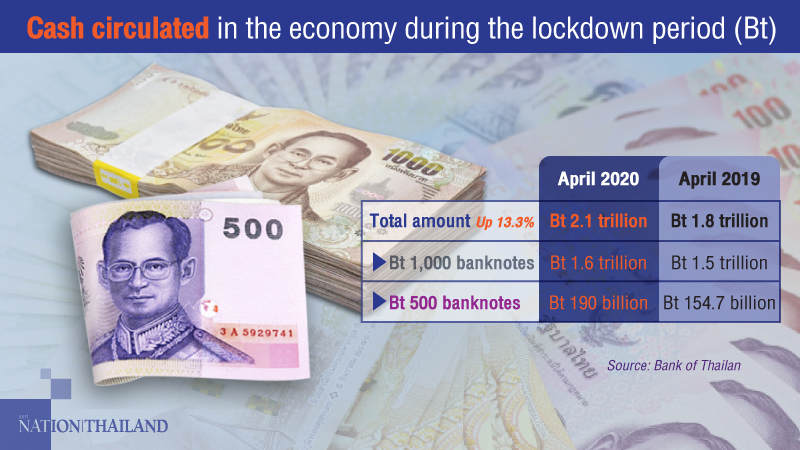
The amount of cash circulated in the economy was far higher than expected during the height of Covid-19 outbreak because many consumers had a lot of cash in hand due to the unpredictable situation wrought by the virus and lockdown restrictions.
Cash circulation in April surged to an all-time high at Bt2.1 trillion or up 13.3 per cent, even though conditions were tough in March and April as the government told businesses to stop operating temporarily and closed the country to foreigners.
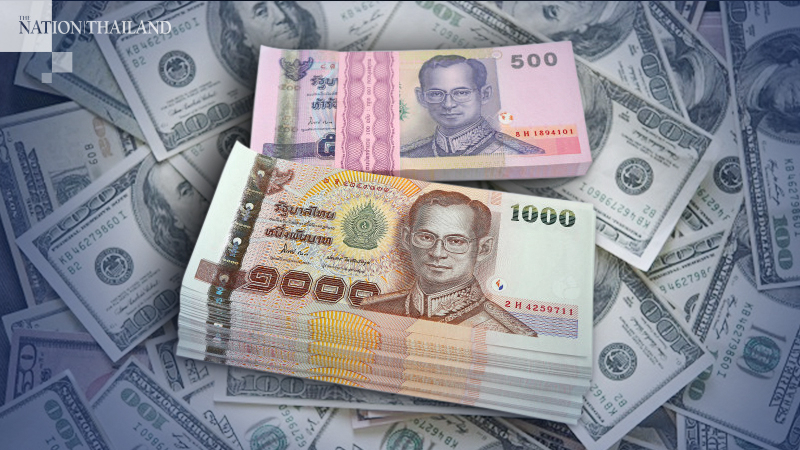
In response to these changes, consumers decided to hold more cash than usual, resulting in Bt1.6 trillion worth of Bt1,000 banknotes being used or 8.4 per cent more than the Bt1.5 trillion worth used in April last year. They also used 23.3 per cent more Bt500 banknotes worth Bt190.5 billion, up from Bt154.7 billion in April 2019.
Somboon Chitphentom, the Bank of Thailand’s assistant governor, said people withdrew large amounts of money in April as the crisis hit acute levels and the government put the country under state of emergency. Many venues were closed, and Thailand’s borders were sealed off.
These factors created uncertainty, leading consumers to hold more cash, he noted. They began withdrawing large amounts in the last week of March and continued to do so until mid-April, he said.
The government’s financial aid for affected people also contributed an increase in the circulation of cash in the economy, as the first batch of cash was distributed in April, leading to Bt64.5 billion being withdrawn from banks.
Now that the government has lifted most lockdown restrictions, the withdrawal of cash has returned to normal, Somboon said.
He also believes that people will use more digital money in the post-Covid new normal, especially since online transactions have become so easy and more widespread.
The Stock Exchange of Thailand (SET) Index rose 9.05 points or 0.66 per cent to close at 1,376.18 today (June 17). Transactions, meanwhile, totalled to Bt71.554 billion with an index high of 1,381.00 and a low of 1,358.27.
In the morning session, a stock analyst at Krungsri Securities said he expected the index to fluctuate between 1,360 and 1,380 before falling.
“Positive sentiment was gained from the fact that US retail sales have risen by 17.7 per cent, and that the US government is preparing to spend US$1 trillion on infrastructure to stimulate the economy,” he said.
“Energy stocks also gained a boost from rising crude oil price after the International Energy Agency raised its oil demand forecast for this year to 91.7 million barrels per day in response to several countries easing lockdown measures.”
However, he said, the index will be under pressure from tight SET valuations and uncertainty following the second wave of Covid-19 cases in many countries, including the US, China and Japan.
The top 10 stocks with the highest trade values today were MINT, PTT, STA, KTC, PTTEP, BAM, SUPER, CPF, KBANK and ADVANC.
As of 4.30pm, crude oil dropped by $0.37 or 0.96 per cent to $38.01 per barrel, while gold dropped by $12.80 or 0.74 per cent to $1,723.70 per ounce.
Other Asian indices were mixed:
Japan’s Nikkei Index closed at 22,455.76, down 126.45 points, or 0.56 per cent.
China’s Shanghai SE Composite Index closed at 2,935.87, up 4.12 points, or 0.14 per cent, while Shenzhen SE Component Index closed at 11,420.84, up 21.87 points, or 0.19 per cent.
Hong Kong’s Hang Seng Index closed at 24,481.41, up 137.32 points, or 0.56 per cent.
South Korea’s KOSPI Index closed at 2,141.05, up 3.00 points, or 0.14 per cent.
Taiwan’s TAIEX Index closed at 11,534.59, up 22.95 points, or 0.20 per cent.
The Board of Investment (BoI) has approved investment privileges for five mega projects worth over Bt41.83 billion, in a bid to kick-start Thailand’s economic engines as the country emerges from lockdown.
BoI secretary-general Duangjai Asawachintachit announced the move – expected to include exemptions on corporate tax and import duties – on Wednesday (June 17) after a BoI board meeting chaired by Prime Minister Gen Prayut Chan-o-cha.
The five operators and projects chosen to receive privileges are:
1. Sammitr Motors Group, which is investing Bt5.5 billion to manufacture battery electric vehicles (BEV) in Phetburi province with a capacity of 30,000 units annually. The project expects to use domestic materials worth Bt8.5 billion annually and will sell mostly to domestic markets.
2. Thai Oil Public Co Ltd, which is investing Bt24.11 billion to generate 250 megawatts of electricity annually from 80,300 tonnes of pitch and sulphuric acid. The project is located in Sriracha district, Chonburi province.
3. Envicco Ltd, which is investing Bt2.47 billion to manufacture recycled PET plastic beads for food and beverage packaging and recycled HDPE plastic beads for personal care and consumer product packaging. The project is located in the Asia Industrial Estate, Rayong province.
4. B Grimm Power (Laem Chabang) Ltd, which will invest Bt6 billion to generate electricity from natural gas and steam with a capacity of 157 megawatts, to be sold to the Electricity Generating Authority of Thailand and factories in Chonburi’s Laem Chabang Industrial Estate.
5. Bangkok Arena Ltd, which is investing Bt3.74 billion in the construction of convention halls for the MICE (Meetings, Incentive Travel, Conventions, Exhibitions) business, a target industry for Thailand in the 4.0 era. The project is located in the Bangkok Mall complex on Bangna-Trat Road.
Three stimulus packages are expected to generate about Bt70 billion in spending by in-country tourists, said Tourism Council of Thailand president Chairat Trirattanajarasporn.
The packages to stimulate domestic tourism, which are being rolled out with a whopping budget of Bt22.4 billion, were approved by the Cabinet on June 16. They will run for four months between July and October.
The Tiew Pan Suk (Trips to share happiness) package is designed to help transport businesses, from airlines to car rental firms. It will subsidise at least 2 million travellers by paying 40 per cent of their travel fares, not exceeding Bt1,000. The project will cost Bt2 billion.
The Rao Pai Tiew Gun (Let’s travel together) package will offer a 40-per-cent discount on accommodation costing up to Bt3,000 per night for a maximum of five nights. Recipients are required to travel outside their hometowns.
This package will also fill tourists’ e-wallets with Bt600 per night for a maximum of five nights, to be used to pay for tourism activities such as spa services, souvenirs and restaurants. The scheme, which will subsidise up to 5 million nights of stay, will cost Bt18 billion.
The Kum Lang Jai (Encouragement) package will reward about 1.2 million village health volunteers and subdistrict hospital staff for their work during the Covid-19 outbreak. It will offer a subsidy of Bt2,000 per person on travel costs for a minimum of two days. This scheme will cost the government Bt2.4 billion.
Tourism Council chief Chairat added that he wants the government to provide financial aid to small and medium-sized tourism operators, who are short of liquidity.
Thai Hotels Association president Supawan Tanomkietipume expects the travel mood to return in August following the launch of the three packages. She predicts this would boost the hotel occupancy rate nationwide to around 40 per cent from July to October – enough to keep hoteliers in business while they wait for the return of foreign travellers early next year.
Foreign tourists account for 60 per cent of the country’s tourism income.
The price of gold was unchanged in morning trade on Wednesday (June 17), the Gold Traders Association reported.
As of 9.25am, buying price of a gold bar was Bt25,350 per baht weight and selling price Bt25,450, while gold ornaments were priced at Bt24,892.72 and Bt25,950, respectively.
The Gold Spot Index price on Wednesday morning moved to around US$1,724 (Bt53,704) per ounce after the price rose by $9.3 to $1736.5 per ounce at close on Tuesday (June 16).
Investors bought gold as a safe haven asset after the US Federal Reserve chairman Jerome Powell warned that the US economy was still facing uncertainty from the Covid-19 outbreak. However, tensions in Korean peninsula would pressure the gold price.
The price in the Hong Kong gold market dropped by HK$40 to $15,970 (Bt64,191) per tael this morning.
The Stock Exchange of Thailand Index dropped by 8.00 points, or 0.59 per cent, to 1,359.13 on Wednesday morning (June 17).
A stock analyst at Krungsri Securities expected the index to fluctuate between 1,360 and 1,380 before falling.
“The market gained positive sentiment from the US retail sales in May increasing by 17.7 per cent, while the US government prepared to spend US$1 trillion on infrastructure to stimulate the economy,” he said.
“In addition, energy stocks gained positive sentiment from rising crude oil price after the International Energy Agency raised its oil demand forecast for this year to 91.7 million barrels per day in response to several countries easing lockdowns.”
The analyst said that the index, however, would be under pressure from tight SET valuations and uncertainty following the second wave of Covid-19 caaes in many countries, such as US, China, and Japan.
He recommended investors to buy:
▪ Energy stocks that benefit from the rising crude oil price, such as PTT, PTTEP, TOP, PTTGC, IRPC, SPRC, and IVL.
▪ Stocks whose second-quarter performance will improve, such as CKP, TASCO, STA and RS.
▪ Stocks that benefit from the Cabinet’s three tourism stimulus packages, such as MINT, CENTEL, ERW and AOT.
The SET Index rose sharply by 25 points on Tuesday, or 1.87 per cent, closing at 1,367. Total transactions were worth Bt68 billion.
Net buy by foreign investors amounted to Bt423 million in stocks, while net sale of bonds was Bt626 million. There were 9,109 net short TFEX SET50 contracts.
The baht opened at 31.12 to the US dollar this morning (June 17), unchanged from its previous close.
The Thai currency is expected to move between 31.00 and 31.20 today, said Jitipol Puksamatanan, head of Markets Strategy at SCB Securities.
The US foreign exchange market gained positive sentiment from the US economic recovery after retail sales in May recovered by 17.7 per cent month on month.
The S&P 500 rose for three consecutive days by 1.9 per cent, while Euro Stoxx 50 increased by 2.9 per cent. US Ten-Year Treasury bonds, meanwhile, rose by three basis points to 0.75 per cent.
The Asian foreign exchange market is currently under pressure from uncertainty following the fresh wave of Covid-19 cases in Beijing and Tokyo, causing the dollar to strengthen compared to other currencies by approximately 0.2 per cent, Jitipol said.
The baht also weakened due to uncertainty among foreign investors about the impact on their Asian operations from the new Covid-19 outbreak.
In addition, problems between countries in the Asian region may slow the recovery of the baht, Jitipol added.
By The Washington Post · Abha Bhattarai, Rachel Siegel · BUSINESS, RETAIL
Shoppers bought clothing, furniture and sports equipment fueling a record spike in retail sales up 17.7% in May, in the latest sign that the economy could be beginning to recover from the worst economic crisis since the Great Depression.
The strong retail report out Tuesday sent stocks surging and earned praise from President Donald Trump on Twitter: “Wow! May retail sales show biggest one-month increase of ALL TIME, up 17.7%. Far bigger than projected. Looks like a BIG DAY FOR THE STOCK MARKET, AND JOBS!”
Yet, Federal Reserve Chair Jerome Powell warned on Tuesday that the economic road ahead remains long and uncertain with 20 million jobs lost since February, a reported unemployment rate at 13.3%, the highest level since the Great Depression, and $6.5 trillion in household wealth gone in the first quarter. Even with improved retail numbers, overall levels are still down nearly 8% compared with February.
“Significant uncertainty remains about the timing and strength of the recovery,” Powell told a Senate banking panel. “Until the public is confident that the disease is contained, a full recovery is unlikely,” he added.
The speed and degree to which the economy recovers portends high political stakes this fall. Trump plans to make these signs of an economic recovery front and center in his political campaign, while Joe Biden plans to sharpen attacks on Trump’s handling of the crisis, emphasizing the heavy toll on workers.
Spending rose across all categories in May, the Commerce Department reported Tuesday. Sales at clothing stores nearly tripled from a month earlier. Some of the largest gains were at furniture stores, where sales rose 90%, and at sporting goods, musical instrument and book stores where they grew 88%. Sales in electronics and appliance retailers were up 51%. Restaurants and bars, meanwhile, notched a 29% increase in sales, while online sales rose 9%.
The monthly jump in retail sales sent markets soaring. The Dow Jones industrial average surged more than 3% at its open, but scaled back its gains to 2%, as investors cheered the retail sales, as well as news of a possible medical treatment for covid-19. The Standard & Poor’s 500 index closed up 1.9%, and the tech-heavy Nasdaq composite closed up 1.75%.
Yet, economists continue to warn that the economy remains on shaky ground. Powell on Tuesday emphasized that both the public health crisis and recession have unevenly targeted the country’s lowest-income households, noting that some of the jobs lost to this economic crisis could be gone forever.
“The longer the downturn lasts, the greater the potential for longer-term damage from permanent job loss and business closures,” he said to the Senate Banking, Housing and Urban Affairs Committee Tuesday morning. “Long periods of unemployment can erode workers’ skills and hurt their future job prospects.”
Service-sector jobs in retail and hospitality were among the first to go when the pandemic hit. But the impact has cascaded into white-collar industries in recent weeks, with major airlines and professional services firms announcing fresh rounds of layoffs. Economists say it could take years for retailers and shoppers to bounce back from the economic devastation of the ongoing pandemic.
“It is too early to celebrate,” economist Diane Swonk, wrote in a note to clients on Tuesday. “Stimulus checks, along with enhanced unemployment benefits, helped many to weather the shutdowns, but food lines lengthened as only about half of renters were confident they could pay rent in May. High-end consumers were much more confident as their stock portfolios rallied. They also may be feeling a false sense of security in their jobs.”
The May bounce in retail sales follows two months of record-breaking declines, as Americans abruptly pulled back on discretionary spending. Retail sales fell 8.3% in March, and 14.7% in April, which is a revised figure.
“We’re seeing some rebound, but overall these are still … low numbers,” said Andrew Lipsman, a retail analyst for market research firm eMarketer. “The reality is, we still have high unemployment numbers, and despite the feel-good momentum of the last month, the consumer economy is still not on very strong footing.”
A number of national chains – including Nordstrom, Gap and Macy’s – reopened their stores last month with new safety measures and curbside pickup options. Retailers say shoppers have begun trickling back, albeit cautiously. Although spending at clothing stores jumped 188% in May, overall sales are still down 63% from a year ago.
At Adeline, a women’s clothing boutique in Dallas, sales have been steadily rising since reopening the first week of May, with shoppers stocking up on summer clothing and dresses for graduation parties.
“The first couple of weeks after we reopened were slow, but it keeps picking up as the weeks go by,” said owner Graeme Gehring. “Now we’re super busy every day. People are excited to buy cute clothes.”
Consumer spending, which typically drives 70% of the nation’s economy, has dropped sharply in recent months. Americans spent nearly 14% less in April than they did in March, one of the steepest declines on record, according to Commerce Department data.
The pandemic has also hastened a wave of retail bankruptcies, with iconic chains such as J. Crew, Neiman Marcus and J.C. Penney filing for Chapter 11 protection in May.
“The disruption caused by the pandemic has done strange things to our perception of numbers,” Neil Saunders, managing director of GlobalData Retail, wrote in a note to clients. “Usually, a 7.7% year-over-year decline in retail sales would be an unmitigated disaster – but in the context of everything that is going on, the outcome is palatable.”
Some 20 million Americans are still without jobs. Even though U.S. employers added 2.5 million jobs in May, economists say ongoing uncertainties about the public health crisis and the economy have made it difficult to know when consumers and businesses might return to spending levels more common in the past few years.
Pool company American Sale shuttered all eight of its Chicago-area locations in late March. By the time it reopened in early May, demand for pools, hot tubs, trampolines and swing sets was booming. Sales are up about 30% from a year ago.
“Business has jumped considerably,” said Bob Jones, the company’s president. “During the lockdown, you had all of these people at home, saying ‘I’m not traveling or taking vacations. What can I do instead?'”
He said stimulus checks helped prop up many households, at least temporarily. But the looming uncertainty also has many business owners worried about how the coming months could play out.
“The numbers are improving because of staged reopenings around the country, but the economy will remain soft for some period of time,” said Brian Marks, an economist and senior lecturer at the University of New Haven. “People need to have trust, confidence and faith – both in the economy and in monitoring and testing (of the coronavirus), social distancing and, ultimately, a vaccine. But we’re not there yet.”
In all, consumers spent $485.5 billion in May on retail goods, groceries and gas. And 17% of sales -$86.4 billion – were purchased online.
E-commerce, which is up 31% from a year ago, has emerged as a bright spot during the pandemic, as homebound Americans turn to the internet for groceries, books, furniture and other discretionary goods. Although online shopping has been on the rise for years, analysts say the recent lockdown orders have sped up the process, resulting in long-term shifts in how and where people shop. Online sales at Target have more than doubled during the pandemic, with e-commerce growing 282% in April alone.
“We’ve just seen Cyber Monday occur almost every day except the volume is twice the size,” Target chief executive Brian Cornell told investors last month.
Local businesses in Phuket are being offered a financial kick-start as the holiday province prepares to welcome back tourists after months of Covid-19 lockdown.
City Hall on Tuesday (June 16) hosted a meet-and-greet between local entrepreneurs and providers of loans and other financial services, in a bid to get businesses back on their feet after the long shutdown.
Phuket governor Pakkapong Taweepat said 85 per cent of the province’s GDP came from the services and tourism sectors, which had been battered by the pandemic. The absence of visitors for the past two and half months had left tourism businesses with no revenue and huge debts, he added. Local authorities had therefore liaised with 15 financial institutes to bring support measures for residents and entrepreneurs.
Boonchod Kittisitto, president of the Phuket Bank Club, expressed thanks to Phuket City Hall for coordinating the financial meet-and-greet with the club. Entrepreneurs who attended the event were offered help on a case-by-case basis.


 Duangjai Asawachintachit

 Federal Reserve Chair Jerome Powell