U.S. initial jobless claims worse than forecast at 1.51 million #ศาสตร์เกษตรดินปุ๋ย

#ศาสตร์เกษตรดินปุ๋ย : ขอบคุณแหล่งข้อมูล : หนังสือพิมพ์ The Nation.

U.S. initial jobless claims worse than forecast at 1.51 million

Econ

Jun 18. 2020A worker walks past empty tables inside a restaurant in Montclair, N..J., on June 15, 2020. MUST CREDIT: Bloomberg photo by Gabby Jones.A worker walks past empty tables inside a restaurant in Montclair, N..J., on June 15, 2020. MUST CREDIT: Bloomberg photo by Gabby Jones.

By Syndication Washington Post, Bloomberg · Reade Pickert · BUSINESS, US-GLOBAL-MARKETS 

Applications for unemployment benefits in the U.S. fell less than forecast last week, showing only gradual improvement from the worst of the pandemic-related layoffs even as states re-open more of their economies.

Initial jobless claims for regular state programs totaled 1.51 million in the week ended June 13, down slightly from an upwardly revised 1.57 million in the prior period, Labor Department figures showed Thursday. The 58,000 weekly drop was the smallest since claims began to retreat in early April.

Continuing claims — the total number of Americans claiming ongoing unemployment benefits in state programs — decreased to 20.5 million in the week ended June 6, compared with a median projection of 19.9 million. Those figures are reported with a one-week lag.

“The employment data are very unconvincing, it’s one of the things causing the markets to stall,” said Aneta Markowska, chief financial economist at Jefferies. “Without employment starting to cooperate or participate in the recovery, you’re not able to sustain the consumer spending which helps drive the market.”

A separate report Thursday showed manufacturing in the Philadelphia region unexpectedly expanded in June. The Federal Reserve Bank of Philadelphia’s index of general business activity soared to 27.5 from minus 43.1 a month earlier as orders and sales picked up. The 70.6-point swing was the largest in records back to 1968.

U.S. stocks recovered from early losses while the 10-year Treasury note was little changed approaching midday.

By several metrics, the economy has rebounded at a faster pace than many anticipated. Payrolls at companies increased by several million in May and consumer spending on cars, restaurant meals and more soared last month, exceeding expectations as states loosened restrictions. But the jobless claims data remain a glaring blemish that shows churn and volatility in a labor market that entered the year in solid shape.

The number of Americans applying for jobless benefits exceeded the 1.29 million median estimate in a Bloomberg survey of economists for the latest week, which coincides with the survey period for the monthly employment report.

The labor market recovery “is going to be a long recovery, and today was a reminder that it’s not going to improve every week in a straight line,” said Brett Ryan, senior U.S. economist at Deutsche Bank Securities. He added that the data suggest the June employment report, out early next month, may not be as positive as forecasters would have expected.

Fed Chair Jerome Powell underscored this dichotomy to lawmakers Tuesday when he said, “We would expect to see large numbers of people during this period coming back to work during this second period — call it the bounce back or the beginning of the recovery,” Powell said. “Then we think, and I think most if not all forecasters think, that will leave us well short of where we were in February.”

Given the unprecedented surge of claims in recent months, many economists look to the non-seasonally adjusted figures for a more accurate read on claims. Unadjusted continuing claims actually climbed by almost 26,000 to 18.7 million, boosted by an almost quarter-million jump in California from the previous week. Unadjusted initial claims dropped by more than 128,000 last week.

In addition to California, unadjusted continuing claims rose almost 110,000 in Texas and Oregon saw a more than 144,000 jump.

In the week ended June 13, states reported 760,526 initial claims for Pandemic Unemployment Assistance, the federal program that extends unemployment benefits to those not typically eligible like the self-employed. The total number of unadjusted continuing claims in all programs edged lower to 29.2 million in the week ended May 30.

Krungsri Research reckons Thai economy will only fully recover in last quarter of 2022 #ศาสตร์เกษตรดินปุ๋ย

#ศาสตร์เกษตรดินปุ๋ย : ขอบคุณแหล่งข้อมูล : หนังสือพิมพ์ The Nation.

Krungsri Research reckons Thai economy will only fully recover in last quarter of 2022

Econ

Jun 18. 2020Dr Somprawin ManprasertDr Somprawin Manprasert

By THE NATION

Krungsri Research expects the Thai economy to make a U-shaped recovery and return to pre-outbreak levels by the fourth quarter of 2022, though sectors affected by the spread of Covid-19 will recover at different times.

Dr Somprawin Manprasert, chief economist and head of Krungsri Research, said: “The Covid-19 outbreak has unprecedently affected the Thai economy. Thus, Krungsri Research is keeping its 2020 GDP projection unchanged at 5 per cent contraction and it is likely that the economy will gradually recover, while business sectors will have to adapt to new trends, which will be clearer in 2021.”

The Covid-19 outbreak has affected not just current economic activities, but also those that are medium- and long-term, in four ways: businesses forced to close due to lockdown measures, a drop in overall demand, disruption in global supply chains and a change in consumer behaviour.

These four points will determine a path of sectoral recovery. The sectors hit by the lockdown measures will have severely contracted, but they will also recover faster than other sectors.

However, sectors affected by the change in consumer behaviour will take a longer time to recover, so therefore, relief measures and business adjustments will be different and vary depend on each sector’s path of recovery.

As per Krungsri Research’s analysis of the impact Covid-19 has had on the business sector, 26 out of 60 sectors or 46 per cent are severely affected by the outbreak. Meanwhile, 24 sectors are moderately hit, while 10 are only suffering mild impacts.

The research house expects the health and food-manufacturing sectors to return to the pre-outbreak level by 2021, while the retail, wholesale, electricity and natural gas sectors that have been severely affected, may rebound relatively faster than other business sectors.

However, sectors affected by the change in demand, such as airlines and hospitality industry, will take a longer time to recover.

Tourism is one of the key sectors to have sustained the largest damage from the outbreak, while sectors related to public gatherings, like concerts, performances or matches, will also take a longer time to recover.

“Most sectors in Thailand are unlikely to recover to the pre-crisis state by 2021, though Thailand has a strong health-management sector, which has allowed us to efficiently control the outbreak in the first half of 2020.

“However, the outbreak has severely affected the global economy and led to a change in daily behaviour. Hence, we expect the global economy to bottom out in the second quarter, though negative consequences will last into the next year,” Somprawin said.

“Funds from the government’s relief measures will be released in the system in the third quarter, which will help shore up the economy.

“However, it remains to be seen whether assistance measures will be effective enough to revive the economy and able to create jobs that will generate more money to circulate in the economy and ensure that households have sufficient income to repay their debts thus mitigating risks in the financial sector, and whether there are appropriate measures to help each sector get back on the path to recovery,” he added.

Thailand on road to becoming cashless society: Visa study #ศาสตร์เกษตรดินปุ๋ย

#ศาสตร์เกษตรดินปุ๋ย : ขอบคุณแหล่งข้อมูล : หนังสือพิมพ์ The Nation.

Thailand on road to becoming cashless society: Visa study

Econ

Jun 18. 2020

By The Nation

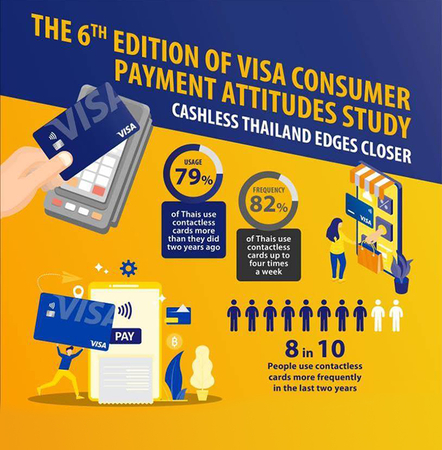
Almost eight in 10 Thais (79 per cent) are using contactless payments more often than they did two years ago, according to a study released by Visa on Thursday (June 18).

The study, which tracks consumer payments habits across Southeast Asia, also revealed three in four Thai respondents who are not using contactless payments today, are interested in doing so in the future.

Suripong Tantiyanon, country manager for Visa Thailand, said: “It is heartening to see Thai consumers embracing new payment technologies, especially the use of contactless cards for payments. The shift in behaviour and the rise in confidence can be attributed to an industry effort to educate the general public on the benefits of contactless and an increase acceptance points. Contactless payments are still in the early stages of adoption in Thailand, but we are optimistic for their growth due to the speed, convenience, security and global acceptance.”

Top reasons consumers cited for adopting contactless payments are: not needing to carry cash (68 per cent), innovative way to pay (58 per cent), and faster payment (55 per cent).

On frequency of contactless payments, 82 per cent of respondents said they used cards at least once a week.

Top places for contactless card payments were overseas destinations (17 per cent), supermarkets (12 per cent), and retail shops (11 per cent).

The study also delved into demographics: While Gen Y is more likely to use contactless cards (55 per cent), use among older Gen X users was significant (45 per cent). The younger generation uses contactless payments more frequently, with three in 10 making payments more than four times a week, while only one in five Gen X users will make the same number of payments.

State of the Nation: Cashless Society

Based on the findings, over two in five respondents (43 per cent) said they carry less cash now than they did two years ago. 

Increasingly, Thai consumers are confident in going cashless, said Visa. Two in five (38 per cent) believe they can last more than a month without cash. In contrast, nearly six in 10 (58 per cent) believe they could only get by for 24 hours without paying by cash.

When asked how long it would take for Thailand to become a cashless nation, 40 per cent of the people surveyed believe it will take between two to five years, 27 per cent thought it would take between six to 10 years, and 7 per cent believe it could happen next year.

Worries over second wave of Covid-19, cut in bank interest rates hammer SET #ศาสตร์เกษตรดินปุ๋ย

#ศาสตร์เกษตรดินปุ๋ย : ขอบคุณแหล่งข้อมูล : หนังสือพิมพ์ The Nation.

Worries over second wave of Covid-19, cut in bank interest rates hammer SET

Econ

Jun 18. 2020

By The Nation

The Stock Exchange of Thailand (SET) Index dropped 3.20 points or 0.23 per cent, closing at 1,372.98 today (June 18), with transactions amounting to a total of Bt70.282 billion with an index high of 1,377.39 and a low of 1,358.11.

In the morning session, a stock analyst at Krungsri Securities said he expected the index to fall to between 1,360 and 1,365 due to uncertainty over a second wave of Covid-19 infections as the subsequent slowdown of economy.

“Investors are worried that the US and China will issue lockdown measures to curb the contagion again after the number of new cases in the US rose to 26,000, while China has reintroduced emergency,” the analyst said.

“The stocks of banks and financial institutions will be under pressure after the Bank of Thailand told them to cut their interest rate by 2 to 4 per cent from July 1 to the end of the year in order to ease people’s suffering from the Covid-19 fallout.”

The top 10 stocks with the highest trade values today were SUPER, AOT, KBANK, SAWAD, CPF, MINT, KTC, BAM, DIF, and TASCO.

As of 4.30pm, crude oil rose by US$0.25 or 0.66 per cent to $38.21 per barrel, while gold dropped by $10.40 or 0.60 per cent to $1,746.00 per ounce.

Changes in other Asian indices were mixed:

Japan’s Nikkei Index closed at 22,355.46, down 100.30 points, or 0.45 per cent.

China’s Shanghai SE Composite Index closed at 2,939.32, up 3.44 points, or 0.12 per cent, while Shenzhen SE Component Index closed at 11,494.56, up 73.72 points, or 0.65 per cent.

Hong Kong’s Hang Seng Index closed at 24,464.94, down 16.47 points, or 0.067 per cent.

South Korea’s KOSPI Index closed at 2,133.48, down 7.57 points, or 0.35 per cent.

Taiwan’s TAIEX Index closed at 11,548.33, up 13.74 points, or 0.12 per cent.

ADB expects Thai economy to shrink by 6.5% #ศาสตร์เกษตรดินปุ๋ย

#ศาสตร์เกษตรดินปุ๋ย : ขอบคุณแหล่งข้อมูล : หนังสือพิมพ์ The Nation.

ADB expects Thai economy to shrink by 6.5%

Econ

Jun 18. 2020

By The Nation

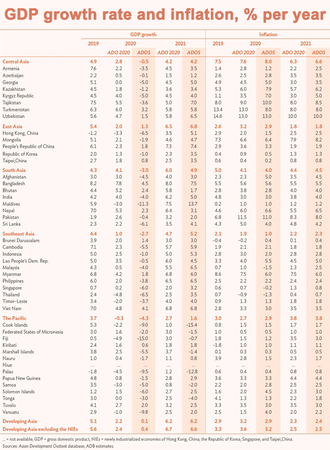
The Asian Development Bank (ADB) has downgraded its forecast for the Thai economy to a 6.5 per cent contraction due to the severe impact of Covid-19.

In April, the ADB predicted the Thai economy would sink 4.8 per cent this year. 

The new forecast makes Thailand the worst-hit economy among Asean countries, followed by Singapore’s 6 per cent contraction, while Vietnam is predicted to be the top performer with 4.1 per cent expansion.

ADB also paints a gloomy future for developing countries in Asia.

Developing Asia will barely grow in 2020 as Covid-19 containment measures hamper economic activity and weaken external demand, according to a new set of ADB forecasts released on Thursday (June 18).

IADB forecasts growth of 0.1 per cent for the region in 2020, down from the 2.2 per cent forecast in April and marking the slowest growth for the region since 1961. 

Growth in 2021 is expected to rise to 6.2 per cent, as forecast in April. Gross domestic product (GDP) levels in 2021 would remain below what had been envisioned and below pre-crisis trends.

Excluding Hong Kong, South Korea, Singapore and Taiwan, developing Asia is forecast to grow 0.4 per cent this year and 6.6 per cent in 2021.

“Economies in Asia and the Pacific will continue to feel the blow of the Covid-19 pandemic this year even as lockdowns are slowly eased and select economic activities restart in a ‘new normal’ scenario,” said ADB chief economist Yasuyuki Sawada. “While we see a higher growth outlook for the region in 2021, this is mainly due to weak numbers this year, and this will not be a V-shaped recovery. Governments should undertake policy measures to reduce the negative impact of Covid-19 and ensure that no further waves of outbreaks occur.”

Downside risks include multiple outbreak waves in the coming period and sovereign debt and financial crises cannot be ruled out, said the bank. It also identified risk of renewed escalation in trade tensions between the United States and China.

East Asia is forecast to grow 1.3 per cent in 2020 – the only subregion to experience growth this year – while growth in 2021 would recover to 6.8 per cent. Growth in China is forecast at 1.8 per cent this year and 7.4 per cent in 2021, compared to the April estimates of 2.3 and 7.3 per cent.

Hit hard by Covid-19, South Asia is forecast to contract by 3 per cent in 2020, compared to 4.1 per cent growth predicted in April. Growth prospects for 2021 are revised down to 4.9 per cent from 6.0 per cent. India’s economy is forecast to contract by 4 per cent in fiscal year 2020, ending on March 31, 2021, before growing 5 per cent in FY2021.

Economic activity in Southeast Asia is expected to contract by 2.7 per cent this year before growing by 5.2 per cent in 2021. Contractions are forecast in key economies as containment measures affect domestic consumption and investment, including Indonesia (-1.0 per cent), the Philippines (-3.8), and Thailand (-6.5). Vietnam is forecast to grow 4.1 per cent in 2020. While that is 0.7 percentage points lower than ADB’s April estimates, it is the fastest growth expected in Southeast Asia.

Central Asia’s economic activity is expected to contract by 0.5 per cent compared to the 2.8 per cent growth forecast in April due to trade disruptions and low oil prices. Growth is forecast to recover to 4.2 per cent in 2021.

Restricted trade flows and declining tourism numbers have dampened economic outlook for the Pacific subregion. The subregional economy is forecast to contract by 4.3 per cent in 2020 before rising to 1.6 per cent growth in 2021.

Inflation for developing Asia is forecast at 2.9 per cent in 2020, down from a forecast of 3.2 per cent in April, reflecting depressed demand and lower oil prices. In 2021, inflation is expected to ease to 2.4 per cent.

Strengthening dollar pressures gold price #ศาสตร์เกษตรดินปุ๋ย

#ศาสตร์เกษตรดินปุ๋ย : ขอบคุณแหล่งข้อมูล : หนังสือพิมพ์ The Nation.

Strengthening dollar pressures gold price

Econ

Jun 18. 2020

By The Nation

The price of gold rose by Bt50 per baht weight in morning trade on Thursday (June 18), the Gold Traders Association reported.

As of 9.26am, buying price of a gold bar was Bt25,350 per baht weight and selling price Bt25,450, while gold ornaments were priced at Bt24,892.72 and Bt25,950, respectively.

At close on Wednesday (June 17), buying price of a gold bar was Bt25,300 per baht weight and selling price Bt25,400, while gold ornaments were priced at Bt24,847.24 and Bt25,900, respectively.

The Gold Spot Index price on Thursday morning moved to around US$1,725 (Bt53,708) per ounce after the price dropped slightly by 90 cent to $1735.6 per ounce at close on Wednesday.

The gold price was pressured by the strengthening dollar, while investors reduced gold in their assets after European stock indices rose.

The price in the Hong Kong gold market rose by HK$40 to $15,960 (Bt64,126) per tael this morning.

SET slides amid concerns over economic impact from second wave of Covid-19 #ศาสตร์เกษตรดินปุ๋ย

#ศาสตร์เกษตรดินปุ๋ย : ขอบคุณแหล่งข้อมูล : หนังสือพิมพ์ The Nation.

SET slides amid concerns over economic impact from second wave of Covid-19

Econ

Jun 18. 2020

By The Nation

The Stock Exchange of Thailand Index dropped by 13.72 points, or 1.00 per cent, to 1,362.46 on Thursday morning (June 18).

A stock analyst at Krungsri Securities expected the index to fall to between 1,360 and 1,365 due to uncertainty following the second wave of Covid-19 cases, as it would slowdown the economy.

“Investors are worried that the US and China would issue lockdown measures to contain the spread of Covid-19 again after the number of new cases in the US rose to 26,000, while China has raised its emergency level back,” the analyst said.

“In addition, bank and financial stocks would be under pressure after the Bank of Thailand asked financial institutions to cut interest rate by 2-4 per cent, starting from July 1 until the end of this year in order to relieve people’s suffering from the Covid-19 impact.”

He recommended investors to buy:

▪ Stocks whose second-quarter performance will improve, such as CKP, TASCO, STA, and RS.

▪ Defensive stocks, such as INTUCH, TTW, and DIF.

▪ Marine shipping stock that benefit from rising freight rate, such as PSL, TTA, AMA, and PRM.

The SET Index rose by 9 points on Wednesday, or 0.66 per cent, closing at 1,376. Total transactions amounted to Bt71.5 billion.

Net sale by foreign investors amounted to Bt1.861 billion in stocks, while net buy of bonds was Bt11.492 billion. There were 11,020 net short TFEX SET50 contracts.

Lighthizer defends China trade deal that Trump has soured on #ศาสตร์เกษตรดินปุ๋ย

#ศาสตร์เกษตรดินปุ๋ย : ขอบคุณแหล่งข้อมูล : หนังสือพิมพ์ The Nation.

Lighthizer defends China trade deal that Trump has soured on

Econ

Jun 18. 2020

By The Washington Post · David J. Lynch · NATIONAL, BUSINESS, CONGRESS, US-GLOBAL-MARKETS
WASHINGTON – U.S. Trade Representative Robert E. Lighthizer said he expects China to fulfill its promise to buy an additional $200 billion in American goods and services over the next two years, despite its slow start to placing new orders amid the coronavirus pandemic.

Lighthizer said Chinese authorities recently bought sizable amounts of U.S. agricultural goods, including $1 billion worth of cotton, and publicly reiterated that they intended to comply with the “phase one” trade deal they had signed with President Donald Trump in January.

“I expect them to live up to the agreement. They have indicated they will,” he said.

Appearing before the House Ways and Means Committee, Lighthizer provided a far more upbeat assessment of the deal than the president has in recent weeks. Trump repeatedly has expressed irritation with China, saying last month he had “lost a little flavor” for the trade deal and threatening to “cut off the whole relationship.” Trump has blamed the Chinese government for not doing more to prevent the spread of the novel coronavirus, a pandemic that has severely damaged the U.S. economy.

But Lighthizer said the Chinese would comply with the deal’s provisions, including the purchase commitments and changes required in their treatment of foreign companies’ technology secrets.

In a day-long appearance before House and Senate panels, Lighthizer defended the president’s use of tariffs to overhaul U.S. trade policy, cast doubt on prospects for quickly reaching agreements with the European Union and the United Kingdom, and pledged to crack down on any violations of a new North American trade deal that takes effect on July 1.

Lighthizer called the U.S.-Mexico-Canada Agreement (USMCA) “the best trade agreement in U.S. history,” but acknowledged that he anticipates issues with its implementation. The pact replaces the 1994 North American Free Trade Agreement (NAFTA), which Trump has blamed for the loss of millions of American factory jobs.

The new deal contains strict labor and environmental standards designed to prevent similar U.S. payroll erosion, which will mark a sharp break with traditional Mexican labor market practices.

“Labor enforcement in Mexico is going to be a problem,” Lighthizer said.

Underscoring Trump’s revolutionary approach to U.S. global ties, Lighthizer also pointedly assailed the World Trade Organization (WTO). Though the body was established in 1995 under Washington’s auspices, the trade chief said it had undermined U.S. interests by failing to police China’s trade behavior.

“I think the WTO is a mess. The WTO has failed America and it’s failed the international trading system,” the trade chief told lawmakers.

Lighthizer has been a longtime critic of the WTO’s system for resolving disputes between members, blocking appointments to the appellate body and leaving it without a quorum. Lighthizer escalated his criticism on Wednesday, saying it did not matter whether the panel ever returned to normal operations.

“I don’t think the appellate body was working well…I don’t feel any compulsion to have it ever come back into effect,” he said. “I’m not a fan of the appellate body.”

As the WTO searches for a replacement for outgoing Director General Roberto Azevedo, Lighthizer said the organization required “fundamental reform” and he vowed to veto any candidate who had “any whiff of anti-Americanism in their past actions.”

He also had harsh words for U.S. trading partners that are eyeing new taxes on American internet companies. After France and other European countries announced plans to tax companies such as Amazon, Facebook and Google, the Trump administration threatened to retaliate with tariffs.

The Organization for Economic Cooperation and Development (OECD) in Paris has been hosting negotiations aimed at brokering a compromise. But Treasury Secretary Steven Mnuchin earlier this month pulled out of the talks, saying they should take a back seat to dealing with economic fallout from the pandemic.

“They all came together and agreed they’d screw America,” he said of the talks.

Lighthizer appeared in person in a House hearing room, while most lawmakers questioned him by video link. He offered a vigorous defense of the president’s repeated use of tariffs to prod U.S. trading partners into changes, saying that any American company forced to pay higher prices for imported raw materials or other inputs should have shifted by now to alternative suppliers.

“If you have a year or two years to make a change, then you should have made a change,” he said. “People have had a substantial period of time to find another source.”

Citing the pandemic, Lighthizer also called for using tariffs to support domestic production of critical medical supplies, clashing with lawmakers who have pushed for cutting import fees on medical products made overseas.

Multinational corporations that “thought they were so clever running these supply chains all over the world rather than making the stuff in the United States now realize they were taking on substantially more risk than they thought they were,” he said.

With little more than five months before election day, Lighthizer said it was unlikely that a trade deal with the UK could be reached before Americans head to the polls, adding that negotiators also had made “very little headway” with the EU in talks aimed at a broad trade pact.

“It’s not looking good in the short run although ultimately we have to get something worked out with Europe,” he said.

Stocks drop for first time in 4 days; bonds rise #ศาสตร์เกษตรดินปุ๋ย

#ศาสตร์เกษตรดินปุ๋ย : ขอบคุณแหล่งข้อมูล : หนังสือพิมพ์ The Nation.

Stocks drop for first time in 4 days; bonds rise

Econ

Jun 18. 2020File photo of Wall Street sign/ Credit: Syndication Washington Post, BloombergFile photo of Wall Street sign/ Credit: Syndication Washington Post, Bloomberg

By Syndication Washington Post, Bloomberg · Claire Ballentine, Katherine Greifeld · BUSINESS, US-GLOBAL-MARKETS 
U.S. stocks fell for the first time in four days as worry about coronavirus cases overtook optimism about stimulus measures. Treasury note yields fell, and the dollar was little changed.

The benchmark S&P 500 index swung between gains and losses for most of Wednesday before turning red late, with the energy, real estate and financial sectors leading the declines. Apple and Microsoft helped the Nasdaq composite close positive. The number of infections increased from China to Brazil, and Iran warned that it may need a new lockdown. Texas reported a surge in hospitalizations.

“The market is searching for a new catalyst,” said Sameer Samana, senior global market strategist at Wells Fargo Investment Institute. “The narrative around policy stimulus and better economic data seems to be losing its sway.”

While volume was 20% below the 30-day average Wednesday, trading has been volatile for the past two weeks. After rising to a 12-week high on June 8, the S&P 500 tumbled 7% over three days before staging a 4% rebound in the next three sessions.

“Volatility is for sure here to stay and probably through the end of the year,” said Michael Reynolds, investment strategy officer at Glenmede Trust. “We’re dealing with something that is not economic in nature, anyone who thinks they can predict the path of this virus is surely kidding themselves.”

The thin volume exacerbated swings, including a drop that began around the time newspapers covered portions of John Bolton’s critical book about President Donald Trump.

Investor optimism toward risk assets had been reflected in bets that new virus outbreaks won’t lead governments to pull back from gradually reopening businesses. Federal Reserve Chairman Jerome Powell urged Congress not to pull back too quickly on federal relief to households and small businesses put in place because of the pandemic.

“Global markets could remain stretched between a health situation likely to remain a threat in several regions for some time on the one hand, and a stream of positive macro figures confirming that we have passed the low point on the other,” said Xavier Chapard, a global macro strategist at Credit Agricole.

Texas reported an 11% surge in virus hospitalizations, the biggest 24-hour increase since June 4. Brazil registered a record 34,918 new infections, while China is escalating containment measures in Beijing including canceling flights.

Cabinet approves move to open aviation maintenance, manufacturing to 100% foreign businesses #ศาสตร์เกษตรดินปุ๋ย

#ศาสตร์เกษตรดินปุ๋ย : ขอบคุณแหล่งข้อมูล : หนังสือพิมพ์ The Nation.

Cabinet approves move to open aviation maintenance, manufacturing to 100% foreign businesses

Econ

Jun 18. 2020

Chula Sukmanop

Chula Sukmanop

By THE NATION

The Cabinet has endorsed the draft of an emergency decree allowing 100 per cent foreign-owned entities to be granted licences to run three aviation-related businesses.

The businesses are Type 1 aviation maintenance facilities, aircraft manufacturing, and manufacturing of key aircraft components.

Chula Sukmanop, director-general of the Civil Aviation Authority of Thailand, said that the draft will amend existing legislation by raising the limit on foreign ownership in these segments from 49 per cent to 100 per cent.

It will also oblige applicants to transfer technology to Thai staff and employ Thai workforces.

The council of state is expected to spend three months examining the draft, said Chula.

According to the draft, applicants for the licence must be receiving tax-privilege support under the law on investment promotion or related law. They must also submit their technology transfer plan.

Meanwhile at least 80 per cent of their employees must be Thai for the five-year period after they receive the licence.