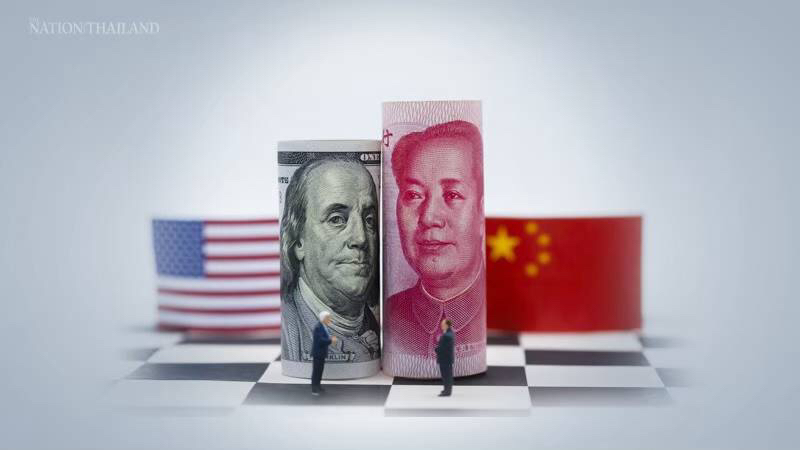
By Syndication Washington Post, Bloomberg · No Author · BUSINESS China plans to accelerate purchases of American farm goods to comply with the phase one trade deal with the U.S. following talks in Hawaii this week.
The world’s top soybean importer intends to step up buying of everything from soybeans to corn and ethanol after purchases fell behind due to coronavirus disruptions, said two people familiar with the matter, who asked not to be named because the information is private.
A separate person said the Chinese government has asked state-owned agricultural buyers to make all efforts to meet the phase one agreement. Nobody from the commerce ministry responded to a fax seeking comment.
The plan offers respite to markets concerned about trade disruptions after the countries exchanged blows over everything from the origins of the coronavirus to new security legislation in Hong Kong. U.S. equity futures, the Euro Stoxx 50, soybeans in Chicago and the yuan extended gains.
On Thursday, U.S. Secretary of State Michael Pompeo said China’s top foreign policy official committed to honor all of his nation’s commitments under the trade deal.
“During my meeting with CCP Politburo Member Yang Jiechi, he recommitted to completing and honoring all of the obligations of Phase 1 of the trade deal between our two countries,” Pompeo said in a tweet on Thursday, using an acronym for the Chinese Communist Party.
Pompeo offered no details beyond the tweet, but that was the first substantive news out of the secretive meeting with Yang at Hickam Air Force Base in Hawaii on Wednesday. It’s still unclear how the meeting came about or who had asked for it. Both sides have said the other initiated it.
China pledged to buy $36.5 billion worth of American agriculture products under the phase one deal, up from $24 billion in 2017, before the trade war.
However, China purchased only $4.65 billion in the first four months of the year, data from the U.S. Department of Agriculture show. That’s only 13% of the goal set in the trade deal and almost 40% below the same period in 2017.
China had asked state buyers to halt some purchases of American farm goods including soy, Bloomberg News reported earlier this month. However, Chinese importers had continued to increase its American soy purchases, picking up 2.2 million metric tons of the oilseed in the two weeks ended June 11, according to the USDA data.
The Stock Exchange of Thailand (SET) Index closed at 1,370.82 today (June 19), down 2.16 points or 0.16 per cent. Total transaction volume was Bt63.320 billion with an index high of 1,380.02 and a low of 1,368.03.
In the morning session, a stock analyst at Krungsri Securities expected the index to fluctuate between1,365 and 1,380 thanks to a mix of factors, both positive and negative.
“Energy and petroleum stocks gained positive sentiment from the rising crude oil price as Opec+ countries’ moved to cut oil production by 9.7 million barrels per day,” the analyst said.
But the index would be dragged down by uncertainty following a second wave of 28,000 new Covid-19 infections in the US, along with the FTSE All World index’s move to reduce its weight of Thai stocks from 3.05 per cent to 2.98 per cent, worth Bt3.7 billion, added the analyst.
“Meanwhile, profits of commercial banks and non-banking entities may come under pressure after the Bank of Thailand ordered them to cut interest rates they charge for credit cards, personal credit and hire purchase, to help people struggling with debt due to the Covid-19 crisis.”
The analyst advised investors to follow the European Council meeting on raising €750 billion for the €1.1-trillion euro-zone stimulus measures.
The 10 stocks with the highest trade value today were BAM, PTTEP, CPF, KBANK, PTT, MINT, ADVANC, CPALL, KTC, and BBL.
As of 4.30pm, the price of crude oil rose by US$1.29 or 3.32 per cent to $40.13 per barrel, while the gold price rose by $5.70 or 0.33 per cent, to $1,736.80 per ounce.
Changes in other Asian indices were as follows:
Japan’s Nikkei Index closed at 22,478.79, up 123.33 points, or 0.55 per cent.
China’s Shang Hai SE Composite Index closed at 2,967.63, up 28.32 points, or 0.96 per cent, while Shenzhen SE Component Index closed at 11,668.13, up 173.58 points, or 1.51 per cent.
Hong Kong’s Hang Seng Index closed at 24,643.89, up 178.95 points, or 0.73 per cent.
South Korea’s KOSPI Index closed at 2,141.32, up 7.84 points, or 0.37 per cent.
Taiwan’s TAIEX Index closed at 11,549.86, up 1.53 points, or 0.013 per cent.
The price of gold dropped by Bt50 per baht weight in morning trade on Friday (June 19), the Gold Traders Association reported.
As of 9.30am, buying price of a gold bar was Bt25,300 per baht weight and selling price Bt25,400, while gold ornaments were priced at Bt24,847.24 and Bt25,900, respectively.
At close on Thursday (June 18), buying price of a gold bar was Bt25,350 per baht weight and selling price Bt25,450, while gold ornaments were priced at Bt24,892.72 and Bt25,950, respectively.
The Gold Spot Index price on Friday morning moved to around US$1,726 (Bt53,538) per ounce after the price dropped by $4.5 to $1,731.1 per ounce at yesterday’s close due to the strengthening dollar.
Investors continued to buy gold after the US revealed that the number of Americans claiming jobless benefits this week was higher than expected and there was uncertainty about a second wave of Covid-19 cases.
Gold in Hong Kong opened at HK$15,920 (Bt63,717) per tael on Friday morning.
The Stock Exchange of Thailand Index rose by 5.08 points, or 0.37 per cent, to 1,378.06 on Friday morning (June 19).
A stock analyst at Krungsri Securities expected the index to fluctuate between 1,365 and 1,380 from mixed positive and negative factors.
“Energy and petroleum stocks gained positive sentiment from the rising crude oil price as Opec+ countries’ move to cut oil production by 9.7 million barrels per day was 87 per cent completed,” the analyst said.
The analyst said that uncertainty following the second wave of the Covid-19 fallout after the number of new cases in US rose by over 28,000 and FTSE All World’s move to reduce the weight on Thai stocks from 3.05 per cent to 2.98 per cent worth Bt3.7 billion would plunge the index.
“Meanwhile, the profits of commercial banks and non-banking entities may be under pressure after the Bank of Thailand ordered them to cut the interest rates they charge for credit cards, personal credit and hire purchase to help people struggling with debt due to the Covid-19 crisis,” the analyst said.
The analyst advised investors to follow the European Council meeting on raising €750 billion for the €1.1-trillion euro-zone economic stimulus measure from 2021 to 2027.
He recommended the following stocks:
▪ Energy stocks that benefit from the rising crude oil price, such as PTT, PTTEP, TOP, PTTGC, IRPC, SPRC, and IVL.
▪ Stocks whose second-quarter performance will improve, such as CKP, TASCO, STA, and RS.
▪ Marine shipping stocks that benefit from the rising freight rate, such as PSL, TTA, AMA, and PRM.
The SET Index dropped by 3.20 points on Thursday, or 0.23 per cent, closing at 1,373. Total transactions amounted to Bt70 billion.
Net sale by foreign investors amounted to Bt4.463 billion in stocks and Bt2.819 billion in bonds. There were 8,832 net long TFEX SET50 contracts.
By Syndication Washington Post, Bloomberg · Sarah Ponczek, Vildana Hajric · BUSINESS, US-GLOBAL-MARKETS
U.S. stocks edged higher after trading in a narrow range for much of Thursday as investors weighed the latest economic data and reports about fresh outbreaks of the novel coronavirus. Treasuries extended their advance.
The benchmark S&P 500 rose 0.06%, led by gains in energy, consumer staple and technology shares. Equities had opened lower in the wake of a report that weekly U.S. jobless claims stayed above 1 million. Meanwhile, Florida’s new cases rose faster than the past week’s average and Texas hospitalizations climbed for a record seventh straight day.
Volume in S&P 500 stocks was 25% lighter than the average during the last 30 days, the first time this year where trading fell at least 15% two sessions in a row. The slide in volume came just ahead of Friday’s quadruple witching, during which options and futures on indexes and equities are scheduled to expire.
“The story has been and remains that with such powerful cross-currents facing the market we are going to have periods of positivity and even exuberance, and we’re going to have moments of disappointment,” said Lauren Goodwin, economist and multi-asset portfolio strategist at New York Life Investments. “It’s just endemic of the economic, political, earnings, health, everything environment just being so uncertain.”
Elsewhere, the Stoxx Europe 600 declined. The pound held onto losses and gilt yields rose after the Bank of England expanded its quantitative easing program.
The picture for global markets remains complex as investors mull reports on China battling its worst outbreak since Wuhan, and Israel pausing further reopening of the economy after a rise in cases. That’s competing with some positive news on the economic front, as well as a flood of promised stimulus measures.
Crude oil prices gained after erasing earlier losses.
“The markets are fragile right now and I think a lot of investors see how quick the markets have recovered – equity market in particular,” said Chris Gaffney, president of world markets at TIAA Bank. “Everyone is starting to feel that maybe we’re ahead of ourselves.”
These are some of the main moves in markets:
– – –
Stocks
– The S&P 500 Index increased 0.1%, to 3,115.34, at closing.
– The Dow Jones Industrial Average fell 0.2%, to 26,080.10.
– The Nasdaq Composite Index climbed 0.3%, to 9,943.05, hitting the highest in more than a week with its fifth consecutive advance.
– The MSCI All-Country World Index declined 0.1%, to 527.51, the first retreat in a week.
Currencies
– The Bloomberg Dollar Spot Index advanced, 0.5% to 1,220.54, the highest in almost three weeks on the largest gain in a week.
– The euro declined 0.4% to $1.1204, the weakest in more than two weeks.
– The Japanese yen was little changed at 106.98 per dollar, the strongest in a week.
– The British pound fell 1.1%, to $1.242, the weakest in almost three weeks on the biggest fall in a week.
Bonds
– The yield on two-year Treasuries dipped less than one basis point, to 0.19%.
– The yield on 10-year Treasuries fell four basis points, to 0.70%, the lowest in a week on the biggest fall in a week.
– Germany’s 10-year yield declined two basis points, to -0.41%.
– Britain’s 10-year yield jumped four basis points to 0.228%, the highest in more than a week on the biggest surge in almost two weeks.
Commodities
– West Texas Intermediate crude gained 2.3%, to $38.85 a barrel, the highest in more than a week.
– Gold depreciated 0.1%, to $1,724.87 an ounce, the weakest in more than a week.
The government will on Friday (June 19) sign a contract worth Bt290 billion with U-Tapao International Aviation Company for the development of U-Tapao Airport and Eastern Aviation City.
The move comes after the Cabinet endorsed the results of bidding for the project, won on June 2 by BBS Joint Venture Group. BBS has established the U-Tapao International Aviation Company Co Ltd to carry out the development.
The airport development scheme is one of five mega-projects in the government’s flagship Eastern Economic Corridor infrastructure plan.
The EEC Office (EECO) will sign the joint investment agreement in a ceremony overseen by Prime Minister Prayut Chan-o-cha at Government House.
U-Tapao International Aviation Company Co Ltd has registered capital of Bt4.5 billion and is a joint venture between Bangkok Airways, which holds 45 per cent of the shares, BTS Group Holdings Limited (35 per cent) and Sino-Thai Engineering and Construction Plc (STEC) 20 per cent. Narita International Airport Corporation has been contracted to manage U-Tapao Airport.
After signing the contract, U-Tapao International Aviation Company Co Ltd must prepare a master plan of investment in the project within 60 days, then begin construction. U-Tapao International Aviation Company Co Ltd will invest in all four phases. The first phase for construction will take three years, with operations due to start in the fourth year.
Phase 1 will see construction of a third passenger terminal at U-Tapao airport with annual capacity of 15 million passengers, exceeding the 12 million specified in the contract’s terms of reference. It includes a Bt40-million rail connection system to be managed by Narita Airport Corp. Phase 2 will develop the APM electric train system to link the project as yearly passenger capacity grows to 30 million. Phase 3 will expand capacity to 45 million passengers, with a capacity of 60 million reached in phase 4.
The Mass Rapid Transit Authority of Thailand (MRTA) will call bids for the extension of two mass transit systems within this year, the MRTA governor Pakapong Sirikantaramas said.
Bids will be sought for the western extension of the Orange Line, stretching from Bang Khun Non to Thailand Cultural Centre and the southern extension of the Purple Line from Tao Pun to Rat Burana.
The terms of reference for the MRT Orange Line should be completed within July and it should be ready for bids in October. The whole bidding process for the Orange Line extension should be completed before the end of this year.
The Orange Line will be developed under a public-private joint venture basis. The construction will cost Bt110 billion, Bt14 billion of which will be spent on land expropriation, Bt96 billion on civil work and Bt32 billion will be spent on the service operation for 30 years.
The MRTA expects to call bids for the MRT Purple Line in September. Of the Bt100 billion total development cost, Bt80 billion will be spent on civil works, Bt16 billion on land reclamation and the remainder on mechanical and electrical work. Like the Orange Line, this route will also be jointly invested in by public and private sectors.
The MRTA will hire a consultant to draw up documents for a public-private partnership for the Brown Line, for which bids are expected to be called next year.
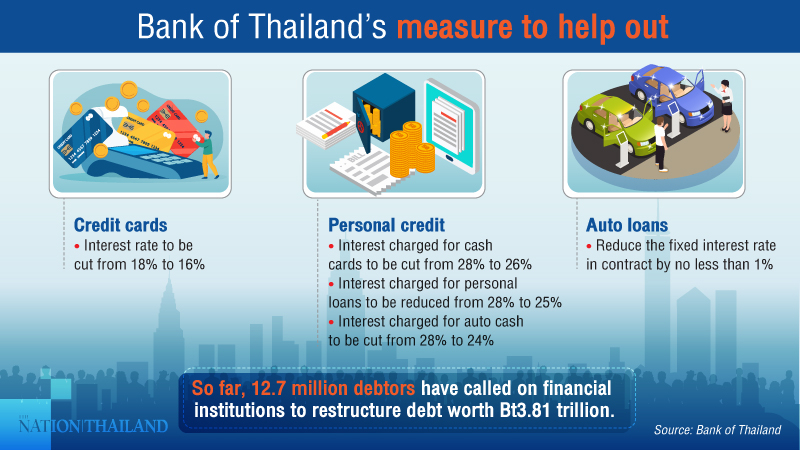
The profits of commercial banks and non-banking entities may be under pressure now that the Bank of Thailand (BOT) has issued measures to help debtors.
The central bank recently ordered them to cut down the interest rates they charge for credit cards, personal credit and hire purchase by 2 to 4 per cent in a bid to help people struggling with debt due to the Covid-19 crisis.
Anekpong Putthapiban, assistant director at Asia Plus Securities, said BOT’s move may have an adverse impact on commercial banks’ net interest margin due to the decline in real interest rate depending on the number of debtors participating in these measures.
“For every 0.10 per cent drop in net interest margin, banks’ profit forecast this year will decrease by about 5 per cent,” he said.
He also said that for every 1 per cent interest rate cut by leasing companies, such as Aeon Thana Sinsap (AEONTS), Srisawad Corporation (SAWAD) and Muangthai Capital (MTC), their net profit forecast this year will drop by 3 to 9 per cent.
“AEONTS’s net profit will be affected by the new interest rate ceiling on credit cards because they charge approximately 20 per cent, but the new interest rate ceiling is 16 per cent,” he said. “However, the impact on SAWAD and MTC’s net profit are limited because they charge for personal loans at 24 per cent, which is less than the new interest rate ceiling of 25 per cent.”
He advised investors to avoid investing in leasing companies, because most leasing firms’ stock prices rose to its base value and received a negative factor from BOT’s interest rate control measures.
Meanwhile, a stock analyst at Yuanta Securities said BOT’s measures will affect the profit earned from credit-card interest the most.
“Therefore, we expect Krungthai Card and AEONTS’s profit forecast this year to drop by 4.1 per cent and 2.1 per cent respectively,” the analyst said.
The Bank of Thailand (BOT) has announced that it will develop a prototype payment system for businesses using the Central Bank Digital Currency (CBDC), which will build on the knowledge learned from Project Inthanon. The project’s scope will include conducting a feasibility study and developing a process that integrates CBDC with an innovative business platform, the central bank said on Thursday (June 18).
The digital currency is being launched to enhance the competitiveness and readiness of the business sector to enter the digital age and will first be introduced with large corporates.
BOT takes a step towards pushing the use of digital currency The Bank of Thailand (BOT) signed an agreement on Thursday (June 18) with corporate giant SCG and Digital Ventures to trial the use of digital currency. Seen in the photo are, left to right: Thammasak Sethaudom, vice president, Finance and Investment, and chief financial officer at SCG; Mathee Supapongse, deputy governor of the Bank of Thailand; and Orapong Thien-Ngern, chief executive officer and chairman of the executive committee of Digital Ventures.
The CBDC prototype will initially be integrated with the procurement and financial management systems of Siam Cement Public Company Limited and its suppliers. The system will be developed by Digital Ventures Co Ltd.
The prototype is expected to serve as a financial innovation that enables higher payment efficiency for businesses such as boosting flexibility for fund transfers and making payments easier.
“It is like using the baht currency in digital form,” assistant BOT governor Chantavarn Sucharitakul said.
By using this digital currency, Siam Cement can integrate smart contracts when the company makes business deals with suppliers, she added.
The project will begin in July and should run until the end of the year, after which the BOT will publish a summary and outcome.
Project Inthanon, a collaboration between the BOT and eight leading financial institutions, launched to study and develop “proof of concept” for domestic wholesale transfers using CBDC was successfully accomplished in January with the completion of a cross-border transfer prototype co-developed with the Hong Kong Monetary Authority (HKMA).
The next step will see the BOT, HKMA and participating financial institutions continuing to collaborate on experimental use of CBDC to other cases, which the BOT will later announce in detail.
The central bank strongly believes continuous collaborations and development in financial innovation with the business sector will help lay a strong foundation in building technological capacity and readiness for financial services and businesses rapidly entering the digital age.
Moreover, BOT remains open to private sector engagements to further promote the innovation and explore potential uses for future adoption of the currency, a statement from the bank said.
This is the second digital currency to be launched in the region after the Monetary Authority of Singapore launched its prototype in November last year.
By The Washington Post · Eli Rosenberg · NATIONAL, BUSINESS, US-GLOBAL-MARKETS, CAREER-WORKPLACE An additional 1.5 million workers filed for unemployment benefits for the first time last week, a drop of 58,000 claims from the week before.
The continued elevated level of jobless claims raises new questions about whether steep job losses during the pandemic could last longer than hoped, economists say.
This year, amid the novel-coronavirus pandemic, there have been 13 straight weeks in which more than 1 million people have filed for unemployment for the first time. In February, before the virus took hold in the United States, the weekly jobless claims were about 200,000 a week. The previous record was 695,000 in 1982.
Hopes that the reopening of businesses that had been forced to close would see jobbless numbers drop precipitously, helping to speed the economy’s recovery at a comparable rate to its fall. But such a “V-shaped” recovery does not appear to be materializing as job losses remain severe several months into the pandemic.
Another 760,000 people filed initial claims for Pandemic Unemployment Assistance, a supplemental program created by Congress for self-employed and gig workers. And the total number of people receiving benefits fell slightly, to 20.5 million. More than 45 million people have filed for unemployment at some point during the pandemic.
Analysts said the weekly numbers pointed to steep challenges the country faces in its recovery.
“The fact that we’re not seeing a huge decline in continuing claims as the economy starts to reopen suggests that firms in directly affected industries are only partially recalling some employees,” said Nick Bunker, an economist at Indeed Hiring Lab. “And that’s not going to lead to a huge snap back.”
“We all looked for confirmation of hopes that these claims would continue to decline,” said Mark Hamrick, a senior economic analyst at Bankrate. “But we see the decline was just [over] 50,000. That’s less of an improvement we’ve seen in recent weeks.”
The economic outlook is complicated by continuing coronavirus outbreaks across the country: Twenty-one states are seeing an increase in their daily average of new coronavirus cases this week compared to last week, according to data compiled by The Washington Post. New infections surged nationwide.
The numbers of people heading back to work or gaining new jobs has kept pace nominally with those still filing for unemployment for the first time, raising questions about whether the recovery is stalling.
The weekly unemployment insurance data remains an imperfect measurement. It does not capture which industries shed jobs or why, nor does it necessarily reflect the exact time period a person filed for unemployment benefits – instead revealing the time a state first processed the claim. So there are unanswered questions about whether some of the backlogs that plagued state unemployment agencies early in the crisis are still being worked through, affecting the data.
Attempts to battle wide-scale fraud have slowed application processing in states including Maine, Michigan, Pennsylvania and Washington. In Kentucky, hundreds of people lined up outside of the Capitol on Wednesday, seeking help with stalled claims in an estimated eight-hour wait, some of the tens of thousands who have had trouble with their claims in the state.
President Donald Trump and his economic team have expressed hopes of a swift recovery. And the most optimistic forecasters have suggested that as the economy reopens, businesses that had forcibly shuttered will be able to bring back their workers. But Bunker, of Indeed, said the pace of rehiring was slowing even as the country opens up.
“In the May jobs report we saw an increase in employment and a drop in unemployment rate due to an increase in businesses that got hit really hard initially,” he said. “What we may be seeing now is that pace of rehirings is slowed or that the recovery could be stalling out, but it’s not 100% clear from the data.”
There have been other positive indications: Retail sales spiked 17.7% in May, though they continue to be down nearly 8% since February.
But analysts and key economic leaders such as Federal Reserve Chair Jerome Powell continue to warn that despite bright signs, the economic pain could be deep and long lasting for many sectors of the economy.
The unemployment rate remains the highest it has been since the Great Depression. The official rate for May was 13.3%, but the Bureau of Labor Statistics said that it would have been closer to 16.3% if not for an error in the data collection process.
Since February, nearly 20 million jobs have been lost and the unemployment rate has risen about 10 percentage points, Powell told a Senate committee this week. He said the decline in a key measure of economic growth, gross domestic product, during this pandemic is likely to be the most severe on record.
There are other problems on the horizon. The $600 weekly supplement for unemployed workers will end by August. Unemployment benefits could also begin to expire for workers after the summer in some states with shorter durations allowed on unemployment insurance.