House panel projects 3-5% GDP contraction as Bankers’ Association calls for recovery plan #ศาสตร์เกษตรดินปุ๋ย

#ศาสตร์เกษตรดินปุ๋ย : ขอบคุณแหล่งข้อมูล : หนังสือพิมพ์ The Nation.

https://www.nationthailand.com/business/30389398?utm_source=category&utm_medium=internal_referral

House panel projects 3-5% GDP contraction as Bankers’ Association calls for recovery plan

Jun 10. 2020
Predee Daochai

Predee Daochai
By The Nation

The Joint Standing Committee on Commerce, Industry and Banking has maintained its forecast of a 3 to 5 per cent contraction for Thailand’s Gross Domestic Product (GDP) this year.

Meanwhile, it projects a 5-10 per cent drop in exports this year, and inflation rate to move between 0 and minus-1.5 per cent.

Predee Daochai, chairman of the Thai Bankers’ Association, said that almost all economic indicators fell in April, including exports, manufacturing, consumption, and investment.

“Only government spending expanded,” he said.

“The economic decline was mainly due to disruption caused by lockdown measures issued by countries around the world to contain the spread of Covid-19.”

He noted that the government had allowed businesses to reopen and issued relief measures to mitigate the impact of Covid-19.

“However, economic recovery will take time due to changes in consumers’ behaviour, the economic recession, and the US-China trade war,” he added. “Therefore, the unemployment situation in the country is still worrisome.”

He advised the government to issue a recovery plan as soon as possible, focusing on projects that generate income for the grassroots economy and help local businesses to create jobs for people nationwide.

Gold boosted by fall in world stock markets #ศาสตร์เกษตรดินปุ๋ย

#ศาสตร์เกษตรดินปุ๋ย : ขอบคุณแหล่งข้อมูล : หนังสือพิมพ์ The Nation.

https://www.nationthailand.com/business/30389379?utm_source=category&utm_medium=internal_referral

Gold boosted by fall in world stock markets

Jun 10. 2020
By The Nation

The price of gold rose by Bt100 per baht weight in the morning trade on Wednesday (June 10), the Gold Traders Association reported.

As of 9.23am, buying price of a gold bar was Bt25,350 per baht weight and selling price Bt25,450, while gold ornaments were priced at Bt24,892.72 and Bt25,950, respectively.

At close on Tuesday (June 9), buying price of a gold bar was Bt25,250 per baht weight and selling price Bt25,350, while gold ornaments were priced at Bt24,801.76 and Bt25,850, respectively.

The Gold Spot Index price on Wednesday morning moved to around US$1,718 (Bt53,642) per ounce after the price rose by $16.8 to $1,721.9 per ounce at close on Tuesday.

Investors were buying safe-haven assets after stock indices worldwide dropped due to mass sell-offs, while the dollar weakened after the US reported decline in economic data.

The price in the Hong Kong gold market rose by HK$115 to $15,860 (Bt63,895) per tael.

SET seen as having little room for upward movement #ศาสตร์เกษตรดินปุ๋ย

#ศาสตร์เกษตรดินปุ๋ย : ขอบคุณแหล่งข้อมูล : หนังสือพิมพ์ The Nation.

https://www.nationthailand.com/business/30389378?utm_source=category&utm_medium=internal_referral

SET seen as having little room for upward movement

Jun 10. 2020
By The Nation

The Stock Exchange of Thailand Index opened at 1,419.06, up 10.69 points, or 0.76 per cent, on Wednesday morning (June 10).

A stock analyst at Krungsri Securities expected the index to fall between 1,395 and 1,400, before rebounding, due to lack of new positive sentiment to stimulate investment, while investors would hold off on trading to follow developments in the US Federal Open Market Committee (FOMC) meeting.

“Investors expect the FOMC to maintain the interest rate at 0-0.25 per cent and unlimited quantitative easing,” the analyst said.

“Meanwhile, we have to also keep an eye on the US Federal Reserve’s announcement on signs of a US economic recovery after the lockdown relaxation.”

The analyst added that the index would be under pressure from tight valuation as the index’s price-to-earnings ratio is more than 20 times.

He recommended investors buy:

▪ Stocks that would be added to the SET50 and SET100 calculation, such as BPP, TTW, ACE, DOHOME, RBF, SIRI, SISB, TVO and WHAUP.

▪ Stocks whose second-quarter performance will improve, such as CKP, TASCO, STA and RS.

▪ Defensive stocks, such as INTUCH, TTW and DIF.

The SET Index on Tuesday dropped sharply by 30.29 points or 2.11 per cent, closing at 1,408.37 as investors sold stocks due to tight valuation. The total transaction volume was Bt115.559 billion.

Foreign investors made net buy of Bt486 million in stocks, but made net sales of Bt4.975 billion in the bond market. There were 5,301 Net Long TFEX SET50 contracts.

Following messy start, enormous Paycheck Protection Program shows signs of buttressing economy #ศาสตร์เกษตรดินปุ๋ย

#ศาสตร์เกษตรดินปุ๋ย : ขอบคุณแหล่งข้อมูล : หนังสือพิมพ์ The Nation.

https://www.nationthailand.com/business/30389357?utm_source=category&utm_medium=internal_referral

Following messy start, enormous Paycheck Protection Program shows signs of buttressing economy

Jun 10. 2020
President Trump, Small Business Administration Administrator Jovita Carranza and Treasury Secretary Steven Mnuchin speak about the Paycheck Protection Program at the White House on April 28. MUST CREDIT: Washington Post photo by Jabin Botsford.

President Trump, Small Business Administration Administrator Jovita Carranza and Treasury Secretary Steven Mnuchin speak about the Paycheck Protection Program at the White House on April 28. MUST CREDIT: Washington Post photo by Jabin Botsford.
By The Washington Post · Jonathan O’Connell, Jeanne Whalen, Jeff Stein, Erica Werner · NATIONAL, BUSINESS, HEALTH, POLITICS, CONGRESS, WHITEHOUSE 

WASHINGTON – After a flood of complaints, balky computer systems, changed rules and frantic calls to the Treasury Department, the federal government’s small business Paycheck Protection Program is suddenly looking like a measured success.

The U.S. economy buckled in March and April amid the coronavirus pandemic, but it appeared to regain some of its footing in May, adding 2.5 million jobs. The economy remains extremely weak, with a high unemployment rate and a surge in Americans seeking assistance. Many economists think conditions will remain shaky for at least another year.

But they also think things would be even worse without the giant corporate loan forgiveness program, which Sen. Marco Rubio, R-Fla., shepherded through Congress and then helped defend during chaotic weeks of implementation.

Getting to this point strained the government, the banking industry and small businesses, with many missteps and pivots along the way as they tried to build a program from scratch. And the Trump administration vacillated wildly between trying to rush money out the door and then trying to tighten rules, enraging lawmakers such as Rubio, confusing borrowers and nearly overwhelming banks, even those with small business expertise.

“It was like saying, ‘I want my locally owned farmers market to work like Walmart or Amazon,’ ” said Alicia Wade of Oklahoma City’s Valliance Bank, which processed 178 loans the first weekend the fund opened. “It’s not feasible.”

—

Confusion engulfed the program from the outset.

One week before the program began, a bank lobbyist group wrote to the Treasury Department warning of a major flaw.

Treasury was not planning to waive strict criminal penalties for lenders who did not thoroughly vet their new customers. The banking group warned that leaving the rules in place would require a level of vetting that they couldn’t quickly provide. “As currently envisioned, CARES Act funding will only be provided to banks’ current legal entity customers,” stated the letter, which was obtained by The Washington Post. The PPP was established as part of the $2 trillion Coronavirus Aid, Relief and Economic Security (Cares) Act.

When the PPP began accepting applications on April 3, the bank lobbyists’ prediction proved true. Rather than covering all businesses that qualified, much of the funding went first to the customers the banks already knew and trusted ― including large corporations ― igniting a public firestorm that outraged tens of thousands of business owners still desperately awaiting funding.

This created a logistical and public relations nightmare, with many smaller companies sidelined while larger firms found easy access to the money. Treasury had to make repeated changes to the program and eventually ask Congress for more money before many of the problems were ironed out.

Two months later, the PPP has directed more than $530 billion to 4.5 million companies, and economists, business leaders, White House officials and lawmakers from both parties think it helped stabilize the economy. Because the government has released no detailed information about how many jobs the program has saved, it’s still unclear whether it achieved its primary goal of apportioning the lion’s share of the money to workers.

The program is now about to enter a new stage, as many of the companies that received loans will begin applying for loan forgiveness to determine whether they have to repay the money. The program will also face its first congressional hearing on Wednesday, when Rubio will call Treasury Secretary Steven Mnuchin, who had appeared skeptical about creating the program while the legislation was being drafted, and Small Business Association head Jovita Carranza to testify.

Rubio said in an interview that part of his inquiry will focus on “some early regulatory decisions, made or not made, that could have provided a little bit of clarity on the front end and sort of prevented some of the issues that happened.”

—

Many of the Paycheck Protection Program’s initial problems can be traced to its hurried creation in the frenzied days and nights of negotiation that led to the passage of the Cares Act, which was rushed together at breakneck speed to arrest the economy’s sudden free-fall.

Congress created the program in March with very loose restrictions, an attempt to give the Trump administration flexibility to spray billions of dollars across the economy as quickly as possible to try to contain a tidal wave of layoffs.

The Small Business Administration, the government’s smallest Cabinet-level agency, didn’t post the rules for the program until the night before it went live, a day when 1,363 people died of covid-19 and the numbers were on the rise. At agency headquarters on launch day, the SBA’s software for processing applications repeatedly malfunctioned, creating a massive backlog. Large banks, leery of inadvertently misusing taxpayer money, waited for more clarity from the government before they started lending. Community bankers asked staff members to work overtime, but even the most successful ones say it was nowhere near enough.

Although the program was designed so that companies with 500 or fewer employees could tap up to $10 million in forgivable loans, it was soon clear that much bigger companies could access the program as large chains including Ruth’s Chris Steakhouse began announcing in securities filings that they had received millions in funding.

As one report after another came out about large, public firms getting money, the National Federation of Independent Business asked policymakers to “put an immediate halt to this nonsense.”

“Publicly traded companies did not access this money on their own,” the group said April 27. “The legislation lacked strong guardrails, leaving an opening for big business, and allowing large financial institutions to help their bigger clients access money intended for real small businesses.”

Facing public backlash about concerns that large companies were taking taxpayer money, Mnuchin urged well-capitalized businesses to return the money they’d received and said that all loans over $2 million would be audited.

The administration was also forced to ask Congress for more money, and lawmakers agreed to an additional $310 billion in April as part of a larger bill that tried to ensure that more of the money went to minority-owned businesses and underserved communities.

Rubio and Sen. Ben Cardin, D-Md., two sponsors of the program, say there are things they would have done differently. Although the first $349 billion allocated was more than initial drafts of the legislation called for, Rubio said that in retrospect, it’s clear that the program should have been funded at a higher level to begin with. That first pool of money was gone after just 13 days, leaving thousands of small-business owners struggling and furious with policymakers. More than 100,000 small businesses have closed permanently since the start of the pandemic.

Cardin said that Congress’ intent was for large chains to be able to get only one loan totaling $10 million, not multiple loans exceeding that amount, as happened in a some instances.

Rubio said that, in hindsight, Congress should have given the administration more direct instructions, including the percentage of the loan that had to go to payroll.

“If I had a time machine and could have seen everything that happened, we probably would have been more specific, and some of the things that there was regulatory uncertainty about, that ultimately we had to wait for guidance from Treasury to write rules about, I think in hindsight, we probably would have been more specific about,” he said.

—

After starting with too little money, the PPP now appears to have too much, as more than $130 billion has gone unspent for more than a month. The slowdown in borrowing required additional changes to loosen the rules. Last week, President Donald Trump signed into law a new piece of legislation that extends the amount of time companies have to use the loans and have them forgiven from eight weeks to 24 weeks, and could cause demand for the program to pick back up.

When the program began, the nation’s tourism and entertainment sectors had been mostly shut down for three weeks, as sports arenas, museums and concert venues had closed en masse in mid-March.

Small-business owners logged into their banks’ websites from the backs of their darkened restaurants and the empty lobbies of their hotels. Many of them had no income. Some had sent their employees home, unable to pay them any longer.

“We started seeing massive cancellations coming in,” said Katen Patel, who owns an Econolodge, Best Western and other hotels in Oregon. He laid off 70% of his staff, who became part of about 4 million hospitality workers in the country who lost their jobs.

In the six days between the signing of the $2 trillion Cares Act and the morning that lending began, Small Business Administration leaders asked Robert Scott, Great Lakes regional administrator, to come to Washington to serve as director of a “war room” overseeing the rollout.

The SBA is used to providing aid to businesses after localized natural disasters such as tornadoes and hurricanes. The cross-country scale of the coronavirus crisis was an entirely different sort of disaster.

For several nights as the program got underway, Scott said he and colleagues, including Carranza, an SBA veteran and former UPS executive, stayed in the office until 3 or 4 a.m., eating food they ordered from Costco.

The plan was to cede much of the underwriting and approval process to banks, which would accept applications from their customers and then forward qualifying borrowers to SBA for processing. The agency’s E-Tran software was supposed to quickly vet the applications for duplicates or overdue SBA debts, then approve them.

When the system is working, said Steve Bulger, administrator of the SBA’s Atlantic Region and acting administrator for its Mid-Atlantic Region, “it’s a matter of a few seconds and ‘boom,’ that application goes back out.”

But the rollout was anything but smooth. Headquarters staff members, led by a crew of 10 to 15 socially distanced officials on the seventh floor of the agency’s Washington headquarters, didn’t finish the rules until the night before the program’s launch, sending details to the public at 6:40 p.m. Thursday.

The delay prompted many big banks not to accept applications for hours the next morning, even as their customers rushed to get to the front of the line for money they’d been told was to be given on a first-come, first-served basis.

In district SBA offices nationwide, the normal call volume quickly quadrupled. C.J. Castro, who runs the SBA office in Tampa, said even his cellphone “started ringing at 7 in the morning and it didn’t stop till 10 o’clock at night” for weeks afterward.

“When you hear folks on the other line in tears, and they don’t know where to go, it leaves an impression,” Castro said.

—

E-Tran, which normally vets loans from about 1,700 agency-approved lenders, was suddenly being asked to vet loans from close to 5,000 lenders (more than 5,400 are currently approved). Banks nationwide complained that E-Tran kept crashing, preventing all of the newly registered lenders from entering applicants into the government system for final approval.

After a long wait, some business owners got frustrated and applied with a smaller lender, only to be told by E-Tran that they were already in the system with an approved loan from the original bank, which hadn’t yet told them or disbursed the money, Castro said.

Eric Terrell, senior manager at the SBA office in Memphis, started getting 120 calls a day, many from panicked entrepreneurs who hadn’t heard from their banks after applying.

“You get phone calls from business owners who are crying, all the savings they had have run out,” Terrell said. “You get other people, they’re so upset they use profanity. And I understand.”

By April 16, the first $349 billion was gone. For the SBA, it was a pace many times greater than it usually operated. In a typical year, the agency approves $25 billion in such loans; since April 3, it has approved about $530 billion.

Within days of the fund running dry, another problem emerged, as dozens of publicly traded companies reported receiving money. AutoNation, a Fortune 500 network of car dealerships, applied for dozens of loans from its Florida headquarters and received at least $77 million. Ashford Group, a Dallas-based owner of 130 hotels, received at least $76 million.

It remains unclear how many large hotel and restaurant chains may have taken advantage of the program, but publicly traded firms in all received more than $1 billion in funding. The government has largely refused to disclose any beneficiaries of the program and has not said how much has been returned.

In an interview, Carranza acknowledged the frustration from Rubio and Cardin with getting data about the performance of the program, but said the priority had been getting money out the door to businesses.

“Senator Rubio and Senator Cardin wanted those funds in the hands of small businesses rapidly. And so that was my focus,” Carranza said, adding that data integrity was also important and that she tried to provide information to the Small Business Committee as fast as possible. “We’ve been providing data. At this point, it’s not sufficient enough. However, we’re working very closely with his office to help them realize exactly what the performance level is.”

After the outcry, it fell to Treasury officials to resolve the problem.

Lawmakers had initially planned to approve even less money for the program, with early drafts calling for $100 billion, according to three people aware of internal discussions who spoke on the condition of anonymity to share details of the private negotiations.

Mnuchin appeared either lukewarm or skeptical about the effort and was more focused on the loan programs for airlines and large corporations during the drafting of the legislation, two of these people said. Publicly, Mnuchin has heralded the program as a successful answer to the nation’s greatest downturn since the Great Depression.

After the problems began to arise, the Treasury Department issued a stream of changing and sometimes confusing new rules.

—

Mnuchin was under constant pressure from Capitol Hill to make changes. Sen. Susan Collins, R-Maine, has complained to him in private phone calls about Treasury’s changing guidance on whether firms will face audits and potential sanctions if they misuse the money, said two people aware of the conversations who spoke on the condition of anonymity to share private conversations. (Collins declined to comment about this through a spokesperson.)

The inadequate size of the funding created further problems. Fearful that the money would run out quickly, the administration had created a new requirement ― one not specified in the legislation Congress approved ― stipulating that firms could receive loan forgiveness only if 75% of the aid went to maintaining payrolls at precrisis levels. The rest had to be spent on utilities, rent or mortgage interest. (Last week, this rule was changed and the new ratio is 60/40.)

That meant many firms could not take the loans with confidence that they would be forgiven. Restaurants that were still open for takeout and delivery needed cash to pay food suppliers, but realized that if they used PPP money for those expenses, they would be forced to pay that portion back, without knowing when they could return to business as usual. And with their businesses closed for sit-down service, they didn’t need 100% of their staff back on the payroll, restaurateurs said.

Lobbyists for the restaurants immediately took their complaints to the White House and the Treasury Department, but without success. Now, about half of food service and accommodation businesses have only two weeks of cash left, said Adam Ozimek, chief economist at Upwork, putting up to 2 million restaurant jobs at risk.

“It was frankly inexplicable, that they’d take that approach because it directly contradicts the program’s intended flexibility,” said John Lettieri, president and chief executive of the Economic Innovation Group, a nonpartisan public policy organization. “It works better for least-affected employers and worse for the most affected, which is perverse.”

Some who were skeptical of the program early on have now changed their tune. Despite criticizing the way public companies tapped into it, NFIB now considers the program a “qualified success,” said Kevin Kuhlman, the group’s vice president of federal government relations. He said a recent NFIB survey found that 77% of small businesses had applied for loans under the program, and 93% had been approved.

Wade, the Oklahoma City banker, said her staff worked 14-hour days when PPP began. She said she was hoarse by the end of the first week, after going through applications with carpenters, contractors, restaurant owners and dozens of others.

All in all, she said, “I believe the program has worked, regardless of its ease of use.”

U.S. stocks pare losses as Nasdaq 100 tops 10,000 #ศาสตร์เกษตรดินปุ๋ย

#ศาสตร์เกษตรดินปุ๋ย : ขอบคุณแหล่งข้อมูล : หนังสือพิมพ์ The Nation.

https://www.nationthailand.com/business/30389354?utm_source=category&utm_medium=internal_referral

U.S. stocks pare losses as Nasdaq 100 tops 10,000

Jun 10. 2020
By Bloomberg · Rita Nazareth, Claire Ballentine · BUSINESS, US-GLOBAL-MARKETS

U.S. stocks dropped on concern the blistering rally in risk assets overshot economic prospects. Treasurys climbed.

The S&P 500 halted a surge that drove the gauge higher for 2020, led by energy and industrial companies. Small-cap shares underperformed after a 10% advance in six June sessions. The Nasdaq 100 briefly topped 10,000 as Apple Inc. jumped on a news report it’s preparing to announce a shift to its own main processors in Mac computers. Treasury yields sank to as low as 0.8%. The dollar fell for a ninth straight day — its longest slide since 2006.

After a record-breaking rally that added $21 trillion to global stock markets, technical indicators suggest a pullback is overdue. Sentiment toward U.S. equities swung to extreme confidence from equally extreme fear in less than three months. Nearly 300 stocks in the S&P 500 are trading at prices that exceed their consensus 12-month targets set by individual company analysts, data compiled by Bloomberg show. That’s a swift change from late March, when only two stocks boasted prices higher than analysts forecast.

“When you have an overbought market, it will not take much to have the market consolidate,” said Quincy Krosby, chief market strategist at Prudential Financial Inc. “Whether it is a sideways market or a 5% to 10% pullback, there will be something that ensures we will see a pullback.”

While the easing lockdowns around the globe fueled a stock rally from the lows, the World Bank warned the economy will contract the most since World War II this year. U.S. job openings plummeted in April to the lowest since 2014 and separations remained elevated as the pandemic ripped through the labor market with devastating speed.

These are some of the main moves in markets:

Stocks

– The S&P 500 dipped 0.8% as of 4 p.m. EDT.

– The Stoxx Europe 600 Index fell 1.2%.

– The MSCI Asia Pacific Index rose 0.7%.

Currencies

– The Bloomberg Dollar Spot Index decreased 0.1%.

– The euro climbed 0.4% to $1.1334.

– The Japanese yen appreciated 0.6% to 107.76 per dollar.

Bonds

– The yield on 10-year Treasurys decreased five basis points to 0.82%.

– Germany’s 10-year yield climbed one basis point to -0.31%.

– Britain’s 10-year yield rose less than one basis point to 0.336%.

Commodities

– The Bloomberg Commodity Index climbed 0.1%.

– West Texas Intermediate crude increased 1.6% to $38.80 a barrel.

– Gold climbed 0.9% to $1,720 an ounce.

Strengthening baht will benefit energy firms, airlines, say stock analysts #ศาสตร์เกษตรดินปุ๋ย

#ศาสตร์เกษตรดินปุ๋ย : ขอบคุณแหล่งข้อมูล : หนังสือพิมพ์ The Nation.

https://www.nationthailand.com/business/30389346?utm_source=category&utm_medium=internal_referral

Strengthening baht will benefit energy firms, airlines, say stock analysts

Jun 10. 2020
By The Nation

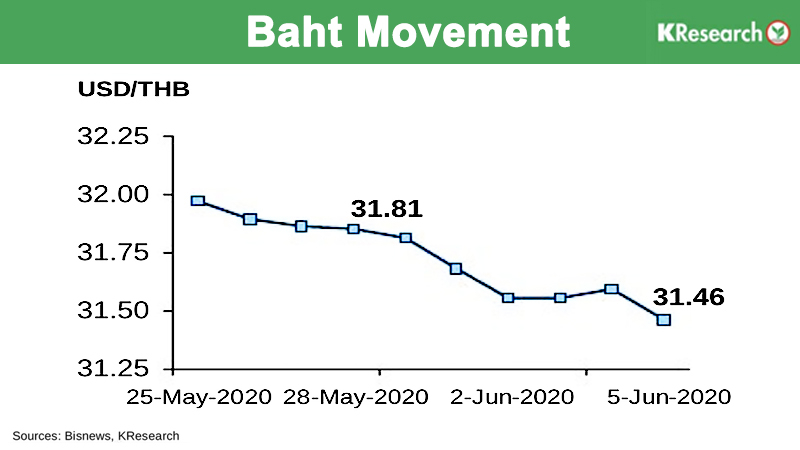
The baht has been highly volatile over the first two quarters of this year, weakening about 10 per cent against the US dollar in the first quarter, moving from about Bt30 to the dollar to about Bt32.7. However, over the past two months, it has risen by about 5 per cent, staying at about Bt31.3 against the dollar.

Sunthorn Thongthip, a senior director at Kasikorn Securities, said the US currency has been the weakest in three months. Economic recovery has led to large investments in risk assets, while the unrest in the US has also contributed to the weakening of the dollar. Populist policies that have led to a budget deficit of $4 trillion – an all-time high – has also weakened the currency.

Now, however, with the Covid-19 pandemic hitting a decline, many countries are reopening their businesses, which is starting to benefit Thai exports. Also, he said, Thailand’s economy is showing signs of improvement, which is strengthening the baht.

A stronger baht will benefit energy, electricity and airline companies, but the losers will be the electronics and food sectors.

Energy and electricity firms have higher dollar debts, hence every time there is a Bt1 rise against the dollar, their profits will be boosted by 2 to 15 per cent. Airlines will also save on fuel costs when the baht rises, so their profits could jump between 80 and 100 per cent.

Electronics and food companies, however, largely earn in dollars, so when there is a Bt1 rise, their profits will be pulled down by 7 to 18 per cent.

However, the Banpu Public Company is different from other energy firms because it holds a large amount of dollar assets, while its debts are in the Thai currency. Hence, every Bt1 rise in the currency will bring its profit down by 62 per cent this year. The company did, however, make exchange rate gains in the first quarter when the baht was weak, he said.

Asia Plus Securities believes the baht will not appreciate as much as it did last year, rising from Bt33 on December 15, 2018, to Bt29.68 on December 31, 2019. Thailand this year will have a smaller account surplus due to a slowdown in exports and drop in tourist arrivals due to the fallout of the coronavirus pandemic. It said the tourism sector may only recover at the end of the year.

SET slides after rising continuously over past four weeks #ศาสตร์เกษตรดินปุ๋ย

#ศาสตร์เกษตรดินปุ๋ย : ขอบคุณแหล่งข้อมูล : หนังสือพิมพ์ The Nation.

https://www.nationthailand.com/business/30389340?utm_source=category&utm_medium=internal_referral

SET slides after rising continuously over past four weeks

Jun 09. 2020
By The Nation

The Stock Exchange of Thailand (SET) Index fell 30.29 points or 2.11 per cent, closing at 1,408.37 today (June 9). The value of total transactions stood at Bt115.559 billion with an index high of 1,448.13 and a low of 1,400.87.

In the morning session, an analyst from Krungsri Securities said he expected the index to fluctuate between 1,425 and 1,450 points, thanks to positive sentiments from the rise in US stock markets.

“US stock markets rose amid hopes for an economic recovery after lockdown restrictions have been eased, while the country’s non-farm employment rose by 2.5 million,” the analyst said.

However, he said, energy and petroleum stocks will be under pressure from a drop in the price of crude oil after Saudi Arabia aimed to increase oil production in July to comply with its production quota.

“We expect investors to hold off on trading to follow the US Federal Open Market Committee meeting on June 9 and 10,” he said.

“The SET, meanwhile, will be under pressure from tight valuation as the index’s price-to-earnings ratio is more than 20 times.”

As of 3.43pm today, SET Index dropped sharply by 34.18 points or 2.38 per cent to 1,404.48 in response to the 270-point drop in Dow Jones Index owing to the lack of positive sentiment and high index valuation.

Therdsak Thaveeteeratham, senior vice president at Asia Plus Securities, expects investors who have bought stocks in March to sell off because the index has risen by about 48 per cent from its lowest point this year.

The top 10 stocks with the highest trade value today were MINT, BAM, PTT, PTTEP, CPALL, GPSC, KBANK, SCB, BGRIM and CPF.

As of 4.30pm, the price of crude oil dropped by $0.94 or 2.46 per cent to $37.25 per barrel, while gold rose by $10.60 or 0.62 per cent, to $1,715.70 per ounce.

Changes in Asian indices were as follows:

Japan’s Nikkei Index closed at 23,091.03, down 87.07 points, or 0.38 per cent.

China’s Shanghai SE Composite Index closed at 2,956.11, up 18.34 points, or 0.62 per cent, while Shenzhen SE Component Index closed at 11,284.24, up 68.48 points, or 0.61 per cent.

Hong Kong’s Hang Seng Index closed at 25,057.22, up 280.45 points, or 1.13 per cent.

South Korea’s KOSPI Index closed at 2,188.92, up 4.63 points, or 0.21 per cent.

Taiwan’s TAIEX Index closed at 11,637.11, up 26.79 points, or 0.23 per cent.

Gold price remains flat amid hopes of economic stimulus measures #ศาสตร์เกษตรดินปุ๋ย

#ศาสตร์เกษตรดินปุ๋ย : ขอบคุณแหล่งข้อมูล : หนังสือพิมพ์ The Nation.

https://www.nationthailand.com/business/30389312?utm_source=category&utm_medium=internal_referral

Gold price remains flat amid hopes of economic stimulus measures

Jun 09. 2020
By The Nation

The price of gold was unchanged in morning trade today (June 9), the Gold Traders Association reported.

As of 9.25am, the buying price of a gold bar was Bt25,150 per baht weight and selling price Bt25,250, while gold ornaments cost Bt24,695.64 and Bt25,750, respectively.

The Gold Spot Index price this morning moved to around US$1,697 (Bt53,183) per ounce after the price rose by $22.1 to $1,705.1 at close yesterday.

Gold gained from hopes that governments and central banks worldwide would continue to issue economic stimulus measures, while investors were buying up the metal for speculation after a sharp drop in prices the previous week.

Meanwhile, the Hong Kong gold price rose by HK$30 to $15,700 (Bt63,486) per tael.

SET rises on hopes of economic recovery after lockdown easing #ศาสตร์เกษตรดินปุ๋ย

#ศาสตร์เกษตรดินปุ๋ย : ขอบคุณแหล่งข้อมูล : หนังสือพิมพ์ The Nation.

https://www.nationthailand.com/business/30389311?utm_source=category&utm_medium=internal_referral

SET rises on hopes of economic recovery after lockdown easing

Jun 09. 2020
By The Nation

The Stock Exchange of Thailand Index opened at 1,440.96, up 2.30 points, or 0.16 per cent, this morning (June 9).

A stock analyst at Krungsri Securities expected the index to fluctuate between 1,425 and 1,450 points as the market gained positive sentiment from a rise in the US stock market.

“The US stock market rose amid hopes for an economic recovery after an easing in lockdowns, while the country’s non-farm employment increased by 2.5 million,” the analyst said.

He said energy and petroleum stocks would be under pressure from a decline in the crude oil price after Saudi Arabia aimed to increase oil production in July to comply with its production quota.

“We expect investors to hold off on trading to follow the US Federal Open Market Committee meeting on June 9 and 10,” he said. “Meanwhile, the SET would be under pressure from tight valuation as the index’s price-to-earnings ratio was more than 20 times.”

He recommended investors buy:

▪ Stocks which will benefit from the cabinet’s move to come out with tourism stimulus measures, such as Mint, Centel, ERW and AOT.

▪ Stocks which will benefit from the Eastern Economic Corridor, such as Amata and WHA.

▪ Stocks whose second quarter performance will improve, such as CKP, Tasco, STA and RS.

The SET Index closed at 1,438.66 yesterday, up 2.96 points or 0.21 per cent. The total transaction volume was Bt105.39 billion, with an index high of 1,454.95 points and a low of 1,429.68.

Krungsri Asset Management recommends investing in Chinese funds for long-term profit #ศาสตร์เกษตรดินปุ๋ย

#ศาสตร์เกษตรดินปุ๋ย : ขอบคุณแหล่งข้อมูล : หนังสือพิมพ์ The Nation.

https://www.nationthailand.com/business/30389310?utm_source=category&utm_medium=internal_referral

Krungsri Asset Management recommends investing in Chinese funds for long-term profit

Jun 09. 2020
By The Nation

Krungsri Asset Management said the Chinese stock market will generate good returns in the long term as the country’s economy has already bottomed out.

Kiattisak Preecha-anusorn, assistant vice president for alternative investment at Krungsri Asset Management, said China’s stock market has recovered by 10 per cent after the Covid-19 crisis led to a 15 per cent market plunge.

“Therefore, we believe the Chinese stock market has already bottomed out,” he said. “China’s economy has recovered quickly due to various government measures and public cooperation in containing the spread of Covid-19.”

Kiattisak expects the global economy to “grow at a low level”, while interest rates are also likely to be low for a long time to come.

“So we advise investors to seek strong investment themes, such as ‘New China’ that would meet investors’ needs,” he said.

According to him, the UBS Investment-China A Opportunity, the Krungsri China A Shares Equity-A (KFAChina-A) master fund, has seen outstanding performance.

“In 2019, this fund generated returns of more than 50 per cent [source: Morningstar Thailand, December 30, 2019],” he said.

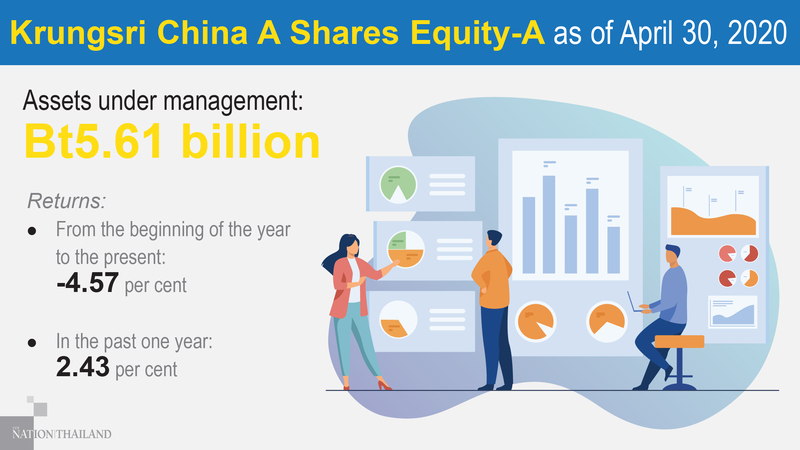
“As of April 30 this year, the Krungsri China A Shares Equity-A fund had assets under management of Bt5.61 billion, while returns from the beginning of the year to the present were a contracted 4.57 per cent but 2.43 per cent in the past year.”

Meanwhile, Vivien Ng, an investment specialist at UBS Asset Management, said the two factors that have accelerated Chinese economic growth are an increase in premium products and services consumption and continuous development of innovations.

Navin Intharasombat, first senior vice president for foreign investment management at Kasikorn Asset Management, said the company will also offer the K Foreign Fixed Income 6MQ Fund Not for Retail Investors (KFF6MQ-AI).

“The fund’s return is approximately 1.30 per cent per year,” he said. “The initial public offering will be made from June 9 to 15.”

Krungthai Asset Management chief executive officer Chavinda Hanratanakool said the company would additionally offer the Krung Thai Smart Invest 6M3 open-end fund until June 12.

“The project duration is approximately six months, focusing on investment in government, commercial bank and Thai corporate bonds,” she said “The fund’s return is approximately 0.40 per cent per year.”