Nasdaq sets record high, S&P positive for 2020 as investors double down on recovery #ศาสตร์เกษตรดินปุ๋ย

#ศาสตร์เกษตรดินปุ๋ย : ขอบคุณแหล่งข้อมูล : หนังสือพิมพ์ The Nation.

https://www.nationthailand.com/business/30389289?utm_source=category&utm_medium=internal_referral

Nasdaq sets record high, S&P positive for 2020 as investors double down on recovery
Jun 09. 2020
By The Washington Post · Thomas Heath, Taylor Telford · BUSINESS, PERSONAL-FINANCE, US-GLOBAL-MARKETS

Investors greeted the first recession in 11 years with yet another stock surge that sent the Nasdaq composite to a record and lifted the Standard & Poor’s 500 index into positive territory for the year.

The tech-heavy Nasdaq stormed to a record 9,924.75, a 110-point, or 1.1%, gain on the day. The previous milestone, 9,817.18, was set in February.

The S&P 500 finished at 3,232.39, up nearly 1.2%, to erase its losses for the year. The S&P had been more than 30% in the hole three months ago. The Dow Jones industrial average also had a big day, jumping 461 points, or 1.7%, to close at 27,572.44. The Dow is on a six-day winning streak, its best since September.

U.S. stocks are on pace to post three straight months of gains on renewed optimism that the country is pushing out from its coronavirus stranglehold. The federal government has fed trillions into the economy to keep it from descending into a depression.

The stock gains come at a time when many indicators point to an economy that is wheezing from a once-in-a-century pandemic. On Monday, the National Bureau of Economic Research declared that the U.S. entered its first recession in nearly 11 years due to the “unprecedented magnitude of the decline and production, and its broad reach across the entire economy.”

Markets ignored the bad news.

“This appears to be the triumph of hope over experience,” said Michael Farr, president of Farr, Miller & Washington. “People are believing the win-win scenario, which means either the recovery happens and corporate earnings really do recover and go up. Or it means the government continues to add stimulus. In short, the market doesn’t believe these are problems that a couple more trillion from the federal government can’t solve.”

The U.S. economy added 2.5 million jobs in May, the Labor Department reported Friday, a shockingly positive reading. “This will go down in history as the biggest positive data shock for the markets and the economy,” said Mohamed El-Erian in an interview on Fox News Sunday.

The employment picture continues to brighten, with as many as 400,000 people returning to work Monday in New York City, once the epicenter of the U.S. coronavirus outbreak. The city is kicking off phase one of its reopening plan by allowing nonessential retailers, construction sites and manufacturing to resume operations.

Investors are also buoyed by a drumbeat of news over companies chasing cures for the coronavirus, which has killed more than 109,000 Americans.

Many longtime Wall Street hands were caught flat-footed by the broad stock market’s steep ascent over the past month. Many had put their faith in the “stay-at-home” technology stocks such as Amazon, Netflix, Microsoft and Zoom, that have powered much of the stock market in recent years. (Amazon founder Jeff Bezos owns The Washington Post.)

Hedge fund manager Stanley Druckenmiller told CNBC in an interview Monday that he was “humbled” that his personal investments have returned a mere 3% over the past month while the S&P turned in a 40% gain.

“Well I’ve been humbled many times in my career, and I’m sure I’ll be many times in the future. And the last three weeks certainly fits that category,” Druckenmiller said.

Many sectors that people had long given up for dead have broken out from their coronavirus coma. Airlines, cruise lines, oil companies, hotels, casinos and restaurants have all popped to the upside on the belief that people will resume their pre-covid lives sooner rather than later.

The Nasdaq 100, an index of the biggest nonfinancial stocks, has hit a record on big advances by American Airlines, United Airlines, Wynn Resorts, Marriott International and Liberty Global. Aerospace giant Boeing has staged a remarkable recovery, closing up 12.30% Monday at $230.50 as it led the Dow. The company’s shares were selling at less than $100 in March

Investors are still concerned that a fall surge from the coronavirus could slow what many hope will be a strong second-half of the year for the U.S. economy.

Investors are waiting to hear Wednesday from the Federal Reserve, which will issue an updated policy statement and its first economic projections of 2020.

“The jobs report raised some eyebrows that a fast rebound could ultimately end the stimulus trade a lot sooner than anyone expected,” Ed Moya, an analyst with OANDA, wrote in commentary Monday. “One report however should not trigger a change with Fed guidance.”

Oil prices edged downward Monday, with Brent crude, the international benchmark, trading down 1.1% at $41.84 a barrel. Over the weekend, OPEC and its allies agreed to extend production cuts through July to keep oil supplies from ballooning while the world gets back in motion.
U.S. economy officially entered recession in February, ending record 128-month expansion #ศาสตร์เกษตรดินปุ๋ย

#ศาสตร์เกษตรดินปุ๋ย : ขอบคุณแหล่งข้อมูล : หนังสือพิมพ์ The Nation.

https://www.nationthailand.com/business/30389288?utm_source=category&utm_medium=internal_referral

U.S. economy officially entered recession in February, ending record 128-month expansion

Jun 09. 2020
By The Washington Post · Rachel Siegel · NATIONAL, BUSINESS 
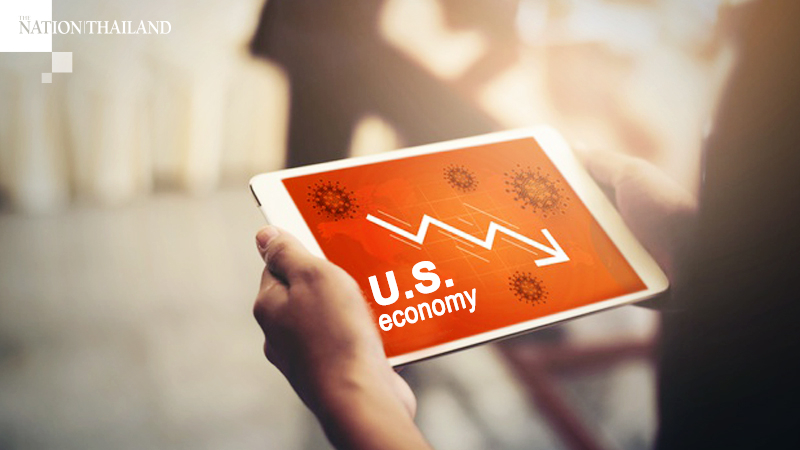
The United States officially fell into recession in February, ending a historic 128-month expansion as the coronavirus swept the country and put the economy into a tailspin.

The Business Cycle Dating Committee, which tracks and dates business cycles for the National Bureau of Economic Research, said the economy peaked just before the pandemic forced business and social activity into a holding pattern. Recessions often refer to two consecutive quarters of contraction, but the NBER’s calculation includes other factors, such as domestic production and employment.

“The time that it takes for the economy to return to its previous peak level of activity or its previous trend path may be quite extended,” the committee’s report said.

States and communities began issuing stay-at-home orders in mid-March to stem the spread of the highly contagious virus. The moves prevented an estimated 60 million coronavirus infections in the United States, according to a study published Monday, but came at great cost to the economy. More than 40 million Americans lost their jobs in the coronavirus recession as consumers stayed out of shopping malls, restaurants, theaters and other places where crowds gathers. Travel, tourism, retail and other industries were devastated, tipping such well-known brands as J. Crew, Neiman Marcus and Hertz into bankruptcy.

And though the nation’s unemployment rate dropped to 13.3% in May, versus 14.7% in April, the reading comes with an asterisk. The Bureau of Labor Statistics said it had misclassified data in May, April and March. Without the error, the unemployment rate would have been 16.3% for May and 19.7% for April, the agency said.

Now, as states gradually ease pandemic restrictions, the question will be whether “reopening” fuels an economic turnaround anytime soon, or whether the downturn will extend into next year as people struggle to go back to work and the nation contends with a possible second wave of infections.

That the economy had plunged into a recession was not a surprise. As economist Ernie Tedeschi put it: “It’s now official (and utterly unsurprising).”

Still, NBER’s report highlighted just how sharply the pandemic upended such vast swaths of the economy and closed the book on an expansion that started in June 2009.

“In the case of the February 2020 peak in economic activity, the committee concluded that the drop in activity had been so great and so widely diffused throughout the economy that the downturn should be classified as a recession even if it proved to be quite brief,” the report noted.

In tracking business cycles and their inflection points, the NBER committee also takes into account indicators such as initial unemployment insurance claims, wholesale retail sales and industrial production. The committee’s official reports come retrospectively – or once it becomes clear there won’t be a need for major revisions even when more data becomes available.

Government officials and economists have offered different timelines for when the economy might rebound, offering up an alphabet soup of “W,”- “V”- and “U”-shaped recoveries that could unfold later in the year or into 2021.

The nonpartisan Congressional Budget Office expects the economic consequences of the novel coronavirus to exceed $8 trillion and suggests the economy will not fully recover until 2030. It also expects unemployment to hover above 10% into 2021, meaning the nation could still have joblessness that is worse than the Great Recession for months.

But experts say the turnaround will hinge on controlling the spread of the novel coronavirus, which has killed more than 109,000 people in the United States.

The NBER report had no effect on Wall Street, which is in the midst of a stunning three-month rally. On Monday, the Standard & Poor’s 500 index moved into positive territory for the year, the tech-heavy Nasdaq Composite set a record high and the Dow Jones industrial average extended its winning streak to six days.

THAI should take no more than seven years to recover #ศาสตร์เกษตรดินปุ๋ย

#ศาสตร์เกษตรดินปุ๋ย : ขอบคุณแหล่งข้อมูล : หนังสือพิมพ์ The Nation.

https://www.nationthailand.com/business/30389267?utm_source=category&utm_medium=internal_referral

THAI should take no more than seven years to recover

Jun 09. 2020
By The Nation

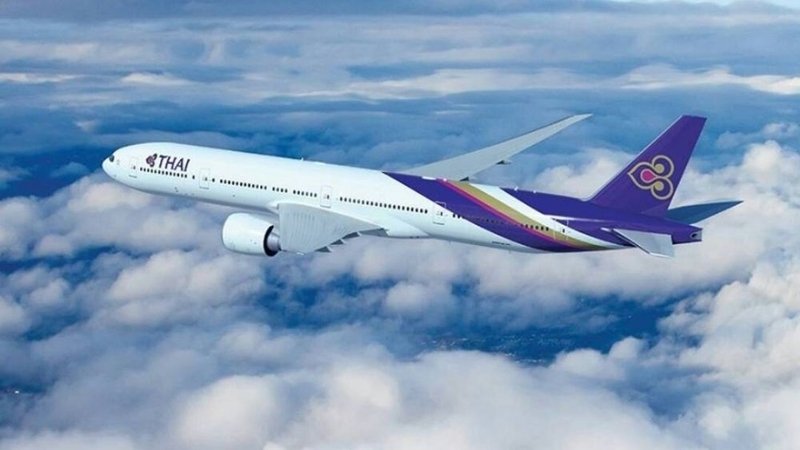
Once the creditors are listed and classified within two months after the rehab plan is established, Thai Airways International (THAI)’s rehabilitation should be completed within seven years.

Meanwhile, Onanong Chuhaman, chief of THAI’s Investor Relations Department, said the airline’s stock has been given the “C” grade due to overwhelming debt caused by stiffer competition, open skies policy and the effects of the Covid-19 crisis.

The carrier filed a request for rehabilitation with the Central Bankruptcy Court on May 26, which the court accepted the following day. The airline’s stock was marked down to C in the Stock Exchange of Thailand (SET), though trading is allowed with a cash balance account. The creditors have until August 13 to object to the rehab request, before the court launches an inquiry on April 17. The court is expected to order THAI to start working on its rehab plan by end August or early September.

Once the court agrees to the list of rehab planners proposed by THAI, the team of planners have three months to complete the plan and should have it ready by January 2021. Then creditors will be brought together to consider the plan between February and March 2021, while the court should approve the plan by April.

The plan, once approved by the court, should be implemented within five years. The airline will only be allowed to extend the deadline twice and by no more than a year each time.

So far, THAI has named EY Corporate Advisory Services Co Ltd, THAI chairman Chaiyapruk Didyasarin, acting president Chakkrit Parapuntakul as well as independent directors, namely Pirapan Salirathavibhaga, Boontuck Wangcharoen, Piyasawat Amranan and Chansin Treenuchagon as rehab planners.

Preliminary rehab solutions include:

– Debt restructuring and negotiating with creditors as well as finding additional sources of funds to enhance short-term liquidity and adjust capital structure in the long term;

– Improving routes and removing those that are not profitable;

– Improving the organisation and business units related to aviation by boosting flexibility in management services such as setting up a subsidiary, looking for new opportunities and increasing the profits of different business units;

– Improving the commercial strategy and ability to bring in revenue;

– Improving the organisational structure by reducing repetitive and unnecessary tasks, increasing working capacity in each business unit so it is consistent, adjusting the number of employees and benefits etc.

Kitipong Urapeepatanapong, chairman of the law firm Baker & McKenzie, which is THAI’s law adviser, said it will take between three months and a year to consider the airline’s rehab plan. After that, it should take about five years to implement the plan. Hence, he said, THAI’s rehab procedure should take no more than seven years to complete.

THAI has been negotiating with its creditors who have leased planes to the airline, and many are allowing the carrier to continue as per normal. The airline has also filed for business rehab in two countries and has, so far, had good results.

Kitipong confirmed that so far, no creditors have cancelled the lease or seized a plane operated by Thai Airways. He added that THAI’s board of directors decided against resorting to filing Chapter 11 in the US for global protection because negotiations with foreign creditors are quite good, though it will be used as a last resort.

As for procuring funds, Thai Airways will no longer be granted loans or guarantees by the Finance Ministry because the airline has lost its state-enterprise status. However, it can borrow from financial institutions under the court’s approval.

The finding of future funding sources depends on the rehab planners’ decision on how much will be spent on finding new partners, increasing capital or selling assets etc.

SET Index has highest price to earnings ratio in Asia, but faces more risks #ศาสตร์เกษตรดินปุ๋ย

#ศาสตร์เกษตรดินปุ๋ย : ขอบคุณแหล่งข้อมูล : หนังสือพิมพ์ The Nation.

https://www.nationthailand.com/business/30389270?utm_source=category&utm_medium=internal_referral

SET Index has highest price to earnings ratio in Asia, but faces more risks

Jun 09. 2020
By The Nation

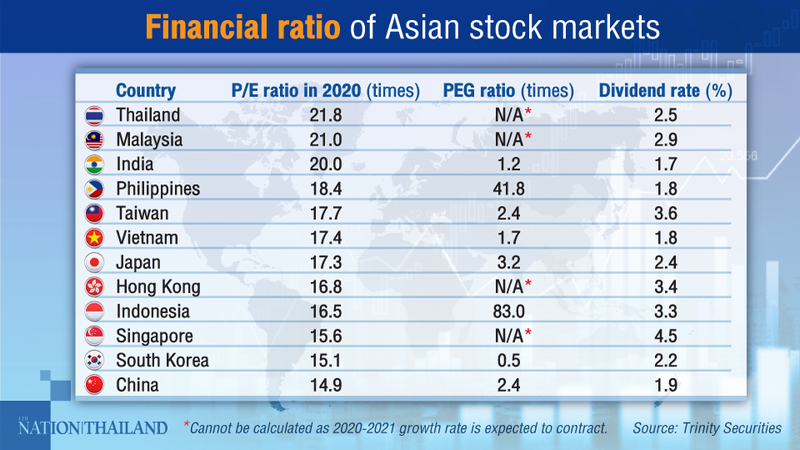
The Stock Exchange of Thailand (SET) Index has had a price to earnings ratio of 21.8 times, which is the highest in Asia, Nuttachart Mekmasin, a research analyst at Trinity Securities, said on Monday (June 8).

He said in comparison to the past five years, SET’s price to earnings ratio was higher than the standard deviation of 5.5 times, which is partly due to the forecast that the stock market’s profits this year will drop by up to 34.8 per cent.

“The Thai stock market’s valuation is currently too high,” he said, adding that it was driven by liquidity, especially from quasi-money that has risen sharply over the past two months, causing individual investors to return.

“SET also gained because foreign investors returned to the market,” he added. “We advise investors to maintain confidence in the bond market as it causes cash to flow into the stock market and pushes up bond dividends.”

Meanwhile, a stock analyst at UOB Kay Hian Securities (Thailand) said SET gained from energy stocks in the morning session as the market expected the energy and petrochemical companies’ second-quarter performance to improve.

“However, it was short-term speculation because oil refineries’ profit will drop drastically due to rising refining cost,” he said

“Petrochemical companies will, however, benefit from the drop in the cost of petrol, while firms that run petrol stations will benefit from the drop in oil prices due to oversupply.”

A stock analyst at Asia Plus Securities said over the past week, the SET Index rose sharply by 6.91 per cent, while transactions over the previous two days have risen over Bt100 billion per day.

“These factors have encouraged investors to return to the market as it proved that the index is ready to take risks,” the analyst said. “However, the faster the SET Index rises, the more you have to focus on increased risks.”

After falling to 969 points, its lowest ever, on March 13, the index rose by about 28 per cent, the highest when compared to other indices in Asia.

This continuous recovery has helped the index, which contracted 30 per cent year on year, to rise to contracted 9 per cent year on year.

On Monday, the index rose to its highest at 1,454 points before closing at 1,438.66, up 2.96 points or 0.21 per cent.

Skies may open to tourists end of June, though country may remain under state of emergency #ศาสตร์เกษตรดินปุ๋ย

#ศาสตร์เกษตรดินปุ๋ย : ขอบคุณแหล่งข้อมูล : หนังสือพิมพ์ The Nation.

https://www.nationthailand.com/business/30389274?utm_source=category&utm_medium=internal_referral

Skies may open to tourists end of June, though country may remain under state of emergency

Jun 09. 2020
Bangkok’s popular tourist attraction, the Grand Palace, reopened to visitors on June 7. 

Bangkok’s popular tourist attraction, the Grand Palace, reopened to visitors on June 7.
By The Nation

Though Thailand is gradually preparing to reopen its doors to international flights, the state of emergency may not be lifted by the end of this month, senior officials said on Monday (June 8).

Chula Sukmanop, director general of the Civil Aviation Authority of Thailand, said the authorities will meet with local airlines next week to find out if they are ready to resume international services.

“At the moment, we haven’t yet decided whether we will extend the ban on incoming passenger flights as we are waiting for instructions from the government’s Centre for Covid-19 Situation Administration [CCSA],” he said, referring to the flight ban order which is due to expire at the end of this month.

“We also have to see if other countries will open their skies. Things will become much clearer in the next week or two,” he said.

Many European countries have lifted the ban on flights within Europe, while many other countries plan to reopen their international flights on July 1.

An informed source said Thailand may start reopening its skies to countries that have been successful in controlling the spread of Covid-19, or may only allow some groups, such as businesspersons, to fly in.

Meanwhile, Deputy PM Wissanu Krea-ngam said the government’s decision on whether it lifts or extends the state of emergency depends largely on the number of new infections in the country. He said the current situation is acceptable and the government may further ease restrictions in the fourth phase.

“However, my biggest concern is that schools will reopen on July 1, the state of emergency is scheduled to expire on the same day and international flights will resume bringing foreigners into the country. We have to take all these factors into account when considering the easing of more restrictions,” he said.

He added that in case the government decides to extend the state of emergency, it may allow large gatherings of people.

Putting the country under a state of emergency allows the government to respond quickly, but under the Communicable Disease Act, the public health minister cannot mobilise police or military personnel to enforce the law, he said in reference to proposals to replace the state of emergency with the law.

Civil groups, meanwhile, have been accusing the government of using the state of emergency to silence the voice of political activists and people.

Wissanu, however, said if the Communicable Disease Act was used, it would not be clear how to control interprovincial travel, because this comes under the jurisdiction of governors.

One perfect example of the difference between the state of emergency and authority under the Communicable Disease Act is that the government can close all pubs right away in case there is a second wave of infections, but under the law’s regulations, the authorities can only close individual pubs, he said.

As to whether the government will lift the state of emergency before allowing foreigners to land in the country, Wissanu said that closing the country to foreigners was consistent with the state of emergency. “However, stringent rules can be eased as it depends on the advice of medical doctors,” he said.

Thailand plans to launch the fourth phase of easing lockdowns next week now that there have been no new Covid-19 infections in the country over the past two weeks, with the exception of infections among Thais who have been repatriated from overseas and put under state quarantine. Though foreigners holding residence or work permits were allowed recently to register for their return, the flight ban imposed in early April remains in place until June 30.

South Africa seeking IMF aid crosses a red line for ANC #ศาสตร์เกษตรดินปุ๋ย

#ศาสตร์เกษตรดินปุ๋ย : ขอบคุณแหล่งข้อมูล : หนังสือพิมพ์ The Nation.

https://www.nationthailand.com/business/30389275?utm_source=category&utm_medium=internal_referral

South Africa seeking IMF aid crosses a red line for ANC

Jun 08. 2020
Municipal workers labour at a roadworks site in Johannesburg on May 7, 2020. MUST CREDIT: Bloomberg photo by Waldo Swiegers.

Municipal workers labour at a roadworks site in Johannesburg on May 7, 2020. MUST CREDIT: Bloomberg photo by Waldo Swiegers.
By Syndication Washington Post, Bloomberg · Antony Sguazzin, Prinesha Naidoo · WORLD, AFRICA 

The economic calamity of the coronavirus broke South Africa’s resistance to borrowing from the International Monetary Fund.

And now some allies of President Cyril Ramaphosa and his ruling African National Congress worry that the $4.2 billion loan his government is negotiating with the Washington-based agency marks the first step toward a slippery slope of submission.

“This is a precursor because Cyril’s government doesn’t have the resources,” said Lumkile Mondi, economics lecturer at Johannesburg’s University of the Witwatersrand. “This is just to soften the alliance partners in preparation for a much bigger ask.”

While the money from the IMF’s coronavirus relief facility comes with few strings attached, persuading the unions may be a dress rehearsal for overcoming opposition to a more demanding program in coming years. Scarred by the experiences of African countries such as Zambia in the 1980s, where a program imposed by the IMF led to unrest and poverty, the ANC resolved to remain self-reliant in the aftermath of the apartheid era.

“One of the things the ANC had in its DNA, you don’t want to go the IMF, you will undermine your sovereignty,” said Matthew Parks, parliamentary coordinator for the 1.8 million-member Congress of South African Trade Unions, which has supported the ANC since Nelson Mandela took power in 1994. “The president pleaded with us. We accepted it given the extraordinary challenges.”

The near-decade of mismanagement and corruption under former President Jacob Zuma combined with the coronavirus outbreak and loss of South Africa’s investment-grade rating have left the economy in its worst state in the democratic era. Infrastructure investment has stalled and debt is surging. The National Treasury has forecast an economic contraction of as much as 16.1% this year — the unemployment rate was already almost 30% and the economy was in recession before the coronavirus hit.

South Africa, a founding member of the IMF in 1944, wasn’t always a basket case.

Having inherited an economy decimated by the isolation that apartheid brought, Mandela’s government set up a team that enacted policies that made the country investment grade with all three major credit-rating firms — opening it up to investors everywhere — by 2000. It has raised its own financing in the market ever since.

“It was back in 1996 where I was involved, there was a big debate” over whether to take multilateral finance, said Iraj Abedian, a university economics professor at the time and now chief executive officer of Pan African Investment & Research Services Ltd. “We took the decision that it was inappropriate to rush into this, and decided to get the house in order without someone in Washington telling you what to do.”

In 2007 and 2008, South Africa recorded its first budget surpluses since all-race elections in 1994; in 2008 its debt-to-gross domestic product ratio was just 26.6%.

Its only multilateral debt is a $3.75 billion World Bank loan extended to the state-owned power utility to build a power plant, which is still under construction.

The government currently expects to lose 285 billion rand ($17 billion) of tax revenue as a result of the lockdown. The National Treasury predicted in February, before the outbreak, that debt will reach 65.6% of GDP this financial year with a budget deficit of 6.8% of GDP; the IMF reckons the shortfall could now reach double that. The debt ratio could also reach 80%, according to Finance Minister Tito Mboweni.

“The hole in the budget is dramatic,” said Miriam Altman, a commissioner in the National Planning Commission in the South African Presidency and an economic adviser to government and companies. “We have to find the lowest-cost borrowing.”

Despite the limited conditions – transparency and a commitment to good macroeconomic management – the talks over the $4.2 billion loan are taking longer than expected, a person familiar with the negotiations said, declining to be identified as they are confidential. Still, a deal is likely within a month and the loan will probably be the biggest extended so far from the facility.

“We face different challenges, and circumstances are different, thus we felt this was the best approach to respond to the current situation,” the National Treasury said of the loan application, declining to comment on whether further assistance will be sought. The government is also seeking money from the World Bank, African Development Bank and New Development Bank for the first time.

Still, senior ruling party officials will need to vet any agreements with international finance institutions, said Ace Magashule, the ANC’s secretary general, according to the Sunday Times.

South Africa is not the only country to have had its resolve tested by the virus outbreak.

Bruised by a 1980s austerity plan engineered by the World Bank and the IMF that demanded the economy open up to competing imports, Nigeria had until this year never borrowed from the IMF. Now the administration of President Muhammadu Buhari has taken a $3.4 billion loan from the fund.

Wary of the conditions that could come with broader support programs from the IMF and other multilateral lenders, South Africa would still prefer moving on its own, said Enoch Godongwana, head of the ANC’s Economic Transformation Committee. He, and the unions, have suggested making more use of private pensions to plug the funding gap.

“Bite the bullet, tighten the belt but impose your own terms,” he said. “What may be difficult is if we continue on the same trajectory that we have had over the last 10 years, that eventuality of going to the IMF may happen.”

With a track record that’s seen the government wage bill rise 40% over the last 12 years and state companies accumulate billions of dollars of debt, an IMF program may be inevitable, many economists believe.

“Something like a stand-by arrangement or an extended funding facility is going to be required,” said Peter Attard Montalto, head of capital markets research at Intellidex. “Countries must either reform themselves or it is eventually imposed upon them.”

Bt590 billion sought to boost grassroots economy #ศาสตร์เกษตรดินปุ๋ย

#ศาสตร์เกษตรดินปุ๋ย : ขอบคุณแหล่งข้อมูล : หนังสือพิมพ์ The Nation.

https://www.nationthailand.com/business/30389273?utm_source=category&utm_medium=internal_referral

Bt590 billion sought to boost grassroots economy

Jun 08. 2020
By THE NATION

Different state agencies have proposed projects worth Bt590 billion to help strengthen the grassroots economy, which is considered one of the main engines to drive the country’s recovery in the fallout of Covid-19, said Thosaporn Sirisumphand, secretary-general of the National Social and Economic Development Council.

The government had initially allocated Bt400 billion for the grassroots economy from its Bt1.9-trillion economic stimulus package.

Thosaporn, who chairs the panel screening the spending of this Bt400 billion budget, said as of June 5 the value of proposed spending was Bt590 billion.

Of the total proposed, 28,311 projects worth Bt372 billion were put forward by provincial agencies and local administrative organisations, while the remaining 91 worth Bt220 billion came from other agencies.

Thosaporn said these projects will be submitted to the cabinet next month, and if there are any additional proposals, they can be submitted in August.

On June 2, the Senate endorsed three emergency decrees for a Bt1.9-trillion economic stimulus package after two days of vetting.

SET edges up amid more signs of global recovery #ศาสตร์เกษตรดินปุ๋ย

#ศาสตร์เกษตรดินปุ๋ย : ขอบคุณแหล่งข้อมูล : หนังสือพิมพ์ The Nation.

https://www.nationthailand.com/business/30389259?utm_source=category&utm_medium=internal_referral

SET edges up amid more signs of global recovery

Jun 08. 2020
By The Nation

The Stock Exchange of Thailand (SET) Index closed at 1,438.66 today (June 8), up 2.96 points or 0.21 per cent. Total transaction volume was Bt105.398 billion with an index high of 1,454.95 and a low of 1,429.68.

In the morning session, a stock analyst at Krungsri Securities expected the index to rise between 1,450 and 1,460 points before falling back slightly, in response to rises in regional markets as US non-farm employment increased by 2.5 million and the unemployment rate dropped to 13.3 per cent after an easing of lockdown measures.

“We assess that the negative economic conditions have already bottomed out and the recovery is beginning,” he said.

“The market also gained positive sentiment from the rising price of crude oil. The price rose more than US$40 [Bt1,258.12] per barrel after the Opec+ grouping decided to keep oil production at 9.7 million barrels per day until July.”

The analyst advised investors to beware of mass-sell offs as the SET Index would be under pressure due to signs of “overbuying” and tight valuation.

The 10 stocks with the highest trade value today were BAM, MINT, PTT, PTTEP, TOP, BBL, PTTGC, SCB, KBANK and CPALL.

As of 4.30pm, the price of crude oil rose by US$0.22 or 0.56 per cent to $39.77 per barrel, while gold rose by $14.50 or 0.86 per cent, to $1,697.50 per ounce.

Changes in other Asian indices were as follows:

Japan’s Nikkei Index closed at 23,178.10, up 314.37 points, or 1.37 per cent.

China’s Shang Hai SE Composite Index closed at 2,937.77, up 6.97 points, or 0.24 per cent, while Shenzhen SE Component Index closed at 11,215.76, up 35.16 points, or 0.31 per cent.

Hong Kong’s Hang Seng Index closed at 24,776.77, up 6.36 points, or 0.026 per cent.

South Korea’s KOSPI Index closed at 2,184.29, up 2.42 points, or 0.11 per cent.

Taiwan’s TAIEX Index closed at 11,610.32, up 130.92 points, or 1.14 per cent.

Gold price rises #ศาสตร์เกษตรดินปุ๋ย

#ศาสตร์เกษตรดินปุ๋ย : ขอบคุณแหล่งข้อมูล : หนังสือพิมพ์ The Nation.

https://www.nationthailand.com/business/30389230?utm_source=category&utm_medium=internal_referral

Gold price rises

Jun 08. 2020
By The Nation

The price of gold rose by Bt50 per baht weight in morning trade today (June 8), the Gold Traders Association reported.

As of 9.29am, the buying price of a gold bar was Bt25,150 per baht weight and selling price Bt25,250, while gold ornaments were priced at Bt24,695.64 and Bt25,750, respectively.

At close on Saturday, the buying price of a gold bar was Bt25,100 per baht weight and selling price Bt25,200, while gold ornaments were priced at Bt24,650.16 and Bt25,700, respectively.

The Gold Spot Index price this morning moved to around US$1,688 (Bt53,121) per ounce after the price dropped sharply by $44.4, the lowest in two months, to $1,683 per ounce at Friday’s close.

Investors were selling gold in response to hopes of an economic recovery after the US stock index rose sharply due to rising non-farm employment.

The Hong Kong gold price dropped sharply, by HK$270, to $15,530 (Bt63,061) per tael.

Thai bourse opens up #ศาสตร์เกษตรดินปุ๋ย

#ศาสตร์เกษตรดินปุ๋ย : ขอบคุณแหล่งข้อมูล : หนังสือพิมพ์ The Nation.

https://www.nationthailand.com/business/30389226?utm_source=category&utm_medium=internal_referral

Thai bourse opens up

Jun 08. 2020
By The Nation

The Stock Exchange of Thailand Index opened at 1,452.84, up 17.14 points, or 1.19 per cent, this morning (June 8).

A stock analyst at Krungsri Securities expected the index to rise between 1,450 and 1,460 points before falling in response to the rise in regional markets as US non-farm employment increased by 2.5 million while the unemployment rate dropped to 13.3 per cent after an easing of lockdown measures.

“We expect the negative economic conditions to have already bottomed out and begin to recover,” he said.

“The market also gained positive sentiment from the rising crude oil price. The price rose more than US$40 [Bt1,258.12] per barrel after the Opec+ grouping decided to keep oil production at 9.7 million barrels per day until July.”

The analyst advised investors to beware of mass-sell offs as the SET Index would be under pressure due to signs of “overbuying” and tight valuation.

He recommended investors buy:

▪ Energy stocks which will benefit from the rising crude oil price, such as PTT, PTTEP, Top, PTTGC, IRPC, SPRC and IVL

▪ Stocks which will benefit from the cabinet’s move to come out with tourism stimulus measures, such as Mint, Centel, ERW and AOT.

▪ Stocks which will benefit from the Transport Ministry’s move to summarise the second phase of the Eastern Economic Corridor transport infrastructure, such as Amata and WHA.

▪ Stocks whose second quarter performance will improve, such as CKP, Tasco, STA and RS.

The SET index rose by 24.69 points, or 1.75 per cent, on Friday, closing at 1,435.70 points, with transactions totalling Bt120 billion. Foreign investors made net buys of Bt52 million in stocks and Bt623 million in bonds. There were 15,224 net short TFEX contracts.